REVIEW 4 major objections 4 minor 1 cited by
This paper derives a complete-data likelihood that couples SEIR epidemics, dynamic contact networks, and noisy observations into a single inferential framework.
Reviewed by Pith at T0; open to challenge. T0 means a machine referee read the full paper against a public rubric. the ladder, T0–T4 →
T0 review · deepseek-v4-flash
2026-08-01 23:54 UTC pith:M7LFFSSV
load-bearing objection The CTMC likelihood is assembled correctly, but Theorem 1's closed-form MLEs need a cause split the model never defines, and the simulation table is identical across regimes—the headline claims don't survive a close read. the 4 major comments →
A Complete-Data Likelihood for Epidemic Processes on Partially Observed Dynamic Networks
The pith
A machine-rendered reading of the paper's core claim, the machinery that carries it, and where it could break.
Core claim
The paper's principal contribution is the derivation of a complete-data event-history likelihood for the joint epidemic-network process under partial observation. The latent process is a continuous-time Markov chain whose state Z(t) combines each individual's SEIR compartment and each dyad's contact status; transitions occur at rates lambda_SE_i = beta I_i + xi, lambda_EI = kappa, lambda_IR = gamma, and edge formation/dissolution rates eta_ab, tau_ab that depend on endpoint disease states. Observations of symptoms and contacts occur at discrete times through misclassification kernels. The complete-data likelihood factorizes into the CTMC path likelihood and the observation likelihood, and Th
What carries the argument
The load-bearing object is the factorization in Eq. 4.3: L(theta; Z[0,T],Y,B) = p_theta(Z[0,T]) p_theta(Y,B|Z[0,T]), where p_theta(Z[0,T]) is the event-history density of a continuous-time Markov chain (product of transition intensities times exp(-integrated hazard)) and p_theta(Y,B|Z[0,T]) is the conditional observation likelihood built from symptom and contact misclassification kernels. This decomposition separates the unobserved epidemic-network dynamics from the observation mechanism, making the complete-data likelihood tractable enough to support Gibbs/Metropolis-within-Gibbs data augmentation. Theorem 1's closed-form estimators follow from the path likelihood's Poisson-like structure:
Load-bearing premise
The complete-data maximum-likelihood formulas for beta and xi require each S-to-E event to be labeled as internal or external, but the model's S-to-E hazard is a single combined rate beta*I_i + xi, so the trajectories the paper calls 'complete data' do not contain those labels.
What would settle it
Simulate a single CTMC epidemic-network outbreak with both beta>0 and xi>0, and write down the complete-data log-likelihood directly from the event-history representation (product of lambda_SE_i over S-to-E events, times exponential integrated hazards). For a generic simulated path, evaluate the closed-form estimators from Theorem 1 and show they do not satisfy the score equations of that log-likelihood, because the score equations require the unobserved split of S-to-E events into internal and external causes. If they do satisfy the score equations, the paper's hidden premise is in fact suppl
If this is right
- Provides a unified complete-data likelihood from which Bayesian data-augmentation inference can be built for epidemic-network systems under partial observation.
- Reveals that epidemic parameters (beta, xi, kappa, gamma), network parameters (eta_ab, tau_ab), and observation parameters (p_E, p_I, s, c) admit closed-form complete-data MLEs of event-count-over-exposure form, enabling EM-type algorithms.
- Identifies a taxonomy of observation regimes (fully observed, symptom-only, network-only, joint noisy) and predicts which parameter blocks are identifiable in each, guiding study design.
- Shows that many existing models, including SEIR on static networks, known infection times, and closed populations, arise as special cases, allowing validation against benchmark settings.
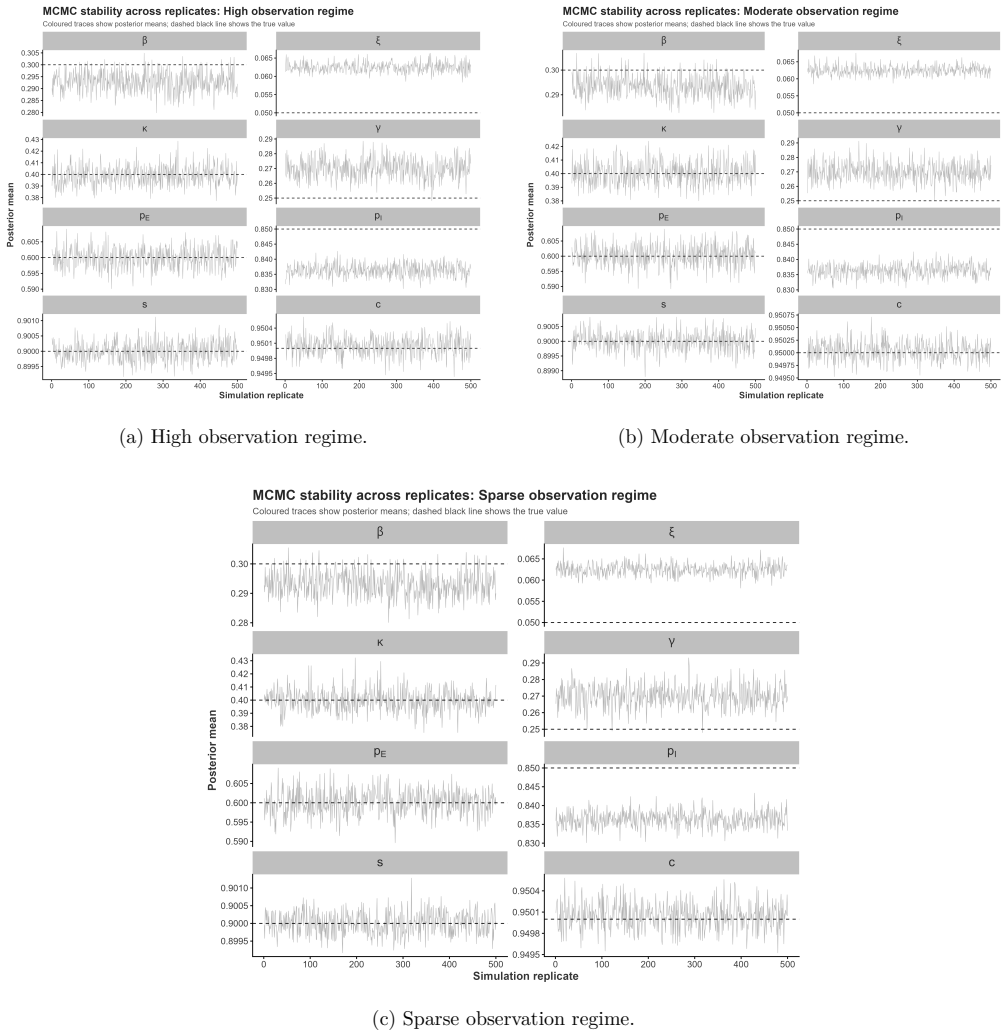
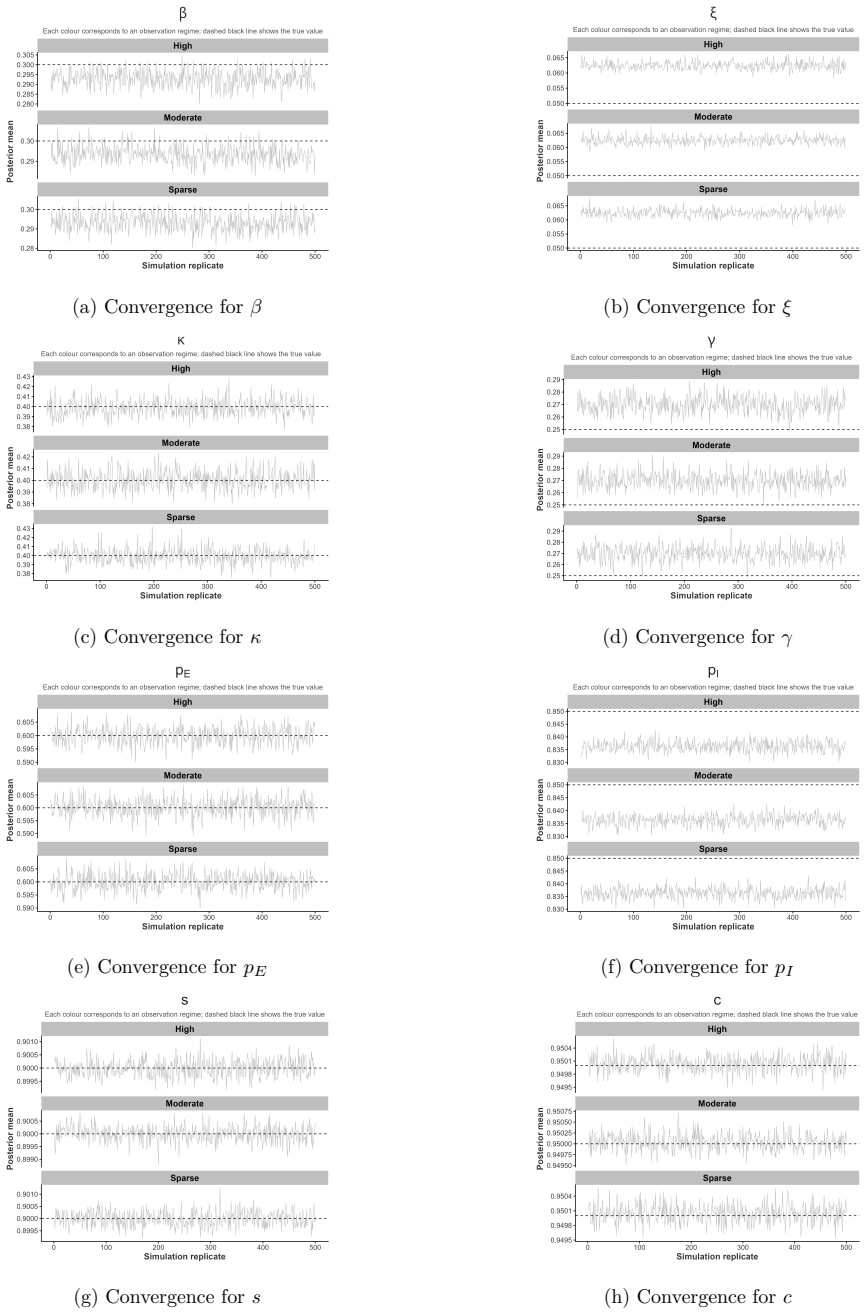
- Simulation results indicate that posterior means and credible intervals remain near nominal even in sparse observation regimes, with the main confounding between internal and external infection rates.
Where Pith is reading between the lines
- The closed-form estimators for beta and xi in Theorem 1 presuppose that each S-to-E event is labeled as internal or external, but the model's hazard lambda_SE_i = beta I_i + xi is a single combined rate, so the complete data defined in Section 3.1 do not contain that label; a faithful data-augmentation sampler must additionally sample cause indicators, and without them the score equations do not s
- The factorization suggests a modular extension path: any observation mechanism (e.g., covariate-dependent misclassification, interval-censored test results) can be plugged into the observation kernel without altering the latent CTMC core, an extension the paper hints at but does not develop.
- The regime-based identifiability taxonomy could be turned into a practical diagnostic: comparing the posterior or profile-likelihood flatness of (beta, xi) as contact-observation frequency varies would empirically confirm the predicted weak separation.
- Because only the transition-intensity layer is disease-specific, the same complete-data likelihood structure likely transfers to other interacting dynamic processes such as information diffusion or behavioral contagion on partially observed networks.
Editorial analysis
A structured set of objections, weighed in public.
Referee Report
Summary. The paper develops a complete-data likelihood framework for a coupled SEIR epidemic process and status-dependent dynamic contact network under partial observation. The latent process is modeled as a continuous-time Markov chain, and the complete-data likelihood is written as p_θ(Z[0,T]) p_θ(Y,B | Z[0,T]) (Eq. 4.3). The authors derive closed-form complete-data MLEs for epidemic, network, and observation parameters (Theorem 1), state an asymptotic normality result (Theorem 2), formulate identifiability under three observation regimes (Theorem 3), and propose a Metropolis-within-Gibbs data-augmentation algorithm. A simulation study with three observation regimes is reported.
Significance. The factorization in Eq. 4.3 is standard but the intended contribution is the unification of SEIR dynamics, status-dependent edge formation/dissolution, and noisy intermittent observation into one event-history likelihood. That formulation, if correct, would provide a useful basis for data-augmentation inference. The paper also correctly identifies important special cases and observation regimes. However, the central claimed technical result — closed-form complete-data MLEs for β and ξ — is not valid for the model as specified, because the split of S→E events into internal and external counts is not observable even from the complete latent trajectory. The simulation results in Table 2 are reported identically across regimes, which undermines the empirical validation. The paper does not provide code or machine-checked proofs, and the asymptotic theorem is stated with unverified regularity conditions. Thus, the paper's principal inferential claims are not established.
major comments (4)
- [§5.1.0.1 / Theorem 1] The closed-form MLEs β̂ = N_SE^int/U_SI and ξ̂ = N_SE^ext/U_S require counts N_SE^int and N_SE^ext that are not measurable functions of the complete trajectory Z[0,T] defined in §3.1. The model's S→E intensity is a single combined hazard λ_i^SE(z) = β I_i(z) + ξ (§3.2). A CTMC path records the state transition S→E but not whether it was caused by internal contact or external pressure. Consequently, the epidemic log-likelihood ℓ_epi in §5.1.0.1 is not the log-likelihood of the model; the actual contribution of each S→E event is log(β I_i(τ) + ξ), not a separated β and ξ term. This invalidates Theorem 1 and the block-diagonal information formulas of §5.3.0.2. To make the claim valid, the state space must be augmented with cause-specific indicators, but no such augmentation is introduced.
- [§6 / Theorem 3, part 1] The identifiability claim for (β,ξ,κ,γ) relies on the same unobservable sufficient statistics N_SE^int and N_SE^ext. Since the full latent epidemic path does not identify which S→E events are internal versus external, the assertion that (β,ξ) are identifiable from the complete epidemic path is unsupported. Part 3 of the theorem is qualitative and essentially restates that marginalization over latent paths can make parameters harder to identify; it does not repair the defect in part 1.
- [§5.2 / Theorem 2] The asymptotic normality theorem is a generic counting-process result with regularity conditions (i)–(iv) stated but not verified for the present model. The paper does not establish that the exposure processes U_SI, U_S, U_E, U_I are asymptotically increasing, that the martingale CLT applies under state-dependent network dynamics, or that the influence of the observation process can be ignored in the complete-data setting. Moreover, because the complete-data MLE for β and ξ is itself not correctly derived, the theorem is claimed for an estimator that is not the MLE of the specified model.
- [§7, Table 2] Table 2 reports posterior summaries for High, Moderate, and Sparse observation regimes that are identical to four decimal places for every parameter (mean, SD, MSE, interval endpoints, bias, coverage). This is incompatible with the different data-generating mechanisms described in §7.1 and with the paper's own qualitative statements that sparse observation increases uncertainty, especially for ξ and network parameters. The near-exact equality across regimes strongly suggests an error in the simulation or in the reporting of results. This undermines the empirical support for the method's claimed stability across observation regimes.
minor comments (4)
- [Abstract / §2.1] The model is called 'SIER' in §2.1 and 'SEIR' in the abstract and most of the paper; the notation should be consistent.
- [Figure 1 caption] Typo 'demonstrtes' for 'demonstrates'.
- [§7.4 / Table 2] The coverage column reports 'Yes' instead of a numerical probability; it should be replaced with the actual proportion, e.g., 0.94.
- [§5.3.0.2] The Hessian expression is diagonal and the information matrix is evaluated at the MLE; however, the formula Var(β̂)≈β̂²/N_SE^int follows from the invalid separated likelihood and is not applicable to the original model. This should be corrected along with the main theorem.
Circularity Check
Theorem 1's closed-form MLEs for β and ξ reduce by construction to a cause-labeled split of S→E events that the Section 3 model does not define; the Eq. 4.3 likelihood framework itself is non-circular.
specific steps
-
self definitional
[Section 5.1.0.1 (Theorem 1, epidemic block); relies on §3.2 hazard and §4.1 event likelihood]
"Under the epidemic hazard specification λSE i (u) = βIi(u) + ξ, λ EI (u) = κ, λ IR(u) = γ, the epidemic contribution to the complete-data log-likelihood is ℓepi(β,ξ,κ,γ) = N int SE log β − βU SI + N ext SE log ξ − ξU S + NEI log κ − κU E + NIR log γ − γU I ... Setting these derivatives to zero gives the closed-form estimators β̂= N int SE / U SI , ξ̂ = N ext SE / U S ."
In §3.2–§4.1, an S→E jump is a single event type with intensity λ_i^SE(z) = β I_i(z) + ξ, so its contribution to log p_θ(Z[0,T]) (Eq. 4.1) is log(β I_i(τ_k) + ξ). Theorem 1's ℓ_epi instead splits S→E events into N_SE^int and N_SE^ext with contributions log β and log ξ — the likelihood of a cause-labeled counting process. The labels 'internal/external' are not part of the complete data Z(t) = (X(t), A(t)) defined in §3.1, and the probability that an S→E event is internal is β I_i/(β I_i + ξ), a function of the very parameters the theorem estimates. Hence β̂ = N_SE^int/U_SI and ξ̂ = N_SE^ext/U_S are empirical rates over an assumed label split, not functions of the model's complete data; the 'derivation' presupposes the β-vs-ξ separation it claims to deliver. Theorem 3(1) reproduces the same
-
self definitional
[Section 5.4.0.4 (Bayesian full conditionals / complete-data conjugacy)]
"if β ∼ Gamma(a β,bβ), and the complete-data epidemic likelihood contributes a factor of the form βN int SE exp(−βUSI ), then the full conditional is β|Z [0,T],Y,B ∼ Gamma ( aβ +N int SE, bβ +USI ) ."
This conjugate update is valid only if the complete-data likelihood contains the labeled factor β^{N_SE^int} exp(−β U_SI). For the §3.2 model, the S→E jumps contribute Π_k (β I_{i_k}(τ_k) + ξ), which does not factor across β and ξ without cause labels. The update therefore conditions on the same unobservable internal/external split presupposed in Theorem 1, so the claimed posterior updating inherits the assumed labels rather than deriving them from the joint likelihood.
full rationale
I walked the paper's derivation chain. The Eq. 4.3 complete-data likelihood L(θ;Z[0,T],Y,B) = p_θ(Z[0,T]) p_θ(Y,B|Z[0,T]) is a correct conditional-probability factorization, and the CTMC event-history product in Eq. 4.1 is a standard, correctly stated result; no fitted input is relabeled as a prediction there. There is no load-bearing self-citation: the present author does not appear among the cited prior works (e.g., Bu et al. 2022/2025, Morsomme & Xu 2025), and no uniqueness theorem is imported from the authors' own prior work. The simulation study generates data from the paper's own model and refits it; that limits independent confirmation and leaves some claims (e.g., §7.5 strong recovery of β and ξ even under sparse observation) under-supported, but by the rules of this review internal re-estimation is an algorithm check, not a circular derivation. The one genuine circular step is confined to the epidemic block. The complete data of §3.1 consist of disease-state and edge paths; an S→E jump is a single event type whose intensity is the sum β I_i + ξ (§3.2, §4.1). Theorem 1's ℓ_epi, however, is the log-likelihood of a process in which every S→E event already carries an 'internal/external' label: N_SE^int log β − β U_SI + N_SE^ext log ξ − ξ U_S. No such label appears anywhere in the model, and the probability a jump is internal is itself β I_i/(β I_i + ξ), a function of the target parameters. The closed-form estimators β̂ = N_SE^int/U_SI and ξ̂ = N_SE^ext/U_S are therefore just the empirical rates of assumed labels; the split that β and ξ are supposed to explain is presupposed, so that portion of the derivation is equivalent to its input by construction rather than derived from the model. Theorem 3(1)'s identifiability proof and the Gamma full conditionals of §5.4.0.4 copy the same labeled form and inherit the flaw, while the network and observation blocks are unaffected. The manuscript's own remarks (§4.8 weak separability of (β,ξ); §5.1.0.4 formulas not directly evaluable; §5.4.0.6 confounding between internal and external infection) are consistent with this diagnosis. Overall: a genuine partial circularity localized to the β/ξ (S→E) block, with the Eq. 4.3 likelihood derivation itself independent, so a moderate score is warranted.
Axiom & Free-Parameter Ledger
axioms (4)
- domain assumption The joint latent process Z(t) = (X(t), A(t)) is a continuous-time Markov chain on a finite state space with generator Q_theta.
- domain assumption Observation kernels are conditionally independent across individuals, dyads, and times given the latent trajectory.
- domain assumption Standard counting-process regularity conditions for consistency and asymptotic normality hold (LLN, martingale CLT, correct specification, interior true parameter).
- domain assumption The external infection hazard is a constant xi per susceptible individual, independent of network state.
invented entities (1)
-
Cause-specific S-to-E event counts (N_SE^int, N_SE^ext)
no independent evidence
read the original abstract
Inference for infectious disease transmission on dynamic contact networks is complicated by latent infection times, partially observed network evolution, measurement error in contact data, and infection originating from outside the observed population. Existing likelihood-based approaches typically address these challenges separately and often rely on restrictive assumptions such as fully observed networks, closed populations, or symptom onset as a surrogate for infection time. We develop a unified complete-data likelihood framework for epidemic processes evolving on partially observed dynamic networks. The proposed formulation represents disease progression, network evolution, and observation mechanisms as interacting continuous-time stochastic processes within a common probabilistic framework. Specifically, we couple a susceptible-exposed-infectious-removed (SEIR) epidemic process with a status-dependent dynamic contact network and explicit observation models for symptoms and contacts. The resulting framework accommodates latent incubation periods, intermittent network observation, contact measurement error, and external infection pressure while preserving a coherent likelihood structure. Our principal contribution is the derivation of a complete-data event-history likelihood for the joint epidemic-network process under partial observation. The likelihood provides a rigorous foundation for likelihood-based and Bayesian inference through data augmentation, clarifies how information from disease progression and contact dynamics jointly determines parameter estimability, and reveals a broad class of existing epidemic network models as special cases. More generally, the framework contributes to statistical inference for partially observed interacting stochastic systems on evolving networks and establishes a foundation for uncertainty-aware analysis of complex transmission processes.
Figures



Forward citations
Cited by 1 Pith paper
-
Identifiability and Information-Based Inference for Epidemic Transmission Models Under Partial Observation
Partial observation regimes determine which epidemic-network parameters are identifiable, and a missing-information decomposition quantifies the loss, with transmission and external infection confounded when exposure ...
Reference graph
Works this paper leans on
-
[1]
Allen, L. J. (2008), An introduction to stochastic epidemic models,in‘Mathematical Epidemiology’, Springer, pp. 81–130. Almutiry, W. & Deardon, R. (2021), ‘Contact network uncertainty in individual level models of infectious disease transmission’,Statistical Communications in Infectious Diseases13(1), 20190012. Ball, F. & Neal, P. (2025), ‘Fast likelihood...
2008
-
[5]
& Shnerb, N
Ben-Zion, Y., Cohen, Y. & Shnerb, N. M. (2010), ‘Modeling epidemics dynamics on heterogenous networks’, Journal of Theoretical Biology264(2), 197–204. Bretó, C. (2018), ‘Modeling and inference for infectious disease dynamics: a likelihood-based approach’, Statistical Science: A review journal of the Institute of Mathematical Statistics33(1),
2010
-
[31]
& Kuri, J
Kotnis, B. & Kuri, J. (2013), ‘Stochastic analysis of epidemics on adaptive time varying networks’,Physical Review E—Statistical, Nonlinear, and Soft Matter Physics87(6), 062810. 38 Kretzschmar, M. & Wallinga, J. (2009), Mathematical models in infectious disease epidemiology,in‘Modern infectious disease epidemiology: Concepts, methods, mathematical models...
2013
-
[57]
& Tran, V
37 Britton, T., Pardoux, E., Ball, F., Laredo, C., Sirl, D. & Tran, V. C. (2019),Stochastic epidemic models with inference, Vol. 2255, Springer. Bu, F., Aiello, A. E., Volfovsky, A. & Xu, J. (2025), ‘Stochastic em algorithm for partially observed stochastic epidemics with individual heterogeneity’,Biostatistics26(1), kxae018. Bu, F., Aiello, A. E., Xu, J....
2019
-
[197]
M., Werkman, M., Brooks-Pollock, E
Dawson, P. M., Werkman, M., Brooks-Pollock, E. & Tildesley, M. J. (2015), ‘Epidemic predictions in an imperfect world: modelling disease spread with partial data’,Proceedings of the Royal Society B: Biological Sciences282(1808). Dubey, P. & Müller, H.-G. (2022), ‘Modeling time-varying random objects and dynamic networks’,Journal of the American Statistica...
2015
-
[218]
& Walker, S
Wang, S. & Walker, S. G. (2025), ‘Bayesian data augmentation for partially observed stochastic compart- mental models’,Bayesian Analysis20(1), 107–130. Whitaker, S. A., Golightly, A., Gillespie, C. S. & Kypraios, T. (2025), ‘Sequential bayesian inference for stochastic epidemic models of cumulative incidence’,Bayesian Analysis1(1), 1–30. Yang, W., Lipsitc...
2025
-
[468]
Grekousis, G. & Liu, Y. (2021), ‘Digital contact tracing, community uptake, and proximity awareness technology to fight covid-19: a systematic review’,Sustainable Cities and Society71, 102995. Grinsztajn, L., Semenova, E., Margossian, C. C. & Riou, J. (2021), ‘Bayesian workflow for disease transmission modeling in stan’,Statistics in Medicine40(27), 6209–...
Pith/arXiv arXiv 2021
discussion (0)
Sign in with ORCID, Apple, or X to comment. Anyone can read and Pith papers without signing in.