REVIEW 5 major objections 5 minor 38 references
Chaos-based losses plus a Mamba-style encoder can cut EMG-to-speech model size by 40.79% while improving reconstructed speech quality.
Reviewed by Pith at T0; open to challenge. T0 means a machine referee read the full paper against a public rubric. the ladder, T0–T4 →
T0 review · deepseek-v4-flash
2026-08-01 14:47 UTC pith:2QZZVGBX
load-bearing objection The WER results look real, but the headline audio-quality claims collapse once you see that DTW alignment is applied only to the proposed model. the 5 major comments →
CS-ETS: Chaos-Inspired Samba-Based EMG-To-Speech Synthesis with Nonlinear Chaotic Losses
The pith
A machine-rendered reading of the paper's core claim, the machinery that carries it, and where it could break.
Core claim
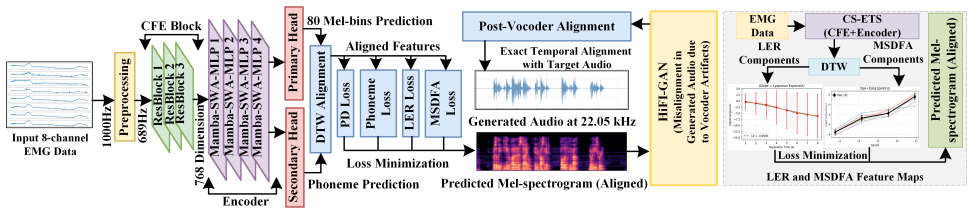
The paper's central claim is that EMG-to-speech synthesis benefits from explicitly supervising chaotic dynamics. On one speaker's 19-hour facial-EMG dataset, CS-ETS — a four-layer Mamba+SWA+MLP encoder with a convolutional front-end — trained with LER and MSDFA losses surpasses the prior best retrained baseline on WER (41.26% vs 42.20%) and on acoustic metrics enabled by Post-Vocoder Alignment, using 32.03M vs 54.10M parameters. The ablation table attributes most of the frame-level metric jump to the alignment procedure (STOI 0.15 to 0.61), and the chaotic losses to a smaller WER improvement (from 50.37% to 41.26% when both are added), so the paper's own numbers show chaos supervision chiefl
What carries the argument
The load-bearing machinery is the pairing of a cheap recurrent-style encoder with two loss terms that compare predicted and target mel-spectrograms through nonlinear-dynamics summaries: the largest Lyapunov exponent (estimated by delay embedding, nearest-neighbor tracking, and log-divergence slope) and the DFA scaling exponent per frequency channel. Because these summaries are invariant to frame-by-frame spectral error, they give the model a training signal about temporal instability and long-range correlation. Post-Vocoder Alignment (DTW on cosine distance between STFT frames, with inverse STFT reconstruction) is what lets the authors compute LSD/STOI/PESQ at all and therefore produces the
Load-bearing premise
That Post-Vocoder Alignment gives valid frame-level scores — if DTW matching the generated waveform to the target inflates LSD/STOI, the headline 2.1x/4.7x/1.25x improvements over a baseline scored without alignment are artifacts rather than model gains.
What would settle it
Score the retrained baseline with the same PVA pipeline used for CS-ETS. If its STOI rises close to 0.61 and LSD falls near 1.07, the claimed superiority of the chaos-inspired architecture evaporates; conversely, if the gap persists, the claim survives. Also run the LER/MSDFA losses on shuffled or phase-randomized targets to check they measure temporal structure rather than global energy.
If this is right
- ETS models can be compressed by about 41% (encoder from 44.03M to 21.96M parameters) and still match or beat a transformer baseline, making silent-speech interfaces more feasible on-device.
- Frame-level metrics become available for ETS once Post-Vocoder Alignment is applied, so future work can report STOI/LSD/PESQ rather than relying on WER alone.
- Chaos-derived losses may transfer to other speech or bio-signal mapping tasks where jitter and aperiodicity matter, since LER and MSDFA are not tied to EMG specifically.
- The 13.33% FLOPs reduction (2.40G to 2.08G) supports real-time use at the same RTF, which is useful for wearable silent-speech systems.
Where Pith is reading between the lines
- The headline quality ratios likely overstate model improvement: Table 3 shows STOI jumping from 0.15 to 0.61 when PVA is added without the chaos losses, so part of the 4.7x gain is an evaluation artifact. A direct test would re-score the baseline with PVA.
- LER/MSDFA's marginal benefit seems concentrated in WER (50.37% to 41.26%) with only slight LSD movement; this pattern is consistent with these terms acting as a regularizer that stabilizes temporal dynamics rather than proof that EMG is deterministic chaos.
- A natural extension is to apply the same losses to streaming or multi-speaker ETS, where the paper's single-speaker, noise-free setting leaves open whether the chaotic supervision generalizes.
Editorial analysis
A structured set of objections, weighed in public.
Referee Report
Summary. The paper proposes CS-ETS, an EMG-to-speech synthesis model combining a Samba-based encoder with two chaos-inspired auxiliary losses (Lyapunov Exponent Regularization, LER, and Multi-Scale Detrended Fluctuation Analysis, MSDFA), plus a Post-Vocoder Alignment (PVA) procedure that DTW-aligns generated audio to the target before computing frame-level metrics. The authors claim a 40.79% parameter reduction over the baseline [5] along with large improvements in LSD (2.1x), STOI (4.7x), and SI-SDR (1.25x), and report WER improvements from the chaotic losses in ablations.
Significance. If the comparisons were controlled, a 40.79% parameter reduction with better or comparable quality would be a useful contribution to EMG-to-speech synthesis, and the WER ablation in Table 3 (50.37% without losses to 41.26% with LER+MSDFA at fixed model size) provides some evidence that the proposed losses help intelligibility. The paper is also transparent in reporting ablations and hyperparameters for the core model. However, the headline audio-quality gains are not supported by the experiments as presented: PVA is applied only to the proposed model, and Table 3 shows that PVA alone accounts for nearly the entire LSD/STOI improvement. The WER margin over the baseline is small (41.26% vs 42.20%) with no significance testing, and the chaos-theoretic premise is asserted rather than demonstrated on the actual signals. The central quantitative claims therefore need substantial rework before the paper can be accepted.
major comments (5)
- [§4.1 and Table 3; §2.4] The headline comparison is confounded by asymmetric evaluation. In Table 3, the baseline [5] (row P0) is evaluated without PVA: STOI 0.13, LSD 2.25. Row P1 (CS-ETS without PVA and without chaotic losses) has STOI 0.15, LSD 1.92. Row P2 adds only PVA and jumps to STOI 0.61, LSD 1.10. Thus PVA alone produces nearly the entire reported improvement over [5] (STOI 0.15→0.61, LSD 1.92→1.10). Since baseline [5] is not subjected to the same PVA post-processing, Table 1's 2.1x/4.7x/1.25x claims are not a valid model comparison. The authors must either apply PVA to the baselines or report unaligned metrics for both systems.
- [§2.4, Table 3] The validity of PVA as an evaluation step is not established. DTW alignment of the synthesized waveform to the target before computing LSD and STOI can mechanically improve frame-aligned distortion/intelligibility metrics even if the underlying speech content is of low quality, because it removes temporal misalignment that these metrics penalize. Table 3 P1→P2 shows the effect is large (STOI 0.15→0.61). The paper should validate PVA by, for example, applying it to the baseline model and to a poor-quality or random system, and showing that it does not artificially inflate scores. Without such a control, the post-alignment metrics cannot be interpreted as evidence of model quality.
- [§4.3, Table 3 (P0 vs P1)] At matched conditions without PVA and without chaotic losses, the proposed compact encoder is worse than the baseline [5]: WER 50.37% (P1) vs 42.20% (P0). The only WER evidence for the full CS-ETS over the baseline is the final row, 41.26% vs 42.20%, a 0.94-point difference with no significance test, confidence interval, or multiple-seed variance. Given that WER is the one metric not affected by PVA, this marginal improvement is insufficient to support the broad claim of 'significantly improved performance' over [5] at 40.79% fewer parameters. Statistical testing or training-seed variance should be reported.
- [§6 Conclusion; §3.1; §6 Limitations] The conclusion states 'Experiments on Gaddy and Klein datasets [4] validate...' but Section 3.1 describes training on a single dataset introduced in [4], and the Limitations section says 'we do not use multiple datasets in a noisy setting in this paper.' This is an internal contradiction, and the claim of validation on multiple datasets is unsupported. The conclusion should be corrected to refer to the single dataset actually used.
- [§2, §2.3.1, §2.3.2] The paper repeatedly asserts that EMG and speech production exhibit 'deterministic chaos' and that the proposed losses 'capture chaotic dynamics,' but no quantitative analysis of the actual EMG/mel features is provided. No Lyapunov spectrum estimate on real signals, no surrogate data test, and no comparison of chaotic statistics before/after training. Without this, 'chaos-inspired' is a plausibility argument rather than a demonstrated property, and the losses are better described as nonlinear feature-matching regularizers. A concrete falsifiable test would be to compute the largest Lyapunov exponent or DFA scaling exponent on the actual EMG features and compare against surrogate time series.
minor comments (5)
- [§2.3.1, Alg. 1; §2.3.2, Alg. 2] Several hyperparameters are not given values: the Theiler window size, kmax, and the MSDFA scale set s. Only m=10 and tau=1 are specified. These affect the loss computation and should be reported for reproducibility.
- [§4.3, Table 3] Row labels such as 'CS-ETS w/o PV A+LER+MSDFA' are ambiguous: it is unclear whether this means 'without PVA, LER, and MSDFA' or 'without PVA but with LER+MSDFA.' Please write 'w/o PVA, LER, MSDFA' and similarly for other rows.
- [Throughout] Typographical and notation inconsistencies: 'PV A' vs 'PVA', 'SISDR' vs 'SI-SDR', 'FLOPS' vs 'FLOPs'.
- [§5 Subjective Analysis] The subjective MOS comparison (4.21 vs 3.98) is based on 10 raters with no confidence intervals or significance test. As reported, the difference may be within listener noise; please provide per-item variance or a paired test.
- [References] Reference [18] appears to duplicate reference [16] ('Nonlinear framework for speech bandwidth extension'). Please check and consolidate.
Circularity Check
No derivation-level circularity; the headline audio-quality claim is confounded by asymmetric Post-Vocoder Alignment, but that is an evaluation validity issue, not an equation-level circularity.
full rationale
The paper's central claims are empirical: the LER and MSDFA losses are defined as differences between nonlinear statistics (Lyapunov exponent λ and DFA scaling exponent α) of predicted and target features, and their contribution is tested through ablations in Table 3. There is no step in which a fitted parameter is renamed as a prediction, and no uniqueness theorem or ansatz is smuggled in via self-citation. The citations to the authors' own prior work [15,16,18] support the motivational premise that speech production is chaotic, but [14] independently grounds that premise, and the premise is not load-bearing for the loss definitions or the encoder modifications. The one serious concern is that Post-Vocoder Alignment (PVA) is applied only to the proposed model and not to baseline [5], and Table 3 shows that PVA alone accounts for essentially all of the LSD/STOI gains: P2 vs P0 gives LSD 2.25→1.10 and STOI 0.13→0.61, nearly identical to the proposed model's 1.07/0.61. This means the headline 2.1x/4.7x/1.25x improvements are largely artifacts of an asymmetric evaluation protocol rather than of the chaotic losses or the modified Samba encoder. However, this is an evaluation-fairness and validity problem, not a circularity: the metrics are not equivalent to the model's inputs by construction, and the WER ablation (50.37% → 41.26% with both losses) provides independent evidence that the losses improve intelligibility. Score 2 reflects the minor self-citations and the evaluation confound, but no derivation-level circularity.
Axiom & Free-Parameter Ledger
free parameters (7)
- LER embedding dimension m =
10
- LER time delay tau =
1
- LER max divergence offset k_max
- MSDFA scale set s
- CFE channel dimension C_D =
768
- Number of Mamba-SWA-MLP layers =
4
- Theiler window size
axioms (4)
- domain assumption Articulatory EMG is a deterministic chaotic dynamical system, so Lyapunov exponents and DFA exponents are meaningful descriptors of speech-production audio features.
- ad hoc to paper DTW-based Post-Vocoder Alignment produces a valid time correspondence for computing frame-level metrics such as LSD and STOI.
- domain assumption Retrained versions of Gaddy et al. [4,5] are faithful reproductions that provide fair baselines.
- ad hoc to paper Matching chaos descriptors in loss functions transfers to perceptual and intelligibility quality.
read the original abstract
We propose a chaos-inspired new architecture for EMG-to-Speech (ETS) synthesis called CS-ETS, which combines a Samba-based encoder with two novel chaos-inspired loss functions -- Lyapunov Exponent Regularization (LER) and Multi-Scale Detrended Fluctuation Analysis (MSDFA). LER is designed based on Lyapunov exponents to capture nonlinear fluctuations and sensitivity to initial conditions. MSDFA exploits detrended fluctuation analysis to quantify fractal-like, long-range temporal chaotic correlation. CS-ETS surpasses prior work with a 40.79\% lower parameter count (32M vs 54.1M) and introduces a new Post-Vocoder Alignment approach that improves LSD by 2.1x, STOI by 4.7x, and SI-SDR by 1.25x. CS-ETS reduces computation by 13.33\% while maintaining improved performance. To the best of our knowledge, for the first time, we show how ETS can be supervised by the subtle non-linear chaotic physics with Samba attention to achieve a significantly smaller model with superior performance.
Figures
Reference graph
Works this paper leans on
-
[1]
modified Samba-based SSMs
Introduction Silent speech interfaces (SSIs) allow speech synthesis without vocalization by interpreting articulatory bio-signals [1], sup- porting individuals with speech impairment and enabling com- munication in acoustically challenging environments [2]. Elec- tromyography (EMG) is an effective modality for recording ar- ticulatory muscle activity for ...
-
[2]
Chaos-Inspired Architecture Design Why we design chaos-inspired models:Speech production is fundamentally anon-linear dynamical process characterized by deterministic chaos[14–16]. Therefore, ETS synthesis is inherently chaotic because it attempts to reconstruct a funda- mentally non-linear, feedback-driven speech production system from partial muscular o...
Pith/arXiv arXiv 2026
-
[3]
Dataset and Preprocessing Our training is performed on the state-of-the-art (SOTA) open- vocabulary dataset introduced in [4]
Experiments 3.1. Dataset and Preprocessing Our training is performed on the state-of-the-art (SOTA) open- vocabulary dataset introduced in [4]. It comprises 19 hours of facial EMG data collected from one English speaker across silent and vocalized speech conditions. Raw EMG signals un- dergo minimal preprocessing as described in [5]. 3.2. Training, Hardwa...
-
[4]
Performance Analysis Table 1 presents a detailed comparison of CS-ETS against SOTA ETS models
Results and Ablation Study 4.1. Performance Analysis Table 1 presents a detailed comparison of CS-ETS against SOTA ETS models. A key distinction of our evaluation is the use of multiple qualitative and quantitative speech-domain metrics that provide rigorous assessment beyond conventional WER. This detailed evaluation is enabled for the first time by our ...
2020
-
[5]
We use 5- point (1=bad to 5=excellent) Mean Opinion Score (MOS) rat- ings for subjective evaluation
Subjective Analysis Subjective comparison of CS-ETS against [5] and unprocessed EMG is conducted by a panel of 10 persons. We use 5- point (1=bad to 5=excellent) Mean Opinion Score (MOS) rat- ings for subjective evaluation. The unprocessed EMG has MOS=1, meaning completely unrecognizable.Our CS-ETS, having MOS=4.21, outperforms [5], which has MOS=3.98. Fr...
-
[6]
modified Samba
Conclusion and Limitations This paper introduces CS-ETS which is the first chaos-inspired Samba-based ETS architecture. Our “modified Samba” encoder with novel chaos-inspired losses achieves better performance at substantially lower computational cost. We propose post- vocoder alignment that allows comprehensive perceptual evalu- ation (LSD, STOI, SISDR, ...
-
[7]
However, we do not use multiple datasets in a noisy setting in this paper
validate that chaos theory improves articulatory-to-acoustic mapping with 40.79% fewer parameters and 13.33% reduction in FLOPS, establishing for the first time that chaos-inspired Samba-based architectures are promising for ETS generation. However, we do not use multiple datasets in a noisy setting in this paper. We will handle these in our upcoming work
-
[8]
Generative AI Use Disclosure We acknowledge the use ofElicitandChatGPTduring early- stage brainstorming to explore theories and help structure the architectural design, as well as for proofreading and language polishing of manuscript drafts. All scientific concepts, method- ological decisions, experimental design, implementations, re- sults, and final wor...
-
[9]
Sentence-level silent speech recognition using a wearable emg/eeg sensor system with ai-driven sensor fusion and language model,
N. Satterlee, X. Zuo, K. Moon, S. Q. Lee, M. Peterson, and J. S. Kang, “Sentence-level silent speech recognition using a wearable emg/eeg sensor system with ai-driven sensor fusion and language model,”Sensors, vol. 25, no. 19, p. 6168, 2025
2025
-
[10]
Decoding silent speech commands from articulatory movements through soft magnetic skin and machine learning,
P. Dong, Y . Li, S. Chen, J. T. Grafstein, I. Khan, and S. Yao, “Decoding silent speech commands from articulatory movements through soft magnetic skin and machine learning,”Materials Horizons, vol. 10, no. 12, pp. 5607–5620, 2023
2023
-
[11]
Soft active emg interface for machine learning-enabled silent speech recognition,
Y . Kurotaki, S. Yamakoshi, R. Yoshida, Y . Isoda, T. Takano, Y . Isano, Y . Miyake, K. Kuribayashi, and H. Ota, “Soft active emg interface for machine learning-enabled silent speech recognition,” 2025
2025
-
[12]
Digital voicing of silent speech,
D. Gaddy and D. Klein, “Digital voicing of silent speech,” in Proceedings of the 2020 Conference on Empirical Methods in Natural Language Processing (EMNLP). Online: Association for Computational Linguistics, Nov. 2020, pp. 5521–5530. [Online]. Available: https://aclanthology.org/2020.emnlp-main. 445/
2020
-
[13]
An improved model for voicing silent speech,
——, “An improved model for voicing silent speech,” in Proceedings of the 59th Annual Meeting of the Association for Computational Linguistics and the 11th International Joint Conference on Natural Language Processing (Volume 2: Short Papers). Online: Association for Computational Linguistics, Aug. 2021, pp. 175–181. [Online]. Available: https://aclantholo...
2021
-
[14]
Motor unit physiology: some unresolved issues,
R. M. Enoka and A. J. Fuglevand, “Motor unit physiology: some unresolved issues,”Muscle & Nerve: Official Journal of the Amer- ican Association of Electrodiagnostic Medicine, vol. 24, no. 1, pp. 4–17, 2001
2001
-
[15]
Common synaptic input to motor neu- rons, motor unit synchronization, and force control,
D. Farina and F. Negro, “Common synaptic input to motor neu- rons, motor unit synchronization, and force control,”Exercise and sport sciences reviews, vol. 43, no. 1, pp. 23–33, 2015
2015
-
[16]
Influence of amplitude cancellation on the simulated sur- face electromyogram,
K. G. Keenan, D. Farina, K. S. Maluf, R. Merletti, and R. M. Enoka, “Influence of amplitude cancellation on the simulated sur- face electromyogram,”Journal of applied physiology, vol. 98, no. 1, pp. 120–131, 2005
2005
-
[17]
A dynamical approach to gestural patterning in speech production,
E. L. Saltzman and K. G. Munhall, “A dynamical approach to gestural patterning in speech production,”Ecological psychology, vol. 1, no. 4, pp. 333–382, 1989
1989
-
[18]
for coordinative structures,
J. S. K. B. Tuller and E. V .-B. C. A. Fowler, “for coordinative structures,”journal of Experimental Psychology, vol. 10, no. 6, pp. 812–832, 1984
1984
-
[19]
Mosaic organization of dna nucleotides,
C.-K. Peng, S. V . Buldyrev, S. Havlin, M. Simons, H. E. Stanley, and A. L. Goldberger, “Mosaic organization of dna nucleotides,” Physical Review E, vol. 49, no. 2, pp. 1685–1689, 1994
1994
-
[20]
A multiplicative ergodic theorem: Lyapunov char- acteristic numbers for dynamical systems,
V . Oseledec, “A multiplicative ergodic theorem: Lyapunov char- acteristic numbers for dynamical systems,”Trans. Moscow Math. Soc., vol. 19, pp. 197–231, 1968
1968
-
[21]
Stream-ets: Low- latency end-to-end speech synthesis from electromyography sig- nals,
K. Scheck, D. Ivucic, Z. Ren, and T. Schultz, “Stream-ets: Low- latency end-to-end speech synthesis from electromyography sig- nals,” inSpeech Communication; 15th ITG Conference. VDE, 2023, pp. 200–204
2023
-
[22]
Exploiting nonlinear recurrence and fractal scaling properties for voice disorder detection,
M. Little, P. Mcsharry, S. Roberts, D. Costello, and I. Moroz, “Exploiting nonlinear recurrence and fractal scaling properties for voice disorder detection,”Nature Precedings, pp. 1–1, 2007
2007
-
[23]
T. I. Tamiti and A. Barua, “Nldsi-bwe: Non linear dynamical systems-inspired multi resolution discriminators for speech bandwidth extension,” 2025. [Online]. Available: https://arxiv. org/abs/2510.01109
arXiv 2025
-
[24]
Nonlinear framework for speech bandwidth extension,
T. I. Tamiti, N. Mamun, and A. Barua, “Nonlinear framework for speech bandwidth extension,” 2025. [Online]. Available: https://arxiv.org/abs/2507.15970
Pith/arXiv arXiv 2025
-
[25]
Samba: Simple hybrid state space models for efficient unlimited context language modeling,
L. Ren, Y . Liu, Y . Lu, Y . Shen, C. Liang, and W. Chen, “Samba: Simple hybrid state space models for efficient unlimited context language modeling,”arXiv preprint arXiv:2406.07522, 2024
Pith/arXiv arXiv 2024
-
[26]
Nonlinear framework for speech bandwidth extension,
T. I. Tamiti, N. Mamun, and A. Barua, “Nonlinear framework for speech bandwidth extension,” 2025
2025
-
[27]
Hifi-gan: Generative adversarial net- works for efficient and high fidelity speech synthesis,
J. Kong, J. Kim, and J. Bae, “Hifi-gan: Generative adversarial net- works for efficient and high fidelity speech synthesis,”Advances in neural information processing systems, vol. 33, pp. 17 022– 17 033, 2020
2020
-
[28]
Mamba: Linear-time sequence modeling with selective state spaces,
A. Gu and T. Dao, “Mamba: Linear-time sequence modeling with selective state spaces,” inFirst conference on language modeling, 2024
2024
-
[29]
Longformer: The long- document transformer,
I. Beltagy, M. E. Peters, and A. Cohan, “Longformer: The long- document transformer,”arXiv preprint arXiv:2004.05150, 2020
Pith/arXiv arXiv 2004
-
[30]
Determin- ing lyapunov exponents from a time series,
A. Wolf, J. B. Swift, H. L. Swinney, and J. A. Vastano, “Determin- ing lyapunov exponents from a time series,”Physica D: Nonlinear Phenomena, vol. 16, no. 3, pp. 285–317, 1985
1985
-
[31]
Spurious dimension from correlation algorithms ap- plied to limited time-series data,
J. Theiler, “Spurious dimension from correlation algorithms ap- plied to limited time-series data,”Physical Review A, vol. 34, no. 3, pp. 2427–2432, 1986
1986
-
[32]
Neu- ral vocoder is all you need for speech super-resolution,
H. Liu, W. Choi, X. Liu, Q. Kong, Q. Tian, and D. Wang, “Neu- ral vocoder is all you need for speech super-resolution,”arXiv preprint arXiv:2203.14941, 2022
Pith/arXiv arXiv 2022
-
[33]
An al- gorithm for intelligibility prediction of time–frequency weighted noisy speech,
C. H. Taal, R. C. Hendriks, R. Heusdens, and J. Jensen, “An al- gorithm for intelligibility prediction of time–frequency weighted noisy speech,”IEEE Transactions on audio, speech, and language processing, vol. 19, no. 7, pp. 2125–2136, 2011
2011
-
[34]
Perceptual evaluation of speech quality (pesq)-a new method for speech quality assessment of telephone networks and codecs,
A. W. Rix, J. G. Beerends, M. P. Hollier, and A. P. Hekstra, “Perceptual evaluation of speech quality (pesq)-a new method for speech quality assessment of telephone networks and codecs,” in 2001 IEEE international conference on acoustics, speech, and signal processing. Proceedings (Cat. No. 01CH37221), vol. 2. IEEE, 2001, pp. 749–752
2001
-
[35]
Sdr– half-baked or well done?
J. Le Roux, S. Wisdom, H. Erdogan, and J. R. Hershey, “Sdr– half-baked or well done?” inICASSP 2019-2019 IEEE Inter- national Conference on Acoustics, Speech and Signal Processing (ICASSP). IEEE, 2019, pp. 626–630
2019
-
[36]
G. Mittag, B. Naderi, A. Chehadi, and S. M ¨oller, “Nisqa: A deep cnn-self-attention model for multidimensional speech quality prediction with crowdsourced datasets,”arXiv preprint arXiv:2104.09494, 2021
Pith/arXiv arXiv 2021
-
[37]
Neural chinese silent speech recognition with facial electromyography,
L. Xie, Y . Zhang, H. Yuan, M. Zhang, X. Zhang, C. Zheng, Y . Yan, and E. Yin, “Neural chinese silent speech recognition with facial electromyography,”Speech Communication, vol. 171, p. 103230, 2025
2025
-
[38]
Diff-ets: Learning a diffusion probabilistic model for electromyography-to-speech conversion,
Z. Ren, K. Scheck, Q. Hou, S. van Gogh, M. Wand, and T. Schultz, “Diff-ets: Learning a diffusion probabilistic model for electromyography-to-speech conversion,” in2024 46th Annual In- ternational Conference of the IEEE Engineering in Medicine and Biology Society (EMBC). IEEE, 2024, pp. 1–4
2024
discussion (0)
Sign in with ORCID, Apple, or X to comment. Anyone can read and Pith papers without signing in.