From Multi-modal Property Dataset to Robot-centric Conceptual Knowledge About Household Objects
Pith reviewed 2026-05-25 15:29 UTC · model grok-4.3
The pith
Ten physical and functional properties extracted from household objects are clustered into robot-centric symbols that generate conceptual knowledge via frequency distributions.
A machine-rendered reading of the paper's core claim, the machinery that carries it, and where it could break.
Core claim
Multi-modal extraction of ten physical and functional properties from 110 household objects supplies numerical data that unsupervised clustering converts into robot-centric symbols; bivariate joint frequency distributions and sample proportions then operate on those symbols to produce conceptual knowledge that supports real-world applications such as tool substitution.
What carries the argument
Unsupervised clustering of numerical property data into symbols, combined with bivariate joint frequency distributions and sample proportion calculations to form conceptual relations.
If this is right
- Robots obtain symbols and concepts grounded directly in their own property measurements.
- The RoCS dataset supplies a concrete resource for testing property extraction and knowledge generation.
- Conceptual knowledge produced this way can inform decision making in household tool-use scenarios.
- The same pipeline evaluates both the semantics of the properties and their practical usefulness.
Where Pith is reading between the lines
- The method could be tested on tasks beyond tool substitution, such as object sorting or grasping planning.
- Periodic re-clustering on new sensor readings would allow the symbols to adapt when object properties change over time.
- Direct comparison of success rates between robot-centric and human-centric knowledge on identical tasks would quantify the claimed advantage.
Load-bearing premise
The ten chosen physical and functional properties, once turned into symbols by clustering, capture enough distinctions to support useful conceptual knowledge for robot decisions.
What would settle it
Run the generated conceptual knowledge in a tool-substitution experiment on the 110-object set and measure success rate against a baseline that uses no such knowledge or uses human-defined categories; zero or negative improvement falsifies the utility claim.
Figures




read the original abstract
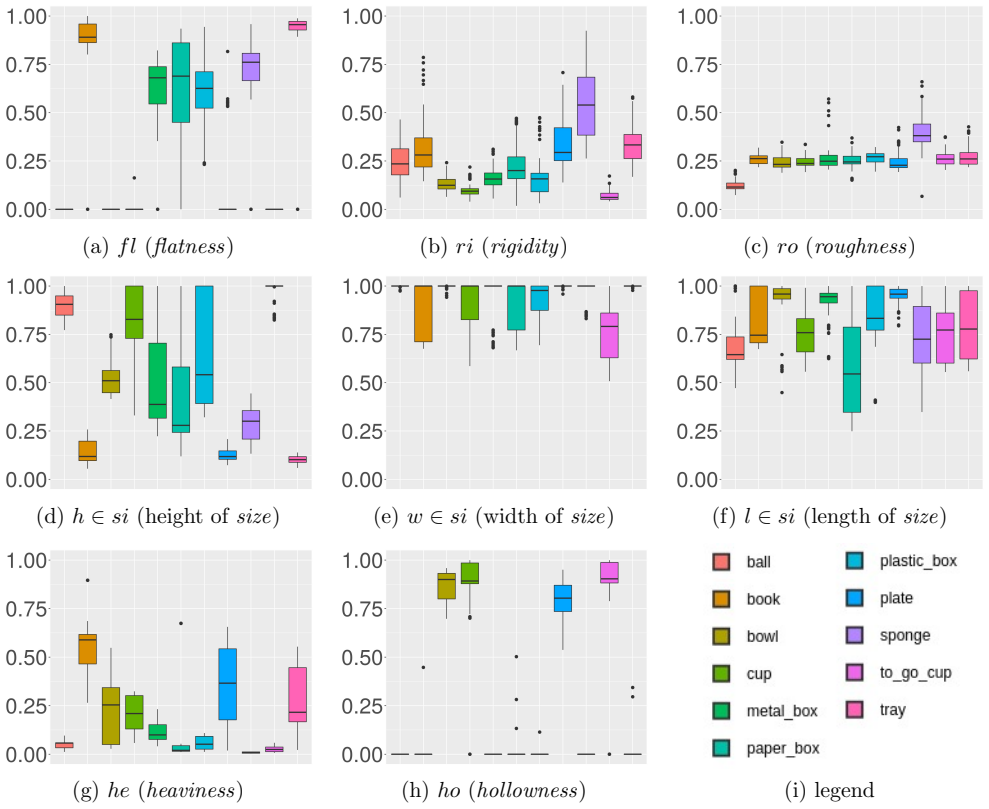
Tool-use applications in robotics require conceptual knowledge about objects for informed decision making and object interactions. State-of-the-art methods employ hand-crafted symbolic knowledge which is defined from a human perspective and grounded into sensory data afterwards. However, due to different sensing and acting capabilities of robots, their conceptual understanding of objects must be generated from a robot's perspective entirely, which asks for robot-centric conceptual knowledge about objects. With this goal in mind, this article motivates that such knowledge should be based on physical and functional properties of objects. Consequently, a selection of ten properties is defined and corresponding extraction methods are proposed. This multi-modal property extraction forms the basis on which our second contribution, a robot-centric knowledge generation is build on. It employs unsupervised clustering methods to transform numerical property data into symbols, and Bivariate Joint Frequency Distributions and Sample Proportion to generate conceptual knowledge about objects using the robot-centric symbols. A preliminary implementation of the proposed framework is employed to acquire a dataset comprising physical and functional property data of 110 houshold objects. This Robot-Centric dataSet (RoCS) is used to evaluate the framework regarding the property extraction methods, the semantics of the considered properties within the dataset and its usefulness in real-world applications such as tool substitution.
Editorial analysis
A structured set of objections, weighed in public.
Referee Report
Summary. The manuscript proposes a framework for generating robot-centric conceptual knowledge about household objects to support tool-use in robotics. It argues that such knowledge must derive entirely from a robot's perspective (in contrast to hand-crafted human symbols), motivates basing it on physical and functional properties, defines a selection of ten properties with corresponding multi-modal extraction methods, creates the RoCS dataset of 110 objects, applies unsupervised clustering to convert numerical property values into symbols, and uses bivariate joint frequency distributions plus sample proportions to derive conceptual relations among objects. A preliminary implementation is evaluated on the accuracy of property extraction, the semantics of the properties within the dataset, and utility for real-world tool substitution tasks.
Significance. If the central claim holds, the work would supply a reproducible dataset (RoCS) and a data-driven pipeline that avoids human-defined symbols, potentially improving robot decision-making in manipulation scenarios by producing symbols grounded in actual sensor/actuator capabilities. The unsupervised clustering plus frequency-based knowledge generation steps are a concrete methodological contribution that could be tested against baselines in tool-use benchmarks.
major comments (2)
- [Abstract] Abstract: the central claim that 'conceptual understanding of objects must be generated from a robot's perspective entirely' is load-bearing yet directly contradicted by the human-authored 'selection of ten properties' whose 'corresponding extraction methods are proposed.' No derivation from robot sensor statistics, actuator limits, or task-performance metrics is supplied to justify why these ten properties (rather than others) become the basis for symbols; unsupervised clustering and bivariate frequency analysis therefore operate only on a pre-filtered human inventory.
- [Evaluation] Evaluation section (tool substitution experiments): without quantitative metrics (e.g., success rate deltas versus human-symbol baselines, error bars on clustering stability, or ablation removing individual properties), it is impossible to assess whether the generated symbols actually support improved robot decision-making or merely reproduce the human-chosen distinctions.
minor comments (2)
- [Abstract] The abstract states that the framework is 'evaluated regarding the property extraction methods, the semantics of the considered properties within the dataset and its usefulness,' yet supplies no numerical results, tables, or statistical tests; these details should be added to the main text or supplementary material for reproducibility.
- [Knowledge Generation] Notation for the bivariate joint frequency distributions and sample proportion calculations is introduced without an explicit equation or pseudocode; adding a short formal definition would clarify how symbols are combined into conceptual knowledge.
Simulated Author's Rebuttal
We thank the referee for the constructive feedback. We respond point-by-point to the major comments, indicating revisions where appropriate.
read point-by-point responses
-
Referee: [Abstract] Abstract: the central claim that 'conceptual understanding of objects must be generated from a robot's perspective entirely' is load-bearing yet directly contradicted by the human-authored 'selection of ten properties' whose 'corresponding extraction methods are proposed.' No derivation from robot sensor statistics, actuator limits, or task-performance metrics is supplied to justify why these ten properties (rather than others) become the basis for symbols; unsupervised clustering and bivariate frequency analysis therefore operate only on a pre-filtered human inventory.
Authors: We agree that the selection of the ten properties is human-authored and motivated by considerations of robot sensing and actuation capabilities for household tasks. The symbols themselves, however, are generated via unsupervised clustering on measured numerical values rather than hand-crafted definitions, and the conceptual relations are produced from bivariate frequency distributions of those symbols. We will revise the abstract and introduction to explicitly acknowledge the human role in property selection while emphasizing that the resulting symbols and knowledge are derived from robot-centric data. revision: yes
-
Referee: [Evaluation] Evaluation section (tool substitution experiments): without quantitative metrics (e.g., success rate deltas versus human-symbol baselines, error bars on clustering stability, or ablation removing individual properties), it is impossible to assess whether the generated symbols actually support improved robot decision-making or merely reproduce the human-chosen distinctions.
Authors: The manuscript reports accuracy of the multi-modal property extraction, semantic coherence of the properties in the RoCS dataset, and a preliminary demonstration of utility for tool substitution. We acknowledge that these evaluations lack the quantitative comparisons (e.g., success-rate deltas against human-symbol baselines or clustering stability metrics) requested. In revision we will add such quantitative metrics and ablations where the existing data permit. revision: yes
Circularity Check
No circularity in derivation chain
full rationale
The paper explicitly states an author-driven selection of ten properties as the starting point, followed by proposed extraction methods, unsupervised clustering to symbols, and bivariate frequency analysis on a new RoCS dataset of 110 objects. No claimed result (e.g., the generated conceptual knowledge) reduces by construction to fitted parameters, prior self-citations, or redefinitions of its own inputs. The framework applies standard unsupervised methods without invoking uniqueness theorems or ansatzes from overlapping prior work. This is a self-contained proposal of a pipeline on fresh data and does not match any enumerated circularity pattern.
Axiom & Free-Parameter Ledger
Reference graph
Works this paper leans on
-
[1]
Christopher Baber. Introduction. In Cognition and Tool Use, chapter 1, pages 1–15. Taylor and Francis, 2003
work page 2003
-
[2]
Christopher Baber. Cognition and Tool Use. Taylor and Francis, 2003
work page 2003
-
[3]
Christopher Baber. The Design of Tools. In Cognition and Tool Use, chapter 6, pages 69–80. Taylor and Francis, 2003. 29
work page 2003
-
[4]
Christopher Baber. Working With Tools. In Cognition and Tool Use, chapter 5, pages 51–68. Taylor and Francis, 2003
work page 2003
-
[5]
Brandon Bennett and Claudia Cialone. Corpus Guided Sense Cluster Analysis: a methodology for ontology development (with examples from the spatial domain). In Pawel Garbacz and Oliver Kutz, editors, 8th International Conference on Formal Ontology in Information Systems (FOIS) , volume 267 of Frontiers in Artificial Intelligence and Applications , pages 213–...
work page 2014
-
[6]
Dora Biro, Michael Haslam, and Christian Rutz. Tool use as adaptation. Philosophical transactions of the Royal Society of London. Series B, Biological sciences , 368(1630), 2013
work page 2013
-
[7]
R. Bischoff, U. Huggenberger, and E. Prassler. Kuka youbot - a mobile manipulator for research and education. In 2011 IEEE International Conference on Robotics and Automation , pages 1–4, May 2011
work page 2011
-
[8]
Ecology and cognition of tool use in chimpanzees
Christophe Boesch. Ecology and cognition of tool use in chimpanzees. In Josep Boesch Christophe Sanz, Crickette M. Call, editor, Tool Use in Animals: Cognition and Ecology , chapter 2, pages 21–47. Cambridge University Press, 2013
work page 2013
-
[9]
An introduction to the anchoring problem
Silvia Coradeschi and Alessandro Saffiotti. An introduction to the anchoring problem. Robotics and Autonomous Systems, 43(2-3):85–96, 2003
work page 2003
-
[10]
Grounding commonsense knowledge in intelligent systems
Marios Daoutis, Silvia Coradeshi, and Amy Loutfi. Grounding commonsense knowledge in intelligent systems. Journal of Ambient Intelligence and Smart Environments , 1(4):311–321, 2009
work page 2009
-
[11]
What Is a Knowledge Representation ? AI Magazine, 14:17–33, 1993
Randall Davis, Howard Shrobe, and Peter Szolovits. What Is a Knowledge Representation ? AI Magazine, 14:17–33, 1993
work page 1993
-
[12]
Nathan J. Emery. Insight, imagination and invention: Tool understanding in a non-tool-using corvid. In Josep Boesch Christophe Sanz, Crickette M. Call, editor, Tool Use in Animals: Cognition and Ecology, chapter 4, pages 67–88. Cambridge University Press, 2013
work page 2013
-
[13]
WordNet: An Electronic Lexical Database
Christiane Fellbaum, editor. WordNet: An Electronic Lexical Database . The MIT Press, Cambridge, MA ; London, 1998
work page 1998
-
[14]
S. Garrido-Jurado, R. Munoz-Salinas, F.J. Madrid-Cuevas, and M.J. Marin-Jimenez. Automatic generation and detection of highly reliable fiducial markers under occlusion. Pattern Recognition, 47(6):2280–2292, 2014
work page 2014
-
[15]
James J Gibson. The Theory of Affordances. In The Ecological Approach to Visual Perception , chapter 8, pages 127–143. Psychology Press, Taylor & Francis Group, 1986
work page 1986
-
[16]
Common Sense Data Acquisition for Indoor Mobile Robots
Rakesh Gupta and Mykel J Kochenderfer. Common Sense Data Acquisition for Indoor Mobile Robots. In Proceedings of the Nineteenth National Conference on Artificial Intelligence, Sixteenth Conference on Innovative Applications of Artificial Intelligence , pages 605–610, San Jose, California, USA, 2004
work page 2004
-
[17]
Stevan Harnad. The Symbol Grounding Problem. Physica D, 42:335–346, 1990. 30
work page 1990
-
[18]
Cognitive, physical, sensory, and functional affordances in interaction design
Rex Hartson. Cognitive, physical, sensory, and functional affordances in interaction design. Behaviour & Information Technology, 22(5):315–338, 2003
work page 2003
-
[19]
Functional understanding facilitates learning about tools in human children
Mikolaj Hernik and Gergely Csibra. Functional understanding facilitates learning about tools in human children. Current Opinion in Neurobiology , 19(1):34–38, 2009
work page 2009
-
[20]
Anis Koubˆ aa.Robot operating system (ros): The complete reference , volume 2. Springer, 2017
work page 2017
-
[21]
An Image-Schematic Account of Spatial Categories
Werner Kuhn. An Image-Schematic Account of Spatial Categories. Spatial Information Theory, pages 152–168, 2007
work page 2007
-
[22]
ORO, a knowledge management platform for cognitive architectures in robotics
Sverin Lemaignan, Raquel Ros, Lorenz M¨ osenlechner, Rachid Alami, and Michael Beetz. ORO, a knowledge management platform for cognitive architectures in robotics. IEEE/RSJ 2010 International Conference on Intelligent Robots and Systems, IROS 2010 - Conference Proceedings , (April):3548–3553, 2010
work page 2010
-
[23]
Douglas B. Lenat. Cyc: A large-scale investment in knowledge infrastructure. Commun. ACM , 38(11):33–38, 11 1995
work page 1995
-
[24]
Ontology-based unified robot knowledge for service robots in indoor environments
Gi Hyun Lim, Il Hong Suh, and Hyowon Suh. Ontology-based unified robot knowledge for service robots in indoor environments. IEEE Transactions on Systems, Man, and Cybernetics Part A:Systems and Humans, 41(3):492–509, 2011
work page 2011
- [25]
-
[26]
Mandler and Cristobal Pagen Canovas
Jean M. Mandler and Cristobal Pagen Canovas. On defining image schemas. Language and Cognition, 6(04):510–532, 2014
work page 2014
-
[27]
Pineda, Arturo Rodr´ ıguez, Gibran Fuentes, Caleb Rasc´ on, and Ivan Meza
Luis A. Pineda, Arturo Rodr´ ıguez, Gibran Fuentes, Caleb Rasc´ on, and Ivan Meza. A light non- monotonic knowledge-base for service robots. Intelligent Service Robotics, 10(3):159–171, 2017
work page 2017
-
[28]
April M. Ruiz and Laurie R. Santos. Understanding differences in the way human and non-human primates represent tools: The role of teleological-intentional information. In Crickette M. Sanz, Josep Call, and Christophe Boesch, editors, Tool Use in Animals: Cognition and Ecology , chapter 6, pages 119–133. Cambridge University Press, 2013
work page 2013
-
[29]
Sanz, Josep Call, and Christophe Boesch, editors
Crickette M. Sanz, Josep Call, and Christophe Boesch, editors. Tool Use in Animals: Cognition and Ecology. Cambridge University Press, 2013
work page 2013
-
[30]
Ashutosh Saxena, Ashesh Jain, Ozan Sener, Aditya Jami, Dipendra K. Misra, and Hema S. Koppula. RoboBrain: Large-Scale Knowledge Engine for Robots. arXiv, pages 1 – 11, 2014
work page 2014
-
[31]
Why We Need Many Knowledge Representation Formalisms
Aaron Sloman. Why We Need Many Knowledge Representation Formalisms. Proceedings BCS Expert Systems Conference, pages 163–183, 1984. 31
work page 1984
-
[32]
Ontology-based multi-layered robot knowledge framework (OMRKF) for robot intelligence
Il Hong Suh, Gi Hyun Lim, Wonil Hwang, Hyowon Suh, Jung Hwa Choi, and Young Tack Park. Ontology-based multi-layered robot knowledge framework (OMRKF) for robot intelligence. IEEE International Conference on Intelligent Robots and Systems , (October):429–436, 2007
work page 2007
-
[33]
T. Susi and T. Ziemke. On the subject of objects: Four views on object perception and tool use. tripleC-Cognition, Communication, Co-operation, 3(2):619, 2005
work page 2005
-
[34]
A comprehensive characterization of the asus xtion pro depth sensor
Daniel Maximilian Swoboda. A comprehensive characterization of the asus xtion pro depth sensor. 2014
work page 2014
-
[35]
KNOWROB- Knowledge Processing for Autonomous Personal Robots
Moritz Tenorth and Michael Beetz. KNOWROB- Knowledge Processing for Autonomous Personal Robots. In IEEE/RSJ International Conference on Intelligent Robots and Systems , pages 4261–4266, 2009
work page 2009
-
[36]
Madhura Thosar, Christian Mueller, and Sebastian Zug. What Stands-in for a Missing Tool?: A Pro- totypical Grounded Knowledge-based Approach to Tool Substitution. In 11th International Workshop on Cognitive Robotics in 16th International Conference on Principles of Knowledge Representation and Reasoning, Tempe, Arizona, 2018
work page 2018
-
[37]
A Review of Knowledge Bases for Service Robots in Household Environments
Madhura Thosar, Sebastian Zug, Alpha Mary Skaria, and Akshay Jain. A Review of Knowledge Bases for Service Robots in Household Environments. In 6th International Workshop on Artificial Intelligence and Cognition , 2018
work page 2018
-
[38]
The cognitive bases of human tool use
Krist Vaesen. The cognitive bases of human tool use. Behavioral and Brain Sciences , 35(04):203–218, 2012
work page 2012
-
[39]
J. Vauclair and J. A. Anderson. Object Manipulation, Tool Use, and The Social Context in Human and Non-Human Primates. Techniques and Culture, 23-24:121136, 1994
work page 1994
-
[40]
Reasoning About Object Affordance in a Knowledge Based Representation
Yuke Zhu, Alireza Fathi, and Li Fei-Fei. Reasoning About Object Affordance in a Knowledge Based Representation. European Conference on Computer Vision , (3):408–424, 2014. 32
work page 2014
discussion (0)
Sign in with ORCID, Apple, or X to comment. Anyone can read and Pith papers without signing in.