Weak Supervision Enhanced Generative Network for Question Generation
Pith reviewed 2026-05-25 12:12 UTC · model grok-4.3
The pith
WeGen uses weak supervision to automatically identify relevant passage features for an answer span, improving generated question quality by capturing whole-passage semantic relations.
A machine-rendered reading of the paper's core claim, the machinery that carries it, and where it could break.
Core claim
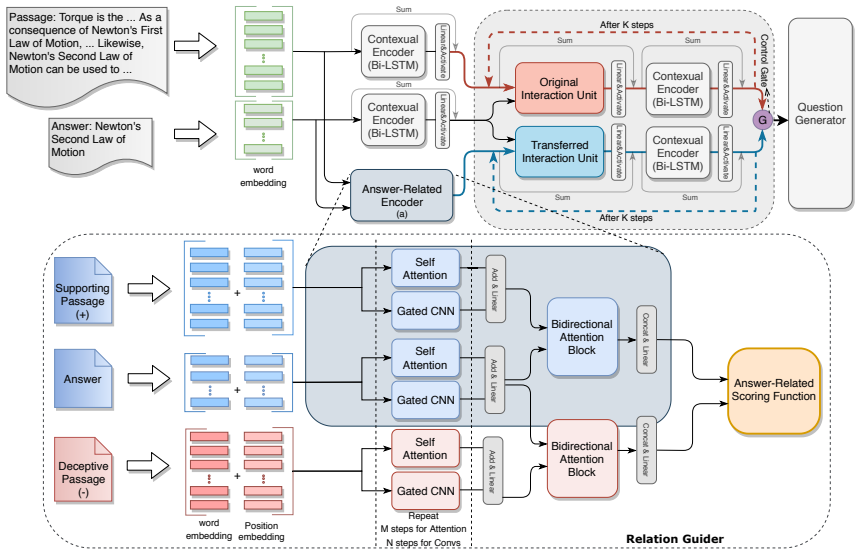
We propose the Weak Supervision Enhanced Generative Network (WeGen) which automatically discovers relevant features of the passage given the answer span in a weakly supervised manner to improve the quality of generated questions. We devise a discriminator, Relation Guider, to capture the relations between the whole passage and the associated answer and then the Multi-Interaction mechanism is deployed to transfer the knowledge dynamically for our question generation system.
What carries the argument
The Relation Guider, a discriminator that identifies semantic relations between the full passage and answer span using only downstream question quality feedback, combined with the Multi-Interaction mechanism that dynamically transfers this knowledge into the generator.
If this is right
- Generated questions incorporate semantic relations from the entire passage rather than relying on pre-extracted sentences.
- The approach eliminates the need for manual rules or separate supervised networks to select important sentences.
- Performance improves on both automatic metrics and human evaluations compared to prior pipelines.
- The weak supervision allows the model to learn relevant features without direct labels for passage-answer relations.
Where Pith is reading between the lines
- If the Relation Guider works as claimed, similar weak supervision could be applied to other text generation tasks like summarization where global context matters.
- This might enable question generation in low-resource settings where labeled extraction data is scarce.
- Future work could test whether the discovered relations align with human judgments of what makes a good question.
Load-bearing premise
The Relation Guider discriminator, trained only through the downstream question-quality signal, can reliably identify and transfer the semantic relations between the full passage and the answer span that are necessary for good question generation.
What would settle it
Train the model without the Relation Guider component and measure if question quality on standard datasets like SQuAD drops significantly in both automatic scores and human ratings; if no drop occurs, the central claim fails.
Figures
read the original abstract
Automatic question generation according to an answer within the given passage is useful for many applications, such as question answering system, dialogue system, etc. Current neural-based methods mostly take two steps which extract several important sentences based on the candidate answer through manual rules or supervised neural networks and then use an encoder-decoder framework to generate questions about these sentences. These approaches neglect the semantic relations between the answer and the context of the whole passage which is sometimes necessary for answering the question. To address this problem, we propose the Weak Supervision Enhanced Generative Network (WeGen) which automatically discovers relevant features of the passage given the answer span in a weakly supervised manner to improve the quality of generated questions. More specifically, we devise a discriminator, Relation Guider, to capture the relations between the whole passage and the associated answer and then the Multi-Interaction mechanism is deployed to transfer the knowledge dynamically for our question generation system. Experiments show the effectiveness of our method in both automatic evaluations and human evaluations.
Editorial analysis
A structured set of objections, weighed in public.
Referee Report
Summary. The paper proposes WeGen, a generative model for answer-aware question generation. It introduces a Relation Guider discriminator that learns to capture semantic relations between the full passage and answer span in a weakly supervised fashion (via downstream question quality signal only) and a Multi-Interaction mechanism that dynamically transfers this knowledge to an encoder-decoder generator. The central claim is that this avoids the limitations of prior two-step extract-then-generate pipelines that rely on manual rules or supervised sentence selection, and that experiments confirm improved question quality on automatic and human evaluations.
Significance. If the Relation Guider demonstrably encodes the intended passage-answer relations rather than generic features, the weakly supervised discovery approach would be a useful contribution to reducing reliance on explicit extractors in QG and related generation tasks. The dynamic modulation via Multi-Interaction is a reasonable architectural idea, but its value depends on the guider's semantic fidelity.
major comments (2)
- [§3.2] §3.2 (Relation Guider description): the claim that the guider 'automatically discovers relevant features ... in a weakly supervised manner' rests on the untested assumption that the downstream question-quality reward alone suffices to learn passage-answer semantic relations; no probing classifier, attention visualization, or auxiliary diagnostic is reported to confirm the relation vector encodes the intended semantics rather than training artifacts or generic passage features.
- [Experiments] Experiments section (and abstract): while effectiveness on automatic and human evaluations is asserted, the manuscript supplies no concrete numbers, baseline comparisons, ablation results isolating the guider or Multi-Interaction, or error analysis; without these it is impossible to determine whether reported gains are load-bearing for the weakly-supervised discovery claim or attributable to other factors.
minor comments (2)
- [§3.3] Notation for the Multi-Interaction mechanism is introduced without accompanying equations or pseudocode, making the dynamic transfer step difficult to reproduce precisely.
- [Abstract] The abstract states improvements but does not name the datasets or metrics used; this information should appear in the abstract or early in §4.
Simulated Author's Rebuttal
Thank you for the constructive feedback on our manuscript. We respond to each major comment below and will revise the paper to address the points raised.
read point-by-point responses
-
Referee: [§3.2] §3.2 (Relation Guider description): the claim that the guider 'automatically discovers relevant features ... in a weakly supervised manner' rests on the untested assumption that the downstream question-quality reward alone suffices to learn passage-answer semantic relations; no probing classifier, attention visualization, or auxiliary diagnostic is reported to confirm the relation vector encodes the intended semantics rather than training artifacts or generic passage features.
Authors: We agree that the manuscript does not provide direct diagnostics such as probing classifiers or attention visualizations to verify the semantic content encoded by the Relation Guider. While the weakly supervised training via question quality is designed to encourage relevant relation learning, additional evidence would strengthen the claim. We will add attention visualizations over the passage-answer pairs and a simple probing classifier experiment in the revised version. revision: yes
-
Referee: [Experiments] Experiments section (and abstract): while effectiveness on automatic and human evaluations is asserted, the manuscript supplies no concrete numbers, baseline comparisons, ablation results isolating the guider or Multi-Interaction, or error analysis; without these it is impossible to determine whether reported gains are load-bearing for the weakly-supervised discovery claim or attributable to other factors.
Authors: The current manuscript version indeed omits the requested concrete numbers, baseline comparisons, ablations, and error analysis. We will expand the Experiments section in the revision to include quantitative results on standard datasets, comparisons to prior models, ablations isolating the Relation Guider and Multi-Interaction, and qualitative error analysis. revision: yes
Circularity Check
No circularity: empirical architecture with experimental validation
full rationale
The paper proposes an empirical neural model (WeGen) whose central claim is that a Relation Guider trained only on downstream question-quality reward improves generated questions. No mathematical derivation, uniqueness theorem, or first-principles prediction is offered; the architecture is presented as a design choice whose value is assessed via automatic and human evaluations. No equations appear that define a quantity in terms of itself, no fitted parameter is relabeled as a prediction, and no self-citation chain is invoked to justify a load-bearing premise. The reader's noted assumption about the guider's semantic fidelity is a question of empirical adequacy, not a circular reduction of the claimed result to its own inputs.
Axiom & Free-Parameter Ledger
axioms (1)
- domain assumption An encoder-decoder framework can generate fluent questions when given relevant context.
invented entities (2)
-
Relation Guider
no independent evidence
-
Multi-Interaction mechanism
no independent evidence
Reference graph
Works this paper leans on
-
[1]
Language modeling with gated convolutional networks
[Dauphin et al., 2017] Yann N Dauphin, Angela Fan, Michael Auli, and David Grangier. Language modeling with gated convolutional networks. In Proceedings of the 34th International Conference on Machine Learning- Volume 70, pages 933–941. JMLR. org,
work page 2017
-
[2]
Identi- fying where to focus in reading comprehension for neural question generation
[Du and Cardie, 2017] Xinya Du and Claire Cardie. Identi- fying where to focus in reading comprehension for neural question generation. In Proceedings of the 2017 Confer- ence on Empirical Methods in Natural Language Process- ing, pages 2067–2073,
work page 2017
-
[3]
Learning to ask: Neural question generation for reading comprehension
[Du et al., 2017] Xinya Du, Junru Shao, and Claire Cardie. Learning to ask: Neural question generation for reading comprehension. In Proceedings of the 55th Annual Meet- ing of the Association for Computational Linguistics (Vol- ume 1: Long Papers), volume 1, pages 1342–1352,
work page 2017
-
[4]
Question generation for question answer- ing
[Duan et al., 2017] Nan Duan, Duyu Tang, Peng Chen, and Ming Zhou. Question generation for question answer- ing. In Proceedings of the 2017 Conference on Empirical Methods in Natural Language Processing, pages 866–874,
work page 2017
-
[5]
A semantic role-based approach to open-domain automatic question generation
[Flor and Riordan, 2018] Michael Flor and Brian Riordan. A semantic role-based approach to open-domain automatic question generation. In Proceedings of the Thirteenth Workshop on Innovative Use of NLP for Building Educa- tional Applications, pages 254–263,
work page 2018
-
[6]
Good question! statistical ranking for question gen- eration
[Heilman and Smith, 2010] Michael Heilman and Noah A Smith. Good question! statistical ranking for question gen- eration. In Human Language Technologies: The 2010 An- nual Conference of the North American Chapter of the As- sociation for Computational Linguistics , pages 609–617. Association for Computational Linguistics,
work page 2010
-
[7]
Teaching machines to read and comprehend
[Hermann et al., 2015] Karl Moritz Hermann, Tomas Ko- cisky, Edward Grefenstette, Lasse Espeholt, Will Kay, Mustafa Suleyman, and Phil Blunsom. Teaching machines to read and comprehend. In Advances in Neural Informa- tion Processing Systems, pages 1693–1701,
work page 2015
-
[8]
Automatic question generation using relative pronouns and adverbs
[Khullar et al., 2018] Payal Khullar, Konigari Rachna, Mukul Hase, and Manish Shrivastava. Automatic question generation using relative pronouns and adverbs. In Proceedings of ACL 2018, Student Research Workshop , pages 153–158,
work page 2018
-
[9]
Automated question generation methods for intelligent english learning systems and its evaluation
[Kunichika et al., 2004] Hidenobu Kunichika, Tomoki Katayama, Tsukasa Hirashima, and Akira Takeuchi. Automated question generation methods for intelligent english learning systems and its evaluation. In Proc. of ICCE,
work page 2004
-
[10]
Computer-aided generation of multiple-choice tests
[Mitkov and Ha, 2003] Ruslan Mitkov and Le An Ha. Computer-aided generation of multiple-choice tests. In Proceedings of the HLT-NAACL 03 workshop on Build- ing educational applications using natural language processing-Volume 2, pages 17–22. Association for Com- putational Linguistics,
work page 2003
-
[11]
MS MARCO: A Human Generated MAchine Reading COmprehension Dataset
[Nguyen et al., 2016] Tri Nguyen, Mir Rosenberg, Xia Song, Jianfeng Gao, Saurabh Tiwary, Rangan Majumder, and Li Deng. Ms marco: A human generated ma- chine reading comprehension dataset. arXiv preprint arXiv:1611.09268,
work page internal anchor Pith review Pith/arXiv arXiv 2016
-
[12]
Glove: Global vectors for word representation
[Pennington et al., 2014] Jeffrey Pennington, Richard Socher, and Christopher Manning. Glove: Global vectors for word representation. In Proceedings of the 2014 conference on empirical methods in natural language processing (EMNLP), pages 1532–1543,
work page 2014
-
[13]
Squad: 100,000+ ques- tions for machine comprehension of text
[Rajpurkar et al., 2016] Pranav Rajpurkar, Jian Zhang, Kon- stantin Lopyrev, and Percy Liang. Squad: 100,000+ ques- tions for machine comprehension of text. In Proceedings of the 2016 Conference on Empirical Methods in Natural Language Processing, pages 2383–2392,
work page 2016
-
[14]
Question asking as program generation
[Rothe et al., 2017] Anselm Rothe, Brenden M Lake, and Todd Gureckis. Question asking as program generation. In Advances in Neural Information Processing Systems , pages 1046–1055,
work page 2017
-
[15]
The first question generation shared task eval- uation challenge
[Rus et al., 2010] Vasile Rus, Brendan Wyse, Paul Pi- wek, Mihai Lintean, Svetlana Stoyanchev, and Christian Moldovan. The first question generation shared task eval- uation challenge. In Proceedings of the 6th International Natural Language Generation Conference,
work page 2010
-
[16]
Bidirectional Attention Flow for Machine Comprehension
[Seo et al., 2016] Minjoon Seo, Aniruddha Kembhavi, Ali Farhadi, and Hannaneh Hajishirzi. Bidirectional atten- tion flow for machine comprehension. arXiv preprint arXiv:1611.01603,
work page internal anchor Pith review Pith/arXiv arXiv 2016
-
[17]
Neural Models for Key Phrase Detection and Question Generation
[Subramanian et al., 2017] Sandeep Subramanian, Tong Wang, Xingdi Yuan, Saizheng Zhang, Yoshua Bengio, and Adam Trischler. Neural models for key phrase detection and question generation. arXiv preprint arXiv:1706.04560,
work page internal anchor Pith review Pith/arXiv arXiv 2017
-
[18]
Answer-focused and position-aware neural question generation
[Sun et al., 2018] Xingwu Sun, Jing Liu, Yajuan Lyu, Wei He, Yanjun Ma, and Shi Wang. Answer-focused and position-aware neural question generation. In Proceedings of the 2018 Conference on Empirical Methods in Natural Language Processing, pages 3930–3939,
work page 2018
-
[19]
Sequence to sequence learning with neural networks
[Sutskever et al., 2014] Ilya Sutskever, Oriol Vinyals, and Quoc V Le. Sequence to sequence learning with neural networks. In Advances in neural information processing systems, pages 3104–3112,
work page 2014
-
[20]
[Vaswani et al., 2017] Ashish Vaswani, Noam Shazeer, Niki Parmar, Jakob Uszkoreit, Llion Jones, Aidan N Gomez, Łukasz Kaiser, and Illia Polosukhin. Attention is all you need. In Advances in Neural Information Processing Sys- tems, pages 5998–6008,
work page 2017
-
[21]
Automatic generation of grounded visual questions
[Zhang et al., 2017] Shijie Zhang, Lizhen Qu, Shaodi You, Zhenglu Yang, and Jiawan Zhang. Automatic generation of grounded visual questions. In Proceedings of the 26th International Joint Conference on Artificial Intelligence , pages 4235–4243. AAAI Press,
work page 2017
-
[22]
Neural ques- tion generation from text: A preliminary study
[Zhou et al., 2017] Qingyu Zhou, Nan Yang, Furu Wei, Chuanqi Tan, Hangbo Bao, and Ming Zhou. Neural ques- tion generation from text: A preliminary study. In Na- tional CCF Conference on Natural Language Processing and Chinese Computing, pages 662–671. Springer, 2017
work page 2017
discussion (0)
Sign in with ORCID, Apple, or X to comment. Anyone can read and Pith papers without signing in.