Realistic simulations of galaxy formation in f(R) modified gravity
Pith reviewed 2026-05-25 01:54 UTC · model grok-4.3
The pith
f(R) modified gravity produces a 20% deviation in the high-redshift neutral hydrogen power spectrum that exceeds SKA1-MID errors.
A machine-rendered reading of the paper's core claim, the machinery that carries it, and where it could break.
Core claim
Cosmological hydrodynamical simulations that embed the Illustris-TNG galaxy-formation model inside f(R) gravity demonstrate that the neutral-hydrogen power spectrum at high redshift differs from the general-relativity case by 20 percent in both F5 and F6 models; this difference lies well above the expected SKA1-MID errors and therefore constitutes a testable signature of modified gravity on large scales.
What carries the argument
A new modified-gravity solver inside the AREPO code that couples the Illustris-TNG full-physics model to f(R) gravity, allowing direct comparison of matter, gas, stellar and HI power spectra between GR and the screened f(R) models.
If this is right
- Rotationally supported disc galaxies form in f(R) gravity even when the fifth force is only partially screened.
- The number of disc galaxies may increase in the weaker F6 model and decrease in the stronger F5 model relative to GR.
- AGN feedback and modified gravity produce a non-negligible back-reaction on the matter power spectrum only in F5, not in F6.
- The degeneracy between AGN feedback and f(R) effects on the matter power spectrum can be broken by examining the neutral-hydrogen and stellar power spectra separately.
Where Pith is reading between the lines
- If the 20 percent HI shift is confirmed, intensity-mapping surveys at high redshift would become a primary route for testing gravity on cosmological scales.
- The result suggests that future HI surveys could distinguish f(R) models from GR even when the matter power spectrum alone is ambiguous because of feedback uncertainties.
- Extending the same simulation setup to other screened modified-gravity models would test whether the HI signature is generic or specific to the chameleon mechanism.
Load-bearing premise
The Illustris-TNG physics prescriptions and the new AREPO modified-gravity solver remain valid when applied to f(R) gravity even in the partially screened regime.
What would settle it
A measurement of the neutral-hydrogen power spectrum at z approximately 2 to 3 that either shows or fails to show a 20 percent excess relative to general-relativity predictions at the wavenumbers probed by SKA1-MID.
Figures


read the original abstract
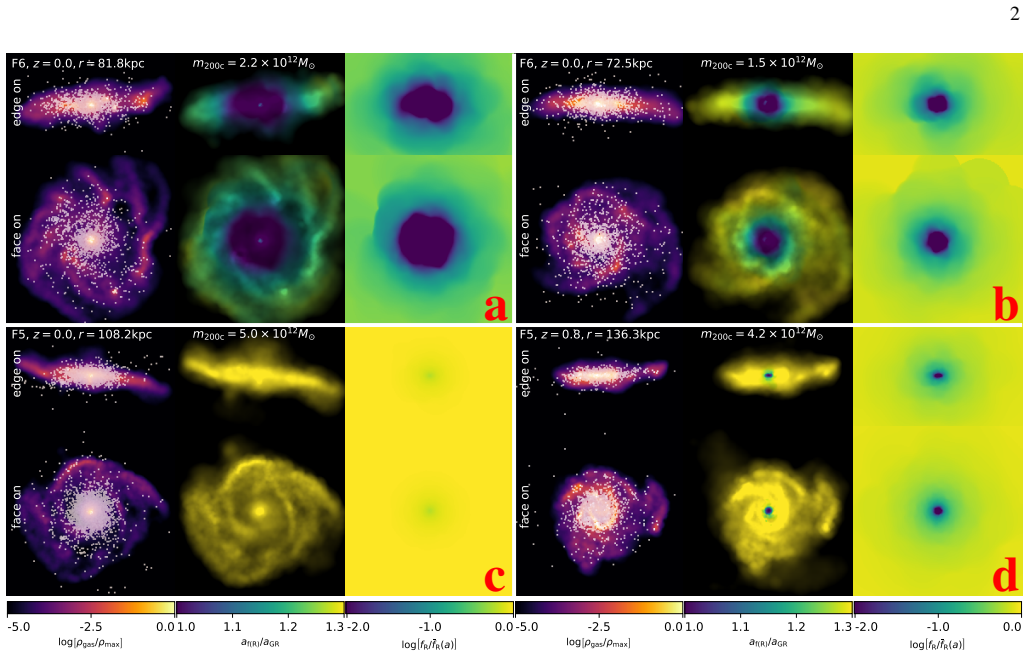
We have carried out a set of cosmological hydrodynamical simulations that follow galaxy formation in $f(R)$ modified gravity models. Our simulations employ the Illustris-TNG full physics model and a new modified gravity solver in the AREPO code. For the first time we are able to investigate the degeneracy in the matter power spectrum between the effects of $f(R)$-gravity and feedback from active galactic nuclei (AGN), and the imprint of modified gravity on the properties of galaxies and on the distribution of dark matter, gas and stars in the universe. $f(R)$-gravity has an observable effect on the neutral hydrogen power spectrum at high redshift at a level of 20%. For both the F6 and F5 models, this is significantly larger than the predicted errors for the SKA1-MID survey, making this probe a powerful test of gravity on large scales. A similar effect is present in the power spectrum of the stars at high redshift. We also show that rotationally supported disc galaxies can form in $f(R)$-gravity, even in the partially screened regime. Our simulations indicate that there might be more disc galaxies in F6 compared to GR, and fewer in F5. Finally, we show that the back reaction between AGN feedback and modified gravity in the matter power spectrum is not important in the F6 model but has a sizeable effect in F5.
Editorial analysis
A structured set of objections, weighed in public.
Referee Report
Summary. The manuscript presents the first set of cosmological hydrodynamical simulations of galaxy formation in f(R) modified gravity, employing the Illustris-TNG full physics model together with a new modified-gravity solver implemented in AREPO. The central claims are that f(R) produces a ~20% effect on the neutral-hydrogen power spectrum at high redshift for both the F5 and F6 models (exceeding predicted SKA1-MID errors), that rotationally supported discs form even in the partially screened regime, that the number of discs may differ from GR, and that the back-reaction between AGN feedback and modified gravity is negligible in F6 but appreciable in F5.
Significance. If the numerical results hold after validation, the work demonstrates that the neutral-hydrogen power spectrum can serve as a powerful, observationally accessible test of gravity on cosmological scales. The use of a full-physics galaxy-formation model rather than dark-matter-only runs is a clear strength, as is the explicit examination of the AGN-feedback degeneracy and the demonstration that discs can form in partially screened f(R) haloes.
major comments (3)
- [Abstract] Abstract: the 20% deviation in the neutral-hydrogen power spectrum (and the assertion that it exceeds SKA1-MID errors) is obtained with the unmodified, GR-calibrated Illustris-TNG subgrid prescriptions for cooling, star formation, stellar feedback and AGN feedback. No information is given on whether these parameters were re-tuned or whether key diagnostics (stellar mass function, gas fractions, HI-halo mass relation) were validated against observations in the F5/F6 runs. Because the fifth force alters halo assembly and potential-well depths even in partially screened objects, this assumption is load-bearing for interpreting the 20% signal as a genuine modified-gravity signature.
- [Abstract] Abstract: the new modified-gravity solver is introduced without any reported tests of its accuracy, convergence with resolution, or comparison against known analytic limits or existing f(R) codes. Given that the central 20% claim rests on the fidelity of the hydrodynamical runs, the absence of such validation constitutes a major gap.
- [Abstract] Abstract: the statement that 'the degeneracy with AGN feedback was investigated' is not accompanied by quantitative details (e.g., the magnitude of the difference between runs with and without feedback, or the k-range and redshift at which the comparison was performed). This information is required to assess whether the reported back-reaction effect in F5 is robust.
minor comments (1)
- [Abstract] The abstract would benefit from explicit statements of the redshift range and wavenumber interval over which the 20% HI-power-spectrum deviation is measured.
Simulated Author's Rebuttal
We thank the referee for their careful reading of the manuscript and for the constructive comments. We respond to each major comment below and indicate the revisions that will be made to address the concerns raised.
read point-by-point responses
-
Referee: [Abstract] Abstract: the 20% deviation in the neutral-hydrogen power spectrum (and the assertion that it exceeds SKA1-MID errors) is obtained with the unmodified, GR-calibrated Illustris-TNG subgrid prescriptions for cooling, star formation, stellar feedback and AGN feedback. No information is given on whether these parameters were re-tuned or whether key diagnostics (stellar mass function, gas fractions, HI-halo mass relation) were validated against observations in the F5/F6 runs. Because the fifth force alters halo assembly and potential-well depths even in partially screened objects, this assumption is load-bearing for interpreting the 20% signal as a genuine modified-gravity signature.
Authors: We agree that the subgrid prescriptions were not re-tuned for the f(R) models and that no validation of key diagnostics such as the stellar mass function, gas fractions or HI-halo mass relation was reported for the F5/F6 runs. The simulations were intentionally performed with the standard GR-calibrated Illustris-TNG model to isolate the effects of modified gravity. To address this point we will add a new subsection (and supporting figures) that presents these diagnostics for the f(R) runs and compares them both to the GR case and to available observational constraints. revision: yes
-
Referee: [Abstract] Abstract: the new modified-gravity solver is introduced without any reported tests of its accuracy, convergence with resolution, or comparison against known analytic limits or existing f(R) codes. Given that the central 20% claim rests on the fidelity of the hydrodynamical runs, the absence of such validation constitutes a major gap.
Authors: The referee is correct that the manuscript does not include tests of the new modified-gravity solver. While such tests were carried out during code development, they were not reported. We will add an appendix containing accuracy tests, resolution convergence studies, and comparisons against analytic limits and other f(R) implementations to document the fidelity of the solver. revision: yes
-
Referee: [Abstract] Abstract: the statement that 'the degeneracy with AGN feedback was investigated' is not accompanied by quantitative details (e.g., the magnitude of the difference between runs with and without feedback, or the k-range and redshift at which the comparison was performed). This information is required to assess whether the reported back-reaction effect in F5 is robust.
Authors: We agree that quantitative details on the AGN-feedback comparison are missing. We will expand the relevant discussion to include explicit numbers for the magnitude of the power-spectrum differences between runs with and without AGN feedback, together with the specific redshift and wavenumber ranges examined, so that the robustness of the back-reaction statement for F5 (and its absence in F6) can be directly assessed. revision: yes
Circularity Check
No circularity: results from direct numerical simulations with no reduction to fitted inputs or self-citations
full rationale
The paper reports outcomes of cosmological hydrodynamical simulations that apply the existing Illustris-TNG subgrid model inside a new f(R) solver in AREPO. No analytical derivation chain, parameter fitting step, or prediction is present that reduces by construction to the inputs. F5/F6 are standard literature values; the 20% HI power-spectrum effect and AGN-feedback back-reaction statements are direct simulation outputs, not re-labeled fits. No load-bearing self-citation or ansatz smuggling is visible in the abstract or described claims.
Axiom & Free-Parameter Ledger
free parameters (1)
- f_R0 amplitude for F5 and F6
axioms (2)
- domain assumption Illustris-TNG galaxy formation physics applies without major modification to f(R) gravity.
- domain assumption New modified gravity solver in AREPO accurately captures f(R) effects including partial screening.
Lean theorems connected to this paper
-
IndisputableMonolith/Foundation/RealityFromDistinction.leanreality_from_one_distinction unclear?
unclearRelation between the paper passage and the cited Recognition theorem.
We have carried out a set of cosmological hydrodynamical simulations that follow galaxy formation in f(R) modified gravity models. Our simulations employ the Illustris-TNG full physics model and a new modified gravity solver in the AREPO code.
-
IndisputableMonolith/Foundation/DimensionForcing.leanalexander_duality_circle_linking unclear?
unclearRelation between the paper passage and the cited Recognition theorem.
f(R)-gravity has an observable effect on the neutral hydrogen power spectrum at high redshift at a level of 20%.
What do these tags mean?
- matches
- The paper's claim is directly supported by a theorem in the formal canon.
- supports
- The theorem supports part of the paper's argument, but the paper may add assumptions or extra steps.
- extends
- The paper goes beyond the formal theorem; the theorem is a base layer rather than the whole result.
- uses
- The paper appears to rely on the theorem as machinery.
- contradicts
- The paper's claim conflicts with a theorem or certificate in the canon.
- unclear
- Pith found a possible connection, but the passage is too broad, indirect, or ambiguous to say the theorem truly supports the claim.
Reference graph
Works this paper leans on
-
[1]
code, by combining the Illustris-TNG galaxy formation model [27–31] and a new, much more efficient, modified grav- ity solver in the code. Below we give an overview of the TNG model and f(R)-gravity, and introduce the new modi- fied gravity solver. Further details about the code verification tests are included in the Supplementary Material. The SHYBONE suite ...
work page 2016
-
[2]
to screen the modifications to gravity and recover GR-like behaviour. The theory is constructed by adding a scalar functionf(R) of the Ricci scalarR to the Einstein-Hilbert action of GR: S = ∫ d4x√−g [R +f(R) 16πG +Lm ] , (1) whereG is the gravitational constant, g is the determinant of the metric gµν andLm is the matter Lagrangian density. Varying this ac...
-
[3]
(4) first before the scalar field can be used to calculate the gravitational potential through Eq
AMR-grid construction and mass assignment In order to solve for the gravitational forces one has to solve Eq. (4) first before the scalar field can be used to calculate the gravitational potential through Eq. (3). Due to the chameleon screening mechanism, which causes the scalar field value to drop by many orders of magnitude in dense environments with respe...
-
[4]
Scalar field solver In the old method, Eq. (4) is rewritten in the following form by defining a new variableu = ln ( fR/ ¯fR(a) ) , ∇2eu =− 1 3c2 ¯fR(a) [ ¯R(a) ( 1− e− u 2 ) + 8πGδρ ] , (10) which is solved using the Newton-Raphson relaxation scheme with red black sweeps and multigrid acceleration (see
-
[5]
for more detail). This way unphysical positive values of fR which might occur due to numerical errors during the iter- ations can be avoided. The new method makes use of a different re- parametrisation offR. Following [55], we define u≡ √ fR ¯fR(a), (11) which prevents positive values forfR as well. This leads to a different form of the scalar field equatio...
-
[6]
Multigrid acceleration The relaxation method used above successively reduces the error of the initial guess by iterations. It is well known that the decay of long wave-length modes of the error can be dramati- cally sped up by multigrid methods. For both the old and the new method we therefore use multigrid acceleration arranged in terms of V-cycles to sp...
-
[7]
Force calculation Both the old and new methods adopt the effective mass ap- proach to calculate the total gravity force as in MG-GADGET , making use of the fact that the modified Poisson equation, (3), can be rewritten in terms of an effective density ∇2Φ = 4πG(δρ +δρeff), (30) where δρeff = δρ 3 − δR 24πG. (31) The advantage of this approach is that it allo...
-
[8]
Local time stepping To keep the number of computationally expensive modified gravity force calculation low, we adopt the local time-stepping scheme that was first implemented in MG-GADGET (for more details see [36]). This scheme takes advantage of the fact that the regions which require the smallest time steps, i.e., the re- gions with the highest accelerat...
-
[9]
Buchdahl, H. A. Non-linear Lagrangians and cosmological the- ory. MNRAS 150, 1 (1970)
work page 1970
-
[10]
Models of f(R) Cosmic Acceleration that Evade Solar-System Tests
Hu, W. & Sawicki, I. Models of f(R) cosmic acceleration that evade solar system tests. Phys. Rev. D 76, 064004 (2007). 0705.1158
work page internal anchor Pith review Pith/arXiv arXiv 2007
-
[11]
Khoury, J. & Weltman, A. Chameleon cosmology. Phys. Rev. D 69, 044026 (2004). arXiv:astro-ph/0309411
work page internal anchor Pith review Pith/arXiv arXiv 2004
-
[12]
Will, C. M. The Confrontation between General Relativity and Experiment. Living Reviews in Relativity 17, 4 (2014). 1403.7377
work page internal anchor Pith review Pith/arXiv arXiv 2014
-
[13]
Lombriser, L. & Taylor, A. Breaking a dark degeneracy with gravitational waves. Journal of Cosmology and Astro-Particle Physics 2016, 031 (2016)
work page 2016
-
[14]
Implications of the Neutron Star Merger GW170817 for Cosmological Scalar-Tensor Theories
Sakstein, J. & Jain, B. Implications of the Neutron Star Merger GW170817 for Cosmological Scalar-Tensor Theories.Physical Review Letters 119, 251303 (2017). 1710.05893
work page internal anchor Pith review Pith/arXiv arXiv 2017
-
[15]
Ezquiaga, J. M. & Zumalac ´arregui, M. Dark Energy After GW170817: Dead Ends and the Road Ahead. Physical Review Letters 119, 251304 (2017)
work page 2017
- [16]
-
[17]
Sotiriou, T. P. & Faraoni, V . f(R) theories of gravity. Reviews of Modern Physics 82, 451–497 (2010). 0805.1726
work page internal anchor Pith review Pith/arXiv arXiv 2010
-
[18]
Beyond the Cosmological Standard Model
Joyce, A., Jain, B., Khoury, J. & Trodden, M. Beyond the cosmological standard model. Phys. Rep. 568, 1–98 (2015). 1407.0059
work page internal anchor Pith review Pith/arXiv arXiv 2015
-
[19]
Dynamical Masses in Modified Gravity
Schmidt, F. Dynamical masses in modified gravity. Phys. Rev. D 81, 103002 (2010). 1003.0409
work page internal anchor Pith review Pith/arXiv arXiv 2010
-
[20]
Testing General Relativity using the Environmental Dependence of Dark Matter Halos
Zhao, G.-B., Li, B. & Koyama, K. Testing Gravity Using the Environmental Dependence of Dark Matter Halos.Physical Re- view Letters 107, 071303 (2011). 1105.0922
work page internal anchor Pith review Pith/arXiv arXiv 2011
-
[21]
Li, Y . & Hu, W. Chameleon halo modeling in f(R) gravity. Phys. Rev. D 84, 084033 (2011). 1107.5120
work page internal anchor Pith review Pith/arXiv arXiv 2011
-
[22]
Modeling halo mass functions in chameleon f(R) gravity
Lombriser, L., Li, B., Koyama, K. & Zhao, G.-B. Modeling halo mass functions in chameleon f(R) gravity. Phys. Rev. D 87, 123511 (2013). 1304.6395
work page internal anchor Pith review Pith/arXiv arXiv 2013
-
[23]
Puchwein, E., Baldi, M. & Springel, V . Modified-Gravity- GADGET: a new code for cosmological hydrodynamical sim- ulations of modified gravity models. MNRAS 436, 348–360 (2013). 1305.2418
work page internal anchor Pith review Pith/arXiv arXiv 2013
-
[24]
Hierarchical clustering in chameleon $f(R)$ gravity
Hellwing, W. A., Li, B., Frenk, C. S. & Cole, S. Hierarchical clustering in chameleon f(R) gravity. MNRAS 435, 2806–2821 (2013). 1305.7486
work page internal anchor Pith review Pith/arXiv arXiv 2013
-
[25]
Using cosmic voids to distinguish f(R) gravity in future galaxy surveys
Zivick, P., Sutter, P. M., Wandelt, B. D., Li, B. & Lam, T. Y . Using cosmic voids to distinguish f(R) gravity in future galaxy surveys. MNRAS 451, 4215–4222 (2015). 1411.5694
work page internal anchor Pith review Pith/arXiv arXiv 2015
-
[26]
Cautun, M. et al. The Santiago-Harvard-Edinburgh-Durham void comparison I: SHEDding light on chameleon gravity tests. MNRAS (2018). 1710.01730
work page internal anchor Pith review Pith/arXiv arXiv 2018
-
[27]
Mitchell, M. A., He, J.-h., Arnold, C. & Li, B. A general frame- work to test gravity using galaxy clusters - I. Modelling the dy- namical mass of haloes in f(R) gravity. MNRAS 477, 1133– 1152 (2018)
work page 2018
-
[28]
Galaxy-galaxy weak gravitational lensing in $f(R)$ gravity
Li, B. & Shirasaki, M. Galaxy-galaxy weak gravitational lensing in f(R) gravity. MNRAS 474, 3599–3614 (2018). 1710.07291
work page internal anchor Pith review Pith/arXiv arXiv 2018
-
[29]
Scaling relations and mass bias in hydrodynamical f(R) gravity simulations of galaxy clusters
Arnold, C., Puchwein, E. & Springel, V . Scaling relations and mass bias in hydrodynamical f (R) gravity simulations of galaxy clusters. MNRAS 440, 833–842 (2014). 1311.5560
work page internal anchor Pith review Pith/arXiv arXiv 2014
-
[30]
The Lyman-alpha forest in f(R) modified gravity
Arnold, C., Puchwein, E. & Springel, V . The Lyman α for- est in f(R) modified gravity. MNRAS 448, 2275–2283 (2015). 1411.2600
work page internal anchor Pith review Pith/arXiv arXiv 2015
-
[31]
Hammami, A., Llinares, C., Mota, D. F. & Winther, H. A. Hy- drodynamic effects in the symmetron and f(R)-gravity models. MNRAS 449, 3635–3644 (2015). 1503.02004
work page internal anchor Pith review Pith/arXiv arXiv 2015
-
[32]
He, J.-h. & Li, B. Accurate method of modeling cluster scaling relations in modified gravity. Phys. Rev. D 93, 123512 (2016). 1508.07350
work page internal anchor Pith review Pith/arXiv arXiv 2016
-
[33]
Winther, H. A. et al. Modified gravity N-body code comparison project. MNRAS 454, 4208–4234 (2015). 1506.06384
work page internal anchor Pith review Pith/arXiv arXiv 2015
-
[34]
E pur si muove: Galiliean-invariant cosmological hydrodynamical simulations on a moving mesh
Springel, V . E pur si muove: Galilean-invariant cosmological hydrodynamical simulations on a moving mesh. MNRAS 401, 791–851 (2010). 0901.4107
work page internal anchor Pith review Pith/arXiv arXiv 2010
-
[35]
Pillepich, A. et al. Simulating galaxy formation with the Illus- trisTNG model. MNRAS 473, 4077–4106 (2018)
work page 2018
-
[36]
Springel, V . et al. First results from the IllustrisTNG simu- lations: matter and galaxy clustering. MNRAS 475, 676–698 13 (2018). 1707.03397
work page internal anchor Pith review Pith/arXiv arXiv 2018
-
[37]
Genel, S. et al. The size evolution of star-forming and quenched galaxies in the IllustrisTNG simulation. MNRAS 474, 3976– 3996 (2018)
work page 2018
-
[38]
Marinacci, F. et al. First results from the IllustrisTNG simu- lations: radio haloes and magnetic fields. MNRAS 480, 5113– 5139 (2018)
work page 2018
-
[39]
Nelson, D. et al. First results from the IllustrisTNG simulations: the galaxy colour bimodality. MNRAS 475, 624–647 (2018). 1707.03395
work page internal anchor Pith review Pith/arXiv arXiv 2018
- [40]
-
[41]
Ferrero, I. et al. Size matters: abundance matching, galaxy sizes, and the Tully-Fisher relation in EAGLE. MNRAS 464, 4736–4746 (2017)
work page 2017
-
[42]
Hellwing, W. A. et al. The effect of baryons on redshift space distortions and cosmic density and velocity fields in the EAGLE simulation. MNRAS 461, L11–L15 (2016)
work page 2016
-
[43]
Pillepich, A. et al. First results from the IllustrisTNG simula- tions: the stellar mass content of groups and clusters of galax- ies. MNRAS 475, 648–675 (2018). 1707.03406
work page internal anchor Pith review Pith/arXiv arXiv 2018
-
[44]
Zoomed cosmological simulations of Milky Way sized halos in f(R)-gravity
Arnold, C., Springel, V . & Puchwein, E. Zoomed cosmological simulations of Milky Way-sized haloes in f(R) gravity.MNRAS 462, 1530–1541 (2016). 1604.06095
work page internal anchor Pith review Pith/arXiv arXiv 2016
-
[45]
Villaescusa-Navarro, F. et al. Ingredients for 21 cm Intensity Mapping. ApJ 866, 135 (2018). 1804.09180
work page internal anchor Pith review Pith/arXiv arXiv 2018
-
[46]
Santos, M. et al. Cosmology from a SKA HI intensity mapping survey. In Advancing Astrophysics with the Square Kilometre Array (AASKA14), 19 (2015). 1501.03989
work page internal anchor Pith review Pith/arXiv arXiv 2015
-
[47]
Altay, G., Theuns, T., Schaye, J., Booth, C. M. & Dalla Vec- chia, C. The impact of different physical processes on the statis- tics of Lyman-limit and damped Lyman α absorbers. MNRAS 436, 2689–2707 (2013). 1307.6879
work page internal anchor Pith review Pith/arXiv arXiv 2013
-
[48]
The Average Star Formation Histories of Galaxies in Dark Matter Halos from z=0-8
Behroozi, P. S., Wechsler, R. H. & Conroy, C. The Average Star Formation Histories of Galaxies in Dark Matter Halos from z = 0-8. ApJ 770, 57 (2013). 1207.6105
work page internal anchor Pith review Pith/arXiv arXiv 2013
-
[49]
The Massive End of the Stellar Mass Function
D’Souza, R., Vegetti, S. & Kauffmann, G. The massive end of the stellar mass function. MNRAS 454, 4027–4036 (2015). 1509.07418
work page internal anchor Pith review Pith/arXiv arXiv 2015
-
[50]
Bernardi, M. et al. The massive end of the luminosity and stel- lar mass functions: dependence on the fit to the light profile. MNRAS 436, 697–704 (2013). 1304.7778
work page internal anchor Pith review Pith/arXiv arXiv 2013
-
[51]
Baldry, I. K. et al. Galaxy And Mass Assembly (GAMA): the galaxy stellar mass function at z < 0.06. MNRAS 421, 621– 634 (2012). 1111.5707
work page internal anchor Pith review Pith/arXiv arXiv 2012
-
[52]
Giodini, S. et al. Stellar and Total Baryon Mass Fractions in Groups and Clusters Since Redshift 1. ApJ 703, 982–993 (2009). 0904.0448
work page internal anchor Pith review Pith/arXiv arXiv 2009
-
[53]
Lovisari, L., Reiprich, T. H. & Schellenberger, G. Scaling prop- erties of a complete X-ray selected galaxy group sample. A&A 573, A118 (2015). 1409.3845
work page internal anchor Pith review Pith/arXiv arXiv 2015
-
[54]
Planck 2015 results. XIII. Cosmological parameters
Planck Collaboration et al. Planck 2015 results. XIII. Cosmo- logical parameters. A&A 594, A13 (2016). 1502.01589
work page internal anchor Pith review Pith/arXiv arXiv 2015
-
[55]
V ogelsberger, M. et al. Properties of galaxies reproduced by a hydrodynamic simulation. Nature 509, 177–182 (2014). 1405.1418
work page internal anchor Pith review Pith/arXiv arXiv 2014
-
[56]
V ogelsberger, M.et al. Introducing the Illustris Project: simu- lating the coevolution of dark and visible matter in the Universe. MNRAS 444, 1518–1547 (2014). 1405.2921
work page internal anchor Pith review Pith/arXiv arXiv 2014
-
[57]
Weinberger, R. et al. Simulating galaxy formation with black hole driven thermal and kinetic feedback. MNRAS 465, 3291– 3308 (2017)
work page 2017
-
[58]
Limits of Quasi-Static Approximation in Modified-Gravity Cosmologies
Sawicki, I. & Bellini, E. Limits of quasistatic approximation in modified-gravity cosmologies.Phys. Rev. D92, 084061 (2015). 1503.06831
work page internal anchor Pith review Pith/arXiv arXiv 2015
-
[59]
Terukina, A. et al. Testing chameleon gravity with the Coma cluster. JCAP 4, 013 (2014). 1312.5083
work page internal anchor Pith review Pith/arXiv arXiv 2014
-
[60]
No evidence for modifications of gravity from galaxy motions on cosmological scales
He, J.-h., Guzzo, L., Li, B. & Baugh, C. M. No evidence for modifications of gravity from galaxy motions on cosmological scales. Nature Astronomy 2, 967–972 (2018). 1809.09019
work page internal anchor Pith review Pith/arXiv arXiv 2018
-
[61]
The cosmological simulation code GADGET-2
Springel, V . The cosmological simulation code GADGET-2. MNRAS 364, 1105–1134 (2005). arXiv:astro-ph/0505010
work page internal anchor Pith review Pith/arXiv arXiv 2005
-
[62]
ECOSMOG: An Efficient Code for Simulating Modified Gravity
Li, B., Zhao, G.-B., Teyssier, R. & Koyama, K. ECOSMOG: an Efficient COde for Simulating MOdified Gravity. JCAP 1, 51 (2012). 1110.1379
work page internal anchor Pith review Pith/arXiv arXiv 2012
-
[63]
Bose, S. et al. Speeding up N-body simulations of modified gravity: chameleon screening models. Journal of Cosmology and Astro-Particle Physics2017, 050 (2017)
work page 2017
-
[64]
Llinares, C., Mota, D. F. & Winther, H. A. ISIS: a new N-body cosmological code with scalar fields based on RAMSES. Code presentation and application to the shapes of clusters.A&A 562, A78 (2014). 1307.6748
work page internal anchor Pith review Pith/arXiv arXiv 2014
-
[65]
Press, W. H., Teukolsky, S. A., Vetterling, W. T. & Flannery, B. P. (eds.) Numerical recipes (Cambridge Univ. Press, Cam- bridge [u.a.], 2007), 3. ed. edn. Includes bibliographical refer- ences and index. - This printing is corrected to software version 3.0
work page 2007
-
[66]
Schaye, J. et al. The EAGLE project: simulating the evolution and assembly of galaxies and their environments. MNRAS 446, 521–554 (2015). 1407.7040
work page internal anchor Pith review Pith/arXiv arXiv 2015
-
[67]
Benitez-Llambay, A. py-sphviewer: Py-sphviewer v1.0.0 (2015). URL http://dx.doi.org/10.5281/zenodo. 21703
discussion (0)
Sign in with ORCID, Apple, or X to comment. Anyone can read and Pith papers without signing in.