Cylinder-Specific Model-Based Control of Combustion Phasing for Multiple-Cylinder Diesel Engines Operating with High Dilution and Boost Levels
Pith reviewed 2026-05-24 19:59 UTC · model grok-4.3
The pith
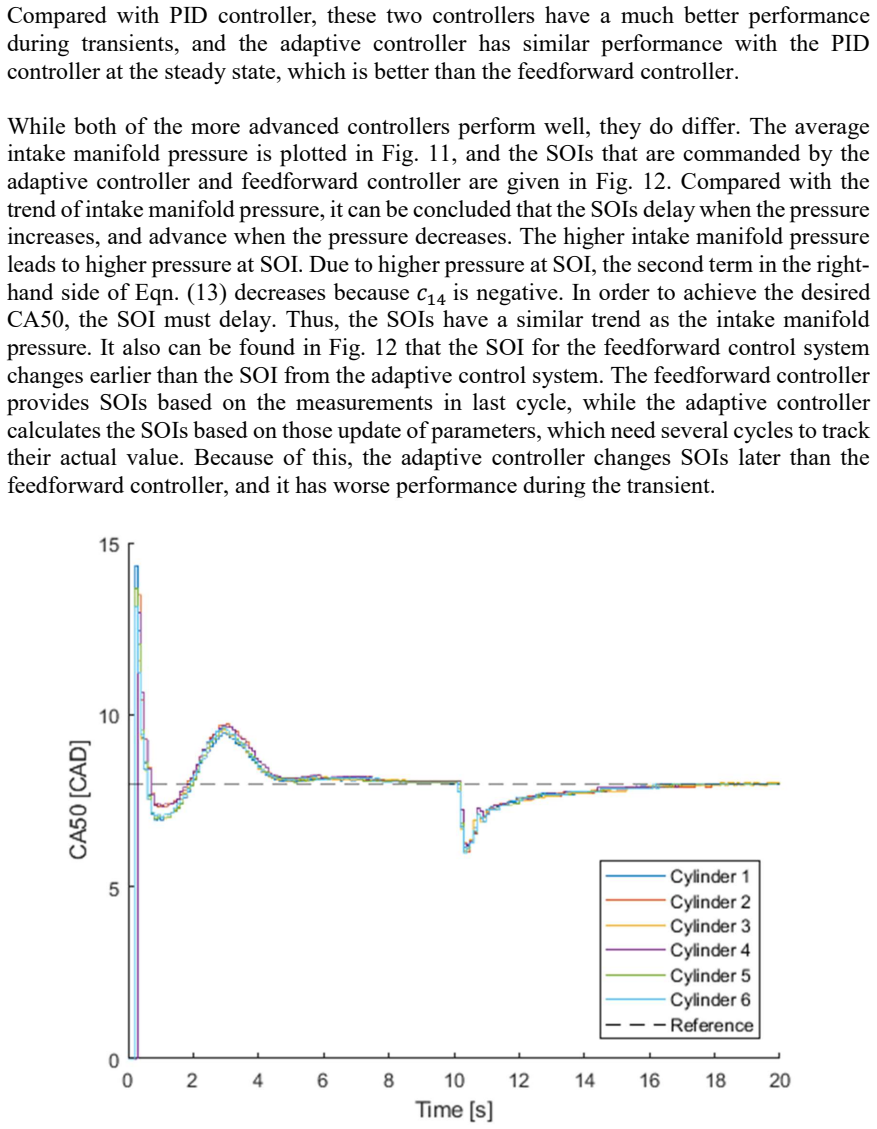
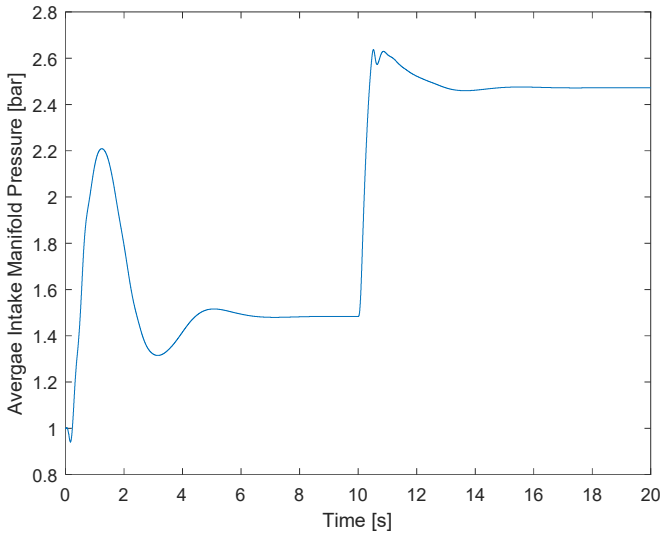
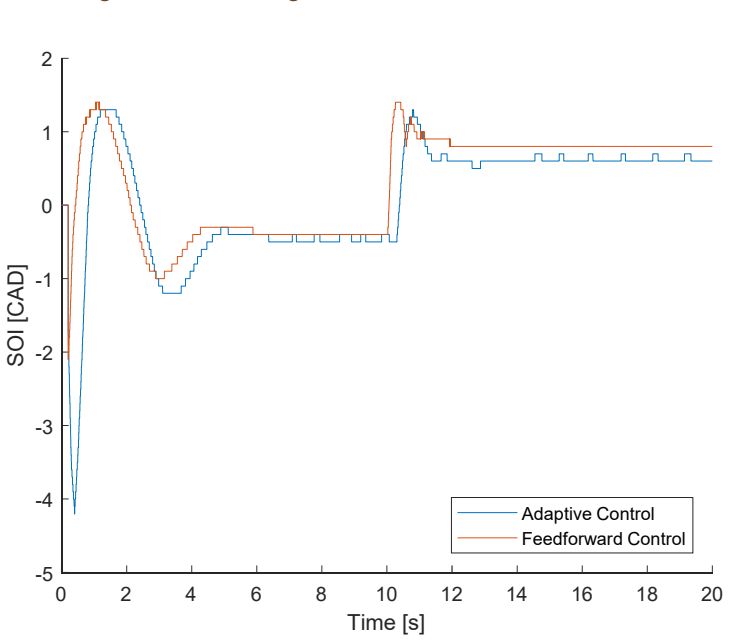
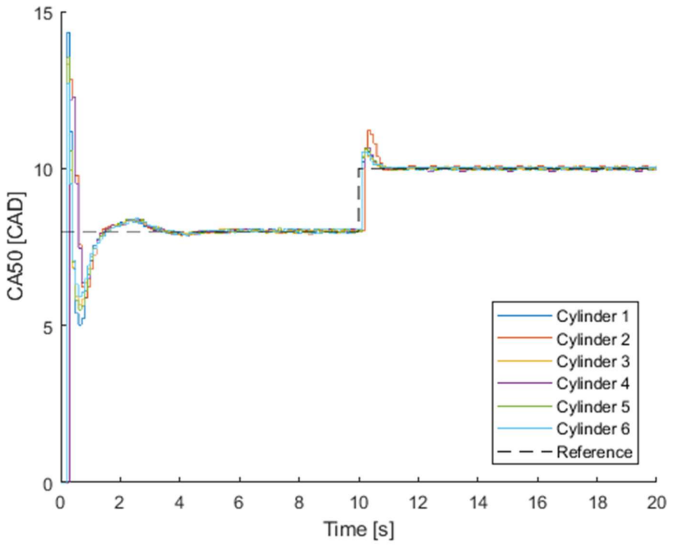
Cylinder-specific models enable adaptive and feedforward controllers to bring CA50 to steady state within 10 cycles in six-cylinder diesel engines with errors below 0.1 and 1.3 CAD.
A machine-rendered reading of the paper's core claim, the machinery that carries it, and where it could break.
Core claim
A nonlinear combustion phasing model using knock integral, burn duration, and Wiebe function, integrated with a cylinder-specific intake gas model that accounts for per-cylinder EGR, pressure, and temperature at IVC, is simplified for control and supports an adaptive closed-loop controller plus a feedforward open-loop controller that achieve steady-state CA50 within 10 cycles with steady-state errors below 0.1 CAD and 1.3 CAD respectively in six-cylinder diesel engine simulations.
What carries the argument
The simplified nonlinear combustion phasing model (knock integral plus burn duration plus Wiebe) coupled to the cylinder-specific intake gas model that supplies per-cylinder EGR fraction and IVC conditions.
If this is right
- The adaptive controller maintains CA50 errors below 0.1 CAD across all cylinders once steady state is reached.
- The feedforward controller achieves CA50 errors below 1.3 CAD without requiring sensor feedback.
- Both controllers converge to the target CA50 for every cylinder in fewer than 10 engine cycles.
- Cylinder-to-cylinder differences in intake conditions are explicitly handled in the model and therefore in the resulting control actions.
Where Pith is reading between the lines
- The modeling approach could reduce the calibration effort needed when moving between different dilution or boost setpoints.
- If the model predictions hold on hardware, the feedforward strategy might serve as a reliable backup when sensors are unavailable.
- Similar cylinder-specific intake modeling might improve phasing control in other diluted combustion regimes such as low-temperature combustion.
Load-bearing premise
The nonlinear combustion phasing model and cylinder-specific intake gas model remain sufficiently accurate after simplification for controller design under the examined high-dilution and high-boost conditions.
What would settle it
Engine test data on a six-cylinder diesel engine where the adaptive controller produces steady-state CA50 errors above 0.1 CAD or where either controller fails to reach steady state within 10 cycles would falsify the reported performance.
Figures
read the original abstract
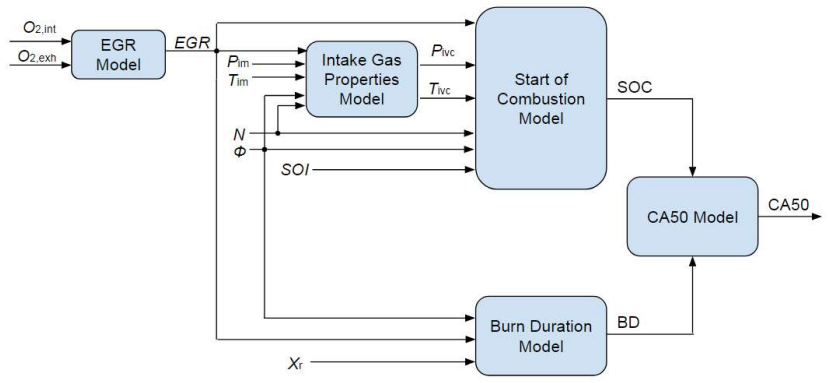
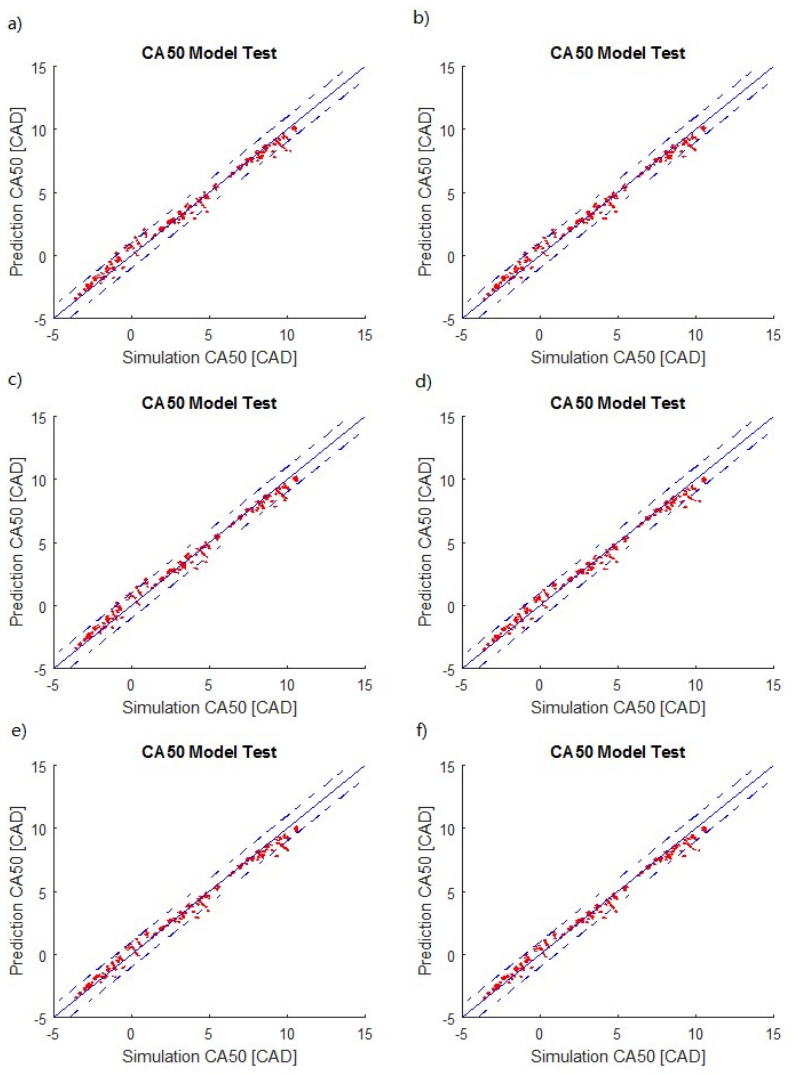
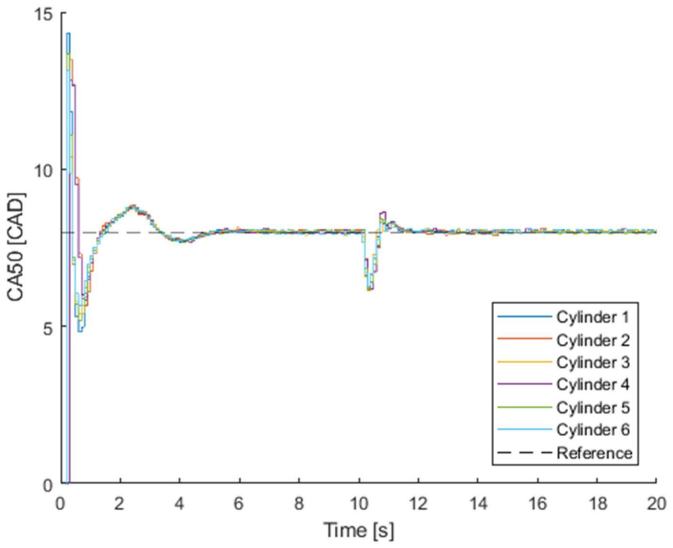
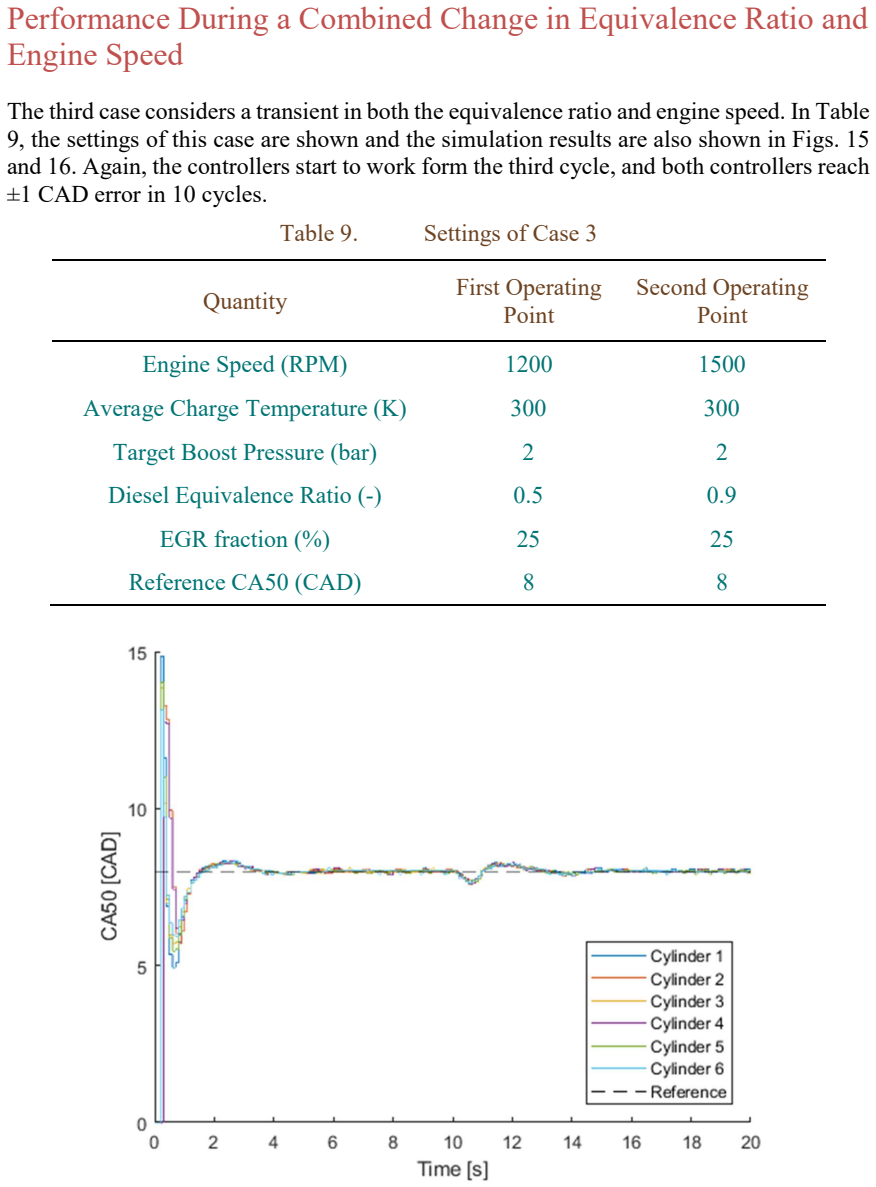
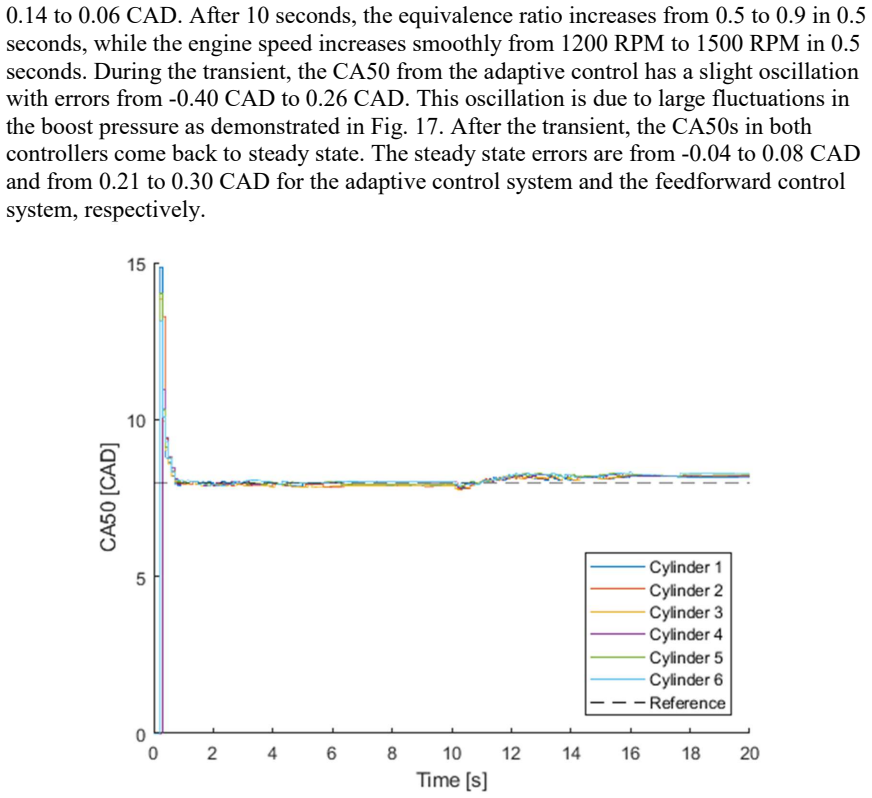
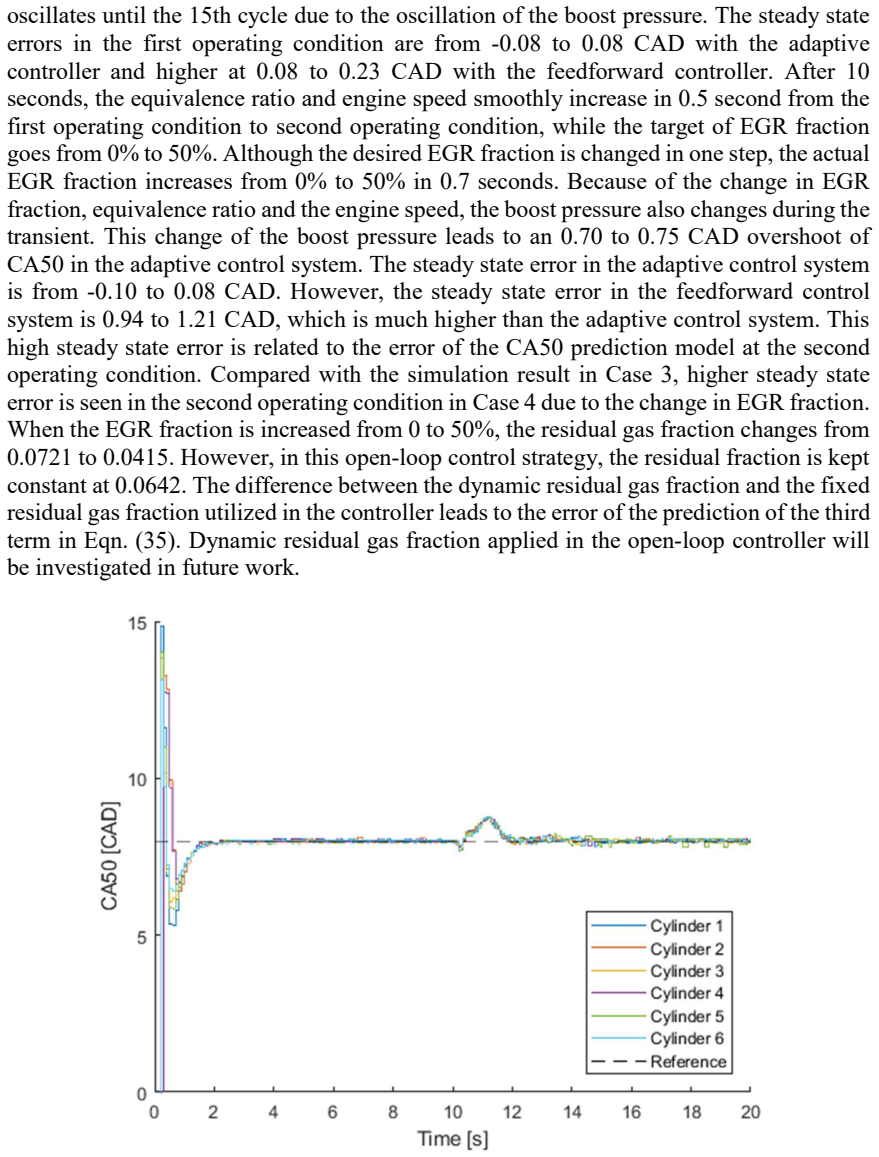
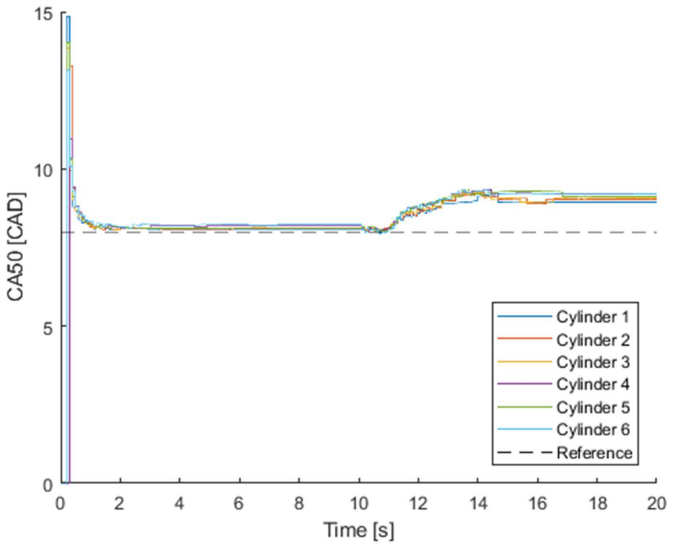
Accurate control of combustion phasing is indispensable for diesel engines due to the strong impact of combustion timing on efficiency. In this work, a non-linear combustion phasing model is developed and integrated with a cylinder-specific model of intake gas. The combustion phasing model uses a knock integral model, a burn duration model and a Wiebe function to predict CA50 (the crank angle at which 50% of the mass of fuel has burned). Meanwhile, the intake gas property model predicts the EGR fraction and the in-cylinder pressure and temperature at intake valve closing (IVC) for different cylinders. As such, cylinder-to-cylinder variation of the pressure and temperature at intake valves closing is also considered in this model. This combined model is simplified for controller design and validated. Based on these models, two combustion phasing control strategies are explored. The first is an adaptive controller that is designed for closed-loop control and the second is a feedforward model-based control strategy for open-loop control. These two control approaches were tested in simulations for all six cylinders and the results demonstrate that the CA50 can reach steady state conditions within 10 cycles. In addition, the steady state errors are less than +/-0.1 crank angle degree (CAD) with the adaptive control approach, and less than +/-1.3 CAD with feedforward model-based control. The impact of errors on the control algorithms is also discussed in the paper.
Editorial analysis
A structured set of objections, weighed in public.
Referee Report
Summary. The paper develops a nonlinear combustion phasing model (knock integral + burn duration + Wiebe function) to predict CA50, integrated with a cylinder-specific intake gas model that accounts for EGR fraction and IVC pressure/temperature variations across cylinders. The combined model is simplified for controller design. Two strategies are presented: an adaptive closed-loop controller and a feedforward model-based open-loop controller. Simulations on a six-cylinder diesel engine under high dilution/boost show CA50 reaching steady state within 10 cycles, with steady-state errors < ±0.1 CAD (adaptive) and < ±1.3 CAD (feedforward).
Significance. The integration of cylinder-specific intake modeling with combustion phasing control addresses a relevant problem for efficiency in multi-cylinder diesel engines. If the simplified model remains accurate under the examined conditions, the reported simulation performance would indicate practical utility for both closed- and open-loop strategies. However, the in-silico results against the design model itself provide limited evidence for robustness.
major comments (1)
- [Abstract (results paragraph) and simulation results section] The central performance claims (steady-state within 10 cycles; errors <±0.1 CAD adaptive / <±1.3 CAD feedforward) are obtained exclusively from closed-loop simulations of the controllers against the identical nonlinear combustion + intake-gas model used for their derivation. This setup does not probe simplification-induced mismatch, cylinder-to-cylinder effects not captured in the model, or sensor/actuator dynamics that would appear on hardware.
Simulated Author's Rebuttal
We thank the referee for the detailed review and constructive feedback. The manuscript presents a simulation-based study of cylinder-specific modeling and control for combustion phasing. We address the central concern regarding the simulation setup below.
read point-by-point responses
-
Referee: [Abstract (results paragraph) and simulation results section] The central performance claims (steady-state within 10 cycles; errors <±0.1 CAD adaptive / <±1.3 CAD feedforward) are obtained exclusively from closed-loop simulations of the controllers against the identical nonlinear combustion + intake-gas model used for their derivation. This setup does not probe simplification-induced mismatch, cylinder-to-cylinder effects not captured in the model, or sensor/actuator dynamics that would appear on hardware.
Authors: We agree that the reported performance metrics are obtained from closed-loop simulations against the same nonlinear model used for controller synthesis. This is a standard first step in model-based control development to verify that the designed laws achieve the intended behavior under the modeling assumptions. The manuscript already includes a discussion of the impact of model errors on the algorithms. However, we acknowledge that these in-silico results against the design model do not capture unmodeled dynamics, sensor/actuator effects, or additional cylinder-to-cylinder variations that would arise in hardware. We will revise the abstract and simulation results section to explicitly qualify the claims as nominal-model simulation results and to note the requirement for future experimental validation to assess robustness. revision: partial
Circularity Check
No significant circularity detected in derivation chain
full rationale
The paper assembles standard physical sub-models (knock integral, burn duration, Wiebe function for combustion phasing; cylinder-specific intake gas model for EGR, pressure and temperature at IVC) whose grounding is external to the paper. These are integrated, simplified for controller design, and used to test adaptive and feedforward controllers in simulation. No equations or steps reduce the claimed performance metrics (steady-state within 10 cycles, errors <±0.1 CAD adaptive / <±1.3 CAD feedforward) to self-definition, fitted inputs renamed as predictions, or self-citation chains. The simulation results on the design model are standard for model-based control validation and do not force the outcomes by construction. No uniqueness theorems or ansatzes smuggled via self-citation appear in the provided text.
Axiom & Free-Parameter Ledger
Reference graph
Works this paper leans on
-
[1]
Kataoka, M., Terazawa, Y., Hayashibara, H. and Saito, T. Combustion control apparatus for an engine. U.S. Patent 6,964,256, issued November 15, 2005
work page 2005
-
[2]
Combustion control apparatus of diesel engine
Kataoka, M., Kobayashi, A., and Saito, T. Combustion control apparatus of diesel engine. U.S. Patent 6,725,829, issued April 27, 2004
work page 2004
-
[3]
Heywood, J. B. Internal Combustion Engine Fundamentals. Indian Edition 2011. New York: McGraw-Hill Companies, Inc, 2011, p. 390, 501 – 502, 586 – 592
work page 2011
-
[4]
Introduction to Internal Combustion Engines
Stone R. Introduction to Internal Combustion Engines. Third Edition. Warrendale: Society of Automotive Engineers, Inc., 1999, p. 97, 424
work page 1999
-
[5]
Ickes A. M., Bohac S. V., and Assanis D. N. Effect of Fuel Cetane Number on a Premixed Diesel Combustion Mode. International Journal of Engine Research, 2009, 10(4): 251-263
work page 2009
-
[6]
A Diesel Engine Combustion Phasing Optimization Using a Model Guided Extremum Seeking Approach
Tan Q., Divekar P., Tan Y., et al. A Diesel Engine Combustion Phasing Optimization Using a Model Guided Extremum Seeking Approach. 35th Chinese Control Conference, Chengdu, China, 2837-2842, 2016, New York: IEEE Control Systems Society
work page 2016
-
[7]
and Stola, F., Instantaneous engine speed measurement and processing for MFB50 evaluation
Ponti, F., Ravaglioli, V., Serra, G. and Stola, F., Instantaneous engine speed measurement and processing for MFB50 evaluation. SAE International Journal of Engines, 2(2), pp.235-244, 2010
work page 2010
-
[8]
Ponti, F., Ravaglioli, V., Moro, D. and Serra, G. MFB50 on-board estimation methodology for combustion control. Control Engineering Practice, 21(12), pp.1821-1829, 2013
work page 2013
-
[9]
Relationship Between Ignition Processes and the Lift-Off Length of Diesel Fuel Jets
Pickett, L., Siebers, D., and Idicheria, C. Relationship Between Ignition Processes and the Lift-Off Length of Diesel Fuel Jets. SAE Technical Paper 2005-01-3843, doi:10.4271/2005-01-3843
-
[10]
Kook, S., Bae, C., Miles, P., et al. The Influence of Charge Dilution and Injection Timing on Low-Temperature Diesel Combustion and Emissions. SAE Technical Paper 2005-01-3837, doi:10.4271/2005-01-3837
-
[11]
A Predictive Real Time NOx Model for Conventional and Partially Premixed Diesel Combustion
Andersson, M., Johansson, B., Hultqvist, A., et al. A Predictive Real Time NOx Model for Conventional and Partially Premixed Diesel Combustion. SAE Technical Paper 2006-01-3329, doi:10.4271/2006-01-3329
-
[12]
Loganathan, S., Murali Manohar, R., Thamaraikannan, R., et al. Direct Injection Diesel Engine Rate of Heat Release Prediction using Universal Load Correction 38 Factor in Double Wiebe Function for Performance Simulation. SAE Technical Paper 2011-01-2456, doi:10.4271/2011-01-2456
-
[13]
Suzuki, Y., Kusaka, J., Ogawa, M., et al. Modeling of Diesel Engine Components for Model-Based Control (Second Report): Prediction of Combustion with High Speed Calculation Diesel Combustion Model. SAE Technical Paper 2011-01- 2044, doi:10.4271/2011-01-2044
- [14]
-
[15]
Modeling of HCCI engine combustion for control analysis
Bengtsson J., Gafvert M., Strandh P. Modeling of HCCI engine combustion for control analysis. In: 43rd IEEE Conference on Decision and Control, Atlantis, Paradise Island, Bahamas, 2004, 2: 1682 - 1687, 2004, New York: IEEE
work page 2004
-
[16]
Correlation of Autoignition Phenomena in Internal Combustion Engines and Rapid Compression Machines
Livengood JC., and Wu PC. Correlation of Autoignition Phenomena in Internal Combustion Engines and Rapid Compression Machines. Symposium (International) on Combustion, 1955, 5(1): 347 – 356
work page 1955
-
[17]
Combustion Control of Diesel Engines Using Injection Timing
Hillion, M., Buhlbuck, H., Chauvin, J., et al. Combustion Control of Diesel Engines Using Injection Timing. SAE Technical Paper 2009-01-0367, doi:10.4271/2009-01-0367
-
[18]
Development and Application of a 0D D.I
Lafossas, F., Marbaix, M., and Menegazzi, P. Development and Application of a 0D D.I. Diesel combustion model for Emissions Prediction. SAE Technical Paper 2007-01-1841, doi:10.4271/2007-01-1841
-
[19]
Multi-Zone Predictive Modeling of Common Rail Multi-Injection Diesel Engines
Arsie, I., Di Genova, F., Mogavero, A., et al. Multi-Zone Predictive Modeling of Common Rail Multi-Injection Diesel Engines. SAE Technical Paper 2006-01- 1384, doi:10.4271/2006-01-1384
-
[20]
Modeling and Experimental Study of an HCCI Engine for Combustion Timing Control
Shahbakhti M. Modeling and Experimental Study of an HCCI Engine for Combustion Timing Control. PhD dissertation, University of Alberta, Canada, 2009
work page 2009
-
[21]
Thermodynamic based modeling for nonlinear control of combustion
Bettis J.B. Thermodynamic based modeling for nonlinear control of combustion. Master Thesis, Missouri University of Science and Technology, MO, USA, 2010
work page 2010
-
[22]
Wenbo Sui, and Carrie M. Hall. Combustion phasing modeling and control for compression ignition engines with high dilution and boost levels. Journal of Automobile Engineering, 2018
work page 2018
-
[23]
Kassa M. Analysis and Control of Compression-Ignition and Spark-Ignited Engines Operations with Dual-Fuel Combustion Strategy. PhD dissertation, Illinois Institute of Technology, IL, USA, 2017. 39
work page 2017
-
[24]
Al-Durra A., Fiorentini L., Canova M., and Yurkovich S. A Model-Based Estimator of Engine Cylinder Pressure Imbalance for Combustion Feedback Control Applications. American Control Conference (ACC), 2011, San Francisco, CA, USA, 2011
work page 2011
-
[25]
Stockar S., Canova M., and Guezennec Y. Model-Order Reduction for Prediction of Pressure Wave Propagation Dynamics in the IC Engine Air Path System. American Control Conference (ACC), 2013, Washington, DC, USA, 2013
work page 2013
-
[26]
Chen S., and Yan F. Extended Kalman Filter Based In-Cylinder Temperature Estimation for Diesel Engine with Thermocouple Lag Compensation. Journal of Dynamic Systems, Measurement and Control, 2014, 136(5): 051010, doi: 10.1115/1.4027170
-
[27]
Willems, F., Doosje, E., Engels, F., et al. Cylinder Pressure-Based Control in Heavy-Duty EGR Diesel Engines Using a Virtual Heat Release and Emission Sensor. SAE Technical Paper 2010-01-0564, doi: 10.4271/2010-01-0564
-
[28]
Yu S., Choi H., Cho S., et al. Development of engine control using the in-cylinder pressure signal in a high speed direct injection diesel engine. International Journal of Automotive Technology, 2013, 14(2): 175-182
work page 2013
-
[29]
Closed-loop diesel engine combustion phasing control based on crankshaft torque measurements
Thor M., Egardt B., McKelvey T., et al. Closed-loop diesel engine combustion phasing control based on crankshaft torque measurements. Control Engineering Practice, 2014, 33: 115-124
work page 2014
-
[30]
Fuzzy Logic Control of Diesel Combustion Phasing Using Ion Current Signal
Badawy T., Khaled N., and Henein N. Fuzzy Logic Control of Diesel Combustion Phasing Using Ion Current Signal. ASME 2012 Internal Combustion Engine Division Spring Technical Conference, Torino, Piemonte, Italy, 645-658, 2012, New York: ASME
work page 2012
-
[31]
A method for combustion phasing control using cylinder pressure measurement in a CRDI diesel engine
Yoon M., Lee K., and Sunwoo M. A method for combustion phasing control using cylinder pressure measurement in a CRDI diesel engine. Mechatronics, 2007, 17(9): 469-479
work page 2007
-
[32]
R. Finesso and E. Spessa, A Feed-Forward Approach for the Real-Time Estimation and Control of MFB50 and SOI In Diesel Engines. SAE International Journal of Engines, 7(1), pp.528-549, 2014
work page 2014
-
[33]
Adaptive Control of a Recompression Four-Cylinder HCCI engine
Larimore J., Jade S., Hellstrom E., et al. Adaptive Control of a Recompression Four-Cylinder HCCI engine. IEEE Transactions on Control Systems Technology, 2015, 23(6): 2144-2154. 40
work page 2015
-
[34]
Hall C. M., Shaver G. M., Chauvin J., et al. Combustion phasing model for control of a gasoline-ethanol fueled SI engine with variable valve timing. American Control Conference (ACC), 2012, Montreal, QC, Canada, 2012
work page 2012
-
[35]
Sadabadi K. K., Shahbakhti M., Bharath A. N. et al. Modeling of combustion phasing of a reactivity-controlled compression ignition engine for control applications. International Journal of Engine Research, 2016, 17(4): 421-435
work page 2016
-
[36]
Engine and Powertrain Control, Simulation, and Modeling
Lyle Kocher, Carrie Hall, Karla Stricker, David Fain, Dan Van Alstine, and Gregory M. Shaver, Robust Oxygen Fraction Estimation for Conventional land Premixed Charge Compression Ignition Engines with Variable Valve Actuation, IFAC Control Engineering Practice for a Special Issue Entitled: “Engine and Powertrain Control, Simulation, and Modeling”, vol. 29,...
work page 2014
-
[37]
Air fraction estimation for multiple combustion mode diesel engines with dual-loop EGR systems
Junmin Wang, "Air fraction estimation for multiple combustion mode diesel engines with dual-loop EGR systems", Control Engineering Practice, vol. 16, pp. 1479, 2008
work page 2008
-
[38]
Hulbert M. Modeling the Impact of Natural Gas Variation on Combustion in a Dual-Fuel Engine Master Thesis, Illinois Institute of Technology, IL, USA, 2017
work page 2017
-
[39]
Hokayem P. A., and Gallestey E. Lecture Notes on Nonlinear Systems and Control. http://people.ee.ethz.ch/~apnoco/Lectures2018/NLSC_lecture_notes_2018.pdf (2018, accessed 17 August 2018) 41 Appendix: Proof of Adaptive Control System Stability The stability of the adaptive control system is proved by the Lyapunov direct method. Since the purpose of the cont...
work page 2018
discussion (0)
Sign in with ORCID, Apple, or X to comment. Anyone can read and Pith papers without signing in.