Space Based Gravitational Wave Astronomy Beyond LISA
Pith reviewed 2026-05-24 15:36 UTC · model grok-4.3
The pith
LISA's opening of the millihertz gravitational wave band around 2034 will require a follow-on space mission to reach the rest of the spectrum accessible only from space.
A machine-rendered reading of the paper's core claim, the machinery that carries it, and where it could break.
Core claim
When LISA opens the low-frequency window of the gravitational wave spectrum around 2034, the surge of gravitational-wave astronomy will strongly compel a subsequent mission to further explore the frequency bands of the GW spectrum that can only be accessed from space. The 2020s is the time to start developing technology and studying mission concepts for a large-scale mission to be launched in the 2040s, with the mission concept proposed to Astro2030.
What carries the argument
The bLISA generic mission concept, a post-LISA space-based gravitational wave detector targeting the 10 nHz to 1 Hz band that ground detectors cannot access.
If this is right
- A dedicated technology development program in the 2020s to mature instruments and concepts across several possible designs.
- A mission concept study during the same decade to select one specific architecture for submission to Astro2030.
- Access to gravitational wave sources and signal types that lie outside LISA's 0.1-100 mHz window.
- Extension of space-based gravitational wave observations into the nanohertz and sub-millihertz regimes for the 2040s.
Where Pith is reading between the lines
- A bLISA mission could enable joint observations that connect nanohertz signals from pulsar timing arrays with higher-frequency events seen by LISA and ground detectors.
- Wider frequency coverage would allow continuous tracking of individual supermassive black hole binaries as they evolve through multiple bands.
- The program could test whether space-based interferometry at these frequencies can reach the sensitivity needed to detect stochastic backgrounds from the early universe.
Load-bearing premise
The 2020s provide enough lead time to develop the required technology and produce a mature mission concept ready for the Astro2030 proposal process.
What would settle it
LISA data arriving in the mid-2030s that shows the millihertz band contains far fewer sources or lower discovery potential than projected, removing the claimed imperative for an immediate follow-on mission.
Figures


read the original abstract
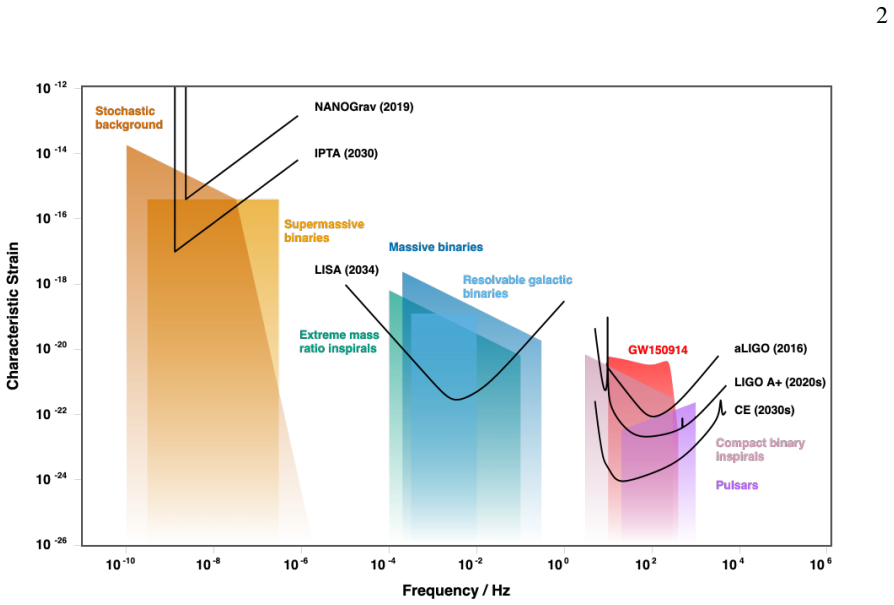
The Laser Interferometer Space Antenna (LISA) will open three decades of gravitational wave (GW) spectrum between 0.1 and 100 mHz, the mHz band. This band is expected to be the richest part of the GW spectrum, in types of sources, numbers of sources, signal-to-noise ratios and discovery potential. When LISA opens the low-frequency window of the gravitational wave spectrum, around 2034, the surge of gravitational-wave astronomy will strongly compel a subsequent mission to further explore the frequency bands of the GW spectrum that can only be accessed from space. The 2020s is the time to start developing technology and studying mission concepts for a large-scale mission to be launched in the 2040s. The mission concept would then be proposed to Astro2030. Only space based missions can access the GW spectrum between 10 nHz and 1 Hz because of the Earths seismic noise. This white paper surveys the science in this band and mission concepts that could accomplish that science. The proposed small scale activity is a technology development program that would support a range of concepts and a mission concept study to choose a specific mission concept for Astro2030. In this white paper, we will refer to a generic GW mission beyond LISA as bLISA.
Editorial analysis
A structured set of objections, weighed in public.
Referee Report
Summary. The manuscript is a white paper arguing that LISA will open the mHz gravitational-wave band around 2034, creating a surge in discoveries that will compel a follow-on space-based mission (bLISA) to explore the 10 nHz–1 Hz portion of the spectrum accessible only from space. It surveys science opportunities and mission concepts in this band and recommends a small-scale technology development program in the 2020s to prepare a specific concept for Astro2030, targeting launch in the 2040s.
Significance. If LISA’s projected source richness materializes, the paper supplies useful strategic framing for the subsequent phase of space-based GW astronomy by correctly noting the unique access to the cited frequency range and by advocating early technology maturation for long-lead missions. Its contribution is primarily in policy and planning rather than new quantitative results or derivations.
minor comments (1)
- [Abstract] Abstract: the introduction of bLISA as a generic label is clear, but the text would benefit from an explicit statement of how the generic term relates to the specific mission concepts surveyed later in the document.
Simulated Author's Rebuttal
We thank the referee for their constructive review and recommendation of minor revision. We appreciate the recognition that the manuscript provides useful strategic framing for post-LISA space-based gravitational-wave astronomy.
Circularity Check
No significant circularity; survey white paper with no derivations
full rationale
This is a policy-oriented white paper surveying expected science from LISA and advocating technology development for a follow-on mission (bLISA). It advances no equations, quantitative predictions, fitted parameters, or derivations. The central claim is a forward-looking recommendation that LISA results will motivate a subsequent mission, supported by external astrophysical expectations rather than any self-referential construction. No self-citation load-bearing steps, ansatzes, or uniqueness theorems appear. The timing assumption for the 2020s is an explicit policy premise, not a hidden reduction inside a derivation. The paper is self-contained as a survey and scores at the low end of the allowed range.
Axiom & Free-Parameter Ledger
Forward citations
Cited by 7 Pith papers
-
Primary gravitational waves at high frequencies II: Emergence of the exponential cut-off in the power spectrum
For infinitely differentiable effective potentials describing the post-inflation transition, the regularized power spectrum of primary gravitational waves exhibits exponential suppression at small scales.
-
Demonstration of a compact optical resonator-based displacement sensing technique with sub-femtometer precision
A centimeter-scale dynamic optical cavity with heterodyne readout achieves sub-femtometer per square root Hertz displacement sensitivity above 8 Hz and tracks motions over ten orders of magnitude in range.
-
The new generation lunar gravitational wave detectors: sky map resolution and joint analysis
CIGO and TCIGO lunar detectors achieve superior sky localization for 0.1-10 Hz gravitational waves compared to TianQin and LISA when noise mitigation succeeds, with TCIGO offering five-fold improvement.
-
Primary gravitational waves at high frequencies I: Origin of suppression in the power spectrum
Adiabatic regularization combined with smoothed transitions suppresses the high-frequency oscillations in the power spectrum of primary gravitational waves about a zero mean.
-
Unveiling the Gravitational Universe at \mu-Hz Frequencies
Proposal for a μ-Hz space-based gravitational wave interferometer to observe massive black hole binaries in early inspiral and low-frequency galactic binaries.
-
Statistic threshold of distinguishing the environmental effects and modified theory of gravity with multiple massive black-hole binaries
The paper derives statistic thresholds to distinguish dynamical friction from dark matter spikes, extra dimension theory, and varying G theory using -4 PN order GW corrections in massive black hole binary inspirals ac...
-
The Early Career Workshop of GR-Amaldi 2025
The paper reports on the aims, activities, and conclusions of an early-career workshop focused on scientific overviews, transferable skills, and networking in gravitational physics.
Reference graph
Works this paper leans on
-
[1]
The LISA proposal is available at https://www.elisascience.org/files/publications/LISA L3 20170120.pdf
-
[2]
J. Aasi et al. (LIGO Scientific Collaboration), Advanced LIGO, Classical and Quantum Gravity, V ol- ume 32, Number 7 (2015)
work page 2015
-
[3]
B. P. Abbott et al. (LIGO Scientific Collaboration and Virgo Collaboration), GW150914: First results from the search for binary black hole coalescence with Advanced LIGO, Phys. Rev. D 93, 122003 (2016)
work page 2016
-
[4]
B. P. Abbott et al. (LIGO Scientific Collaboration and Virgo Collaboration), GW170817: Observation of Gravitational Waves from a Binary Neutron Star Inspiral, Phys. Rev. Lett. 119, 161101
-
[5]
Christopher J. Moore, Robert H. Cole, Christopher P. L. Berry, Gravitational-wave sensitivity curves, Classical and Quantum Gravity, V olume 32, Number 1
- [6]
-
[7]
G. Anderson, J. Anderson, M. Anderson, G. Aveni, D. Bame, P. Barela, K. Blackman, A. Carmain, L. Chen, and M. Cherng. Experimental results from the ST7 mission on LISA Pathfinder. Phys. Rev. D, 98(10):102005 (2018)
work page 2018
- [8]
- [9]
- [10]
- [11]
-
[12]
Verbiest, J. P. W., Lentati, L., Hobbs, G. et al., The International Pulsar Timing Array: First data release, MNRAS, 458, 1267 (2016)
work page 2016
-
[13]
KAGRA collaboration, KAGRA: 2.5 generation interferometric gravitational wave detector, Nature Astronomy 3, pages 35–40 (2019)
work page 2019
-
[14]
Punturo, M. et al. The Einstein Telescope: a third-generation gravitational wave observatory. Class. Quantum Gravity 27, 194002 (2010)
work page 2010
-
[15]
B. Abbott et al. for the LIGO Science Collaboration, Exploring the sensitivity of next generation gravitational wave detectors, Classical and Quantum Gravity, V olume 34, Number 4 (2017)
work page 2017
-
[16]
E. S. Phinney et al., Big Bang Observer, NASA Mission Concept Study, 2003
work page 2003
- [17]
-
[18]
P. L. Bender, M. C. Begelman and J. R. Gair, ”Possible LISA follow-on mission scientific objectives”, Class. Quantum Grav. 30, 165017 (2013)
work page 2013
-
[19]
Available at https://www.lisa.nasa.gov/documentsReference.html
Gravitational-Wave Community Science Team, Gravitational-Wave Core Team and Gravitational- Wave Science Task Force, Gravitational-Wave Mission Concept Study Final Report, August 9, 2012. Available at https://www.lisa.nasa.gov/documentsReference.html
work page 2012
-
[20]
Sean McWilliams, Geostationary Antenna for Disturbance-Free Laser Interferometry (GADFLI), arXiv:1111.3708 [astro-ph.IM]
work page internal anchor Pith review Pith/arXiv arXiv
-
[21]
M. Tinto, Jose C.N. de Araujo, Coherent observations of gravitational radiation with LISA and gLISA, Phys. Rev. D 94, 081101(R) (2016) 12
work page 2016
-
[22]
Martin Hewitson, Ewan Fitzsimons, Bill Weber, LISA Performance Model and Error Budget, LISA- LCST-INST-TN-003
discussion (0)
Sign in with ORCID, Apple, or X to comment. Anyone can read and Pith papers without signing in.