Closed-form solutions of spinning, eccentric binary black holes at 1.5 post-Newtonian order
Pith reviewed 2026-05-24 10:26 UTC · model grok-4.3
The pith
This paper derives two closed-form solutions for the 1.5 post-Newtonian dynamics of binary black holes with arbitrary masses, spins, and eccentricity.
A machine-rendered reading of the paper's core claim, the machinery that carries it, and where it could break.
Core claim
By merging the direct integration method without action-angle variables and the action-angle variable method, the paper obtains two distinct closed-form solutions for the 1.5PN binary black hole Hamiltonian that remain valid for arbitrary mass ratios, spin vectors, and orbital eccentricity.
What carries the argument
The 1.5PN binary black hole Hamiltonian, integrated via combined non-action-angle and action-angle techniques to yield explicit time-dependent solutions for orbital elements and spins.
If this is right
- The solutions enable direct computation of gravitational waveforms from eccentric spinning binaries without numerical orbit integration.
- Numerical agreement between the two solutions verifies the five action variables constructed in the action-angle framework.
- The solutions provide an explicit starting point for applying canonical perturbation theory at the next order.
- A public implementation allows immediate use and cross-checks against full numerical evolution of the same system.
Where Pith is reading between the lines
- These expressions could reduce the computational cost of template banks for eccentric signals in current and future detectors.
- Extending the same combination technique might systematically reach 2PN order without new conceptual obstacles.
- The closed forms could serve as test cases for checking consistency of other post-Newtonian resummation schemes.
Load-bearing premise
That filling the identified gaps between the two earlier solution methods produces no missing interaction terms or inconsistencies precisely at 1.5PN order.
What would settle it
A high-precision numerical integration of the 1.5PN equations of motion that produces trajectories differing from either closed-form solution beyond numerical error.
Figures



read the original abstract
The closed-form solution of the 1.5 post-Newtonian (PN) accurate binary black hole (BBH) Hamiltonian system has proven to be difficult to obtain for a long time since its introduction in 1966. Closed-form solutions of the PN BBH systems with arbitrary parameters (masses, spins, eccentricity) are required for modeling the gravitational waves (GWs) emitted by them. Accurate models of GWs are crucial for their detection by LIGO/Virgo and LISA. Only recently, two solution methods for solving the BBH dynamics were proposed in arXiv:1908.02927 (without using action-angle variables), and arXiv:2012.06586, arXiv:2110.15351 (action-angle based). This paper combines the ideas laid out in the above articles, fills the missing gaps and provides the two solutions which are fully 1.5PN accurate. We also present a public Mathematica package BBHpnToolkit which implements these two solutions and compares them with a fully numerical treatment. The level of agreement between these solutions provides a numerical verification for all the five actions constructed in arXiv:2012.06586, and arXiv:2110.15351. This paper hence serves as a stepping stone for pushing the action-angle-based solution to 2PN order via canonical perturbation theory.
Editorial analysis
A structured set of objections, weighed in public.
Referee Report
Summary. The manuscript claims to deliver two fully 1.5PN accurate closed-form solutions for the Hamiltonian dynamics of spinning, eccentric binary black holes with arbitrary masses by combining the non-action-angle method of arXiv:1908.02927 with the action-angle approaches of arXiv:2012.06586 and arXiv:2110.15351. It identifies and fills gaps in prior work, supplies a public Mathematica package BBHpnToolkit implementing the solutions, and demonstrates agreement with direct numerical integration of the 1.5PN system, thereby verifying the five actions constructed in the earlier action-angle papers.
Significance. If the closed-form expressions are correct at 1.5PN order, the work is significant for gravitational-wave astronomy as it enables analytic modeling of waveforms from eccentric, spinning binaries, which are relevant for LIGO/Virgo and future LISA detections. The provision of reproducible code and numerical verification constitutes a strength, offering an independent check on the completeness of the 1.5PN terms. This also lays groundwork for extending to 2PN via canonical perturbation theory.
minor comments (3)
- [Abstract] The abstract states that the solutions are 'fully 1.5PN accurate' but does not specify the exact functional form (e.g., whether the radial motion is expressed via elliptic integrals or other special functions) or the precise manner in which the two solutions differ.
- A dedicated section or table quantifying the maximum relative error between the closed-form solutions and the numerical integration (as a function of eccentricity, spin magnitude, and mass ratio) would strengthen the verification claim.
- [Introduction] The manuscript would benefit from an explicit statement, perhaps in the introduction, of which specific terms or cross terms were missing in each of the cited prior works and how they are now included.
Simulated Author's Rebuttal
We thank the referee for their positive assessment of the manuscript and for recommending minor revision. We appreciate the recognition of the work's significance for gravitational-wave astronomy, the value of the public BBHpnToolkit package, and its role in verifying the actions from prior papers.
Circularity Check
No significant circularity identified
full rationale
The paper constructs its closed-form solutions by combining the known 1.5PN Hamiltonian with methods from cited prior works (arXiv:1908.02927 and the action-angle papers), explicitly filling gaps, and then validates the results via direct comparison to independent numerical integration of the full 1.5PN system using a public Mathematica package. This numerical check is external and falsifiable. The agreement is presented as verification of the prior actions rather than an assumption, and no step reduces by construction to a self-definition, fitted input renamed as prediction, or load-bearing self-citation chain. The derivation remains self-contained against external benchmarks.
Axiom & Free-Parameter Ledger
axioms (1)
- domain assumption The 1.5PN Hamiltonian for spinning eccentric binary black holes is correctly given by the expressions in the cited prior literature.
Forward citations
Cited by 2 Pith papers
-
Analytical Solution of Spinning, Eccentric Binary Black Hole Dynamics at the Second Post-Newtonian Order
An analytical 2PN solution is constructed for the orbital and spin dynamics of eccentric, arbitrarily spinning binary black holes, with spin oscillations retained only at 1.5PN accuracy.
-
Action-angle variables of a binary black hole with arbitrary eccentricity, spins, and masses at 1.5 post-Newtonian order
Derives the fifth action for 1.5PN BBH with arbitrary eccentricity, spins, and masses, completing action-angle variables for analytical dynamics solution.
Reference graph
Works this paper leans on
-
[1]
[17] but with the 1PN terms included
Re-present the solution of Ref. [17] but with the 1PN terms included. We will call it the Standard Solution
-
[2]
Present a systematic procedure to construct the AA- based solution. As we will see later, the construction of the AA-based solution requires the Standard Solution as one of the inputs
-
[3]
Makeavailable BBHpnToolkit, apublic Mathemat- ica package [21] which (1) implements the Standard Solution, the AA-based solution, and the numerical solution (2) gives the numerical values of all five frequencies (rate of increase of the angle variables) of a given BBH system, (3) computes the Poisson brackets (PBs) between any two functions of the phase-s...
-
[4]
With this, we also have in our hands the value of⃗ p·ˆr, which will be used in the next step
From Eqs.(66) and (67), determinep2 or p, which takes care of the magnitude of⃗ p. With this, we also have in our hands the value of⃗ p·ˆr, which will be used in the next step. What now remains is to determine the azimuthal angle of⃗ pin the NIF
-
[5]
Next we compute the angleϕoffset, which is defined as ϕoffset = arcsin L(t) r(t)p(t) if ⃗ p·ˆr> 0, ϕoffset =π−arcsin L(t) r(t)p(t) if ⃗ p·ˆr< 0. (75)
-
[6]
This completes the specification of ⃗P
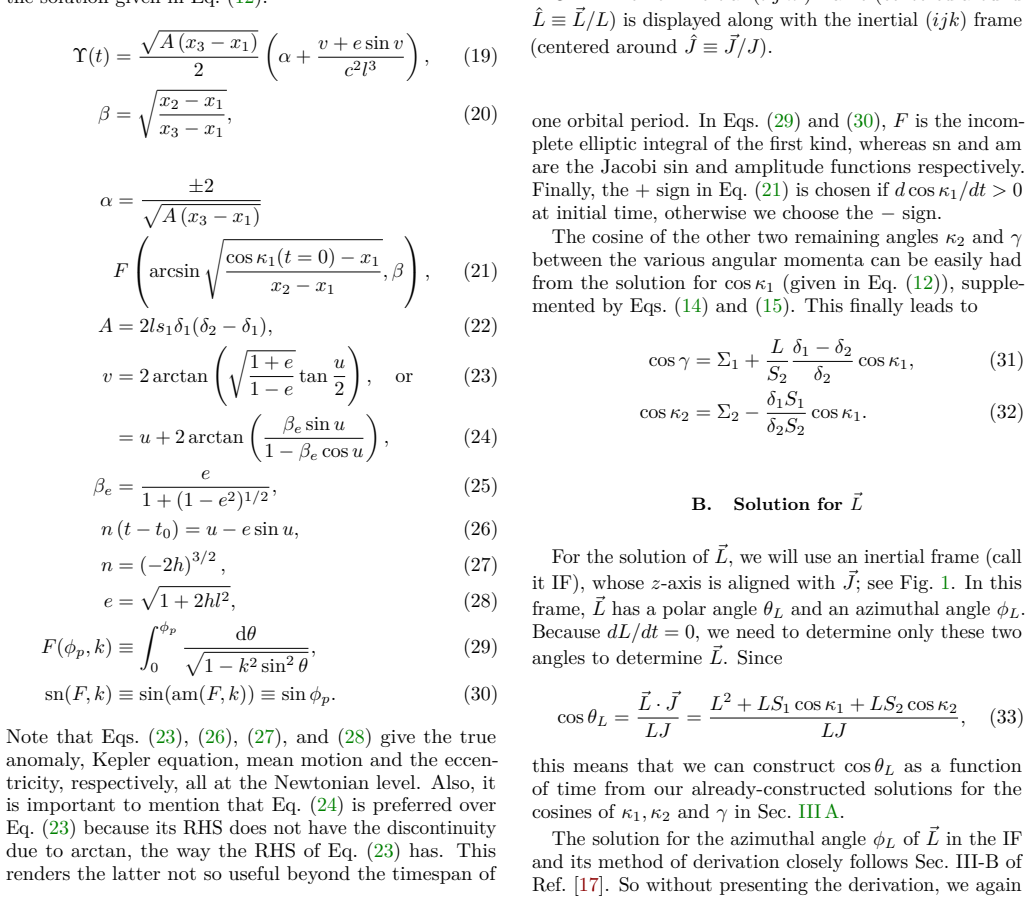
Now it is a simple matter to see that the azimuthal angle that⃗ pmakes with thex-axis of the NIF is ϕ+ϕoffset, whereϕis the azimuthal angle of⃗ rin the NIF andϕoffset is the relative azimuthal angle between⃗ rand ⃗ p. This completes the specification of ⃗P. IV. ACTION-ANGLE BASED SOLUTION We devote this section to explaining our construction of an alterna...
-
[7]
These constants are ⃗C = {J,Jz,L,H,S eff·L}
The phase space of the 1.5PN system is 10 di- mensional (since spin magnitudes are constants) and has five mutually commuting constants, resulting in an integrable system. These constants are ⃗C = {J,Jz,L,H,S eff·L}. We thus have five action variables ⃗J = {J1 =J,J2 =Jz,J3 =L,J4,J5}, which can be found in Refs. [18] and [19]; their notations and defi- nit...
-
[8]
Under the real-time evolution of the BBH system, the angles change as∆θi = ωit′, t′= tGM being the physical time;ωi’s are naturally called the frequencies of the system and are constants since they are functions of the action variables, which are themselves constants. Sec. VI-A of Ref. [19] shows how to compute the five frequencies. The process mainly con...
-
[9]
Let all the phase space variables be collectively denoted by⃗V = { ⃗R,⃗P, ⃗S1,⃗S2 } with their initial values being ⃗V0≡⃗V (t′= 0). Suppose that ⃗V0 represents the state of the system att′= 0, and we want to obtain⃗V (t′) at any non-zero timet′
-
[10]
Then at the final timet′, the angles of the system would have become ⃗θ=⃗ ω×t′
Att′= 0, assign all the angle variables of the system to have the value equal to 0;⃗θ(t′= 0) = ⃗0. Then at the final timet′, the angles of the system would have become ⃗θ=⃗ ω×t′. The problem of finding the state of the system att′now becomes that of increasing all the angle variables by⃗ ω×t′
-
[11]
As shown in Sec VI-B of Ref. [19], the angleθi can be increased by a certain amount if we flow under the corresponding actionJi by the same amount. Therefore the problem becomes that of flowing under the actionsJi by amountsωit′(starting from the⃗V0 configuration). The order of flows does not matter because just like all the members of⃗C, all the actions ...
-
[12]
Again, we can flow under the commuting constantsCj’s in any order, since they all mutually commute
Because the flow equation under the actions reads d⃗V dλ= { ⃗V,Ji(⃗C) } = { ⃗V,C j } ∂Ji ∂Cj , (76) a flow under an actionJi by ∆λi can be achieved by flow- ing under all the commuting constantsCj’s by respective amounts (∂Ji/∂Cj)∆λi. Again, we can flow under the commuting constantsCj’s in any order, since they all mutually commute. This finally breaks do...
-
[13]
III ob- tained by integrating the flow under the Hamilto- nian
Implements the Standard Solution of Sec. III ob- tained by integrating the flow under the Hamilto- nian
-
[14]
Implements the action-angle-based solution of Sec. IV
-
[15]
Provides the numerical solution of the system by numerically integrating the EOMs
-
[16]
Provides numerical values of all five frequencies of the system, wherein by frequency we refer to the rates of change of the five angles (as in action-angle variables) of the system. For the reference of the future users of ourMathematica package, we mention herein that we have retained some unnecessary high PN terms in the coded expressions which impleme...
work page 2000
-
[17]
Solution for flow under H The solution of flow underH has been constructed in Sec. III. It is mainly contained in Eqs.(12), (34), (41), (47), (72), and (75)
-
[18]
[19]; it is mainly contained in Eqs
Solution for flow under Seff· L The solution of flow underSeff·L has been constructed in Ref. [19]; it is mainly contained in Eqs. (A39), (A66), (A76) and (A102) of that article. These four equations seem to determine only⃗R,⃗L, and⃗S1, and not⃗S2 and ⃗P. But once we have⃗R,⃗L, and ⃗S1, determining ⃗S2 and ⃗P is quite easy. The former is found via⃗S2 = ⃗J...
-
[19]
Solution for flow under J As arrived at in Sec. VI-B of Ref. [19], the effect of a flow underJ by an amount∆λis increasing the azimuthal angles of⃗R,⃗P, ⃗S1, and ⃗S2 in the IF by an amount∆λ
-
[20]
Solution for flow under L As also arrived at in Sec. VI-B of Ref. [19], the effect of a flow underL by an amount ∆λis increasing the azimuthal angles of⃗R, and⃗P in the NIF by an amount ∆λ. 13
-
[21]
Solution for flow under Jz As seen in Sec. VI-B of Ref. [19], the effect of a flow under Jz by an amount∆λis increasing the azimuthal angles of⃗R,⃗P, ⃗S1, and ⃗S2 by an amount∆λ, around the z-axis of any inertial frame. IF is a special inertial frame whose z-axis coincides with⃗J. Appendix B: TheBBHpnToolkit package Here we give the details on some coded ...
-
[22]
B. Abbott et al. (LIGO Scientific, Virgo), GWTC-1: A Gravitational-Wave Transient Catalog of Compact Binary Mergers Observed by LIGO and Virgo during the First and Second Observing Runs, Phys. Rev. X9, 031040 (2019), arXiv:1811.12907 [astro-ph.HE]
work page internal anchor Pith review Pith/arXiv arXiv 2019
-
[23]
R. Abbottet al. (LIGO Scientific, Virgo), GWTC-2: Com- pact Binary Coalescences Observed by LIGO and Virgo During the First Half of the Third Observing Run, (2020), arXiv:2010.14527 [gr-qc]
work page internal anchor Pith review Pith/arXiv arXiv 2020
-
[24]
B. P. Abbottet al. (LIGO Scientific, Virgo), GW170817: Observation of Gravitational Waves from a Binary Neu- tron Star Inspiral, Phys. Rev. Lett.119, 161101 (2017), arXiv:1710.05832 [gr-qc]
work page internal anchor Pith review Pith/arXiv arXiv 2017
-
[25]
Post-Newtonian Theory for Gravitational Waves
L. Blanchet, Gravitational Radiation from Post- Newtonian Sources and Inspiralling Compact Binaries, Living Rev. Rel.17, 2 (2014), arXiv:1310.1528 [gr-qc]
work page internal anchor Pith review Pith/arXiv arXiv 2014
-
[26]
G. Schäfer and P. Jaranowski, Hamiltonian formula- tion of general relativity and post-Newtonian dynam- ics of compact binaries, Living Rev. Rel.21, 7 (2018), arXiv:1805.07240 [gr-qc]
-
[27]
T. Damour and N. Deruelle, General relativistic celes- tial mechanics of binary systems. I. The post-Newtonian motion., Ann. Inst. Henri Poincaré Phys. Théor43, 107 (1985)
work page 1985
-
[28]
B. M. Barker, S. N. Gupta, and R. D. Haracz, One- Graviton Exchange Interaction of Elementary Particles, Phys. Rev.149, 1027 (1966)
work page 1966
-
[29]
S. Tiwari, A. Gopakumar, M. Haney, and P. Heman- takumar, Ready-to-use Fourier domain templates for com- pact binaries inspiraling along moderately eccentric orbits, Phys. Rev. D99, 124008 (2019), arXiv:1905.07956 [gr-qc]
work page internal anchor Pith review Pith/arXiv arXiv 2019
-
[30]
Effective potentials and morphological transitions for binary black-hole spin precession
M. Kesden, D. Gerosa, R. O’Shaughnessy, E. Berti, and U. Sperhake, Effective Potentials and Morphological Tran- sitions for Binary Black Hole Spin Precession, Phys. Rev. Lett. 114, 081103 (2015), arXiv:1411.0674 [gr-qc]
work page internal anchor Pith review Pith/arXiv arXiv 2015
-
[31]
Multi-timescale analysis of phase transitions in precessing black-hole binaries
D. Gerosa, M. Kesden, U. Sperhake, E. Berti, and R. O’Shaughnessy, Multi-timescale analysis of phase tran- sitions in precessing black-hole binaries, Phys. Rev. D92, 064016 (2015), arXiv:1506.03492 [gr-qc]
work page internal anchor Pith review Pith/arXiv arXiv 2015
-
[32]
I.Hinder, L.E.Kidder,andH.P.Pfeiffer,Eccentricbinary black hole inspiral-merger-ringdown gravitational wave- form model from numerical relativity and post-Newtonian theory, Phys. Rev. D98, 044015 (2018), arXiv:1709.02007 [gr-qc]
work page internal anchor Pith review Pith/arXiv arXiv 2018
-
[33]
Constructing Gravitational Waves from Generic Spin-Precessing Compact Binary Inspirals
K. Chatziioannou, A. Klein, N. Yunes, and N. Cor- nish, Constructing gravitational waves from generic spin- precessing compact binary inspirals, Phys. Rev. D95, 104004 (2017), arXiv:1703.03967 [gr-qc]
work page internal anchor Pith review Pith/arXiv arXiv 2017
-
[34]
Spin effects in the phasing of gravitational waves from binaries on eccentric orbits
A. Klein and P. Jetzer, Spin effects in the phasing of gravitational waves from binaries on eccentric orbits, Phys. Rev. D81, 124001 (2010), arXiv:1005.2046 [gr-qc]
work page internal anchor Pith review Pith/arXiv arXiv 2010
-
[35]
Fourier domain gravitational waveforms for precessing eccentric binaries
A. Klein, Y. Boetzel, A. Gopakumar, P. Jetzer, and L. de Vittori, Fourier domain gravitational waveforms for pre- cessing eccentric binaries, Phys. Rev. D98, 104043 (2018), arXiv:1801.08542 [gr-qc]
work page internal anchor Pith review Pith/arXiv arXiv 2018
-
[36]
C. Konigsdorffer and A. Gopakumar, Phasing of gravi- tational waves from inspiralling eccentric binaries at the third-and-a-half post-Newtonian order, Phys. Rev. D73, 124012 (2006), arXiv:gr-qc/0603056
work page internal anchor Pith review Pith/arXiv arXiv 2006
-
[37]
C. Konigsdorffer and A. Gopakumar, Post-Newtonian accurate parametric solution to the dynamics of spinning compact binaries in eccentric orbits: The Leading order spin-orbit interaction, Phys. Rev. D71, 024039 (2005), arXiv:gr-qc/0501011
work page internal anchor Pith review Pith/arXiv arXiv 2005
- [39]
- [40]
-
[41]
S. Tanay, Integrability and action-angle-based solution of the post-Newtonian BBH system (lecture notes) (2022) arXiv:2206.05799 [gr-qc]. 14
-
[42]
https://github.com/sashwattanay/BBH-PN-Toolkit (2022)
work page 2022
- [43]
- [44]
- [45]
-
[46]
J. José and E. Saletan,Classical Dynamics: A Contem- porary Approach (Cambridge University Press, 1998)
work page 1998
-
[47]
A. Gopakumar and G. Schafer, Gravitational wave phas- ing for spinning compact binaries in inspiraling eccentric orbits, Phys. Rev.D84, 124007 (2011)
work page 2011
-
[48]
H. Goldstein, C. Poole, and J. Safko,Classical Mechanics (Pearson, 2013)
work page 2013
-
[49]
T. Damour and G. Schafer, Higher-order relativistic peri- astron advances and binary pulsars., Nuovo Cimento B Serie 101B, 127 (1988)
work page 1988
- [50]
discussion (0)
Sign in with ORCID, Apple, or X to comment. Anyone can read and Pith papers without signing in.