Quantum Algorithms for Simulating Nuclear Effective Field Theories
Pith reviewed 2026-05-24 05:13 UTC · model grok-4.3
The pith
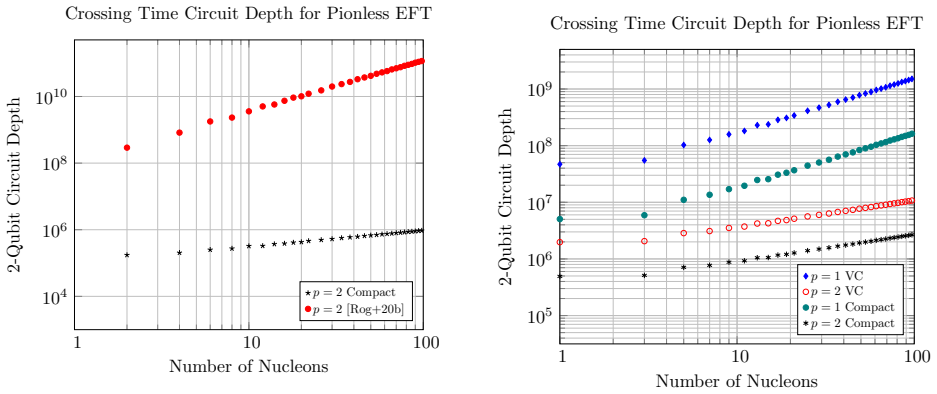
Simulating low-energy nuclear effective field theories on quantum computers requires qubit and gate counts improved by several orders of magnitude over prior estimates, with the pionless EFT being the least costly.
A machine-rendered reading of the paper's core claim, the machinery that carries it, and where it could break.
Core claim
Within the nuclear lattice EFT framework, the leading-order pionless EFT is the least costly to simulate, followed by the one-pion-exchange theory and then the dynamical-pion theory. Resource costs are estimated for time evolution and energy estimation at physically relevant scales, accounting for truncation errors in long-range interactions or the pionic Hilbert space and algorithmic errors from product-formula approximations and quantum phase estimation. Symmetries of the low-energy nuclear Hamiltonians are utilized to obtain tighter error bounds. By retaining the locality of nucleonic interactions when mapped to qubits, reduced circuit depth and substantial parallelization are achieved. T
What carries the argument
Hamiltonian simulation with product formulas and quantum phase estimation, using symmetries and locality-preserving mappings of fermionic interactions to obtain tighter Trotter and overall error bounds.
If this is right
- The pionless EFT requires the fewest qubits and gates among the three models.
- Retaining locality of interactions on qubits enables substantial parallelization and shallower circuits.
- Explicit computation of nested commutators yields tighter Trotter error bounds than standard estimates.
- Symmetries of the Hamiltonians produce improved error bounds for both time evolution and energy estimation.
- Dynamical pions incur the highest costs because of the additional bosonic field degrees of freedom.
Where Pith is reading between the lines
- These improved scalings could be used to set concrete targets for qubit counts and coherence times in hardware designed for nuclear many-body problems.
- The locality-preserving mapping technique might be applied directly to other fermionic lattice models outside nuclear physics.
- If the error bounds remain valid at larger system sizes, certain nuclear reaction rates previously inaccessible to classical computation could become simulable on intermediate-scale quantum devices.
Load-bearing premise
The chosen physical scales, truncation cutoffs for long-range interactions or pionic Hilbert space, and the validity of the leading-order EFTs themselves do not introduce errors that would invalidate the reported resource scalings.
What would settle it
An explicit gate-count calculation or small-scale simulation of a low-energy nuclear process whose measured resource requirement exceeds the paper's estimated scaling by more than one order of magnitude.
Figures




read the original abstract
Quantum computers offer the potential to simulate nuclear processes that are classically intractable. With the goal of understanding the necessary quantum resources to realize this potential, we employ state-of-the-art Hamiltonian-simulation methods, and conduct a thorough algorithmic analysis, to estimate the qubit and gate costs to simulate low-energy effective field theories (EFTs) of nuclear physics. Within the framework of nuclear lattice EFT, we obtain simulation costs for the leading-order pionless and pionful EFTs. For the latter, we consider both static pions represented by a one-pion-exchange potential between the nucleons, and dynamical pions represented by relativistic bosonic fields coupled to non-relativistic nucleons. Within these models, we examine the resource costs for the tasks of time evolution and energy estimation for physically relevant scales. We account for model errors associated with truncating either long-range interactions in the one-pion-exchange EFT or the pionic Hilbert space in the dynamical-pion EFT, and for algorithmic errors associated with product-formula approximations and quantum phase estimation. We find that the pionless EFT is the least costly to simulate, followed by the one-pion-exchange theory, then the dynamical-pion theory. We demonstrate how symmetries of the low-energy nuclear Hamiltonians can be utilized to obtain tighter error bounds. By retaining the locality of nucleonic interactions when mapped to qubits, we achieve reduced circuit depth and substantial parallelization. In the process, we develop new methods to bound the algorithmic error for classes of fermionic number-preserving Hamiltonians, and obtain tighter Trotter error bounds by explicitly computing nested commutators of Hamiltonian terms. Compared to previous estimates for the pionless EFT, our results represent an improvement by several orders of magnitude.
Editorial analysis
A structured set of objections, weighed in public.
Referee Report
Summary. The manuscript estimates qubit and gate costs for quantum simulation of leading-order nuclear lattice EFTs (pionless, static one-pion-exchange, and dynamical-pion) using product formulas and quantum phase estimation. It accounts for model truncation errors and algorithmic errors, derives new Trotter bounds via explicit nested commutators for number-preserving fermionic Hamiltonians, exploits symmetries and locality for tighter bounds and parallelization, and claims several orders-of-magnitude resource improvement over prior pionless-EFT estimates.
Significance. If the resource numbers and fair comparison hold, the work supplies concrete, improved feasibility estimates for nuclear EFT simulation and introduces reusable techniques for bounding Trotter error in local fermionic Hamiltonians; the explicit commutator calculations and retention of interaction locality are concrete strengths that could be adopted more broadly.
major comments (2)
- [Abstract] Abstract: the central claim of 'an improvement by several orders of magnitude' relative to previous pionless-EFT estimates is load-bearing for the paper's contribution; however, no side-by-side table or explicit matching argument is provided for lattice spacing, spatial volume, nucleon number, target accuracy, or truncation cutoffs, leaving open the possibility that part of the reported reduction arises from a redefinition of the physical problem instance rather than algorithmic advance alone.
- [Abstract / model-error discussion] Model-error paragraph (abstract and corresponding methods section): the statement that 'model errors associated with truncating either long-range interactions... or the pionic Hilbert space' are accounted for is central to validating the final resource scalings, yet the manuscript does not show how the chosen cutoffs propagate into the quoted gate counts or whether they are stricter, equal, or looser than those used in the referenced prior estimates.
minor comments (2)
- [Throughout] Notation for lattice parameters (a, L, N) should be introduced once with a dedicated table and used uniformly in all resource formulas and numerical examples.
- [Figures] Figure captions for resource plots should explicitly state the physical scales (volume, nucleon number, target precision) used in each curve.
Simulated Author's Rebuttal
We thank the referee for the careful review and constructive feedback. The comments correctly identify areas where explicit comparisons to prior work can be strengthened for clarity. We address each point below and will revise the manuscript accordingly.
read point-by-point responses
-
Referee: [Abstract] Abstract: the central claim of 'an improvement by several orders of magnitude' relative to previous pionless-EFT estimates is load-bearing for the paper's contribution; however, no side-by-side table or explicit matching argument is provided for lattice spacing, spatial volume, nucleon number, target accuracy, or truncation cutoffs, leaving open the possibility that part of the reported reduction arises from a redefinition of the physical problem instance rather than algorithmic advance alone.
Authors: We agree that an explicit side-by-side comparison would eliminate ambiguity. In the revised manuscript we will add a table (main text or appendix) that matches lattice spacing, spatial volume, nucleon number, target accuracy, and truncation cutoffs between our pionless-EFT estimates and the referenced prior work. The table will be accompanied by text clarifying that the reported orders-of-magnitude reduction originates from the new symmetry-based Trotter bounds, explicit nested-commutator calculations, and locality-preserving qubit mapping rather than from altered problem definitions. revision: yes
-
Referee: [Abstract / model-error discussion] Model-error paragraph (abstract and corresponding methods section): the statement that 'model errors associated with truncating either long-range interactions... or the pionic Hilbert space' are accounted for is central to validating the final resource scalings, yet the manuscript does not show how the chosen cutoffs propagate into the quoted gate counts or whether they are stricter, equal, or looser than those used in the referenced prior estimates.
Authors: We acknowledge that the propagation of the chosen cutoffs into the final gate counts should be shown explicitly. In the revision we will expand the methods section and add a short appendix subsection that derives or bounds how the long-range-interaction cutoff (one-pion-exchange EFT) and pionic-Hilbert-space truncation (dynamical-pion EFT) enter the resource estimates. Where data from prior estimates are available we will note whether our cutoffs are comparable, stricter, or adjusted for the specific models, thereby making the accounting for model error transparent. revision: yes
Circularity Check
Resource estimates derived via explicit commutator calculations and algorithmic constructions with no reduction to fitted inputs or self-definitional steps
full rationale
The paper performs explicit algorithmic analysis of Hamiltonian simulation costs for nuclear EFTs, including computation of nested commutators to tighten Trotter bounds, utilization of symmetries for error bounds, and retention of locality in qubit mappings. These steps are constructive and independent of the target resource numbers being estimated. The orders-of-magnitude improvement claim is a post-hoc comparison to external prior work rather than a derivation that reduces to the same data or parameters by construction. No self-citation chains, ansatzes smuggled via citation, or fitted inputs renamed as predictions appear in the load-bearing steps. The derivations remain self-contained against external benchmarks such as explicit error accounting and model truncations.
Axiom & Free-Parameter Ledger
free parameters (1)
- truncation cutoffs for long-range interactions or pionic Hilbert space
axioms (2)
- domain assumption Leading-order pionless and pionful nuclear lattice EFTs provide faithful low-energy descriptions of nuclear interactions at the scales considered
- standard math Standard Hamiltonian-simulation error bounds (product formulas, phase estimation) apply directly once the nuclear Hamiltonian is mapped to qubits
Forward citations
Cited by 9 Pith papers
-
Tightening energy-based boson truncation bound using Monte Carlo-assisted methods
A Monte Carlo-assisted analytic method tightens energy-based bounds on boson truncation errors, substantially reducing the volume dependence of the required cutoff in scalar and gauge theories.
-
Tightening energy-based boson truncation bound using Monte Carlo-assisted methods
Monte Carlo-assisted tightening of the energy-based boson truncation bound substantially reduces volume dependence in (1+1)D scalar field theory and (2+1)D U(1) gauge theory.
-
Fault-Tolerant Resource Comparison of Qudit and Qubit Encodings for Diagonal Quadratic Operators
Qudit encodings for quadratic diagonal evolutions require exponentially stronger synthesis advantages than qubits to win asymptotically in product formulas but can yield constant-factor savings in LCU at low d.
-
Systematic VQE Benchmarking of the Deuteron, Triton, and Helium-3 within Lattice Pionless Effective Field Theory
VQE applied to deuteron, triton, and helium-3 in lattice pionless EFT yields energies matching classical exact diagonalization after fitting two- and three-body constants, with a noisy simulation example for triton.
-
Quantum simulations of Green's functions for small superfluid systems
A hybrid quantum-classical method computes accurate Green's functions for the pairing model across the normal-to-superfluid transition by combining variational ground-state preparation with quantum subspace expansion ...
-
Fault-Tolerant Resource Comparison of Qudit and Qubit Encodings for Diagonal Quadratic Operators
The paper derives explicit finite-d break-even synthesis costs for qudit vs. qubit encodings of diagonal quadratic operators in product-formula and LCU simulations, identifying low-d regions where qudits yield savings.
-
Tightening energy-based boson truncation bound using Monte Carlo-assisted methods
New analytic and Monte Carlo-assisted method tightens energy-based boson truncation bounds, reducing volume dependence in (1+1)D scalar and (2+1)D U(1) gauge theories.
-
Quantum computing for effective nuclear lattice model
A VQE quantum-computing method for nuclear lattice models shows ground-state energies for 2H, 3H, and 4He approaching experimental values with increasing lattice size.
-
The Role of Quantum Computing in Advancing Scientific High-Performance Computing: A perspective from the ADAC Institute
A synthesis of expert insights from the ADAC Quantum Computing Working Group and member survey on the complementary roles of quantum and classical high-performance computing in future hybrid infrastructures.
Reference graph
Works this paper leans on
-
[1]
Theorem 48(One-Pion-Exchange Trotter Error Bound)
One-Pion-Exchange Bounds In this Appendix, we derive the𝑝 = 1Trotter error bounds for the OPE EFT Hamiltonian. Theorem 48(One-Pion-Exchange Trotter Error Bound). For the time evolution of the OPE EFT with a first-order product formula, P (OPE) 1 (𝑡) − 𝑒−𝑖𝑡 𝐻OPE 𝜂 ≤ 𝑡2 2 𝜁, where𝜁 is the sum of the bounds which are reported in the Lemmas noted in Table XVI...
-
[2]
Wethenpartition the terms as per the Trotter decomposition used
Dynamical-Pion Bounds Thedynamical-pioncaserequiresustodealwiththeexplicitrepresentationofthepions. Wethenpartition the terms as per the Trotter decomposition used. To this end,𝐻 𝜋 defined in Eq. (67) is split into two separate contributions: 𝐻 (1) 𝜋 B 𝐻Π2 = 𝑎𝐷 𝐿 2 ∑︁ x ∑︁ 𝐼 Π2 𝐼 (x), (G124) 𝐻 (2) 𝜋 B 𝐻(∇ 𝜋 )2 + 𝐻 𝜋2 = 𝑎𝐷−2 𝐿 2 ∑︁ x, 𝑗 ∑︁ 𝐼 𝜋𝐼 (x + 𝑎 𝐿 ˆn...
-
[3]
J. Carlson and W. Nazarewicz,Exascale Requirements Review for Nuclear Physics, Tech. Rep. (Lawrence Livermore National Lab.(LLNL), Livermore, CA (United States), 2016)
work page 2016
-
[4]
P. Bedaqueet al., A.I. for nuclear physics, Eur. Phys. J. A57, 100 (2021)
work page 2021
-
[5]
A. Boehnlein, M. Diefenthaler, N. Sato, M. Schram, V. Ziegler, C. Fanelli, M. Hjorth-Jensen, T. Horn, M. P. Kuchera, D. Lee, W. Nazarewicz, P. Ostroumov, K. Orginos, A. Poon, X.-N. Wang, A. Scheinker, M. S. Smith, and L.-G. Pang, Colloquium: Machine learning in nuclear physics, Rev. Mod. Phys.94, 031003 (2022)
work page 2022
-
[6]
Y. Aoki, T. Blum, G. Colangelo, S. Collins, M. D. Morte, P. Dimopoulos, S. Dürr, X. Feng, H. Fukaya, M. Golterman,et al., Flag review 2021, Eur. Phys. J. C82, 869 (2022)
work page 2021
-
[7]
Z. Davoudi, E. T. Neil, C. W. Bauer, T. Bhattacharya, T. Blum, P. Boyle, R. C. Brower, S. Catterall, N. H. Christ, V. Cirigliano,et al., Report of the snowmass 2021 topical group on lattice gauge theory, arXiv preprint arXiv:2209.10758 (2022)
-
[8]
Z. Davoudi, W. Detmold, P. Shanahan, K. Orginos, A. Parreno, M. J. Savage, and M. L. Wagman, Nuclear matrix elements from lattice QCD for electroweak and beyond-standard-model processes, Phys. Rep.900, 1 (2021)
work page 2021
-
[9]
C. Drischler, W. Haxton, K. McElvain, E. Mereghetti, A. Nicholson, P. Vranas, and A. Walker-Loud, Towards grounding nuclear physics in QCD, Prog. Part. Nucl. Phys.121, 103888 (2021)
work page 2021
-
[10]
J. Carlson, S. Gandolfi, F. Pederiva, S. C. Pieper, R. Schiavilla, K. Schmidt, and R. B. Wiringa, Quantum monte carlo methods for nuclear physics, Rev. Mod. Phys.87, 1067 (2015)
work page 2015
-
[11]
B. R. Barrett, P. Navrátil, and J. P. Vary, Ab initio no core shell model, Prog. Part. Nucl. Phys.69, 131 (2013)
work page 2013
- [12]
-
[13]
A. Carbone, A. Cipollone, C. Barbieri, A. Rios, and A. Polls, Self-consistent Green’s functions formalism with three-body interactions, Phys. Rev. C88, 054326 (2013)
work page 2013
-
[14]
H.Hergert,S.K.Bogner,T.D.Morris,A.Schwenk,andK.Tsukiyama,Thein-mediumsimilarityrenormalization group: A novel ab initio method for nuclei, Phys. Rep.621, 165 (2016)
work page 2016
-
[15]
T. A. Lähde and U.-G. Meißner,Nuclear lattice effective field theory: An introduction, Vol. 957 (Springer, 2019)
work page 2019
-
[16]
I. Tews, Z. Davoudi, A. Ekström, J. D. Holt, and J. E. Lynn, New ideas in constraining nuclear forces, J. Phys. G 47, 103001 (2020). 112
work page 2020
-
[17]
P. Navratil and S. Quaglioni, Ab initio nuclear reaction theory with applications to astrophysics, arXiv preprint arXiv:2204.01187 (2022)
-
[18]
L. A. Ruso, A. Ankowski, S. Bacca, A. Balantekin, J. Carlson, S. Gardiner, R. Gonzalez-Jimenez, R. Gupta, T. Hobbs, M. Hoferichter,et al., Theoretical tools for neutrino scattering: interplay between lattice QCD, EFTs, nuclear physics, phenomenology, and neutrino event generators, arXiv preprint arXiv:2203.09030 (2022)
-
[19]
K. D. Launey, A. Mercenne, and T. Dytrych, Nuclear dynamics and reactions in the ab initio symmetry-adapted framework, Annu. Rev. Nucl. Part. Sci.71, 253 (2021)
work page 2021
-
[20]
A. Faessler, G. L. Fogli, E. Lisi, V. Rodin, A. M. Rotunno, and F. Šimkovic, Quasiparticle random phase approximation uncertainties and their correlations in the analysis of0𝜈𝛽𝛽 decay, Phys. Rev. D79, 053001 (2009)
work page 2009
-
[21]
A. Arima and F. Iachello, The interacting boson model, Annu. Rev. Nucl. Part. Sci.31, 75 (1981)
work page 1981
- [22]
-
[23]
Y.YuandA.Bulgac,Energydensityfunctionalapproachtosuperfluidnuclei,Phys.Rev.Lett. 90,222501(2003)
work page 2003
-
[24]
A.Bulgac,S.Jin,andI.Stetcu,Nuclearfissiondynamics: past,present,needs,andfuture,Front.Phys.(Lausanne) , 63 (2020)
work page 2020
-
[25]
J. W. Negele, The mean-field theory of nuclear structure and dynamics, Rev. Mod. Phys.54, 913 (1982)
work page 1982
-
[26]
E.Caurier,G.Martínez-Pinedo,F.Nowacki,A.Poves,andA.Zuker,Theshellmodelasaunifiedviewofnuclear structure, Rev. Mod. Phys.77, 427 (2005)
work page 2005
- [27]
-
[28]
S. McArdle, S. Endo, A. Aspuru-Guzik, S. C. Benjamin, and X. Yuan, Quantum computational chemistry, Rev. Mod. Phys.92, 015003 (2020)
work page 2020
-
[29]
Y.Cao,J.Romero,J.P.Olson,M.Degroote,P.D.Johnson,M.Kieferová,I.D.Kivlichan,T.Menke,B.Peropadre, N. P. Sawaya,et al., Quantum chemistry in the age of quantum computing, Chem. Rev.119, 10856 (2019)
work page 2019
- [31]
-
[32]
V. von Burg, G. H. Low, T. Häner, D. S. Steiger, M. Reiher, M. Roetteler, and M. Troyer, Quantum computing enhanced computational catalysis, Phys. Rev. Research3, 033055 (2021)
work page 2021
-
[33]
L. Clinton, T. Cubitt, B. Flynn, F. M. Gambetta, J. Klassen, A. Montanaro, S. Piddock, R. A. Santos, and E. Sheridan, Towards near-term quantum simulation of materials, Nat. Commun.15, 211 (2024)
work page 2024
-
[34]
C. W. Bauer, Z. Davoudi, A. B. Balantekin, T. Bhattacharya, M. Carena, W. A. de Jong, P. Draper, A. El-Khadra, N.Gemelke,M.Hanada,D.Kharzeev,H.Lamm,Y.-Y.Li,J.Liu,M.Lukin,Y.Meurice,C.Monroe,B.Nachman, G. Pagano, J. Preskill, E. Rinaldi, A. Roggero, D. I. Santiago, M. J. Savage, I. Siddiqi, G. Siopsis, D. Van Zanten, N. Wiebe, Y. Yamauchi, K. Yeter-Aydeniz,...
work page 2023
-
[35]
S. Catterall, R. Harnik, V. E. Hubeny, C. W. Bauer, A. Berlin, Z. Davoudi, T. Faulkner, T. Hartman, M. Headrick, Y. F. Kahn,et al., Report of the snowmass 2021 theory frontier topical group on quantum information science, arXiv preprint arXiv:2209.14839 (2022)
- [36]
-
[37]
D. Becket al., Nuclear Physics and Quantum Information Science: Report by the NSAC QIS Subcommittee, Tech. Rep. (NSF & DOE Office of Science, 2019)
work page 2019
- [38]
-
[39]
C. W. Bauer, Z. Davoudi, N. Klco, and M. J. Savage, Quantum simulation of fundamental particles and forces, Nature Rev. Phys.5, 420 (2023)
work page 2023
-
[40]
N. C. Rubin, D. W. Berry, A. Kononov, F. D. Malone, T. Khattar, A. White, J. Lee, H. Neven, R. Babbush, and A. D. Baczewski, Quantum computation of stopping power for inertial fusion target design, Proceedings of the 113 National Academy of Sciences121, e2317772121 (2024)
work page 2024
- [41]
-
[42]
M. B. Hastings, D. Wecker, B. Bauer, and M. Troyer, Improving quantum algorithms for quantum chemistry, arXiv preprint arXiv:1403.1539 (2014)
work page internal anchor Pith review Pith/arXiv arXiv 2014
- [43]
-
[44]
R. Babbush, N. Wiebe, J. McClean, J. McClain, H. Neven, and G. K.-L. Chan, Low-depth quantum simulation of materials, Phys. Rev. X8, 011044 (2018)
work page 2018
-
[45]
A. Peruzzo, J. McClean, P. Shadbolt, M.-H. Yung, X.-Q. Zhou, P. J. Love, A. Aspuru-Guzik, and J. L. O’Brien, A variational eigenvalue solver on a photonic quantum processor, Nat. Commun.5, 4213 (2014)
work page 2014
-
[46]
J.R.McClean,J.Romero,R.Babbush,andA.Aspuru-Guzik,Thetheoryofvariationalhybridquantum-classical algorithms, New J. Phys.18, 023023 (2016)
work page 2016
-
[47]
P. J. O’Malley, R. Babbush, I. D. Kivlichan, J. Romero, J. R. McClean, R. Barends, J. Kelly, P. Roushan, A. Tranter, N. Ding,et al., Scalable quantum simulation of molecular energies, Phys. Rev. X6, 031007 (2016)
work page 2016
- [48]
-
[49]
Quantum computation algorithm for many-body studies
E. Ovrum and M. Hjorth-Jensen, Quantum computation algorithm for many-body studies, arXiv preprint arXiv:0705.1928 (2007)
work page internal anchor Pith review Pith/arXiv arXiv 1928
-
[50]
E. F. Dumitrescu, A. J. McCaskey, G. Hagen, G. R. Jansen, T. D. Morris, T. Papenbrock, R. C. Pooser, D. J. Dean, and P. Lougovski, Cloud quantum computing of an atomic nucleus, Phys. Rev. Lett.120, 210501 (2018)
work page 2018
-
[51]
A. Roggero and J. Carlson, Dynamic linear response quantum algorithm, Phys. Rev. C100, 034610 (2019), arXiv:1804.01505 [quant-ph]
-
[52]
A.Roggero,A.C.Li,J.Carlson,R.Gupta,andG.N.Perdue,Quantumcomputingforneutrino-nucleusscattering, Phys. Rev. D101, 074038 (2020)
work page 2020
-
[53]
A. Roggero, C. Gu, A. Baroni, and T. Papenbrock, Preparation of excited states for nuclear dynamics on a quantum computer, Phys. Rev. C102, 064624 (2020)
work page 2020
- [54]
-
[55]
K. Choi, D. Lee, J. Bonitati, Z. Qian, and J. Watkins, Rodeo algorithm for quantum computing, Phys. Rev. Lett. 127, 040505 (2021)
work page 2021
- [56]
-
[57]
E. T. Holland, K. A. Wendt, K. Kravvaris, X. Wu, W. E. Ormand, J. L. DuBois, S. Quaglioni, and F. Pederiva, Optimal control for the quantum simulation of nuclear dynamics, Phys. Rev. A101, 062307 (2020)
work page 2020
-
[58]
F. Turro, T. Chistolini, A. Hashim, Y. Kim, W. Livingston, J. M. Kreikebaum, K. A. Wendt, J. L. Dubois, F. Pederiva, S. Quaglioni, D. I. Santiago, and I. Siddiqi, Demonstration of a quantum-classical coprocessing protocol for simulating nuclear reactions, Phys. Rev. A108, 032417 (2023)
work page 2023
- [59]
- [60]
- [61]
-
[62]
W. Du, J. P. Vary, X. Zhao, and W. Zuo, Quantum simulation of nuclear inelastic scattering, Phys. Rev. A104, 012611 (2021)
work page 2021
- [63]
- [64]
-
[65]
A. Pérez-Obiol, A. Romero, J. Menéndez, A. Rios, A. García-Sáez, and B. Juliá-Díaz, Nuclear shell-model simulation in digital quantum computers, Sci. Rep.13, 12291 (2023)
work page 2023
-
[66]
C.E.P.RobinandM.J.Savage,Quantumsimulationsineffectivemodelspaces: Hamiltonian-learningvariational quantum eigensolver using digital quantum computers and application to the lipkin-meshkov-glick model, Phys. Rev. C108, 024313 (2023)
work page 2023
-
[67]
I. D. Kivlichan, N. Wiebe, R. Babbush, and A. Aspuru-Guzik, Bounding the costs of quantum simulation of many-body physics in real space, J. Phys. A: Math. Theor.50, 305301 (2017)
work page 2017
- [68]
-
[69]
R. Babbush, D. W. Berry, I. D. Kivlichan, A. Y. Wei, P. J. Love, and A. Aspuru-Guzik, Exponentially more precise quantum simulation of fermions in second quantization, New J. Phys.18, 033032 (2016)
work page 2016
-
[70]
Jorgensen,Second quantization-based methods in quantum chemistry(Elsevier, 2012)
P. Jorgensen,Second quantization-based methods in quantum chemistry(Elsevier, 2012)
work page 2012
-
[71]
N. Moll, A. Fuhrer, P. Staar, and I. Tavernelli, Optimizing qubit resources for quantum chemistry simulations in second quantization on a quantum computer, J. Phys. A: Math. Theor.49, 295301 (2016)
work page 2016
-
[72]
R. Babbush, D. W. Berry, Y. R. Sanders, I. D. Kivlichan, A. Scherer, A. Y. Wei, P. J. Love, and A. Aspuru-Guzik, Exponentially more precise quantum simulation of fermions in the configuration interaction representation, Quantum Science and Technology3, 015006 (2017)
work page 2017
-
[73]
T. F. Stetina, A. Ciavarella, X. Li, and N. Wiebe, Simulating effective qed on quantum computers, Quantum6, 622 (2022)
work page 2022
-
[74]
Lee, Lattice simulations for few-and many-body systems, Prog
D. Lee, Lattice simulations for few-and many-body systems, Prog. Part. Nucl. Phys.63, 117 (2009)
work page 2009
-
[75]
M.Suzuki,Generaltheoryoffractalpathintegralswithapplicationstomany-bodytheoriesandstatisticalphysics, J. Math. Phys.32, 400 (1991)
work page 1991
- [76]
-
[77]
A. M. Childs, Y. Su, M. C. Tran, N. Wiebe, and S. Zhu, Theory of trotter error with commutator scaling, Phys. Rev. X11, 011020 (2021)
work page 2021
- [78]
- [79]
-
[80]
B. Şahinoğlu and R. D. Somma, Hamiltonian simulation in the low-energy subspace, npj Quantum Inf.7, 119 (2021)
work page 2021
-
[81]
Q. Zhao, Y. Zhou, A. F. Shaw, T. Li, and A. M. Childs, Hamiltonian simulation with random inputs, Phys. Rev. Lett.129, 270502 (2022)
work page 2022
discussion (0)
Sign in with ORCID, Apple, or X to comment. Anyone can read and Pith papers without signing in.