In Context Learning and Reasoning for Symbolic Regression with Large Language Models
Pith reviewed 2026-05-23 18:47 UTC · model grok-4.3
The pith
LLMs can rediscover physical equations from data when prompted to reason over scientific context.
A machine-rendered reading of the paper's core claim, the machinery that carries it, and where it could break.
Core claim
GPT-4 and GPT-4o, given iterative chain-of-thought prompts that include data analysis, prior expressions, and scientific context in natural language, rediscover the Langmuir and dual-site Langmuir models from adsorption datasets and produce better-fitting expressions for Nikuradse's rough-pipe data, with gains from scratchpad use and context.
What carries the argument
Iterative prompting loop in which the LLM analyzes data patterns and scientific context in natural language, proposes symbolic expressions, receives external optimization results, and refines the next proposals while respecting complexity and loss constraints.
If this is right
- Natural-language prompts allow LLMs to incorporate domain theory directly into expression search.
- Strategic chain-of-thought instructions raise the rate at which LLMs generate meaningful equations.
- Symbolic constraints drawn from background knowledge can be enforced simply by stating them in the prompt.
- The workflow lets models iterate toward lower loss while obeying explicit instructions on complexity.
Where Pith is reading between the lines
- Scientists without coding expertise could use the same prompting style to explore equations from their own measurements.
- The natural-language interface may let the method transfer to fields where context is rich but formal models are sparse.
- Hybrid systems could route LLM-generated candidates into conventional symbolic-regression optimizers for final refinement.
Load-bearing premise
That scientific context supplied in natural language will steer the LLM toward expressions whose externally fitted parameters recover the actual physical relationships instead of coincidental or overfit forms.
What would settle it
Running the identical workflow on the Langmuir dataset but omitting the scientific-context portion of the prompt and checking whether the recovered functional forms still match the known models.
Figures




read the original abstract
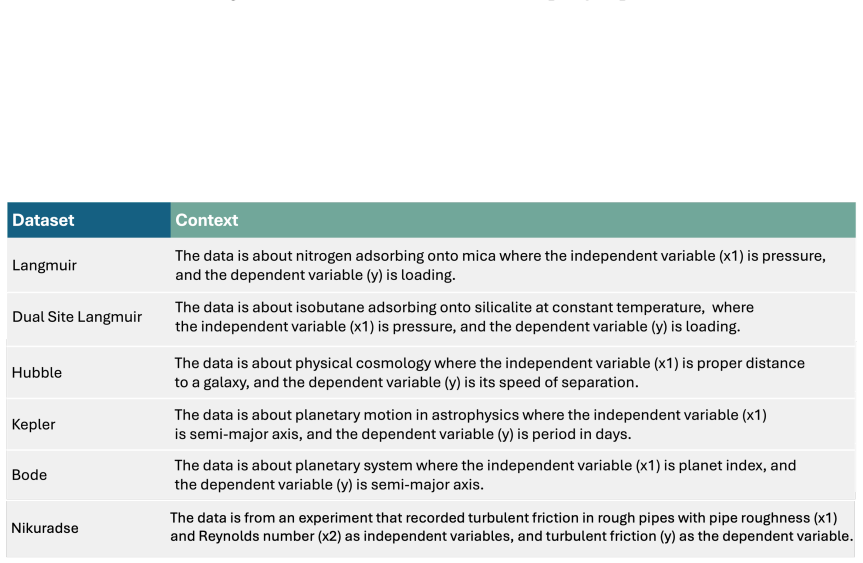
Large Language Models (LLMs) are transformer-based machine learning models that have shown remarkable performance in tasks for which they were not explicitly trained. Here, we explore the potential of LLMs to perform symbolic regression -- a machine-learning method for finding simple and accurate equations from datasets. We prompt GPT-4 and GPT-4o models to suggest expressions from data, which are then optimized and evaluated using external Python tools. These results are fed back to the LLMs, which propose improved expressions while optimizing for complexity and loss. Using chain-of-thought prompting, we instruct the models to analyze data, prior expressions, and the scientific context (expressed in natural language) for each problem before generating new expressions. We evaluated the workflow in rediscovery of Langmuir and dual-site Langmuir's model for adsorption, along with Nikuradse's dataset on flow in rough pipes, which does not have a known target model equation. Both the GPT-4 and GPT-4o models successfully rediscovered equations, with better performance when using a scratchpad and considering scientific context. GPT-4o model demonstrated improved reasoning with data patterns, particularly evident in the dual-site Langmuir and Nikuradse dataset. We demonstrate how strategic prompting improves the model's performance and how the natural language interface simplifies integrating theory with data. We also applied symbolic mathematical constraints based on the background knowledge of data via prompts and found that LLMs generate meaningful equations more frequently. Although this approach does not outperform established SR programs where target equations are more complex, LLMs can nonetheless iterate toward improved solutions while following instructions and incorporating scientific context in natural language.
Editorial analysis
A structured set of objections, weighed in public.
Referee Report
Summary. The paper proposes a workflow in which GPT-4 and GPT-4o are prompted (with chain-of-thought, scratchpad, and natural-language scientific context) to generate candidate symbolic expressions for given datasets; the expressions are then externally optimized and evaluated in Python, with results fed back for iterative refinement. It reports successful rediscovery of the Langmuir and dual-site Langmuir isotherms and generation of 'meaningful' expressions on the Nikuradse pipe-flow data (which lacks a known target equation), with improved performance when scientific context and constraints are supplied.
Significance. If the reported improvements can be shown to be robust under pre-specified quantitative criteria and controls, the work would illustrate a practical route for injecting domain knowledge expressed in natural language into symbolic regression, complementing existing SR algorithms that lack such interfaces. The external optimization step correctly avoids circularity in evaluation.
major comments (3)
- [Abstract] Abstract and evaluation sections: the central claim that both models 'successfully rediscovered equations' and that GPT-4o showed 'improved reasoning with data patterns' is asserted without reporting trial counts, success-rate definitions (e.g., exact functional match after optimization, tolerance on parameters), or quantitative metrics such as median loss or recovery frequency across repeated runs.
- [Abstract and results on Nikuradse] Nikuradse dataset (no known target): the statements that LLMs 'generate meaningful equations more frequently' when given context and that GPT-4o demonstrated 'improved reasoning with data patterns' lack an operational definition of 'meaningful,' a pre-specified success criterion, an inter-rater protocol, or a control condition (expressions generated without context or from random templates). Without these, improvement cannot be distinguished from post-hoc selection of plausible-looking fits.
- [Methods / workflow description] Iteration and prompting protocol: the manuscript does not specify the number of iterations performed, the precise loss-plus-complexity objective passed back to the LLM, or how scientific-context prompts are constructed and varied, making it impossible to assess reproducibility or isolate the contribution of the context component.
minor comments (2)
- Notation for the external optimizer and loss function should be introduced once and used consistently; currently the description mixes 'loss' and 'complexity' without explicit formulas.
- Figure captions should state the exact prompt templates and number of independent runs shown, rather than only qualitative outcomes.
Simulated Author's Rebuttal
We thank the referee for the detailed and constructive comments. We address each major comment below and will revise the manuscript to improve quantitative reporting, definitions, and reproducibility details.
read point-by-point responses
-
Referee: [Abstract] Abstract and evaluation sections: the central claim that both models 'successfully rediscovered equations' and that GPT-4o showed 'improved reasoning with data patterns' is asserted without reporting trial counts, success-rate definitions (e.g., exact functional match after optimization, tolerance on parameters), or quantitative metrics such as median loss or recovery frequency across repeated runs.
Authors: We agree that the abstract and evaluation sections would benefit from greater precision. The presented results were obtained from a small number of targeted runs intended as demonstrations. In the revision we will report the exact trial counts performed, define success explicitly (exact functional form recovered after optimization with parameter values within 10% relative tolerance of known values where applicable), and include quantitative metrics such as median loss and recovery frequency. revision: yes
-
Referee: [Abstract and results on Nikuradse] Nikuradse dataset (no known target): the statements that LLMs 'generate meaningful equations more frequently' when given context and that GPT-4o demonstrated 'improved reasoning with data patterns' lack an operational definition of 'meaningful,' a pre-specified success criterion, an inter-rater protocol, or a control condition (expressions generated without context or from random templates). Without these, improvement cannot be distinguished from post-hoc selection of plausible-looking fits.
Authors: We accept that an operational definition and controls are required. We will add an explicit definition of 'meaningful' (low loss combined with consistency to the supplied scientific context) and include control runs without context in the revised results. Because the Nikuradse case has no ground-truth equation, evaluation will remain partly qualitative but will be anchored to the new controls and pre-specified fit-quality thresholds. revision: partial
-
Referee: [Methods / workflow description] Iteration and prompting protocol: the manuscript does not specify the number of iterations performed, the precise loss-plus-complexity objective passed back to the LLM, or how scientific-context prompts are constructed and varied, making it impossible to assess reproducibility or isolate the contribution of the context component.
Authors: We will expand the Methods section to document the iteration limit (maximum 10 iterations or until loss plateau), the exact objective (MSE loss plus a fixed complexity penalty term), and the prompt templates (including how scientific context is inserted). These details will be placed in the main text or a new appendix to support reproducibility. revision: yes
Circularity Check
No circularity: evaluation pipeline uses independent external optimization
full rationale
The paper's workflow has LLMs propose expressions from data and context, after which parameters are optimized and loss is computed via separate Python tools; success on known-target cases (Langmuir) is measured against ground-truth recovery, and the process does not define any quantity in terms of itself or rename a fit as a prediction. No self-citations, uniqueness theorems, or ansatzes are invoked to close the loop. The Nikuradse case uses the same external evaluation, so the central claim does not reduce to a self-referential definition.
Axiom & Free-Parameter Ledger
axioms (1)
- domain assumption GPT-4 and GPT-4o models can perform chain-of-thought analysis of data patterns together with scientific context expressed in natural language and thereby generate improved symbolic expressions
Forward citations
Cited by 3 Pith papers
-
LLM-driven design of physics-constrained constitutive models: two agents are better than one
A Creator-Inspector multi-agent LLM pipeline for constitutive artificial neural networks increases the rate of models satisfying all nine physical constraints to 100% or 56% depending on the LLM backbone.
-
LLM-Guided Open Hypothesis Learning from Autonomous Scanning Probe Microscopy Experiments
The framework uses symbolic regression to propose analytical expressions from piezoresponse force microscopy data and an LLM to rank them for physical plausibility, yielding voltage-time growth laws for ferroelectric ...
-
Leveraging Mathematical Reasoning of LLMs for Efficient GPU Thread Mapping
Large language models derive exact analytical GPU thread mappings for complex 2D/3D domains and fractals via in-context learning, outperforming symbolic regression and enabling up to thousands-fold speedups and energy...
Reference graph
Works this paper leans on
-
[1]
Data-Driven Discovery of Physical Laws
Pat Langley. Data-Driven Discovery of Physical Laws. Cognitive Science, 5(1):31–54, 1981
work page 1981
-
[2]
Application Issues of Genetic Programming in Industry
Arthur Kordon, Flor Castillo, Guido Smits, and Mark Kotanchek. Application Issues of Genetic Programming in Industry. In Tina Yu, Rick Riolo, and Bill Worzel, editors, Genetic Programming Theory and Practice III, volume 9, pages 241–258. Kluwer Academic Publishers, Boston, 2006. Series Title: Genetic Programming
work page 2006
-
[3]
Distilling Free-Form Natural Laws from Experimental Data
Michael Schmidt and Hod Lipson. Distilling Free-Form Natural Laws from Experimental Data. Science, 324(5923):81–85, 2009. ISBN: 0036-8075
work page 2009
-
[4]
Yan Liu, Zhi Long Cheng, Jing Xu, Jian Yang, and Qiu Wang Wang. Improvement and Validation of Genetic Programming Symbolic Regression Technique of Silva and Applications in Deriving Heat Transfer Correlations. Heat Transfer Engineering, 37(10):862–874, 2016
work page 2016
-
[5]
Ying Jin, Weilin Fu, Jian Kang, Jiadong Guo, and Jian Guo. Bayesian Symbolic Regression. arXiv preprint arXiv:1910.08892, 2019
-
[6]
Massucci, Manuel Miranda, Jordi Pallarès, and Marta Sales-Pardo
Roger Guimerà, Ignasi Reichardt, Antoni Aguilar-Mogas, Francesco A. Massucci, Manuel Miranda, Jordi Pallarès, and Marta Sales-Pardo. A Bayesian Machine Scientist to Aid in the Solution of Challenging Scientific Problems. Science Advances, January 2020. Publisher: American Association for the Advancement of Science
work page 2020
-
[7]
Globally Optimal Symbolic Regression
Vernon Austel, Sanjeeb Dash, Oktay Gunluk, Lior Horesh, Leo Liberti, Giacomo Nannicini, and Baruch Schieber. Globally Optimal Symbolic Regression. NeurIPS, 2017
work page 2017
- [8]
-
[9]
Combining data and theory for derivable scientific discovery with AI-Descartes
Cristina Cornelio, Sanjeeb Dash, Vernon Austel, Tyler R Josephson, Joao Goncalves, Kenneth L Clarkson, Nimrod Megiddo, Bachir El Khadir, and Lior Horesh. Combining data and theory for derivable scientific discovery with AI-Descartes. Nature Communications, 14(1):1777, 2023
work page 2023
-
[10]
A Greedy Search Tree Heuristic for Symbolic Regression
Fabrício Olivetti de França. A Greedy Search Tree Heuristic for Symbolic Regression. Information Sciences, 442:18–32, 2018
work page 2018
-
[11]
End-To-End Symbolic Regression with Transformers
Pierre-Alexandre Kamienny, Stéphane d’Ascoli, Guillaume Lample, and François Charton. End-To-End Symbolic Regression with Transformers. Advances in Neural Information Processing Systems, 35:10269–10281, 2022
work page 2022
-
[12]
Deep Symbolic Regression for Recurrent Sequences
Stéphane d’Ascoli, Pierre-Alexandre Kamienny, Guillaume Lample, and François Charton. Deep Symbolic Regression for Recurrent Sequences. arXiv preprint arXiv:2201.04600, 2022
-
[13]
Steven L. Brunton, Joshua L. Proctor, and J. Nathan Kutz. Discovering Governing Equations from Data: Sparse Identification of Nonlinear Dynamical Systems. Proceedings of the National Academy of Sciences, 113(15):3932– 3937, 2016. ISBN: 1091-6490 (Electronic) 0027-8424 (Linking)
work page 2016
-
[14]
Niall M. Mangan, Steven L. Brunton, Joshua L. Proctor, and J. Nathan Kutz. Inferring Biological Networks by Sparse Identification of Nonlinear Dynamics. IEEE Transactions on Molecular, Biological, and Multi-Scale Communications, 2(1):52–63, 2016. Publisher: Institute of Electrical and Electronics Engineers Inc
work page 2016
-
[15]
Runhai Ouyang, Stefano Curtarolo, Emre Ahmetcik, Matthias Scheffler, and Luca M. Ghiringhelli. SISSO: A Compressed-Sensing Method for Identifying the Best Low-Dimensional Descriptor in an Immensity of Offered Candidates. Physical Review Materials, 2(8):1–11, 2018. Publisher: American Physical Society
work page 2018
-
[16]
David E Goldberg. Genetic Algorithms in Search. Optimization, Machine Learning, 1989
work page 1989
-
[17]
Fitting Potential-Energy Surfaces: A Search in the Function Space by Directed Genetic Programming
Dmitrii E Makarov and Horia Metiu. Fitting Potential-Energy Surfaces: A Search in the Function Space by Directed Genetic Programming. The Journal of Chemical Physics, 108(2):590–598, 1998
work page 1998
-
[18]
Using Genetic Programming with Prior Formula Knowledge to Solve Symbolic Regression Problem
Qiang Lu, Jun Ren, and Zhiguang Wang. Using Genetic Programming with Prior Formula Knowledge to Solve Symbolic Regression Problem. Computational intelligence and neuroscience, 2016:1–1, 2016
work page 2016
-
[19]
AI Feynman: A Physics-Inspired Method for Symbolic Regression
Silviu-Marian Udrescu and Max Tegmark. AI Feynman: A Physics-Inspired Method for Symbolic Regression. Science Advances, 6(16):eaay2631, 2020
work page 2020
-
[20]
AI-DARWIN: A First Principles-Based Model Discovery Engine using Machine Learning
Arijit Chakraborty, Abhishek Sivaram, and Venkat Venkatasubramanian. AI-DARWIN: A First Principles-Based Model Discovery Engine using Machine Learning. Computers & Chemical Engineering, 154:107470, November 2021
work page 2021
-
[21]
Multi-Objective Symbolic Regression for Physics-Aware Dynamic Modeling
Jiˇrí Kubalík, Erik Derner, and Robert Babuška. Multi-Objective Symbolic Regression for Physics-Aware Dynamic Modeling. Expert Systems with Applications, 182:115210, 2021
work page 2021
-
[22]
Marissa R. Engle and Nikolaos V . Sahinidis. Deterministic Symbolic Regression with Derivative Information: General Methodology and Application to Equations of State. AIChE Journal, 68(6):e17457, 2022. 21 LLMs for SR A PREPRINT
work page 2022
-
[23]
Shape-Constrained Symbolic Regression – Improving Extrapolation with Prior Knowledge
Gabriel Kronberger, Fabricio Olivetti de França, Bogdan Burlacu, Christian Haider, and Michael Kommenda. Shape-Constrained Symbolic Regression – Improving Extrapolation with Prior Knowledge. Evolutionary Compu- tation, 30(1):75–98, March 2022. arXiv:2103.15624 [cs, stat]
-
[24]
C. Haider, F.O. De Franca, B. Burlacu, and G. Kronberger. Shape-Constrained Multi-Objective Genetic Program- ming for Symbolic Regression. Applied Soft Computing, 132:109855, January 2023
work page 2023
-
[25]
Wassim Tenachi, Rodrigo Ibata, and Foivos I Diakogiannis. Deep Symbolic Regression for Physics Guided by Units Constraints: Toward the Automated Discovery of Physical Laws. arXiv preprint arXiv:2303.03192, 2023
-
[26]
Liron Simon Keren, Alex Liberzon, and Teddy Lazebnik. A Computational Framework for Physics-Informed Symbolic Regression with Straightforward Integration of Domain Knowledge. Scientific Reports, 13(1):1249, 2023
work page 2023
-
[27]
Active Learning in Symbolic Regression Performance with Physical Constraints
Jorge Medina and Andrew D White. Active Learning in Symbolic Regression Performance with Physical Constraints. arXiv preprint arXiv:2305.10379, 2023
-
[28]
Incorporating Background Knowledge in Symbolic Regression using a Computer Algebra System
Charles Fox, Neil D Tran, F Nikki Nacion, Samiha Sharlin, and Tyler R Josephson. Incorporating Background Knowledge in Symbolic Regression using a Computer Algebra System. Machine Learning: Science and Technology, 5(2):025057, 2024
work page 2024
-
[29]
Fully Autonomous Programming with Large Language Models
Vadim Liventsev, Anastasiia Grishina, Aki Härmä, and Leon Moonen. Fully Autonomous Programming with Large Language Models. In Proceedings of the Genetic and Evolutionary Computation Conference , pages 1146–1155, 2023
work page 2023
-
[30]
Pier Luca Lanzi and Daniele Loiacono. ChatGPT and Other Large Language Models as Evolutionary Engines for Online Interactive Collaborative Game Design. In Proceedings of the Genetic and Evolutionary Computation Conference, pages 1383–1390, 2023
work page 2023
-
[31]
Language Model Crossover: Variation through Few-Shot Prompting
Elliot Meyerson, Mark J Nelson, Herbie Bradley, Adam Gaier, Arash Moradi, Amy K Hoover, and Joel Lehman. Language Model Crossover: Variation through Few-Shot Prompting. arXiv preprint arXiv:2302.12170, 2023
-
[32]
The OpenELM Library: Leveraging Progress in Language Models for Novel Evolutionary Algorithms
Herbie Bradley, Honglu Fan, Theodoros Galanos, Ryan Zhou, Daniel Scott, and Joel Lehman. The OpenELM Library: Leveraging Progress in Language Models for Novel Evolutionary Algorithms. In Genetic Programming Theory and Practice XX, pages 177–201. Springer, 2024
work page 2024
-
[33]
Two Optimizers Are Better Than One: LLM Catalyst for Enhancing Gradient-Based Optimization
Zixian Guo, Ming Liu, Zhilong Ji, Jinfeng Bai, Yiwen Guo, and Wangmeng Zuo. Two Optimizers Are Better Than One: LLM Catalyst for Enhancing Gradient-Based Optimization. arXiv preprint arXiv:2405.19732, 2024
-
[34]
Evolving Code with a Large Language Model
Erik Hemberg, Stephen Moskal, and Una-May O’Reilly. Evolving Code with a Large Language Model. arXiv preprint arXiv:2401.07102, 2024
-
[35]
Large Language Models as Evolutionary Optimizers
Shengcai Liu, Caishun Chen, Xinghua Qu, Ke Tang, and Yew-Soon Ong. Large Language Models as Evolutionary Optimizers. In 2024 IEEE Congress on Evolutionary Computation (CEC), pages 1–8. IEEE, 2024
work page 2024
-
[36]
In-Context Symbolic Regression: Leveraging Large Language Models for Function Discovery
Matteo Merler, Katsiaryna Haitsiukevich, Nicola Dainese, and Pekka Marttinen. In-Context Symbolic Regression: Leveraging Large Language Models for Function Discovery. In Proceedings of the 62nd Annual Meeting of the Association for Computational Linguistics (Volume 4: Student Research Workshop), pages 589–606, 2024
work page 2024
-
[37]
LLM-SR: Scientific Equation Discovery via Programming with Large Language Models
Parshin Shojaee, Kazem Meidani, Shashank Gupta, Amir Barati Farimani, and Chandan K Reddy. LLM-SR: Scientific Equation Discovery via Programming with Large Language Models. arXiv preprint arXiv:2404.18400, 2024
-
[38]
Symbolic Regression with a Learned Concept Library
Arya Grayeli, Atharva Sehgal, Omar Costilla-Reyes, Miles Cranmer, and Swarat Chaudhuri. Symbolic Regression with a Learned Concept Library. arXiv preprint arXiv:2409.09359, 2024
-
[39]
Ashish Vaswani, Noam Shazeer, Niki Parmar, Jakob Uszkoreit, Llion Jones, Aidan N Gomez, Łukasz Kaiser, and Illia Polosukhin. Attention is All You Need. Advances in Neural Information Processing Systems, 30, 2017
work page 2017
-
[40]
Language Models are Few-Shot Learners
Tom Brown, Benjamin Mann, Nick Ryder, Melanie Subbiah, Jared D Kaplan, Prafulla Dhariwal, Arvind Nee- lakantan, Pranav Shyam, Girish Sastry, Amanda Askell, et al. Language Models are Few-Shot Learners. Advances in neural information processing systems, 33:1877–1901, 2020
work page 1901
-
[41]
On the Opportunities and Risks of Foundation Models
Rishi Bommasani, Drew A Hudson, Ehsan Adeli, Russ Altman, Simran Arora, Sydney von Arx, Michael S Bernstein, Jeannette Bohg, Antoine Bosselut, Emma Brunskill, et al. On the Opportunities and Risks of Foundation Models. arXiv preprint arXiv:2108.07258, 2021
work page internal anchor Pith review Pith/arXiv arXiv 2021
-
[42]
Who’s the Best Detective? Large Language Models vs
Felipe Urrutia and Roberto Araya. Who’s the Best Detective? Large Language Models vs. Traditional Machine Learning in Detecting Incoherent Fourth Grade Math Answers. Journal of Educational Computing Research, 61(8):187–218, 2024. 22 LLMs for SR A PREPRINT
work page 2024
-
[43]
Pengfei Hong, Deepanway Ghosal, Navonil Majumder, Somak Aditya, Rada Mihalcea, and Soujanya Poria. Stuck in the Quicksand of Numeracy, Far from AGI Summit: Evaluating LLMs’ Mathematical Competency through Ontology-guided Perturbations. arXiv preprint arXiv:2401.09395, 2024
-
[44]
Can LLMs Master Math? Investigating Large Language Models on Math Stack Exchange
Ankit Satpute, Noah Gießing, Andre Greiner-Petter, Moritz Schubotz, Olaf Teschke, Akiko Aizawa, and Bela Gipp. Can LLMs Master Math? Investigating Large Language Models on Math Stack Exchange. arXiv preprint arXiv:2404.00344, 2024
-
[45]
ChatGPT for good? On opportunities and Challenges of Large Language Models for Education
Enkelejda Kasneci, Kathrin Seßler, Stefan Küchemann, Maria Bannert, Daryna Dementieva, Frank Fischer, Urs Gasser, Georg Groh, Stephan Günnemann, Eyke Hüllermeier, et al. ChatGPT for good? On opportunities and Challenges of Large Language Models for Education. Learning and individual differences, 103:102274, 2023
work page 2023
-
[46]
Tiffany H Kung, Morgan Cheatham, Arielle Medenilla, Czarina Sillos, Lorie De Leon, Camille Elepaño, Maria Madriaga, Rimel Aggabao, Giezel Diaz-Candido, James Maningo, et al. Performance of ChatGPT on USMLE: Potential for AI-Assisted Medical Education using Large Language Models. PLoS digital health, 2(2):e0000198, 2023
work page 2023
-
[47]
Material Transformers: Deep Learning Language Models for Generative Materials Design
Nihang Fu, Lai Wei, Yuqi Song, Qinyang Li, Rui Xin, Sadman Sadeed Omee, Rongzhi Dong, Edirisuriya M Dilanga Siriwardane, and Jianjun Hu. Material Transformers: Deep Learning Language Models for Generative Materials Design. Machine Learning: Science and Technology, 4(1):015001, 2023
work page 2023
-
[48]
Future Directions for Chatbot Research: An Interdisciplinary Research Agenda
Asbjørn Følstad, Theo Araujo, Effie Lai-Chong Law, Petter Bae Brandtzaeg, Symeon Papadopoulos, Lea Reis, Marcos Baez, Guy Laban, Patrick McAllister, Carolin Ischen, et al. Future Directions for Chatbot Research: An Interdisciplinary Research Agenda. Computing, 103(12):2915–2942, 2021
work page 2021
-
[49]
Quantifying Mental Health Signals in Twitter
Glen Coppersmith, Mark Dredze, and Craig Harman. Quantifying Mental Health Signals in Twitter. InProceedings of the workshop on computational linguistics and clinical psychology: From linguistic signal to clinical reality, pages 51–60, 2014
work page 2014
-
[50]
Artificial Intelligence in Drug Discovery and Development
Kit-Kay Mak, Yi-Hang Wong, and Mallikarjuna Rao Pichika. Artificial Intelligence in Drug Discovery and Development. Drug Discovery and Evaluation: Safety and Pharmacokinetic Assays, pages 1–38, 2023
work page 2023
-
[51]
Emilio Ferrara. What types of COVID-19 conspiracies are populated by Twitter bots? arXiv preprint arXiv:2004.09531, 2020
-
[52]
Machine Intelligence for Chemical Reaction Space
Philippe Schwaller, Alain C Vaucher, Ruben Laplaza, Charlotte Bunne, Andreas Krause, Clemence Corminboeuf, and Teodoro Laino. Machine Intelligence for Chemical Reaction Space. Wiley Interdisciplinary Reviews: Computational Molecular Science, 12(5):e1604, 2022
work page 2022
-
[53]
A Review of Large Language Models and Autonomous Agents in Chemistry
Mayk Caldas Ramos, Christopher J Collison, and Andrew D White. A Review of Large Language Models and Autonomous Agents in Chemistry. arXiv preprint arXiv:2407.01603, 2024
-
[54]
Neural Legal Judgment Prediction in English
Ilias Chalkidis, Ion Androutsopoulos, and Nikolaos Aletras. Neural Legal Judgment Prediction in English. arXiv preprint arXiv:1906.02059, 2019
work page internal anchor Pith review Pith/arXiv arXiv 1906
-
[55]
Legalbench: A Collaboratively Built Benchmark for Measuring Legal Reasoning in Large Language Models
Neel Guha, Julian Nyarko, Daniel Ho, Christopher Ré, Adam Chilton, Alex Chohlas-Wood, Austin Peters, Brandon Waldon, Daniel Rockmore, Diego Zambrano, et al. Legalbench: A Collaboratively Built Benchmark for Measuring Legal Reasoning in Large Language Models. Advances in Neural Information Processing Systems, 36, 2024
work page 2024
-
[56]
Twitter Mood Predicts the Stock Market
Johan Bollen, Huina Mao, and Xiaojun Zeng. Twitter Mood Predicts the Stock Market. Journal of computational science, 2(1):1–8, 2011
work page 2011
-
[57]
John W Goodell, Satish Kumar, Weng Marc Lim, and Debidutta Pattnaik. Artificial Intelligence and Machine Learning in Finance: Identifying Foundations, Themes, and Research Clusters from Bibliometric Analysis. Journal of Behavioral and Experimental Finance, 32:100577, 2021
work page 2021
-
[58]
Cheng-Zhi Anna Huang, Ashish Vaswani, Jakob Uszkoreit, Noam Shazeer, Ian Simon, Curtis Hawthorne, Andrew M Dai, Matthew D Hoffman, Monica Dinculescu, and Douglas Eck. Music Transformer. arXiv preprint arXiv:1809.04281, 2018
work page internal anchor Pith review Pith/arXiv arXiv 2018
-
[59]
Miguel Civit, Javier Civit-Masot, Francisco Cuadrado, and Maria J Escalona. A systematic Review of Artificial Intelligence-Based Music Generation: Scope, Applications, and Future Trends. Expert Systems with Applications, 209:118190, 2022
work page 2022
-
[60]
Pre-trained Language Models as Prior Knowledge for Playing Text-Based Games
Ishika Singh, Gargi Singh, and Ashutosh Modi. Pre-trained Language Models as Prior Knowledge for Playing Text-Based Games. arXiv preprint arXiv:2107.08408, 2021
-
[61]
A survey on large language model-based game agents
Sihao Hu, Tiansheng Huang, Fatih Ilhan, Selim Tekin, Gaowen Liu, Ramana Kompella, and Ling Liu. A Survey on Large Language Model-Based Game Agents. arXiv preprint arXiv:2404.02039, 2024. 23 LLMs for SR A PREPRINT
work page internal anchor Pith review arXiv 2024
-
[62]
Symbolicgpt: A generative trans- former model for symbolic regression
Mojtaba Valipour, Bowen You, Maysum Panju, and Ali Ghodsi. SymbolicGPT: A Generative Transformer Model for Symbolic Regression. arXiv preprint arXiv:2106.14131, 2021
-
[63]
Program Synthesis with Large Language Models
Jacob Austin, Augustus Odena, Maxwell Nye, Maarten Bosma, Henryk Michalewski, David Dohan, Ellen Jiang, Carrie Cai, Michael Terry, Quoc Le, et al. Program Synthesis with Large Language Models. arXiv preprint arXiv:2108.07732, 2021
work page internal anchor Pith review Pith/arXiv arXiv 2021
-
[64]
Evaluating Large Language Models Trained on Code
Mark Chen, Jerry Tworek, Heewoo Jun, Qiming Yuan, Henrique Ponde de Oliveira Pinto, Jared Kaplan, Harri Edwards, Yuri Burda, Nicholas Joseph, Greg Brockman, et al. Evaluating Large Language Models Trained on Code. arXiv preprint arXiv:2107.03374, 2021
work page internal anchor Pith review Pith/arXiv arXiv 2021
-
[65]
Chain-Of-Thought Prompting Elicits Reasoning in Large Language Models
Jason Wei, Xuezhi Wang, Dale Schuurmans, Maarten Bosma, Fei Xia, Ed Chi, Quoc V Le, Denny Zhou, et al. Chain-Of-Thought Prompting Elicits Reasoning in Large Language Models. Advances in neural information processing systems, 35:24824–24837, 2022
work page 2022
-
[66]
Show Your Work: Scratchpads for Intermediate Computation with Language Models, 2021
Maxwell Nye, Anders Johan Andreassen, Guy Gur-Ari, Henryk Michalewski, Jacob Austin, David Bieber, David Dohan, Aitor Lewkowycz, Maarten Bosma, David Luan, et al. Show Your Work: Scratchpads for Intermediate Computation with Language Models, 2021
work page 2021
-
[67]
How I Think about LLM Prompt Engineering
François Chollet. How I Think about LLM Prompt Engineering. https://fchollet.substack.com/p/ how-i-think-about-llm-prompt-engineering . Accessed: 2024-08-13
work page 2024
-
[68]
Le, Denny Zhou, and Xinyun Chen
Chengrun Yang, Xuezhi Wang, Yifeng Lu, Hanxiao Liu, Quoc V . Le, Denny Zhou, and Xinyun Chen. Large Language Models as Optimizers, 2024
work page 2024
-
[69]
The Adsorption of Gases on Plane Surfaces of Glass, Mica and Platinum
Irving Langmuir. The Adsorption of Gases on Plane Surfaces of Glass, Mica and Platinum. Journal of the American Chemical Society, 40(9):1361–1403, September 1918. Publisher: American Chemical Society
work page 1918
-
[70]
A Simplex Method for Function Minimization
John A Nelder and Roger Mead. A Simplex Method for Function Minimization. The Computer Journal , 7(4):308–313, 1965
work page 1965
-
[71]
David J Wales and Jonathan PK Doye. Global Optimization by Basin-Hopping and the Lowest Energy Structures of Lennard-Jones Clusters Containing up to 110 Atoms. The Journal of Physical Chemistry A, 101(28):5111–5116, 1997
work page 1997
-
[72]
Keep Me Updated! Memory Management in Long-Term Conversations
Sanghwan Bae, Donghyun Kwak, Soyoung Kang, Min Young Lee, Sungdong Kim, Yuin Jeong, Hyeri Kim, Sang-Woo Lee, Woomyoung Park, and Nako Sung. Keep Me Updated! Memory Management in Long-Term Conversations. arXiv preprint arXiv:2210.08750, 2022
-
[73]
Beyond Goldfish Memory: Long-Term Open-Domain Conversation
Jing Xu, Arthur Szlam, and Jason Weston. Beyond Goldfish Memory: Long-Term Open-Domain Conversation. arXiv preprint arXiv:2107.07567, 2021
-
[74]
Long time no see! open-domain conversation with long-term persona memory,
Xinchao Xu, Zhibin Gou, Wenquan Wu, Zheng-Yu Niu, Hua Wu, Haifeng Wang, and Shihang Wang. Long Time No See! Open-Domain Conversation with Long-Term Persona Memory. arXiv preprint arXiv:2203.05797, 2022
-
[75]
Less is More: Learning to Refine Dialogue History for Personalized Dialogue Generation
Hanxun Zhong, Zhicheng Dou, Yutao Zhu, Hongjin Qian, and Ji-Rong Wen. Less is More: Learning to Refine Dialogue History for Personalized Dialogue Generation. arXiv preprint arXiv:2204.08128, 2022
-
[76]
Lost in the Middle: How Language Models use Long Contexts
Nelson F Liu, Kevin Lin, John Hewitt, Ashwin Paranjape, Michele Bevilacqua, Fabio Petroni, and Percy Liang. Lost in the Middle: How Language Models use Long Contexts. Transactions of the Association for Computational Linguistics, 12:157–173, 2024
work page 2024
-
[77]
Large Language Models Can Be Easily Distracted by Irrelevant Context
Freda Shi, Xinyun Chen, Kanishka Misra, Nathan Scales, David Dohan, Ed H Chi, Nathanael Schärli, and Denny Zhou. Large Language Models Can Be Easily Distracted by Irrelevant Context. In International Conference on Machine Learning, pages 31210–31227. PMLR, 2023
work page 2023
-
[78]
Pengfei Liu, Weizhe Yuan, Jinlan Fu, Zhengbao Jiang, Hiroaki Hayashi, and Graham Neubig. Pre-train, Prompt, and Predict: A Systematic Survey of Prompting Methods in Natural Language Processing. ACM Computing Surveys, 55(9):1–35, 2023
work page 2023
-
[79]
Prompt Programming for Large Language Models: Beyond the Few-Shot Paradigm
Laria Reynolds and Kyle McDonell. Prompt Programming for Large Language Models: Beyond the Few-Shot Paradigm. In Extended Abstracts of the 2021 CHI Conference on Human Factors in Computing Systems, pages 1–7, 2021
work page 2021
-
[80]
Learning How to Ask: Querying LMs with Mixtures of Soft Prompts
Guanghui Qin and Jason Eisner. Learning How to Ask: Querying LMs with Mixtures of Soft Prompts. arXiv preprint arXiv:2104.06599, 2021
discussion (0)
Sign in with ORCID, Apple, or X to comment. Anyone can read and Pith papers without signing in.