REVIEW 4 major objections 5 minor 3 cited by
How to Correctly do Semantic Backpropagation on Language-based Agentic Systems
T0 review · 4 major / 5 minor · reviewed 2026-08-11 · deepseek-v4-flash
Pith's one-line read Semantic backpropagation that conditions backward feedback on neighbors outperforms TextGrad and related optimizers on BIG-Bench Hard and GSM8K, the paper shows.
desk verdict A useful formalization of semantic backprop with a convincing neighbor-conditioning ablation, but the evaluation protocol needs tightening before the headline numbers can be trusted. read the letter →
The pith
A machine-rendered reading of the paper's core claim, the machinery that carries it, and where it could break.
The reading
What carries the argument
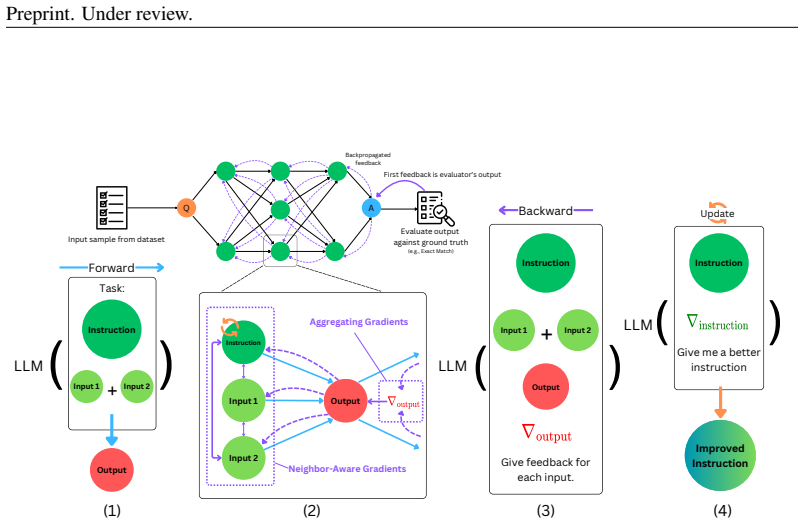
The central object is the semantic gradient $\nabla_v l_Q$, a string-valued directional message indicating how variable $v$ should change to improve the system output for query $Q$. Semantic backpropagation computes it by applying backward functions $\hat{h}^v_w$ to each successor $w$, where $\hat{h}^v_w$ receives $\mathrm{Predecessors}(w)$, $w$, and $\nabla_w l_Q$, and thus depends on both the target variable $v$ and its neighbors; the aggregator $A_v$ then combines the messages from all successors. This machinery generalizes the chain rule in reverse-mode automatic differentiation, and reduces to TextGrad when the backward functions ignore $v$ and the other predecessors. The argument's force comes from making this neighbor conditioning explicit: it allows complementary and synergistic roles of neighboring nodes to shape each variable's update direction.
What would settle it
Run semantic gradient descent and TextGrad on a fresh multi-component LLM task with identical forward and backward language models, iteration counts, and optimizers, but with the backward messages forced to ignore neighbor nodes; if the no-neighbor variant matches or exceeds the neighbor-conditioned variant's accuracy on a held-out test set, the central claim that neighbor conditioning improves credit assignment is refuted.
Extended reading notes
Core claim
The central claim is that the correct generalization of backpropagation to language-based computational graphs is semantic backpropagation, which computes a semantic gradient for each variable by aggregating backward messages from its successors, where each message explicitly conditions on the variable in question and on the other predecessors of the successor. This differs from TextGrad, whose backward functions ignore the receiving variable and its neighbors; the paper argues these independence assumptions are unjustified and empirically harmful. Formally, semantic gradients are directions for how to change a variable to improve the system output, and semantic gradient descent applies them through an LLM-based update function gated by a validation-set comparison. The paper reports that this method reaches 93.2 on GSM8K, 82.5 on BBH NLP, and 85.6 on BBH Algorithmic, outperforming TextGrad and OptoPrime, while ablation on LIAR shows that removing neighborhood conditioning, gradients, or the update gate each degrades performance.
Load-bearing premise
The method's gains rest on the assumption that evaluating proposed updates on the same training samples used for optimization—rather than on a held-out validation set—is enough to prevent the update gate from accepting harmful prompt changes and to keep the reported results representative.
Editorial extensions
If this is right
- Backpropagation-style credit assignment transfers to natural-language computational graphs, provided backward messages are conditioned on the full local neighborhood.
- The independence assumptions in TextGrad—messages independent of the receiving variable and of sibling predecessors—are not just theoretically questionable but empirically harmful.
- Automatic optimization of multi-component LLM systems becomes feasible with modest compute, since forward passes dominate the cost while backward passes and optimizer calls are few.
- The update gate is essential: accepting every LLM-proposed prompt change can cause the system to drift to worse regions, which is why semantic gradient descent rejects updates that fail to improve on the validation set.
Reading between the lines
- If neighbor conditioning is the operative mechanism, then the same principle should transfer to other credit-assignment schemes for LLM pipelines, such as edge optimization or structural changes, where local context also matters.
- The success of the gate suggests that a lightweight predictor of validation performance might replace full evaluation and preserve the gains at lower cost.
- The formalization invites a unified view of automatic differentiation and LLM-as-optimizer methods, in which any semantically interoperable message passing in reverse topological order counts as semantic backpropagation.
- If the method generalizes, it could make end-to-end optimization of full agentic systems beyond question answering feasible, including code-generation pipelines and tool-using agents where multi-component credit assignment is currently manual.
Editorial analysis
A structured set of objections, weighed in public.
Referee Report
Summary. The paper formalizes graph-based agentic system optimization (GASO) and proposes semantic backpropagation, which propagates 'semantic gradients' (directional natural-language feedback) through a computational graph while conditioning on neighboring nodes. It introduces semantic gradient descent with an update gate, shows that TextGrad is a special case of the framework, and reports experiments on GSM8K, BIG-Bench Hard, and BigCodeBench comparing with TextGrad, OptoPrime, and COPRO, plus an ablation on LIAR. A public implementation is provided.
Significance. If the empirical claims hold, the paper makes a useful conceptual contribution: it unifies reverse-mode automatic differentiation and TextGrad under a single message-passing view, and the neighbor-aware backward pass is a plausible improvement for credit assignment in language-agent graphs. The public code, the explicit algorithm listings, and the prompt-rephrasing robustness check in Appendix C.4 are strengths. However, the empirical support is weakened by the evaluation-protocol issues detailed below, so the significance of the reported gains is not yet established.
major comments (4)
- [Section 5.2, Table 2] The evaluation protocol for the LIAR ablation is not specified. The text says the same 50 samples are used as the query distribution D and as the validation set for the update gate, but it never states the set on which the classification accuracy in Table 2 is computed. If that accuracy is on the same 50 samples, then the gate is selecting on the evaluation set and the reported 71.2±3.2 is a training-set number, which would invalidate the ablation as evidence for generalization and may explain why removing the gate drops accuracy to 49.2±5.0. Please state the evaluation split explicitly; if it is the training set, re-run the ablation on a held-out split.
- [Section 5.1, Table 1] No variance or significance information is provided for any entry in Table 1. The headline differences (e.g., 93.2 versus 83.9 on GSM8K, 82.5 versus 48.7 on BBH NLP) come from single runs of stochastic LLM-based optimizers and could change substantially across seeds. Report multiple seeds with standard errors or confidence intervals for every row, including BCB, where 27.8 versus 27.6 is effectively a tie and the abstract's 'outperforms' claim should be qualified.
- [Section 3.2.2, Algorithm 2, Section 5.1] The update gate is evaluated on the training samples, so the same data are used to generate semantic gradients, to accept or reject candidate updates, and (in the LIAR experiment) to compute the reported accuracy. This is a selection-on-training procedure. Because the Remark in Section 3.2.2 identifies the gate as essential and Section 5.1 states that the gate 'is computed using the training samples,' the method's advantage over TextGrad and OptoPrime may reflect the availability of a labeled training set for model selection rather than neighbor-aware credit assignment. The authors should re-run the main comparisons with a held-out validation set for the gate, or provide evidence that training-set gating does not bias the comparison.
- [Section 3.3, Eqs. (3) and (4)] The claim that TextGrad is a special case of semantic backpropagation is central to the paper's motivation, but the formal statement is incomplete. Equation (3) quantifies u ambiguously ('for all u ∈ V, w ∈ Successors(v), and u ∈ Predecessors(w)'), and no derivation is given showing that TextGrad's backward pass satisfies these equations. Please provide a precise statement of the conditions and a mapping from TextGrad's actual algorithm to the notation.
minor comments (5)
- [Section 5.1, paragraph after Table 1] The sentence 'This proposal may be integrated or rejected depending on the (as introduced in Section 3.2iteration regardless.' is garbled; please rewrite it.
- [Section 3.2.2] Algorithm 2 uses a strict inequality in the gate condition while the text defines the condition with '≤'; please make the two consistent.
- [Section 4.1] The citation 'APE (Zhou et al., 2023)' points to the reference 'Large language models are human-level prompt engineers' (OPRO), not to the APE paper; please correct the citation.
- [Table 1] The rows marked with † are external results from Cheng et al. (2024); since the authors state they could not reproduce them, these rows should be clearly labeled as reported values and the potential differences in setup should be discussed.
- [Abstract and Conclusion] The abstract and conclusion say the method 'outperforms' existing methods, but Table 1 shows 27.8 vs 27.6 on BCB, which the text itself calls 'roughly equal'; please qualify the summary claims accordingly.
Circularity Check
Main BBH/GSM8K comparisons are self-contained and not circular; the LIAR ablation's reported accuracy is computed on the same 50 samples used for update gating, making that particular 'prediction' partly an artifact of selection on the evaluation set.
-
fitted input called prediction
[Section 5.2 (Experiment Design), Algorithm 2, Table 2]
"We optimize on 50 randomly selected samples from the LIAR training split, as done by Pryzant et al. (2023). We use these 50 random samples as both the query distribution D and the validation set."
Algorithm 2 accepts a proposed parameter update only when LVal({phi(theta,G_theta)}) < LVal(Theta), i.e., only when the proposed prompts improve on the validation set. In Section 5.2 that validation set is identical to the 50 LIAR samples used as the query distribution, and the paper does not describe a separate LIAR test split for Table 2. The final parameters are therefore selected by evaluating on the same samples later reported as the classification accuracy. The reported accuracy is thus a selection-set score rather than an independent estimate of generalization.
full rationale
The formal core of the paper is not circular: semantic gradients and semantic backpropagation are defined as directional information, and TextGrad is shown to be a special case by explicit conditions (Eqs. 3-4) rather than by assuming the conclusion. The main BBH/GSM8K results in Table 1 are evaluated on held-out test splits after optimization on training samples, so the headline comparison against TextGrad, OptoPrime, and COPRO is not reduced to the method's own inputs. The self-citations from overlapping authors, e.g., Zhuge et al. 2023 and 2024, serve as background motivation for the importance of neighbor heterogeneity, not as the load-bearing proof of the method's advantage. The one genuine circularity concern is the LIAR ablation: the update gate is called essential in Section 3.2.2, it operates through LVal, and Section 5.2 sets the validation set equal to the 50 query samples, with Table 2 reporting accuracy on that setup and no separate held-out LIAR evaluation described. This makes the ablation numbers partly a selection-on-the-evaluation-set artifact. Since the abstract's central claim rests on the held-out BBH/GSM8K numbers, the circularity is partial and confined to the LIAR ablation, giving score 4.
Assumptions & free parameters
free parameters (3)
- loss threshold tau =
0.5
- batch size b =
2
- number of optimization iterations =
4 (12 for BCB)
assumptions (4)
- domain assumption A directed acyclic computational graph with natural-language variables adequately represents a language-based agentic system for optimization.
- domain assumption LLM-based backward functions produce semantically useful directional gradients for each variable.
- domain assumption Including neighboring predecessors in backward messages improves credit assignment, analogous to reverse-mode automatic differentiation.
- ad hoc to paper An update gate using LVal computed on training samples is necessary to prevent destructive updates.
Cite this review
Pith. "Pith review of How to Correctly do Semantic Backpropagation on Language-based Agentic Systems." pith.science (2026). https://pith.science/paper/DVCOIBRY
@misc{pith2026241203624,
  author       = {Pith},
  title        = {Pith review of: How to Correctly do Semantic Backpropagation on Language-based Agentic Systems},
  year         = {2026},
  howpublished = {\url{https://pith.science/paper/DVCOIBRY}},
  note         = {Machine review of arXiv:2412.03624}
}
read the original abstract
Language-based agentic systems have shown great promise in recent years, transitioning from solving small-scale research problems to being deployed in challenging real-world tasks. However, optimizing these systems often requires substantial manual labor. Recent studies have demonstrated that these systems can be represented as computational graphs, enabling automatic optimization. Despite these advancements, most current efforts in Graph-based Agentic System Optimization (GASO) fail to properly assign feedback to the system's components given feedback on the system's output. To address this challenge, we formalize the concept of semantic backpropagation with semantic gradients -- a generalization that aligns several key optimization techniques, including reverse-mode automatic differentiation and the more recent TextGrad by exploiting the relationship among nodes with a common successor. This serves as a method for computing directional information about how changes to each component of an agentic system might improve the system's output. To use these gradients, we propose a method called semantic gradient descent which enables us to solve GASO effectively. Our results on both BIG-Bench Hard and GSM8K show that our approach outperforms existing state-of-the-art methods for solving GASO problems. A detailed ablation study on the LIAR dataset demonstrates the parsimonious nature of our method. A full copy of our implementation is publicly available at https://github.com/HishamAlyahya/semantic_backprop
Figures


Figures from the paper (16 more)





Forward citations
Cited by 3 Pith papers
-
TRACE: TRajectory Attribution for Automated Context Engineering
TRACE, a three-agent pipeline for context debugging, reports 72.7% root-cause node accuracy and 82% fix effectiveness on a self-generated synthetic benchmark of 60 dissatisfaction traces.
-
EMAS: Stabilizing Multi-Agent System Evolution through Evidence-Guided Revision
EMAS evolves a multi-agent system's prompts and topology from its own execution traces, accepting a revision only after it recurs across samples and passes a paired validation check.
-
LLM-AutoDiff: Auto-Differentiate Any LLM Workflow
An automatic differentiation-style framework optimizes prompts across multi-component and cyclic LLM workflows, outperforming single-node textual-gradient baselines on several small benchmarks.
Reference graph
Works this paper leans on
-
[1]
Start by evaluating the truthfulness of the first statement independently
-
[2]
For each subsequent statement, determine its truth value based on the truth or falsehood of the previous statements and the content of the current statement
-
[3]
Use logical deductions to build a chain of reasoning that connects all the statements
-
[4]
Work out an intermediate step that helps solve the problem
Conclude by using this chain of reasoning to answer the final question about the truthfulness of the last character's statement. Work out an intermediate step that helps solve the problem. ... When answering questions involving a sequence of statements where characters make claims about each other's truthfulness, follow these steps:
-
[5]
This may involve flipping the assumed truth value of one or more statements to resolve contradictions
**Adjust Truth Values**: If a contradiction arises, reassess and adjust the truth values of the involved statements. This may involve flipping the assumed truth value of one or more statements to resolve contradictions
-
[6]
**List All Statements**: Begin by listing every statement made by the characters in the order they appear
-
[7]
Assume the first statement is true and proceed accordingly
**Initial Truth Assignment**: Assign a tentative truth value to each character's statement starting with the first one. Assume the first statement is true and proceed accordingly
-
[8]
**Identify Dependencies**: For each statement, identify which other statements it depends on. For example, if a character claims another character is lying, the truth value of the claim depends on the truthfulness of the other character's statement
Show all 19 references
-
[9]
Check if assuming a statement as true leads to any contradictions in the dependencies
**Evaluate Logical Consistency**: Use logical reasoning to evaluate the consistency of each statement with those it depends on. Check if assuming a statement as true leads to any contradictions in the dependencies
-
[11]
**Iterative Reassessment**: Repeat the evaluation of logical consistency and adjustment of truth values until no further contradictions are found
-
[12]
Characters whose statements consistently lead to contradictions are less reliable
**Determine Character Reliability**: Assess the reliability of each character based on the final truth values of their statements. Characters whose statements consistently lead to contradictions are less reliable
-
[13]
**Resolve Final Question**: Use the established truths and the reliability of the characters to answer the final question
-
[14]
Yes" if the final character tells the truth, otherwise answer with
**Review and Confirm**: Re-examine the logical flow and consistency of the analysis to ensure no statement or relationship has been misinterpreted or overlooked. Initial prompt Iteration 1 Iteration N Final iteration Analyze the statements made by each character in the scenario....
-
[15]
This reflects a broader concern about economic inequality and the need for wage reform, par- ticularly from a Democratic perspective
The statement highlights that the federal minimum wage of $7.75 is insufficient to lift in- dividuals above half the poverty level, emphasizing the inadequacy of current wage standards. This reflects a broader concern about economic inequality and the need for wage reform, par...
-
[16]
They would generally advocate for raising the mini- mum wage to ensure a living wage for all
The Democratic party likely feels that the statement highlights the inadequacy of the federal minimum wage in addressing poverty, emphasizing the need for an increase to better support low-income workers. They would generally advocate for raising the mini- mum wage to ensure a...
-
[17]
Representative, as it reflects a concern for economic issues affecting constituents
Yes, the statement is consistent with the job title of a U.S. Representative, as it reflects a concern for economic issues affecting constituents. As a Democrat, advocating for higher wages aligns with party values focused on social justice and economic equity
-
[18]
Representative likely released the statement to highlight the inadequacy of the federal minimum wage in addressing poverty and to advocate for an increase in wages
The U.S. Representative likely released the statement to highlight the inadequacy of the federal minimum wage in addressing poverty and to advocate for an increase in wages. This aligns with the Democratic Party’s focus on economic justice and support for worker s’ rights
-
[19]
""Context Information: 4 {utils.add_indent(self.question.question_str)} 5
The state likely feels that the federal minimum wage of $7.75 is insufficient, as it does not provide a living wage and fails to meet the basic needs of individuals and families. This sen- timent aligns with the Democratic Party’s advocacy for raising the minimum wage to comba...
-
[1990]
liar, liar pants on fire
(In November there appeared a revised and extended version.). J¨urgen Schmidhuber. Learning to control fast-weight memories: An alternative to recurrent nets. Neural Computation, 4(1):131–139, 1992. doi: 10.1162/neco.1992.4.1.131. J¨urgen Schmidhuber. On learning to think: Alg...
2024 arXiv
Reviewed August 11, 2026 · model on record in the stance chip above.
Discussion (0). Continue with ORCID to comment.