Coordinate- and spacetime-independent quantum physics
Pith reviewed 2026-05-23 07:46 UTC · model grok-4.3
The pith
A scalar field solution serves as a coordinate- and spacetime-independent model for quantum particles.
A machine-rendered reading of the paper's core claim, the machinery that carries it, and where it could break.
Core claim
The authors exhibit an explicit scalar-field-equation solution that is a zero-rank tensor under general coordinate transformations, is shared by anti-de Sitter, de Sitter, closed and open Einstein static universes, reduces locally to a Minkowski plane-wave solution, and remains non-perturbative in curvature.
What carries the argument
The scalar-field-equation solution that satisfies the equation uniformly across the listed spacetimes and transforms as a scalar under coordinate transformations.
If this is right
- The solution supports standard particle-physics calculations without reference to a particular coordinate frame.
- It supplies non-perturbative information about quantum fields in strong-gravity regimes.
- The same object can be used across different background spacetimes without re-derivation.
Where Pith is reading between the lines
- If the solution is correct, particle-creation rates in expanding cosmologies could be computed without choosing a preferred slicing.
- The construction may suggest how to define particles in quantum gravity settings that lack a fixed classical background.
- Local flat-space tests could be performed by expanding the explicit form around Minkowski space and comparing coefficients.
Load-bearing premise
A single explicit functional form exists that satisfies the scalar field equation in all listed spacetimes at once, transforms as a scalar under arbitrary coordinate changes, and matches the Minkowski plane wave locally without additional fitting or expansion.
What would settle it
An explicit check showing that the proposed functional form fails to solve the scalar field equation in de Sitter space or deviates from the Minkowski plane-wave limit when curvature is taken to zero.
Figures
read the original abstract
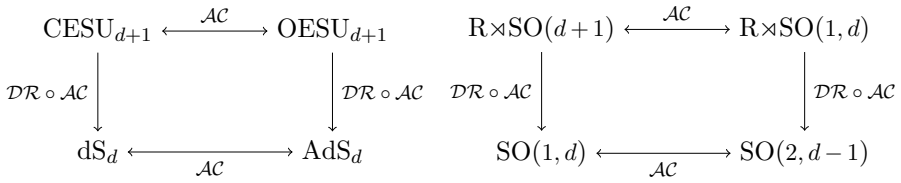
The concept of a particle is ambiguous in quantum field theory. It is generally agreed that particles depend not only on spacetime, but also on coordinates used to parametrise spacetime points. One of us has in contrast proposed a coordinate-frame-independent model of quantum particles within the framework of quantum field theory in curved spacetime. The aim of this article is to present a scalar-field-equation solution that is not only a zero-rank tensor under general coordinate transformations, but also common for anti-de-Sitter, de-Sitter, closed and open Einstein static universes. Moreover, it locally reduces to a Minkowski plane-wave solution and is non-perturbative in curvature. The former property makes it suitable for the standard applications of quantum theory in particle physics, while the latter allows then to gain insights into quantum physics in the strong-gravity regime.
Editorial analysis
A structured set of objections, weighed in public.
Referee Report
Summary. The manuscript claims to construct an explicit scalar-field solution that is a coordinate scalar (zero-rank tensor under arbitrary coordinate transformations), satisfies the Klein-Gordon equation identically in anti-de Sitter, de Sitter, closed Einstein static, and open Einstein static universes, locally reduces to the Minkowski plane-wave solution, and is non-perturbative in curvature, thereby providing a coordinate- and spacetime-independent model of quantum particles.
Significance. If an explicit functional form were supplied and shown by direct substitution to satisfy the curved-space Klein-Gordon operator identically in each of the four spacetimes while reducing to the flat-space plane wave, the result would allow coordinate-independent particle definitions in QFT on curved backgrounds and enable non-perturbative analysis of quantum effects in strong gravity.
major comments (2)
- [Abstract] Abstract: the central claim asserts the existence of a single explicit functional form that satisfies the scalar wave equation identically in AdS, dS, closed and open Einstein static universes, yet the manuscript supplies neither the functional form itself nor any derivation or algebraic verification that the same expression satisfies the Klein-Gordon operator when each metric is substituted.
- The manuscript as a whole: the 'common' and 'non-perturbative' properties rest on the algebraic identity obtained after direct substitution into each metric; without this identity being exhibited, the claim that one expression works for all listed spacetimes and matches the Minkowski plane wave locally without additional fitting cannot be checked.
Simulated Author's Rebuttal
We thank the referee for the careful reading and for identifying the need for greater explicitness in the presentation. We agree that the central claims require direct exhibition of the functional form and algebraic verifications to be verifiable, and we will revise the manuscript to address this.
read point-by-point responses
-
Referee: [Abstract] Abstract: the central claim asserts the existence of a single explicit functional form that satisfies the scalar wave equation identically in AdS, dS, closed and open Einstein static universes, yet the manuscript supplies neither the functional form itself nor any derivation or algebraic verification that the same expression satisfies the Klein-Gordon operator when each metric is substituted.
Authors: We agree that the manuscript does not supply the explicit functional form or the direct algebraic verifications in a form that permits immediate checking. In the revised version we will state the explicit scalar-field expression in the abstract and main text and add a dedicated section (or appendix) showing the substitution of this expression into the Klein-Gordon operator for each of the four metrics, confirming that the equation is satisfied identically. revision: yes
-
Referee: The manuscript as a whole: the 'common' and 'non-perturbative' properties rest on the algebraic identity obtained after direct substitution into each metric; without this identity being exhibited, the claim that one expression works for all listed spacetimes and matches the Minkowski plane wave locally without additional fitting cannot be checked.
Authors: We concur that the common and non-perturbative character of the solution cannot be assessed without the explicit algebraic identity. The revised manuscript will include the full substitution steps for all four metrics together with the local flat-space limit, thereby making the identity and the absence of additional fitting parameters directly verifiable. revision: yes
Circularity Check
Minor self-citation to prior proposal; explicit solution constructed independently across metrics
full rationale
The paper cites one author's earlier proposal for a coordinate-independent particle model but presents a new explicit functional form claimed to solve the Klein-Gordon equation identically in AdS, dS, and static Einstein universes while reducing locally to the Minkowski plane wave. No equations show the solution defined in terms of itself, no parameters fitted to the target result and then relabeled as prediction, and the self-citation is not used to justify uniqueness or forbid alternatives. The derivation is therefore self-contained as a direct algebraic construction verified by substitution into each metric.
Axiom & Free-Parameter Ledger
axioms (1)
- standard math The scalar field obeys the standard wave equation on a curved background that is invariant under general coordinate transformations.
Reference graph
Works this paper leans on
- [1]
-
[2]
N.D. Birrell, P.C.W. Davies,Quantum Fields in Curved Space(Cambridge UP, 1984)
work page 1984
-
[3]
Weinberg,Quantum Theory of Fields(Cambridge UP, 1995)
S. Weinberg,Quantum Theory of Fields(Cambridge UP, 1995)
work page 1995
- [4]
- [5]
- [6]
- [7]
- [8]
- [9]
- [10]
- [11]
- [12]
- [13]
- [14]
- [15]
- [16]
-
[17]
Emelyanov, Annalen der Physik535(2023) 2200386
V.A. Emelyanov, Annalen der Physik535(2023) 2200386
work page 2023
- [18]
-
[19]
R. Haag,Local Quantum Physics. Fields, Particles, Algebras(Springer-Verlag, 1996)
work page 1996
-
[20]
H. Umezawa,Advanced Field Theory. Micro, Macro and Thermal Physics(AIP, 1995)
work page 1995
- [21]
- [22]
- [23]
- [24]
-
[25]
Petrov,Einstein Spaces(Pergamon Press Ltd., 1969)
A.Z. Petrov,Einstein Spaces(Pergamon Press Ltd., 1969)
work page 1969
- [26]
-
[27]
Srednicki,Quantum Field Theory(Cambridge UP, 2007)
M. Srednicki,Quantum Field Theory(Cambridge UP, 2007)
work page 2007
-
[28]
DeWitt,Dynamical Theory of Groups and Fields(Gordon and Breach, 1965)
B.S. DeWitt,Dynamical Theory of Groups and Fields(Gordon and Breach, 1965)
work page 1965
- [29]
-
[30]
Mukhanov,Physical Foundations of Cosmology(Cambridge UP, 2005)
V. Mukhanov,Physical Foundations of Cosmology(Cambridge UP, 2005)
work page 2005
- [31]
- [32]
- [33]
- [34]
- [35]
-
[36]
I.S. Gradshteyn, I.M. Ryzhik,Tables of Integrals, Series, and Products(Elsevier Inc., 2007)
work page 2007
-
[37]
V. Mukhanov, S. Winitzki,Introduction to Quantum Effects in Gravity(Cambridge UP, 2007)
work page 2007
- [38]
- [39]
- [40]
- [41]
- [42]
- [43]
-
[44]
Olveret al.,NIST Handbook of Mathematical Functions(Cambridge UP, 2010)
F.W.J. Olveret al.,NIST Handbook of Mathematical Functions(Cambridge UP, 2010)
work page 2010
-
[45]
Prudnikovet al.,Integrals and Series
A.P. Prudnikovet al.,Integrals and Series. Vol. 2: Special Functions(Fizmatlit, 2003)
work page 2003
- [46]
- [47]
- [48]
-
[49]
L. Pitaevskii, S. Stringari,Bose-Einstein Condensation and Superfluidity(Oxford UP, 2016)
work page 2016
- [50]
-
[51]
M. Meisteret.al.,Efficient Description of Bose-Einstein Condensates in Time-Dependent Ro- tating TrapsinAdvances In Atomic, Molecular, and Optical Physicsedited by E. Arimondo, C.C. Lin and S.F. Yelin (Academic Press, 2017)
work page 2017
- [52]
- [53]
discussion (0)
Sign in with ORCID, Apple, or X to comment. Anyone can read and Pith papers without signing in.