REVIEW 5 major objections 4 minor 7 cited by
Scalar-Tensor Gravity and DESI 2024 BAO data
T0 review · 5 major / 4 minor · reviewed 2026-08-10 · deepseek-v4-flash
Pith's one-line read The Brans-Dicke Galileon model, fitted to Planck and DESI 2024 BAO data, puts $H_0$ at 71.0 and brings the SH0ES tension down to $1.2\sigma$.
desk verdict A competent, honest constraints paper whose BDG 'detection' is explicitly contingent on the two lowest DESI redshift bins; worth refereeing, not worth treating as a discovery yet. read the letter →
The pith
A machine-rendered reading of the paper's core claim, the machinery that carries it, and where it could break.
The reading
What carries the argument
The central object is the Brans-Dicke Galileon (BDG) model, a scalar-tensor theory with a nonminimal coupling $F(\sigma)R$, a negative kinetic term, and a Galileon term controlled by the parameter $\alpha$; the sampled combination is written as $1/e_{\alpha 8} = 10^{-8} e_\alpha$, with the $\Lambda$CDM limit at zero. In this theory the Galileon parameter is degenerate with the Hubble constant, so larger $1/e_{\alpha 8}$ pushes $H_0$ upward while leaving most other cosmological parameters close to their $\Lambda$CDM values. The model also relies on Vainshtein screening, which restores general relativity and the Newtonian gravitational constant on small scales while allowing the cosmological gravitational constant to evolve in time. The comparison models (induced gravity, $\Delta$IG, and EMG-CC) isolate which feature, nonminimal coupling versus a Galileon term, is responsible for the data preference.
What would settle it
Recompute the P18+DESI analysis using pre-reconstruction BAO distances or the linear-point estimator for the BGS and LRG1 bins; if the Galileon parameter $1/e_{\alpha 8}$ then becomes consistent with zero at below $2\sigma$, the claimed $3\sigma$ detection and the $1.2\sigma$ Hubble-tension reduction would be shown to depend on reconstruction systematics in those two bins.
Extended reading notes
Core claim
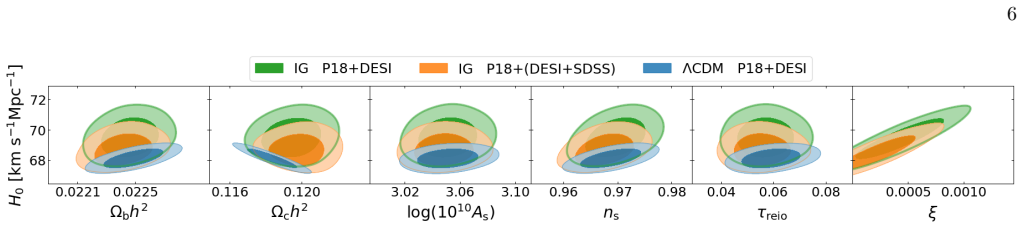
On the paper's own terms, the discovery is that DESI 2024 BAO data break a previous degeneracy: the combination P18+DESI moves the Brans-Dicke Galileon parameter away from its $\Lambda$CDM value of zero, giving $1/e_{\alpha 8} = 0.255^{+0.095}_{-0.064}$ (68% CI, about $3\sigma$), and correspondingly raises $H_0$ to $71.0^{+1.5}_{-1.3}$ km/s/Mpc. The paper shows this is driven mainly by the first two DESI redshift bins (BGS and LRG1) and that the same mechanism operates in induced gravity, induced gravity with a gravitational-constant offset, and early modified gravity, all of which prefer larger modified-gravity parameters and higher $H_0$ with DESI than with previous SDSS BAO data. In BDG the fit improves over $\Lambda$CDM by $\Delta\chi^2 = -5.6$ ($\Delta\mathrm{AIC} = -3.6$), the dark-energy equation of state becomes phantom at low redshift, and the result sits between the SH0ES and CCHP local measurements, consistent with both.
Load-bearing premise
The central claim stands on the assumption that the DESI BAO measurements in the first two redshift bins (BGS and LRG1, $z<0.8$) are free of systematics that mimic a preference for higher $H_0$; replacing those bins with SDSS low-$z$ data lowers the Galileon parameter from $3\sigma$ to $2\sigma$ significance and raises the Hubble tension from $1.2\sigma$ to $2.6\sigma$.
Editorial extensions
If this is right
- If the BDG preference is real, Planck and SH0ES measurements of $H_0$ agree at the $1.2\sigma$ level, so the Hubble tension does not require unknown systematics in either experiment.
- The nonzero $1/e_{\alpha 8}$ value implies a dark-energy equation of state that crosses below $-1$ at low redshift, aligning with DESI's preference for dynamical dark energy over a pure cosmological constant.
- Constraints on the nonminimal coupling $\xi$ in induced gravity become weaker with DESI than with SDSS because DESI pulls $H_0$ higher, changing the upper limits cosmology can place on modified-gravity parameters.
- Replacing the two lowest DESI redshift bins with SDSS low-$z$ data reduces the Galileon significance from $3\sigma$ to $2\sigma$ and raises the $H_0$ tension to $2.6\sigma$, showing that the result depends on those specific bins.
- When a SH0ES prior is added, BDG improves over $\Lambda$CDM by $\Delta\chi^2 = -23.4$ and $\Delta\mathrm{AIC} = -21.4$, making the model statistically preferred when local $H_0$ information is included.
Reading between the lines
- If the $3\sigma$ detection survives scrutiny of the low-redshift DESI bins, a next testable signature is the predicted present-day time variation of the gravitational constant, $\dot{G}_{\rm cosm}/G_{\rm cosm} \simeq -1.1 \times 10^{-12}$ yr$^{-1}$, which improved lunar laser ranging or solar-system ephemerides could detect or rule out.
- The paper's own dataset substitution suggests a decisive cross-check: reanalyzing with pre-reconstruction BAO estimators or the linear-point method in the BGS and LRG1 bins should either confirm or erase the $1/e_{\alpha 8}$ detection.
- Because only BDG among the four models generates a phantom equation of state, the comparison implies that the Galileon term, not the nonminimal coupling per se, is what makes the fit to DESI BAO data work; models without that term only mildly ease the tension.
Signed reviews
Editorial analysis
A structured set of objections, weighed in public.
Referee Report
Summary. The paper analyzes four scalar-tensor gravity models (induced gravity IG, induced gravity with an effective gravitational-constant imbalance DeltaIG, Brans-Dicke Galileon BDG, and early modified gravity with conformal coupling EMG-CC) against Planck 2018 CMB data combined with DESI 2024 BAO data, with variants replacing the two lowest DESI redshift bins by SDSS low-z BAO data and with SH0ES/CCHP H0 priors. The main claim is that BDG prefers a nonzero Galileon term, 1/eα8 = 0.255+0.095−0.064, about 3σ from the ΛCDM limit, and H0 = 71.0+1.5−1.3 km/s/Mpc, reducing the SH0ES tension to 1.2σ, while the same parameter is only an upper limit with previous SDSS BAO data. The paper also reports that this preference is mainly driven by the first two DESI redshift bins, and that replacing them with SDSS data lowers the Galileon significance to roughly 2σ and increases the H0 tension to 2.6σ. The IG, DeltaIG, and EMG-CC models do not show a statistical preference over ΛCDM with CMB+BAO alone.
Significance. If the BDG detection were robust, this would be an interesting and timely result: a concrete modified-gravity model that simultaneously explains the DESI BAO preference for dynamical dark energy and substantially alleviates the Hubble tension, with a full treatment of background and perturbations rather than a phenomenological parametrization. The authors are to be credited for performing a complete Einstein-Boltzmann treatment, for comparing four models on equal footing, and for explicitly reporting the cross-check with SDSS low-z data instead of hiding the fragility. However, the central claim is highly sensitive to the low-redshift DESI bins, and the paper contains internal inconsistencies in the reported significance and in the treatment of lunar laser ranging constraints. The significance for the field is therefore conditional: the manuscript is a useful parameter study, but its headline conclusion needs additional robustness work before it can be regarded as a secure detection.
major comments (5)
- [Abstract; Section IV.B; Table III] The headline BDG detection is not robust to the choice of low-z BAO data. With P18+DESI the Galileon parameter is 1/eα8 = 0.255+0.095−0.064 and H0 = 71.0+1.5−1.3, but with P18+(DESI+SDSS), which replaces the BGS and first LRG bins with SDSS low-z data, the same parameter becomes 0.157+0.088−0.076 (consistent with zero at about 2σ) and H0 = 69.2+0.9−1.2, with the SH0ES tension growing to 2.6σ. Since the abstract itself states that the results are 'mainly driven by the first two redshift bins of DESI,' the central claim is contingent on those two bins being free of systematics. The authors should either provide an explicit systematic-robustness analysis of the BGS and LRG1 measurements, or substantially rephrase the conclusions to present the BDG preference as dataset-dependent rather than as a detection.
- [Section IV.B, Eq. following 'about 3σ'] The claim that 1/eα8 = 0.255+0.095−0.064 is 'about 3σ away from the ΛCDM value of 0' is not supported by the quoted asymmetric 68% interval alone: the ratio of the mean to the two one-sided errors gives values between about 2.7 and 4.0, and for a strongly non-Gaussian posterior either number is not a valid significance. The authors should report the posterior probability at zero, or the credible interval excluding zero, to justify the significance statement. This is load-bearing because the '3σ detection' is the paper's central quantitative result.
- [Section IV.B, Gdot/Gcosm paragraph; Table III] The quoted time derivative of the cosmological gravitational constant for P18+DESI, Gdot/Gcosm(z=0) = (−11.1+2.4−3.9)×10^-13 yr^-1, does not contain zero at even the 2σ level under a Gaussian interpretation, and the same is true for the P18+(DESI+SDSS) value (−7.1+3.1−3.9)×10^-13. The sentence that these values are 'consistent with 0 at the 2σ level' is therefore inaccurate. The subsequent arguments that LLR constraints may be weakened by core-rotation correlations or by inhomogeneous local evolution are plausible directions but are not quantified here. As written, the paper simultaneously acknowledges exceeding the LLR limits and asserts consistency with zero, which is internally inconsistent and leaves the viability of BDG unclear.
- [Section III.B (BDG sampling)] In the BDG analysis the nonminimal coupling is fixed to ξ = 5×10^-5 rather than sampled, and only the Galileon amplitude 1/eα8 varies. Since the posterior for 1/eα8 is strongly degenerate with H0 and the model's viability depends on the chosen ξ, the reported 'detection' is conditional on an untested prior choice. A robustness check varying ξ within a range consistent with solar-system and cosmological constraints, or a discussion of why the result is insensitive to ξ, is needed before the 3σ claim can be taken as a property of the model class rather than of the chosen parameter point.
- [Table IV vs Section IV.D.3] There is a numerical inconsistency in the EMG-CC results: the text states that with P18+DESI+SH0ES the 95% upper bound is 'V0 < 1.2,' while Table IV reports 'V0 < −1.2 (95%)'. The same table also uses an em-dash for the other dataset combinations, so the reader cannot tell which value is correct. In addition, the Conclusions section contains an incomplete sentence 'Δχ2 = − for EMG-CC' with a missing number. These need to be corrected.
minor comments (4)
- [Section IV.C] The text says 'the 65% CI for the Hubble constant' where the context and tables indicate a 68% credible interval.
- [Section III (datasets)] The paper would be easier to reproduce if the chains or the modified CLASSig likelihood code were made public, or if a link to the existing public code were provided. The current reference list names Cobaya and CLASS, but not the exact version or repository used for the modified gravity extension.
- [Figure 2 and Appendix C] The definition of wDE in Eq. (C12) is clear, but the comparison with the w0waCDM curve in Figure 2 would benefit from a statement about how the latter is normalized (e.g., whether it is evaluated at the same best-fit background) and from error bars on the wDE curve, since the differences between models are otherwise hard to assess.
- [Section IV.B, previous constraint] The statement that DESI constrains 1/eα8 'by a factor of 2 better' than the earlier SDSS upper limit is imprecise; the earlier work gave an upper limit, not a measurement, so a direct comparison of precision is not straightforward. Please clarify what is meant.
Circularity Check
No circularity: the BDG Galileon parameter and H0 are posterior outputs of standard MCMC on external Planck and DESI data, not re-labeled inputs or self-citation-derived predictions.
full rationale
The paper performs conventional Bayesian parameter estimation: cosmological parameters including H0 and the modified-gravity parameter 1/eα8 are sampled, with the likelihood built from externally published Planck and DESI/SDSS measurements. There is no equation in which a claimed prediction is defined in terms of the data that it purportedly predicts: the 3σ departure of 1/eα8 from zero and the H0 = 71.0 posterior are outputs of the P18+DESI analysis, not inputs. The boundary conditions fixing Geff or Gcosm to measured values are physical consistency constraints imported from solar-system physics, not fitted predictions. The main self-citations are to the authors' earlier model implementations and priors (e.g., CLASSig in Ref. [77] and the fixed ξ = 5×10⁻⁵ in Ref. [87]); these are code and model-prescription reuse, and the central inference remains sensitive to external data rather than being forced by those citations. The paper's own limitation statement that the result is 'mainly driven by the first two redshift bins of DESI' and the DESI+SDSS cross-check showing reduced significance are empirical robustness concerns, not circularity: replacing data changes the posterior, which is exactly what a non-circular inference should do. No fitted quantity is renamed as a prediction, no uniqueness theorem from the authors' prior work is invoked to forbid alternatives, and no derived result reduces by construction to its own input. Therefore the circularity score is 0.
Assumptions & free parameters
free parameters (6)
- 1/eα8 (BDG Galileon amplitude) =
0.255+0.095-0.064 (68% CI, P18+DESI)
- ξ (BDG nonminimal coupling) =
5e-5 (fixed by hand)
- ζIG (IG and ∆IG coupling) =
< 0.0035 (95% CI, P18+DESI)
- ∆ (∆IG gravitational-constant imbalance) =
-0.008 ± 0.035 (P18+DESI)
- σini/MPl (EMG-CC initial field) =
< 0.38 (95% CI, P18+DESI)
- V0 (EMG-CC potential amplitude) =
unconstrained (P18+DESI)
assumptions (4)
- domain assumption The action (1) with the specified Horndeski functions (2) captures the relevant gravitational physics on cosmological scales.
- domain assumption Vainshtein screening suppresses the scalar field's local effects in BDG, so the model passes Solar System tests and the local gravitational constant is Gcosm.
- ad hoc to paper The homogeneous cosmic evolution of the scalar field can be used to compute the local time derivative of the gravitational constant, comparable to LLR bounds.
- domain assumption The DESI BAO likelihood and the first two redshift bins are free of systematics that mimic a preference for higher H0.
Cite this review
Pith. "Pith review of Scalar-Tensor Gravity and DESI 2024 BAO data." pith.science (2026). https://pith.science/paper/GQPUIQKS
@misc{pith2026250115298,
  author       = {Pith},
  title        = {Pith review of: Scalar-Tensor Gravity and DESI 2024 BAO data},
  year         = {2026},
  howpublished = {\url{https://pith.science/paper/GQPUIQKS}},
  note         = {Machine review of arXiv:2501.15298}
}
abstract
We discuss the implications of the DESI 2024 BAO data on scalar-tensor models of gravity. We consider four representative models: induced gravity (IG, equivalent to Jordan-Brans-Dicke), where we either fix today's value of the effective gravitational constant on cosmological scales to the Newton's constant or allow them to differ, Jordan-Brans-Dicke supplemented with a Galileon term (BDG), and early modified gravity (EMG) with a conformal coupling. In this way it is possible to investigate how different modified gravity models compare with each other when confronted with DESI 2024 BAO data. Compared to previous analyses, for all of these models, the combination of Planck and DESI data favors a larger value of the key parameter of the theory, such as the nonminimal coupling to gravity or the Galileon term, leading also to a larger value of $H_0$, due to the known degeneracy between these parameters. These new results are mainly driven by the first two redshift bins of DESI. In BDG, in which we find the largest value for $H_0$ among the models considered, the combination of Planck and DESI is consistent with CCHP results and reduces the $H_0$ tension with the SH0ES measurement to $1.2\sigma$ (compared to $4.5\sigma$ of $\Lambda$CDM in our Planck + DESI analysis).
Figures


Figures from the paper (9 more)




Forward citations
Cited by 7 Pith papers
-
The $H_0$ world cup. II. A comprehensive competition between proposed Hubble tension solutions
Against a common 2025-26 dataset (Planck PR4, ACT DR6, SPT-3G, DESI DR2, Pantheon+), early dark energy and early modified gravity models win the H0 competition (~3σ residual tension), while radiation and late-time sol...
-
Is Dark Energy an Effective Manifestation of Non-equilibrium Thermodynamics? -- Insights from DESI
Two phenomenological dark matter creation rates can reproduce the accelerated expansion of the universe and fit current background data as well as or slightly better than LambdaCDM for some DESI-based data combinations.
-
Can the universe experience an AdS landscape since matter-radiation equality?
A universe with an AdS (negative cosmological constant) phase at recombination and another at low redshift is compatible with Planck, DESI, Pantheon Plus and SH0ES data, though not preferred by them.
-
Robustness of dark energy phenomenology across different parameterizations
The viability of minimally and non-minimally coupled quintessence models is robust across CPL, JBP, BA, and EXP parameterizations, with all four reproducing the models' predicted observables accurately.
-
Imprint of swampland-inspired coupled early dark energy
A swampland-inspired DM-EDE coupling is tested against DESI DR2 BAO data, showing the EDE potential construction affects late-time dark energy constraints.
-
Observational constraints on early time non-phantom behaviour of dynamical dark energy
Early scaling dark energy is constrained to be less than about one percent at matter-radiation equality and is disfavored by model selection, while late-time CPL dynamics show only a weak preference away from ΛCDM.
-
An overview of what current data can (and cannot yet) say about evolving dark energy
The apparent preference for evolving dark energy depends strongly on which supernova catalog and which BAO survey are used, and is not robust across all independent data combinations.
Reference graph
Works this paper leans on
-
[1]
BDG In Fig. 8 we present the results of the analysis for the BDG model: the addition of the Gaussian prior pulls the credible interval of 1 /eα8 away from zero, indicating a stronger preference for BDG with respect to ΛCDM. With the SH0ES prior, both an upward shift in the mean of H0 and a reduction in the error bars contribute to this effect. The CCHP pr...
-
[2]
The trends are qualitatively similar: the detection of the modified gravity parameters is more stringent due to the degeneracies with H0, highlighted in Secs
IG and ∆IG We now discuss the effect of the Gaussian prior in IG, ∆IG and EMG-CC. The trends are qualitatively similar: the detection of the modified gravity parameters is more stringent due to the degeneracies with H0, highlighted in Secs. IV A and IV C. This is also reflected in a statistical preference for all models with respect to ΛCDM when the SH0ES...
-
[3]
This is due to the degeneracy between the nonminimal coupling function (and hence σini) and H0
EMG-CC In EMG-CC, with the addition of the SH0ES prior to P18 and DESI, there is a sharper detection of the ini- tial value of the scalar field: its 68% CI is σini[MPl] = 0.38+0.08 −0.06. This is due to the degeneracy between the nonminimal coupling function (and hence σini) and H0. Since larger values of the Hubble constant are favored by the SH0ES prior...
2024
-
[4]
A. Aghamousa et al. (DESI), The DESI Experiment Part I: Science,Targeting, and Survey Design, (2016), arXiv:1611.00036 [astro-ph.IM]
arXiv 2016
-
[5]
A. G. Adame et al. (DESI), DESI 2024 III: Baryon Acoustic Oscillations from Galaxies and Quasars, (2024), arXiv:2404.03000 [astro-ph.CO]
arXiv 2024
-
[6]
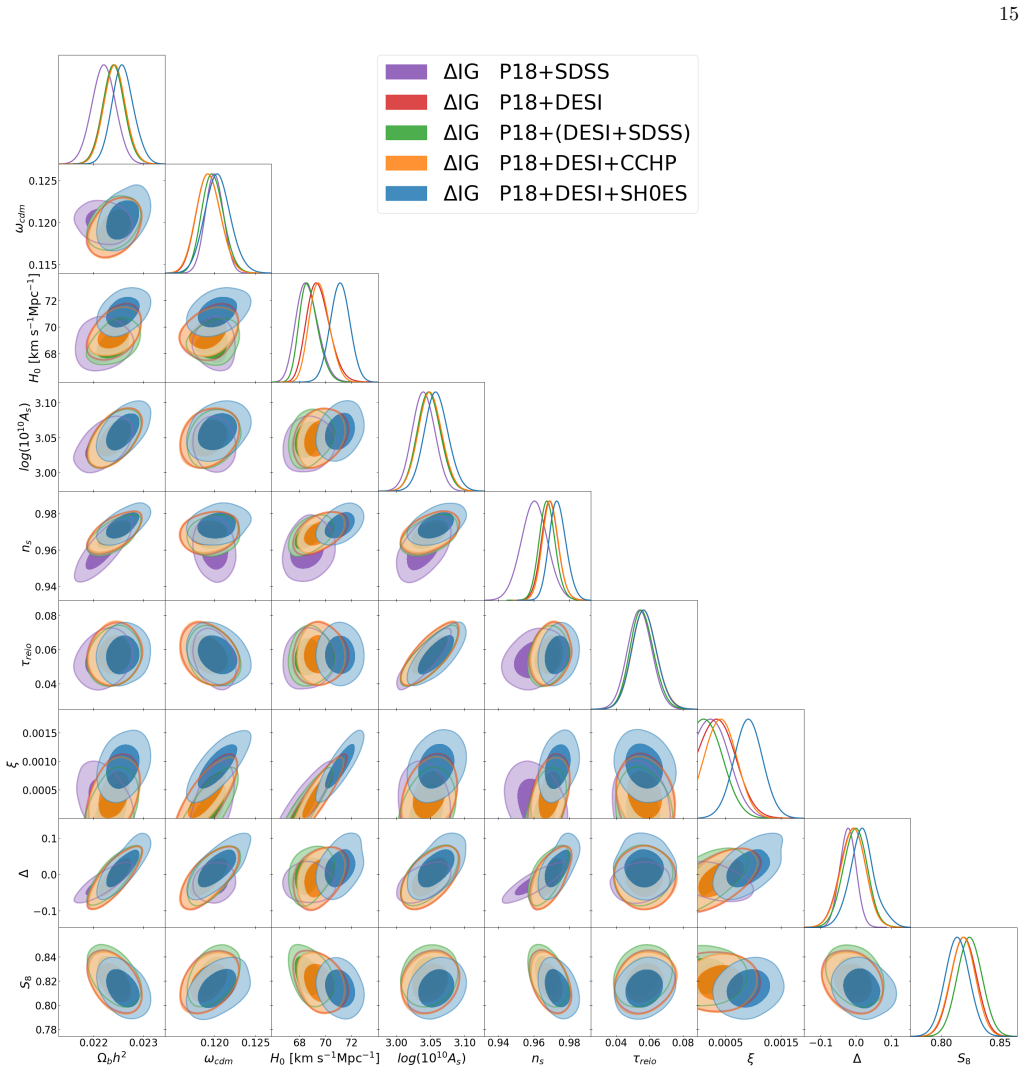
consensus results on BAOs in three redshift slices with effective redshifts zeff = 0.38, 0.51, 0.61 [121–123], in combination with measure from 6dF [125] at zeff = 0.106 and the one from SDSS DR7 [120] at zeff = 0.15. 16 FIG. 11. Triangle plot in BDG comparing results for P18+SDSS, P18+DESI, P18+(DESI+SDSS), P18+DESI+SH0ES, and P18+DESI+CCHP. The results ...
-
[7]
D. J. Eisenstein et al. (SDSS), Detection of the Baryon Acoustic Peak in the Large-Scale Correlation Function of SDSS Luminous Red Galaxies, Astrophys. J. 633, 560 (2005), arXiv:astro-ph/0501171
arXiv 2005
-
[8]
S. Cole et al. (2dFGRS), The 2dF Galaxy Redshift Sur- vey: Power-spectrum analysis of the final dataset and cosmological implications, Mon. Not. Roy. Astron. Soc. 362, 505 (2005), arXiv:astro-ph/0501174
arXiv 2005
Show all 150 references
-
[9]
https://www.desi.lbl.gov/
-
[10]
Tada and T
Y. Tada and T. Terada, Quintessential interpretation of the evolving dark energy in light of DESI observations, Phys. Rev. D 109, L121305 (2024), arXiv:2404.05722 [astro-ph.CO]
2024 arXiv
-
[11]
Yin, Cosmic clues: DESI, dark energy, and the cosmological constant problem, JHEP 05, 327, arXiv:2404.06444 [hep-ph]
W. Yin, Cosmic clues: DESI, dark energy, and the cosmological constant problem, JHEP 05, 327, arXiv:2404.06444 [hep-ph]
-
[12]
A. G. Adame et al. (DESI), DESI 2024 IV: Baryon Acoustic Oscillations from the Lyman Alpha Forest, (2024), arXiv:2404.03001 [astro-ph.CO]
2024 arXiv
-
[13]
A. G. Adame et al. (DESI), DESI 2024 VI: Cosmological Constraints from the Measurements of Baryon Acoustic Oscillations, (2024), arXiv:2404.03002 [astro-ph.CO]
2024 arXiv
-
[14]
A. G. Adame et al. (DESI), DESI 2024 V: Full-Shape Galaxy Clustering from Galaxies and Quasars, (2024), arXiv:2411.12021 [astro-ph.CO]
2024 arXiv
-
[15]
Van Raamsdonk and C
M. Van Raamsdonk and C. Waddell, Suggestions of de- creasing dark energy from supernova and BAO data, JCAP 06, 047, arXiv:2305.04946 [astro-ph.CO]
-
[16]
Carloni, O
Y. Carloni, O. Luongo, and M. Muccino, Does dark energy really revive using DESI 2024 data?, (2024), arXiv:2404.12068 [astro-ph.CO]
2024 arXiv
-
[17]
Wang, The Self-Consistency of DESI Analysis and Comment on ”Does DESI 2024 Confirm ΛCDM?”, (2024), arXiv:2404.13833 [astro-ph.CO]
D. Wang, The Self-Consistency of DESI Analysis and Comment on ”Does DESI 2024 Confirm ΛCDM?”, (2024), arXiv:2404.13833 [astro-ph.CO]
2024 arXiv
-
[18]
Wang, Constraining Cosmological Physics with DESI BAO Observations, (2024), arXiv:2404.06796 [astro- ph.CO]
D. Wang, Constraining Cosmological Physics with DESI BAO Observations, (2024), arXiv:2404.06796 [astro- ph.CO]
2024 arXiv
-
[19]
Luongo and M
O. Luongo and M. Muccino, Model-independent cosmo- graphic constraints from DESI 2024, Astron. Astrophys. 690, A40 (2024), arXiv:2404.07070 [astro-ph.CO]
2024 arXiv
-
[20]
Cortˆ es and A
M. Cortˆ es and A. R. Liddle, Interpreting DESI’s evidence for evolving dark energy, JCAP 12, 007, arXiv:2404.08056 [astro-ph.CO]
-
[21]
E. O. Colg´ ain, M. G. Dainotti, S. Capozziello, S. Pouro- jaghi, M. M. Sheikh-Jabbari, and D. Stojkovic, Does DESI 2024 Confirm ΛCDM?, (2024), arXiv:2404.08633 [astro-ph.CO]
2024 arXiv
-
[22]
Y. Yang, X. Ren, Q. Wang, Z. Lu, D. Zhang, Y.-F. Cai, and E. N. Saridakis, Quintom cosmology and mod- ified gravity after DESI 2024, Sci. Bull. 69, 2698 (2024), arXiv:2404.19437 [astro-ph.CO]
2024 arXiv
-
[23]
Craig, D
N. Craig, D. Green, J. Meyers, and S. Rajendran, No νs is Good News, JHEP 09, 097, arXiv:2405.00836 [astro- ph.CO]
-
[24]
I. J. Allali, A. Notari, and F. Rompineve, Reduced Hub- ble tension in dark radiation models after DESI 2024, JCAP 03, 023, arXiv:2404.15220 [astro-ph.CO]
2024 arXiv
-
[25]
Giar` e, M
W. Giar` e, M. A. Sabogal, R. C. Nunes, and E. Di Valentino, Interacting Dark Energy after DESI Baryon Acoustic Oscillation Measurements, Phys. Rev. Lett. 133, 251003 (2024), arXiv:2404.15232 [astro- ph.CO]
2024 arXiv
-
[26]
F. J. Qu, K. M. Surrao, B. Bolliet, J. C. Hill, B. D. Sherwin, and H. T. Jense, Accelerated inference on ac- celerated cosmic expansion: New constraints on axion- like early dark energy with DESI BAO and ACT DR6 CMB lensing, (2024), arXiv:2404.16805 [astro-ph.CO]
2024 arXiv
-
[27]
Wang and Y.-S
H. Wang and Y.-S. Piao, Dark energy in light of recent DESI BAO and Hubble tension, (2024), arXiv:2404.18579 [astro-ph.CO]
2024 arXiv
-
[28]
Chudaykin and M
A. Chudaykin and M. Kunz, Modified gravity interpre- tation of the evolving dark energy in light of DESI data, Phys. Rev. D 110, 123524 (2024), arXiv:2407.02558 [astro-ph.CO]
2024 arXiv
-
[29]
Green and J
D. Green and J. Meyers, The Cosmological Preference for Negative Neutrino Mass, (2024), arXiv:2407.07878 [astro-ph.CO]
2024 arXiv
-
[30]
Mukherjee and A
P. Mukherjee and A. A. Sen, Model-independent cosmo- logical inference post DESI DR1 BAO measurements, Phys. Rev. D 110, 123502 (2024), arXiv:2405.19178 [astro-ph.CO]
2024
-
[31]
zabat, Y
S. zabat, Y. Kehal, and K. Nouicer, Alleviating the H0 and σ8 tensions in the interacting cubic covariant Galileon model, (2024), arXiv:2405.20240 [gr-qc]
2024 arXiv
-
[32]
Roy, Dynamical dark energy in the light of DESI 2024 data, (2024), arXiv:2406.00634 [astro-ph.CO]
N. Roy, Dynamical dark energy in the light of DESI 2024 data, (2024), arXiv:2406.00634 [astro-ph.CO]
2024 arXiv
-
[33]
I. D. Gialamas, G. H¨ utsi, K. Kannike, A. Racioppi, M. Raidal, M. Vasar, and H. Veerm¨ ae, Interpreting DESI 2024 BAO: late-time dynamical dark energy or a local effect?, (2024), arXiv:2406.07533 [astro-ph.CO]
2024 arXiv
-
[34]
Park and B
C.-G. Park and B. Ratra, Is excess smoothing of Planck CMB ansiotropy data partially responsible for evi- dence for dark energy dynamics in other w(z)CDM parametrizations?, (2025), arXiv:2501.03480 [astro- ph.CO]
2025 arXiv
-
[35]
O. F. Ramadan, J. Sakstein, and D. Rubin, DESI con- straints on exponential quintessence, Phys. Rev. D 110, L041303 (2024), arXiv:2405.18747 [astro-ph.CO]. 20
2024 arXiv
-
[36]
Giar` e, M
W. Giar` e, M. Najafi, S. Pan, E. Di Valentino, and J. T. Firouzjaee, Robust preference for Dynamical Dark En- ergy in DESI BAO and SN measurements, JCAP 10, 035, arXiv:2407.16689 [astro-ph.CO]
-
[37]
Barbieri, T
N. Barbieri, T. Brinckmann, S. Gariazzo, M. Lattanzi, S. Pastor, and O. Pisanti, Current constraints on cosmo- logical scenarios with very low reheating temperatures, (2025), arXiv:2501.01369 [astro-ph.CO]
2025
-
[38]
C.-G. Park, J. d. C. P´ erez, and B. Ratra, Us- ing non-DESI data to confirm and strengthen the DESI 2024 spatially flat w0waCDM cosmological parametrization result, Phys. Rev. D 110, 123533 (2024), arXiv:2405.00502 [astro-ph.CO]
2024 arXiv
-
[39]
C.-G. Park, J. d. C. P´ erez, and B. Ratra, Is the w0waCDM cosmological parameterization evidence for dark energy dynamics partially caused by the excess smoothing of Planck CMB anisotropy data?, (2024), arXiv:2410.13627 [astro-ph.CO]
2024 arXiv
-
[40]
Bhattacharya, G
S. Bhattacharya, G. Borghetto, A. Malhotra, S. Parameswaran, G. Tasinato, and I. Zavala, Cos- mological tests of quintessence in quantum gravity, (2024), arXiv:2410.21243 [astro-ph.CO]
2024
-
[41]
Taule, M
P. Taule, M. Marinucci, G. Biselli, M. Pietroni, and F. Vernizzi, Constraints on dark energy and modified gravity from the BOSS Full-Shape and DESI BAO data, (2024), arXiv:2409.08971 [astro-ph.CO]
2024 arXiv
-
[42]
W. J. Wolf, C. Garc ´ ıa-Garc ´ ıa, D. J. Bartlett, and P. G. Ferreira, Scant evidence for thawing quintessence, Phys. Rev. D 110, 083528 (2024), arXiv:2408.17318 [astro- ph.CO]
2024 arXiv
-
[43]
W. J. Wolf, P. G. Ferreira, and C. Garc ´ ıa- Garc ´ ıa, Matching current observational constraints with nonminimally coupled dark energy, (2024), arXiv:2409.17019 [astro-ph.CO]
2024 arXiv
-
[44]
G. Ye, M. Martinelli, B. Hu, and A. Silvestri, Non- minimally coupled gravity as a physically viable fit to DESI 2024 BAO, (2024), arXiv:2407.15832 [astro- ph.CO]
2024 arXiv
-
[45]
Bhattacharya, G
S. Bhattacharya, G. Borghetto, A. Malhotra, S. Parameswaran, G. Tasinato, and I. Zavala, Cosmo- logical constraints on curved quintessence, JCAP 09, 073, arXiv:2405.17396 [astro-ph.CO]
-
[46]
Di Valentino et al
E. Di Valentino et al. , Cosmology intertwined III: f σ8 and S8, Astropart. Phys. 131, 102604 (2021), arXiv:2008.11285 [astro-ph.CO]
2021 arXiv
-
[47]
Di Valentino, O
E. Di Valentino, O. Mena, S. Pan, L. Visinelli, W. Yang, A. Melchiorri, D. F. Mota, A. G. Riess, and J. Silk, In the realm of the Hubble tension—a review of solutions, Class. Quant. Grav. 38, 153001 (2021), arXiv:2103.01183 [astro-ph.CO]
2021 arXiv
-
[48]
E. O. Colg´ ain, S. Pourojaghi, and M. M. Sheikh- Jabbari, Implications of DES 5YR SNe Dataset for ΛCDM, (2024), arXiv:2406.06389 [astro-ph.CO]
2024 arXiv
-
[49]
E. O. Colg´ ain and M. M. Sheikh-Jabbari, DESI and SNe: Dynamical Dark Energy, Ω m Tension or System- atics?, (2024), arXiv:2412.12905 [astro-ph.CO]
2024 arXiv
-
[50]
Knox and M
L. Knox and M. Millea, Hubble constant hunter’s guide, Phys. Rev. D 101, 043533 (2020), arXiv:1908.03663 [astro-ph.CO]
2020 arXiv
-
[51]
Di Valentino et al., Snowmass2021 - Letter of interest cosmology intertwined II: The hubble constant tension, Astropart
E. Di Valentino et al., Snowmass2021 - Letter of interest cosmology intertwined II: The hubble constant tension, Astropart. Phys. 131, 102605 (2021), arXiv:2008.11284 [astro-ph.CO]
2021 arXiv
-
[52]
Aghanim et al
N. Aghanim et al. (Planck), Planck 2018 results. I. Overview and the cosmological legacy of Planck, Astron. Astrophys. 641, A1 (2020), arXiv:1807.06205 [astro- ph.CO]
2020 arXiv
-
[53]
A. G. Riess et al. , A Comprehensive Measurement of the Local Value of the Hubble Constant with 1 km s−1 Mpc−1 Uncertainty from the Hubble Space Tele- scope and the SH0ES Team, Astrophys. J. Lett. 934, L7 (2022), arXiv:2112.04510 [astro-ph.CO]
2022 arXiv
-
[54]
Perivolaropoulos and F
L. Perivolaropoulos and F. Skara, Challenges for ΛCDM: An update, New Astron. Rev. 95, 10.1016/j.newar.2022.101659 (2022), arXiv:2105.05208 [astro-ph.CO]
2022
-
[55]
Sch¨ oneberg, G
N. Sch¨ oneberg, G. Franco Abell´ an, A. P´ erez S´ anchez, S. J. Witte, V. Poulin, and J. Lesgourgues, The H0 Olympics: A fair ranking of proposed models, Phys. Rept. 984, 1 (2022), arXiv:2107.10291 [astro-ph.CO]
2022 arXiv
-
[56]
P. Shah, P. Lemos, and O. Lahav, A buyer’s guide to the Hubble constant, Astron. Astrophys. Rev. 29, 9 (2021), arXiv:2109.01161 [astro-ph.CO]
2021 arXiv
-
[57]
Abdalla et al
E. Abdalla et al. , Cosmology intertwined: A review of the particle physics, astrophysics, and cosmology asso- ciated with the cosmological tensions and anomalies, JHEAp 34, 49 (2022), arXiv:2203.06142 [astro-ph.CO]
2022 arXiv
-
[58]
Kobayashi, Horndeski theory and beyond: a review, Rept
T. Kobayashi, Horndeski theory and beyond: a review, Rept. Prog. Phys. 82, 086901 (2019), arXiv:1901.07183 [gr-qc]
2019 arXiv
-
[59]
Quiros, Selected topics in scalar–tensor theories and beyond, Int
I. Quiros, Selected topics in scalar–tensor theories and beyond, Int. J. Mod. Phys. D 28, 1930012 (2019), arXiv:1901.08690 [gr-qc]
2019 arXiv
-
[60]
Jordan, Schwerkraft und Weltall: Grundlagen der theoretischen Kosmologie, Die Wissenschaft (F
P. Jordan, Schwerkraft und Weltall: Grundlagen der theoretischen Kosmologie, Die Wissenschaft (F. Vieweg, 1955)
1955
-
[61]
Brans and R
C. Brans and R. H. Dicke, Mach’s principle and a rel- ativistic theory of gravitation, Phys. Rev. 124, 925 (1961)
1961
-
[62]
G. W. Horndeski, Second-order scalar-tensor field equa- tions in a four-dimensional space, Int. J. Theor. Phys. 10, 363 (1974)
1974
-
[63]
Kase and S
R. Kase and S. Tsujikawa, Dark energy in Horndeski theories after GW170817: A review, Int. J. Mod. Phys. D 28, 1942005 (2019), arXiv:1809.08735 [gr-qc]
2019 arXiv
-
[64]
Esposito-Farese and D
G. Esposito-Farese and D. Polarski, Scalar tensor grav- ity in an accelerating universe, Phys. Rev. D 63, 063504 (2001), arXiv:gr-qc/0009034
2001 arXiv
-
[65]
Gannouji, D
R. Gannouji, D. Polarski, A. Ranquet, and A. A. Starobinsky, Scalar-Tensor Models of Normal and Phantom Dark Energy, JCAP 09, 016, arXiv:astro- ph/0606287
-
[66]
Cooper and G
F. Cooper and G. Venturi, Cosmology and Broken Scale Invariance, Phys. Rev. D 24, 3338 (1981)
1981
-
[67]
Amendola, Scaling solutions in general nonminimal coupling theories, Phys
L. Amendola, Scaling solutions in general nonminimal coupling theories, Phys. Rev. D 60, 043501 (1999), arXiv:astro-ph/9904120
1999 arXiv
-
[68]
Boisseau, G
B. Boisseau, G. Esposito-Farese, D. Polarski, and A. A. Starobinsky, Reconstruction of a scalar tensor theory of gravity in an accelerating universe, Phys. Rev. Lett. 85, 2236 (2000), arXiv:gr-qc/0001066
2000 arXiv
-
[69]
D. F. Torres, Quintessence, superquintessence and ob- servable quantities in Brans-Dicke and nonminimally coupled theories, Phys. Rev. D 66, 043522 (2002), arXiv:astro-ph/0204504
2002 arXiv
-
[70]
Deffayet, X
C. Deffayet, X. Gao, D. A. Steer, and G. Zahariade, From k-essence to generalised Galileons, Phys. Rev. D 84, 064039 (2011), arXiv:1103.3260 [hep-th]
2011 arXiv
-
[71]
F. P. Silva and K. Koyama, Self-Accelerating Universe in Galileon Cosmology, Phys. Rev. D 80, 121301(R) (2009), arXiv:0909.4538 [astro-ph.CO]
2009 arXiv
-
[72]
Finelli, A
F. Finelli, A. Tronconi, and G. Venturi, Dark Energy, Induced Gravity and Broken Scale Invariance, Phys. Lett. B 659, 466 (2008), arXiv:0710.2741 [astro-ph]
2008 arXiv
-
[73]
Cerioni, F
A. Cerioni, F. Finelli, A. Tronconi, and G. Venturi, In- flation and Reheating in Induced Gravity, Phys. Lett. B 681, 383 (2009), arXiv:0906.1902 [astro-ph.CO]
2009 arXiv
-
[74]
Nicolis, R
A. Nicolis, R. Rattazzi, and E. Trincherini, The Galileon as a local modification of gravity, Phys. Rev. D 79, 064036 (2009), arXiv:0811.2197 [hep-th]
2009 arXiv
-
[75]
Deffayet, G
C. Deffayet, G. Esposito-Farese, and A. Vikman, Co- variant Galileon, Phys. Rev. D 79, 084003 (2009), arXiv:0901.1314 [hep-th]
2009 arXiv
-
[76]
De Felice and S
A. De Felice and S. Tsujikawa, Conditions for the cos- mological viability of the most general scalar-tensor the- ories and their applications to extended Galileon dark energy models, JCAP 02, 007, arXiv:1110.3878 [gr-qc]
-
[77]
Umilt` a, M
C. Umilt` a, M. Ballardini, F. Finelli, and D. Paoletti, CMB and BAO constraints for an induced gravity dark energy model with a quartic potential, JCAP 08, 017, arXiv:1507.00718 [astro-ph.CO]
-
[78]
Kobayashi, H
T. Kobayashi, H. Tashiro, and D. Suzuki, Evolution of linear cosmological perturbations and its observa- tional implications in Galileon-type modified gravity, 21 Phys. Rev. D 81, 063513 (2010), arXiv:0912.4641 [astro- ph.CO]
2010 arXiv
-
[79]
Kobayashi, Cosmic expansion and growth histories in Galileon scalar-tensor models of dark energy, Phys
T. Kobayashi, Cosmic expansion and growth histories in Galileon scalar-tensor models of dark energy, Phys. Rev. D 81, 103533 (2010), arXiv:1003.3281 [astro-ph.CO]
2010 arXiv
-
[80]
Chow and J
N. Chow and J. Khoury, Galileon Cosmology, Phys. Rev. D 80, 024037 (2009), arXiv:0905.1325 [hep-th]
2009 arXiv
-
[81]
De Felice and S
A. De Felice and S. Tsujikawa, Generalized Brans-Dicke theories, JCAP 07, 024, arXiv:1005.0868 [astro-ph.CO]
-
[82]
Ballardini, M
M. Ballardini, M. Braglia, F. Finelli, D. Paoletti, A. A. Starobinsky, and C. Umilt` a, Scalar-tensor theories of gravity, neutrino physics, and the H0 tension, JCAP 10, 044, arXiv:2004.14349 [astro-ph.CO]
2004 arXiv
-
[83]
Braglia, M
M. Braglia, M. Ballardini, F. Finelli, and K. Koyama, Early modified gravity in light of the H0 tension and LSS data, Phys. Rev. D 103, 043528 (2021), arXiv:2011.12934 [astro-ph.CO]
2021 arXiv
-
[84]
Ballardini, F
M. Ballardini, F. Finelli, C. Umilt` a, and D. Paoletti, Cosmological constraints on induced gravity dark en- ergy models, JCAP 05, 067, arXiv:1601.03387 [astro- ph.CO]
-
[85]
Paoletti, M
D. Paoletti, M. Braglia, F. Finelli, M. Ballardini, and C. Umilt` a, Isocurvature fluctuations in the effective Newton’s constant, Phys. Dark Univ.25, 100307 (2019), arXiv:1809.03201 [astro-ph.CO]
2019 arXiv
-
[86]
Rossi, M
M. Rossi, M. Ballardini, M. Braglia, F. Finelli, D. Pao- letti, A. A. Starobinsky, and C. Umilt` a, Cosmological constraints on post-Newtonian parameters in effectively massless scalar-tensor theories of gravity, Phys. Rev. D 100, 103524 (2019), arXiv:1906.10218 [astro-ph.CO]
2019 arXiv
-
[87]
Braglia, M
M. Braglia, M. Ballardini, W. T. Emond, F. Finelli, A. E. Gumrukcuoglu, K. Koyama, and D. Pao- letti, Larger value for H0 by an evolving gravita- tional constant, Phys. Rev. D 102, 023529 (2020), arXiv:2004.11161 [astro-ph.CO]
2020 arXiv
-
[88]
Raveri, B
M. Raveri, B. Hu, N. Frusciante, and A. Silvestri, Effec- tive Field Theory of Cosmic Acceleration: constraining dark energy with CMB data, Phys. Rev. D 90, 043513 (2014), arXiv:1405.1022 [astro-ph.CO]
2014 arXiv
-
[89]
Bellini, A
E. Bellini, A. J. Cuesta, R. Jimenez, and L. Verde, Constraints on deviations from ΛCDM within Horn- deski gravity, JCAP 02, 053, [Erratum: JCAP 06, E01 (2016)], arXiv:1509.07816 [astro-ph.CO]
2016 arXiv
-
[90]
Ballardini, F
M. Ballardini, F. Finelli, and D. Sapone, Cosmologi- cal constraints on the gravitational constant, JCAP 06 (06), 004, arXiv:2111.09168 [astro-ph.CO]
-
[91]
Ballardini and F
M. Ballardini and F. Finelli, Type Ia supernovae data with scalar-tensor gravity, Phys. Rev. D 106, 063531 (2022), arXiv:2112.15126 [astro-ph.CO]
2022 arXiv
-
[92]
Ballardini, A
M. Ballardini, A. G. Ferrari, and F. Finelli, Phantom scalar-tensor models and cosmological tensions, JCAP 04, 029, arXiv:2302.05291 [astro-ph.CO]
-
[93]
A. G. Ferrari, M. Ballardini, F. Finelli, D. Paoletti, and N. Mauri, Cosmological effects of the Galileon term in scalar-tensor theories, Phys. Rev. D108, 063520 (2023), arXiv:2307.02987 [astro-ph.CO]
2023 arXiv
-
[94]
Joudaki, P
S. Joudaki, P. G. Ferreira, N. A. Lima, and H. A. Winther, Testing gravity on cosmic scales: A case study of Jordan-Brans-Dicke theory, Phys. Rev. D 105, 043522 (2022), arXiv:2010.15278 [astro-ph.CO]
2022 arXiv
-
[95]
J. A. Kable, G. Benevento, N. Frusciante, A. De Felice, and S. Tsujikawa, Probing modified gravity with inte- grated Sachs-Wolfe CMB and galaxy cross-correlations, JCAP 09, 002, arXiv:2111.10432 [astro-ph.CO]
-
[96]
Peirone, N
S. Peirone, N. Frusciante, B. Hu, M. Raveri, and A. Sil- vestri, Do current cosmological observations rule out all Covariant Galileons?, Phys. Rev. D 97, 063518 (2018), arXiv:1711.04760 [astro-ph.CO]
2018 arXiv
-
[97]
Sol` a Peracaula, A
J. Sol` a Peracaula, A. Gomez-Valent, J. de Cruz P´ erez, and C. Moreno-Pulido, Brans–Dicke Gravity with a Cosmological Constant Smoothes Out ΛCDM Tensions, Astrophys. J. Lett. 886, L6 (2019), arXiv:1909.02554 [astro-ph.CO]
2019 arXiv
-
[98]
Benevento, M
G. Benevento, M. Raveri, A. Lazanu, N. Bartolo, M. Liguori, P. Brax, and P. Valageas, K-mouflage Im- prints on Cosmological Observables and Data Con- straints, JCAP 05, 027, arXiv:1809.09958 [astro- ph.CO]
-
[99]
Peirone, G
S. Peirone, G. Benevento, N. Frusciante, and S. Tsu- jikawa, Cosmological data favor Galileon ghost conden- sate over ΛCDM, Phys. Rev. D 100, 063540 (2019), arXiv:1905.05166 [astro-ph.CO]
2019 arXiv
-
[100]
Zumalacarregui, Gravity in the Era of Equality: To- wards solutions to the Hubble problem without fine- tuned initial conditions, Phys
M. Zumalacarregui, Gravity in the Era of Equality: To- wards solutions to the Hubble problem without fine- tuned initial conditions, Phys. Rev. D 102, 023523 (2020), arXiv:2003.06396 [astro-ph.CO]
2020 arXiv
-
[101]
S. A. Hosseini Mansoori and H. Moshafi, Alleviating H 0 and S 8 Tensions Simultaneously in K-essence Cosmol- ogy, Astrophys. J. 975, 275 (2024), arXiv:2405.05843 [astro-ph.CO]
2024 arXiv
-
[102]
Barreira, B
A. Barreira, B. Li, C. Baugh, and S. Pascoli, The obser- vational status of Galileon gravity after Planck, JCAP 08, 059, arXiv:1406.0485 [astro-ph.CO]
-
[103]
J. Renk, M. Zumalacarregui, and F. Montanari, Gravity at the horizon: on relativistic effects, CMB-LSS correla- tions and ultra-large scales in Horndeski’s theory, JCAP 07, 040, arXiv:1604.03487 [astro-ph.CO]
-
[104]
Frusciante, S
N. Frusciante, S. Peirone, L. Atayde, and A. De Fe- lice, Phenomenology of the generalized cubic covariant Galileon model and cosmological bounds, Phys. Rev. D 101, 064001 (2020), arXiv:1912.07586 [astro-ph.CO]
2020 arXiv
-
[105]
Bessa, Strong gravitational lensing in Horndeski theory of gravity, Phys
P. Bessa, Strong gravitational lensing in Horndeski theory of gravity, Phys. Rev. D 108, 024062 (2023), arXiv:2304.08141 [gr-qc]
2023 arXiv
-
[106]
Hohmann, Parametrized post-Newtonian limit of Horndeski’s gravity theory, Phys
M. Hohmann, Parametrized post-Newtonian limit of Horndeski’s gravity theory, Phys. Rev. D 92, 064019 (2015), arXiv:1506.04253 [gr-qc]
2015 arXiv
-
[107]
Quiros, R
I. Quiros, R. De Arcia, R. Garc ´ ıa-Salcedo, T. Gonzalez, and F. A. Horta-Rangel, An issue with the classifica- tion of the scalar–tensor theories of gravity, Int. J. Mod. Phys. D 29, 2050047 (2020), arXiv:1905.08177 [gr-qc]
2020 arXiv
-
[108]
Ye and A
G. Ye and A. Silvestri, Cubic Galileon gravity ef- fects in the CMB, Phys. Rev. D 111, 023502 (2025), arXiv:2407.02471 [astro-ph.CO]
2025 arXiv
-
[109]
Bellini and I
E. Bellini and I. Sawicki, Maximal freedom at minimum cost: linear large-scale structure in general modifica- tions of gravity, JCAP 07, 050, arXiv:1404.3713 [astro- ph.CO]
-
[110]
Kobayashi, M
T. Kobayashi, M. Yamaguchi, and J. Yokoyama, Gen- eralized G-inflation: Inflation with the most general second-order field equations, Prog. Theor. Phys. 126, 511 (2011), arXiv:1105.5723 [hep-th]
2011 arXiv
-
[111]
B. P. Abbott et al. (LIGO Scientific, Virgo, Fermi- GBM, INTEGRAL), Gravitational Waves and Gamma- rays from a Binary Neutron Star Merger: GW170817 and GRB 170817A, Astrophys. J. Lett.848, L13 (2017), arXiv:1710.05834 [astro-ph.HE]. 22
2017 arXiv
-
[112]
Torrado and A
J. Torrado and A. Lewis, Cobaya: Bayesian analysis in cosmology, Astrophysics Source Code Library, record ascl:1910.019 (2019)
2019
-
[113]
Lesgourgues, The Cosmic Linear Anisotropy Solv- ing System (CLASS) I: Overview, arXiv e-prints , arXiv:1104.2932 (2011), arXiv:1104.2932 [astro-ph.IM]
J. Lesgourgues, The Cosmic Linear Anisotropy Solv- ing System (CLASS) I: Overview, arXiv e-prints , arXiv:1104.2932 (2011), arXiv:1104.2932 [astro-ph.IM]
2011 arXiv
-
[114]
Wetterich, Cosmologies With Variable Newton’s ’Constant’, Nucl
C. Wetterich, Cosmologies With Variable Newton’s ’Constant’, Nucl. Phys. B 302, 645 (1988)
1988
-
[115]
A. I. Vainshtein, To the problem of nonvanishing grav- itation mass, Phys. Lett. B 39, 393 (1972)
1972
-
[116]
Kimura, T
R. Kimura, T. Kobayashi, and K. Yamamoto, Vain- shtein screening in a cosmological background in the most general second-order scalar-tensor theory, Phys. Rev. D 85, 024023 (2012), arXiv:1111.6749 [astro- ph.CO]
2012 arXiv
-
[117]
Torrado and A
J. Torrado and A. Lewis, Cobaya: Code for Bayesian Analysis of hierarchical physical models, JCAP 05, 057, arXiv:2005.05290 [astro-ph.IM]
2005 arXiv
-
[118]
Aghanim et al
N. Aghanim et al. (Planck), Planck 2018 results. V. CMB power spectra and likelihoods, Astron. Astrophys. 641, A5 (2020), arXiv:1907.12875 [astro-ph.CO]
2020 arXiv
-
[119]
Aghanim et al
N. Aghanim et al. (Planck), Planck 2018 results. VIII. Gravitational lensing, Astron. Astrophys. 641, A8 (2020), arXiv:1807.06210 [astro-ph.CO]
2020 arXiv
-
[120]
D. Blas, J. Lesgourgues, and T. Tram, The Cosmic Lin- ear Anisotropy Solving System (CLASS) II: Approxi- mation schemes, JCAP 07, 034, arXiv:1104.2933 [astro- ph.CO]
-
[121]
Gelman and D
A. Gelman and D. B. Rubin, Inference from Iterative Simulation Using Multiple Sequences, Statist. Sci. 7, 457 (1992)
1992
-
[122]
https://getdist.readthedocs.io/en/latest/
-
[123]
Lewis, GetDist: a Python package for analysing Monte Carlo samples, arXiv e-prints , arXiv:1910.13970 (2019), arXiv:1910.13970 [astro-ph.IM]
A. Lewis, GetDist: a Python package for analysing Monte Carlo samples, arXiv e-prints , arXiv:1910.13970 (2019), arXiv:1910.13970 [astro-ph.IM]
2019 arXiv
-
[124]
Alam et al
S. Alam et al. (eBOSS), Completed SDSS-IV extended Baryon Oscillation Spectroscopic Survey: Cosmological implications from two decades of spectroscopic surveys at the Apache Point Observatory, Phys. Rev. D 103, 083533 (2021), arXiv:2007.08991 [astro-ph.CO]
2021 arXiv
-
[125]
Beutler, C
F. Beutler, C. Blake, M. Colless, D. H. Jones, L. Staveley-Smith, L. Campbell, Q. Parker, W. Saun- ders, and F. Watson, The 6dF Galaxy Survey: baryon acoustic oscillations and the local Hubble constant, MN- RAS 416, 3017 (2011), arXiv:1106.3366 [astro-ph.CO]
2011 arXiv
-
[126]
A. J. Ross, L. Samushia, C. Howlett, W. J. Percival, A. Burden, and M. Manera, The clustering of the SDSS DR7 main Galaxy sample – I. A 4 per cent distance measure at z = 0.15, Mon. Not. Roy. Astron. Soc. 449, 835 (2015), arXiv:1409.3242 [astro-ph.CO]
2015 arXiv
-
[127]
A. J. Ross et al. (BOSS), The clustering of galax- ies in the completed SDSS-III Baryon Oscillation Spectroscopic Survey: Observational systematics and baryon acoustic oscillations in the correlation func- tion, Mon. Not. Roy. Astron. Soc. 464, 1168 (2017), arXiv:1607.03145 [a...
2017 arXiv
-
[128]
Vargas-Maga˜ na et al
M. Vargas-Maga˜ na et al. (BOSS), The clustering of galaxies in the completed SDSS-III Baryon Oscilla- tion Spectroscopic Survey: theoretical systematics and Baryon Acoustic Oscillations in the galaxy correlation function, Mon. Not. Roy. Astron. Soc.477, 1153 (2018), arXiv:161...
2018 arXiv
-
[129]
Beutler et al
F. Beutler et al. (BOSS), The clustering of galaxies in the completed SDSS-III Baryon Oscillation Spec- troscopic Survey: baryon acoustic oscillations in the Fourier space, Mon. Not. Roy. Astron. Soc. 464, 3409 (2017), arXiv:1607.03149 [astro-ph.CO]
2017 arXiv
-
[130]
W. L. Freedman, B. F. Madore, I. S. Jang, T. J. Hoyt, A. J. Lee, and K. A. Owens, Status Report on the Chicago-Carnegie Hubble Program (CCHP): Measurement of the Hubble Constant Using the Hub- ble and James Webb Space Telescopes, (2024), arXiv:2408.06153 [astro-ph.CO]
2024 arXiv
-
[131]
Pisanti, A
O. Pisanti, A. Cirillo, S. Esposito, F. Iocco, G. Mangano, G. Miele, and P. D. Serpico, PArthENoPE: Public Algorithm Evaluating the Nucleosynthesis of Pri- mordial Elements, Comput. Phys. Commun. 178, 956 (2008), arXiv:0705.0290 [astro-ph]
2008 arXiv
-
[132]
de Sainte Agathe et al
V. de Sainte Agathe et al. , Baryon acoustic oscillations at z = 2.34 from the correlations of Ly α absorption in eBOSS DR14, Astron. Astrophys. 629, A85 (2019), arXiv:1904.03400 [astro-ph.CO]
2019 arXiv
-
[133]
Blomqvist et al
M. Blomqvist et al. , Baryon acoustic oscillations from the cross-correlation of Ly α absorption and quasars in eBOSS DR14, Astron. Astrophys. 629, A86 (2019), arXiv:1904.03430 [astro-ph.CO]
2019 arXiv
-
[134]
Anselmi, G
S. Anselmi, G. D. Starkman, and R. K. Sheth, Beating non-linearities: improving the Baryon Acoustic Oscilla- tions with the linear point, Mon. Not. Roy. Astron. Soc. 455, 2474 (2016), arXiv:1508.01170 [astro-ph.CO]
2016 arXiv
-
[135]
Anselmi, G
S. Anselmi, G. D. Starkman, P.-S. Corasaniti, R. K. Sheth, and I. Zehavi, Galaxy Correlation Functions Pro- vide a More Robust Cosmological Standard Ruler, Phys. Rev. Lett. 121, 021302 (2018), arXiv:1703.01275 [astro- ph.CO]
2018 arXiv
-
[136]
The number of ad- ditional parameters, i.e
of the extended model M relative to that of ΛCDM: ∆AIC = ∆χ2 + 2(NM − NΛCDM), where NM is the num- ber of free parameters of the model. The number of ad- ditional parameters, i.e. NM − NΛCDM, is one for IG and BDG and it is two for ∆IG and EMG-CC. IV. RESUL TS This section exa...
-
[137]
consensus results on BAOs in three redshift slices with effective redshifts zeff = 0.38, 0.51, 0.61 [121–123], in combination with measure from 6dF [125] at zeff = 0.106 and the one from SDSS DR7 [120] at zeff = 0.15. 15 FIG. 10. Triangle plot in ∆IG comparing results for P18+...
-
[138]
Consiglio, P
R. Consiglio, P. F. de Salas, G. Mangano, G. Miele, S. Pastor, and O. Pisanti, PArthENoPE reloaded, Com- put. Phys. Commun. 233, 237 (2018), arXiv:1712.04378 [astro-ph.CO]
2018 arXiv
-
[139]
M. Powell, The bobyqa algorithm for bound con- strained optimization without derivatives, Technical Re- port, Department of Applied Mathematics and Theoret- ical Physics (2009), https://www.damtp.cam.ac.uk/ user/na/NA_papers/NA2009_06.pdf
2009
-
[140]
Cartis, J
C. Cartis, J. Fiala, B. Marteau, and L. Roberts, Im- proving the flexibility and robustness of model-based derivative-free optimization solvers, ACM Transactions on Mathematical Software (TOMS) 45, 1 (2019)
2019
-
[141]
Cartis, L
C. Cartis, L. Roberts, and O. Sheridan-Methven, Escap- ing local minima with local derivative-free methods: a numerical investigation, Optimization 71, 2343 (2022)
2022
-
[142]
Akaike, A new look at the statistical model identi- fication, IEEE Transactions on Automatic Control 19, 716 (1974)
H. Akaike, A new look at the statistical model identi- fication, IEEE Transactions on Automatic Control 19, 716 (1974)
1974
-
[143]
Alam et al
S. Alam et al. (BOSS), The clustering of galaxies in the completed SDSS-III Baryon Oscillation Spectroscopic Survey: cosmological analysis of the DR12 galaxy sam- ple, Mon. Not. Roy. Astron. Soc. 470, 2617 (2017), arXiv:1607.03155 [astro-ph.CO]
2017 arXiv
-
[144]
Cuceu, J
A. Cuceu, J. Farr, P. Lemos, and A. Font-Ribera, Baryon Acoustic Oscillations and the Hubble Con- 23 stant: Past, Present and Future, JCAP 10, 044, arXiv:1906.11628 [astro-ph.CO]
1906 arXiv
-
[145]
Tsujikawa, Lunar Laser Ranging constraints on non- minimally coupled dark energy and standard sirens, Phys
S. Tsujikawa, Lunar Laser Ranging constraints on non- minimally coupled dark energy and standard sirens, Phys. Rev. D 100, 043510 (2019), arXiv:1903.07092 [gr- qc]
2019 arXiv
-
[146]
Hofmann and J
F. Hofmann and J. M¨ uller, Relativistic tests with lunar laser ranging, Class. Quant. Grav. 35, 035015 (2018)
2018
-
[147]
Franco Abell´ an, M
G. Franco Abell´ an, M. Braglia, M. Ballardini, F. Finelli, and V. Poulin, Probing early modification of grav- ity with Planck, ACT and SPT, JCAP 12, 017, arXiv:2308.12345 [astro-ph.CO]
-
[148]
A. G. Riess, S. Casertano, W. Yuan, L. M. Macri, and D. Scolnic, Large Magellanic Cloud Cepheid Stan- dards Provide a 1% Foundation for the Determina- tion of the Hubble Constant and Stronger Evidence for Physics beyond ΛCDM, Astrophys. J. 876, 85 (2019), arXiv:1903.07603 [ast...
2019 arXiv
-
[149]
Alonso, E
D. Alonso, E. Bellini, P. G. Ferreira, and M. Zu- malac´ arregui, Observational future of cosmological scalar-tensor theories, Phys. Rev. D 95, 063502 (2017), arXiv:1610.09290 [astro-ph.CO]
2017 arXiv
-
[150]
Ballardini, D
M. Ballardini, D. Sapone, C. Umilt` a, F. Finelli, and D. Paoletti, Testing extended Jordan-Brans-Dicke the- ories with future cosmological observations, JCAP 05, 049, arXiv:1902.01407 [astro-ph.CO]
1902 arXiv
Reviewed August 10, 2026 · model on record in the stance chip above.
Discussion (0). Continue with ORCID to comment.