REVIEW 3 major objections 5 minor 2 cited by
Fourteen proposed fixes for the Hubble tension, scored on shared CMB, BAO, and supernova data, leave a clear winner — early dark energy and early modified gravity — and no fully successful solution.
Reviewed by Pith at T0; open to challenge. T0 means a machine referee read the full paper against a public rubric. the ladder, T0–T4 →
T0 review · deepseek-v4-flash
2026-08-02 05:39 UTC pith:DRNT2KLB
load-bearing objection The definitive H0-tension bake-off: careful and transparent, but the 'clear hierarchy' claim rests on ACT more than the abstract lets on. the 3 major comments →
The H₀ world cup. II. A comprehensive competition between proposed Hubble tension solutions
The pith
A machine-rendered reading of the paper's core claim, the machinery that carries it, and where it could break.
Core claim
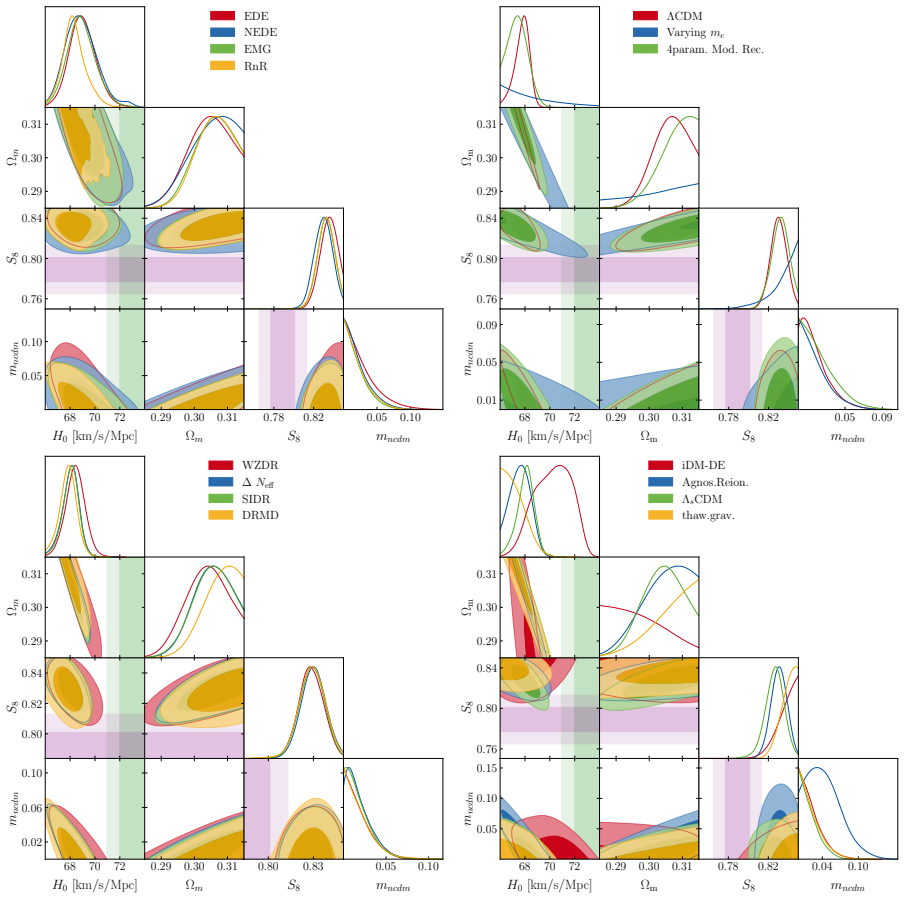
On its own terms, the paper's finding is a hierarchy. In the baseline analysis, ΛCDM sits at a 5.4σ (ΔDMAP) tension with the locally calibrated supernova magnitude, and no contender closes the gap completely. The best performers are early-time mechanisms: axion-like early dark energy reaches a residual 2.5σ with −ΔAIC ≈ 23 and log-Bayes ≈ 10.5; early modified gravity, Rock'n'Roll, and NEDE cluster at 2.7–3.1σ. The varying-electron-mass model is the only non-early contender to pass the selection thresholds, at roughly 4σ; radiation and late-time groups stay near or above 4.5σ. Without ACT data, most radiation and recombination models recover to 3–3.5σ, so the preference for early dark energy
What carries the argument
The load-bearing object is the comoving sound horizon at recombination: models that shrink it push the CMB-inferred expansion rate upward through the angular-diameter-distance degeneracy, and the whole contest is about which mechanism does this without wrecking the fit to the CMB damping tail and lensing. The scoring apparatus is a single shared pipeline — Planck PR4, ACT DR6, and SPT-3G CMB likelihoods with fixed multipole cuts, DESI DR2 BAO, Pantheon+ supernovae, and a Gaussian prior on the supernova absolute magnitude — evaluated with both a frequentist tension metric (ΔDMAP) and a Bayesian parameter-shift metric, plus two preference criteria (−ΔAIC and the log-Bayes factor). All fourteen
Load-bearing premise
The ranking assumes the combined CMB dataset (Planck PR4, ACT DR6, SPT-3G, with the chosen multipole cuts) is internally consistent with no significant double-counting — and the paper's own no-ACT runs show this assumption is load-bearing, since dropping ACT lets most radiation and recombination models recover from ~5σ to 3–3.5σ.
What would settle it
Run the baseline with ACT DR6 replaced by an independent high-multipole CMB dataset, or with ACT and SPT jointly recalibrated: if the radiation and recombination models then recover to 3–3.5σ while early dark energy stays near 2.5–3σ, the headline hierarchy is an ACT artifact; if they remain near 5σ, the hierarchy is physics. A second check: tighten BBN deuterium and helium measurements — the paper finds these worsen the early-dark-energy models by +0.4 to +0.7σ, enough to push them toward the ΛCDM tension level.
If this is right
- If the hierarchy holds, the productive path to resolving the Hubble tension runs through pre-recombination physics that shrinks the sound horizon; late-time fixes and weakly interacting extra radiation are observably disfavored.
- ACT data carry the ranking: the claim that radiation and recombination solutions fail is contingent on ACT's high-multipole measurements, and would weaken if those data were revised.
- The leading early-dark-energy models are exactly the ones most squeezed by BBN light-element abundances and by the DES Y6 clustering amplitude, so better deuterium and helium measurements and large-scale-structure data are the sharpest independent tests.
- Allowing a running of the primordial spectrum restores the dark-radiation models to 3–3.5σ tension, so conclusions about radiation mechanisms cannot be separated from assumptions about the initial power spectrum.
- Models that ease the tension also dilute the DESI preference for dynamical dark energy, linking the two anomalies.
Where Pith is reading between the lines
- A near-term decisive test is an ACT–SPT cross-calibration at high multipoles: if ACT's preference for extra small-scale power turns out to be a calibration artifact, the paper's own no-ACT numbers suggest the early-dark-energy lead would collapse to a near-tie with radiation and recombination models at 3–3.5σ.
- The running-spectrum rescue of the radiation models hints that one shared modification — a blue-tilted primordial spectrum — could mimic either an early-dark-energy or a dark-radiation solution depending on which model family is fitted; a joint fit of both classes together with running parameters would settle which mechanism is actually needed.
- If early dark energy is real, it should leave correlated imprints beyond the CMB — a higher matter-clustering amplitude (S8) and signatures in future high-redshift probes such as 21-cm or CMB spectral-distortion measurements — which current data only weakly constrain.
- Because the paper scores tension through the supernova magnitude and quotes Bayes factors that it flags as prior-dependent, the absolute significance levels are the least transferable numbers in it; a recalibrated distance ladder would rescale all σ values roughly uniformly, and different priors would move the evidence values by several units — the ordering of mechanisms is the more robust conclus
Editorial analysis
A structured set of objections, weighed in public.
Referee Report
Summary. This paper presents a systematic, model-by-model reassessment of proposed Hubble tension solutions, updating the 'H0 Olympics' framework. Fourteen models (grouped into late-time, recombination, radiation, and early energy-injection mechanisms, plus an early+late hybrid) are fit to a common baseline of CMB data (Planck PR4 CamSpec with multipole cuts, ACT DR6 and SPT-3G 'lite' primary likelihoods, ACT/SPT lensing), DESI DR2 BAO, Pantheon+, and an SH0ES MB prior, with free neutrino mass. Performance is assessed with Frequentist (DMAP, AIC) and Bayesian (parameter shift, Bayes factor) metrics, with thresholds fixed before inspecting the results. The headline finding is that early dark energy-type models (EDE, NEDE, EMG, RnR) reduce the residual tension to ~2.5-3.1 sigma and are strongly preferred by AIC/BF, while recombination and dark-radiation models fare worse and late-time models fail; no model fully resolves the tension. The robustness section varies CMB likelihoods, SN samples, neutrino-mass priors, S8, baryonic feedback, and BBN, and the authors explicitly show that removing ACT changes the ranking substantially.
Significance. If correct, this is an important field-level result: it sharpens the case that early-time sound-horizon reduction is the only currently viable mechanism class, and it places quantitative constraints on the viability of other proposals. The analysis has real strengths: metrics and thresholds are pre-registered, both Bayesian and Frequentist rankings agree, the neutrino mass sum is varied, and the robustness tests include alternative CMB likelihoods, extended multipole cuts, DES Dovekie, BBN, and S8. The paper ships public code/chain repositories (with a placeholder for analysis notebooks) and is transparent about the ACT-dependence. The central quantitative exercise is careful and reproducible. However, the robustness of the headline hierarchy hinges on the internal consistency of the ACT+Planck data combination, which is not independently validated, and the knockout round contains one untested finalist (EMG) in the BBN analysis.
major comments (3)
- [Sec. IV E, VI; Tables VIIIa-VIIIb vs Table VI] The headline 'clear hierarchy' is ACT-dependent. In the baseline, DeltaNeff, SIDR, and WZDR have ln BF = -0.09, -1.42, and 1.77, respectively; without ACT these become 9.33, 9.54, and 9.91, and the residual tensions drop to ~3-3.5 sigma (DRMD Delta_shift = 2.8 sigma, NEDE 2.3 sigma). The paper explicitly states that ACT is 'central to the stronger baseline constraints on groups R and M and to the clearer preference for group E' (Sec. VI). Yet no cross-calibration or consistency test between ACT DR6 and Planck PR4 is performed, despite the known 2-3 sigma ACT-vs-Planck Neff discrepancy cited in Sec. IV E. Because the headline ranking is precisely the difference between the with-ACT baseline and the no-ACT case, this is load-bearing; the claim of a 'clear hierarchy' should be made conditional on the relative calibration of the two experiments or supported by an explicit null test (e.g., AC
- [Sec. V G, Table X] The EMG model is excluded from the BBN tests because 'specific modifications of BBN theory codes are required.' This matters because BBN constraints worsen all other tested finalists by +0.4-0.7 sigma in Delta_shift(MB) (for example, EDE from 3.0 to 3.5-3.7, NEDE from 2.7 to 3.2-3.5), and because EMG is a headline member of group E. The authors' statement that Ref. [252] bounds 'likely apply' is not a substitute for running the test. The conclusion that early dark energy injection 'minimally and non-minimally coupled to gravity' currently performs best is therefore not fully supported for EMG. Please either implement the BBN treatment for EMG or explicitly restrict the robustness claim to models for which BBN was computed.
- [Sec. II L and Tables V-VI] The 'Agnos. Reion.' case is not compared on the same data vector, because the SROLL2 low-ell EE likelihood is removed. Its Total chi2 = 5575.66 vs LambdaCDM's 5970.34, and Delta chi2 = -394.68, are not measures of model performance but of data removal. Reporting this row in the same model-comparison tables (DeltaAIC, ln BF) is inconsistent with the paper's stated 'common datasets, likelihoods' framework. Mark this row as not comparable, or re-run it against a LambdaCDM baseline that also drops SROLL2, or remove it from the common ranking tables. This does not change the Group E/R/M ordering, but it is a methodological flaw in a competition whose purpose is fair comparison.
minor comments (5)
- [Abstract vs Sec. VI] The abstract says 'four broad mechanisms,' while the conclusions and figures distinguish five categories including 'Group E+L.' Please make the count consistent.
- [Acknowledgments] The reproducibility statement contains a placeholder: 'A repository containing the analysis outputs and reproducibility notebooks is available at XXX.' This must be replaced with a working URL before publication.
- [Table XI, DRMD row] In the +w0,wa columns, the entries for f_idm and log10(zstop) appear transposed: f_idm is bounded by physics to be < 1, yet is listed as '>2.4', while log10(zstop) is listed as '<0.023'. Check and correct the column ordering.
- [Abstract] The name 'Chevallier-Polarski-Lindner' should be 'Chevallier-Polarski-Linder'.
- [Sec. IV F] The alpha_s/beta_s extension parameterization is discussed as a robustness test for group R, but the paper notes that full-shape galaxy clustering and Lyman-alpha constraints are not included. This caveat is reported, but it should be repeated in the conclusions where 'Deviations from a pure power-law ... substantially improve' group R models, so readers do not over-interpret the rescue.
Circularity Check
No significant circularity: model parameters are fitted to external likelihoods and the headline residual tensions compare the CMB+BAO+SN prediction against the external SH0ES MB calibration, with the pipeline cross-validated against independent published results; the paper's self-citations are not load-bearing.
full rationale
Walking the derivation chain: each contender's parameters are fitted to external likelihoods (Planck PR4, ACT DR6, SPT-3G, DESI DR2, Pantheon+), and the tension metrics of Sec. III A (Eqs. 16-20) compare dataset A = CMB+BAO+SN with dataset B = the external SH0ES MB prior, so the reported residual tensions (tables II-IV; the headline 2.2-3.1 sigma for group E) are out-of-sample comparisons rather than quantities defined in terms of themselves. The model-comparison metrics (AIC, Bayes factor, Eqs. 21-24) are standard with explicit complexity penalties, and the thresholds were 'fixed before inspecting the results' (Sec. I, Sec. III C). No fitted parameter is renamed as a prediction: H0 and MB are genuinely inferred from early-Universe data and then confronted with the local calibration. The paper also validates its pipeline against external benchmarks independent of the present authors (e.g., reproducing Ref. [127]'s H0 for modified recombination, Ref. [224]'s alpha_s/beta_s results, and Ref. [111]'s thawing-gravity scaling regime), which per the reviewing rule counts as real independent support. Self-citations do exist -- the framework of Ref. [13] (H0 Olympics), model codes such as [44, 119, 102], and interpretive high-ell spectral-shape claims [92, 123, 153, 223] involve the present authors -- but the competition results are recomputed in-house from public likelihoods, the stated spectral-shape explanations are also referenced to external works (e.g., Refs. [2, 137, 222]) and are consistent with the paper's own fits, and no uniqueness theorem or ansatz is imported from the authors' prior work to force the ranking. The known sensitivity of the headline hierarchy to ACT (Sec. IV E, tables VIIIa-VIIIb; 'ACT data are therefore central to the stronger baseline constraints on groups R and M and to the clearer preference for group E') is explicitly acknowledged by the authors; it is a dataset-robustness/correctness caveat, not internal circularity. The paper also honestly declares its models are 'phenomenological toy models' rather than first-principles theories. Overall the central claim is a standard, self-contained model comparison with external validation; residual minor self-referential framing does not constitute circularity.
Axiom & Free-Parameter Ledger
free parameters (10)
- EDE: f_EDE(zc), log10(zc), Θi =
f_EDE<0.090; log10 zc=-3.44±0.10; Θi unconstrained (baseline, Table XI)
- NEDE: f_NEDE, log10 zc, 3w, Ωφ =
f_NEDE=0.135±0.024; log10 zc=3.455±0.044; 3w=2.55±0.26; Ωφ<0.0030
- EMG: ξσi²/Mpl², σi/Mpl, α_EMG =
ξσi²/Mpl²<0.033; σi/Mpl=0.34±0.14; α_EMG=2.54±0.34
- Varying electron mass: mearly/melate =
1.0056±0.0048
- 4-param recombination: Δz, Agauss, zgauss, σgauss =
Δz=2.9±3.4; zgauss=1464±27; Agauss and σgauss unconstrained
- Radiation group: N_ur, N_SIDR_eff, N_wzdr + log10(zt), ΔN_DRMD_eff + f_idm + log10(zstop) =
N_ur<0.14; N_SIDR<0.11; N_wzdr<0.25; ΔN_DRMD=0.223±0.096; log10(zt) unconstrained
- Late-time group: zt (ΛsCDM), ξ_ide (iDM-DE), λTG/σi/ξ (thawing gravity) =
zt=6.0±2.4; ξ_ide>−0.10; λTG=1.43±0.32; σi/Mpl=−0.195; ξσi²/Mpl²=−0.040
- Neutrino mass sum Σmν (free in baseline) =
ΛCDM 95% CL <84 meV; up to <123 meV (varying me); <120 meV (Agnos. Reion.)
- MB prior from SH0ES =
MB=−19.253±0.027 (gives H0=73.26±0.98 when combined with Pantheon+)
- Extension parameters: Ωk, (w0, wa), (αs, βs) =
Ωk=0.0012±0.0012; w0=−0.846±0.054, wa=−0.52±0.20 (ΛCDM); αs=0.0122±0.0057, βs=0.0144±0.088
axioms (8)
- domain assumption CLASS v3.3 plus the stated model forks (AxiCLASS, TriggerCLASS, ClassIG, DRMD-CLASS, schoeneberg/class_public_versions) computes the background and perturbation observables for all 14 models accurately.
- domain assumption The combined Planck PR4 + ACT DR6 + SPT-3G CMB dataset is internally consistent under the chosen multipole cuts (CamSpec ℓ<1000 TT, ℓ<600 EE), with ignorable inter-experiment covariance.
- domain assumption The adopted MB=−19.253±0.027 prior (SH0ES) and the Pantheon+ catalogue are unbiased calibrations of the supernova distance scale.
- domain assumption The OLE emulator does not bias the posteriors (accuracy is tested during sampling).
- standard math Standard Bayesian and Frequentist model-comparison statistics (AIC, MCEvidence log-evidence, parameter-shift significance via Eqs. 19–20) are valid for these highly non-Gaussian posteriors.
- domain assumption Phenomenological toy implementations represent the physical mechanisms (instantaneous electron-mass transition; 4-parameter ionization parametrization for PMF-induced recombination; NEDE two-field potential).
- domain assumption BBN light-element abundances computed with PRyMordial using PArthENoPE or PRIMAT rates correctly bind the models; EMG and thawing gravity are exempted because their BBN is non-trivial.
- domain assumption Flat priors and the stated ranges on model parameters (Table I, Sec. II) are appropriate; Bayes factors inherit these prior choices.
read the original abstract
Cosmology stands at a crossroads. The Hubble tension has reached a nominal significance above $7\sigma$, while analyses combining DESI BAO and Type Ia supernova data show emerging hints of departures from $\Lambda$CDM. Meanwhile, high-precision CMB measurements from ACT and SPT enable a timely and more stringent reassessment of proposed solutions to the tension. In this paper, we revisit the $H_0$ Olympics, a systematic contest comparing proposed alternatives to $\Lambda$CDM using common datasets, likelihoods, and statistical criteria. In this updated edition, the $H_0$ World Cup, we subject fourteen representative solutions to a common analysis of current CMB, BAO, and SN data. The contenders span four broad mechanisms: late-time modifications of the expansion history, modified recombination, additional pre-recombination radiation, and early non-radiative energy injection. Relative to the original analysis, the present competition includes models and mechanisms proposed in the intervening years and evaluates all contenders using both Bayesian and Frequentist tests of tension and model performance, letting the neutrino mass sum vary. We further test if late-time extensions through curvature or the Chevallier-Polarski-Linder (CPL) dark energy parametrization can aid the success of the models. Finally, we subject the leading contenders to dedicated robustness tests involving alternative CMB likelihoods and multipole cuts, supernova samples, large-scale-structure information, and big-bang nucleosynthesis constraints. This framework assesses both the ability of each mechanism to ease the Hubble tension and the robustness of our conclusions to datasets and analysis choices.
Figures




Forward citations
Cited by 2 Pith papers
-
Hubble tension: the shape wall
Late-time modifications to the expansion history can raise H0 by at most about 2% (conservative) to 3.7% (permissive) if the CMB acoustic scale is fixed.
-
What could an emerging Big Bang Nucleosynthesis discrepancy be hinting at?
A transient expansion-rate boost during deuterium burning can reconcile the measured deuterium abundance with the high baryon density preferred by early dark energy models, without changing helium-4.
Reference graph
Works this paper leans on
-
[1]
N. Aghanimet al.(Planck), Astron. Astrophys.641, A1 (2020), arXiv:1807.06205 [astro-ph.CO]
Pith/arXiv arXiv 2020
-
[2]
Louiset al.(Atacama Cosmology Telescope), J
T. Louiset al.(Atacama Cosmology Telescope), J. Cosmol. Astropart. Phys.2025, 062 (2025), arXiv:2503.14452 [astro-ph.CO]
Pith/arXiv arXiv 2025
-
[3]
E. Camphuiset al.(SPT-3G), Phys. Rev. D113, 083504 (2026), arXiv:2506.20707 [astro-ph.CO]
Pith/arXiv arXiv 2026
-
[4]
S. Casertanoet al.(H0DN), Astron. Astrophys.708, A166 (2026), arXiv:2510.23823 [astro-ph.CO]
Pith/arXiv arXiv 2026
-
[5]
Fine, Synthese195, pp
K. Fine, Synthese195, pp. 4031 (2018)
2018
-
[6]
A. G. Riess, G. S. Anand, W. Yuan, S. Casertano, A. Dolphin, L. M. Macri, L. Breuval, D. Scolnic, M. Perrin, and R. I. Anderson, Astrophys. J. Lett.956, L18 (2023), arXiv:2307.15806 [astro-ph.CO]
Pith/arXiv arXiv 2023
-
[7]
M. Tristram, M. Douspis, A. Gorce, S. Henrot-Versill´ e, L. T. Hergt, S. Ilic, L. McBride, M. Mu˜ noz- Echeverr ´ ıa, E. Pointecouteau, and L. Salvati, A&A 710, A165 (2026) 10.1051/0004-6361/202558015 (2025), arXiv:2511.04733 [astro-ph.CO]
Pith/arXiv arXiv 2026
-
[8]
Di Valentinoet al.(CosmoVerse Network), Phys
E. Di Valentinoet al.(CosmoVerse Network), Phys. Dark Univ.49, 101965 (2025), arXiv:2504.01669 [astro-ph.CO]
Pith/arXiv arXiv 2025
-
[9]
M. Abdollahi and A. Javadi, arXiv e-prints , arXiv:2606.17008 (2026), arXiv:2606.17008 [astro-ph.SR]
arXiv 2026
-
[10]
C. L. Bennett, D. Larson, J. L. Weiland, N. Jarosik, G. Hinshaw, N. Odegard, K. M. Smith, R. S. Hill, B. Gold, M. Halpern, E. Komatsu, M. R. Nolta, L. Page, D. N. Spergel, E. Wollack, J. Dunkley, A. Kogut, M. Limon, S. S. Meyer, G. S. Tucker, and E. L. Wright (WMAP), Astrophys. J. Suppl. 208, 20 (2013), arXiv:1212.5225 [astro-ph.CO]
Pith/arXiv arXiv 2013
-
[11]
L. Verde, N. Sch¨ oneberg, and H. Gil-Mar ´ ın, arXiv e-prints (2023), arXiv:2311.13305 [astro-ph.CO]
Pith/arXiv arXiv 2023
-
[12]
E. Di Valentino, O. Mena, S. Pan, L. Visinelli, W. Yang, A. Melchiorri, D. F. Mota, A. G. Riess, and J. Silk, Class. Quant. Grav.38, 153001 (2021), arXiv:2103.01183 [astro-ph.CO]
Pith/arXiv arXiv 2021
-
[13]
N. Sch¨ oneberg, G. Franco Abell´ an, A. P´ erez S´ anchez, S. J. Witte, V. Poulin, and J. Lesgourgues, Phys. Rept.984, 1 (2022), arXiv:2107.10291 [astro-ph.CO]
Pith/arXiv arXiv 2022
-
[14]
H. G. Escudero, J.-L. Kuo, R. E. Keeley, and K. N. Abazajian, Phys. Rev. D106, 103517 (2022), arXiv:2208.14435 [astro-ph.CO]
Pith/arXiv arXiv 2022
-
[15]
A. R. Khalife, M. B. Zanjani, S. Galli, S. G¨ unther, J. Lesgourgues, and K. Benabed, J. Cosmol. Astropart. Phys.2024, 059 (2024), arXiv:2312.09814 [astro-ph.CO]
Pith/arXiv arXiv 2024
-
[16]
Calabreseet al.(Atacama Cosmology Telescope), J
E. Calabreseet al.(Atacama Cosmology Telescope), J. Cosmol. Astropart. Phys.2025, 063 (2025), arXiv:2503.14454 [astro-ph.CO]
Pith/arXiv arXiv 2025
-
[17]
Lodhaet al.(DESI), arXiv e-prints (2025), arXiv:2503.14743 [astro-ph.CO]
K. Lodhaet al.(DESI), arXiv e-prints (2025), arXiv:2503.14743 [astro-ph.CO]
Pith/arXiv arXiv 2025
-
[18]
V. Poulin, T. L. Smith, R. Calder´ on, and T. Simon, arXiv e-prints (2025), arXiv:2505.08051 [astro- ph.CO]
Pith/arXiv arXiv 2025
-
[19]
R. K. Sharma, M. Archidiacono, and J. Lesgourgues, arXiv e-prints (2026), arXiv:2605.18716 [astro- ph.CO]
Pith/arXiv arXiv 2026
-
[20]
Sch¨ oneberg, A
N. Sch¨ oneberg, A. G. Ferrari, F. Finelli, J. Lesgourgues, L. Morelli, M. R. Mosbech, V. Poulin, R. Sharma, T. Simon, and T. L. Smith, TheH 0 world cup. i. summary of the baseline group stage results (2026), letter submitted concurrently
2026
-
[21]
Lesgourgues, arXiv e-prints (2011), arXiv:1104.2932 [astro-ph.IM]
J. Lesgourgues, arXiv e-prints (2011), arXiv:1104.2932 [astro-ph.IM]
Pith/arXiv arXiv 2011
-
[22]
L. Lancaster, F.-Y. Cyr-Racine, L. Knox, and Z. Pan, J. Cosmol. Astropart. Phys.2017, 033 (2017), arXiv:1704.06657 [astro-ph.CO]. 57 10 20 30 40A143 10 20 30 40A217 10 20 30 40A143×217 1 2 3n143 1 2 3 4n217 1 2 3 4A143×217 0.995 1.000 1.005 calSPT TT 1.00 1.01 1.02 calSPT EE 0.98 0.99 1.00 1.01 calACT TE 0.99 1.00 1.01 calACT EE 0.995 1.000 1.005 calACT+P...
Pith/arXiv arXiv 2017
-
[23]
C. D. Kreisch, F.-Y. Cyr-Racine, and O. Dor´ e, Phys. Rev. D101, 123505 (2020), arXiv:1902.00534 [astro-ph.CO]
Pith/arXiv arXiv 2020
-
[24]
M. Escudero and S. J. Witte, Eur. Phys. J. C80, 294 (2020), arXiv:1909.04044 [astro-ph.CO]
Pith/arXiv arXiv 2020
-
[25]
M. Escudero and S. J. Witte, Eur. Phys. J. C81, 515 (2021), arXiv:2103.03249 [hep-ph]
Pith/arXiv arXiv 2021
-
[26]
D. Camarena, F.-Y. Cyr-Racine, and J. Houghteling, Phys. Rev. D108, 103535 (2023), arXiv:2309.03941 [astro-ph.CO]
Pith/arXiv arXiv 2023
-
[27]
D. Camarena and F.-Y. Cyr-Racine, Phys. Rev. D111, 023504 (2025), arXiv:2403.05496 [astro- ph.CO]
Pith/arXiv arXiv 2025
-
[28]
A. Poudou, T. Simon, T. Montandon, E. M. Teixeira, and V. Poulin, Phys. Rev. D112, 103535 (2025), arXiv:2503.10485 [astro-ph.CO]
Pith/arXiv arXiv 2025
-
[29]
F.-Y. Cyr-Racine, F. Ge, and L. Knox, Phys. Rev. Lett.128, 201301 (2022), arXiv:2107.13000 [astro- ph.CO]
Pith/arXiv arXiv 2022
-
[30]
F. Ge, F.-Y. Cyr-Racine, and L. Knox, Phys. Rev. D107, 023517 (2023), arXiv:2210.16335 [astro- ph.CO]
Pith/arXiv arXiv 2023
-
[31]
K. L. Greene and F.-Y. Cyr-Racine, J. Cosmol. Astropart. Phys.2023, 065 (2023), arXiv:2306.06165 [astro-ph.CO]
Pith/arXiv arXiv 2023
-
[32]
K. Greene and F.-Y. Cyr-Racine, arXiv e-prints (2024), arXiv:2403.05619 [astro-ph.CO]
Pith/arXiv arXiv 2024
-
[33]
CosmoVerse Network, Title to be announced (2026), in preparation
2026
-
[34]
J. Lesgourgues, S. Pastor, and L. Perotto, Phys. Rev. D70, 045016 (2004), arXiv:hep-ph/0403296
Pith/arXiv arXiv 2004
-
[35]
M. Archidiacono, S. Hannestad, and J. Lesgourgues, J. Cosmol. Astropart. Phys.2020, 021 (2020), arXiv:2003.03354 [astro-ph.CO]
Pith/arXiv arXiv 2020
-
[36]
S. G¨ unther, L. Balkenhol, C. Fidler, A. R. Khalife, J. Lesgourgues, M. R. Mosbech, and R. K. Sharma, J. Cosmol. Astropart. Phys.2025, 059 (2025), arXiv:2503.13183 [astro-ph.CO]
arXiv 2025
-
[37]
T. Brinckmann and J. Lesgourgues, Phys. Dark Univ.24, 100260 (2019), arXiv:1804.07261 [astro- ph.CO]
Pith/arXiv arXiv 2019
-
[38]
Audren, J
B. Audren, J. Lesgourgues, K. Benabed, and S. Prunet, Journal of Cosmology and Astroparticle Physics2013(02), 001
- [39]
-
[40]
C. Wetterich, Phys. Lett. B594, 17 (2004), arXiv:astro-ph/0403289
Pith/arXiv arXiv 2004
-
[41]
M. Doran and G. Robbers, J. Cosmol. Astropart. Phys.2006, 026 (2006), arXiv:astro-ph/0601544
Pith/arXiv arXiv 2006
-
[42]
T. Karwal and M. Kamionkowski, Phys. Rev.D94, 103523 (2016), arXiv:1608.01309
Pith/arXiv arXiv 2016
-
[43]
V. Poulin, T. L. Smith, T. Karwal, and M. Kamionkowski, Phys. Rev. Lett.122, 221301 (2019), arXiv:1811.04083
Pith/arXiv arXiv 2019
-
[44]
T. L. Smith, V. Poulin, and M. A. Amin, Phys. Rev. D101, 063523 (2020), arXiv:1908.06995 [astro- ph.CO]
Pith/arXiv arXiv 2020
-
[45]
P. Agrawal, F.-Y. Cyr-Racine, D. Pinner, and L. Randall, Phys. Dark Univ.42, 101347 (2023), arXiv:1904.01016 [astro-ph.CO]
Pith/arXiv arXiv 2023
-
[46]
M.-X. Lin, G. Benevento, W. Hu, and M. Raveri, Phys. Rev. D100, 063542 (2019), arXiv:1905.12618 [astro-ph.CO]
Pith/arXiv arXiv 2019
-
[47]
S. Alexander and E. McDonough, Phys. Lett. B797, 134830 (2019), arXiv:1904.08912 [astro-ph.CO]
Pith/arXiv arXiv 2019
-
[48]
J. Sakstein and M. Trodden, Phys. Rev. Lett.124, 161301 (2020), arXiv:1911.11760 [astro-ph.CO]
Pith/arXiv arXiv 2020
-
[49]
A. Gogoi, R. Kumar Sharma, P. Chanda, and S. Das, Astrophysical Journal915, 132 (2021), arXiv:2005.11889 [astro-ph.CO]
Pith/arXiv arXiv 2021
-
[50]
F. Niedermann and M. S. Sloth, Phys. Rev. D103, L041303 (2021), arXiv:1910.10739 [astro-ph.CO]
Pith/arXiv arXiv 2021
-
[51]
F. Niedermann and M. S. Sloth, Phys. Rev. D102, 063527 (2020), arXiv:2006.06686 [astro-ph.CO]
Pith/arXiv arXiv 2020
-
[52]
F. Niedermann and M. S. Sloth, Phys. Rev. D105, 063509 (2022), arXiv:2112.00770 [hep-ph]
Pith/arXiv arXiv 2022
-
[53]
G. Ye and Y.-S. Piao, Phys. Rev. D101, 083507 (2020), arXiv:2001.02451 [astro-ph.CO]
Pith/arXiv arXiv 2020
-
[54]
T. Simon, Phys. Rev. D110, 023528 (2024), arXiv:2310.16800 [astro-ph.CO]
Pith/arXiv arXiv 2024
-
[55]
K. V. Berghaus and T. Karwal, Phys. Rev. D101, 083537 (2020), arXiv:1911.06281 [astro-ph.CO]
Pith/arXiv arXiv 2020
-
[56]
K. Freese and M. W. Winkler, Phys. Rev. D104, 083533 (2021), arXiv:2102.13655 [astro-ph.CO]
Pith/arXiv arXiv 2021
-
[57]
M. Braglia, W. T. Emond, F. Finelli, A. E. Gumrukcuoglu, and K. Koyama, Phys. Rev. D102, 083513 (2020), arXiv:2005.14053 [astro-ph.CO]. 62
Pith/arXiv arXiv 2020
-
[58]
V. I. Sabla and R. R. Caldwell, Phys. Rev. D103, 103506 (2021), arXiv:2103.04999 [astro-ph.CO]
Pith/arXiv arXiv 2021
-
[59]
V. I. Sabla and R. R. Caldwell, Phys. Rev. D106, 063526 (2022), arXiv:2202.08291 [astro-ph.CO]
Pith/arXiv arXiv 2022
-
[60]
A. G´ omez-Valent, Z. Zheng, L. Amendola, V. Pettorino, and C. Wetterich, Phys. Rev. D104, 083536 (2021), arXiv:2107.11065 [astro-ph.CO]
Pith/arXiv arXiv 2021
-
[61]
A. Moss, E. Copeland, S. Bamford, and T. Clarke, arXiv e-prints (2021), arXiv:2109.14848 [astro- ph.CO]
Pith/arXiv arXiv 2021
-
[62]
E. Guendelman, R. Herrera, and D. Benisty, Phys. Rev. D105, 124035 (2022), arXiv:2201.06470 [gr-qc]
Pith/arXiv arXiv 2022
-
[63]
T. Karwal, M. Raveri, B. Jain, J. Khoury, and M. Trodden, arXiv e-prints , arXiv:2106.13290 (2021), arXiv:2106.13290
Pith/arXiv arXiv 2021
-
[64]
E. McDonough, M.-X. Lin, J. C. Hill, W. Hu, and S. Zhou, Phys. Rev. D106, 043525 (2022), arXiv:2112.09128 [astro-ph.CO]
Pith/arXiv arXiv 2022
-
[65]
H. Wang and Y.-S. Piao, Phys.Rev.D 108 (2023) 8, 083516 10.1103/PhysRevD.108.083516 (2022), arXiv:2209.09685 [astro-ph.CO]
Pith/arXiv arXiv 2023
-
[66]
S. Alexander, H. Bernardo, and M. W. Toomey, arXiv e-prints 10.1088/1475-7516/2023/03/037 (2022), arXiv:2207.13086 [astro-ph.CO]
Pith/arXiv arXiv 2023
-
[67]
E. McDonough and M. Scalisi, JHEP2023(10), 118, arXiv:2209.00011 [hep-th]
-
[68]
S. Nakagawa, F. Takahashi, and W. Yin, arXiv e-prints 10.1103/PhysRevD.107.063016 (2022), arXiv:2209.01107 [astro-ph.CO]
Pith/arXiv arXiv 2022
-
[69]
A. G´ omez-Valent, Z. Zheng, L. Amendola, C. Wetterich, and V. Pettorino, arXiv e-prints 10.1103/PhysRevD.106.103522 (2022), arXiv:2207.14487 [astro-ph.CO]
Pith/arXiv arXiv 2022
-
[70]
H. Mohseni Sadjadi and V. Anari, Eur. Phys. J. Plus 138, 84 (2023) 10.1140/epjp/s13360-023-03716-9 (2022), arXiv:2205.15693 [gr-qc]
Pith/arXiv arXiv 2023
-
[71]
K. Kojima and Y. Okubo, Phys. Rev. D106, 063540 (2022), arXiv:2205.13777 [astro-ph.CO]
Pith/arXiv arXiv 2022
-
[72]
Rudelius, arXiv e-prints 10.1088/1475-7516/2023/01/014 (2022), arXiv:2203.05575 [hep-th]
T. Rudelius, arXiv e-prints 10.1088/1475-7516/2023/01/014 (2022), arXiv:2203.05575 [hep-th]
Pith/arXiv arXiv 2023
-
[73]
V. K. Oikonomou, Phys. Rev. D103, 044036 (2021), arXiv:2012.00586 [astro-ph.CO]
Pith/arXiv arXiv 2021
-
[74]
S. X. Tian and Z.-H. Zhu, Phys. Rev. D103, 043518 (2021), arXiv:2102.06399 [gr-qc]
Pith/arXiv arXiv 2021
-
[75]
M. Maziashvili, Astropart. Phys.145, 102792 (2023), arXiv:2111.07288 [astro-ph.CO]
Pith/arXiv arXiv 2023
-
[76]
M. Kamionkowski, J. Pradler, and D. G. E. Walker, Phys. Rev. Lett.113, 251302 (2014), arXiv:1409.0549 [hep-ph]
Pith/arXiv arXiv 2014
-
[77]
V. Poulin, T. L. Smith, D. Grin, T. Karwal, and M. Kamionkowski, Phys. Rev.D98, 083525 (2018), arXiv:1806.10608
Pith/arXiv arXiv 2018
-
[78]
P. Svrcek and E. Witten, JHEP2006(06), 051, arXiv:hep-th/0605206 [hep-th]
-
[79]
M. R. Douglas and S. Kachru, Rev. Mod. Phys.79, 733 (2007), arXiv:hep-th/0610102
Pith/arXiv arXiv 2007
-
[80]
A. Arvanitaki, S. Dimopoulos, S. Dubovsky, N. Kaloper, and J. March-Russell, Phys. Rev. D81, 123530 (2010), arXiv:0905.4720 [hep-th]
Pith/arXiv arXiv 2010
discussion (0)
Sign in with ORCID, Apple, or X to comment. Anyone can read and Pith papers without signing in.