De Sitter Horizon Edge Partition Functions
Pith reviewed 2026-05-23 04:14 UTC · model grok-4.3
The pith
For linearized Einstein gravity on S^{d+1}, the edge partition function receives contributions from shift-symmetric vector and scalar fields on S^{d-1}.
A machine-rendered reading of the paper's core claim, the machinery that carries it, and where it could break.
Core claim
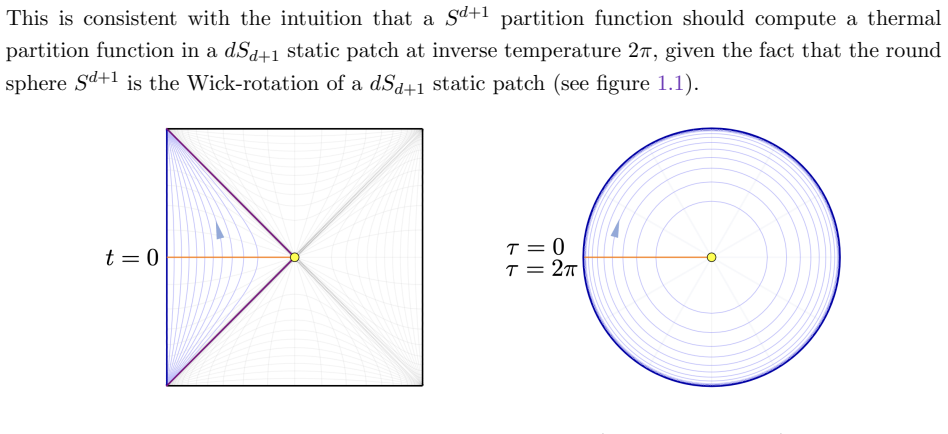
One-loop S^{d+1} path integrals factorize into a bulk thermal ideal gas partition function in a dS_{d+1} static patch and an edge partition function associated with degrees of freedom living on S^{d-1}. For linearized Einstein gravity on S^{d+1}, the edge partition function receives contributions from shift-symmetric vector and scalar fields on S^{d-1}, suggesting a possible interpretation in terms of an embedded S^{d-1} brane. The same so(d) analysis applies to massive and massless totally symmetric tensors of any rank in d greater than or equal to 3.
What carries the argument
Edge partition function for totally symmetric tensor fields on S^{d-1}, obtained by isolating the so(d) content after bulk-edge factorization of the one-loop path integral.
If this is right
- The edge partition function for any totally symmetric tensor is fixed once its so(d) representation content on S^{d-1} is known.
- Linearized gravity receives edge contributions precisely from the shift-symmetric vector and scalar sectors on the horizon sphere.
- The same edge structure holds for both massive and massless tensors in every dimension d at least 3.
- The edge modes admit a possible reinterpretation as the degrees of freedom of an embedded S^{d-1} brane.
Where Pith is reading between the lines
- The brane suggestion would imply that the horizon carries an effective lower-dimensional theory whose spectrum is exhausted by the shift-symmetric fields already identified.
- The bulk-edge split could be applied to other maximally symmetric spaces to isolate analogous horizon contributions.
- Computing the edge partition function for interacting or higher-spin fields would test whether the shift-symmetric pattern persists beyond the free linearized case.
Load-bearing premise
One-loop S^{d+1} path integrals factorize into a bulk thermal ideal gas partition function in a dS_{d+1} static patch and an edge partition function associated with degrees of freedom living on S^{d-1}.
What would settle it
An explicit computation of the full one-loop partition function for linearized gravity on S^{4} that fails to equal the sum of the known bulk static-patch ideal-gas term plus the edge term built from shift-symmetric vector and scalar fields on S^{3}.
Figures

read the original abstract
One-loop $S^{d+1}$ path integrals were shown to factorize into two parts: a bulk thermal ideal gas partition function in a $dS_{d+1}$ static patch and an edge partition function associated with degrees of freedom living on $S^{d-1}$. Here, we analyze the $\mathfrak{so}(d)$ structure of the edge partition functions for massive and massless totally symmetric tensors of arbitrary rank in any $d\geq 3$. For linearized Einstein gravity on $S^{d+1}$, we find that the edge partition function receives contributions from shift-symmetric vector and scalar fields on $S^{d-1}$, suggesting a possible interpretation in terms of an embedded $S^{d-1}$ brane.
Editorial analysis
A structured set of objections, weighed in public.
Referee Report
Summary. The manuscript analyzes the so(d) representation content of edge partition functions arising from one-loop path integrals of massive and massless totally symmetric tensor fields of arbitrary rank on S^{d+1} (d≥3). Building on a prior factorization of these path integrals into a bulk thermal ideal gas contribution in the dS_{d+1} static patch and an edge contribution associated with degrees of freedom on S^{d-1}, the paper reports that for linearized Einstein gravity the edge partition function receives contributions from shift-symmetric vector and scalar fields on S^{d-1}, suggesting a possible interpretation in terms of an embedded S^{d-1} brane.
Significance. If the factorization and representation decomposition hold, the work supplies a systematic so(d) decomposition of edge modes for tensor fields in de Sitter space, which may clarify horizon degrees of freedom and motivate brane interpretations. The extension to arbitrary rank tensors is a technical strength, though the absence of explicit derivations, error estimates, or checks against known cases for the spin-2 sector reduces immediate applicability.
major comments (2)
- [Abstract] Abstract: The central claim that the edge partition function for linearized Einstein gravity receives contributions specifically from shift-symmetric vector and scalar fields on S^{d-1} rests on the factorization of the one-loop S^{d+1} path integral into bulk ideal gas plus edge on S^{d-1}. The manuscript states this factorization 'were shown to factorize' but provides no re-derivation or verification for the spin-2 case, leaving the identification dependent on unexamined technical steps from prior work.
- [Abstract] The identification of the edge so(d) content for gravity assumes an exact bulk-edge separation. No explicit check is given against possible mixing from residual gauge modes, boundary terms in the Lichnerowicz operator, or regularization choices, which would undermine the reported shift-symmetric contributions if the separation is not exact.
Simulated Author's Rebuttal
We thank the referee for their careful reading and constructive comments. We address the major comments point by point below.
read point-by-point responses
-
Referee: [Abstract] Abstract: The central claim that the edge partition function for linearized Einstein gravity receives contributions specifically from shift-symmetric vector and scalar fields on S^{d-1} rests on the factorization of the one-loop S^{d+1} path integral into bulk ideal gas plus edge on S^{d-1}. The manuscript states this factorization 'were shown to factorize' but provides no re-derivation or verification for the spin-2 case, leaving the identification dependent on unexamined technical steps from prior work.
Authors: The factorization into bulk thermal ideal gas and edge contributions on S^{d-1} was established in our prior work for the graviton (spin-2) case. The present manuscript takes this established result as input and performs the so(d) decomposition of the resulting edge partition function for arbitrary-rank tensors. To address the concern about self-contained presentation, we will revise the manuscript to include a concise recap of the key factorization steps specific to the linearized gravity case. revision: yes
-
Referee: [Abstract] The identification of the edge so(d) content for gravity assumes an exact bulk-edge separation. No explicit check is given against possible mixing from residual gauge modes, boundary terms in the Lichnerowicz operator, or regularization choices, which would undermine the reported shift-symmetric contributions if the separation is not exact.
Authors: The bulk-edge separation is defined by the path-integral factorization, which incorporates gauge fixing, boundary conditions, and the Lichnerowicz operator for the graviton. The shift-symmetric vector and scalar contributions on S^{d-1} arise directly from this separation. While the current work does not repeat explicit checks for mixing or regularization artifacts (these were addressed in the derivation of the factorization), we can add a clarifying paragraph referencing how residual gauge modes are excluded from the edge sector. revision: partial
Circularity Check
Factorization cited from prior work; new edge decomposition is independent
specific steps
-
self citation load bearing
[Abstract]
"One-loop $S^{d+1}$ path integrals were shown to factorize into two parts: a bulk thermal ideal gas partition function in a $dS_{d+1}$ static patch and an edge partition function associated with degrees of freedom living on $S^{d-1}$."
The identification that the edge piece for linearized Einstein gravity receives contributions from shift-symmetric fields on $S^{d-1}$ presupposes the exact bulk/edge split; this split is imported via citation without re-derivation or check for the spin-2 case in the present work.
full rationale
The paper cites a prior result for the bulk-edge factorization of the one-loop path integral and then performs a direct representation-theoretic decomposition of the edge piece for symmetric tensors. No quantities are fitted to data, no self-definitional loops appear in the so(d) content calculation, and the central new claim (shift-symmetric vector/scalar contributions for gravity) follows from the decomposition rather than reducing to the cited input by construction. This is a standard minor self-citation on an enabling assumption, not load-bearing circularity.
Axiom & Free-Parameter Ledger
axioms (1)
- domain assumption One-loop S^{d+1} path integrals factorize into bulk thermal ideal gas and edge partition functions on S^{d-1}
invented entities (1)
-
embedded S^{d-1} brane
no independent evidence
Forward citations
Cited by 4 Pith papers
-
Horizon Edge Partition Functions in $\Lambda>0$ Quantum Gravity
Horizon edge mode spectra in de Sitter and Nariai spacetimes exhibit universal shift symmetries that produce novel symmetry breaking in one-loop partition functions.
-
de Sitter Vacua & pUniverses
The p-Schwinger model on de Sitter space supports p distinct de Sitter-invariant vacua that are Hadamard, and coupling a multi-flavor version to gravity yields a semiclassical de Sitter saddle at large N_f.
-
Localization and anomalous reference frames in gravity
Constructs a phase space for gravitational degrees of freedom on null ray segments with commuting localized observables via edge modes and dressing time, then introduces an effective classical theory with Virasoro def...
-
Gravitons on Nariai Edges
The one-loop graviton path integral on S² × S^{d-1} factorizes into a bulk thermal graviton gas partition function in Nariai geometry and an edge contribution from shift-symmetric fields on S^{d-1}.
Reference graph
Works this paper leans on
-
[1]
D. Anninos, F. Denef, Y. T. A. Law, and Z. Sun, “Quantum de Sitter horizon entropy from quasicanonical bulk, edge, sphere and topological string partition functions,” JHEP 01 (2022) 088, arXiv:2009.12464 [hep-th]
-
[2]
A compendium of sphere path integrals,
Y. T. A. Law, “A compendium of sphere path integrals,” JHEP 21 (2020) 213, arXiv:2012.06345 [hep-th]
-
[3]
Partition functions of p-forms from Harish-Chandra characters,
J. R. David and J. Mukherjee, “Partition functions of p-forms from Harish-Chandra characters,” JHEP 09 (2021) 094, arXiv:2105.03662 [hep-th]
-
[4]
Three-dimensional de Sitter horizon thermodynamics,
D. Anninos and E. Harris, “Three-dimensional de Sitter horizon thermodynamics,” JHEP 10 (2021) 091, arXiv:2106.13832 [hep-th] . 58
-
[5]
The two-sphere partition function in two-dimensional quantum gravity,
D. Anninos, T. Bautista, and B. M¨ uhlmann, “The two-sphere partition function in two-dimensional quantum gravity,” JHEP 09 (2021) 116, arXiv:2106.01665 [hep-th]
-
[6]
D. Anninos and B. M¨ uhlmann, “The semiclassical gravitational path integral and random matrices (toward a microscopic picture of a dS 2 universe),” JHEP 12 (2021) 206, arXiv:2111.05344 [hep-th]
-
[7]
Characters, quasinormal modes, and Schwinger pairs in dS2 with flux,
M. Grewal and K. Parmentier, “Characters, quasinormal modes, and Schwinger pairs in dS2 with flux,” arXiv:2112.07630 [hep-th]
-
[8]
The two-sphere partition function from timelike Liouville theory at three-loop order,
B. M¨ uhlmann, “The two-sphere partition function from timelike Liouville theory at three-loop order,” JHEP 05 (2022) 057, arXiv:2202.04549 [hep-th]
-
[9]
Microscopics of de Sitter Entropy from Precision Holography,
N. Bobev, T. Hertog, J. Hong, J. Karlsson, and V. Reys, “Microscopics of de Sitter Entropy from Precision Holography,” Phys. Rev. X 13 no. 4, (2023) 041056, arXiv:2211.05907 [hep-th]
-
[10]
Keeping matter in the loop in dS 3 quantum gravity,
A. Castro, I. Coman, J. R. Fliss, and C. Zukowski, “Keeping matter in the loop in dS 3 quantum gravity,” JHEP 07 (2023) 120, arXiv:2302.12281 [hep-th]
-
[11]
Coupling Fields to 3D Quantum Gravity via Chern-Simons Theory,
A. Castro, I. Coman, J. R. Fliss, and C. Zukowski, “Coupling Fields to 3D Quantum Gravity via Chern-Simons Theory,” Phys. Rev. Lett. 131 no. 17, (2023) 171602, arXiv:2304.02668 [hep-th]
-
[12]
Spinning up the spool: Massive spinning fields in 3d quantum gravity,
R. Bourne, A. Castro, and J. R. Fliss, “Spinning up the spool: Massive spinning fields in 3d quantum gravity,” arXiv:2407.09608 [hep-th]
-
[13]
B. Bandaru, “Quantum de sitter entropy and sphere partition functions: A-hypergeometric approach to higher loop corrections,” 2024. https://arxiv.org/abs/2411.16636
-
[14]
Action Integrals and Partition Functions in Quantum Gravity,
G. W. Gibbons and S. W. Hawking, “Action Integrals and Partition Functions in Quantum Gravity,” Phys. Rev. D 15 (1977) 2752–2756
work page 1977
-
[15]
T T + Λ 2 deformed CFT on the stretched dS 3 horizon,
V. Shyam, “T T + Λ 2 deformed CFT on the stretched dS 3 horizon,” JHEP 04 (2022) 052, arXiv:2106.10227 [hep-th]
-
[16]
De Sitter microstates from T T + Λ2 and the Hawking-Page transition,
E. Coleman, E. A. Mazenc, V. Shyam, E. Silverstein, R. M. Soni, G. Torroba, and S. Yang, “De Sitter microstates from T T + Λ2 and the Hawking-Page transition,” JHEP 07 (2022) 140, arXiv:2110.14670 [hep-th]
-
[17]
Infinite Temperature is Not So Infinite: The Many Temperatures of de Sitter Space,
A. A. Rahman and L. Susskind, “Infinite Temperature is Not So Infinite: The Many Temperatures of de Sitter Space,” arXiv:2401.08555 [hep-th]
-
[18]
On infinitesimal operators of irreducible representations of the Lorentz group of n-th order,
T. Hirai, “On irreducible representations of the Lorentz group of n-th order,” Proceedings of the Japan Academy 38 no. 6, (1962) 258 – 262. https://doi.org/10.3792/pja/1195523378. 59
-
[19]
On infinitesimal operators of irreducible representations of the Lorentz group of n-th order,
T. Hirai, “On infinitesimal operators of irreducible representations of the Lorentz group of n-th order,” Proceedings of the Japan Academy 38 no. 3, (1962) 83 – 87. https://doi.org/10.3792/pja/1195523460
-
[20]
The characters of semisimple lie groups,
Harish-Chandra, “The characters of semisimple lie groups,” Transactions of the American Mathematical Society 83 no. 1, (1956) 98–163. http://www.jstor.org/stable/1992907
-
[21]
Invariant eigendistributions on semisimple lie groups,
Harish-Chandra, “Invariant eigendistributions on semisimple lie groups,” Bulletin of the American Mathematical Society 69 no. 1, (1963) 117 – 123. https://doi.org/
work page 1963
-
[22]
The characters of irreducible representations of the Lorentz group of n-th order,
T. Hirai, “The characters of irreducible representations of the Lorentz group of n-th order,” Proceedings of the Japan Academy 41 no. 7, (1965) 526 – 531. https://doi.org/10.3792/pja/1195522333
-
[23]
Real-time observables in de Sitter thermodynamics,
M. Grewal and Y. T. A. Law, “Real-time observables in de Sitter thermodynamics,” arXiv:2403.06006 [hep-th]
- [24]
-
[25]
Black hole scattering and partition functions,
Y. T. A. Law and K. Parmentier, “Black hole scattering and partition functions,” JHEP 10 (2022) 039, arXiv:2207.07024 [hep-th]
-
[26]
Characters, Quasinormal Modes, and Quantum de Sitter Thermodynamics,
Y. T. A. Law, “Characters, Quasinormal Modes, and Quantum de Sitter Thermodynamics,” in CORFU2022: 22th Hellenic School and Workshops on Elementary Particle Physics and Gravity. 4, 2023. arXiv:2304.01471 [hep-th]
-
[27]
Notes on gauge fields and discrete series representations in de Sitter spacetimes,
A. Rios Fukelman, M. Semp´ e, and G. A. Silva, “Notes on gauge fields and discrete series representations in de Sitter spacetimes,” JHEP 01 (2024) 011, arXiv:2310.14955 [hep-th]
-
[28]
Dynamical edge modes and entanglement in Maxwell theory,
A. Ball, Y. T. A. Law, and G. Wong, “Dynamical edge modes and entanglement in Maxwell theory,” JHEP 09 (2024) 032, arXiv:2403.14542 [hep-th]
-
[29]
Entanglement entropy and the boundary action of edge modes,
J. Mukherjee, “Entanglement entropy and the boundary action of edge modes,” arXiv:2310.14690 [hep-th]
-
[30]
Dynamical Edge Modes in p-form Gauge Theories,
A. Ball and Y. T. A. Law, “Dynamical Edge Modes in p-form Gauge Theories,” arXiv:2411.02555 [hep-th]
-
[31]
Black Hole Entropy and Entropy of Entanglement
D. N. Kabat, “Black hole entropy and entropy of entanglement,” Nucl. Phys. B 453 (1995) 281–299, arXiv:hep-th/9503016
work page internal anchor Pith review Pith/arXiv arXiv 1995
-
[32]
Decomposition of entanglement entropy in lattice gauge theory
W. Donnelly, “Decomposition of entanglement entropy in lattice gauge theory,” Phys. Rev. D 85 (2012) 085004, arXiv:1109.0036 [hep-th] . 60
work page internal anchor Pith review Pith/arXiv arXiv 2012
-
[33]
Do gauge fields really contribute negatively to black hole entropy?
W. Donnelly and A. C. Wall, “Do gauge fields really contribute negatively to black hole entropy?,” Phys. Rev. D 86 (2012) 064042, arXiv:1206.5831 [hep-th]
work page internal anchor Pith review Pith/arXiv arXiv 2012
-
[34]
Entanglement and Thermal Entropy of Gauge Fields
C. Eling, Y. Oz, and S. Theisen, “Entanglement and Thermal Entropy of Gauge Fields,” JHEP 11 (2013) 019, arXiv:1308.4964 [hep-th]
work page internal anchor Pith review Pith/arXiv arXiv 2013
-
[35]
Notes on Entanglement in Abelian Gauge Theories
D. Radicevic, “Notes on Entanglement in Abelian Gauge Theories,” arXiv:1404.1391 [hep-th]
work page internal anchor Pith review Pith/arXiv arXiv
-
[36]
Entanglement entropy and nonabelian gauge symmetry
W. Donnelly, “Entanglement entropy and nonabelian gauge symmetry,” Class. Quant. Grav. 31 no. 21, (2014) 214003, arXiv:1406.7304 [hep-th]
work page internal anchor Pith review Pith/arXiv arXiv 2014
-
[37]
Entanglement entropy of electromagnetic edge modes
W. Donnelly and A. C. Wall, “Entanglement entropy of electromagnetic edge modes,” Phys. Rev. Lett. 114 no. 11, (2015) 111603, arXiv:1412.1895 [hep-th]
work page internal anchor Pith review Pith/arXiv arXiv 2015
-
[38]
Central Charge and Entangled Gauge Fields
K.-W. Huang, “Central Charge and Entangled Gauge Fields,” Phys. Rev. D 92 no. 2, (2015) 025010, arXiv:1412.2730 [hep-th]
work page internal anchor Pith review Pith/arXiv arXiv 2015
-
[39]
On The Entanglement Entropy For Gauge Theories
S. Ghosh, R. M. Soni, and S. P. Trivedi, “On The Entanglement Entropy For Gauge Theories,” JHEP 09 (2015) 069, arXiv:1501.02593 [hep-th]
work page internal anchor Pith review Pith/arXiv arXiv 2015
-
[40]
Revisiting Entanglement Entropy of Lattice Gauge Theories
L.-Y. Hung and Y. Wan, “Revisiting Entanglement Entropy of Lattice Gauge Theories,” JHEP 04 (2015) 122, arXiv:1501.04389 [hep-th]
work page internal anchor Pith review Pith/arXiv arXiv 2015
-
[41]
On the definition of entanglement entropy in lattice gauge theories
S. Aoki, T. Iritani, M. Nozaki, T. Numasawa, N. Shiba, and H. Tasaki, “On the definition of entanglement entropy in lattice gauge theories,” JHEP 06 (2015) 187, arXiv:1502.04267 [hep-th]
work page internal anchor Pith review Pith/arXiv arXiv 2015
-
[42]
Geometric entropy and edge modes of the electromagnetic field
W. Donnelly and A. C. Wall, “Geometric entropy and edge modes of the electromagnetic field,” Phys. Rev. D 94 no. 10, (2016) 104053, arXiv:1506.05792 [hep-th]
work page internal anchor Pith review Pith/arXiv arXiv 2016
-
[43]
Entanglement in Weakly Coupled Lattice Gauge Theories
D. Radiˇ cevi´ c, “Entanglement in Weakly Coupled Lattice Gauge Theories,”JHEP 04 (2016) 163, arXiv:1509.08478 [hep-th]
work page internal anchor Pith review Pith/arXiv arXiv 2016
-
[44]
Entanglement Entropy of U(1) Quantum Spin Liquids
M. Pretko and T. Senthil, “Entanglement entropy of U(1) quantum spin liquids,” Phys. Rev. B 94 no. 12, (2016) 125112, arXiv:1510.03863 [cond-mat.str-el]
work page internal anchor Pith review Pith/arXiv arXiv 2016
-
[45]
Aspects of Entanglement Entropy for Gauge Theories
R. M. Soni and S. P. Trivedi, “Aspects of Entanglement Entropy for Gauge Theories,” JHEP 01 (2016) 136, arXiv:1510.07455 [hep-th]
work page internal anchor Pith review Pith/arXiv arXiv 2016
-
[46]
A note on electromagnetic edge modes
F. Zuo, “A note on electromagnetic edge modes,” arXiv:1601.06910 [hep-th]
work page internal anchor Pith review Pith/arXiv arXiv
-
[47]
Entanglement Entropy in (3+1)-d Free $U(1)$ Gauge Theory
R. M. Soni and S. P. Trivedi, “Entanglement entropy in (3 + 1)-d free U(1) gauge theory,” JHEP 02 (2017) 101, arXiv:1608.00353 [hep-th]
work page internal anchor Pith review Pith/arXiv arXiv 2017
-
[48]
On entanglement entropy in non-Abelian lattice gauge theory and 3D quantum gravity
C. Delcamp, B. Dittrich, and A. Riello, “On entanglement entropy in non-Abelian lattice gauge theory and 3D quantum gravity,” JHEP 11 (2016) 102, arXiv:1609.04806 [hep-th]. 61
work page internal anchor Pith review Pith/arXiv arXiv 2016
-
[49]
Gauge-invariant Variables and Entanglement Entropy
A. Agarwal, D. Karabali, and V. P. Nair, “Gauge-invariant Variables and Entanglement Entropy,” Phys. Rev. D 96 no. 12, (2017) 125008, arXiv:1701.00014 [hep-th]
work page internal anchor Pith review Pith/arXiv arXiv 2017
-
[50]
Edge State Quantization: Vector Fields in Rindler
A. Blommaert, T. G. Mertens, H. Verschelde, and V. I. Zakharov, “Edge State Quantization: Vector Fields in Rindler,” JHEP 08 (2018) 196, arXiv:1801.09910 [hep-th]
work page internal anchor Pith review Pith/arXiv arXiv 2018
-
[51]
Edge Dynamics from the Path Integral: Maxwell and Yang-Mills
A. Blommaert, T. G. Mertens, and H. Verschelde, “Edge dynamics from the path integral — Maxwell and Yang-Mills,” JHEP 11 (2018) 080, arXiv:1804.07585 [hep-th]
work page internal anchor Pith review Pith/arXiv arXiv 2018
-
[52]
Electromagnetic duality and central charge
L. Freidel and D. Pranzetti, “Electromagnetic duality and central charge,” Phys. Rev. D 98 no. 11, (2018) 116008, arXiv:1806.03161 [hep-th]
work page internal anchor Pith review Pith/arXiv arXiv 2018
-
[53]
On the Quantum Structure of a Black Hole,
G. ’t Hooft, “On the Quantum Structure of a Black Hole,” Nucl. Phys. B 256 (1985) 727–745
work page 1985
-
[54]
Local subsystems in gauge theory and gravity
W. Donnelly and L. Freidel, “Local subsystems in gauge theory and gravity,” JHEP 09 (2016) 102, arXiv:1601.04744 [hep-th]
work page internal anchor Pith review Pith/arXiv arXiv 2016
-
[55]
Edge modes and corner ambiguities in 3d Chern-Simons theory and gravity
M. Geiller, “Edge modes and corner ambiguities in 3d Chern–Simons theory and gravity,” Nucl. Phys. B 924 (2017) 312–365, arXiv:1703.04748 [gr-qc]
work page internal anchor Pith review Pith/arXiv arXiv 2017
-
[56]
Local phase space and edge modes for diffeomorphism-invariant theories
A. J. Speranza, “Local phase space and edge modes for diffeomorphism-invariant theories,” JHEP 02 (2018) 021, arXiv:1706.05061 [hep-th]
work page internal anchor Pith review Pith/arXiv arXiv 2018
-
[57]
Lorentz-diffeomorphism edge modes in 3d gravity
M. Geiller, “Lorentz-diffeomorphism edge modes in 3d gravity,” JHEP 02 (2018) 029, arXiv:1712.05269 [gr-qc]
work page internal anchor Pith review Pith/arXiv arXiv 2018
-
[58]
Gravitational edge modes: from Kac–Moody charges to Poincar´ e networks,
L. Freidel, E. R. Livine, and D. Pranzetti, “Gravitational edge modes: from Kac–Moody charges to Poincar´ e networks,”Class. Quant. Grav. 36 no. 19, (2019) 195014, arXiv:1906.07876 [hep-th]
-
[59]
Gravity Edges Modes and Hayward Term,
T. Takayanagi and K. Tamaoka, “Gravity Edges Modes and Hayward Term,” JHEP 02 (2020) 167, arXiv:1912.01636 [hep-th]
-
[60]
Edge modes of gravity. Part I. Corner potentials and charges,
L. Freidel, M. Geiller, and D. Pranzetti, “Edge modes of gravity. Part I. Corner potentials and charges,” JHEP 11 (2020) 026, arXiv:2006.12527 [hep-th]
-
[61]
Edge modes of gravity. Part II. Corner metric and Lorentz charges,
L. Freidel, M. Geiller, and D. Pranzetti, “Edge modes of gravity. Part II. Corner metric and Lorentz charges,” JHEP 11 (2020) 027, arXiv:2007.03563 [hep-th]
-
[62]
Edge modes of gravity. Part III. Corner simplicity constraints,
L. Freidel, M. Geiller, and D. Pranzetti, “Edge modes of gravity. Part III. Corner simplicity constraints,” JHEP 01 (2021) 100, arXiv:2007.12635 [hep-th]
-
[63]
Gravitational edge modes, coadjoint orbits, and hydrodynamics,
W. Donnelly, L. Freidel, S. F. Moosavian, and A. J. Speranza, “Gravitational edge modes, coadjoint orbits, and hydrodynamics,” JHEP 09 (2021) 008, arXiv:2012.10367 [hep-th] . 62
-
[64]
Isolated surfaces and symmetries of gravity,
L. Ciambelli and R. G. Leigh, “Isolated surfaces and symmetries of gravity,” Phys. Rev. D 104 no. 4, (2021) 046005, arXiv:2104.07643 [hep-th]
-
[65]
Edge modes as reference frames and boundary actions from post-selection,
S. Carrozza and P. A. Hoehn, “Edge modes as reference frames and boundary actions from post-selection,” JHEP 02 (2022) 172, arXiv:2109.06184 [hep-th]
-
[66]
Embeddings and Integrable Charges for Extended Corner Symmetry,
L. Ciambelli, R. G. Leigh, and P.-C. Pai, “Embeddings and Integrable Charges for Extended Corner Symmetry,” Phys. Rev. Lett. 128 (2022) , arXiv:2111.13181 [hep-th]
-
[67]
Edge modes as dynamical frames: charges from post-selection in generally covariant theories,
S. Carrozza, S. Eccles, and P. A. Hoehn, “Edge modes as dynamical frames: charges from post-selection in generally covariant theories,” SciPost Phys. 17 no. 2, (2024) 048, arXiv:2205.00913 [hep-th]
-
[68]
Universal corner symmetry and the orbit method for gravity,
L. Ciambelli and R. G. Leigh, “Universal corner symmetry and the orbit method for gravity,” Nucl. Phys. B 986 (2023) 116053, arXiv:2207.06441 [hep-th]
-
[69]
A proposal for 3d quantum gravity and its bulk factorization,
T. G. Mertens, J. Sim´ on, and G. Wong, “A proposal for 3d quantum gravity and its bulk factorization,” JHEP 06 (2023) 134, arXiv:2210.14196 [hep-th]
-
[70]
A note on the bulk interpretation of the quantum extremal surface formula,
G. Wong, “A note on the bulk interpretation of the quantum extremal surface formula,” JHEP 04 (2024) 024, arXiv:2212.03193 [hep-th]
-
[71]
Matrix Quantization of Gravitational Edge Modes,
W. Donnelly, L. Freidel, S. F. Moosavian, and A. J. Speranza, “Matrix Quantization of Gravitational Edge Modes,” JHEP 05 (2027) 163, arXiv:2212.09120 [hep-th]
-
[72]
Gravitational edge mode in N = 1 Jackiw-Teitelboim supergravity,
K.-S. Lee, A. Sivakumar, and J. Yoon, “Gravitational edge mode in N = 1 Jackiw-Teitelboim supergravity,” JHEP 08 (2024) 011, arXiv:2403.17182 [hep-th]
-
[73]
Minimal Areas from Entangled Matrices,
J. R. Fliss, A. Frenkel, S. A. Hartnoll, and R. M. Soni, “Minimal Areas from Entangled Matrices,” arXiv:2408.05274 [hep-th]
-
[74]
From Asymptotic Symmetries to the Corner Proposal,
L. Ciambelli, “From Asymptotic Symmetries to the Corner Proposal,” PoS Modave2022 (2023) 002, arXiv:2212.13644 [hep-th]
-
[75]
Entanglement entropy of linearized gravitons in a sphere,
V. Benedetti and H. Casini, “Entanglement entropy of linearized gravitons in a sphere,” Phys. Rev. D 101 no. 4, (2020) 045004, arXiv:1908.01800 [hep-th]
-
[76]
Entanglement entropy of gravitational edge modes,
J. R. David and J. Mukherjee, “Entanglement entropy of gravitational edge modes,” JHEP 08 (2022) 065, arXiv:2201.06043 [hep-th]
-
[77]
The entropy of finite gravitating regions,
V. Balasubramanian and C. Cummings, “The entropy of finite gravitating regions,” arXiv:2312.08434 [hep-th]
-
[78]
A. Blommaert and S. Colin-Ellerin, “Gravitons on the edge,” arXiv:2405.12276 [hep-th] . 63
-
[79]
Spectra of laplace-beltrami operators on SO( n + 2)/SO(2) × SO(n) and Sp(n + 1)/Sp(1) × Sp(n),
C. Tsukamoto, “Spectra of laplace-beltrami operators on SO( n + 2)/SO(2) × SO(n) and Sp(n + 1)/Sp(1) × Sp(n),” Osaka Journal of Mathematics 18 no. 2, (1981) 407–426. https://hdl.handle.net/11094/8349. Publisher: Osaka University and Osaka City University, Departments of Mathematics
work page 1981
-
[80]
Topological entanglement entropy
A. Kitaev and J. Preskill, “Topological entanglement entropy,” Phys. Rev. Lett. 96 (2006) 110404, arXiv:hep-th/0510092
work page internal anchor Pith review Pith/arXiv arXiv 2006
discussion (0)
Sign in with ORCID, Apple, or X to comment. Anyone can read and Pith papers without signing in.