Higher-order topological corner states and edge states in grid-like frames
Pith reviewed 2026-05-22 18:24 UTC · model grok-4.3
The pith
Analytical expressions give frequencies of higher-order topological corner states and edge states in kagome and square beam frames even when overlapping bulk bands.
A machine-rendered reading of the paper's core claim, the machinery that carries it, and where it could break.
Core claim
In rigidly jointed continuum beam frames arranged in kagome and square grids, the frequencies of higher-order topological corner states, edge states, and bulk states admit analytical expressions together with criteria for their existence and their ordering within the spectrum.
What carries the argument
Closed-form frequency expressions that isolate higher-order topological corner and edge modes from bulk bands in planar rigidly jointed beam lattices while preserving topological character under the continuum approximation.
If this is right
- Corner states remain inside edge-state bandgaps except when a topological transition is crossed.
- Topological corner and edge states can be identified even when their frequencies coincide with bulk bands.
- The states stay localized under moderate perturbations to the frame geometry or stiffness.
- The same analytical approach applies equally to kagome and square grid topologies.
Where Pith is reading between the lines
- The analytical tractability may allow similar frequency formulas to be derived for other regular grid topologies such as hexagonal or triangular frames.
- These expressions could be used to tune frame dimensions so that corner states fall at desired operating frequencies for vibration isolation devices.
- The robustness result suggests that fabrication imperfections in large-scale truss structures will not destroy the topological protection of corner modes.
Load-bearing premise
The rigid-joint and continuum-beam modeling choices permit clean analytical separation of topological corner and edge frequencies from bulk bands despite possible spectral overlap.
What would settle it
A numerical modal analysis of a finite kagome frame whose computed corner-state frequencies deviate from the paper's analytical predictions by more than the expected numerical tolerance.
Figures







read the original abstract
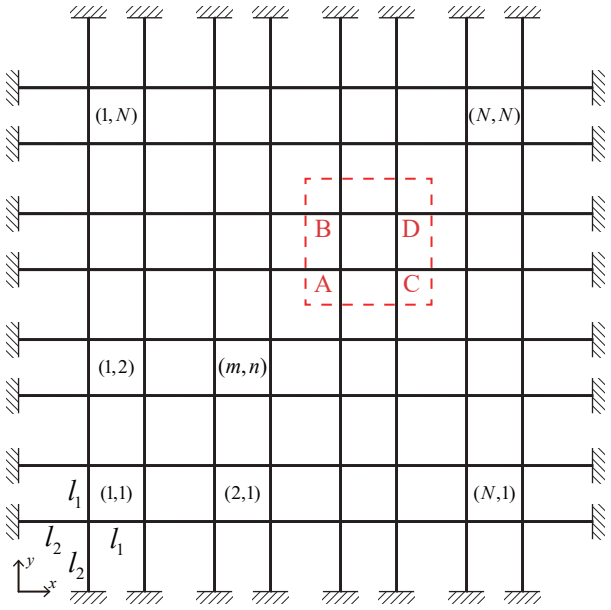
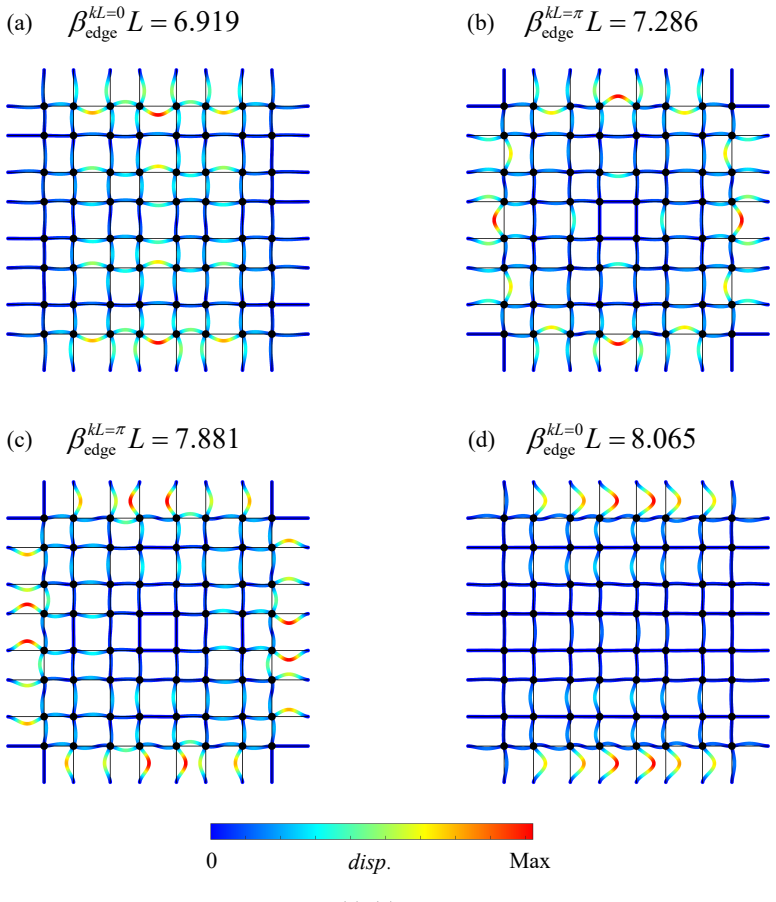
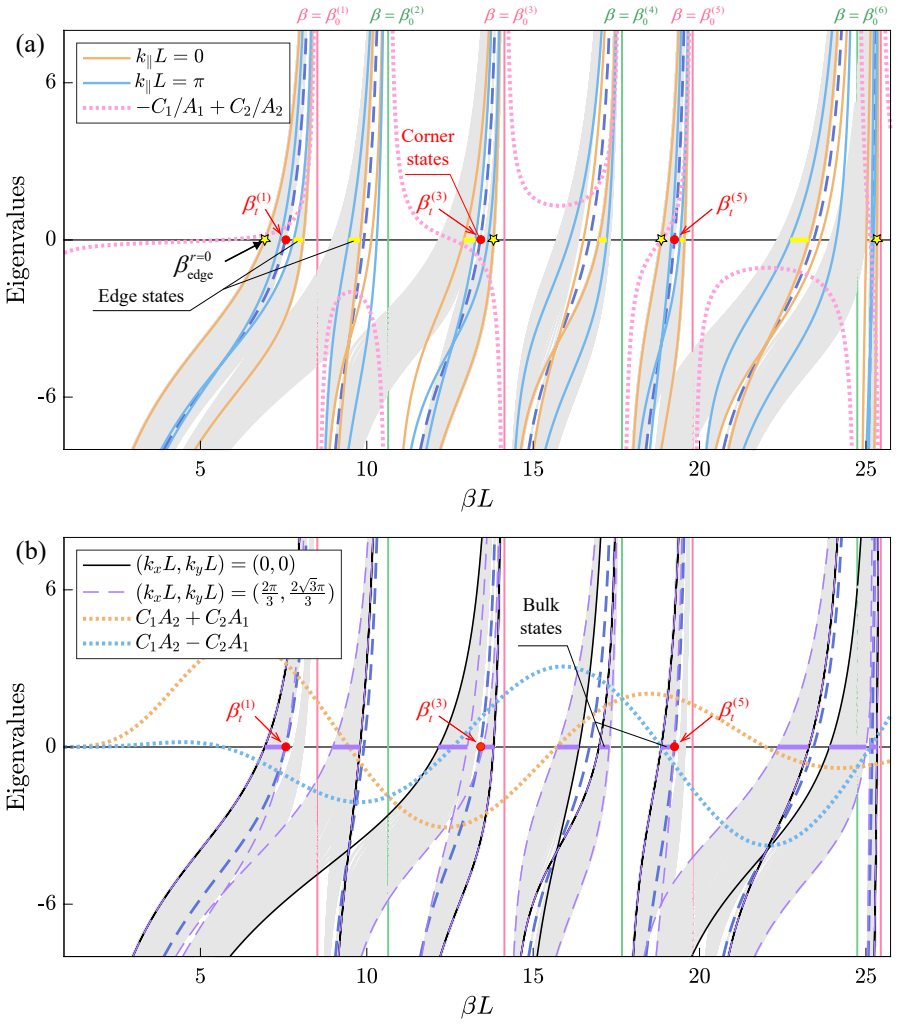
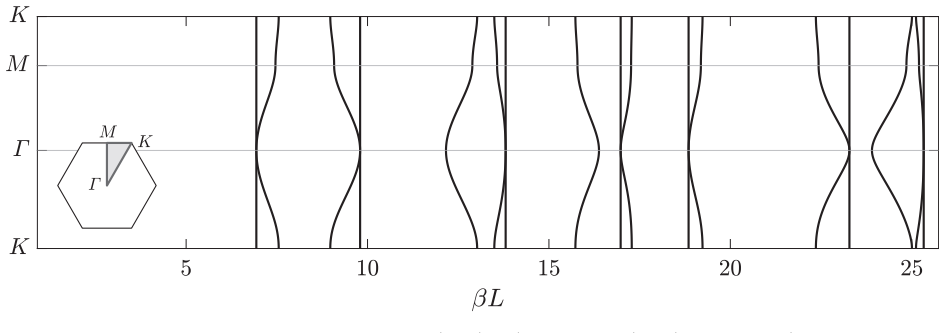
Continuum grid-like frames composed of rigidly jointed beams are classic subjects in the field of structural mechanics, whose topological dynamical properties have only recently been revealed. For two-dimensional frames, higher-order topological phenomena may occur, with frequency ranges of topological states and bulk bands becoming overlapped, leading to hybrid mode shapes. Concise theoretical results are necessary to identify the topological modes in such planar continuum systems with complex spectra. In this work, we present analytical expressions for the frequencies of higher-order topological corner states, edge states, and bulk states in kagome frames and square frames, as well as the criteria of existence of these topological states and patterns of their distribution in the spectrum. We identify the edge and corner states even under their degeneracy with the bulk bands. We show that the corner states are within the bandgaps of edge states unless topological transitions occur, and demonstrate the robustness of higher-order topological states under perturbations. These theoretical results fully demonstrate that the grid-like frames, despite being a large class of two-dimensional continuum systems, have topological states that can be accurately characterized through concise analytical expressions. This work contributes to the study of topological mechanics, and the accurate and concise theoretical results facilitate direct applications of topological grid-like frame structures in industry and engineering.
Editorial analysis
A structured set of objections, weighed in public.
Referee Report
Summary. The manuscript develops analytical expressions for the frequencies of higher-order topological corner states, edge states, and bulk states in kagome and square grid-like frames composed of rigidly jointed beams. It provides criteria for the existence of these states and their distribution patterns in the spectrum, including identification under degeneracy with bulk bands. The work also demonstrates that corner states are located within edge-state bandgaps (barring topological transitions) and shows robustness of these states to perturbations.
Significance. Should the analytical expressions prove to be exact and derived without undisclosed approximations, this would represent a significant advance in topological mechanics. It offers concise, closed-form tools for characterizing topological phenomena in continuum structural systems with complex, overlapping spectra, which could facilitate practical applications in engineering. The explicit treatment of degeneracy and perturbation robustness adds to the reliability of the results for real-world structures.
major comments (2)
- [§3.2, Eq. (18)] §3.2 (Kagome frames), Eq. (18): The closed-form expression for the corner-state frequency is stated to remain valid and topologically diagnostic even under degeneracy with bulk bands, but the governing fourth-order Euler-Bernoulli equations with rigid-joint continuity conditions yield a transcendental characteristic equation; the manuscript must explicitly show how this reduces to the reported algebraic form without an approximation that decouples hybrid modes.
- [§4] §4 (Square frames), the existence criteria paragraph: The claim that corner states lie strictly inside edge-state bandgaps (except at transitions) relies on the analytical separation of spectra; if the expressions are obtained via an effective discrete model rather than the full continuum beam equations, this must be stated, as it directly affects whether the results apply to the rigidly jointed continuum systems advertised in the abstract.
minor comments (2)
- [Figure 5] Figure 5: The mode-shape plots for degenerate corner and bulk states would benefit from an additional panel showing the participation factor or localization measure to visually confirm the topological character under overlap.
- [Introduction] Introduction, paragraph 2: The phrase 'grid-like frames' is used without a precise definition of the joint rigidity and beam slenderness assumptions; a short clarifying sentence would help readers distinguish this continuum setting from discrete spring-mass models.
Simulated Author's Rebuttal
We thank the referee for the careful and constructive review of our manuscript. We address each major comment point by point below, clarifying the derivations and outlining planned revisions to improve clarity and rigor.
read point-by-point responses
-
Referee: [§3.2, Eq. (18)] §3.2 (Kagome frames), Eq. (18): The closed-form expression for the corner-state frequency is stated to remain valid and topologically diagnostic even under degeneracy with bulk bands, but the governing fourth-order Euler-Bernoulli equations with rigid-joint continuity conditions yield a transcendental characteristic equation; the manuscript must explicitly show how this reduces to the reported algebraic form without an approximation that decouples hybrid modes.
Authors: We appreciate the referee's attention to the derivation details. The closed-form expression in Eq. (18) follows exactly from substituting the general solutions of the Euler-Bernoulli equations into the rigid-joint continuity conditions for displacements, rotations, shear forces, and bending moments. For the topologically protected corner mode, the resulting determinant of the linear system factors algebraically at the specific frequency due to symmetry and localization properties that cause exact cancellation of transcendental terms; no decoupling approximation or hybrid-mode separation is introduced. We will add a dedicated appendix in the revised manuscript that walks through this reduction step by step, including the matrix form and the exact factoring, to make the absence of approximations fully transparent even under degeneracy. revision: yes
-
Referee: [§4] §4 (Square frames), the existence criteria paragraph: The claim that corner states lie strictly inside edge-state bandgaps (except at transitions) relies on the analytical separation of spectra; if the expressions are obtained via an effective discrete model rather than the full continuum beam equations, this must be stated, as it directly affects whether the results apply to the rigidly jointed continuum systems advertised in the abstract.
Authors: We thank the referee for this clarification request. All analytical expressions and existence criteria in §4 (and throughout the manuscript) are derived directly from the full continuum Euler-Bernoulli beam equations with the rigid-joint continuity conditions; no effective discrete model is employed at any stage. The separation of bulk, edge, and corner frequencies emerges from the exact solutions of the continuum system. To remove any ambiguity, we will revise the relevant paragraph in §4 (and add a brief clarifying sentence in the methods or introduction) to explicitly state that the results originate from the continuum beam formulation and therefore apply to the rigidly jointed systems described in the abstract. revision: yes
Circularity Check
No circularity detected; derivations presented as independent analytical results from beam-frame models
full rationale
The paper claims to derive closed-form analytical expressions for topological frequencies in kagome and square frames directly from the governing equations of rigidly jointed continuum beams. No load-bearing step reduces a claimed prediction to a fitted parameter, self-defined quantity, or prior self-citation chain. The abstract and claimed results position the expressions as obtained from the transcendental characteristic equations of the Euler-Bernoulli or Timoshenko beam segments with joint continuity conditions, without evidence that the final formulas are tautological renamings or forced by internal definitions. External benchmarks (spectral patterns in structural mechanics) remain independent of the present derivations. This is the expected non-finding for a paper whose central contribution is explicit algebraic characterization rather than parameter fitting or uniqueness theorems imported from the same authors.
Axiom & Free-Parameter Ledger
Reference graph
Works this paper leans on
-
[1]
S. D. Huber, Topological mechanics, Nat. Phys. 12 (2016) 621–623. doi:10.1038/nphys3801
-
[2]
K. von Klitzing, T. Chakraborty, P. Kim, V. Madhavan, X. Dai, J. McIver, Y. Tokura, L. Savary, D. Smirnova, A. M. Rey, C. Felser, J. Gooth, X. Qi, 40 years of the quantum Hall effect, Nat. Rev. Phys. 2 (2020) 397–401. doi:10.1038/s42254-020-0209-1
-
[3]
C. L. Kane, T. C. Lubensky, Topological boundary modes in isostatic lattices, Nat. Phys. 10 (2014) 39–45. doi:10.1038/nphys2835
-
[4]
Y. Chen, J. P. McInerney, P. N. Krause, J. L. Schneider, M. Wegener, X. Mao, Observation of floppy flexural modes in a 3D polarized maxwell beam, Phys. Rev. Lett. 134 (2025) 086101. doi:10.1103/ PhysRevLett.134.086101
work page 2025
-
[5]
P. Wang, L. Lu, K. Bertoldi, Topological phononic crystals with one-way elastic edge waves, Phys. Rev. Lett. 115 (2015) 104302. doi:10.1103/PhysRevLett.115.104302
-
[6]
D. Zhao, M. Xiao, C. W. Ling, C. T. Chan, K. H. Fung, Topological interface modes in local resonant acoustic systems, Phys. Rev. B 98 (2018) 014110. doi:10.1103/PhysRevB.98.014110
-
[7]
H. Chen, H. Nassar, G. Huang, A study of topological effects in 1D and 2D mechanical lattices, J. Mech. Phys. Solids 117 (2018) 22–36. doi:10.1016/j.jmps.2018.04.013
-
[8]
Y. Chen, X. Liu, G. Hu, Topological phase transition in mechanical honeycomb lattice, J. Mech. Phys. Solids 122 (2019) 54–68. doi:10.1016/j.jmps.2018.08.021
-
[9]
X. Shi, I. Kiorpelidis, R. Chaunsali, V. Achilleos, G. Theocharis, J. Yang, Disorder-induced topological phase transition in a one-dimensional mechanical system, Phys. Rev. Res. 3 (2021) 033012. doi:10. 1103/PhysRevResearch.3.033012
work page 2021
-
[10]
T.-L. Yang, Y.-Z. Wang, Hall effect and topological phase transition of nonlinear elastic wave metamate- rials with local resonators, J. Mech. Phys. Solids 193 (2024) 105889. doi:10.1016/j.jmps.2024.105889. 34
-
[11]
A. Wang, C. Q. Chen, Static topological mechanics: from space-time duality to localized deformations, J. Mech. Phys. Solids 206 (2026) 106248. doi:10.1016/j.jmps.2025.106248
-
[12]
X. Huang, J. Lu, W. Deng, Z. Liu, Topological materials for elastic wave in continuum, Acta Mech. Sin. 39 (2023) 723041. doi:10.1007/s10409-023-23041-x
-
[13]
X. Mao, T. C. Lubensky, Maxwell lattices and topological mechanics, Annu. Rev. Condens. Matter Phys. 9 (2018) 413–433. doi:10.1146/annurev-conmatphys-033117-054235
-
[14]
D. Zhou, L. Zhang, X. Mao, Topological edge floppy modes in disordered fiber networks, Phys. Rev. Lett. 120 (2018) 068003. doi:10.1103/PhysRevLett.120.068003
-
[15]
J. Yin, M. Ruzzene, J. Wen, D. Yu, L. Cai, L. Yue, Band transition and topological interface modes in 1D elastic phononic crystals, Sci. Rep. 8 (2018) 6806. doi:10.1038/s41598-018-24952-5
-
[16]
Muhammad, W. Zhou, C. Lim, Topological edge modeling and localization of protected interface modes in 1D phononic crystals for longitudinal and bending elastic waves, Int. J. Mech. Sci. 159 (2019) 359–372. doi:10.1016/j.ijmecsci.2019.05.020
-
[17]
M. I. N. Rosa, R. K. Pal, J. R. F. Arruda, M. Ruzzene, Edge states and topological pumping in spatially modulated elastic lattices, Phys. Rev. Lett. 123 (2019) 034301. doi:10.1103/PhysRevLett.123.034301
-
[18]
H. Fan, B. Xia, L. Tong, S. Zheng, D. Yu, Elastic higher-order topological insulator with topologically protected corner states, Phys. Rev. Lett. 122 (2019) 204301. doi:10.1103/PhysRevLett.122.204301
-
[19]
W.Zhou, B.Wu, Z.Chen, W.Chen, C.Lim, J. Reddy, Activelycontrollable topological phasetransition in homogeneous piezoelectric rod system, J. Mech. Phys. Solids 137 (2020) 103824. doi:10.1016/j. jmps.2019.103824
work page doi:10.1016/j 2020
-
[20]
X.-Q. Zhang, J. Tang, T.-X. Ma, Y.-S. Wang, Multiple topological interface states in coupled phononic cavity chains, Int. J. Mech. Sci. 307 (2025) 110928. doi:10.1016/j.ijmecsci.2025.110928
-
[21]
Q. Zhang, Y. Chen, K. Zhang, G. Hu, Dirac degeneracy and elastic topological valley modes induced by local resonant states, Phys. Rev. B 101 (2020) 014101. doi:10.1103/PhysRevB.101.014101
-
[22]
W. Cheng, H. Zhang, Y. Wei, K. Wang, G. Hu, Elastic energy and polarization transport through spatial modulation, J. Mech. Phys. Solids 182 (2024) 105475. doi:10.1016/j.jmps.2023.105475
-
[23]
Q. Wu, H. Chen, X. Li, G. Huang, In-plane second-order topologically protected states in elastic kagome lattices, Phys. Rev. Appl. 14 (2020) 014084. doi:10.1103/PhysRevApplied.14.014084. 35
- [24]
-
[25]
Y. Tang, W. Zhou, Y. Mai, Y. Chen, Z. Zhong, W. Chen, Higher-order topological states and magnetic field control in elastic metamaterials, Acta Mech. Sin. 42 (2026) 524537. doi:10.1007/ s10409-024-24537-x
work page 2026
-
[26]
M. Xiao, Z. Zhang, C. Chan, Surface impedance and bulk band geometric phases in one-dimensional systems, Phys. Rev. X 4 (2014) 021017. doi:10.1103/PhysRevX.4.021017
-
[27]
Y. Sun, J. Xing, L.-H. Shao, J. Wang, The topological dynamics of continuum lattice grid structures, J. Mech. Phys. Solids 194 (2025) 105935. doi:10.1016/j.jmps.2024.105935
-
[28]
W. A. Benalcazar, B. A. Bernevig, T. L. Hughes, Quantized electric multipole insulators, Science 357 (2017) 61–66. doi:10.1126/science.aah6442
-
[29]
F. Schindler, A. M. Cook, M. G. Vergniory, Z. Wang, S. S. P. Parkin, B. A. Bernevig, T. Neupert, Higher-order topological insulators, Sci. Adv. 4 (2018) eaat0346. doi:10.1126/sciadv.aat0346
-
[30]
M. Ezawa, Higher-order topological insulators and semimetals on the breathing kagome and pyrochlore lattices, Phys. Rev. Lett. 120 (2018) 026801. doi:10.1103/PhysRevLett.120.026801
-
[32]
W. A. Benalcazar, T. Li, T. L. Hughes, Quantization of fractional corner charge inC n-symmetric higher-order topological crystalline insulators, Phys. Rev. B 99 (2019) 245151. doi:10.1103/PhysRevB. 99.245151
-
[33]
B. Xie, H.-X. Wang, X. Zhang, P. Zhan, J.-H. Jiang, M. Lu, Y. Chen, Higher-order band topology, Nat. Rev. Phys. 3 (2021) 520–532. doi:10.1038/s42254-021-00323-4
-
[34]
X. Xiang, Y.-G. Peng, F. Gao, X. Wu, P. Wu, Z. Chen, X. Ni, X.-F. Zhu, Demonstration of acoustic higher-order topological Stiefel-Whitney semimetal, Phys. Rev. Lett. 132 (2024) 197202. doi:10.1103/ PhysRevLett.132.197202
work page 2024
-
[35]
M.-H. Ling, P. Wu, Y.-G. Peng, X.-F. Zhu, Twist-induced all-flat-band higher-order acoustic topological insulator, Adv. Mater. 38 (2026) e19287. doi:10.1002/adma.202519287. 36
-
[36]
G. Ma, M. Xiao, C. T. Chan, Topological phases in acoustic and mechanical systems, Nat. Rev. Phys. 1 (2019) 281–294. doi:10.1038/s42254-019-0030-x
-
[37]
Y. Wu, M. Yan, Z.-K. Lin, H.-X. Wang, F. Li, J.-H. Jiang, On-chip higher-order topological microme- chanical metamaterials, Sci. Bull. 66 (2021) 1959–1966. doi:10.1016/j.scib.2021.06.024
-
[38]
F. Liu, K. Wakabayashi, Novel topological phase with a zero Berry curvature, Phys. Rev. Lett. 118 (2017) 076803. doi:10.1103/PhysRevLett.118.076803
-
[39]
X. Zhang, H.-X. Wang, Z.-K. Lin, Y. Tian, B. Xie, M.-H. Lu, Y.-F. Chen, J.-H. Jiang, Second-order topology and multidimensional topological transitions in sonic crystals, Nat. Phys. 15 (2019) 582–588. doi:10.1038/s41567-019-0472-1
-
[40]
D. Obana, F. Liu, K. Wakabayashi, Topological edge states in the Su-Schrieffer-Heeger model, Phys. Rev. B 100 (2019) 075437. doi:10.1103/PhysRevB.100.075437
-
[41]
S. Huybrechts, S. W. Tsai, Analysis and behavior of grid structures, Compos. Sci. Technol. 56 (1996) 1001–1015. doi:10.1016/0266-3538(96)00063-2
-
[42]
R.-T. Wang, J.-S. Lin, Vibration of multi-span Timoshenko frames due to moving loads, J. Sound Vib. 212 (1998) 417–434. doi:10.1006/jsvi.1997.1437
-
[43]
P. G. Martinsson, A. B. Movchan, Vibrations of lattice structures and phononic band gaps, Q. J. Mech. Appl. Math. 56 (2003) 45–64. doi:10.1093/qjmam/56.1.45
-
[44]
C. J. Hunt, F. Morabito, C. Grace, Y. Zhao, B. K. S. Woods, A review of composite lattice structures, Compos. Struct. 284 (2022) 115120. doi:10.1016/j.compstruct.2021.115120
-
[45]
C.-W. Chen, R. Chaunsali, J. Christensen, G. Theocharis, J. Yang, Corner states in a second-order mechanical topological insulator, Commun. Mater. 2 (2021) 62. doi:10.1038/s43246-021-00170-x
-
[46]
Z. Wang, Q. Wei, An elastic higher-order topological insulator based on kagome phononic crystals, J. Appl. Phys. 129 (2021) 035102. doi:10.1063/5.0031377
-
[47]
J. Yi, C. Q. Chen, Delocalization and higher-order topology in a nonlinear elastic lattice, New J. Phys. 26 (2024) 063004. doi:10.1088/1367-2630/ad4f07
-
[48]
A. S. Phani, J. Woodhouse, N. A. Fleck, Wave propagation in two-dimensional periodic lattices, J. Acoust. Soc. Am. 119 (2006) 1995–2005. doi:10.1121/1.2179748
-
[49]
H. Liu, Q. Zhang, K. Zhang, G. Hu, H. Duan, Designing 3D digital metamaterial for elastic waves: From elastic wave polarizer to vibration control, Adv. Sci. 6 (2019) 1900401. doi:10.1002/advs.201900401. 37
-
[50]
S. S. Rao, Vibration of Continuous Systems, 2nd ed., Wiley, Hoboken, NJ, 2019
work page 2019
-
[51]
W. P. Su, J. R. Schrieffer, A. J. Heeger, Solitons in polyacetylene, Phys. Rev. Lett. 42 (1979) 1698–1701. doi:10.1103/PhysRevLett.42.1698
-
[52]
Zak, Berry’s phase for energy bands in solids, Phys
J. Zak, Berry’s phase for energy bands in solids, Phys. Rev. Lett. 62 (1989) 2747–2750. doi:10.1103/ PhysRevLett.62.2747
work page 1989
-
[53]
Resta, Macroscopic polarization in crystalline dielectrics: the geometric phase approach, Rev
R. Resta, Macroscopic polarization in crystalline dielectrics: the geometric phase approach, Rev. Mod. Phys. 66 (1994) 899–915. doi:10.1103/RevModPhys.66.899
-
[54]
B.-Y. Xie, G.-X. Su, H.-F. Wang, H. Su, X.-P. Shen, P. Zhan, M.-H. Lu, Z.-L. Wang, Y.-F. Chen, Vi- sualization of higher-order topological insulating phases in two-dimensional dielectric photonic crystals, Phys. Rev. Lett. 122 (2019) 233903. URL:https://link.aps.org/doi/10.1103/PhysRevLett.122. 233903. doi:10.1103/PhysRevLett.122.233903
- [55]
-
[56]
doi:10.1038/s41377-020-00352-1
-
[57]
X. Ni, M. Weiner, A. Alù, A. B. Khanikaev, Observation of higher-order topological acoustic states protected by generalized chiral symmetry, Nat. Mater. 18 (2019) 113–120. doi:10.1038/ s41563-018-0252-9
work page 2019
- [58]
-
[59]
H. Xue, Y. Yang, F. Gao, Y. Chong, B. Zhang, Acoustic higher-order topological insulator on a kagome lattice, Nat. Mater. 18 (2019) 108–112. doi:10.1038/s41563-018-0251-x
-
[60]
V. V. Vasiliev, A. F. Razin, Anisogrid composite lattice structures for spacecraft and aircraft applica- tions, Compos. Struct. 76 (2006) 182–189. doi:10.1016/j.compstruct.2006.06.025
-
[61]
V. V. Vasiliev, V. A. Barynin, A. F. Razin, Anisogrid composite lattice structures – development and aerospace applications, Compos. Struct. 94 (2012) 1117–1127. doi:10.1016/j.compstruct.2011.10. 023
-
[62]
F. Kiakojouri, V. De Biagi, B. Chiaia, M. R. Sheidaii, Progressive collapse of framed building structures: Current knowledge and future prospects, Eng. Struct. 206 (2020) 110061. doi:10.1016/j.engstruct. 2019.110061. 38
-
[63]
Y. Jiang, D. Yan, J. Wang, L.-H. Shao, P. Sharma, The giant flexoelectric effect in a luffa plant- based sponge for green devices and energy harvesters, Proc. Natl. Acad. Sci. 120 (2023) e2311755120. doi:10.1073/pnas.2311755120
-
[64]
X. Wang, S. Sarkar, S. Gonella, X. Mao, Topological mechanical metamaterial for robust and ductile one-way fracturing, Nat. Commun. 17 (2026) 2420. doi:10.1038/s41467-026-69026-7. 39
discussion (0)
Sign in with ORCID, Apple, or X to comment. Anyone can read and Pith papers without signing in.