REVIEW 3 major objections 5 minor 1 cited by
Understanding the Skill Gap in Recurrent Language Models: The Role of the Gather-and-Aggregate Mechanism
T0 review · 3 major / 5 minor · reviewed 2026-08-16 · deepseek-v4-flash
Pith's one-line read The Transformer-SSM retrieval gap comes down to a few specialized Gather-and-Aggregate heads, not the whole model.
desk verdict A credible and well-triangulated mechanistic story that localizes the Transformer–SSM retrieval gap to a few Gather-and-Aggregate heads, but the headline single-head cliff is an artifact of heavy pruning and the broad claim needs reining in. read the letter →
The pith
A machine-rendered reading of the paper's core claim, the machinery that carries it, and where it could break.
The reading
What carries the argument
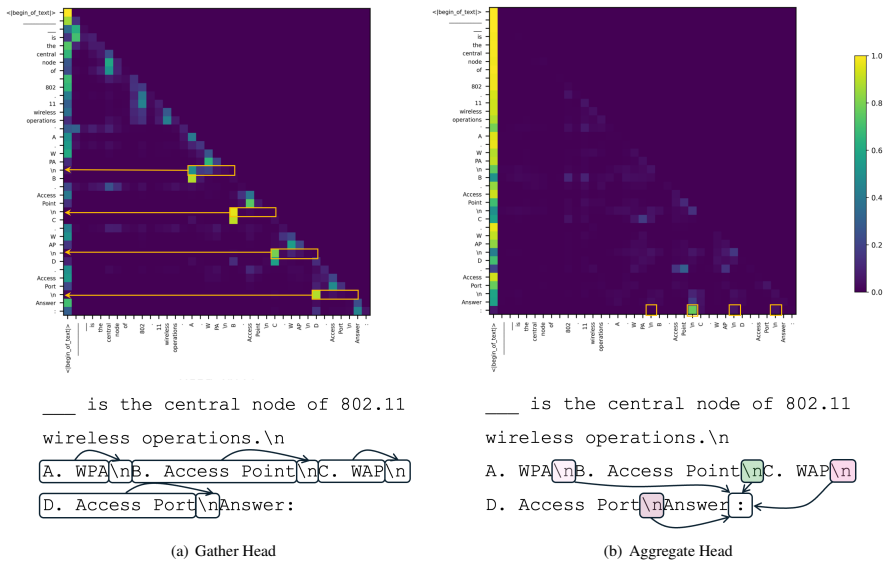
The central object is the Gather-and-Aggregate (G&A) mechanism, a two-stage circuit for in-context retrieval. The first stage, a Gather Head, attends over a segment of input and compresses it into a summary token, typically the segment-final newline; the second stage, an Aggregate Head, attends from the query position to those summary tokens and effectively selects the correct one. The paper isolates this pair with layer pruning, head ablations, attention masking, and layer-replacement experiments, and shows that the Transformer-SSM gap in retrieval-heavy benchmarks tracks how sharply each architecture's G&A heads can implement these two operations.
What would settle it
A direct falsifier would be to use activation patching on a natural retrieval-heavy benchmark to identify the heads that carry the correct-answer information and check whether they coincide with the G&A heads found by the synthetic diagnostic. If patching points to different heads, or if removing the identified G&A heads leaves some model's MMLU unaffected while removing a different head collapses it, the localization claim would be refuted. A simpler check is to run the same head-ablation ranking on the KV-retrieval task with a trailing space in the prompt and see whether the top-ranked heads change.
Extended reading notes
Core claim
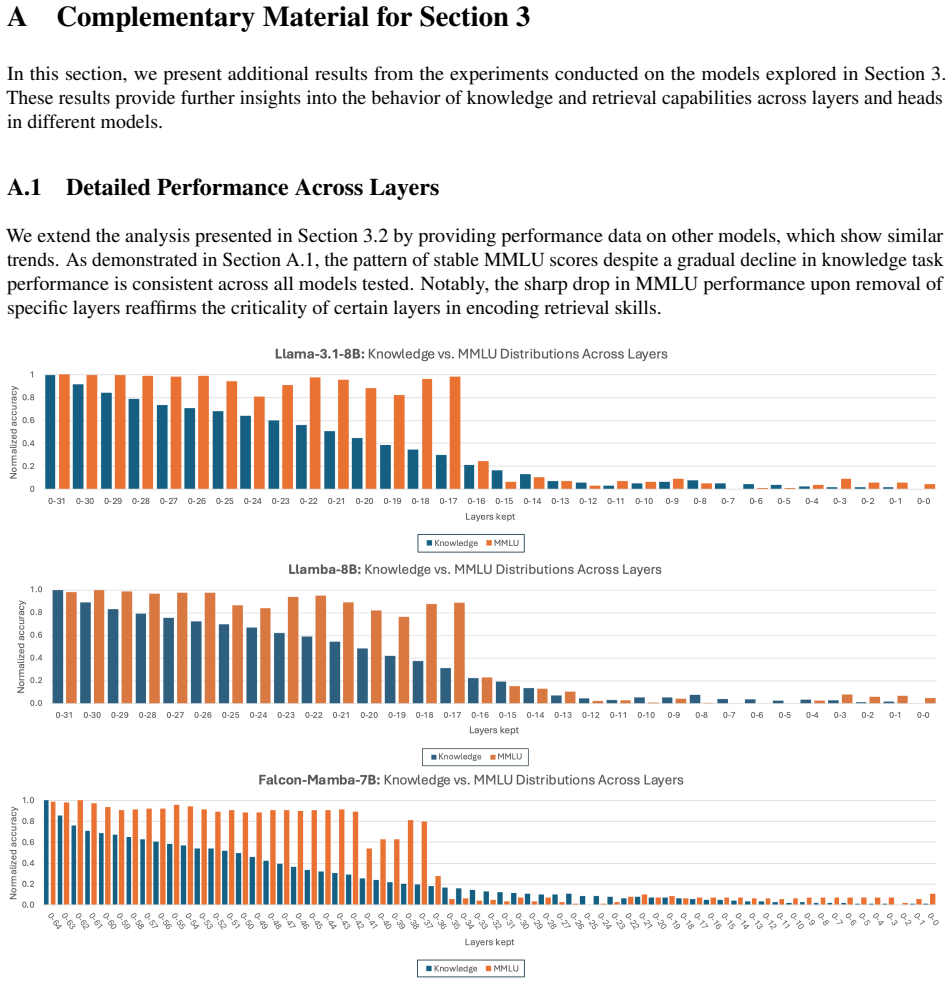
Both Transformer- and SSM-based language models retrieve information from context through the same two-stage Gather-and-Aggregate mechanism, and in both families the mechanism is concentrated in a very small number of heads. A Gather Head condenses each relevant segment of context into a single representative token; an Aggregate Head then attends to those summaries from the query position and selects the relevant one. In a minimal Llama-3.1-8B, two heads, L16H22 and L17H24, are jointly responsible for MMLU letter selection: removing either drops accuracy from 66% to about 25%, while retaining just these two heads in the final layers sustains performance. Falcon-Mamba-7B and Llamba-8B show the same pattern, with a few Mamba channels or heads recovering most of the full model's MMLU score. The paper further shows that SSM heads implement the mechanism with smoother, less sharply localized attention, so they need more heads to approach Transformer-level retrieval, and that replacing one SSM Aggregate Head layer with attention raises MMLU from 33% to 50%.
Load-bearing premise
The cross-task conclusion rests on the assumption that the synthetic KV-retrieval diagnostic, run with answer scoring and deliberately without a trailing space, activates the same heads and the same retrieval process that drive performance on natural benchmarks such as MMLU, GSM8K, BBH, and dialogue comprehension.
Editorial extensions
If this is right
- MMLU scores on these models should be read partly as retrieval ability: a model can score 66% on MMLU while its knowledge-task scores are already degraded, and can fall to 25% when one head is removed.
- Hybrid models work because attention takes over aggregation: ablating six attention heads in Zamba2-7B drops MMLU from 64.3% to 34.9% while knowledge-task accuracy remains at 70%.
- For hybrid design, attention is most valuable in middle layers where G&A heads emerge; when distilling a Transformer into an SSM, preserving attention at layers containing Aggregate Heads recovers most of the lost MMLU performance.
- SSMs can compensate for weak per-head aggregation by using more heads, but this redundancy only partially closes the gap; replacing a single Aggregate Head layer with attention gave the largest measured gain.
- The localized-retrieval account extends beyond MMLU to GSM8K, BBH, SWDE, and chat-formatted ARC, so the bottleneck is not specific to multiple-choice letter selection.
Reading between the lines
- If this diagnosis is right, then adding parameters or training data to pure SSMs will not by itself fix retrieval; the cheaper lever is architectural, inserting a small number of attention slots at the layers where G&A heads emerge.
- The diagnostic format matters: the paper deliberately uses answer scoring without a trailing space because that format concentrates retrieval in a few heads. A natural extension is to test whether the same head identities are recovered under more natural token-boundary formats or longer contexts, since the head ranking could shift with prompt format.
- Because MMLU's letter-selection format is what makes retrieval decisive, leaderboard comparisons between architectures may partly be comparisons of retrieval-format handling rather than knowledge; reformatting benchmarks to free-form answers could change relative rankings.
- Another testable extension is to run the same head-ablation protocol across models of different scale, pretraining objective, or depth to see whether G&A heads always settle in middle layers or whether their preferred depth shifts with architecture and data.
Signed reviews
Editorial analysis
A structured set of objections, weighed in public.
Referee Report
Summary. The paper proposes a unified mechanistic account of in-context retrieval in Transformer- and SSM-based language models. It identifies a two-stage Gather-and-Aggregate (G&A) mechanism: a Gather Head compresses each answer segment into a summary token, and an Aggregate Head later combines these summaries to select the correct label. The authors argue that this mechanism is concentrated in a small number of heads in both architecture families, that SSMs implement it less sharply (smoother attention patterns, more redundant heads), and that the resulting retrieval bottleneck can explain much of the Transformer–SSM performance gap on tasks like MMLU, GSM8K, BBH, and dialogue comprehension. Evidence comes from layer/head pruning and zeroing in Llama-3.1-8B, Falcon-Mamba-7B, Llamba-8B, and Zamba2, a synthetic KV-retrieval diagnostic, masking interventions that restrict heads to the hypothesized pattern, and hybrid layer-replacement experiments on a distilled SSM. The central claim is that the retrieval gap 'exists in just a few heads' rather than reflecting a broad architectural deficiency, with implications for hybrid model design.
Significance. If the central claim holds, the paper makes a valuable contribution: it extends the 'retrieval heads' literature from Transformers to SSMs, refines the single-head view by emphasizing a coordinated two-stage mechanism, and offers a concrete design rule for hybrid models (place or retain attention near the layers where G&A heads emerge). The paper's strengths include multiple independent interventions (layer pruning, head zeroing, runtime masking, hybrid replacement), a synthetic diagnostic intended to isolate retrieval, and honest caveats in Section 3.6 about cases where the two layers are non-adjacent. The findings are falsifiable and the experiments are publicly released. However, as detailed below, the strongest quantitative claim (a single-head MMLU cliff) is demonstrated only in a heavily pruned model, and the cross-task generalization from the synthetic diagnostic to natural benchmarks is not fully validated. These issues are load-bearing for the paper's headline conclusion, so the manuscript needs substantial revision rather than acceptance in its current form.
major comments (3)
- [§3.4, Table 1 and §6.2, Table 2]
- [§6.1, Appendix A.5, Table 5]
- [§5.4, Hybrid Replacements]
minor comments (5)
- [Abstract and §1]
- [§2]
- [Appendix A.4]
- [§3.6]
- [Throughout]
Circularity Check
No material circularity: the G&A head identifications are validated by synthetic KV-retrieval and masking interventions, and the only self-referential elements are model artifacts that are not load-bearing.
full rationale
The paper's derivation chain is self-contained and externally checked. Critical heads are first located by ablating the minimal Llama-3.1-8B on MMLU (Section 3.4), then the same heads are tested on a synthetic KV-retrieval task that has no factual overlap with MMLU (Section 3.5), and later the KV-retrieval head rankings in Table 5 are used to ablate heads on GSM8K, BBH, and ARC-Chat (Section 6). These are independent measurements rather than re-statements of the selection criterion. The masking experiment in Section 4.3 is a sufficiency test: restricting the preserved heads to the hypothesized Gather-and-Aggregate attention pattern and observing the same MMLU accuracy does not define the result in terms of the conclusion; it tests whether the proposed pattern can reproduce the behavior. The paper's self-citations to MOHAWK and Llamba are model artifacts; the observation that Llamba places G&A heads in the teacher layers could be inherited from layer-wise distillation, but that observation is not load-bearing because from-scratch Falcon-Mamba shows the same mechanism, and the direct masking and KV-retrieval tests on Llamba stand independently. The choice of the no-trailing-space answer-scoring probe in Appendix A.5 is a probe-design choice that may bias which heads are flagged, but the natural-benchmark ablations are out-of-sample with respect to the probe and are not derived from it. No equation, fitted parameter, or uniqueness claim is reused as a prediction, so I find no circular step to report.
Assumptions & free parameters
assumptions (5)
- domain assumption Zeroing a head's output projection is a clean causal intervention that removes only that head's contribution to the residual stream.
- domain assumption The synthetic KV-retrieval task with answer scoring and no trailing space measures the same in-context retrieval mechanism used by MMLU, GSM8K, BBH, and dialogue benchmarks.
- domain assumption Knowledge-focused benchmarks such as ARC, PIQA, Winogrande, OpenBookQA, and HellaSwag have minimal in-context retrieval demands.
- domain assumption The hidden-attention approximation used to visualize SSM token mixing faithfully represents the smoothness of SSM G&A heads.
- domain assumption The pruned minimal model preserves the same retrieval machinery as the full model, so head criticality transfers to the unpruned model.
invented entities (2)
-
Gather Head
independent evidence
-
Aggregate Head
independent evidence
Cite this review
Pith. "Pith review of Understanding the Skill Gap in Recurrent Language Models: The Role of the Gather-and-Aggregate Mechanism." pith.science (2026). https://pith.science/paper/WQHNPUIJ
@misc{pith2026250418574,
  author       = {Pith},
  title        = {Pith review of: Understanding the Skill Gap in Recurrent Language Models: The Role of the Gather-and-Aggregate Mechanism},
  year         = {2026},
  howpublished = {\url{https://pith.science/paper/WQHNPUIJ}},
  note         = {Machine review of arXiv:2504.18574}
}
read the original abstract
State-space models (SSMs) offer efficient alternatives to Transformers for long sequences, but their fixed-size recurrent state limits capability on algorithmic tasks, such as retrieving past context. In this work, we examine how in-context retrieval operates in Transformer- and SSM-based language models and find that both rely on a similar Gather-and-Aggregate (G&A) mechanism: a Gather Head extracts relevant information pieces from context, which an Aggregate Head integrates into a single representation. In both architectures, G&A concentrates in a few heads, forming critical bottlenecks even for simple retrieval. For example, we show that disabling a single Gather or Aggregate Head in a pruned Llama-3.1-8B impairs retrieving the correct answer letter in MMLU, reducing its accuracy from 66% to 25% (random guessing). Moreover, this retrieval bottleneck can obscure limited knowledge demands of tasks as the pruned model succeeds on MMLU with functioning G&A heads yet fails on other knowledge benchmarks. The bottleneck similarly extends to tasks where SSMs typically underperform, such as GSM8K, BBH, and dialogue comprehension. We show that SSMs' retrieval challenges manifest in these heads, creating smoother attention patterns instead of the sharp token transitions effective G&A requires. Thus, the Transformer-SSM retrieval gap exists in just a few heads, rather than the entire language model. This suggests a unified explanation for Transformer vs. SSM performance gap while showing how to merge their strengths. We find that pretrained hybrid models, where SSMs are combined with a few attention layers, delegate the role of Aggregate Heads to attention. Similarly, replacing a single G&A head in a pretrained SSM with an attention variant boosts retrieval and benchmark scores.
Figures


Figures from the paper (7 more)




Forward citations
Cited by 1 Pith paper
-
Mechanistic Attention Guidance for Agent Memory Refinement
Attention patterns reveal how an AI agent uses memory, and using these patterns to rewrite memory improves task performance and memory efficiency.
Reference graph
Works this paper leans on
-
[1]
The hidden attention of mamba models, 2024
Ameen Ali, Itamar Zimerman, and Lior Wolf. The hidden attention of mamba models, 2024. URL https://arxiv.org/abs/2403.01590
arXiv 2024
-
[2]
When benchmarks are targets: Revealing the sensitivity of large language model leaderboards, 2024
Norah Alzahrani, Hisham Abdullah Alyahya, Yazeed Alnumay, Sultan Alrashed, Shaykhah Alsubaie, Yusef Almushaykeh, Faisal Mirza, Nouf Alotaibi, Nora Altwairesh, Areeb Alowisheq, M Saiful Bari, and Haidar Khan. When benchmarks are targets: Revealing the sensitivity of large language model leaderboards, 2024. URL https://arxiv.org/abs/2402.01781
arXiv 2024
-
[3]
Mechanistic evaluation of transformers and state space models, 2025 a
Aryaman Arora, Neil Rathi, Nikil Roashan Selvam, Róbert Csórdas, Dan Jurafsky, and Christopher Potts. Mechanistic evaluation of transformers and state space models, 2025 a . URL https://arxiv.org/abs/2505.15105
arXiv 2025
-
[4]
Zoology: Measuring and improving recall in efficient language models, 2023
Simran Arora, Sabri Eyuboglu, Aman Timalsina, Isys Johnson, Michael Poli, James Zou, Atri Rudra, and Christopher Ré. Zoology: Measuring and improving recall in efficient language models, 2023. URL https://arxiv.org/abs/2312.04927
arXiv 2023
-
[6]
Simple linear attention language models balance the recall-throughput tradeoff, 2025 b
Simran Arora, Sabri Eyuboglu, Michael Zhang, Aman Timalsina, Silas Alberti, Dylan Zinsley, James Zou, Atri Rudra, and Christopher Ré. Simple linear attention language models balance the recall-throughput tradeoff, 2025 b . URL https://arxiv.org/abs/2402.18668
arXiv 2025
-
[7]
xlstm: Extended long short-term memory, 2024
Maximilian Beck, Korbinian Pöppel, Markus Spanring, Andreas Auer, Oleksandra Prudnikova, Michael Kopp, Günter Klambauer, Johannes Brandstetter, and Sepp Hochreiter. xlstm: Extended long short-term memory, 2024. URL https://arxiv.org/abs/2405.04517
arXiv 2024
-
[8]
Aviv Bick, Kevin Y. Li, Eric P. Xing, J. Zico Kolter, and Albert Gu. Transformers to ssms: Distilling quadratic knowledge to subquadratic models, 2024. URL https://arxiv.org/abs/2408.10189
arXiv 2024
-
[9]
Llamba: Scaling distilled recurrent models for efficient language processing, 2025
Aviv Bick, Tobias Katsch, Nimit Sohoni, Arjun Desai, and Albert Gu. Llamba: Scaling distilled recurrent models for efficient language processing, 2025. URL https://arxiv.org/abs/2502.14458
arXiv 2025
Show all 59 references
-
[10]
Birth of a transformer: A memory viewpoint, 2023
Alberto Bietti, Vivien Cabannes, Diane Bouchacourt, Herve Jegou, and Leon Bottou. Birth of a transformer: A memory viewpoint, 2023. URL https://arxiv.org/abs/2306.00802
2023 arXiv
-
[11]
Piqa: Reasoning about physical commonsense in natural language, 2019
Yonatan Bisk, Rowan Zellers, Ronan Le Bras, Jianfeng Gao, and Yejin Choi. Piqa: Reasoning about physical commonsense in natural language, 2019. URL https://arxiv.org/abs/1911.11641
2019 arXiv
-
[12]
Sam Blouir, Jimmy T. H. Smith, Antonios Anastasopoulos, and Amarda Shehu. Birdie: Advancing state space models with reward-driven objectives and curricula, 2025. URL https://arxiv.org/abs/2411.01030
2025 arXiv
-
[13]
Tom B. Brown, Benjamin Mann, Nick Ryder, Melanie Subbiah, Jared Kaplan, Prafulla Dhariwal, Arvind Neelakantan, Pranav Shyam, Girish Sastry, Amanda Askell, Sandhini Agarwal, Ariel Herbert-Voss, Gretchen Krueger, Tom Henighan, Rewon Child, Aditya Ramesh, Daniel M. Ziegler, Jeffr...
2020
-
[14]
Think you have solved question answering? try arc, the ai2 reasoning challenge, 2018
Peter Clark, Isaac Cowhey, Oren Etzioni, Tushar Khot, Ashish Sabharwal, Carissa Schoenick, and Oyvind Tafjord. Think you have solved question answering? try arc, the ai2 reasoning challenge, 2018. URL https://arxiv.org/abs/1803.05457
2018 arXiv
-
[15]
Training verifiers to solve math word problems, 2021
Karl Cobbe, Vineet Kosaraju, Mohammad Bavarian, Mark Chen, Heewoo Jun, Lukasz Kaiser, Matthias Plappert, Jerry Tworek, Jacob Hilton, Reiichiro Nakano, Christopher Hesse, and John Schulman. Training verifiers to solve math word problems, 2021. URL https://arxiv.org/abs/2110.14168
2021 arXiv
-
[16]
Transformers are SSM s: Generalized models and efficient algorithms through structured state space duality
Tri Dao and Albert Gu. Transformers are SSM s: Generalized models and efficient algorithms through structured state space duality. In International Conference on Machine Learning (ICML), 2024
2024
-
[17]
Fu, Stefano Ermon, Atri Rudra, and Christopher Ré
Tri Dao, Daniel Y. Fu, Stefano Ermon, Atri Rudra, and Christopher Ré. Flashattention: Fast and memory-efficient exact attention with io-awareness, 2022
2022
-
[18]
A mathematical framework for transformer circuits
Nelson Elhage, Neel Nanda, Catherine Olsson, Tom Henighan, Nicholas Joseph, Ben Mann, Amanda Askell, Yuntao Bai, Anna Chen, Tom Conerly, Nova DasSarma, Dawn Drain, Deep Ganguli, Zac Hatfield-Dodds, Danny Hernandez, Andy Jones, Jackson Kernion, Liane Lovitt, Kamal Ndousse, Dari...
2021
-
[19]
Zamba: A compact 7b ssm hybrid model, 2024
Paolo Glorioso, Quentin Anthony, Yury Tokpanov, James Whittington, Jonathan Pilault, Adam Ibrahim, and Beren Millidge. Zamba: A compact 7b ssm hybrid model, 2024. URL https://arxiv.org/abs/2405.16712
2024 arXiv
-
[20]
Mamba: Linear-time sequence modeling with selective state spaces, 2023
Albert Gu and Tri Dao. Mamba: Linear-time sequence modeling with selective state spaces, 2023
2023
-
[21]
Efficiently modeling long sequences with structured state spaces, 2022
Albert Gu, Karan Goel, and Christopher Ré. Efficiently modeling long sequences with structured state spaces, 2022
2022
-
[22]
Measuring massive multitask language understanding, 2021
Dan Hendrycks, Collin Burns, Steven Basart, Andy Zou, Mantas Mazeika, Dawn Song, and Jacob Steinhardt. Measuring massive multitask language understanding, 2021. URL https://arxiv.org/abs/2009.03300
2021 arXiv
-
[23]
Kakade, and Eran Malach
Samy Jelassi, David Brandfonbrener, Sham M. Kakade, and Eran Malach. Repeat after me: Transformers are better than state space models at copying, 2024. URL https://arxiv.org/abs/2402.01032
2024 arXiv
-
[24]
Transformers are rnns: Fast autoregressive transformers with linear attention, 2020
Angelos Katharopoulos, Apoorv Vyas, Nikolaos Pappas, and François Fleuret. Transformers are rnns: Fast autoregressive transformers with linear attention, 2020
2020
-
[25]
Jamba: A hybrid transformer-mamba language model, 2024
Opher Lieber, Barak Lenz, Hofit Bata, Gal Cohen, Jhonathan Osin, Itay Dalmedigos, Erez Safahi, Shaked Meirom, Yonatan Belinkov, Shai Shalev-Shwartz, Omri Abend, Raz Alon, Tomer Asida, Amir Bergman, Roman Glozman, Michael Gokhman, Avashalom Manevich, Nir Ratner, Noam Rozen, Ere...
2024 arXiv
-
[26]
Does circuit analysis interpretability scale? evidence from multiple choice capabilities in chinchilla, 2023
Tom Lieberum, Matthew Rahtz, János Kramár, Neel Nanda, Geoffrey Irving, Rohin Shah, and Vladimir Mikulik. Does circuit analysis interpretability scale? evidence from multiple choice capabilities in chinchilla, 2023. URL https://arxiv.org/abs/2307.09458
2023 arXiv
-
[27]
Locating and editing factual associations in gpt, 2023
Kevin Meng, David Bau, Alex Andonian, and Yonatan Belinkov. Locating and editing factual associations in gpt, 2023. URL https://arxiv.org/abs/2202.05262
2023 arXiv
-
[28]
Circuit component reuse across tasks in transformer language models, 2024
Jack Merullo, Carsten Eickhoff, and Ellie Pavlick. Circuit component reuse across tasks in transformer language models, 2024. URL https://arxiv.org/abs/2310.08744
2024 arXiv
-
[29]
Can a suit of armor conduct electricity? a new dataset for open book question answering, 2018
Todor Mihaylov, Peter Clark, Tushar Khot, and Ashish Sabharwal. Can a suit of armor conduct electricity? a new dataset for open book question answering, 2018. URL https://arxiv.org/abs/1809.02789
2018 arXiv
-
[30]
In-context learning and induction heads
Catherine Olsson, Nelson Elhage, Neel Nanda, Nicholas Joseph, Nova DasSarma, Tom Henighan, Ben Mann, Amanda Askell, Yuntao Bai, Anna Chen, Tom Conerly, Dawn Drain, Deep Ganguli, Zac Hatfield-Dodds, Danny Hernandez, Scott Johnston, Andy Jones, Jackson Kernion, Liane Lovitt, Kam...
2022
-
[31]
Li, Aviv Bick, J
Daniele Paliotta, Junxiong Wang, Matteo Pagliardini, Kevin Y. Li, Aviv Bick, J. Zico Kolter, Albert Gu, François Fleuret, and Tri Dao. Thinking slow, fast: Scaling inference compute with distilled reasoners, 2025. URL https://arxiv.org/abs/2502.20339
2025 arXiv
-
[32]
The lambada dataset: Word prediction requiring a broad discourse context, 2016
Denis Paperno, Germán Kruszewski, Angeliki Lazaridou, Quan Ngoc Pham, Raffaella Bernardi, Sandro Pezzelle, Marco Baroni, Gemma Boleda, and Raquel Fernández. The lambada dataset: Word prediction requiring a broad discourse context, 2016. URL https://arxiv.org/abs/1606.06031
2016 arXiv
-
[33]
Can mamba learn how to learn? a comparative study on in-context learning tasks, 2024
Jongho Park, Jaeseung Park, Zheyang Xiong, Nayoung Lee, Jaewoong Cho, Samet Oymak, Kangwook Lee, and Dimitris Papailiopoulos. Can mamba learn how to learn? a comparative study on in-context learning tasks, 2024. URL https://arxiv.org/abs/2402.04248
2024 arXiv
-
[34]
Eagle and finch: Rwkv with matrix-valued states and dynamic recurrence, 2024
Bo Peng, Daniel Goldstein, Quentin Anthony, Alon Albalak, Eric Alcaide, Stella Biderman, Eugene Cheah, Xingjian Du, Teddy Ferdinan, Haowen Hou, Przemysław Kazienko, Kranthi Kiran GV, Jan Kocoń, Bartłomiej Koptyra, Satyapriya Krishna, Ronald McClelland Jr., Jiaju Lin, Niklas Mu...
2024 arXiv
-
[35]
Hgrn2: Gated linear rnns with state expansion, 2024
Zhen Qin, Songlin Yang, Weixuan Sun, Xuyang Shen, Dong Li, Weigao Sun, and Yiran Zhong. Hgrn2: Gated linear rnns with state expansion, 2024. URL https://arxiv.org/abs/2404.07904
2024 arXiv
-
[36]
A practical review of mechanistic interpretability for transformer-based language models, 2024
Daking Rai, Yilun Zhou, Shi Feng, Abulhair Saparov, and Ziyu Yao. A practical review of mechanistic interpretability for transformer-based language models, 2024. URL https://arxiv.org/abs/2407.02646
2024
-
[37]
Samba: Simple hybrid state space models for efficient unlimited context language modeling, 2024
Liliang Ren, Yang Liu, Yadong Lu, Yelong Shen, Chen Liang, and Weizhu Chen. Samba: Simple hybrid state space models for efficient unlimited context language modeling, 2024. URL https://arxiv.org/abs/2406.07522
2024 arXiv
-
[38]
Winogrande: An adversarial winograd schema challenge at scale, 2019
Keisuke Sakaguchi, Ronan Le Bras, Chandra Bhagavatula, and Yejin Choi. Winogrande: An adversarial winograd schema challenge at scale, 2019. URL https://arxiv.org/abs/1907.10641
2019 arXiv
-
[39]
Transformers, parallel computation, and logarithmic depth, 2024
Clayton Sanford, Daniel Hsu, and Matus Telgarsky. Transformers, parallel computation, and logarithmic depth, 2024. URL https://arxiv.org/abs/2402.09268
2024 arXiv
-
[40]
Retentive network: A successor to transformer for large language models, 2023
Yutao Sun, Li Dong, Shaohan Huang, Shuming Ma, Yuqing Xia, Jilong Xue, Jianyong Wang, and Furu Wei. Retentive network: A successor to transformer for large language models, 2023
2023
-
[41]
Le, Ed H
Mirac Suzgun, Nathan Scales, Nathanael Schärli, Sebastian Gehrmann, Yi Tay, Hyung Won Chung, Aakanksha Chowdhery, Quoc V. Le, Ed H. Chi, Denny Zhou, and Jason Wei. Challenging big-bench tasks and whether chain-of-thought can solve them, 2022. URL https://arxiv.org/abs/2210.09261
2022 arXiv
-
[42]
Llama: Open and efficient foundation language models, 2023
Hugo Touvron, Thibaut Lavril, Gautier Izacard, Xavier Martinet, Marie-Anne Lachaux, Timothée Lacroix, Baptiste Rozière, Naman Goyal, Eric Hambro, Faisal Azhar, Aurelien Rodriguez, Armand Joulin, Edouard Grave, and Guillaume Lample. Llama: Open and efficient foundation language...
2023
-
[43]
Listening to the wise few: Select-and-copy attention heads for multiple-choice qa, 2024
Eduard Tulchinskii, Laida Kushnareva, Kristian Kuznetsov, Anastasia Voznyuk, Andrei Andriiainen, Irina Piontkovskaya, Evgeny Burnaev, and Serguei Barannikov. Listening to the wise few: Select-and-copy attention heads for multiple-choice qa, 2024. URL https://arxiv.org/abs/2410.02343
2024 arXiv
-
[44]
Gomez, Lukasz Kaiser, and Illia Polosukhin
Ashish Vaswani, Noam Shazeer, Niki Parmar, Jakob Uszkoreit, Llion Jones, Aidan N. Gomez, Lukasz Kaiser, and Illia Polosukhin. Attention is all you need, 2023. URL https://arxiv.org/abs/1706.03762
2023 arXiv
-
[45]
An empirical study of mamba-based language models, 2024
Roger Waleffe, Wonmin Byeon, Duncan Riach, Brandon Norick, Vijay Korthikanti, Tri Dao, Albert Gu, Ali Hatamizadeh, Sudhakar Singh, Deepak Narayanan, Garvit Kulshreshtha, Vartika Singh, Jared Casper, Jan Kautz, Mohammad Shoeybi, and Bryan Catanzaro. An empirical study of mamba-...
2024 arXiv
-
[46]
Rush, and Tri Dao
Junxiong Wang, Daniele Paliotta, Avner May, Alexander M. Rush, and Tri Dao. The mamba in the llama: Distilling and accelerating hybrid models, 2024 a . URL https://arxiv.org/abs/2408.15237
2024 arXiv
-
[47]
Mmlu-sr: A benchmark for stress-testing reasoning capability of large language models, 2024 b
Wentian Wang, Sarthak Jain, Paul Kantor, Jacob Feldman, Lazaros Gallos, and Hao Wang. Mmlu-sr: A benchmark for stress-testing reasoning capability of large language models, 2024 b . URL https://arxiv.org/abs/2406.15468
2024 arXiv
-
[48]
Rnns are not transformers (yet): The key bottleneck on in-context retrieval, 2024
Kaiyue Wen, Xingyu Dang, and Kaifeng Lyu. Rnns are not transformers (yet): The key bottleneck on in-context retrieval, 2024. URL https://arxiv.org/abs/2402.18510
2024 arXiv
-
[49]
Answer, assemble, ace: Understanding how lms answer multiple choice questions, 2025
Sarah Wiegreffe, Oyvind Tafjord, Yonatan Belinkov, Hannaneh Hajishirzi, and Ashish Sabharwal. Answer, assemble, ace: Understanding how lms answer multiple choice questions, 2025. URL https://arxiv.org/abs/2407.15018
2025 arXiv
-
[50]
Retrieval head mechanistically explains long-context factuality, 2024
Wenhao Wu, Yizhong Wang, Guangxuan Xiao, Hao Peng, and Yao Fu. Retrieval head mechanistically explains long-context factuality, 2024. URL https://arxiv.org/abs/2404.15574
2024 arXiv
-
[51]
Efficient streaming language models with attention sinks, 2024
Guangxuan Xiao, Yuandong Tian, Beidi Chen, Song Han, and Mike Lewis. Efficient streaming language models with attention sinks, 2024. URL https://arxiv.org/abs/2309.17453
2024 arXiv
-
[52]
Gated delta networks: Improving mamba2 with delta rule, 2024 a
Songlin Yang, Jan Kautz, and Ali Hatamizadeh. Gated delta networks: Improving mamba2 with delta rule, 2024 a . URL https://arxiv.org/abs/2412.06464
2024 arXiv
-
[53]
Gated linear attention transformers with hardware-efficient training, 2024 b
Songlin Yang, Bailin Wang, Yikang Shen, Rameswar Panda, and Yoon Kim. Gated linear attention transformers with hardware-efficient training, 2024 b . URL https://arxiv.org/abs/2312.06635
2024 arXiv
-
[54]
Gwon, and Sungroh Yoon
Sangwon Yu, Jongyoon Song, Bongkyu Hwang, Hoyoung Kang, Sooah Cho, Junhwa Choi, Seongho Joe, Taehee Lee, Youngjune L. Gwon, and Sungroh Yoon. Correcting negative bias in large language models through negative attention score alignment, 2024. URL https://arxiv.org/abs/2408.00137
2024 arXiv
-
[55]
Hellaswag: Can a machine really finish your sentence?, 2019
Rowan Zellers, Ari Holtzman, Yonatan Bisk, Ali Farhadi, and Yejin Choi. Hellaswag: Can a machine really finish your sentence?, 2019. URL https://arxiv.org/abs/1905.07830
2019 arXiv
-
[56]
Interpreting and improving large language models in arithmetic calculation, 2024 a
Wei Zhang, Chaoqun Wan, Yonggang Zhang, Yiu ming Cheung, Xinmei Tian, Xu Shen, and Jieping Ye. Interpreting and improving large language models in arithmetic calculation, 2024 a . URL https://arxiv.org/abs/2409.01659
2024 arXiv
-
[57]
Gated slot attention for efficient linear-time sequence modeling, 2024 b
Yu Zhang, Songlin Yang, Ruijie Zhu, Yue Zhang, Leyang Cui, Yiqiao Wang, Bolun Wang, Freda Shi, Bailin Wang, Wei Bi, Peng Zhou, and Guohong Fu. Gated slot attention for efficient linear-time sequence modeling, 2024 b . URL https://arxiv.org/abs/2409.07146
2024 arXiv
-
[58]
Mmlu-cf: A contamination-free multi-task language understanding benchmark, 2024
Qihao Zhao, Yangyu Huang, Tengchao Lv, Lei Cui, Qinzheng Sun, Shaoguang Mao, Xin Zhang, Ying Xin, Qiufeng Yin, Scarlett Li, and Furu Wei. Mmlu-cf: A contamination-free multi-task language understanding benchmark, 2024. URL https://arxiv.org/abs/2412.15194
2024 arXiv
-
[59]
Attention heads of large language models: A survey, 2024
Zifan Zheng, Yezhaohui Wang, Yuxin Huang, Shichao Song, Mingchuan Yang, Bo Tang, Feiyu Xiong, and Zhiyu Li. Attention heads of large language models: A survey, 2024. URL https://arxiv.org/abs/2409.03752
2024 arXiv
-
[60]
Falcon mamba: The first competitive attention-free 7b language model, 2024
Jingwei Zuo, Maksim Velikanov, Dhia Eddine Rhaiem, Ilyas Chahed, Younes Belkada, Guillaume Kunsch, and Hakim Hacid. Falcon mamba: The first competitive attention-free 7b language model, 2024. URL https://arxiv.org/abs/2410.05355
2024 arXiv
Reviewed August 16, 2026 · model on record in the stance chip above.
Discussion (0). Continue with ORCID to comment.