Cheaper, Better, Faster, Stronger: Robust Text-to-SQL without Chain-of-Thought or Fine-Tuning
Pith reviewed 2026-05-22 13:45 UTC · model grok-4.3
The pith
Using multiple representations of the same schema lets smaller LLMs produce robust text-to-SQL outputs without chain-of-thought or fine-tuning.
A machine-rendered reading of the paper's core claim, the machinery that carries it, and where it could break.
Core claim
N-rep consistency generates multiple distinct representations of the input schema, runs the same base LLM on each representation, and combines the outputs to produce a final SQL query. The method achieves similar accuracy to approaches that use chain-of-thought, self-consistency, or fine-tuning, yet requires no reasoning steps, no task-specific training, and only a small number of LLM calls per query.
What carries the argument
N-rep consistency, which creates varied schema representations of the same database and aggregates LLM outputs across those representations to improve robustness.
If this is right
- Smaller and cheaper models can reach competitive text-to-SQL accuracy without fine-tuning.
- Per-query costs drop to approximately $0.039 while matching more expensive methods.
- Robustness improves on queries that expose weaknesses in any single schema view.
- No chain-of-thought prompting or task-specific training is required to obtain the gains.
Where Pith is reading between the lines
- The same multi-representation idea may help other structured generation tasks where input formatting strongly affects output quality.
- N-rep could be stacked with existing consistency techniques to explore further cost-accuracy trade-offs.
- Practical deployments on modest hardware become more feasible for natural-language database interfaces.
Load-bearing premise
That combining outputs across multiple schema representations will reliably improve accuracy and robustness on unseen queries without introducing new failure modes.
What would settle it
Running N-rep and single-representation baselines on a new set of complex or out-of-distribution queries and finding that the multi-representation version shows no accuracy gain or higher error rates.
Figures


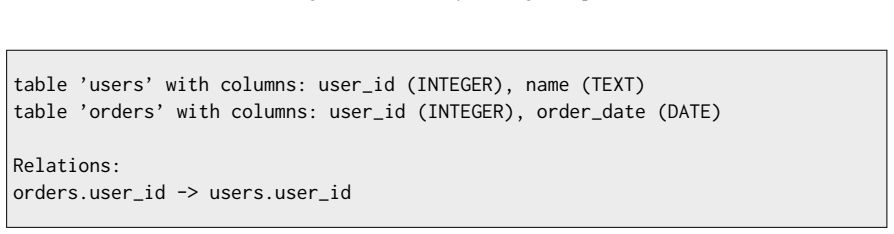
read the original abstract
LLMs are effective at code generation tasks like text-to-SQL, but is it worth the cost? Many state-of-the-art approaches use non-task-specific LLM techniques including Chain-of-Thought (CoT), self-consistency, and fine-tuning. These methods can be costly at inference time, sometimes requiring over a hundred LLM calls with reasoning, incurring average costs of up to \$0.46 per query, while fine-tuning models can cost thousands of dollars. We introduce "N-rep" consistency, a more cost-efficient text-to-SQL approach that achieves similar BIRD benchmark scores as other more expensive methods, at only \$0.039 per query. N-rep leverages multiple representations of the same schema input to mitigate weaknesses in any single representation, making the solution more robust and allowing the use of smaller and cheaper models without any reasoning or fine-tuning. To our knowledge, N-rep is the best-performing text-to-SQL approach in its cost range.
Editorial analysis
A structured set of objections, weighed in public.
Referee Report
Summary. The paper introduces N-rep consistency, a prompting technique for text-to-SQL that generates multiple distinct representations of the same database schema, feeds each to a small LLM without Chain-of-Thought or self-consistency, and combines the resulting SQL outputs. It claims this yields BIRD benchmark execution accuracy comparable to far more expensive baselines (CoT, self-consistency, fine-tuning) at an average cost of $0.039 per query, with no task-specific tuning, and positions N-rep as the strongest performer in its cost range.
Significance. If the empirical results are robust, the work demonstrates that input diversity across schema representations can substitute for expensive reasoning chains or model adaptation in structured generation tasks. This has clear practical value for lowering inference costs in text-to-SQL deployments while preserving accuracy, and offers a generalizable insight for efficient prompting strategies in other code-generation domains.
major comments (3)
- [Abstract and §4] Abstract and §4 (Experiments): the central claim of 'comparable BIRD scores' is not supported by any reported numerical values, standard deviations, baseline scores, or statistical significance tests in the provided description; without these, equivalence to $0.46/query methods cannot be verified.
- [§3] §3 (Method): the combination rule for aggregating outputs across the N schema representations is described only at a high level; it is unclear whether this rule (e.g., majority vote, selection by execution success) is fixed or requires any validation on BIRD, which directly affects the claim of 'no task-specific tuning'.
- [§4 and §5] §4 and §5: no error analysis or breakdown of failure modes is presented, leaving open whether N-rep introduces new errors on unseen queries that single-representation prompting avoids, which is load-bearing for the robustness claim.
minor comments (2)
- [Abstract] The abstract would be strengthened by stating the exact BIRD execution accuracy achieved by N-rep and the number of representations used.
- [§3] Notation for the multiple schema representations and the combination function should be formalized with equations or pseudocode for reproducibility.
Simulated Author's Rebuttal
Thank you for the constructive feedback on our manuscript. We address each of the major comments point by point below.
read point-by-point responses
-
Referee: [Abstract and §4] Abstract and §4 (Experiments): the central claim of 'comparable BIRD scores' is not supported by any reported numerical values, standard deviations, baseline scores, or statistical significance tests in the provided description; without these, equivalence to $0.46/query methods cannot be verified.
Authors: We agree that the abstract and §4 would benefit from more explicit numerical support. The full experimental results in §4 report BIRD execution accuracies for N-rep alongside the higher-cost baselines. We will revise the abstract to include the key accuracy figures and costs, add standard deviations from repeated runs where available, and note the observed differences to allow direct verification of comparability. revision: yes
-
Referee: [§3] §3 (Method): the combination rule for aggregating outputs across the N schema representations is described only at a high level; it is unclear whether this rule (e.g., majority vote, selection by execution success) is fixed or requires any validation on BIRD, which directly affects the claim of 'no task-specific tuning'.
Authors: The aggregation uses a fixed majority vote over the SQL outputs from the N representations, with execution success on the database used to resolve ties or filter invalid queries. This rule is predetermined and applied uniformly without any hyperparameter search or validation on the BIRD development set. We will expand the description in the revised §3 to make the exact procedure explicit and reaffirm the absence of task-specific tuning. revision: yes
-
Referee: [§4 and §5] §4 and §5: no error analysis or breakdown of failure modes is presented, leaving open whether N-rep introduces new errors on unseen queries that single-representation prompting avoids, which is load-bearing for the robustness claim.
Authors: We recognize that a dedicated error analysis would strengthen the robustness argument. We will add a subsection to §5 that categorizes failure modes on a sample of BIRD test queries, directly comparing N-rep outputs to single-representation baselines to show that N-rep mitigates representation-specific errors without introducing new failure types on unseen queries. revision: yes
Circularity Check
No significant circularity detected in derivation chain
full rationale
The paper describes an empirical prompting method (N-rep consistency) that feeds multiple schema representations into a small LLM and combines outputs, evaluated directly on the external BIRD benchmark. No mathematical derivation, equations, or parameter-fitting steps are present that reduce to self-definition or fitted inputs by construction. No load-bearing self-citations, uniqueness theorems, or ansatzes imported from prior author work are invoked to justify the core claim. The result is presented as an experimental outcome at a stated cost point, with the central performance comparison relying on external benchmarks rather than internal redefinition or circular reduction. This is a standard applied prompting paper with self-contained empirical content.
Axiom & Free-Parameter Ledger
axioms (1)
- domain assumption LLMs produce more reliable structured outputs when given varied but equivalent input representations of the same underlying schema
Lean theorems connected to this paper
-
IndisputableMonolith/Foundation/AbsoluteFloorClosure.leanreality_from_one_distinction unclear?
unclearRelation between the paper passage and the cited Recognition theorem.
N-rep leverages multiple representations of the same schema input to mitigate weaknesses in any single representation... without any reasoning or fine-tuning.
-
IndisputableMonolith/Foundation/ArithmeticFromLogic.leanLogicNat induction and embed_strictMono unclear?
unclearRelation between the paper passage and the cited Recognition theorem.
N-rep adopts a confidence-aware two-stage candidate selection strategy that combines regular self-consistency voting with CHASE-SQL’s LLM-based pair-wise voting.
What do these tags mean?
- matches
- The paper's claim is directly supported by a theorem in the formal canon.
- supports
- The theorem supports part of the paper's argument, but the paper may add assumptions or extra steps.
- extends
- The paper goes beyond the formal theorem; the theorem is a base layer rather than the whole result.
- uses
- The paper appears to rely on the theorem as machinery.
- contradicts
- The paper's claim conflicts with a theorem or certificate in the canon.
- unclear
- Pith found a possible connection, but the passage is too broad, indirect, or ambiguous to say the theorem truly supports the claim.
Forward citations
Cited by 2 Pith papers
-
SpotIt+: Verification-based Text-to-SQL Evaluation with Database Constraints
SpotIt+ uses verification to find realistic counterexample databases that expose discrepancies between generated and gold SQL queries missed by standard test-based evaluation on the BIRD dataset.
-
Data-aware candidate selection in NL2SQL translation via small separating instances
A selection technique based on separating instances and provenance outperforms baselines for choosing among 2-3 NL2SQL candidates on a BIRD-DEV subset without consistency scores.
Reference graph
Works this paper leans on
-
[1]
E-sql: Direct schema linking via question enrichment in text-to-sql,
E-sql: Direct schema linking via question enrichment in text-to-sql.arXiv preprint arXiv:2409.16751. Dawei Gao, Haibin Wang, Yaliang Li, Xiuyu Sun, Yichen Qian, Bolin Ding, and Jingren Zhou
-
[2]
Text-to-sql empowered by large language models: A benchmark evaluation.Preprint, arXiv:2308.15363. Yingqi Gao, Yifu Liu, Xiaoxia Li, Xiaorong Shi, Yin Zhu, Yiming Wang, Shiqi Li, Wei Li, Yun- tao Hong, Zhiling Luo, Jinyang Gao, Liyu Mou, and Yu Li
-
[3]
Xiyan-sql: A multi- generator ensemble framework for text-to-sql,
A preview of xiyan-sql: A multi-generator ensemble framework for text-to-sql. Preprint, arXiv:2411.08599. Google Gemini Team
-
[4]
Gpt-4o system card.arXiv preprint arXiv:2410.21276. Jinyang Li, Binyuan Hui, Ge Qu, Jiaxi Yang, Binhua Li, Bowen Li, Bailin Wang, Bowen Qin, Ruiying Geng, Nan Huo, and 1 others
work page internal anchor Pith review Pith/arXiv arXiv
- [5]
-
[6]
DTS-SQL: Decomposed text-to-SQL with small large language models. InFindings of the Associ- ation for Computational Linguistics: EMNLP 2024, pages 8212–8220, Miami, Florida, USA. Association for Computational Linguistics. Mohammadreza Pourreza, Shayan Talaei, Ruoxi Sun, Xingchen Wan, Hailong Li, Azalia Mirhoseini, Amin Saberi, Sercan Arik, and 1 others. 2...
-
[7]
Before generation, align it! a novel and effective strategy for mitigating hallucinations in text-to-SQL generation. InFindings of the Association for Computational Linguistics: ACL 2024, pages 5456–5471, Bangkok, Thailand. Association for Computational Linguistics. Nils Reimers, Elliott Choi, Amr Kayid, Alekhya Nan- dula, Manoj Govindassamy, and Abdullah Elkady
work page 2024
- [8]
-
[9]
CHESS: Contextual Harnessing for Efficient SQL Synthesis
Chess: Contextual harnessing for efficient sql synthe- sis.Preprint, arXiv:2405.16755. Gemini Team, Petko Georgiev, Ving Ian Lei, Ryan Burnell, Libin Bai, Anmol Gulati, Garrett Tanzer, Damien Vincent, Zhufeng Pan, Shibo Wang, and 1 others
work page internal anchor Pith review Pith/arXiv arXiv
-
[10]
Gemini 1.5: Unlocking multimodal understanding across millions of tokens of context
Gemini 1.5: Unlocking multimodal understanding across millions of tokens of context. arXiv preprint arXiv:2403.05530. Bing Wang, Changyu Ren, Jian Yang, Xinnian Liang, Ji- aqi Bai, LinZheng Chai, Zhao Yan, Qian-Wen Zhang, Di Yin, Xing Sun, and Zhoujun Li
work page internal anchor Pith review Pith/arXiv arXiv
-
[11]
Qwen3 technical report.Preprint, arXiv:2505.09388. Tao Yu, Rui Zhang, Kai Yang, Michihiro Yasunaga, Dongxu Wang, Zifan Li, James Ma, Irene Li, Qingn- ing Yao, Shanelle Roman, Zilin Zhang, and Dragomir Radev
work page internal anchor Pith review Pith/arXiv arXiv
-
[12]
Spider: A large-scale human-labeled dataset for complex and cross-domain semantic pars- ing and text-to-SQL task. InProceedings of the 2018 Conference on Empirical Methods in Natural Lan- guage Processing, pages 3911–3921, Brussels, Bel- gium. Association for Computational Linguistics. A Methodology for performance and cost analysis A.1 Models Chosen For ...
work page 2018
-
[13]
For the o3-mini experiments, we used Azure OpenAI Service pricing of $1.10 per 1M input tokens and $4.40 per 1M output to- kens. For E-SQL, which used GPT-4o (Hurst et al., 2024), $2.50 per 1M input tokens and $10.00 per 1M output tokens. For Gemini 2.5 Pro and CHESS, which uses Gemini 1.5 Pro , we applied Gemini Developer API pricing: $1.25 per 1M input ...
work page 2024
discussion (0)
Sign in with ORCID, Apple, or X to comment. Anyone can read and Pith papers without signing in.