Orientation Reversal and the Chern-Simons Natural Boundary
Pith reviewed 2026-05-22 14:09 UTC · model grok-4.3
The pith
The unique Borel-summed decomposition of Mordell integrals defines the crossing of the natural boundary for q-series invariants in complex Chern-Simons theory, corresponding to orientation reversal of 3-manifolds.
A machine-rendered reading of the paper's core claim, the machinery that carries it, and where it could break.
Core claim
We show that the fundamental property of preservation of relations, underlying resurgent analysis, provides a new perspective on crossing a natural boundary. This reveals a deeper rigidity of resurgence in a quantum field theory. We study the non-perturbative completion of complex Chern-Simons theory that associates to a 3-manifold a collection of q-series invariants labeled by Spin^c structures, for which crossing the natural boundary corresponds to orientation reversal of the 3-manifold. The Mordell integral is analytic across the natural boundary of the q and tilde q series, and uniqueness of a similar decomposition which preserves algebraic relations on the other side of the boundary 2ef
What carries the argument
The Mordell integral, as the transform of a resurgent function whose unique Borel-summed transseries decomposition on either side of the Stokes line gives the real and imaginary parts that preserve algebraic relations.
If this is right
- This leads to a practical numerical algorithm that generates q-series dual to unary q-series composed of false theta functions.
- Identifies known unique mock modular identities and extends them to more general cases.
- Provides a new perspective on crossing natural boundaries that is very different from approaches based on indefinite theta series, Appell-Lerch sums, and logarithmic vertex operator algebras.
- Reveals deeper rigidity of resurgence in quantum field theory.
Where Pith is reading between the lines
- If correct, this method could be applied to other physical systems with natural boundaries in their partition functions or invariants.
- Testable by checking if the generated dual q-series match known cases or new computations from other methods.
- May connect to broader questions in resurgence and modular forms in quantum topology.
Load-bearing premise
The decomposition of the Mordell integral into real and imaginary parts is the unique one that preserves all algebraic relations needed for the continuation across the natural boundary.
What would settle it
Finding a different decomposition of the Mordell integral that also preserves the algebraic relations but produces a different continuation of the q-series across the boundary, or observing that the numerically generated series does not correspond to the orientation-reversed manifold invariants.
Figures




read the original abstract
We show that the fundamental property of preservation of relations, underlying resurgent analysis, provides a new perspective on crossing a natural boundary, an important general problem in theoretical and mathematical physics. This reveals a deeper rigidity of resurgence in a quantum field theory. We study the non-perturbative completion of complex Chern-Simons theory that associates to a 3-manifold a collection of $q$-series invariants labeled by Spin$^c$ structures, for which crossing the natural boundary corresponds to orientation reversal of the 3-manifold. Our new resurgent perspective leads to a practical numerical algorithm that generates $q$-series which are dual to unary $q$-series composed of false theta functions. Until recently, these duals were only known in a limited number of cases, essentially based on Ramanujan's mock theta functions, and the common belief was that the more general duals might not even exist. Resurgence analysis identifies as primary objects Mordell integrals: transforms of resurgent functions. Their unique Borel summed transseries decomposition on either side of the Stokes line is the unique decomposition into real and imaginary parts. The latter are combinations of unary $q$-series in terms of $q$ and its modular counterpart $\tilde{q}$, and are resurgent by construction. The Mordell integral is analytic across the natural boundary of the $q$ and $\tilde{q}$ series, and uniqueness of a similar decomposition which preserves algebraic relations on the other side of the boundary defines the unique boundary crossing of the $q$ series. This continuation can be efficiently implemented numerically. This identifies known unique mock modular identities, and extends well beyond. The resurgent approach reveals new aspects, and is very different from other approaches based on indefinite theta series, Appell-Lerch sums, and logarithmic vertex operator algebras.
Editorial analysis
A structured set of objections, weighed in public.
Referee Report
Summary. The manuscript claims that resurgent analysis, via preservation of algebraic relations, provides a new perspective on crossing natural boundaries in the non-perturbative completion of complex Chern-Simons theory. For q-series invariants labeled by Spin^c structures, crossing the natural boundary corresponds to orientation reversal of the 3-manifold. Mordell integrals are identified as primary objects; their unique Borel-summed transseries decomposition into real and imaginary parts on either side of the Stokes line yields unary q-series in q and its modular counterpart, which are resurgent by construction. Uniqueness of a similar decomposition preserving algebraic relations on the far side defines the boundary crossing, enabling a numerical algorithm that generates dual q-series beyond known mock theta cases.
Significance. If the central uniqueness claim holds, the work supplies a concrete resurgent mechanism for analytic continuation across natural boundaries, a longstanding issue in mathematical physics. It yields a practical algorithm for dual q-series that extends limited Ramanujan-era examples and identifies new mock modular identities, while highlighting rigidity of resurgence in QFT. The approach differs from indefinite theta series or logarithmic VOAs and could impact computations of Chern-Simons invariants.
major comments (1)
- [Abstract] Abstract (paragraph on Mordell integrals and uniqueness): The central claim that the Borel-summed transseries decomposition of the Mordell integral is the unique continuation preserving all algebraic relations on the far side of the natural boundary is asserted by construction and resurgence properties, but no explicit argument, proof, or counter-example exclusion is supplied to show why the real/imaginary split is forced over other possible relation-preserving splittings. This step is load-bearing for identifying the continuation with orientation reversal.
minor comments (1)
- [Abstract] The abstract and introduction would benefit from a brief concrete example (e.g., a specific 3-manifold and its q-series) to illustrate the numerical algorithm before the general claims.
Simulated Author's Rebuttal
We thank the referee for their thorough review and for highlighting the importance of rigorously establishing the uniqueness of the decomposition. We address the major comment in detail below and will make the corresponding revisions to strengthen the manuscript.
read point-by-point responses
-
Referee: [Abstract] Abstract (paragraph on Mordell integrals and uniqueness): The central claim that the Borel-summed transseries decomposition of the Mordell integral is the unique continuation preserving all algebraic relations on the far side of the natural boundary is asserted by construction and resurgence properties, but no explicit argument, proof, or counter-example exclusion is supplied to show why the real/imaginary split is forced over other possible relation-preserving splittings. This step is load-bearing for identifying the continuation with orientation reversal.
Authors: We acknowledge that the uniqueness argument, while grounded in the properties of resurgence and the analytic continuation provided by the Mordell integral, would benefit from a more explicit elaboration to address potential alternative splittings. In the revised version, we will expand the discussion in the abstract and add a new paragraph or subsection detailing the reasoning. The real/imaginary decomposition arises uniquely from the Stokes phenomenon: the Borel sum on one side of the Stokes line yields a transseries whose imaginary part jumps across the line in a manner dictated by the Stokes automorphism, which preserves the algebraic structure of the q-series relations. Any other splitting that preserves all algebraic relations would have to match this one because the Mordell integral is the minimal analytic object bridging the two sides, and its decomposition is fixed by the requirement that the resulting q-series satisfy the same modular and resurgence properties on both sides. We will include a brief proof outline showing that supposing another relation-preserving continuation exists leads to a contradiction with the uniqueness of the Borel resummation or the known identities for the unary q-series. This will also reinforce the identification with orientation reversal, as the reversal corresponds to conjugating the imaginary component. We believe this addition will make the central claim more robust without changing the main results. revision: yes
Circularity Check
No significant circularity; derivation relies on external analytic properties
full rationale
The paper's derivation chain begins from the known analytic continuation properties of the Mordell integral and applies standard Borel summation plus transseries decomposition rules from resurgence theory. The uniqueness of the real/imaginary splitting that preserves algebraic relations is asserted as a consequence of those external properties and the integral's analyticity across the natural boundary, rather than being defined circularly in terms of the orientation-reversal map itself. No equation or step reduces by construction to a fitted input, self-citation chain, or ansatz imported from the authors' prior work; the identification with orientation reversal is presented as a consequence of the resulting q-series continuation, which is independently verifiable numerically and matches known mock modular cases. The central claim therefore remains self-contained against external mathematical benchmarks.
Axiom & Free-Parameter Ledger
axioms (2)
- domain assumption Preservation of relations is a fundamental property of resurgent analysis.
- domain assumption Mordell integrals admit unique Borel-summed transseries decompositions on either side of the Stokes line.
Forward citations
Cited by 3 Pith papers
-
On Uniqueness of Mock Theta Functions
Mock theta functions admit a unique resurgent continuation across their natural boundary, with the continuation fixed by their Mordell-Appell integrals via rotated Laplace contours.
-
Analyticity, asymptotics and natural boundary for a one-point function of the finite-volume critical Ising chain
The spin one-point function in the critical Ising chain has a natural boundary of analyticity on the negative real axis after Borel resummation, with singularities matching those of an odd-divisor sum series.
-
$c_{\rm eff}$ from Resurgence at the Stokes Line
Resurgent cyclic orbits' algebraic structure plus the leading q-series term determines the asymptotic growth exponent of dual q-series coefficients, which equals an effective central charge c_eff in a related 3d N=2 QFT.
Reference graph
Works this paper leans on
-
[1]
J Stat Phys 26, 427–452 (1981)
Baxter, R.J., Rogers-Ramanujan identities in the hard hexagon model. J Stat Phys 26, 427–452 (1981)
work page 1981
-
[2]
Andrews, The hard-hexagon model and Rogers—Ramanujan type identities, PNAS 78 (9) 5290-5292 (1981)
George E. Andrews, The hard-hexagon model and Rogers—Ramanujan type identities, PNAS 78 (9) 5290-5292 (1981)
work page 1981
-
[3]
Orrick, W.P., Nickel, B., Guttmann, A.J. et al. The Susceptibility of the Square Lattice Ising Model: New Developments. Journal of Statistical Physics 102, 795–841 (2001)
work page 2001
-
[4]
Orrick, W. P., Nickel, B. G., Guttmann, A. J. and Perk, J. H. H., Critical Behavior of the Two- Dimensional Ising Susceptibility, Phys. Rev. Lett.86, 4120-4123 (2001)
work page 2001
-
[5]
The saga of the Ising susceptibility
B.M. McCoy, M. Assis, S. Boukraa, S. Hassani, J-M Maillard, W.P. Orrick, and N. Zenine, The saga of the Ising susceptibility, arXiv:1003.0751
work page internal anchor Pith review Pith/arXiv arXiv
-
[6]
Polynomial Identities, Indices, and Duality for the N=1 Superconformal Model SM(2,4\nu)
Alexander Berkovich, Barry M. McCoy, William P. Orrick Polynomial Identities, Indices, and Duality for the N=1 Superconformal Model SM(2,4v), 1995.Journal of Statistical Physics, Vol. 83. Nos. 5/6, 1996, arXiv:hep-th/9507072
work page internal anchor Pith review Pith/arXiv arXiv 1995
-
[7]
Resurgence in complex Chern-Simons theory
Sergei Gukov, Marcos Marino, and Pavel Putrov. Resurgence in complex Chern-Simons theory, 2016. arXiv:1605.07615
work page internal anchor Pith review Pith/arXiv arXiv 2016
- [8]
-
[9]
Miranda C. N. Cheng, Francesca Ferrari, and Gabriele Sgroi. Three-Manifold Quantum Invariants and Mock Theta Functions.Phil. Trans. Roy. Soc. Lond., 378(2163):20180439, 2019
work page 2019
- [10]
-
[11]
Dunne, Angus Gruen, and Sergei Gukov
Ovidiu Costin, Gerald V. Dunne, Angus Gruen, and Sergei Gukov. Going to the Other Side via the Resurgent Bridge. arXiv:2310.12317
-
[12]
Srinivasa Ramanujan, The Lost Notebook and Other Unpublished Papers. Narosa, New Delhi, 1988
work page 1988
-
[13]
G. N. Watson. The final problem: An account of the mock theta functions.J., London Math. Soc., 11(2):55–80, 1936
work page 1936
-
[14]
B. Gordon and R. J. McIntosh. A survey of classical mock theta functions. InPartitions, q-Series and Modular Forms, volume 23 ofDevelopments in Mathematics, pages 95–143. Springer, 2012
work page 2012
-
[15]
Costin.Asymptotics and Borel summability
O. Costin.Asymptotics and Borel summability. Chapman and Hall/CRC, 2008
work page 2008
-
[16]
M. Mari˜ no, “Lectures on non-perturbative effects in largeN gauge theories, matrix models and strings,” Fortsch. Phys.62, 455-540 (2014), [arXiv:1206.6272 [hep-th]]
-
[17]
An Introduction to Resurgence, Trans-Series and Alien Calculus,
D. Dorigoni, “An Introduction to Resurgence, Trans-Series and Alien Calculus,” Annals Phys.409, 167914 (2019), [arXiv:1411.3585 [hep-th]]
-
[18]
I. Aniceto, G. Basar, and R. Schiappa. A Primer on Resurgent Transseries and Their Asymptotics. Physics Reports, 809:1–135, 2019
work page 2019
- [19]
-
[20]
David Sauzin,Resurgent functions and splitting problems, RIMS Kokyuroku, (2006), 1493, pp.48-117
work page 2006
- [21]
-
[22]
Don Zagier.Ramanujan’s mock theta functions and their applications [d’apr` es Zwegers and Bringmann- Ono], S´ eminaire Bourbaki, 60` eme ann´ ee, 2007-2008,n◦986, Ast´ erisque 326 (2009), Soc. Math. de France, 143-164
work page 2007
-
[23]
Rudin, Real and Complex Analysis, pp
W. Rudin, Real and Complex Analysis, pp. 377-383 (1987)
work page 1987
-
[24]
Sergei Gukov and Mrunmay Jagadale.c eff for 3dN= 2 theories. arXiv:2308.05360
-
[25]
Dunne, Sergei Gukov and O˘ guz ¨Oner
Griffen Adams, Ovidiu Costin, Gerald V. Dunne, Sergei Gukov and O˘ guz ¨Oner. cefffrom Resurgence at the Stokes Line. preprint, May, 2025
work page 2025
-
[26]
Ovidiu Costin and Gerald V. Dunne, Resurgence, Natural Boundaries and the Uniqueness of Solutions of Mock Modular Identities, to appear
-
[27]
Fivebranes and 3-manifold homology.JHEP, 07:071,
Sergei Gukov, Pavel Putrov, and Cumrun Vafa. Fivebranes and 3-manifold homology.JHEP, 07:071,
-
[28]
Kathrin Bringmann and Antun Milas. W-Algebras, False Theta Functions and Quantum Modular Forms, I.International Mathematics Research Notices, 2015(21):11351–11387, 02 2015
work page 2015
-
[29]
Resurgence and partial theta series, 2022
Li Han, Yong Li, David Sauzin, and Shanzhong Sun. Resurgence and partial theta series, 2022. 48
work page 2022
-
[30]
R. C. Rhoades K. Bringmann, A. Folsom. Partial theta functions and mock modular forms as q-hypergeometric series.Ramanujan J., 29:295–310, 2012
work page 2012
-
[31]
BPS spectra and 3-manifold invariants
Sergei Gukov, Du Pei, Pavel Putrov, and Cumrun Vafa. BPS spectra and 3-manifold invariants, 2017. arXiv:1701.06567
work page internal anchor Pith review Pith/arXiv arXiv 2017
-
[32]
Sungbong Chun. A resurgence analysis of the SU (2) Chern-Simons partition functions on a Brieskorn homology sphere Σ(2,5,7). 1 2017
work page 2017
-
[33]
David H. Wu. Resurgent analysis of SU(2) Chern-Simons partition function on Brieskorn spheres Σ(2,3,6n+ 5).JHEP, 21:008, 2020
work page 2020
-
[34]
Resurgent Analysis for Some 3-manifold Invariants.JHEP, 05:106, 2021
Hee-Joong Chung. Resurgent Analysis for Some 3-manifold Invariants.JHEP, 05:106, 2021
work page 2021
-
[35]
Resurgence analysis of quantum invariants of Seifert fibered homology spheres.J
Jørgen Ellegaard Andersen and William Elbæk Misteg˚ ard. Resurgence analysis of quantum invariants of Seifert fibered homology spheres.J. Lond. Math. Soc. (2), 105(2):709–764, 2022
work page 2022
-
[36]
Optimal Mock Jacobi Theta Functions
Miranda C. Cheng and John F.R. Duncan. Optimal mock Jacobi theta functions.Advances in Mathematics, 372, 107284, 2020. arXiv:1605.04480
work page internal anchor Pith review Pith/arXiv arXiv 2020
-
[37]
M-Theory and Topological Strings--I
R. Gopakumar and C. Vafa, “M theory and topological strings. 1.,” [arXiv:hep-th/9809187 [hep-th]]
work page internal anchor Pith review Pith/arXiv arXiv
-
[38]
On the Gauge Theory/Geometry Correspondence
R. Gopakumar and C. Vafa, “On the gauge theory / geometry correspondence,” Adv. Theor. Math. Phys.3, 1415-1443 (1999) [arXiv:hep-th/9811131 [hep-th]]
work page internal anchor Pith review Pith/arXiv arXiv 1999
-
[39]
M-Theory and Topological Strings--II
R. Gopakumar and C. Vafa, “M theory and topological strings. 2.,” [arXiv:hep-th/9812127 [hep-th]]
work page internal anchor Pith review Pith/arXiv arXiv
-
[40]
Knot Invariants and Topological Strings
H. Ooguri and C. Vafa, “Knot invariants and topological strings,” Nucl. Phys. B577, 419-438 (2000) [arXiv:hep-th/9912123 [hep-th]]
work page internal anchor Pith review Pith/arXiv arXiv 2000
-
[41]
Brownian Motion, Chern-Simons Theory, and 2d Yang-Mills
S. de Haro and M. Tierz, “Brownian motion, Chern-Simons theory, and 2-D Yang-Mills,” Phys. Lett. B601, 201-208 (2004) [arXiv:hep-th/0406093 [hep-th]]
work page internal anchor Pith review Pith/arXiv arXiv 2004
-
[42]
Discrete and oscillatory Matrix Models in Chern-Simons theory
S. de Haro and M. Tierz, “Discrete and oscillatory matrix models in Chern-Simons theory,” Nucl. Phys. B731, 225-241 (2005) [arXiv:hep-th/0501123 [hep-th]]
work page internal anchor Pith review Pith/arXiv arXiv 2005
-
[43]
Knots, Perturbative Series and Quantum Modularity,
S. Garoufalidis and D. Zagier, “Knots, Perturbative Series and Quantum Modularity,” SIGMA20, 055 (2024), [arXiv:2111.06645 [math.GT]]
-
[44]
V. Fantini and C. Rella, “Modular resurgent structures,” [arXiv:2404.11550 [math.NT]]
-
[45]
A two-variable series for knot complements.Quantum Topol., 12(1):1–109, 2021
Sergei Gukov and Ciprian Manolescu. A two-variable series for knot complements.Quantum Topol., 12(1):1–109, 2021
work page 2021
-
[46]
D. Hickerson and E. Mortenson. Hecke-type double sums, Appell–Lerch sums, and mock theta functions. Proc. London Math. Soc., 109(3):382–422, 2014
work page 2014
-
[47]
E. T. Mortenson. On the dual nature of partial theta functions and Appell–Lerch sums.Advances in Mathematics, 264:236–260, 2014. 49 AppendixA.Results for Duals of F alse ThetasΨ (a) p (q) In this appendix we display tables containing the small q expansions of the unary false thetas Ψ(a) p (q) forp= 11,13,15,17,19, and their corresponding duals Ψ (a) p (q)...
work page 2014
-
[48]
r 4pt π cJS (p,A1)(2t) # = r π t NX j=1 M1jΨ(Aj) p 1 eq2 (B.2) = r π t NX j=1 M1j Re
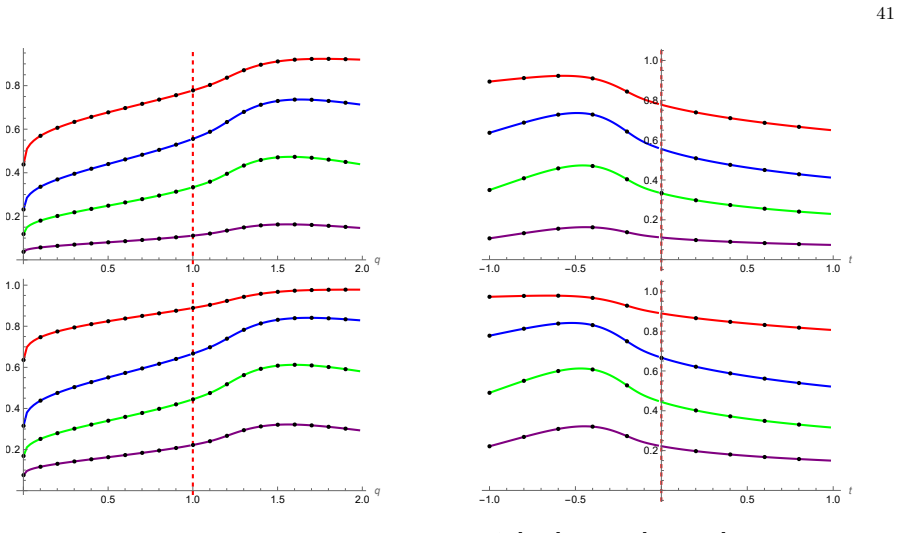
We note the growth of the coefficients in the non-unary q-series is much slower forasuch that gcd(15, a)̸= 1. 53 0.5 1.0 1.5 2.0 q 0.2 0.4 0.6 0.8 1.0 -1.0 -0.5 0.5 1.0 t 0.2 0.4 0.6 0.8 1.0 0.5 1.0 1.5 2.0 q 0.2 0.4 0.6 0.8 1.0 -1.0 -0.5 0.5 1.0 t 0.2 0.4 0.6 0.8 1.0 Figure 11.Plots of the real parts of the set A [top] and C [bottom] relations (4.10) and...
discussion (0)
Sign in with ORCID, Apple, or X to comment. Anyone can read and Pith papers without signing in.