REVIEW 3 major objections 5 minor 12 references
Evaluation of Few-Shot Learning Methods for Kidney Stone Type Recognition in Ureteroscopy
T0 review · 3 major / 5 minor · reviewed 2026-08-07 · deepseek-v4-flash
Pith's one-line read This paper claims that Prototypical Networks, trained on only 25% of available ureteroscopic kidney-stone patches, match or exceed a traditional ResNet-34 trained on the full dataset.
desk verdict A useful empirical evaluation of ProtoNet for kidney stone classification, but the headline comparison is weakened by an under-specified traditional baseline and missing variance. read the letter →
The pith
A machine-rendered reading of the paper's core claim, the machinery that carries it, and where it could break.
The reading
What carries the argument
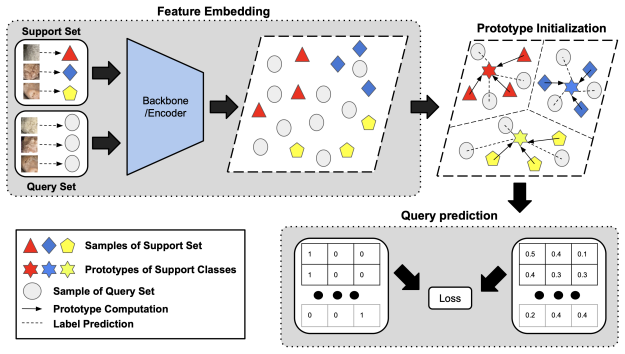
The load-bearing mechanism is Prototypical Networks (ProtoNet). For each class, a prototype is the mean embedding of that class's support examples after a shared ResNet encoder; every query image is classified by its Euclidean distance to the nearest prototype. Training is episodic: the model repeatedly sees simulated few-shot tasks, which prepares it for genuine data scarcity. A one-step transfer step initializes the ResNet backbone with ImageNet weights, which the authors argue is crucial when starting from limited target-domain data. This machinery is what lets a 6-way, 10- or 15-shot configuration trained on 25% of the patches stay competitive with a full-data classifier.
What would settle it
Train a traditional ResNet-34 from the same codebase on the same SUR, SEC, and MIX splits with the same optimizer (Adam, learning rate 0.0001), iteration count, and patch preprocessing used for ProtoNet, sweeping epochs and augmentation. If the tuned baseline reaches or exceeds ProtoNet's accuracy at 25%, 50%, 75%, and 100% data fractions, the central claim is refuted.
Extended reading notes
Core claim
On the paper's own terms, the discovery is that Prototypical Networks with an ImageNet-pretrained ResNet-34 backbone maintain high discriminative performance even when the training set is cut to a quarter. Across surface (SUR), section (SEC), and mixed (MIX) views, the best Prototypical Network configuration (6-way, 10 or 15 shots) produces accuracies comparable to or higher than those of a traditional ResNet-34 trained on the same data fractions, and in several cells the few-shot model trained on 25% of the data matches or exceeds the traditional model trained on 100%. For example, on the SEC view, ProtoNet at 25% data reaches 95.22% accuracy, versus 90.00% for the traditional model at the same fraction. The authors interpret this as evidence that the episodic, prototype-based training procedure makes more efficient use of scarce endoscopic images.
Load-bearing premise
The headline comparison assumes the traditional ResNet-34 is a strong, fairly tuned baseline; its training details are not reported, so a weaker baseline would inflate the apparent few-shot advantage.
Editorial extensions
If this is right
- A hospital with only a small archive of labeled endoscopic images could still train a useful six-class stone classifier, because 25% of the current patch set suffices.
- Models built this way stay accurate across all three views (surface, section, mixed), so the approach does not depend on image engineers having full cross-section access.
- The configuration search gives practitioners a concrete default: ResNet-34 with 6-way, 10- or 15-shot episodic training.
- Because the traditional baseline at 25% data drops sharply (e.g., 77% on SUR) while ProtoNet stays near 88%, the method is particularly valuable at exactly the data-scarce operating point.
Reading between the lines
- A fairer comparison would tune the traditional ResNet-34 with the same optimizer schedule, epochs, and augmentation as ProtoNet; the paper does not report these details for the baseline, so part of the gap may be baseline under-training rather than few-shot learning itself.
- The evaluation uses balanced 6-way episodes, but real kidney stone classes are highly imbalanced; testing ProtoNet under class-imbalanced episode sampling would show whether the advantage survives natural prevalence.
- Since training and testing use 256x256 patches, a full-image variant could change the ranking; the authors themselves list full-image training as future work.
- An immediate extension is to measure calibration and error patterns per stone type, since equal accuracy across classes can hide confusion between visually similar subtypes such as WW and WD.
Signed reviews
Editorial analysis
A structured set of objections, weighed in public.
Referee Report
Summary. This manuscript evaluates few-shot learning methods, specifically Prototypical Networks, for kidney stone type recognition in ex vivo ureteroscopy images. The authors use a dataset of 409 endoscopic images from which 6,000 patches per view (surface, section, and mixed) are extracted, split by image into 80% training/validation and 20% test. Prototypical Networks are tested with ResNet-18/34/50 backbones, multiple shots (5, 10, 15, 20), and training-data fractions (100%, 75%, 50%, 25%). The central claim, stated in the abstract, is that Prototypical Networks trained on up to 25% of the data can match or exceed a traditional deep learning model trained on the full dataset. The experimental setup is mostly clear and all results are tabulated, but the key comparisons in Table III rely on an under-specified baseline and lack variance information.
Significance. If the comparison were valid, the result would be practically useful: for a domain where annotated kidney stone images are scarce and class frequencies are imbalanced, demonstrating that a few-shot method can match or beat a traditional model with a quarter of the data would support deployment in low-resource settings. The paper's strengths are its multi-view evaluation (SUR, SEC, MIX), the range of backbones and data fractions, the image-level split that avoids patch leakage, and the transparent reporting of accuracy/precision/recall/F1 in Table II. However, the headline claim rests on an unspecified traditional baseline and on selected ProtoNet configurations, so the current evidence is suggestive rather than conclusive.
major comments (3)
- [Section III.B, Table III] The 'Traditional DL model' baseline is severely under-specified. The text only states that a ResNet-34 was implemented without FSL, but gives no optimizer, learning rate, number of epochs/iterations, batch size, data augmentation, or initialization scheme. Section II.C explicitly says the ProtoNet backbones are initialized with ImageNet-pretrained weights; if the traditional ResNet-34 is trained from scratch on 500-2000 patches, the comparison conflates transfer learning with few-shot learning and the reported ProtoNet advantage could be an artifact of the baseline's undertraining. The authors must specify the baseline training details and, ideally, retrain the baseline with ImageNet initialization and a comparable tuned budget.
- [Table III and Section III.A] Table III reports single accuracy values with no standard deviations, confidence intervals, or number of seeds. The mean +/- std in Table II is computed across 16 heterogeneous configurations (combinations of shots and data percentages), so it cannot serve as an uncertainty estimate for the specific rows used in the headline comparison. The gaps used to support the central claim (e.g., SUR 88.77 vs. 85.17, SEC 95.22 vs. 90.00) may be within run-to-run noise. Repeated runs with different seeds and variance reporting for the key ProtoNet and baseline rows are needed.
- [Section III.A, paragraph after Table II] The claim that 'the 6-ways-10-shots configuration consistently achieves the best performance across all views and various data percentages' is contradicted by Table III itself. For example, at 25% data on SEC, 6-15 achieves 95.22% while 6-10 achieves 89.92%; at 50% data on SUR, 6-15 achieves 88.37% while 6-10 achieves 83.77%; at 50% MIX, 6-15 achieves 90.52% while 6-10 achieves 87.42%. The text should either be revised to state that the best configuration varies, or the selection procedure for choosing the 'best' ProtoNet configuration per view and data fraction should be described explicitly, since this selection affects the strength of the central claim.
minor comments (5)
- [Section II.D.1] The sentence 'the dataset size was gradually reduced by randomly selecting subsets in 25' is incomplete and should be finished, presumably as 'in 25% increments' or similar.
- [Sections II.B and II.C] Prototypical Networks are attributed to reference [9], which is a survey, while Section II.C correctly cites the original source [12]. The citation in Section II.B should be [12] or should include [12] alongside the survey.
- [Table II caption and text] The caption states that each metric is the average over experiments with varying shots and data proportions, but the text says 'sixteen models were generated.' It should be clarified whether the standard deviation is across independent training runs or across the heterogeneous configurations; if the latter, the current notation is misleading.
- [Section II.A] The patch extraction procedure is not described in enough detail for reproducibility: it is unclear how many patches are extracted per image, whether patches overlap, and whether the standardization mean/standard deviation is computed only on the training split.
- [Figure 3] Figure 3 is presented as a qualitative comparison, but the subfigures show only example outputs, not a systematic visualization of the quantitative difference. The caption should make clear that the figure is illustrative, and the quantitative evidence should come from the tables.
Circularity Check
No significant circularity: the paper is an empirical benchmark with a held-out test set and no fitted-parameter predictions.
full rationale
The paper's central claim is that Prototypical Networks trained on 25% of the data match or beat a traditional ResNet-34 trained on 100% of the data. This is presented purely as an experimental comparison against a disjoint 20% test split described in Section II-A, with results reported in Table III. No parameter is fitted to the test set and then renamed as a prediction; no quantity is defined in terms of another quantity that it is claimed to predict. The dataset is taken from prior work [5], but using an external dataset as input is not circularity. The ProtoNet method is standard [12], and the fact that one in-text citation points to a survey [9] rather than the original ProtoNet paper is a citation inaccuracy, not a circular dependency. The main weakness identified by the skeptic is that the traditional ResNet-34 baseline is under-specified in Section III.B (no optimizer, epochs, batch size, augmentation, or explicit pretraining state), so the magnitude of the reported advantage is uncertain. That is a fairness and reproducibility concern about the baseline, not a circularity of the derivation: the comparison is still an empirical evaluation with an independent held-out test set. The authors' self-citations concern the dataset and prior endoscopic stone-recognition experiments, and none of these citations is invoked to define the outcome being measured. The analysis is therefore self-contained as an empirical study, and no circular step can be exhibited.
Assumptions & free parameters
assumptions (3)
- domain assumption Ground-truth stone types in the dataset are accurate (based on MCA/FTIR in [5]).
- domain assumption ImageNet-pretrained features transfer to endoscopic stone images.
- domain assumption Patches sampled from one image are independent enough for the reported test metrics.
Cite this review
Pith. "Pith review of Evaluation of Few-Shot Learning Methods for Kidney Stone Type Recognition in Ureteroscopy." pith.science (2026). https://pith.science/paper/MTDQRZDV
@misc{pith2026250517921,
  author       = {Pith},
  title        = {Pith review of: Evaluation of Few-Shot Learning Methods for Kidney Stone Type Recognition in Ureteroscopy},
  year         = {2026},
  howpublished = {\url{https://pith.science/paper/MTDQRZDV}},
  note         = {Machine review of arXiv:2505.17921}
}
read the original abstract
Determining the type of kidney stones is crucial for prescribing appropriate treatments to prevent recurrence. Currently, various approaches exist to identify the type of kidney stones. However, obtaining results through the reference ex vivo identification procedure can take several weeks, while in vivo visual recognition requires highly trained specialists. For this reason, deep learning models have been developed to provide urologists with an automated classification of kidney stones during ureteroscopies. Nevertheless, a common issue with these models is the lack of training data. This contribution presents a deep learning method based on few-shot learning, aimed at producing sufficiently discriminative features for identifying kidney stone types in endoscopic images, even with a very limited number of samples. This approach was specifically designed for scenarios where endoscopic images are scarce or where uncommon classes are present, enabling classification even with a limited training dataset. The results demonstrate that Prototypical Networks, using up to 25% of the training data, can achieve performance equal to or better than traditional deep learning models trained with the complete dataset.
Figures


Reference graph
Works this paper leans on
-
[9]
Few-shot image classification: Current status and research trends
Ying Liu, Hengchang Zhang, Weidong Zhang, Guojun Lu, Qi Tian, and Nam Ling. Few-shot image classification: Current status and research trends. Electronics, 11(11):1752, 2022
work page 2022
-
[12]
Prototypical networks for few-shot learning
Jake Snell, Kevin Swersky, and Richard Zemel. Prototypical networks for few-shot learning. Advances in neural information processing systems, 30, 2017
2017
-
[1]
Where do we stand in ai for endoscopic image analysis? deciphering gaps and future directions
Sharib Ali. Where do we stand in ai for endoscopic image analysis? deciphering gaps and future directions. npj Digital Med., 5(1):184, 2022
work page 2022
-
[2]
Classification of stones according to michel daudon: a narrative review
Mariela Corrales, Steeve Doizi, Yazeed Barghouthy, Olivier Traxer, and Michel Daudon. Classification of stones according to michel daudon: a narrative review. European Urology Focus, 7(1):13–21, 2021
work page 2021
-
[3]
Clinical value of crystalluria and quantitative morphoconstitutional analysis of urinary calculi
Michel Daudon and Paul Jungers. Clinical value of crystalluria and quantitative morphoconstitutional analysis of urinary calculi. Nephron Physiology, 98(2):p31–p36, 2004
work page 2004
-
[4]
Recurrence rates of urinary calculi according to stone composition and morphology
Michel Daudon, Paul Jungers, Dominique Bazin, and James C Williams. Recurrence rates of urinary calculi according to stone composition and morphology. Urolithiasis, 46:459–470, 2018
work page 2018
-
[5]
Evaluation and understanding of automated urinary stone recognition methods
Jonathan El Beze, Charles Mazeaud, Christian Daul, Gilberto Ochoa- Ruiz, Michel Daudon, Pascal Eschw`ege, and Jacques Hubert. Evaluation and understanding of automated urinary stone recognition methods. BJU international, 130(6):786–798, 2022
work page 2022
-
[6]
Vincent Estrade, Michel Daudon, Emmanuel Richard, Jean-Christophe Bernhard, Franck Bladou, Gr ´egoire Robert, and Baudouin Denis de Senneville. Towards automatic recognition of pure and mixed stones using intra-operative endoscopic digital images. BJU international , 129(2):234–242, 2022
work page 2022
Show all 12 references
-
[7]
Global trends in incidence and burden of urolithiasis from 1990 to 2019: an analysis of global burden of disease study data
Jacob Lang, Aparna Narendrula, Ahmed El-Zawahry, Puneet Sindhwani, and Obi Ekwenna. Global trends in incidence and burden of urolithiasis from 1990 to 2019: an analysis of global burden of disease study data. European urology open science , 35:37–46, 2022
1990
-
[8]
Trends in the incidence and dalys of urolithiasis from 1990 to 2019: results from the global burden of disease study 2019
Shasha Li, Xueying Huang, Jie Liu, Suru Yue, Xuefei Hou, Liren Hu, and Jiayuan Wu. Trends in the incidence and dalys of urolithiasis from 1990 to 2019: results from the global burden of disease study 2019. Frontiers in Public Health , 10:825541, 2022
1990
-
[10]
Assessing deep learning methods for the identification of kidney stones in endoscopic images
Francisco Lopez, Andres Varelo, Oscar Hinojosa, Mauricio Mendez, Dinh-Hoan Trinh, Yonathan ElBeze, Jacques Hubert, Vincent Estrade, Miguel Gonzalez, Gilberto Ochoa, et al. Assessing deep learning methods for the identification of kidney stones in endoscopic images. In 2021 43r...
2021
-
[11]
On the in vivo recognition of kidney stones using machine learning
Francisco Lopez-Tiro, Vincent Estrade, Jacques Hubert, Daniel Flores- Araiza, Miguel Gonzalez-Mendoza, Gilberto Ochoa, and Christian Daul. On the in vivo recognition of kidney stones using machine learning. IEEE Access, 12:10736–10759, 2024
2024
Reviewed August 7, 2026 · model on record in the stance chip above.
Discussion (0). Continue with ORCID to comment.