AdaDec: A Uncertainty-Guided Lookahead Decoding Framework for LLM-Based Code Generation
Pith reviewed 2026-05-19 10:14 UTC · model grok-4.3
The pith
AdaDec triggers short lookaheads only at high-uncertainty code tokens to rerank candidates and raises Pass@1 accuracy by up to 20.9 points over greedy decoding.
A machine-rendered reading of the paper's core claim, the machinery that carries it, and where it could break.
Core claim
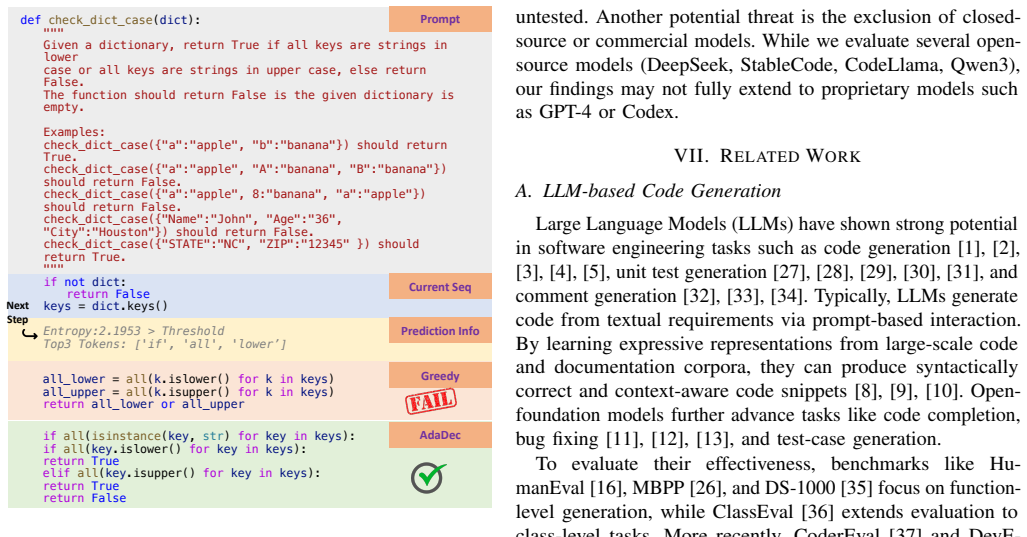
Token ranking mistakes at high-uncertainty decision points cause many generation errors in code, because the correct token is often present in the distribution but not chosen first; AdaDec counters this by learning an uncertainty threshold that triggers a pause-then-rerank step using short lookahead, selecting the continuation that better matches the intended program logic and thereby lifting Pass@1 scores substantially above both greedy decoding and prior adaptive baselines.
What carries the argument
token-level pause-then-rerank mechanism driven by learned model-specific uncertainty thresholds
If this is right
- Selective pausing preserves most of the speed of greedy decoding while correcting logic errors that uniform strategies miss.
- The same threshold-learning approach can be applied to other code-generation models without retraining the underlying LLM.
- Outperformance over beam search indicates that targeted reranking at uncertain points is more efficient than exhaustive search.
- Consistent gains across HumanEval+, MBPP+, and DevEval suggest the method generalizes to both simple and realistic programming tasks.
Where Pith is reading between the lines
- The approach may extend naturally to other structured generation tasks such as math proofs or API call sequences where uncertainty also clusters at critical choice points.
- If uncertainty thresholds prove stable across model sizes, the method could become a lightweight post-training adapter for any LLM used in code.
- Developers might combine AdaDec with test-time verification to further reduce the chance that lookahead selects a locally plausible but globally incorrect path.
Load-bearing premise
Model uncertainty reliably marks the exact steps where the correct token sits in the distribution but not at the top and a short lookahead can correct it without creating new errors downstream.
What would settle it
On a benchmark where tokens at high-uncertainty steps are frequently absent from the top-k candidates during lookahead, AdaDec would show no accuracy gain or would degrade relative to greedy decoding.
Figures


read the original abstract
Code generation with large language models (LLMs) is highly sensitive to token selection during decoding, particularly at uncertain decision points that influence program logic. While standard strategies such as greedy decoding treat all tokens uniformly, they overlook code-specific uncertainty patterns, leading to suboptimal performance. This paper presents an empirical study revealing that many generation errors stem from token ranking mistakes at high-uncertainty steps, where the correct token is present but not top-ranked. Motivated by these findings, we propose AdaDec, a lookahead-based uncertainty-guided adaptive decoding framework that integrates a token-level pause-then-rerank mechanism driven by token uncertainty. AdaDec learns model-specific uncertainty thresholds and applies a lookahead-based reranking strategy when uncertainty is high. Experiments on HumanEval+, MBPP+, and DevEval benchmarks show that AdaDec improves Pass@1 accuracy by up to 20.9% in absolute terms over greedy decoding. More importantly, it consistently outperforms both competitive baselines like Beam Search and state-of-the-art adaptive decoding methods such as AdapT, while maintaining high efficiency through selective, uncertainty-triggered pausing. Our results highlight the promise of uncertainty-aware adaptive decoding for improving both the reliability and efficiency of LLM-based code generation.
Editorial analysis
A structured set of objections, weighed in public.
Referee Report
Summary. The paper proposes AdaDec, an uncertainty-guided lookahead decoding framework for LLM-based code generation. It presents an empirical study showing that many generation errors arise from token ranking mistakes at high-uncertainty steps where the correct token is present but not top-ranked. AdaDec learns model-specific uncertainty thresholds and applies a selective pause-then-rerank mechanism with short lookahead at high-uncertainty tokens. Experiments on HumanEval+, MBPP+, and DevEval report up to 20.9% absolute Pass@1 improvement over greedy decoding, with consistent outperformance of Beam Search and AdapT while preserving efficiency through selective intervention.
Significance. If the empirical results and mechanism hold under closer scrutiny, the work is significant for LLM-based code generation. It offers a targeted, efficiency-preserving alternative to uniform decoding strategies by focusing interventions on uncertain decision points that affect program logic. The benchmark gains and selective application provide a plausible path toward more reliable code synthesis without the full cost of beam search or similar methods.
major comments (2)
- [§4] §4 (Experiments): The central claim of up to 20.9% absolute Pass@1 improvement lacks reporting of the number of runs, standard deviations, or confidence intervals for the gains on HumanEval+, MBPP+, and DevEval. Without these, it is impossible to determine whether the reported outperformance over greedy decoding, Beam Search, and AdapT is robust or could be explained by variance.
- [§3] §3 (Method): The procedure for learning model-specific uncertainty thresholds is described at a high level but does not specify the exact uncertainty metric (e.g., entropy, negative log-probability of the top token), the validation data used for threshold selection, or the optimization criterion. This detail is load-bearing for the adaptive claim and for reproducibility of the selective lookahead trigger.
minor comments (2)
- [Abstract] Abstract: The maximum 20.9% gain is stated without indicating the specific benchmark on which it occurs; adding this would improve clarity for readers.
- [§2] §2 (Related Work): The comparison to AdapT would benefit from a brief statement of how AdaDec's uncertainty-triggered lookahead differs mechanistically from AdapT's adaptation strategy.
Simulated Author's Rebuttal
We thank the referee for the constructive feedback and the recommendation for major revision. We address each major comment below and will revise the manuscript accordingly to strengthen the presentation of our results and methods.
read point-by-point responses
-
Referee: [§4] §4 (Experiments): The central claim of up to 20.9% absolute Pass@1 improvement lacks reporting of the number of runs, standard deviations, or confidence intervals for the gains on HumanEval+, MBPP+, and DevEval. Without these, it is impossible to determine whether the reported outperformance over greedy decoding, Beam Search, and AdapT is robust or could be explained by variance.
Authors: We agree that the current manuscript does not report the number of runs or associated statistical measures such as standard deviations and confidence intervals. This omission limits the ability to fully assess robustness. In the revised version, we will update Section 4 to include results from multiple independent runs and report mean Pass@1 scores with standard deviations and confidence intervals for all benchmarks and baselines. These additions will allow readers to evaluate whether the observed gains are consistent or attributable to variance. revision: yes
-
Referee: [§3] §3 (Method): The procedure for learning model-specific uncertainty thresholds is described at a high level but does not specify the exact uncertainty metric (e.g., entropy, negative log-probability of the top token), the validation data used for threshold selection, or the optimization criterion. This detail is load-bearing for the adaptive claim and for reproducibility of the selective lookahead trigger.
Authors: We acknowledge that the description of threshold learning in Section 3 is high-level and omits key implementation details. In the revised manuscript, we will expand this section to specify the uncertainty metric, the validation data employed for threshold selection, and the optimization criterion used. These clarifications will improve reproducibility and better support the adaptive claims of AdaDec. revision: yes
Circularity Check
No significant circularity; empirical method with held-out evaluation
full rationale
The paper presents an empirical study of token-level uncertainty in LLM code generation and introduces the AdaDec framework, which learns model-specific uncertainty thresholds from data and applies selective lookahead reranking. No equations, derivations, or self-citations are provided that reduce the claimed Pass@1 improvements to the fitted thresholds or inputs by construction. Performance is measured on separate held-out benchmarks (HumanEval+, MBPP+, DevEval), making the evaluation independent of the fitting process. The approach is benchmark-driven rather than a closed-form derivation.
Axiom & Free-Parameter Ledger
free parameters (1)
- model-specific uncertainty threshold
axioms (1)
- domain assumption High uncertainty at a token step indicates the correct token is present but not top-ranked.
Lean theorems connected to this paper
-
IndisputableMonolith/Cost/FunctionalEquation.leanwashburn_uniqueness_aczel unclear?
unclearRelation between the paper passage and the cited Recognition theorem.
ADADEC … uses an entropy-guided pause-then-rerank mechanism based on learned, model-specific thresholds and a lookahead strategy
What do these tags mean?
- matches
- The paper's claim is directly supported by a theorem in the formal canon.
- supports
- The theorem supports part of the paper's argument, but the paper may add assumptions or extra steps.
- extends
- The paper goes beyond the formal theorem; the theorem is a base layer rather than the whole result.
- uses
- The paper appears to rely on the theorem as machinery.
- contradicts
- The paper's claim conflicts with a theorem or certificate in the canon.
- unclear
- Pith found a possible connection, but the passage is too broad, indirect, or ambiguous to say the theorem truly supports the claim.
Forward citations
Cited by 3 Pith papers
-
Bridging Generation and Training: A Systematic Review of Quality Issues in LLMs for Code
A review of 114 studies creates taxonomies for code and data quality issues, formalizes 18 propagation mechanisms from training data defects to LLM-generated code defects, and synthesizes detection and mitigation techniques.
-
Knowledge-Graph-Driven Data Synthesis for Low-Resource Software Development: A HarmonyOS Case Study
APIKG4Syn synthesizes API-oriented training data via knowledge graphs and Monte Carlo search to fine-tune a 7B model that reaches 25% pass@1 on HarmonyOS code generation, beating untuned GPT-4o at 17.59%.
-
Cut Your Losses! Learning to Prune Paths Early for Efficient Parallel Reasoning
STOP is a new learnable internal path-pruning technique that improves efficiency and accuracy of parallel reasoning in LRMs under fixed compute budgets.
Reference graph
Works this paper leans on
-
[1]
J. Li, Y . Li, G. Li, Z. Jin, Y . Hao, and X. Hu, “Skcoder: A sketch-based approach for automatic code generation,” in Proceedings of the 45th International Conference on Software Engineering , ser. ICSE ’23. IEEE Press, 2023, p. 2124–2135. [Online]. Available: https://doi.org/10.1109/ICSE48619.2023.00179
-
[2]
Enhancing code generation via bidirectional comment-level mutual grounding,
Y . Di and T. Zhang, “Enhancing code generation via bidirectional comment-level mutual grounding,” 2025. [Online]. Available: https: //arxiv.org/abs/2505.07768
-
[3]
Test-case-driven programming understanding in large language models for better code generation,
Z. Tian, J. Chen, and X. Zhang, “Fixing large language models’ specification misunderstanding for better code generation,” 2024. [Online]. Available: https://arxiv.org/abs/2309.16120
-
[4]
X. Jiang, Y . Dong, Y . Tao, H. Liu, Z. Jin, W. Jiao, and G. Li, “Rocode: Integrating backtracking mechanism and program analysis in large language models for code generation,” 2025. [Online]. Available: https://arxiv.org/abs/2411.07112
-
[5]
Soen-101: Code generation by emulating software process models using large language model agents,
F. Lin, D. J. Kim, Tse-Husn, and Chen, “Soen-101: Code generation by emulating software process models using large language model agents,”
-
[6]
When llm-based code genera- tion meets the software development process,
[Online]. Available: https://arxiv.org/abs/2403.15852
-
[7]
Code Llama: Open Foundation Models for Code
B. Rozière, J. Gehring, F. Gloeckle, S. Sootla, I. Gat, X. E. Tan, Y . Adi, J. Liu, R. Sauvestre, T. Remez, J. Rapin, A. Kozhevnikov, I. Evtimov, J. Bitton, M. Bhatt, C. C. Ferrer, A. Grattafiori, W. Xiong, A. Défossez, J. Copet, F. Azhar, H. Touvron, L. Martin, N. Usunier, T. Scialom, and G. Synnaeve, “Code llama: Open foundation models for code,” 2024. ...
work page internal anchor Pith review Pith/arXiv arXiv 2024
-
[8]
DeepSeek-Coder: When the Large Language Model Meets Programming -- The Rise of Code Intelligence
D. Guo, Q. Zhu, D. Yang, Z. Xie, K. Dong, W. Zhang, G. Chen, X. Bi, Y . Wu, Y . Li, F. Luo, Y . Xiong, and W. Liang, “Deepseek-coder: When the large language model meets programming – the rise of code intelligence,” 2024. [Online]. Available: https://arxiv.org/abs/2401.14196
work page internal anchor Pith review Pith/arXiv arXiv 2024
-
[9]
Evaluating instruction-tuned large language models on code comprehension and generation,
Z. Yuan, J. Liu, Q. Zi, M. Liu, X. Peng, and Y . Lou, “Evaluating instruction-tuned large language models on code comprehension and generation,” arXiv preprint arXiv:2308.01240 , 2023
-
[10]
Enhancing code generation performance of smaller models by distilling the reasoning ability of llms,
Z. Sun, C. Lyu, B. Li, Y . Wan, H. Zhang, G. Li, and Z. Jin, “Enhancing code generation performance of smaller models by distilling the reasoning ability of llms,” arXiv preprint arXiv:2403.13271 , 2024
- [11]
-
[12]
VulRepair: A T5-based automated software vulnerability repair
M. Fu, C. Tantithamthavorn, T. Le, V . Nguyen, and D. Phung, “Vulrepair: a t5-based automated software vulnerability repair,” in Proceedings of the 30th ACM Joint European Software Engineering Conference and Symposium on the Foundations of Software Engineering , ser. ESEC/FSE 2022. Association for Computing Machinery, 2022, p. 935–947. [Online]. Available...
-
[13]
Inferfix: End-to-end program repair with llms,
M. Jin, S. Shahriar, M. Tufano, X. Shi, S. Lu, N. Sundaresan, and A. Svyatkovskiy, “Inferfix: End-to-end program repair with llms,” in Proceedings of the 31st ACM Joint European Software Engineering Conference and Symposium on the Foundations of Software Engineering , ser. ESEC/FSE 2023. Association for Computing Machinery, 2023, p. 1646–1656. [Online]. A...
-
[14]
Less training, more repairing please: revisiting automated program repair via zero-shot learning,
C. S. Xia and L. Zhang, “Less training, more repairing please: revisiting automated program repair via zero-shot learning,” in Proceedings of the 30th ACM Joint European Software Engineering Conference and Symposium on the Foundations of Software Engineering , ser. ESEC/FSE
-
[15]
Association for Computing Machinery, 2022, p. 959–971. [Online]. Available: https://doi.org/10.1145/3540250.3549101
-
[16]
A Survey on Large Language Models for Code Generation
J. Jiang, F. Wang, J. Shen, S. Kim, and S. Kim, “A survey on large language models for code generation,” 2024. [Online]. Available: https://arxiv.org/abs/2406.00515
work page internal anchor Pith review Pith/arXiv arXiv 2024
-
[17]
N. Huynh and B. Lin, “Large language models for code generation: A comprehensive survey of challenges, techniques, evaluation, and applications,” 2025. [Online]. Available: https://arxiv.org/abs/2503.01245
-
[18]
Evaluating large language models trained on code,
M. Chen, J. Tworek, H. Jun, Q. Yuan, H. P. de Oliveira Pinto, J. Kaplan, H. Edwards, Y . Burda, N. Joseph, G. Brockman, A. Ray, R. Puri, G. Krueger, M. Petrov, H. Khlaaf, G. Sastry, P. Mishkin, B. Chan, S. Gray, N. Ryder, M. Pavlov, A. Power, L. Kaiser, M. Bavarian, C. Winter, P. Tillet, F. P. Such, D. Cummings, M. Plappert, F. Chantzis, E. Barnes, A. Her...
work page 2021
-
[19]
Neurologic a* esque decoding: Constrained text generation with lookahead heuristics,
X. Lu, S. Welleck, P. West, L. Jiang, J. Kasai, D. Khashabi, R. L. Bras, L. Qin, Y . Yu, R. Zellers et al., “Neurologic a* esque decoding: Constrained text generation with lookahead heuristics,” arXiv preprint arXiv:2112.08726, 2021
-
[20]
anonymous, “Adadec,” https://github.com/SYSUSELab/AdaDec, 2025
work page 2025
-
[21]
D. Phung, N. Pinnaparaju, R. Adithyan, M. Zhuravinskyi, J. Tow, and N. Cooper, “Stable code 3b.” [Online]. Available: https: //huggingface.co/stabilityai/stable-code-3b
-
[22]
Q. Team, “Qwen3 technical report,” 2025. [Online]. Available: https://arxiv.org/abs/2505.09388
work page internal anchor Pith review Pith/arXiv arXiv 2025
-
[23]
A mathematical theory of communication,
C. E. Shannon, “A mathematical theory of communication,” The Bell System Technical Journal, vol. 27, no. 3, pp. 379–423, 1948
work page 1948
-
[24]
BigCodeBench: Benchmarking Code Generation with Diverse Function Calls and Complex Instructions
T. Y . Zhuo, M. C. Vu, J. Chim, H. Hu, W. Yu, R. Widyasari, I. N. B. Yusuf, H. Zhan, J. He, I. Paul et al., “Bigcodebench: Benchmarking code generation with diverse function calls and complex instructions,” arXiv preprint arXiv:2406.15877, 2024
work page internal anchor Pith review Pith/arXiv arXiv 2024
-
[25]
Imbalanced-learn: A Python Toolbox to Tackle the Curse of Imbalanced Datasets in Machine Learning
G. Lemaitre, F. Nogueira, and C. K. Aridas, “Imbalanced-learn: A python toolbox to tackle the curse of imbalanced datasets in machine learning,” 2016. [Online]. Available: https://arxiv.org/abs/1609.06570
work page internal anchor Pith review Pith/arXiv arXiv 2016
-
[26]
Lsr-mcts: Alleviating long range dependency in code generation,
T. Lu, Y . Li, L. Wang, B. Lin, J. Tang, Q. Lv, W. Xu, H.-T. Zheng, Y . Li, X. Su, and Z. Shan, “Lsr-mcts: Alleviating long range dependency in code generation,” 2025. [Online]. Available: https://arxiv.org/abs/2504.07433
-
[27]
Adc: Enhancing function calling via adversarial datasets and code line-level feedback,
W. Zhang, Y . Zhang, L. Zhu, Q. Jia, F. Jiang, H. Guo, Z. Li, and M. Zhou, “Adc: Enhancing function calling via adversarial datasets and code line-level feedback,” 2024. [Online]. Available: https://arxiv.org/abs/2412.17754
-
[28]
Program Synthesis with Large Language Models
J. Austin, A. Odena, M. Nye, M. Bosma, H. Michalewski, D. Dohan, E. Jiang, C. Cai, M. Terry, Q. Le, and C. Sutton, “Program synthesis with large language models,” 2021. [Online]. Available: https://arxiv.org/abs/2108.07732
work page internal anchor Pith review Pith/arXiv arXiv 2021
-
[29]
2025.IRFuzzer: Specialized Fuzzing for LLVM Backend Code Generation
Z. Nan, Z. Guo, K. Liu, and X. Xia, “ Test Intention Guided LLM-based Unit Test Generation ,” in 2025 IEEE/ACM 47th International Conference on Software Engineering (ICSE) . Los Alamitos, CA, USA: IEEE Computer Society, May 2025, pp. 779–779. [Online]. Available: https://doi.ieeecomputersociety.org/10.1109/ICSE55347.2025.00243
-
[30]
On the evaluation of large language models in unit test generation,
L. Yang, C. Yang, S. Gao, W. Wang, B. Wang, Q. Zhu, X. Chu, J. Zhou, G. Liang, Q. Wang, and J. Chen, “On the evaluation of large language models in unit test generation,” 2024. [Online]. Available: https://arxiv.org/abs/2406.18181
-
[31]
Evaluating and improving chatgpt for unit test generation,
Z. Yuan, M. Liu, S. Ding, K. Wang, Y . Chen, X. Peng, and Y . Lou, “Evaluating and improving chatgpt for unit test generation,” Proc. ACM Softw. Eng. , vol. 1, no. FSE, Jul. 2024. [Online]. Available: https://doi.org/10.1145/3660783
-
[32]
A. Lops, F. Narducci, A. Ragone, M. Trizio, and C. Bartolini, “A system for automated unit test generation using large language models and assessment of generated test suites,” in 2025 IEEE International Conference on Software Testing, Verification and Validation Workshops (ICSTW), 2025, pp. 29–36
work page 2025
-
[33]
Code-aware prompting: A study of coverage-guided test generation in regression setting using llm,
G. Ryan, S. Jain, M. Shang, S. Wang, X. Ma, M. K. Ramanathan, and B. Ray, “Code-aware prompting: A study of coverage-guided test generation in regression setting using llm,” Proc. ACM Softw. Eng., vol. 1, no. FSE, Jul. 2024. [Online]. Available: https://doi.org/10.1145/3643769
-
[34]
Prompting and fine-tuning large language models for automated code review comment generation,
M. A. Haider, A. B. Mostofa, S. S. B. Mosaddek, A. Iqbal, and T. Ahmed, “Prompting and fine-tuning large language models for automated code review comment generation,” 2024. [Online]. Available: https://arxiv.org/abs/2411.10129
-
[35]
J. Katzy, Y . Huang, G.-R. Panchu, M. Ziemlewski, P. Loizides, S. Vermeulen, A. van Deursen, and M. Izadi, “A qualitative investigation into llm-generated multilingual code comments and automatic evaluation metrics,” 2025. [Online]. Available: https://arxiv.org/abs/2505.15469
-
[36]
Improving retrieval-augmented code comment generation by retrieving for generation,
H. Lu and Z. Liu, “Improving retrieval-augmented code comment generation by retrieving for generation,” in 2024 IEEE International Conference on Software Maintenance and Evolution (ICSME) , 2024, pp. 350–362
work page 2024
-
[37]
Ds-1000: A natural and reliable bench- mark for data science code generation
Y . Lai, C. Li, Y . Wang, T. Zhang, R. Zhong, L. Zettlemoyer, S. W. tau Yih, D. Fried, S. Wang, and T. Yu, “Ds-1000: A natural and reliable benchmark for data science code generation,” 2022. [Online]. Available: https://arxiv.org/abs/2211.11501
-
[38]
X. Du, M. Liu, K. Wang, H. Wang, J. Liu, Y . Chen, J. Feng, C. Sha, X. Peng, and Y . Lou, “Classeval: A manually-crafted benchmark for evaluating llms on class-level code generation,” 2023. [Online]. Available: https://arxiv.org/abs/2308.01861
-
[39]
Unilog: Automatic logging via LLM and in-context learning
Y . Zhang, W. Zhang, D. Ran, Q. Zhu, C. Dou, D. Hao, T. Xie, and L. Zhang, “Learning-based widget matching for migrating gui test cases,” in Proceedings of the IEEE/ACM 46th International Conference on Software Engineering , ser. ICSE ’24. ACM, Feb. 2024, p. 1–13. [Online]. Available: http://dx.doi.org/10.1145/3597503.3623322
-
[40]
Deveval: A manually-annotated code generation benchmark aligned with real-world code repositories,
J. Li, G. Li, Y . Zhao, Y . Li, H. Liu, H. Zhu, L. Wang, K. Liu, Z. Fang, L. Wang, J. Ding, X. Zhang, Y . Zhu, Y . Dong, Z. Jin, B. Li, F. Huang, and Y . Li, “Deveval: A manually-annotated code generation benchmark aligned with real-world code repositories,” 2024. [Online]. Available: https://arxiv.org/abs/2405.19856
-
[41]
Beam Search Strategies for Neural Machine Translation
M. Freitag and Y . Al-Onaizan, “Beam search strategies for neural machine translation,” arXiv preprint arXiv:1702.01806 , 2017
work page internal anchor Pith review Pith/arXiv arXiv 2017
-
[42]
The curious case of neural text degeneration,
A. Holtzman, J. Buys, L. Du, M. Forbes, and Y . Choi, “The curious case of neural text degeneration,” in 8th International Conference on Learning Representations, ICLR 2020, Addis Ababa, Ethiopia, April 26-30, 2020 . OpenReview.net, 2020. [Online]. Available: https://openreview.net/forum?id=rygGQyrFvH
work page 2020
-
[43]
Hot or cold? adaptive temperature sampling for code generation with large language models,
Y . Zhu, J. Li, G. Li, Y . Zhao, J. Li, Z. Jin, and H. Mei, “Hot or cold? adaptive temperature sampling for code generation with large language models,” 2023. [Online]. Available: https://arxiv.org/abs/2309.02772
-
[44]
Uncertainty-guided chain-of-thought for code generation with llms,
Y . Zhu, G. Li, X. Jiang, J. Li, H. Mei, Z. Jin, and Y . Dong, “Uncertainty-guided chain-of-thought for code generation with llms,”
-
[45]
Uncertainty-guided chain-of-thought for code generation with llms.arXiv preprint arXiv:2503.15341,
[Online]. Available: https://arxiv.org/abs/2503.15341
discussion (0)
Sign in with ORCID, Apple, or X to comment. Anyone can read and Pith papers without signing in.