Learning Encodings by Maximizing State Distinguishability: Variational Quantum Error Correction
Pith reviewed 2026-05-19 09:54 UTC · model grok-4.3
The pith
By maximizing distinguishability of states after noise, variational circuits learn efficient quantum error correction encodings tailored to specific noise.
A machine-rendered reading of the paper's core claim, the machinery that carries it, and where it could break.
Core claim
The central claim is that optimizing encodings by maximizing state distinguishability after the noise channel leads to resource-efficient codes that support efficient recovery operations and outperform conventional quantum error correction codes for specific noise structures.
What carries the argument
The distinguishability loss function, which measures the ability to distinguish between different logical states following the application of a noise channel, serving as the variational objective for training encoding circuits.
Load-bearing premise
That maximizing the distinguishability between states after the noise channel is enough to ensure that efficient recovery operations can achieve high fidelity.
What would settle it
A direct comparison experiment where the learned codes fail to achieve higher fidelity or require more resources than standard codes like the surface code under the same noise conditions.
Figures




read the original abstract
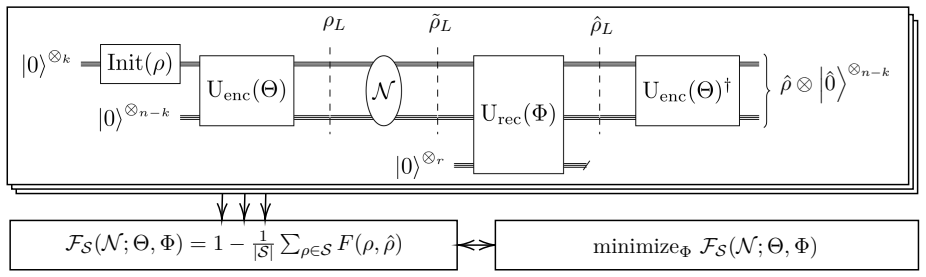
Quantum error correction is crucial for protecting quantum information against decoherence. Traditional codes like the surface code require substantial overhead, making them impractical for near-term, early fault-tolerant devices. We propose a novel objective function for tailoring error correction codes to specific noise structures by maximizing the distinguishability between quantum states after a noise channel, ensuring efficient recovery operations. We formalize this concept with the distinguishability loss function, serving as a machine learning objective to discover resource-efficient encoding circuits optimized for given noise characteristics. We implement this methodology using variational techniques, termed variational quantum error correction (VarQEC). Our approach yields codes with desirable theoretical and practical properties and outperforms standard codes in various scenarios. We also provide proof-of-concept demonstrations on IBM and IQM hardware devices, highlighting the practical relevance of our procedure.
Editorial analysis
A structured set of objections, weighed in public.
Referee Report
Summary. The manuscript introduces variational quantum error correction (VarQEC), a method that learns encoding circuits by variationally maximizing a distinguishability loss function computed after a given noise channel. The goal is to produce resource-efficient codes tailored to specific noise models, with claims that the resulting encodings support efficient recovery, exhibit desirable theoretical and practical properties, and outperform standard codes such as the surface code in various scenarios. Proof-of-concept demonstrations on IBM and IQM hardware are provided.
Significance. If the distinguishability objective can be shown to control logical fidelity under an explicit recovery map, the approach would offer a practical, noise-adaptive alternative to fixed codes for near-term devices. The variational formulation and hardware demonstrations are strengths that could enable tailored error correction with lower overhead than conventional constructions.
major comments (2)
- [§3] §3 (Method): The distinguishability loss is defined directly from the noise channel, yet no derivation or inequality is supplied that bounds the diamond-norm distance of the effective logical channel to the identity or guarantees that a simple (e.g., syndrome-based) recovery map achieves high fidelity. Without this link the central claim that maximization yields efficient, high-fidelity recovery remains unestablished.
- [§4] §4 (Numerical experiments): The reported outperformance over standard codes is stated without tabulated logical error rates, fidelity values, or statistical error bars for the chosen noise models and code distances; the absence of these quantitative metrics prevents verification of the performance advantage.
minor comments (2)
- [Figures] Figure captions should explicitly state the noise model, number of shots, and variational circuit depth used in each hardware run.
- [Abstract] The abstract asserts that the method 'ensures efficient recovery operations' without qualifying that this is an empirical observation rather than a proven guarantee.
Simulated Author's Rebuttal
We thank the referee for their thorough review and constructive feedback on our work. We address each of the major comments below and outline the changes we will make to the manuscript.
read point-by-point responses
-
Referee: [§3] §3 (Method): The distinguishability loss is defined directly from the noise channel, yet no derivation or inequality is supplied that bounds the diamond-norm distance of the effective logical channel to the identity or guarantees that a simple (e.g., syndrome-based) recovery map achieves high fidelity. Without this link the central claim that maximization yields efficient, high-fidelity recovery remains unestablished.
Authors: We acknowledge the validity of this comment. The current manuscript motivates the distinguishability loss as a proxy for enabling effective recovery by maximizing the separation of logical states after the noise channel, but does not provide a formal inequality linking it directly to the diamond norm of the logical channel or to the performance of a specific recovery map. This connection is indeed important for rigorously establishing the central claim. In the revised manuscript, we will expand §3 to include a theoretical discussion that relates the distinguishability loss to bounds on the logical error, for instance by connecting it to the trace distance between the noisy encoded states and discussing implications for syndrome-based recovery. We will also note the heuristic nature of the approach while emphasizing the supporting numerical results. revision: yes
-
Referee: [§4] §4 (Numerical experiments): The reported outperformance over standard codes is stated without tabulated logical error rates, fidelity values, or statistical error bars for the chosen noise models and code distances; the absence of these quantitative metrics prevents verification of the performance advantage.
Authors: We agree that providing detailed quantitative metrics would enhance the verifiability of our results. The manuscript presents performance comparisons primarily through figures, but we recognize the need for tabulated data. In the revised version, we will include a new table in §4 that reports the logical error rates and average fidelities for the VarQEC encodings versus standard codes like the surface code, across the considered noise models and distances. We will also add statistical error bars based on multiple independent optimization runs to quantify the variability. revision: yes
Circularity Check
Distinguishability loss defined from external noise channel; variational optimization yields encodings without reduction to fitted inputs by construction.
full rationale
The derivation begins with an externally specified noise channel and defines a distinguishability loss directly from post-channel state overlaps. This loss is then maximized variationally to obtain an encoding circuit. Numerical demonstrations on specific noise models and hardware are presented as evidence of performance, rather than any claim that the loss mathematically forces recovery fidelity by definition. No equations reduce a claimed prediction to a parameter fitted inside the same paper, and no load-bearing uniqueness theorem or ansatz is imported solely via self-citation. The central construction therefore remains self-contained against external benchmarks.
Axiom & Free-Parameter Ledger
free parameters (1)
- variational circuit parameters
axioms (1)
- domain assumption Maximizing post-noise distinguishability implies the existence of an efficient recovery map
Lean theorems connected to this paper
-
IndisputableMonolith/Cost/FunctionalEquation.leanwashburn_uniqueness_aczel echoes?
echoesECHOES: this paper passage has the same mathematical shape or conceptual pattern as the Recognition theorem, but is not a direct formal dependency.
We formalize this concept with the distinguishability loss function... ΔT(ρ,σ;N;Θ) = T(ρ,σ) − T(N(ρ_L),N(σ_L))... minimize DS(N;Θ)
-
IndisputableMonolith/Foundation/AbsoluteFloorClosure.leanabsolute_floor_iff_bare_distinguishability echoes?
echoesECHOES: this paper passage has the same mathematical shape or conceptual pattern as the Recognition theorem, but is not a direct formal dependency.
maximizing the distinguishability between quantum states after a noise channel
What do these tags mean?
- matches
- The paper's claim is directly supported by a theorem in the formal canon.
- supports
- The theorem supports part of the paper's argument, but the paper may add assumptions or extra steps.
- extends
- The paper goes beyond the formal theorem; the theorem is a base layer rather than the whole result.
- uses
- The paper appears to rely on the theorem as machinery.
- contradicts
- The paper's claim conflicts with a theorem or certificate in the canon.
- unclear
- Pith found a possible connection, but the passage is too broad, indirect, or ambiguous to say the theorem truly supports the claim.
Forward citations
Cited by 2 Pith papers
-
Learning to Concatenate Quantum Codes
A machine-learning approach adaptively chooses quantum code sequences for concatenation to achieve target logical error rates with far fewer qubits than standard methods for structured noise.
-
A Review of Variational Quantum Algorithms: Insights into Fault-Tolerant Quantum Computing
A literature review of VQAs covering ansatz design, classical optimization, barren plateaus, error mitigation strategies, and theoretical adaptations for fault-tolerant quantum computing.
Reference graph
Works this paper leans on
-
[1]
Challenges and opportunities in quantum optimiza- tion
Amira Abbas, Andris Ambainis, Bran- don Augustino, Andreas Bärtschi, Harry Buhrman, Carleton Coffrin, Giorgio Cor- tiana, Vedran Dunjko, Daniel J Egger, Bruce G Elmegreen, et al. Challenges and opportunities in quantum optimiza- tion. Nat. Rev. Phys., pages 1–18, 2024. DOI: 10.1038/s42254-024-00770-9
-
[2]
Technology and per- formance benchmarks of iqm’s 20-qubit quantum com- puter,
Leonid Abdurakhimov, Janos Adam, Has- nain Ahmad, Olli Ahonen, Manuel Al- gaba, Guillermo Alonso, Ville Bergholm, Rohit Beriwal, Matthias Beuerle, Clinton Bockstiegel, et al. Technology and perfor- mance benchmarks of iqm’s 20-qubit quan- tum computer. arXiv:2408.12433, 2024. DOI: 10.48550/arXiv.2408.12433
-
[3]
Gupta, Neereja Sundaresan, Thomas Alexander, Christopher J
Rajeev Acharya, Laleh Aghababaie-Beni, Igor Aleiner, Trond I Andersen, Markus Ansmann, Frank Arute, Kunal Arya, Abra- ham Asfaw, Nikita Astrakhantsev, Juan Atalaya, et al. Quantum error correction below the surface code threshold. Nature, 16 638:920–926, 2025. DOI: 10.1038/s41586- 024-08449-y
-
[4]
Artificial intelligence for quantum computing
Yuri Alexeev, Marwa H Farag, Taylor L Patti, Mark E Wolf, Natalia Ares, Alán Aspuru-Guzik, Simon C Benjamin, Zhenyu Cai, Zohim Chandani, Federico Fedele, et al. Artificial intelligence for quantum computing. arXiv:2411.09131, 2024. DOI: 10.48550/arXiv.2411.09131
-
[5]
Fault- tolerant quantum computation against bi- ased noise
Panos Aliferis and John Preskill. Fault- tolerant quantum computation against bi- ased noise. Phys. Rev. A, 78(5):052331,
-
[6]
DOI: 10.1103/PhysRevA.78.052331
-
[7]
Quantum t-designs: t-wise independence in the quantum world
Andris Ambainis and Joseph Emerson. Quantum t-designs: t-wise independence in the quantum world. In Twenty-Second Annual IEEE Conference on Computa- tional Complexity (CCC’07), pages 129– 140, 2007. DOI: 10.1109/CCC.2007.26
-
[8]
Stability of stochastic gradient descent on nonsmooth convex losses
Raef Bassily, Vitaly Feldman, Cristóbal Guzmán, and Kunal Talwar. Stability of stochastic gradient descent on nonsmooth convex losses. In Advances in Neural In- formation Processing Systems (NeurIPS), volume 33, pages 4381–4391, 2020. DOI: 10.48550/arXiv.2006.06914
-
[9]
Quan- tum codes from neural networks
JohannesBauschandFelixLeditzky. Quan- tum codes from neural networks. New J. Phys. , 22(2):023005, 2020. DOI: 10.1088/1367-2630/ab6cdd
-
[10]
Learning high-accuracy error decoding for quantum processors.Nature, 635:834–840, 2024
Johannes Bausch, Andrew W Senior, Fran- cisco JH Heras, Thomas Edlich, Alex Davies, Michael Newman, Cody Jones, Kevin Satzinger, Murphy Yuezhen Niu, Sam Blackwell, et al. Learning high- accuracy error decoding for quantum pro- cessors. Nature, 635:834–840, 2024. DOI: 10.1038/s41586-024-08148-8
-
[12]
PennyLane: Automatic differentiation of hybrid quantum-classical computations
Ville Bergholm, Josh Izaac, Maria Schuld, Christian Gogolin, Shahnawaz Ahmed, Vishnu Ajith, M Sohaib Alam, Guillermo Alonso-Linaje, B AkashNarayanan, Ali Asadi, et al. Pennylane: Automatic differ- entiation of hybrid quantum-classical com- putations. arXiv:1811.04968, 2018. DOI: 10.48550/arXiv.1811.04968
work page internal anchor Pith review Pith/arXiv arXiv doi:10.48550/arxiv.1811.04968 2018
-
[13]
Jacob Biamonte, Peter Wittek, Nicola Pan- cotti, Patrick Rebentrost, Nathan Wiebe, and Seth Lloyd. Quantum machine learn- ing. Nature, 549(7671):195–202, 2017. DOI: 10.1038/nature23474
-
[14]
Donald Bures. An extension of kakutani’s theoremoninfiniteproductmeasurestothe tensor product of semifinite w*-algebras. Trans. Am. Math. Soc., 135:199–212, 1969. DOI: 10.2307/1995012
-
[15]
Good quantum error-correcting codes ex- ist
A Robert Calderbank and Peter W Shor. Good quantum error-correcting codes ex- ist. Phys. Rev. A, 54(2):1098, 1996. DOI: 10.1103/PhysRevA.54.1098
-
[16]
Quan- tumerrorcorrectionandorthogonalgeome- try
A Robert Calderbank, Eric M Rains, Pe- ter W Shor, and Neil JA Sloane. Quan- tumerrorcorrectionandorthogonalgeome- try. Phys. Rev. Lett., 78(3):405, 1997. DOI: 10.1103/PhysRevLett.78.405
-
[17]
Ruishi Chen, Victor R Lee, Annie Camey Kuo, Denise Clark Pope, and Sarah Miles
A Colin Cameron, Jonah B Gelbach, and Douglas L Miller. Bootstrap-based im- provements for inference with clustered er- rors. Rev. Econ. Stat., 90(3):414–427, 2008. DOI: 10.1162/rest.90.3.414
-
[18]
Roads towards fault- tolerant universal quantum computation
Earl T Campbell, Barbara M Terhal, and Christophe Vuillot. Roads towards fault- tolerant universal quantum computation. Nature, 549(7671):172–179, 2017. DOI: 10.1038/nature23460
-
[19]
Quan- tum variational learning for quantum error- correcting codes
Chenfeng Cao, Chao Zhang, Zipeng Wu, Markus Grassl, and Bei Zeng. Quan- tum variational learning for quantum error- correcting codes. Quantum, 6:828, 2022. DOI: 10.22331/q-2022-10-06-828
-
[20]
Variational Quantum Algorithms,
Marco Cerezo, Andrew Arrasmith, Ryan Babbush, Simon C Benjamin, Suguru Endo, Keisuke Fujii, Jarrod R McClean, Kosuke Mitarai, Xiao Yuan, Lukasz Cincio, et al. Variational quantum algorithms.Na- ture Rev. Phys., 3(9):625–644, 2021. DOI: 10.1038/s42254-021-00348-9
-
[21]
Cost function dependent barren plateaus in shallow parametrized quantum circuits,
Marco Cerezo, Akira Sone, Tyler Volkoff, Lukasz Cincio, and Patrick J Coles. Cost function dependent barren plateaus in shal- low parametrized quantum circuits. Na- ture Commun., 12(1):1791, 2021. DOI: 10.1038/s41467-021-21728-w
-
[22]
Marco Cerezo, Martin Larocca, Diego García-Martín, Nelson L Diaz, Paolo Brac- 17 cia, Enrico Fontana, Manuel S Rudolph, Pablo Bermejo, Aroosa Ijaz, Supanut Thanasilp, et al. Does provable absence of barren plateaus imply classical simula- bility? arXiv:2312.09121, 2023. DOI: 10.48550/arXiv.2312.09121
-
[23]
Flag fault-tolerant error correc- tion with arbitrary distance codes.Quan- tum, 2:53, 2018
Christopher Chamberland and Michael E Beverland. Flag fault-tolerant error correc- tion with arbitrary distance codes.Quan- tum, 2:53, 2018. DOI: 10.22331/q-2018-02- 08-53
-
[24]
Automated discovery of logical gates for quantum error correction
Hongxiang Chen, Michael Vasmer, Niko- las P Breuckmann, and Edward Grant. Automated discovery of logical gates for quantum error correction. Quantum Inf. Comput., 22(11-12):947–964, 2022. DOI: 10.26421/QIC22.11-12-3
-
[25]
Quan- tum autoencoders for efficient compression of quantum data,
Ranyiliu Chen, Zhixin Song, Xuanqiang Zhao, and Xin Wang. Variational quan- tum algorithms for trace distance and fi- delity estimation. Quantum Sci. Technol., 7(1):015019, 2021. DOI: 10.1088/2058- 9565/ac38ba
-
[26]
Quantum convolutional neural net- works
Iris Cong, Soonwon Choi, and Mikhail D Lukin. Quantum convolutional neural net- works. Nat. Phys., 15(12):1273–1278, 2019. DOI: 10.1038/s41567-019-0648-8
-
[27]
In- formation theory: coding theorems for discrete memoryless systems
Imre Csiszár and János Körner. In- formation theory: coding theorems for discrete memoryless systems . Cam- bridge University Press, 2011. DOI: 10.1017/CBO9780511921889
-
[28]
Practical quantum advantage in quantum simulation
Andrew J Daley, Immanuel Bloch, Chris- tian Kokail, Stuart Flannigan, Natalie Pearson, Matthias Troyer, and Peter Zoller. Practical quantum advantage in quantum simulation. Nature, 607(7920):667–676,
-
[29]
DOI: 10.1038/s41586-022-04940-6
-
[31]
The computational power of random quantum circuits in arbitrary geometries (2024)
Matthew DeCross, Reza Haghshenas, Minzhao Liu, Enrico Rinaldi, Johnnie Gray, Yuri Alexeev, Charles H Baldwin, John P Bartolotta, Matthew Bohn, Eli Chertkov, et al. The computational power of random quantum circuits in arbitrary geometries. arXiv:2406.02501, 2024. DOI: 10.48550/arXiv.2406.02501
-
[32]
Abhinav Deshpande, Marcel Hinsche, Sona Najafi, Kunal Sharma, Ryan Sweke, and Christa Zoufal. Dynamic parameterized quantum circuits: expressive and barren- plateau free.arXiv:2411.05760, 2024. DOI: 10.48550/arXiv.2411.05760
-
[35]
Cryptographic distinguishability measures for quantum-mechanical states
Christopher A Fuchs and Jeroen Van De Graaf. Cryptographic distinguishability measures for quantum-mechanical states. IEEE Trans. Inf. Theory, 45(4):1216–1227,
-
[36]
DOI: 10.1109/18.761271
-
[37]
Iulia M Georgescu, Sahel Ashhab, and Franco Nori. Quantum simulation. Rev. Mod. Phys., 86(1):153–185, 2014. DOI: 10.1103/RevModPhys.86.153
work page internal anchor Pith review doi:10.1103/revmodphys.86.153 2014
-
[38]
Stabilizer codes and quantum error correction
Daniel Gottesman. Stabilizer codes and quantum error correction. PhD thesis, California Institute of Technology, 1997. URL https://thesis.library.caltech. edu/2900/2/THESIS.pdf
work page 1997
-
[39]
An introduction to quantum error correction
Daniel Gottesman. An introduction to quantum error correction. In Proc. Sym. Appl. Math., volume 58, pages 221–236,
-
[40]
DOI: 10.1090/psapm/068
-
[41]
Nature Communications , volume =
Harper R Grimsley, Sophia E Economou, Edwin Barnes, and Nicholas J Mayhall. An adaptive variational algorithm for exact molecular simulations on a quantum com- puter. Nature Commun., 10(1):3007, 2019. DOI: 10.1038/s41467-019-10988-2
-
[42]
Properties of the Quantum Channel
Laszlo Gyongyosi and Sandor Imre. Properties of the quantum chan- nel. arXiv:1208.1270, 2012. DOI: 10.48550/arXiv.1208.1270
work page internal anchor Pith review Pith/arXiv arXiv doi:10.48550/arxiv.1208.1270 2012
-
[43]
Trevor Hastie. The elements of statistical learning: data mining, inference, and pre- 18 diction. Springer, 2009. DOI: 10.1007/978- 0-387-84858-7
-
[44]
Discov- ering highly efficient low-weight quantum error-correcting codes with reinforcement learning
Austin Yubo He and Zi-Wen Liu. Discov- ering highly efficient low-weight quantum error-correcting codes with reinforcement learning. arXiv:2502.14372, 2025. DOI: 10.48550/arXiv.2502.14372
-
[46]
The proper formula for relati ve entropy and its asymptotics in quantum probability
Fumio Hiai and Dénes Petz. The proper formula for relative entropy and its asymp- totics in quantum probability. Comm. Math. Phys., 143:99–114, 1991. DOI: 10.1007/BF02100287
-
[47]
Sur- face code quantum computing by lattice surgery
Dominic Horsman, Austin G Fowler, Si- mon Devitt, and Rodney Van Meter. Sur- face code quantum computing by lattice surgery.New J. Phys., 14(12):123011, 2012. DOI: 10.1088/1367-2630/14/12/123011
-
[48]
Violeta N Ivanova-Rohling, Niklas Rohling, and Guido Burkard. Discovery of an exchange-only gate sequence for cnot with record-low gate time using reinforcement learning. arXiv:2402.10559, 2024. DOI: 10.48550/arXiv.2402.10559
-
[49]
Ali Javadi-Abhari, Matthew Treinish, Kevin Krsulich, Christopher J Wood, Jake Lishman, Julien Gacon, Simon Martiel, Paul D Nation, Lev S Bishop, Andrew W Cross, et al. Quantum computing with Qiskit. arXiv:2405.08810, 2024. DOI: 10.48550/arXiv.2405.08810
work page internal anchor Pith review Pith/arXiv arXiv doi:10.48550/arxiv.2405.08810 2024
-
[50]
QVECTOR: an algorithm for device-tailored quantum error correction
Peter D Johnson, Jonathan Romero, Jonathan Olson, Yudong Cao, and Alán Aspuru-Guzik. Qvector: an algorithm for device-tailored quantum error correc- tion. arXiv:1711.02249, 2017. DOI: 10.48550/arXiv.1711.02249
work page internal anchor Pith review Pith/arXiv arXiv doi:10.48550/arxiv.1711.02249 2017
-
[51]
Fidelity for mixed quantum states
Richard Jozsa. Fidelity for mixed quantum states. J. Mod. Opt., 41(12):2315–2323,
-
[52]
DOI: 10.1080/09500349414552171
-
[53]
Qiskit experiments: A python pack- age to characterize and calibrate quantum computers
NaokiKanazawa, DanielJEgger, YaelBen- Haim, Helena Zhang, William E Shanks, Gadi Aleksandrowicz, and Christopher J Wood. Qiskit experiments: A python pack- age to characterize and calibrate quantum computers. J. Open Source Softw., 8(84): 5329, 2023. DOI: 10.21105/joss.05329
-
[54]
Amara Katabarwa, Katerina Gratsea, Athena Caesura, and Peter D Johnson. Early fault-tolerant quantum computing. PRX Quantum, 5(2):020101, 2024. DOI: 10.1103/PRXQuantum.5.020101
-
[55]
Emanuel Knill and Raymond Laflamme. Concatenated quantum codes. arXiv:quant-ph/9608012, 1996. DOI: 10.48550/arXiv.quant-ph/9608012
work page internal anchor Pith review Pith/arXiv arXiv doi:10.48550/arxiv.quant-ph/9608012 1996
-
[56]
Theory of quantum error-correcting codes
Emanuel Knill and Raymond Laflamme. Theory of quantum error-correcting codes. Phys. Rev. A , 55(2):900, 1997. DOI: 10.1103/PhysRevA.55.900
-
[57]
General state changes in quan- tum theory
Karl Kraus. General state changes in quan- tum theory. Ann. Phys., 64(2):311–335,
-
[58]
DOI: 10.1016/0003-4916(71)90108-4
-
[59]
Perfect quantum error correcting code
Raymond Laflamme, Cesar Miquel, Juan Pablo Paz, and Wojciech Hubert Zurek. Perfect quantum error correcting code. Phys. Rev. Lett., 77(1):198, 1996. DOI: 10.1103/PhysRevLett.77.198
-
[60]
Autonomous quantum er- ror correction and quantum computa- tion
José Lebreuilly, Kyungjoo Noh, Chiao- Hsuan Wang, Steven M Girvin, and Liang Jiang. Autonomous quantum er- ror correction and quantum computa- tion. arXiv:2103.05007, 2021. DOI: 10.48550/arXiv.2103.05007
-
[62]
Paul Pu Liang, Amir Zadeh, and Louis- Philippe Morency. Foundations and trends in multimodal machine learning: Princi- ples, challenges, and open questions.ACM Comput. Surv., 56(10):1–42, 2024
work page 2024
-
[63]
Completely positive maps and entropy inequalities
Göran Lindblad. Completely positive maps and entropy inequalities. Comm. Math. Phys., 40:147–151, 1975. DOI: 10.1007/BF01609396
-
[64]
On the limited memory BFGS method for large scale optimization
Dong C Liu and Jorge Nocedal. On the limited memory bfgs method for large scale optimization. Math. Program., 45(1):503– 528, 1989. DOI: 10.1007/BF01589116
-
[65]
Noise-strength-adapted approx- imate quantum codes inspired by machine 19 learning
Shuwei Liu, Shiyu Zhou, Zi-Wen Liu, and Jinmin Yi. Noise-strength-adapted approx- imate quantum codes inspired by machine 19 learning. arXiv:2503.11783, 2025. DOI: 10.48550/arXiv.2503.11783
-
[66]
Quantum error correction with quantum autoencoders
David F Locher, Lorenzo Cardarelli, and Markus Müller. Quantum error correction with quantum autoencoders. Quantum, 7: 942, 2023. DOI: 10.22331/q-2023-03-09- 942
-
[67]
Optimization of tensor network codes with reinforcement learning
Caroline Mauron, Terry Farrelly, and Thomas M Stace. Optimization of tensor network codes with reinforcement learning. New J. Phys., 26(2):023024, 2024. DOI: 10.1088/1367-2630/ad23a6
-
[68]
Jarrod R McClean, Sergio Boixo, Vadim N Smelyanskiy, Ryan Babbush, and Hart- mut Neven. Barren plateaus in quan- tum neural network training landscapes. Nat. Commun., 9(1):4812, 2018. DOI: 10.1038/s41467-018-07090-4
-
[69]
Bench- marking quantum processor performance at scale,
David C McKay, Ian Hincks, Emily J Pritchett, Malcolm Carroll, Luke CG Govia, and Seth T Merkel. Benchmark- ing quantum processor performance at scale. arXiv:2311.05933, 2023. DOI: 10.48550/arXiv.2311.05933
-
[70]
Nico Meyer, Christian Ufrecht, Manira- man Periyasamy, Daniel D Scherer, Axel Plinge, and Christopher Mutschler. A survey on quantum reinforcement learn- ing. arXiv:2211.03464, 2022. DOI: 10.48550/arXiv.2211.03464
-
[71]
Dubey, Christian Ufrecht, Maniraman Periyasamy, Axel Plinge, Christopher Mutschler & Daniel D
Nico Meyer, Jakob Murauer, Alexan- der Popov, Christian Ufrecht, Axel Plinge, Christopher Mutschler, and Daniel D Scherer. Warm-start varia- tional quantum policy iteration. In IEEE International Conference on Quantum Computing and Engineering (QCE), vol- ume 1, pages 1458–1466, 2024. DOI: 10.1109/QCE60285.2024.00172
-
[72]
Dubey, Christian Ufrecht, Maniraman Periyasamy, Axel Plinge, Christopher Mutschler & Daniel D
Nico Meyer, Christian Ufrecht, Manira- man Periyasamy, Axel Plinge, Christopher Mutschler, Daniel D Scherer, and Andreas Maier. Qiskit-torch-module: Fast proto- typing of quantum neural networks. In IEEE International Conference on Quan- tum Computing and Engineering (QCE), volume 1, pages 817–823, 2024. DOI: 10.1109/QCE60285.2024.00101
-
[73]
Bench- marking quantum reinforcement learn- ing
Nico Meyer, Christian Ufrecht, George Yammine, Georgios Kontes, Christopher Mutschler, and Daniel D Scherer. Bench- marking quantum reinforcement learn- ing. arXiv:2501.15893, 2025. DOI: 10.48550/arXiv.2501.15893
-
[74]
How to gener- ate random matrices from the clas- sical compact groups
Francesco Mezzadri. How to gener- ate random matrices from the clas- sical compact groups. Not. Am. Math. Soc., 54(5):592–604, 2006. URL https://www.ams.org/notices/200705/ fea-mezzadri-web.pdf
work page 2006
-
[75]
Optimizing quantum error correction codes with reinforcement learning
HendrikPoulsenNautrup, NicolasDelfosse, Vedran Dunjko, Hans J Briegel, and Nicolai Friis. Optimizing quantum error correction codes with reinforcement learning. Quan- tum, 3:215, 2019. DOI: 10.22331/q-2019- 12-16-215
-
[76]
Quantum Computation and Quantum In- formation
Michael A Nielsen and Isaac L Chuang. Quantum Computation and Quantum In- formation. Cambridge University Press,
-
[77]
DOI: 10.1017/CBO9780511976667
-
[78]
M.; Diamanti, E.; Kerenidis, I
Jan Olle, Remmy Zen, Matteo Puviani, and Florian Marquardt. Simultaneous dis- covery of quantum error correction codes and encoders with a noise-aware reinforce- ment learning agent. npj Quantum Inf., 10(126):1–17, 2024. DOI: 10.1038/s41534- 024-00920-y
-
[79]
Scaling the automated discovery of quantum cir- cuits via reinforcement learning with gad- gets
Jan Ollé Aguilera, Oleg M Yevtushenko, and Florian Marquardt. Scaling the automated discovery of quantum cir- cuits via reinforcement learning with gad- gets. arXiv:2503.11638, 2025. DOI: 10.48550/arXiv.2503.1163
-
[80]
Hamiltonian variational ansatz without barren plateaus
Chae-Yeun Park and Nathan Killoran. Hamiltonian variational ansatz without barren plateaus. Quantum, 8:1239, 2024. DOI: 10.22331/q-2024-02-01-1239
-
[82]
Pytorch: An impera- tive style, high-performance deep learning library
AdamPaszke, SamGross, FranciscoMassa, Adam Lerer, James Bradbury, Gregory Chanan, Trevor Killeen, Zeming Lin, Natalia Gimelshein, Luca Antiga, Al- ban Desmaison, Andreas Kopf, Edward Yang, Zachary DeVito, Martin Raison, Alykhan Tejani, Sasank Chilamkurthy, Benoit Steiner, Lu Fang, Junjie Bai, and 20 Soumith Chintala. Pytorch: An impera- tive style, high-p...
-
[83]
PyTorch: An Imperative Style, High-Performance Deep Learning Library
Curran Associates, Inc., 2019. DOI: 10.48550/arXiv.1912.01703
work page internal anchor Pith review Pith/arXiv arXiv doi:10.48550/arxiv.1912.01703 2019
-
[84]
Sufficient subalgebras and the relative entropy of states of a von neumann algebra
Dénes Petz. Sufficient subalgebras and the relative entropy of states of a von neumann algebra. Commun. Math. Phys., 105:123– 131, 1986. DOI: 10.1007/BF01212345
-
[85]
Alexander PM Place, Lila VH Rodgers, Pranav Mundada, Basil M Smitham, Mat- tias Fitzpatrick, Zhaoqi Leng, Anjali Premkumar, Jacob Bryon, Andrei Vraji- toarea, Sara Sussman, et al. New mate- rial platform for superconducting transmon qubits with coherence times exceeding 0.3 milliseconds. Nature Commun., 12(1):1779,
-
[86]
DOI: 10.1038/s41467-021-22030-5
-
[87]
Qdistrnd: A gap package for computing the distance of quantum error-correcting codes
Leonid P Pryadko, Vadim A Shabashov, and Valerii K Kozin. Qdistrnd: A gap package for computing the distance of quantum error-correcting codes. J. Open Source Softw., 7(71):4120, 2022. DOI: 10.21105/joss.04120
discussion (0)
Sign in with ORCID, Apple, or X to comment. Anyone can read and Pith papers without signing in.