REVIEW 2 major objections 7 minor 58 references
Clio-X: AWeb3 Solution for Privacy-Preserving AI Access to Digital Archives
T0 review · 2 major / 7 minor · reviewed 2026-08-06 · deepseek-v4-flash
Pith's one-line read Clio-X makes the case that archive-controlled compute can let AI read sensitive records without exposing them.
desk verdict Solid qualitative study of adoption barriers, wrapped in an architecture whose privacy claim is not substantiated. read the letter →
The pith
A machine-rendered reading of the paper's core claim, the machinery that carries it, and where it could break.
The reading
What carries the argument
The load-bearing mechanism is the compute-to-data (CtD) workflow: the archive publishes only encrypted pointers and access tokens; a secure proxy verifies payment and rights; the compute job runs in an access-controlled, trusted-execution-environment-backed clean room at the data holder's site; and the researcher receives the job output, never the raw records. Around this core, Clio-X layers a privacy-preserving AI algorithm that masks sensitive features before analytics, and a visualization hub that turns outputs into distant readings. A confidential blockchain layer provides tamper-evident logs and automated payments. The argument depends on the claim that each layer prevents raw sensitive content from appearing in outputs.
What would settle it
Run a reconstruction attack against the Clio-X pipeline on the Enron email dataset: if a researcher can recover names, addresses, or other sensitive strings from the returned statistics and visualizations, or compromise the secure enclave through a known side-channel, then the central privacy guarantee is false. A simpler check is to test whether masking is reversible by comparing masked outputs against the original corpus.
Extended reading notes
Core claim
The central claim is that a compute-to-data architecture wrapped in Web3 infrastructure can increase researcher access to sensitive archival documents while the archives retain control of the data. In Clio-X, data stays at the archive, AI algorithms visit it inside a secure compute environment, and researchers receive only aggregated statistics and visualizations; a privacy-masking step replaces sensitive features before analysis, and distant-reading outputs are designed to reveal patterns rather than individual records. The paper's user study shows that archival professionals and academics do not dispute this technical vision so much as they question whether the system can be understood, audited, and trusted; participants framed trust as a continuous process requiring transparency, provenance, and accountable governance. The conclusion stops short of claiming the system is proven, instead asserting that the architecture offers the potential to answer the research question affirmatively.
Load-bearing premise
The central premise is that the trusted execution environment and the privacy-masking algorithm actually prevent sensitive information from leaking into outputs; the paper calls the algorithm 'rudimentary' and provides no adversarial tests or leakage measurements.
Editorial extensions
If this is right
- If Clio-X works, archives could allow AI analysis of holdings that are currently closed because manual sensitivity review cannot keep pace, reducing 'dark archives' without exposing personal data.
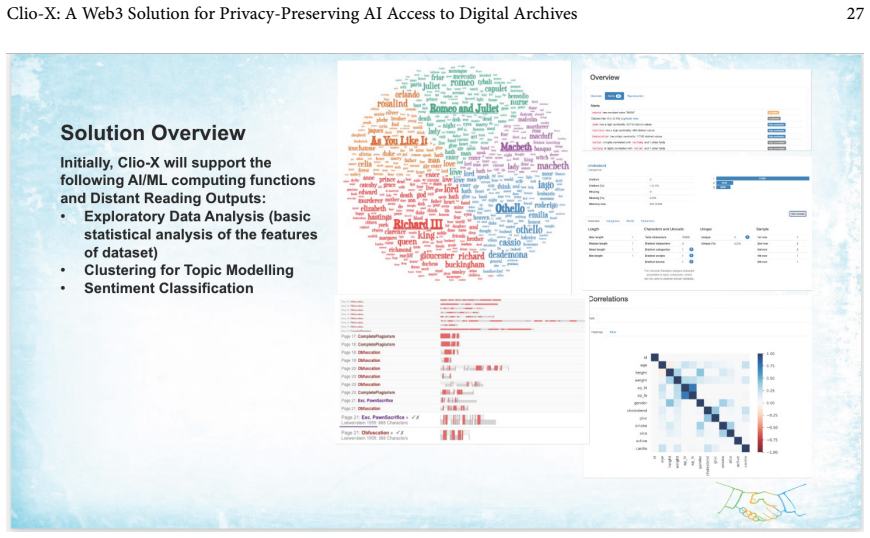
- Researchers could run exploratory analyses, topic modelling, clustering, and sentiment analysis over records they cannot currently see, receiving patterns rather than documents.
- Tamper-evident logging and granular access policies could give custodians auditability, consent controls, and a way to revoke access after each computation.
- The evaluation implies that even a privacy-correct system will not be adopted unless interfaces are transparent, governance is community-based, and users can trace how outputs are derived.
- A decentralized autonomous organization is proposed as the next step to provide the visible, collective oversight that the evaluation shows users expect.
Reading between the lines
- The paper does not provide adversarial evidence that its masking and trusted-execution layers resist real attacks; a natural next test would be to try to re-identify individuals from Clio-X outputs on a public corpus such as the Enron emails.
- If leakage-resistance were validated, the same architecture could generalize beyond archives to other regulated data holders, such as medical records or indigenous knowledge, where data sovereignty is the deciding barrier to sharing.
- The finding that trust is process-based suggests that technical privacy guarantees alone are insufficient; governance and transparency may be the decisive adoption variables, a hypothesis the paper's own data supports but does not test.
- The DAO proposal could be evaluated as a concrete trust mechanism: a controlled follow-up study could ask whether visible community voting and oversight actually change adoption attitudes among archivists.
Signed reviews
Editorial analysis
A structured set of objections, weighed in public.
Referee Report
Summary. The paper presents Clio-X, a decentralized Web3 architecture intended to let archives offer AI-enabled access to sensitive holdings without losing control of the underlying records. The proposed design combines compute-to-data (CtD) infrastructure, trusted execution environments (TEEs), a custom privacy-masking AI algorithm, blockchain-based access management via Pontus-X/Ocean/Oasis, and distant-reading visualizations. The empirical core is a user study of a medium-fidelity prototype with 14 archival practitioners and academics, analyzed through Braun and Clarke thematic analysis and ATLAS.ti; the qualitative findings identify trust-as-process, technical friction, black-box opacity, privacy-for-psychological-safety, desire for analytical value, and governance as determinants of adoption. The paper interprets the results through Rogers' Diffusion of Innovations theory and concludes that Web3 'offers the potential to affirmatively answer yes' to the question of whether PETs and distant reading can increase access to sensitive archival documents.
Significance. The qualitative contribution is genuine and well-reported: the study uses direct quotes, describes an explicit coding method, and includes an unusually honest limitations section covering the small sample, the missed data-consumer role, and incomplete coverage of the interview guide. The Rogers-based analysis is a plausible interpretive lens and the design recommendations are concrete. If the user-study findings are taken as the paper's main contribution, the manuscript is a useful sociotechnical study of adoption barriers for PET-based archival access. The technical side, however, is not at the same standard: the privacy guarantee is asserted rather than demonstrated, and the central affirmative conclusion rests on unvalidated assumptions about TEEs and the masking algorithm. The paper would be strengthened by clearly separating the empirically supported adoption findings from the still-unverified technical privacy claims.
major comments (2)
- [§3.2, §3.3 (Workflow Step 5a), §4, §6] The paper's affirmative conclusion is load-bearing and currently unsupported: no threat model, adversary model, privacy definition, or leakage measurement is supplied for the claim that records 'never leave the custody and control of the archives' (§3.2) while being processed in 'a secure and privacy-preserving compute environment (e.g., a trusted execution environment)' (§3.3, Step 5a). The only implementation evidence in §4 is a 'custom, but still rudimentary privacy-preserving AI algorithm' and a medium-fidelity mockup, with no description of what the algorithm actually does, no masking-accuracy results, and no resistance-to-attack evaluation. Section 2.5 cites Intel SGX and AWS Nitro without discussing known side-channel considerations. Participants in the study themselves asked 'can it be essentially gamed?' and questioned whether replacing a name with 'name' still leaves the name in the system. Because §6 converts this unvalidated assumption into 'the potential to affirmatively answer yes,' the central privacy claim is not established. This is missing evidence for a security property the paper needs, not a disagreement with consensus.
- [§2.7, §3.2] The claim that distant-reading visualizations 'can shield sensitive information in the underlying records from exposure and eliminate the need for archivists to conduct sensitivity reviews' is asserted without any adversarial analysis of aggregate outputs. There is no demonstration that the visualization or masking pipeline resists inference, membership, or mosaic attacks, even though §2.2 itself notes the mosaic effect as a known privacy risk. Since the value proposition for archives is precisely the ability to open 'dark archives' without a sensitivity review, this is a load-bearing assumption and needs at least a formal privacy argument or an empirical leakage test, not just a citation to prior work.
minor comments (7)
- [§2.3] The abbreviation 'TTEs' should be 'TEEs' for Trusted Execution Environments.
- [§3.2] There is a dangling citation '[? ]' after the description of Oasis Sapphire's off-chain computation support; please supply the reference.
- [§4] The section numbering is inconsistent: '4 Method' is followed by '4 Automated Analysis', and '4.1.4 Design Recommendations' appears after an unnumbered subsection. Please renumber the methods and results subsections.
- [§4, Appendix A] The text says Appendix A contains 'details of an early low fidelity prototype', but the appendix shows presentation slides; clarify which artifact was actually used or add the missing low-fidelity prototype material.
- [Captions and figures] There are typos in the captions: 'Presention' in Appendix A and 'visualizaiton' in Figure 4; the text also refers to Figure 5 for the sentiment analysis while Figure 6 is later described as showing sentiment voices, so please check the figure references.
- [Front matter and Table 1] The CCS Concepts list repeats 'Domain-specific security and privacy architectures' four times, and Table 1 breaks 'Infrastruc-ture' across lines; clean these up.
- [§2.5, §2.6] Foundational claims about TEEs, PPML, and blockchain attitudes rely heavily on the authors' own prior work ([4], [25], [57]); adding independent sources would make the background more accessible and easier to assess for readers outside this group.
Circularity Check
No circular derivation: the architecture and user study are self-contained; the privacy gap is missing evidence, not a logical circle.
full rationale
Clio-X does not present a mathematical derivation chain in which an output is equivalent to its inputs by construction. The paper's central claim is that a Web3/CtD/TEE architecture, together with distant-reading visualizations and privacy-masking AI, 'offers the potential to affirmatively answer yes' to the research question. This claim is supported by an architectural description, a workflow specification, and a qualitative user study of a medium-fidelity prototype, not by a fitted parameter or a derived quantity. The privacy-preserving property is asserted through trusted execution environments and a 'custom, but still rudimentary privacy-preserving AI algorithm,' but the absence of a threat model, leakage measurements, or masking accuracy is an evidentiary gap rather than a circular step; the output does not reduce to the input by definition. The paper does cite the authors' own prior work, notably [4], [25], and [57], to motivate the problem and describe components such as Ocean Protocol and compute-to-data, but these citations are contextual and descriptive. The independent empirical content comes from the 14-participant workshops analyzed by both human thematic coding and ATLAS.ti, and that content does not reduce to the self-cited references. No equation is fitted and renamed as a prediction, no uniqueness theorem is imported from the authors' prior work, and no ansatz is smuggled in solely through self-citation. The main weakness of the paper is that a security property is asserted rather than demonstrated, which is a correctness and evidence concern, not a circularity concern. Accordingly, no specific circular step can be quoted or exhibited, and the paper should receive a low score reflecting only the presence of minor, non-load-bearing self-citations.
Assumptions & free parameters
assumptions (4)
- domain assumption Compute-to-data with trusted execution environments prevents exposure of raw records during AI analysis.
- ad hoc to paper The custom privacy-masking AI algorithm sufficiently masks sensitive features before analytics.
- domain assumption The 14-participant workshops provide saturation for the reported themes.
- domain assumption Blockchain and Oasis Sapphire confidential computing operate as described in the cited Pontus-X documentation.
invented entities (3)
-
Clio-X platform
-
Clio-X DAO
-
Clio-X privacy-preserving AI masking algorithms
Cite this review
Pith. "Pith review of Clio-X: AWeb3 Solution for Privacy-Preserving AI Access to Digital Archives." pith.science (2026). https://pith.science/paper/LUIWKXOT
@misc{pith2026250708853,
  author       = {Pith},
  title        = {Pith review of: Clio-X: AWeb3 Solution for Privacy-Preserving AI Access to Digital Archives},
  year         = {2026},
  howpublished = {\url{https://pith.science/paper/LUIWKXOT}},
  note         = {Machine review of arXiv:2507.08853}
}
read the original abstract
As archives turn to artificial intelligence to manage growing volumes of digital records, privacy risks inherent in current AI data practices raise critical concerns about data sovereignty and ethical accountability. This paper explores how privacy-enhancing technologies (PETs) and Web3 architectures can support archives to preserve control over sensitive content while still being able to make it available for access by researchers. We present Clio-X, a decentralized, privacy-first Web3 digital solution designed to embed PETs into archival workflows and support AI-enabled reference and access. Drawing on a user evaluation of a medium-fidelity prototype, the study reveals both interest in the potential of the solution and significant barriers to adoption related to trust, system opacity, economic concerns, and governance. Using Rogers' Diffusion of Innovation theory, we analyze the sociotechnical dimensions of these barriers and propose a path forward centered on participatory design and decentralized governance through a Clio-X Decentralized Autonomous Organization. By integrating technical safeguards with community-based oversight, Clio-X offers a novel model to ethically deploy AI in cultural heritage contexts.
Figures


Figures from the paper (5 more)


Reference graph
Works this paper leans on
-
[1]
Lise Jaillant. Archives, access and artificial intelligence: Working with born-digital and digitized archival collections. Bielefeld University Press, 2022
work page 2022
-
[2]
Navigating AI for Cultural Heritage Organisations
Lise Jaillant, Claire Warwick, Paul Gooding, Katherine Aske, Glen Layne-Worthey, and J Stephen Downie. Navigating AI for Cultural Heritage Organisations. UCL Press, 2024
work page 2024
-
[3]
Archives and ai: An overview of current debates and future perspectives
Giovanni Colavizza, Tobias Blanke, Charles Jeurgens, and Julia Noordegraaf. Archives and ai: An overview of current debates and future perspectives. ACM Journal on Computing and Cultural Heritage (JOCCH), 15(1):1–15, 2021. Manuscript submitted to ACM 24 Lemieux et al
work page 2021
-
[4]
Protecting privacy in digital records: the potential of privacy-enhancing technologies
Victoria L Lemieux and John Werner. Protecting privacy in digital records: the potential of privacy-enhancing technologies. ACM Journal on Computing and Cultural Heritage, 16(4):1–18, 2024
work page 2024
-
[5]
Jason R Baron and Nathaniel Payne. Dark archives and edemocracy: strategies for overcoming access barriers to the public record archives of the future. In 2017 Conference for E-Democracy and Open Government (CeDEM), pages 3–11. IEEE, 2017
work page 2017
-
[6]
Design thinking, UX and born-digital archives: solving the problem of dark archives closed to users
Lise Jaillant. Design thinking, UX and born-digital archives: solving the problem of dark archives closed to users. Loughborough University, 2017
work page 2017
-
[7]
Using ai in providing greater access to the us government’s email: a progress report
Jason R Baron. Using ai in providing greater access to the us government’s email: a progress report. AI & SOCIETY, pages 1–14, 2025
work page 2025
-
[8]
Development of web3 awareness scale as the next evolution of the internet
Mevlüt Uysal, Mutlu Tahsin Üstündağ, Ahmet Çelik, Mustafa Tanrıverdi, Onur Ceran, and Zafer Ayaz. Development of web3 awareness scale as the next evolution of the internet. Participatory Educational Research, 11(1):247–265, 2024
work page 2024
Show all 58 references
-
[9]
Interpares terminology database, 2025
InterPARES. Interpares terminology database, 2025. URL https://interparestrustai.org/terminology
2025
-
[10]
Digital reconstruction of historical artworks using artificial intelligence
Wai Yie Leong. Digital reconstruction of historical artworks using artificial intelligence. In 2025 International Conference on Computer Sciences, Engineering, and Technology Innovation (ICoCSETI), pages 623–628. IEEE, 2025
2025
-
[11]
Innovating heritage: How toast digitally transforms traditional weaving
Reshmi JK Babu, PS Rajeswari, and Shekar Babu. Innovating heritage: How toast digitally transforms traditional weaving. Journal of Information Technology Teaching Cases, page 20438869251338321, 2020
2020
-
[12]
Open dance lab: Digital platform for examining, experimenting, and evolving intangible cultural heritage
Chayapatr Archiwaranguprok, Pat Pataranutaporn, Phoomparin Mano, Piyaporn Bhongse-Tong, Pattie Maes, and Pichet Klunchun. Open dance lab: Digital platform for examining, experimenting, and evolving intangible cultural heritage. In Proceedings of the 24th ACM/IEEE Joint Confere...
2024
-
[13]
Explainable ai, llm, and digitized archival cultural heritage: a case study of the grand ducal archive of the medici
Gabor Mihaly Toth, Richard Albrecht, and Cedric Pruski. Explainable ai, llm, and digitized archival cultural heritage: a case study of the grand ducal archive of the medici. AI & SOCIETY, pages 1–13, 2025
2025
-
[14]
Future archeology: Boosting cultural vibrancy and future memories through ai regenerated materialities in co-designed virtual spaces
Enza Migliore, Y aohan Zhang, and Yujing Ma. Future archeology: Boosting cultural vibrancy and future memories through ai regenerated materialities in co-designed virtual spaces. In Proceedings of the Nineteenth International Conference on Tangible, Embedded, and Embodied Inte...
2025
-
[15]
User experience strategies to share and enrich collective memories about cultural heritage in a digital platform
Mariana Alves, Ana Velhinho, Pedro Almeida, and Telmo Silva. User experience strategies to share and enrich collective memories about cultural heritage in a digital platform. In International Conference on Design and Digital Communication, pages 201–212. Springer, 2024
2024
-
[16]
The model is the museum: Generative ai and the expropriation of cultural heritage
Gabriel Menotti. The model is the museum: Generative ai and the expropriation of cultural heritage. AI & SOCIETY, pages 1–5, 2025
2025
-
[17]
How sensitivity classification effectiveness impacts reviewers in technology-assisted sensitivity review
Graham McDonald, Craig Macdonald, and Iadh Ounis. How sensitivity classification effectiveness impacts reviewers in technology-assisted sensitivity review. In Proceedings of the 2019 Conference on Human Information Interaction and Retrieval, pages 337–341, 2019
2019
-
[18]
Providing more efficient access to government records: a use case involving application of machine learning to improve foia review for the deliberative process privilege
Jason R Baron, Mahmoud F Sayed, and Douglas W Oard. Providing more efficient access to government records: a use case involving application of machine learning to improve foia review for the deliberative process privilege. ACM Journal on Computing and Cultural Heritage (JOCCH), ...
2022
-
[19]
Artificial intelligence and machine learning at the intersection of privacy and archives
Iori Khuhro, Erin Gilmore, Jim Suderman, and Darra L Hofman. Artificial intelligence and machine learning at the intersection of privacy and archives. Archeion, 2024(125):55–78, 2024
2024
-
[20]
Differential Privacy
Simson L Garfinkel. Differential Privacy. MIT Press, 2025
2025
-
[21]
Ai to review government records: new work to unlock historically significant digital records
David Canning and Lise Jaillant. Ai to review government records: new work to unlock historically significant digital records. AI & SOCIETY, pages 1–13, 2025
2025
-
[22]
An overview on edge computing research
Keyan Cao, Y efan Liu, Gongjie Meng, and Qimeng Sun. An overview on edge computing research. IEEE access, 8:85714–85728, 2020
2020
-
[23]
Digital identities and verifiable credentials
Johannes Sedlmeir, Reilly Smethurst, Alexander Rieger, and Gilbert Fridgen. Digital identities and verifiable credentials. Business & Information Systems Engineering, 63(5):603–613, 2021
2021
-
[24]
A decentralised approach to cyber-physical systems as a service: Managing shared access worldwide through blockchain standards
Juan Luis Ramos Villalon, Luis de la Torre, Zhongcheng Lei, Wenshan Hu, Hugo Tadashi Kussaba, and Victoria Lemieux. A decentralised approach to cyber-physical systems as a service: Managing shared access worldwide through blockchain standards. Computers in Industry, 167:104264, 2025
2025
-
[25]
Deepansha Chhabra, Meng Kang, and Victoria Lemieux. Blockchain, ai, and data protection in healthcare: A comparative analysis of two blockchain data marketplaces in relation to fair data processing and the ‘data double-spending’problem. In Blockchain and Artificial Intelligence...
2023
-
[26]
In search of self-sovereign identity leveraging blockchain technology
Md Sadek Ferdous, Farida Chowdhury, and Madini O Alassafi. In search of self-sovereign identity leveraging blockchain technology. IEEE access, 7: 103059–103079, 2019
2019
-
[27]
Core concepts, 2025
Data Spaces Support Centre. Core concepts, 2025. URL https://dssc.eu/space/Glossary/176554052/2.+Core+Concepts
2025
-
[28]
The technology landscape of data spaces, 2023
Antti Poikola, Ville Takanen, P Laszkowicz, and Teemu Toivonen. The technology landscape of data spaces, 2023. URL https://www.sitra.fi/app/ uploads/2023/10/sitra-technology-landscape-of-data-spaces.pdf
2023
-
[29]
Intel® software guard extensions (intel® sgx), 2025
Intel. Intel® software guard extensions (intel® sgx), 2025. URL https://www.intel.com/content/www/us/en/products/docs/accelerator-engines/ software-guard-extensions.html
2025
-
[30]
Aws nitro enclaves, 2025
Amazon Web Services. Aws nitro enclaves, 2025. URL https://aws.amazon.com/es/ec2/nitro/nitro-enclaves/
2025
-
[31]
Blockchain-based federated learning for securing internet of things: A comprehensive survey
Wael Issa, Nour Moustafa, Benjamin Turnbull, Nasrin Sohrabi, and Zahir Tari. Blockchain-based federated learning for securing internet of things: A comprehensive survey. ACM Computing Surveys, 55(9):1–43, 2023
2023
-
[32]
Protecting personal information using homomorphic encryption for person re-identification
Kazunari Morita, Hiroki Y oshimura, Masashi Nishiyama, and Y oshio Iwai. Protecting personal information using homomorphic encryption for person re-identification. In 2018 IEEE 7th Global Conference on Consumer Electronics (GCCE), pages 166–167. IEEE, 2018
2018
-
[33]
Secure multiparty computation
Y ehuda Lindell. Secure multiparty computation. Communications of the ACM, 64(1):86–96, 2020. Manuscript submitted to ACM Clio-X: A Web3 Solution for Privacy-Preserving AI Access to Digital Archives 25
2020
-
[34]
A systematic comparison of encrypted machine learning solutions for image classification
Veneta Haralampieva, Daniel Rueckert, and Jonathan Passerat-Palmbach. A systematic comparison of encrypted machine learning solutions for image classification. In Proceedings of the 2020 workshop on privacy-preserving machine learning in practice, pages 55–59, 2020
2020
-
[35]
Using distant reading to enhance archival access whilst protecting privacy,
Quihong Zhou Victoria Lemieux, Cheuk Kit Chung and Zehua Wang. Using distant reading to enhance archival access whilst protecting privacy,
-
[36]
Distant reading
Franco Moretti. Distant reading. Verso Books, 2013
2013
-
[37]
The colors of the national web: visual data analysis of the historical yugoslav web domain
Anat Ben-David, Adam Amram, and Ron Bekkerman. The colors of the national web: visual data analysis of the historical yugoslav web domain. International Journal on Digital Libraries, 19(1):95–106, 2018
2018
-
[38]
Mining the ‘internet graveyard’: rethinking the historians’ toolkit
Ian Milligan. Mining the ‘internet graveyard’: rethinking the historians’ toolkit. Journal of the Canadian Historical Association, 23(2):21–64, 2012
2012
-
[39]
Research through design as a method for interaction design research in hci
John Zimmerman, Jodi Forlizzi, and Shelley Evenson. Research through design as a method for interaction design research in hci. In Proceedings of the SIGCHI conference on Human factors in computing systems, pages 493–502, 2007
2007
-
[40]
Hci design methods
Brian William Packer and Simeon Keates. Hci design methods. In Designing for Usability, Inclusion and Sustainability in Human-Computer Interaction, pages 26–77. CRC Press, 2024
2024
-
[41]
Collaboration between hci design and software engineering
Jan Gulliksen, Dena Hussain, and Bengt Göransson. Collaboration between hci design and software engineering. In Designing for Usability, Inclusion and Sustainability in Human-Computer Interaction, pages 78–117. CRC Press, 2024
2024
-
[42]
Pontus-x portal, 2025
deltaDAO. Pontus-x portal, 2025. URL https://www.pontus-x.eu
2025
-
[43]
Pontus-x becomes a gaia-x lighthouse data space, 2025, March 21
Gaia-X. Pontus-x becomes a gaia-x lighthouse data space, 2025, March 21. URL https://gaia-x.eu/pontus-x-becomes-a-gaia-x-lighthouse-data-space/
2025
-
[44]
Next generation data and ai ecosystems, 2025
Ocean Enteprise. Next generation data and ai ecosystems, 2025. URL https://www.oceanenterprise.io/
2025
-
[45]
Interview: Pontus-x taps oasis for private, cross-border data sharing in e.u
Jayson Derrick. Interview: Pontus-x taps oasis for private, cross-border data sharing in e.u. Crypto News, 2025. URL https://crypto.news/interview-pontus-x-taps-oasis-for-private-cross-border-data-sharing-in-e-u/
2025
-
[46]
Oasis sapphire, 2025
Oasis. Oasis sapphire, 2025. URL https://oasis.net/sapphire
2025
-
[47]
Enron emails, 2015
Will Cukierski. Enron emails, 2015. URL https://www.kaggle.com/datasets/wcukierski/enron-email-dataset
2015
-
[48]
Conceptual and design thinking for thematic analysis
Virginia Braun and Victoria Clarke. Conceptual and design thinking for thematic analysis. Qualitative psychology, 9(1):3, 2022
2022
-
[49]
Using thematic analysis in psychology
Virginia Braun and Victoria Clarke. Using thematic analysis in psychology. Qualitative research in psychology, 3(2):77–101, 2006
2006
-
[50]
Positioning paradata: A conceptual frame for ai processual documentation in archives and recordkeeping contexts
Scott Cameron, Pat Franks, and Babak Hamidzadeh. Positioning paradata: A conceptual frame for ai processual documentation in archives and recordkeeping contexts. ACM Journal on Computing and Cultural Heritage, 16(4):1–19, 2023
2023
-
[51]
Imperative of paradata
Isto Huvila. Imperative of paradata. In 3D Research Challenges in Cultural Heritage V: Paradata, Metadata and Data in Digitisation, pages 1–11. Springer, 2024
2024
-
[52]
Searching for trust: blockchain technology in an age of disinformation
Victoria Lemieux. Searching for trust: blockchain technology in an age of disinformation. Cambridge University Press, 2022
2022
-
[53]
What they talk about when they talk about the need for critical evaluation of information sources: An analysis of norwegian and swedish news articles mentioning ‘source criticism’
Kim Tallerås and Olle Sköld. What they talk about when they talk about the need for critical evaluation of information sources: An analysis of norwegian and swedish news articles mentioning ‘source criticism’ . In International Conference on Information, pages 380–388. Springer, 2020
2020
-
[54]
Saturation in qualitative research: exploring its conceptualization and operationalization
Benjamin Saunders, Julius Sim, Tom Kingstone, Shula Baker, Jackie Waterfield, Bernadette Bartlam, Heather Burroughs, and Clare Jinks. Saturation in qualitative research: exploring its conceptualization and operationalization. Quality & quantity, 52:1893–1907, 2018
1907
-
[55]
M.(2003)
Everitt Rogers. M.(2003). diffusion of innovations. New York: Simon/Schuster (zuerst New York: The Free Press, 31983), 1962
2003
-
[56]
The knowledge illusion: The myth of individual thought and the power of collective wisdom
Steven Sloman and Philip Fernback. The knowledge illusion: The myth of individual thought and the power of collective wisdom. Pan Macmillan, 2017
2017
-
[57]
Will blockchain technology change how well national archives preserve the trustworthiness of digital records?: Preliminary results of a survey
Özhan Saglik and Victoria Lemieux. Will blockchain technology change how well national archives preserve the trustworthiness of digital records?: Preliminary results of a survey. In 2023 IEEE International Conference on Big Data (BigData), pages 2095–2104. IEEE, 2023. Acknowle...
2023
-
[2024]
URL https://interparestrustai.org/assets/public/dissemination/UsingDistantReadingtoEnhanceArchivalAccessWhilstProtectingPrivacyFINAL_ V2.docx
Reviewed August 6, 2026 · model on record in the stance chip above.
Discussion (0). Continue with ORCID to comment.