REVIEW 3 major objections 5 minor 1 cited by
Learning to Tune Like an Expert: Interpretable and Scene-Aware Navigation via MLLM Reasoning and CVAE-Based Adaptation
T0 review · 3 major / 5 minor · reviewed 2026-08-06 · deepseek-v4-flash
Pith's one-line read LE-Nav lets a robot tune its own planner parameters from a language model's scene rating, reaching human-expert-level tuning in real-world trials.
desk verdict A useful integration paper—MLLM scene description plus CVAE planner tuning—with real wheelchair trials, but the 'outperforms SOTA' claim rests on a hand-weighted metric and thin statistics. read the letter →
The pith
A machine-rendered reading of the paper's core claim, the machinery that carries it, and where it could break.
The reading
What carries the argument
The central object is a conditional variational autoencoder (CVAE): during training its encoder maps expert-annotated hyperparameters into a Gaussian latent space, and at deployment only the decoder runs, sampling hyperparameters conditioned on a Transformer-encoded history of MLLM scene ratings. The conditioning signal is a standardized five-dimensional scene rating produced by the MLLM using one-shot exemplars and chain-of-thought prompting, with an auxiliary visual detector correcting pedestrian-proximity estimates. The CVAE loss combines KL divergence with mean squared reconstruction error, and min-max normalization to the unit interval balances differently scaled hyperparameters while enabling user personalization of speed preferences. Packet-loss augmentation randomly masks frame features during attention so that the condition encoder tolerates dropped MLLM outputs.
What would settle it
Run LE-Nav on a smart wheelchair in a crowded corridor where one pedestrian is fully occluded behind another person or a pillar; if the MLLM then rates the scene as low-density, the CVAE outputs higher speed and lower obstacle-weight settings, and the resulting risk rate or near-collision count exceeds that of conservative fixed parameters, the sufficiency of the five-dimensional rating for safety is disproved.
Extended reading notes
Core claim
LE-Nav's central claim is that expert-level planner tuning can be decoupled into two learned components: scene description and hyperparameter generation. The MLLM does not output motion commands; it outputs a structured numerical scene rating that acts as a condition tensor, while a conditional variational autoencoder, trained on human experts' real-world parameter adjustments, maps the rating history to planner hyperparameters. Because the generator produces parameters rather than actions, the planner's own collision-avoidance machinery stays in the loop, and because the model is generative, it can sample several candidate settings. The experiments claim that this architecture generates hyperparameters within ten percent error of human-expert tuning, generalizes zero-shot to unseen scenes, tolerates MLLM packet loss through attention masking, and outperforms an RL-tuned baseline plus fixed progressive and conservative settings on a composite success-efficiency-safety-comfort score.
Load-bearing premise
The whole pipeline stands on the assumption that the MLLM's five-dimensional scene rating, supplemented by the auxiliary visual detector, reliably captures what matters for safe tuning in an unseen scene; the paper itself admits MLLMs still misestimate pedestrian proximity in complex scenes, and no amount of packet-loss augmentation fixes a rating that was wrong in the first place.
Editorial extensions
If this is right
- Hyperparameter generation stays within ten percent error of human-expert tuning for both TEB and DWA planners when conditioned on any of the three evaluated MLLMs.
- Real-world trials across five task scenarios show LE-Nav variants record no planning failures in four of five scenarios, while the RL-trained DADWA baseline fails repeatedly in narrow and crowded scenes.
- Packet-loss augmentation roughly halves the mean generation error when the latest one or two MLLM frames are dropped, the common real-world failure mode.
- Because LE-Nav adjusts planner hyperparameters rather than replacing the planner, the underlying TEB/DWA feasibility and collision-avoidance logic remains responsible for motion safety.
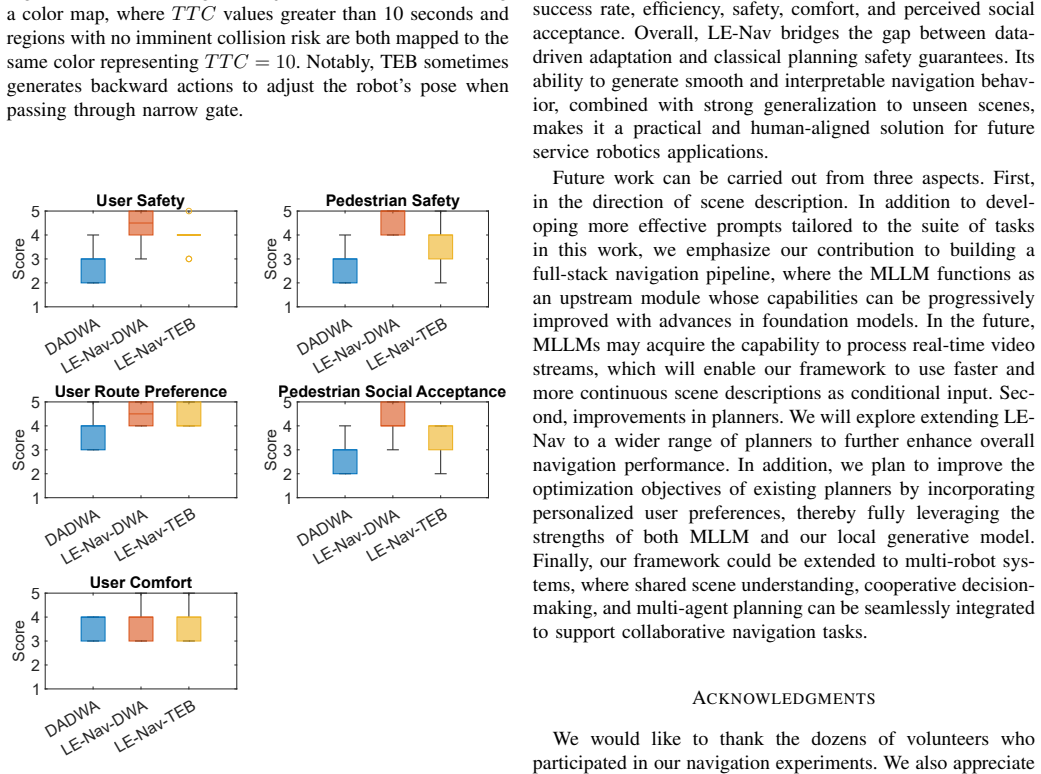
- In the blind user study, both pedestrians and wheelchair users assign LE-Nav higher perceived-safety and social-acceptance scores than the RL-based baseline.
Reading between the lines
- A direct extension would be to gate the CVAE output on the MLLM's token-level log-probability: when scene ratings are uncertain, the system could fall back to conservative planner parameters instead of trusting the generated ones.
- Because the condition signal is low-frequency (roughly 0.5 Hz), LE-Nav's adaptation speed is capped by the language model's latency; a video-streaming MLLM would provide continuous ratings and likely sharpen the safety-efficiency trade-off.
- The same two-stage design should transfer to any optimization-based planner with exposed cost weights, at the price of recollecting expert demonstrations for that planner's parameter space.
- The paper's robustness argument covers dropped frames, not systematically wrong ratings; an adversarial test that corrupts the five scene dimensions would reveal how graceful degradation behaves.
Editorial analysis
A structured set of objections, weighed in public.
Referee Report
Summary. The manuscript proposes LE-Nav, a two-stage framework that uses a multimodal large language model (MLLM) to produce structured scene ratings, then feeds those ratings as conditions to a conditional variational autoencoder (CVAE) that generates hyperparameters for TEB and DWA local planners. The method is evaluated in two ways: offline generation error against expert-tuned hyperparameters (with three MLLMs and an ablation for packet loss), and real-world navigation trials on a smart wheelchair in five scenarios, comparing LE-Nav against progressive/conservative TEB and DWA variants and against DADWA. The authors also report a user study on perceived safety and social acceptance. The central claim is that LE-Nav achieves human-level hyperparameter tuning and outperforms state-of-the-art navigation baselines on success rate, efficiency, safety, and comfort.
Significance. If the claims hold, LE-Nav is a practically useful contribution: it keeps the safety properties of classical planners while adapting their parameters in situ, and it provides an interpretable link between scene semantics and navigation behavior. The paper deserves credit for real physical trials (>100 runs), for releasing code, for including a packet-loss robustness ablation (Table II), and for evaluating across multiple MLLMs. The decoupling of MLLM scene understanding from the CVAE generator is a sensible architecture that avoids end-to-end VLA safety concerns. However, the headline quantitative claim rests on an aggregate Score whose weights are hand-chosen, and the evaluation size is small enough that the reported ranking is not yet robust. The user study is suggestive but lacks statistical support.
major comments (3)
- [§IV-C2, Eq. (5), Table III] The central claim of outperforming state-of-the-art methods is primarily supported by the composite Score in Eq. (5), whose weights are set to α1,2,3={0.8,0.1,0.1} and β1,2,3={0.5,1.0,1.5} without derivation or sensitivity analysis. The score gaps between top methods are often small: in Scenario (c) LE-Nav-DWA scores 0.9129 versus DWA-progressive 0.9121, and in Scenario (a) LE-Nav-TEB scores 0.7957 versus TEB-conservative 0.7722. Since the Score is the only aggregate ranking in Table III and is also used in the abstract and conclusion to assert superiority, a sensitivity analysis over reasonable reweightings of efficiency versus safety/comfort is load-bearing. The authors should either show that the ranking is stable across a range of weights or demote the claim to one about individual metrics.
- [§IV-C1, Table III, §IV-D] The statistical support for the main quantitative claims is thin: each method is run only three times per scenario, failed runs are excluded from the efficiency/safety/comfort averages, and no variance or significance measures are reported. With Rsuc taking values 0, 1/3, 2/3, or 1 after three runs, a single failed run changes the Score substantially, which is especially concerning given the small Score gaps noted above. The user study has only ten groups and no significance testing (Fig. 7), so the claim of 'higher subjective scores' is not statistically established. The authors should report per-method standard deviations or confidence intervals, state whether differences in Table III are reproducible across repeated trials, and provide at least a basic inferential test (e.g., paired or non-parametric) for the user study.
- [§III-C, §IV-C] The paper explicitly acknowledges in §III-C that MLLMs 'still struggle to estimate accurately human proximity in complex scenes,' and therefore introduces YOLOv11 as an auxiliary visual model. This is a reasonable engineering choice, but the navigation safety claim depends on the reliability of the resulting five-dimensional scene condition. The manuscript does not evaluate how often the MLLM's proximity estimates are wrong, how those errors propagate through the CVAE, or whether the packet-loss augmentation addresses systematic misperception. Given that safety is a headline metric, a targeted analysis of condition-error propagation (e.g., perturbing the scene rating and measuring hyperparameter and navigation outcome changes) would substantially strengthen the central claim.
minor comments (5)
- [Abstract and §I] The phrase 'over a hundred real-world navigation trials' is only indirectly supported by Table III (5 scenarios × 7 methods × 3 runs); stating the exact number and how it is counted would improve precision.
- [§III-B3] The list of eight hyperparameters is followed by 'therefore, both TEB and DWA has nine hyperparameters H ∈ R9 for training and learning' — the word 'has' should be 'have,' and the sentence should clarify that the ninth is the global costmap inflation radius.
- [§IV-C2, Eq. (5)] The definitions of Tnorm, Accnorm, and Jnorm are given in the text, but it is not stated over which set of methods the min-max normalization is computed; this should be explicit, since the Score ranking depends on the normalization set.
- [Table II] The row labeled 'DWA w/o ... Latest Two' reports '15.86% / 15.89' with no trailing '%' on the second value; this is likely a formatting typo.
- [§IV-D and Fig. 7] The user study figure would benefit from showing the distribution (e.g., individual participant scores or at least standard error bars) rather than only boxplots, and from stating the number of questionnaire items per dimension.
Circularity Check
Composite-score validation is self-referential, but the core LE-Nav claim rests on independent trials and held-out data.
-
other
[Appendix A: Performance Score (Sec. IV-C2, Eq. (5))]
"In Eq. (5), we propose a novel navigation performance metric that integrates four quantitative factors: success rate, efficiency, comfort, and safety. Moreover, experimental results in Tab. III demonstrate the scientific validity and practical effectiveness of our proposed index."
The Score values in Tab. III are generated by Eq. (5) itself, with alpha1,2,3={0.8,0.1,0.1} and beta1,2,3={0.5,1.0,1.5}. Thus citing Tab. III as evidence that Eq. (5) is scientifically valid is a self-referential loop: the table is the output of the metric being validated. The aggregate 'outperforms SOTA' conclusion is carried by this Score, since in Scenario (a) LE-Nav-TEB has higher risk and worse comfort than TEB-conservative and only wins on the weighted composite. This makes the circular validation load-bearing for the headline ranking. The weights are hand-assigned and are not derived from independent data, and no sensitivity analysis is reported.
full rationale
The central mechanism of LE-Nav—MLLM scene ratings conditioning a CVAE that is trained on expert hyperparameters and then evaluated in held-out validation sequences and real-world trials—is not circular. The validation split, the external TEB/DWA/DADWA baselines, and the blind user study provide independent evidence for the framework's behavior. The one significant self-referential argument is in Appendix A, where the proposed composite Score (Eq. 5) is validated by pointing to Table III, whose Score column was computed from that same equation with hand-assigned weights. That is a circular validation of the aggregate ranking, and because several per-metric comparisons in Table III favor baselines on safety or comfort, the aggregate 'outperforms' claim leans on it. However, this does not make the derivation of the hyperparameter generator itself circular; the generation performance, navigation trials, and user study stand on their own, so the overall circularity is low but not zero.
Assumptions & free parameters
free parameters (3)
- Composite Score weights alpha1, alpha2, alpha3, beta1, beta2, beta3 =
{0.8, 0.1, 0.1, 0.5, 1.0, 1.5}
- CVAE loss balance weight gamma =
not specified
- Scene rating dimensions =
5
assumptions (4)
- domain assumption Human expert tuning is a valid proxy for safe and socially acceptable navigation.
- domain assumption The TEB and DWA cost functions (Eqs. 2 and 3) accurately model navigation quality.
- domain assumption MLLM one-shot exemplar and chain-of-thought prompting produce stable, accurate scene ratings.
- domain assumption Auxiliary visual model (YOLOv11) provides accurate pedestrian proximity estimates.
Cite this review
Pith. "Pith review of Learning to Tune Like an Expert: Interpretable and Scene-Aware Navigation via MLLM Reasoning and CVAE-Based Adaptation." pith.science (2026). https://pith.science/paper/5S6Z2LON
@misc{pith2026250711001,
  author       = {Pith},
  title        = {Pith review of: Learning to Tune Like an Expert: Interpretable and Scene-Aware Navigation via MLLM Reasoning and CVAE-Based Adaptation},
  year         = {2026},
  howpublished = {\url{https://pith.science/paper/5S6Z2LON}},
  note         = {Machine review of arXiv:2507.11001}
}
read the original abstract
Service robots are increasingly deployed in diverse and dynamic environments, where both physical layouts and social contexts change over time and across locations. In these unstructured settings, conventional navigation systems that rely on fixed parameters often fail to generalize across scenarios, resulting in degraded performance and reduced social acceptance. Although recent approaches have leveraged reinforcement learning to enhance traditional planners, these methods often fail in real-world deployments due to poor generalization and limited simulation diversity, which hampers effective sim-to-real transfer. To tackle these issues, we present LE-Nav, an interpretable and scene-aware navigation framework that leverages multi-modal large language model reasoning and conditional variational autoencoders to adaptively tune planner hyperparameters. To achieve zero-shot scene understanding, we utilize one-shot exemplars and chain-of-thought prompting strategies. Additionally, a conditional variational autoencoder captures the mapping between natural language instructions and navigation hyperparameters, enabling expert-level tuning. Experiments show that LE-Nav can generate hyperparameters achieving human-level tuning across diverse planners and scenarios. Real-world navigation trials and a user study on a smart wheelchair platform demonstrate that it outperforms state-of-the-art methods on quantitative metrics such as success rate, efficiency, safety, and comfort, while receiving higher subjective scores for perceived safety and social acceptance. Code is available at https://github.com/Cavendish518/LE-Nav.
Figures


Figures from the paper (6 more)




Forward citations
Cited by 1 Pith paper
-
UniPR-3D: Towards Universal Visual Place Recognition with Visual Geometry Grounded Transformer
A VGGT-based descriptor merging 2D and 3D transformer tokens sets new state-of-the-art recall on single- and multi-frame visual place recognition benchmarks.
Reference graph
Works this paper leans on
-
[1]
V . B. Hoang, V . H. Nguyen, T. D. Ngo, and X.-T. Truong, “Socially aware robot navigation framework: Where and how to approach people in dynamic social environments,” IEEE Transactions on Automation Science and Engineering , vol. 20, no. 2, pp. 1322–1336, 2023
work page 2023
-
[2]
Long-term navigation for autonomous robots based on spatio-temporal map prediction,
Y . Wang, Y . Fan, J. Wang, and W. Chen, “Long-term navigation for autonomous robots based on spatio-temporal map prediction,” Robotics and Autonomous Systems , vol. 179, p. 104724, 2024
work page 2024
-
[3]
T. Deng, Y . Wang, H. Xie, H. Wang, R. Guo, J. Wang, D. Wang, and W. Chen, “Neslam: Neural implicit mapping and self-supervised feature tracking with depth completion and denoising,” IEEE Transactions on Automation Science and Engineering , 2025
work page 2025
-
[4]
Planning-oriented autonomous driving,
Y . Hu, J. Yang, L. Chen, K. Li, C. Sima, X. Zhu, S. Chai, S. Du, T. Lin, W. Wanget al., “Planning-oriented autonomous driving,” in Proceedings of the IEEE/CVF conference on computer vision and pattern recognition, 2023, pp. 17 853–17 862
2023
-
[5]
Diffusion-based planning for autonomous driv- ing with flexible guidance,
Y . Zheng, R. Liang, K. ZHENG, J. Zheng, L. Mao, J. Li, W. Gu, R. Ai, S. E. Li, X. Zhan et al., “Diffusion-based planning for autonomous driv- ing with flexible guidance,” in The Thirteenth International Conference on Learning Representations
-
[6]
Deep reinforcement learning with multiple unrelated rewards for agv mapless navigation,
B. Cai, C. Wei, and Z. Ji, “Deep reinforcement learning with multiple unrelated rewards for agv mapless navigation,” IEEE Transactions on Automation Science and Engineering , 2024
work page 2024
-
[7]
Adaptive dynamic window approach for local navigation,
M. Dobrevski and D. Sko ˇcaj, “Adaptive dynamic window approach for local navigation,” in 2020 IEEE/RSJ International Conference on Intelligent Robots and Systems (IROS) . IEEE, 2020, pp. 6930–6936
work page 2020
-
[8]
Dynamic adaptive dynamic window approach,
——, “Dynamic adaptive dynamic window approach,” IEEE Transac- tions on Robotics , 2024
work page 2024
Show all 46 references
-
[9]
Dwa-rl: Dynamically feasible deep reinforcement learning policy for robot navigation among mobile obstacles,
U. Patel, N. K. S. Kumar, A. J. Sathyamoorthy, and D. Manocha, “Dwa-rl: Dynamically feasible deep reinforcement learning policy for robot navigation among mobile obstacles,” in 2021 IEEE International Conference on Robotics and Automation (ICRA) . IEEE, 2021, pp. 6057–6063
2021
-
[10]
Gpt-4o system card,
A. Hurst, A. Lerer, A. P. Goucher, A. Perelman, A. Ramesh, A. Clark, A. Ostrow, A. Welihinda, A. Hayes, A. Radford et al., “Gpt-4o system card,” arXiv preprint arXiv:2410.21276 , 2024
2024 arXiv
-
[11]
Qwen technical report,
J. Bai, S. Bai, Y . Chu, Z. Cui, K. Dang, X. Deng, Y . Fan, W. Ge, Y . Han, F. Huang et al. , “Qwen technical report,” arXiv preprint arXiv:2309.16609, 2023
2023 arXiv
-
[12]
Kimi-vl technical report,
K. Team, A. Du, B. Yin, B. Xing, B. Qu, B. Wang, C. Chen, C. Zhang, C. Du, C. Weiet al., “Kimi-vl technical report,” arXiv preprint arXiv:2504.07491, 2025
2025 arXiv
-
[13]
The llama 3 herd of models,
A. Grattafiori, A. Dubey, A. Jauhri, A. Pandey, A. Kadian, A. Al-Dahle, A. Letman, A. Mathur, A. Schelten, A. Vaughan et al. , “The llama 3 herd of models,” arXiv e-prints, pp. arXiv–2407, 2024
2024
-
[14]
Psn game: Game-theoretic planning via a player selection network,
T. Qiu, E. Ouano, F. Palafox, C. Ellis, and D. Fridovich-Keil, “Psn game: Game-theoretic planning via a player selection network,” arXiv preprint arXiv:2505.00213, 2025
2025
-
[15]
Lm-nav: Robotic navigation with large pre-trained models of language, vision, and action,
D. Shah, B. Osi ´nski, S. Levine et al., “Lm-nav: Robotic navigation with large pre-trained models of language, vision, and action,” in Conference on robot learning . PMLR, 2023, pp. 492–504
2023
-
[16]
On the road with gpt-4v (ision): Explorations of utilizing visual-language model as autonomous driving agent,
L. Wen, X. Yang, D. Fu, X. Wang, P. Cai, X. Li, T. Ma, Y . Li, L. Xu, D. Shang et al. , “On the road with gpt-4v (ision): Explorations of utilizing visual-language model as autonomous driving agent,” in ICLR 2024 Workshop on Large Language Model (LLM) Agents , 2024
2024
-
[17]
Z. Li, J. Liu, Z. Li, Z. Dong, T. Teng, Y . Ou, D. Caldwell, and F. Chen, “Language-guided dexterous functional grasping by llm generated grasp JOURNAL OF LATEX CLASS FILES, VOL. 14, NO. 8, AUGUST 2021 13 functionality and synergy for humanoid manipulation,” IEEE Transac- tion...
2021
-
[18]
Do as i can, not as i say: Grounding language in robotic affordances,
A. Brohan, Y . Chebotar, C. Finn, K. Hausman, A. Herzog, D. Ho, J. Ibarz, A. Irpan, E. Jang, R. Julian et al., “Do as i can, not as i say: Grounding language in robotic affordances,” in Conference on robot learning. PMLR, 2023, pp. 287–318
2023
-
[19]
Gpt-driver: Learning to drive with gpt,
J. Mao, Y . Qian, J. Ye, H. Zhao, and Y . Wang, “Gpt-driver: Learning to drive with gpt,” in NeurIPS 2023 Foundation Models for Decision Making Workshop
2023
-
[20]
An llm-based vision and language cobot navigation approach for human-centric smart manufacturing,
T. Wang, J. Fan, and P. Zheng, “An llm-based vision and language cobot navigation approach for human-centric smart manufacturing,” Journal of Manufacturing Systems, vol. 75, pp. 299–305, 2024
2024
-
[21]
L3mvn: Leveraging large language models for visual target navigation,
B. Yu, H. Kasaei, and M. Cao, “L3mvn: Leveraging large language models for visual target navigation,” in 2023 IEEE/RSJ International Conference on Intelligent Robots and Systems (IROS) . IEEE, 2023, pp. 3554–3560
2023
-
[22]
Lfenav: Llm-based frontiers exploration for visual semantic navigation,
Y . Shi, J. Liu, and X. Zheng, “Lfenav: Llm-based frontiers exploration for visual semantic navigation,” in IFIP International Conference on Artificial Intelligence Applications and Innovations . Springer, 2024, pp. 375–388
2024
-
[23]
Driving everywhere with large language model policy adaptation,
B. Li, Y . Wang, J. Mao, B. Ivanovic, S. Veer, K. Leung, and M. Pavone, “Driving everywhere with large language model policy adaptation,” in Proceedings of the IEEE/CVF Conference on Computer Vision and Pattern Recognition, 2024, pp. 14 948–14 957
2024
-
[24]
Navcot: Boosting llm-based vision-and-language navigation via learning disentangled reasoning,
B. Lin, Y . Nie, Z. Wei, J. Chen, S. Ma, J. Han, H. Xu, X. Chang, and X. Liang, “Navcot: Boosting llm-based vision-and-language navigation via learning disentangled reasoning,” IEEE Transactions on Pattern Analysis and Machine Intelligence , 2025
2025
-
[25]
Llm as copilot for coarse- grained vision-and-language navigation,
Y . Qiao, Q. Liu, J. Liu, J. Liu, and Q. Wu, “Llm as copilot for coarse- grained vision-and-language navigation,” in European Conference on Computer Vision. Springer, 2024, pp. 459–476
2024
-
[26]
Vlm-social-nav: Socially aware robot navigation through scoring using vision-language models,
D. Song, J. Liang, A. Payandeh, A. H. Raj, X. Xiao, and D. Manocha, “Vlm-social-nav: Socially aware robot navigation through scoring using vision-language models,” IEEE Robotics and Automation Letters , 2024
2024
-
[27]
Measuring inductive biases of in-context learning with underspecified demonstra- tions,
C. Si, D. Friedman, N. Joshi, S. Feng, D. Chen, and H. He, “Measuring inductive biases of in-context learning with underspecified demonstra- tions,” arXiv preprint arXiv:2305.13299 , 2023
2023 arXiv
-
[28]
The dynamic window approach to collision avoidance,
D. Fox, W. Burgard, and S. Thrun, “The dynamic window approach to collision avoidance,” IEEE robotics & automation magazine , vol. 4, no. 1, pp. 23–33, 2002
2002
-
[29]
Trajectory modification considering dynamic constraints of autonomous robots,
C. R ¨osmann, W. Feiten, T. W ¨osch, F. Hoffmann, and T. Bertram, “Trajectory modification considering dynamic constraints of autonomous robots,” in ROBOTIK 2012; 7th German Conference on Robotics. VDE, 2012, pp. 1–6
2012
-
[30]
Planning and control in unstructured terrain,
B. P. Gerkey and K. Konolige, “Planning and control in unstructured terrain,” in ICRA workshop on path planning on costmaps . Citeseer, 2008
2008
-
[31]
Prediction, planning, and coordination of thousand-warehousing-robot networks with motion and communication uncertainties,
Z. Liu, H. Wang, H. Wei, M. Liu, and Y .-H. Liu, “Prediction, planning, and coordination of thousand-warehousing-robot networks with motion and communication uncertainties,” IEEE Transactions on Automation Science and Engineering , vol. 18, no. 4, pp. 1705–1717, 2020
2020
-
[32]
High-speed navigation using the global dynamic window approach,
O. Brock and O. Khatib, “High-speed navigation using the global dynamic window approach,” in Proceedings 1999 ieee international conference on robotics and automation (Cat. No. 99CH36288C) , vol. 1. IEEE, 1999, pp. 341–346
1999
-
[33]
A modified dynamic window approach to obstacle avoidance combined with fuzzy logic,
Z. Hong, S. Chun-Long, Z. Zi-Jun, A. Wei, Z. De-Qiang, and W. Jing- Jing, “A modified dynamic window approach to obstacle avoidance combined with fuzzy logic,” in 2015 14th International Symposium on Distributed Computing and Applications for Business Engineering and Science (...
2015
-
[34]
Predictive collision avoidance for the dynamic window approach,
M. Missura and M. Bennewitz, “Predictive collision avoidance for the dynamic window approach,” in 2019 International Conference on Robotics and Automation (ICRA) . IEEE, 2019, pp. 8620–8626
2019
-
[35]
Predictive dynamic window approach development with artificial neural fuzzy inference improvement,
D. Teso-Fz-Beto ˜no, E. Zulueta, U. Fernandez-Gamiz, A. Saenz-Aguirre, and R. Martinez, “Predictive dynamic window approach development with artificial neural fuzzy inference improvement,” Electronics, vol. 8, no. 9, p. 935, 2019
2019
-
[36]
Reinforcement based mo- bile robot path planning with improved dynamic window approach in unknown environment,
L. Chang, L. Shan, C. Jiang, and Y . Dai, “Reinforcement based mo- bile robot path planning with improved dynamic window approach in unknown environment,” Autonomous robots, vol. 45, pp. 51–76, 2021
2021
-
[37]
D 2 wa:“dynamic
Z. Pan, M. Yuan, R. Wang, J. Wen, Q. Bi, J. Yuan, and X. Zhang, “D 2 wa:“dynamic” dwa for motion planning of mobile robots in dynamic environments,” International Journal of Dynamics and Control , vol. 11, no. 6, pp. 3136–3144, 2023
2023
-
[38]
Evaluation of socially-aware robot naviga- tion,
Y . Gao and C.-M. Huang, “Evaluation of socially-aware robot naviga- tion,” Frontiers in Robotics and AI , vol. 8, p. 721317, 2022
2022
-
[39]
Ros: an open-source robot operating system,
M. Quigley, K. Conley, B. Gerkey, J. Faust, T. Foote, J. Leibs, R. Wheeler, A. Y . Ng et al. , “Ros: an open-source robot operating system,” in ICRA workshop on open source software , vol. 3, no. 3.2. Kobe, 2009, p. 5
2009
-
[40]
Scaling laws for neural language models,
J. Kaplan, S. McCandlish, T. Henighan, T. B. Brown, B. Chess, R. Child, S. Gray, A. Radford, J. Wu, and D. Amodei, “Scaling laws for neural language models,” arXiv preprint arXiv:2001.08361 , 2020
2001 arXiv
-
[41]
Chain-of-thought prompting elicits reasoning in large language models,
J. Wei, X. Wang, D. Schuurmans, M. Bosma, F. Xia, E. Chi, Q. V . Le, D. Zhou et al. , “Chain-of-thought prompting elicits reasoning in large language models,” Advances in neural information processing systems , vol. 35, pp. 24 824–24 837, 2022
2022
-
[42]
Yolov11: An overview of the key architectural enhancements,
R. Khanam and M. Hussain, “Yolov11: An overview of the key architectural enhancements,” arXiv preprint arXiv:2410.17725 , 2024
2024 arXiv
-
[43]
Learning structured output represen- tation using deep conditional generative models,
K. Sohn, H. Lee, and X. Yan, “Learning structured output represen- tation using deep conditional generative models,” Advances in neural information processing systems , vol. 28, 2015
2015
-
[44]
Learning fine- grained bimanual manipulation with low-cost hardware,
T. Z. Zhao, V . Kumar, S. Levine, and C. Finn, “Learning fine- grained bimanual manipulation with low-cost hardware,” arXiv preprint arXiv:2304.13705, 2023
2023 arXiv
-
[45]
Diffusion policy: Visuomotor policy learning via ac- tion diffusion,
C. Chi, Z. Xu, S. Feng, E. Cousineau, Y . Du, B. Burchfiel, R. Tedrake, and S. Song, “Diffusion policy: Visuomotor policy learning via ac- tion diffusion,” The International Journal of Robotics Research , p. 02783649241273668, 2023
2023
-
[46]
A new sociology of humans and machines,
M. Tsvetkova, T. Yasseri, N. Pescetelli, and T. Werner, “A new sociology of humans and machines,” Nature Human Behaviour, vol. 8, no. 10, pp. 1864–1876, 2024
2024
Reviewed August 6, 2026 · model on record in the stance chip above.
Discussion (0). Continue with ORCID to comment.