REVIEW 3 major objections 6 minor 42 references
DINO-VO: A Feature-based Visual Odometry Leveraging a Visual Foundation Model
T0 review · 3 major / 6 minor · reviewed 2026-08-06 · deepseek-v4-flash
Pith's one-line read This paper presents DINO-VO, a monocular visual odometry system that uses a frozen DINOv2 visual foundation model as its feature backbone, paired with a grid-aligned salient keypoint detector and a fine-grained geometric descriptor, and…
desk verdict Solid design and honest ablations, but the KITTI claims rest on a keyframe-selection protocol the baselines don't share. read the letter →
The pith
A machine-rendered reading of the paper's core claim, the machinery that carries it, and where it could break.
The reading
What carries the argument
The load-bearing object is the two-stream descriptor assembled at grid-aligned keypoints. DINOv2-ViT (frozen) contributes a 384-dimensional semantic feature per 14x14 patch, giving robustness and generalization; FinerCNN, a lightweight feature-pyramid CNN inspired by XFeat, contributes a 64-dimensional fine-grained geometric feature at pixel resolution, restoring the localization precision the patchified features lack. The two are concatenated and linearly projected to 192 dimensions, then matched by a transformer matcher (LightGlue) with self- and cross-attention and per-keypoint matchability, and finally fed to a differentiable confidence-weighted eight-point pose layer that supervises the matcher through a pose loss. The combination of coarse-semantic and fine-geometric streams is what lets the system keep DINOv2's robustness without sacrificing the sub-patch accuracy that VO needs.
What would settle it
Evaluate the published DINO-VO model on a held-out real-world sequence with a strong appearance shift, for example night driving or heavy rain on the Oxford RobotCar route, and compare its ATE to its KITTI results without any fine-tuning; the paper's generalization claim predicts the errors should remain in a similar range, so a large degradation would falsify it. A complementary test is to unfreeze DINOv2 during training and check whether out-of-domain ATE worsens, since the argument implies freezing is what preserves the foundation model's robustness.
Extended reading notes
Core claim
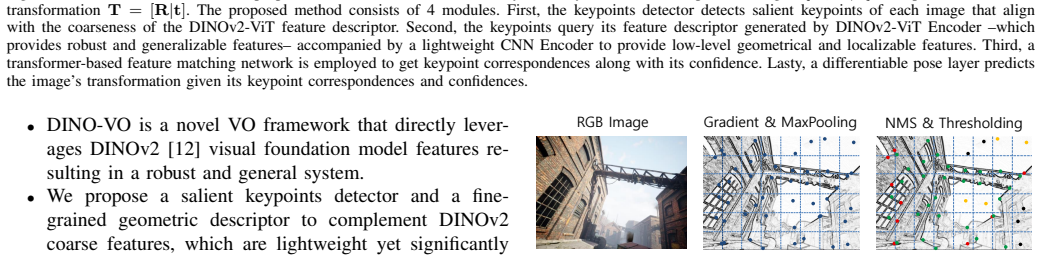
The core discovery is that a frozen DINOv2-ViT encoder can serve as the primary feature descriptor in a sparse, one-stage, frame-to-frame VO pipeline, contrary to the prevailing view that its 14x14 patch-level features are too coarse for localization. The method introduces a salient keypoint detector that selects the strongest-gradient point in each DINOv2 patch grid, applies non-maximum suppression, and then queries both the DINOv2 semantic feature and a pixel-level FinerCNN geometric feature at each keypoint. A LightGlue-style transformer matcher predicts correspondences and confidences, and a confidence-weighted eight-point algorithm regresses the relative pose differentiably. The paper reports that, trained only on TartanAir, DINO-VO achieves the lowest average ATE on KITTI odometry sequences 0-10 among all compared VO/SLAM systems, despite using no multi-frame optimization and no loop closure, and it delivers this at 72 FPS with 0.96 GB GPU memory.
Load-bearing premise
The load-bearing premise is that training only on synthetic TartanAir data, with DINOv2 kept frozen and FinerCNN, the matcher, and the pose layer learned, transfers to real-world domains such as indoor MAV flights and outdoor driving; the paper's generalization claims collapse if the learned layers overfit to TartanAir's statistics.
Editorial extensions
If this is right
- Frame-to-frame monocular VO can inherit robustness and generalization from a frozen visual foundation model, reducing the need to retrain on each new environment.
- Keypoint detectors for patch-based ViT features should align keypoints to the patch grid; this makes one-stage sparse matching with foundation-model features both feasible and real-time.
- Combining coarse semantic features with fine-grained geometric features improves pose accuracy beyond either stream alone, as shown by the ablation study.
- Because DINO-VO is efficient at 72 FPS and under 1 GB of GPU memory, foundation-model-based VO is practical on a single GPU and potentially on embedded hardware.
- The reported KITTI result implies that the remaining gap to multi-frame SLAM methods is not primarily feature quality; adding bundle adjustment or loop closure on top of DINO-VO's frontend should yield further gains.
Reading between the lines
- An untested implication is that freezing DINOv2 while training only the lightweight layers is what preserves its zero-shot transfer; unfreezing the foundation model or adding trainable capacity could erode out-of-domain performance.
- The grid-aligned keypoint principle should transfer to other patch-based vision transformers, suggesting a general recipe for turning any ViT feature map into a sparse matcher.
- Because the pose is up-to-scale and the system uses a keyframe selected by pixel displacement, DINO-VO's accuracy may be sensitive to motion patterns; adaptive keyframe selection based on scene depth or optical flow could extend it to slow or rotation-dominated trajectories.
- Coupling DINO-VO with a metric depth estimator, as the authors mention, would remove the dependence on ground-truth scale and make the frontend usable for metric monocular SLAM.
Editorial analysis
A structured set of objections, weighed in public.
Referee Report
Summary. The paper presents DINO-VO, a monocular feature-based visual odometry system that combines DINOv2 coarse features with a grid-aligned salient keypoint detector, a lightweight CNN encoder (FinerCNN) for fine-grained local features, a LightGlue transformer matcher, and a differentiable confidence-weighted 8-point pose layer. The system is trained on TartanAir and evaluated on TartanAir, EuRoC, and KITTI, with claims of state-of-the-art accuracy among frame-to-frame VO methods, competitive performance against SLAM systems on KITTI, and real-time operation at 72 FPS with under 1 GB GPU memory. Ablations support the design choices for the detector and descriptor combination.
Significance. If the claims hold after a fair evaluation, DINO-VO is a practically valuable contribution: it shows that a visual foundation model can be integrated into a sparse, real-time VO frontend without dense matching, and it reports strong cross-domain generalization from synthetic training to real-world indoor and outdoor sequences. The paper is also commendable for its extensive evaluation across three datasets, its ablation study isolating detector and descriptor contributions, and its explicit acknowledgement of the drift limitation of frame-to-frame estimation. However, the central empirical comparisons currently rest on a protocol mismatch for keyframe selection and ground-truth scale injection, which must be resolved before the headline claims can be accepted.
major comments (3)
- [Section III-F, Tables I-IV] The evaluation protocol used for DINO-VO is not matched by the baselines. The text states that DINO-VO predicts the relative pose to the latest keyframe selected when mean pixel displacement exceeds 24 px and that alternate frames are processed for EuRoC and KITTI. Prior frame-to-frame baselines such as TartanVO, DiffPoseNet, and MAC-VO are compared using their published consecutive-frame results. Since larger temporal baselines make translation estimation easier and reduce drift accumulation, the reported advantages on KITTI and the competitive EuRoC numbers may reflect the input-selection policy rather than the proposed feature and matching design. The paper does not state that baselines were run under the same alternate/keyframe protocol, nor does it report the number of keyframe pairs used per sequence. Please either rerun the comparisons under an identical protocol or report DINO-VO on the same consecutive-frame protocol as the baselines, and state explicitly whether keyframe selection is also applied on TartanAir in Table I.
- [Section III-F and Table IV] The comparison with SLAM systems in Table IV is not on equal terms because DINO-VO uses ground-truth scale. Section III-F says 'we follow [7] to scale the predicted translation with the ground-truth,' while the monocular SLAM systems (ORB-SLAM3, DPVO, DROID-VO, MambaVO) must estimate metric scale from the image stream. Additionally, the baseline numbers in Table IV are taken from [10], whereas DINO-VO is evaluated under its own keyframe protocol. The claim that DINO-VO outperforms multi-frame VO on KITTI therefore is not yet substantiated; please use a common evaluation convention, such as the standard KITTI odometry drift with or without Sim(3) alignment or metric-scale results, and ensure identical input protocols for all methods.
- [Section IV-A and Table I] Training and evaluation splits on TartanAir are not specified. The paper says only that training uses the TartanAir dataset, and Table I evaluates on TartanAir MH sequences, without stating whether the MH environments or the specific sequences were included in training. If MH is in the training distribution, the TartanAir results are in-domain and should be labeled as such; if it is held out, the split should be described. This matters for the interpretation of the TartanAir portion of the frame-to-frame claim.
minor comments (6)
- [Eq. (4)] The cross-attention expression in Eq. (4) contains a garbled term ('kT_i^T kS_j_! = aST_ji'); please rewrite the formula so that the notation is unambiguous.
- [Table II] The EuRoC sequence labels 'V102' and 'V202' each appear twice; the labels should be corrected, likely to V103 and V203.
- [Tables III and IV] The captions use 'Assessment' where 'Assessment' is intended; please correct the spelling.
- [Section IV-A] The training description says the pose loss weight increases by '1.5 × 10^-4 increment per step'; please specify whether this is per training step or per epoch, and state the total number of steps or epochs used.
- [Section IV-B] All reported metrics appear to be single-run evaluations without error bars. Please state whether the system is deterministic or report variance across multiple runs, especially for the cross-domain results.
- [Section III-C] There is a typo, 'indexed by by Kt+1'; please correct it.
Circularity Check
No circularity found: DINO-VO's generalization results are held-out evaluations, and no load-bearing step reduces to a fitted constant or a self-citation chain.
full rationale
DINO-VO is an empirical systems paper whose central claims are benchmark results on TartanAir (in-domain), EuRoC and KITTI (held-out), plus runtime and memory measurements. No step of the derivation defines a predicted quantity in terms of the target quantity: the keypoint detector, DINOv2 plus FinerCNN descriptor, LightGlue matcher, and weighted-eight-point pose layer are trained with matching and pose losses against TartanAir ground truth, then evaluated on sequences not used for training. The only ground-truth information injected at evaluation is the monocular scale alignment: 'Since DINO-VO only predicts up-to-scale transformation, we follow [7] to scale the predicted translation t ∈ R3 with the ground-truth.' This is a standard evaluation convention for monocular VO and does not determine translation direction, rotation, or trajectory shape, which are the quantities that ATE and drift comparisons reward. The keyframe and alternate-frame protocol in Sec. III-F is a possible fairness caveat for the KITTI and EuRoC comparisons, because the paper does not state that baselines used the same protocol, but it is not a circular reduction: the pose estimates are still predictions on selected inputs, not fitted values of the reported errors. There are no author self-citations; DINOv2, LightGlue, and the differentiable pose layer are external, independently published components. The only fitted scalar is the scale alignment, and the paper explicitly disclaims metric scale. Therefore the derivation is self-contained with respect to circularity.
Assumptions & free parameters
free parameters (5)
- Keyframe selection displacement threshold =
24 px
- Top-k keypoints =
512
- NMS radius rNMS =
8
- Gradient magnitude threshold =
0.01
- Pose loss weights (lambda_t, lambda_r, lambda_p) =
lambda_t=400, lambda_r=1/80, lambda_p from 0 to 0.9
assumptions (4)
- standard math The confidence-weighted eight-point algorithm yields an accurate relative pose from correspondences and confidences
- domain assumption DINOv2 features, despite being coarse, provide robust semantic cues that improve matching in challenging conditions, and combining them with fine-grained CNN features preserves localizability
- domain assumption Training on TartanAir's synthetic images with ground-truth depth and pose is sufficient to learn matching and pose estimation that transfers to real-world datasets
- ad hoc to paper Selecting keyframes based on mean pixel displacement greater than 24px avoids degenerate configurations for the 8-point algorithm
Cite this review
Pith. "Pith review of DINO-VO: A Feature-based Visual Odometry Leveraging a Visual Foundation Model." pith.science (2026). https://pith.science/paper/67Y4HO7K
@misc{pith2026250713145,
  author       = {Pith},
  title        = {Pith review of: DINO-VO: A Feature-based Visual Odometry Leveraging a Visual Foundation Model},
  year         = {2026},
  howpublished = {\url{https://pith.science/paper/67Y4HO7K}},
  note         = {Machine review of arXiv:2507.13145}
}
read the original abstract
Learning-based monocular visual odometry (VO) poses robustness, generalization, and efficiency challenges in robotics. Recent advances in visual foundation models, such as DINOv2, have improved robustness and generalization in various vision tasks, yet their integration in VO remains limited due to coarse feature granularity. In this paper, we present DINO-VO, a feature-based VO system leveraging DINOv2 visual foundation model for its sparse feature matching. To address the integration challenge, we propose a salient keypoints detector tailored to DINOv2's coarse features. Furthermore, we complement DINOv2's robust-semantic features with fine-grained geometric features, resulting in more localizable representations. Finally, a transformer-based matcher and differentiable pose estimation layer enable precise camera motion estimation by learning good matches. Against prior detector-descriptor networks like SuperPoint, DINO-VO demonstrates greater robustness in challenging environments. Furthermore, we show superior accuracy and generalization of the proposed feature descriptors against standalone DINOv2 coarse features. DINO-VO outperforms prior frame-to-frame VO methods on the TartanAir and KITTI datasets and is competitive on EuRoC dataset, while running efficiently at 72 FPS with less than 1GB of memory usage on a single GPU. Moreover, it performs competitively against Visual SLAM systems on outdoor driving scenarios, showcasing its generalization capabilities.
Figures


Figures from the paper (2 more)


Reference graph
Works this paper leans on
-
[7]
Tartanvo: A generalizable learning- based vo,
W. Wang, Y . Hu, and S. Scherer, “Tartanvo: A generalizable learning- based vo,” in Conference on Robot Learning , pp. 1761–1772, PMLR, 2021
work page 2021
-
[10]
L. Lipson, Z. Teed, and J. Deng, “Deep Patch Visual SLAM,” in European Conference on Computer Vision , 2024
work page 2024
-
[1]
Orb-slam3: An accurate open-source library for visual, visual– inertial, and multimap slam,
C. Campos, R. Elvira, J. J. G. Rodr ´ıguez, J. M. Montiel, and J. D. Tard´os, “Orb-slam3: An accurate open-source library for visual, visual– inertial, and multimap slam,” IEEE Transactions on Robotics , vol. 37, no. 6, pp. 1874–1890, 2021
work page 2021
-
[2]
J. Engel, V . Koltun, and D. Cremers, “Direct sparse odometry,” IEEE transactions on pattern analysis and machine intelligence , vol. 40, no. 3, pp. 611–625, 2017
work page 2017
-
[3]
Gcnv2: Efficient correspondence prediction for real-time slam,
J. Tang, L. Ericson, J. Folkesson, and P. Jensfelt, “Gcnv2: Efficient correspondence prediction for real-time slam,” IEEE Robotics and Automation Letters, vol. 4, no. 4, pp. 3505–3512, 2019
work page 2019
-
[4]
Semantically guided feature matching for visual slam,
O. Ilter, I. Armeni, M. Pollefeys, and D. Barath, “Semantically guided feature matching for visual slam,” in 2024 IEEE International Con- ference on Robotics and Automation (ICRA) , pp. 12013–12019, IEEE, 2024
work page 2024
-
[5]
Deepvo: Towards end-to- end visual odometry with deep recurrent convolutional neural networks,
S. Wang, R. Clark, H. Wen, and N. Trigoni, “Deepvo: Towards end-to- end visual odometry with deep recurrent convolutional neural networks,” in 2017 IEEE international conference on robotics and automation (ICRA), pp. 2043–2050, IEEE, 2017
work page 2017
-
[6]
Deepv2d: Video to depth with differentiable structure from motion,
Z. Teed and J. Deng, “Deepv2d: Video to depth with differentiable structure from motion,” in 8th International Conference on Learning Representations, ICLR 2020 , 2020
work page 2020
Show all 42 references
-
[8]
Droid-slam: Deep visual slam for monocular, stereo, and rgb-d cameras,
Z. Teed and J. Deng, “Droid-slam: Deep visual slam for monocular, stereo, and rgb-d cameras,” Advances in neural information processing systems, vol. 34, pp. 16558–16569, 2021
2021
-
[9]
Deep patch visual odometry,
Z. Teed, L. Lipson, and J. Deng, “Deep patch visual odometry,” Advances in Neural Information Processing Systems , vol. 36, 2024
2024
-
[11]
Emerging properties in self-supervised vision transformers,
M. Caron, H. Touvron, I. Misra, H. J ´egou, J. Mairal, P. Bojanowski, and A. Joulin, “Emerging properties in self-supervised vision transformers,” in Proceedings of the International Conference on Computer Vision (ICCV), 2021
2021
-
[12]
DINOv2: Learning robust visual features without supervision,
M. Oquab, T. Darcet, T. Moutakanni, H. V . V o, M. Szafraniec, V . Khali- dov, P. Fernandez, D. HAZIZA, F. Massa, A. El-Nouby, M. Assran, N. Ballas, W. Galuba, R. Howes, P.-Y . Huang, S.-W. Li, I. Misra, M. Rabbat, V . Sharma, G. Synnaeve, H. Xu, H. Jegou, J. Mairal, P. Labatu...
2024
-
[13]
An image is worth 16x16 words: Trans- formers for image recognition at scale,
A. Dosovitskiy, L. Beyer, A. Kolesnikov, D. Weissenborn, X. Zhai, T. Unterthiner, M. Dehghani, M. Minderer, G. Heigold, S. Gelly, J. Uszkoreit, and N. Houlsby, “An image is worth 16x16 words: Trans- formers for image recognition at scale,” in International Conference on Learni...
2021
-
[14]
Depth anything: Unleashing the power of large-scale unlabeled data,
L. Yang, B. Kang, Z. Huang, X. Xu, J. Feng, and H. Zhao, “Depth anything: Unleashing the power of large-scale unlabeled data,” in Proceedings of the IEEE/CVF Conference on Computer Vision and Pattern Recognition, pp. 10371–10381, 2024
2024
-
[15]
Roma: Robust dense feature matching,
J. Edstedt, Q. Sun, G. B ¨okman, M. Wadenb¨ack, and M. Felsberg, “Roma: Robust dense feature matching,” in Proceedings of the IEEE/CVF Conference on Computer Vision and Pattern Recognition , pp. 19790– 19800, 2024
2024
-
[16]
Omniglue: Generalizable feature matching with foundation model guidance,
H. Jiang, A. Karpur, B. Cao, Q. Huang, and A. Araujo, “Omniglue: Generalizable feature matching with foundation model guidance,” in Proceedings of the IEEE/CVF Conference on Computer Vision and Pattern Recognition, pp. 19865–19875, 2024
2024
-
[17]
Dino-tracker: Taming dino for self-supervised point tracking in a single video,
N. Tumanyan, A. Singer, S. Bagon, and T. Dekel, “Dino-tracker: Taming dino for self-supervised point tracking in a single video,” 2024
2024
-
[18]
Anyloc: Towards universal visual place recognition,
N. Keetha, A. Mishra, J. Karhade, K. M. Jatavallabhula, S. Scherer, M. Krishna, and S. Garg, “Anyloc: Towards universal visual place recognition,” IEEE Robotics and Automation Letters , 2023
2023
-
[19]
Lightglue: Local feature matching at light speed,
P. Lindenberger, P.-E. Sarlin, and M. Pollefeys, “Lightglue: Local feature matching at light speed,” in Proceedings of the IEEE/CVF International Conference on Computer Vision , pp. 17627–17638, 2023
2023
-
[20]
Efficient loftr: Semi- dense local feature matching with sparse-like speed,
Y . Wang, X. He, S. Peng, D. Tan, and X. Zhou, “Efficient loftr: Semi- dense local feature matching with sparse-like speed,” arXiv preprint arXiv:2403.04765, 2024
2024 arXiv
-
[21]
End2end multi-view feature matching with differentiable pose optimization,
B. Roessle and M. Nießner, “End2end multi-view feature matching with differentiable pose optimization,” in Proceedings of the IEEE/CVF International Conference on Computer Vision , pp. 477–487, 2023
2023
-
[22]
D3vo: Deep depth, deep pose and deep uncertainty for monocular visual odometry,
N. Yang, L. v. Stumberg, R. Wang, and D. Cremers, “D3vo: Deep depth, deep pose and deep uncertainty for monocular visual odometry,” in Proceedings of the IEEE/CVF conference on computer vision and pattern recognition, pp. 1281–1292, 2020
2020
-
[23]
islam: Imperative slam,
T. Fu, S. Su, Y . Lu, and C. Wang, “islam: Imperative slam,” IEEE Robotics and Automation Letters , 2024
2024
-
[24]
Diffposenet: Direct differentiable camera pose estimation,
C. M. Parameshwara, G. Hari, C. Ferm ¨uller, N. J. Sanket, and Y . Aloi- monos, “Diffposenet: Direct differentiable camera pose estimation,” in Proceedings of the IEEE/CVF Conference on Computer Vision and Pattern Recognition, pp. 6845–6854, 2022
2022
-
[25]
Xvo: Generalized visual odometry via cross-modal self-training,
L. Lai, Z. Shangguan, J. Zhang, and E. Ohn-Bar, “Xvo: Generalized visual odometry via cross-modal self-training,” in Proceedings of the IEEE/CVF International Conference on Computer Vision , pp. 10094– 10105, 2023
2023
-
[26]
Raft: Recurrent all-pairs field transforms for opti- cal flow,
Z. Teed and J. Deng, “Raft: Recurrent all-pairs field transforms for opti- cal flow,” in Computer Vision–ECCV 2020: 16th European Conference, Glasgow, UK, August 23–28, 2020, Proceedings, Part II 16 , pp. 402– 419, Springer, 2020
2020
-
[27]
Mambavo: Deep visual odometry based on sequential matching refinement and training smoothing,
S. Wang, W. Li, Y . Wang, Z. Fan, Z. Huang, X. Cai, J. Zhao, and D. Li, “Mambavo: Deep visual odometry based on sequential matching refinement and training smoothing,” in Proceedings of the Computer Vision and Pattern Recognition Conference (CVPR) , pp. 1252–1262, June 2025
2025
-
[28]
Superpoint: Self- supervised interest point detection and description,
D. DeTone, T. Malisiewicz, and A. Rabinovich, “Superpoint: Self- supervised interest point detection and description,” in Proceedings of the IEEE conference on computer vision and pattern recognition workshops, pp. 224–236, 2018
2018
-
[29]
Xfeat: Accelerated features for lightweight image matching,
G. Potje, F. Cadar, A. Araujo, R. Martins, and E. R. Nascimento, “Xfeat: Accelerated features for lightweight image matching,” in IEEE/CVF Conference on Computer Vision and Pattern Recognition (CVPR) , 2024
2024
-
[30]
Superglue: Learning feature matching with graph neural networks,
P.-E. Sarlin, D. DeTone, T. Malisiewicz, and A. Rabinovich, “Superglue: Learning feature matching with graph neural networks,” in Proceedings of the IEEE/CVF conference on computer vision and pattern recognition , pp. 4938–4947, 2020
2020
-
[31]
Roformer: En- hanced transformer with rotary position embedding,
J. Su, M. Ahmed, Y . Lu, S. Pan, W. Bo, and Y . Liu, “Roformer: En- hanced transformer with rotary position embedding,” Neurocomputing, vol. 568, p. 127063, 2024
2024
-
[32]
Hartley and A
R. Hartley and A. Zisserman, Multiple view geometry in computer vision . Cambridge university press, 2003
2003
-
[33]
Visual odometry revisited: What should be learnt?,
H. Zhan, C. S. Weerasekera, J.-W. Bian, and I. Reid, “Visual odometry revisited: What should be learnt?,” in 2020 IEEE International Confer- ence on Robotics and Automation (ICRA) , pp. 4203–4210, 2020
2020
-
[34]
Tartanair: A dataset to push the limits of visual slam,
W. Wang, D. Zhu, X. Wang, Y . Hu, Y . Qiu, C. Wang, Y . Hu, A. Kapoor, and S. Scherer, “Tartanair: A dataset to push the limits of visual slam,” in 2020 IEEE/RSJ International Conference on Intelligent Robots and Systems (IROS), pp. 4909–4916, IEEE, 2020
2020
-
[35]
Vision meets robotics: The kitti dataset,
A. Geiger, P. Lenz, C. Stiller, and R. Urtasun, “Vision meets robotics: The kitti dataset,” The International Journal of Robotics Research , vol. 32, no. 11, pp. 1231–1237, 2013
2013
-
[36]
Svo: Semidirect visual odometry for monocular and multicamera sys- tems,
C. Forster, Z. Zhang, M. Gassner, M. Werlberger, and D. Scaramuzza, “Svo: Semidirect visual odometry for monocular and multicamera sys- tems,” IEEE Transactions on Robotics , vol. 33, no. 2, pp. 249–265, 2016
2016
-
[37]
Mac-vo: Metrics- aware covariance for learning-based stereo visual odometry,
Y . Qiu, Y . Chen, Z. Zhang, W. Wang, and S. Scherer, “Mac-vo: Metrics- aware covariance for learning-based stereo visual odometry,” in 2025 IEEE International Conference on Robotics and Automation (ICRA) , pp. 3803–3814, 2025
2025
-
[38]
A new dense hybrid stereo visual odometry approach,
Z. Liu, E. Malis, and P. Martinet, “A new dense hybrid stereo visual odometry approach,” in 2022 IEEE/RSJ International Conference on Intelligent Robots and Systems (IROS) , pp. 6998–7003, 2022
2022
-
[39]
Dualrefine: Self- supervised depth and pose estimation through iterative epipolar sampling and refinement toward equilibrium,
A. Bangunharcana, A. Magd, and K.-S. Kim, “Dualrefine: Self- supervised depth and pose estimation through iterative epipolar sampling and refinement toward equilibrium,” in Proceedings of the IEEE/CVF Conference on Computer Vision and Pattern Recognition (CVPR) , pp. 726–738, ...
2023
-
[40]
Adaptive learning for hybrid visual odometry,
Z. Liu, E. Malis, and P. Martinet, “Adaptive learning for hybrid visual odometry,” IEEE Robotics and Automation Letters , vol. 9, no. 8, pp. 7341–7348, 2024
2024
-
[41]
Ldso: Direct sparse odometry with loop closure,
X. Gao, R. Wang, N. Demmel, and D. Cremers, “Ldso: Direct sparse odometry with loop closure,” in 2018 IEEE/RSJ International Confer- ence on Intelligent Robots and Systems (IROS) , pp. 2198–2204, IEEE, 2018
2018
-
[42]
imatching: Imperative correspondence learning,
Z. Zhan, D. Gao, Y .-J. Lin, Y . Xia, and C. Wang, “imatching: Imperative correspondence learning,” in European Conference on Computer Vision , pp. 183–200, Springer, 2024
2024
Reviewed August 6, 2026 · model on record in the stance chip above.
Discussion (0). Continue with ORCID to comment.