REVIEW 4 major objections 5 minor 1 cited by
Improving Multislice Electron Ptychography with a Generative Prior
T0 review · 4 major / 5 minor · reviewed 2026-08-15 · deepseek-v4-flash
Pith's one-line read A diffusion model trained on known crystal structures acts as a generative prior for multislice electron ptychography, lifting 3D reconstruction fidelity by about 90% in SSIM on simulated volumes.
desk verdict A plausible diffusion-prior method for multislice electron ptychography with a genuinely useful annealing schedule, but the headline SSIM gain is likely inflated by an in-distribution test set. read the letter →
The pith
A machine-rendered reading of the paper's core claim, the machinery that carries it, and where it could break.
The reading
What carries the argument
The load-bearing mechanism is diffusion posterior sampling: at each sampling step the network produces a clean-data estimate $x_\theta$, the differentiable multislice forward model maps it to diffraction patterns, and the latent is corrected with the gradient of the data-fidelity term $\|f(x_\theta)-y\|^2$, while the diffusion network supplies the prior score. The critical domain adjustment is the shifted-sigmoid guidance schedule, $g(\lambda_t)\propto\mathrm{sigmoid}(4-\lambda_t)^{1/2}$, which keeps physical guidance strong early and anneals it toward zero; the paper shows that the conventional schedule collapses depth slices. The prior itself is a 3D UNet with anisotropic two-stage resampling and a log-SNR loss weighting centered at $\lambda_t=-7$, which the paper finds necessary for generating periodic crystals.
What would settle it
Re-run the 300-volume evaluation with a train/test split that guarantees no test material or close structural relative appears in training, for example by splitting on space group or chemical composition, or apply the method to experimental 4D-STEM data with independently verified atomic structures; if the SSIM gains shrink to baseline levels or depth slices remain wrong, the prior's advantage is memorization rather than generalization.
Extended reading notes
Core claim
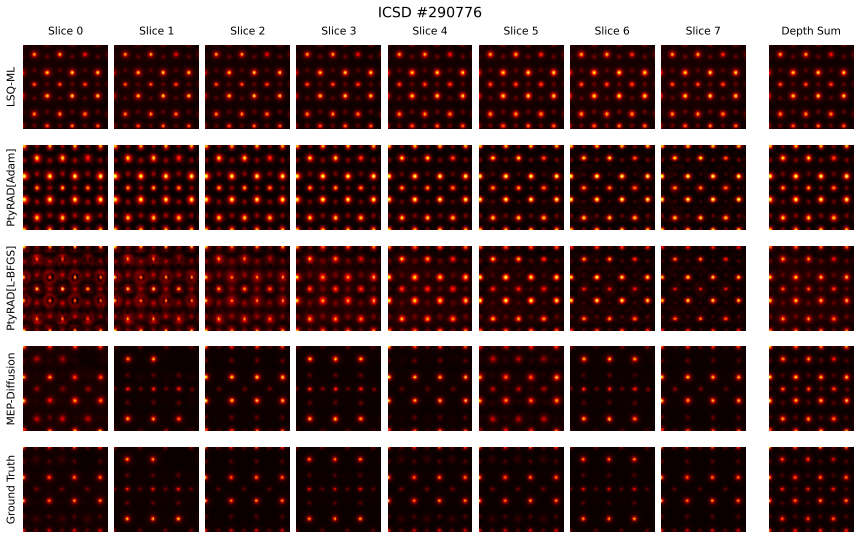
The central claim is that a diffusion prior over crystal structures, trained on roughly 211,000 filtered entries from a large crystallographic database rendered into about 633,000 volumetric samples, can be inserted into any differentiable multislice ptychography solver through diffusion posterior sampling. The discovery, as the paper states it, is that the prior breaks the depth degeneracy of the inverse problem: baseline methods return nearly uniform slices, while MEP-Diffusion returns distinct, mostly correct depth slices, with depth-sum SSIM of 0.8852 versus 0.4279 and 0.7096. A second domain-specific finding is that the standard alpha-proportional guidance schedule fails for this problem and must be replaced by a shifted-sigmoid schedule that anneals the physical-model gradient toward zero as sampling progresses; without that annealing, physical guidance washes out atomic structure and collapses the depth dimension.
Load-bearing premise
The reported SSIM gains are measured on simulated diffraction patterns generated from the same crystal-structure database that trained the generative prior, so the method's advantage over baselines has not been shown for structures or experimental conditions outside that training distribution.
Editorial extensions
If this is right
- If the reported 90.50% SSIM gain holds beyond the simulated test set, MEP-Diffusion would let laboratories recover depth-resolved atomic arrangements from existing 4D-STEM instruments without hardware changes.
- Because the prior is injected at inference time, any existing differentiable MEP solver can be upgraded without retraining the solver, and users can trade sampling steps against quality; the paper reports that 100 steps already beat both baselines.
- The shifted-sigmoid annealing schedule offers a recipe for other scientific inverse problems with imperfect forward models: keep physical gradients early to set global structure, then let the learned prior refine local details.
- Depth-summed metrics improve more than full-volume metrics, so the method's most immediate practical payoff may be accurate projection maps, while full 3D volume recovery still carries residual depth errors.
- Reconstructions run at a flexible quality-to-time trade-off, allowing rapid assessment at fewer steps and higher-fidelity reconstruction when computation time is available.
Reading between the lines
- A direct follow-up would split training and test data by chemistry or space group to test whether the prior generalizes to unseen material families or is partly recalling training structures; the paper does not report such a split.
- Because the paper notes slice misordering as a failure mode, evaluating with a permutation-invariant depth metric would separate correct slices in wrong order from wrong slice content.
- The prior is trained on small-cell crystals with lattice constants under 20 angstroms and three fixed orientations, so extending it to defects, interfaces, larger cells, or amorphous regions is an open test rather than an established capability.
- If generalized, the same diffusion-posterior-sampling machinery could be retrained on simulated structures that include vacancies and defects, potentially enabling dose-sensitive materials work at lower electron doses.
Signed reviews
Editorial analysis
A structured set of objections, weighed in public.
Referee Report
Summary. The manuscript proposes MEP-Diffusion, a denoising diffusion model trained on roughly 211,000 ICSD crystal structures rendered with abTEM, and combines it with multislice electron ptychography through diffusion posterior sampling (DPS). The authors introduce a noise-weighted training objective centered at logSNR -7, a linear logSNR sampling schedule, and a 'shifted sigmoid' guidance schedule that anneals the physical-model gradient during sampling. On 300 simulated test volumes, MEP-Diffusion is reported to outperform LSQ-ML and PtyRAD baselines in PSNR and SSIM, with the abstract highlighting a 90.50% SSIM improvement. The paper also includes an ablation of the guidance schedule, wall-clock time comparisons, and qualitative depth-slice reconstructions.
Significance. If the reconstruction gains survive an out-of-distribution test and forward-model consistency checks, the contribution is significant: it demonstrates a practical recipe for combining a strong periodic-structure prior with a differentiable physical forward model, addresses a known depth-ambiguity failure mode, and offers a quality-time trade-off. The paper's strengths include the clean DPS formulation, the controlled ablation in Table 2 with paired bootstrap significance, the use of an open-source reconstruction package for baselines, and an unusually candid limitations section. However, the current evaluation is entirely simulated and in-distribution with respect to the training database, so the significance is conditional on additional evidence.
major comments (4)
- [Section 4, Dataset Preparation; Table 1] The central claim of a 90.50% SSIM improvement rests on a test set drawn from the same ICSD database used to train the prior, and the paper reports no deduplication between training and test materials. After filtering, the training pool is about 211,000 materials and the test set is 100 materials; a diffusion model can memorize or strongly prefer near-duplicate structures from the same database, so the reported gains may reflect prior familiarity rather than improved inverse-problem solving. Please report the train/test overlap in terms of composition, space group, and structural similarity, and re-evaluate on a held-out set that is disjoint at the level of chemistry and structure, for example by clustering on ICSD collection codes or by training on an older ICSD snapshot and testing on newer entries.
- [Section 4, Evaluation; Section 3, guidance expression and Table 4] No data-consistency metric is reported. All quantitative evaluation in Table 1 uses instance-normalized PSNR/SSIM against ground truth; there is no residual such as ||f(x_hat) - y||_2 / ||y||_2. The shifted sigmoid schedule g(lambda_t) = 5000 * sigmoid(4 - lambda_t)^{1/2} reduces the physical-model gradient to zero at the end of sampling, so a high SSIM can coexist with poor reproduction of the measured diffraction patterns. Please report per-sample forward residuals for all methods, and optionally discard or flag samples that fail a data-fidelity threshold.
- [Abstract; Table 1] The headline '90.50% improvement in SSIM' is computed relative to LSQ-ML (0.7523 vs 0.3949), which is the weakest baseline; relative to PtyRAD[L-BFGS] (0.6506) the full-material SSIM improvement is about 15.6%, and against the alpha schedule in Table 2 it is about 15.8%. The abstract should state the baseline and metric precisely, or report improvements over the strongest baseline.
- [Section 6, Limitations; Appendix G, Figures 9 and 10] The paper's own qualitative appendix shows failure modes, including slice misordering, blurred structures, and incorrect local structures, that are not visible in the aggregate SSIM. Since the central claim is enhanced reconstruction quality, please quantify how often MEP-Diffusion produces correct depth ordering and correct local atomic arrangements, for example by reporting the fraction of test volumes that meet a defined structural-accuracy criterion, and report per-slice or per-volume metrics in addition to the mean.
minor comments (5)
- [Table 4] Table 4 lists 'Sampler SDE DPMSolver++'; DPMSolver++ is typically an ODE solver, and the table also gives a PolyExponential schedule with min and max sigma. Please clarify whether the sampling trajectory is the SDE or the probability-flow ODE and how the logSNR sampling range in Section 3 is converted to these sigma values.
- [Figure 4] The curve labeled 'Unweighted Guidance' is not defined; specify the functional form or state that it is g(lambda_t) proportional to alpha_t with a normalization constant.
- [Section 3] The statement that 'traditional image diffusion schedules like the cosine schedule perform poorly' is not supported by an experiment; either add a small ablation or soften the wording.
- [Appendix A] The dataset generation says the filtered set contains 'unique materials'; since ICSD can contain multiple entries for the same nominal compound, please state the deduplication procedure used before the approximately 211,000 count.
- [General] The paper does not include a data/code availability statement; given the proprietary training set, please state explicitly what will be released to enable replication.
Circularity Check
No significant circularity: MEP-Diffusion's derivation is self-contained; the train/test distribution overlap is a generalization risk, not a circularity.
full rationale
The paper's reconstruction pipeline is not circular. The multislice forward model f is the external abTEM physical model, and the DPS guidance follows the standard score-decomposition derivation of Chung et al. The diffusion prior is trained on a split of ICSD materials disjoint from the 100-material test set, so the test volumes are not training inputs in the direct sense. The only self-citation, PtyRAD (ref. [26]), is an open-source implementation used for baselines and gradient computation; it is not load-bearing for the central claim, and it is code-reproduced rather than an unverified assertion. The concern that the prior and test set share the same structure database is a legitimate generalization and external-validity risk, but no equation reduces to its own input and no fitted parameter is renamed as a prediction. Therefore no circular step is exhibited, and the derivation is self-contained against the stated forward model and standard diffusion-posterior-sampling equations.
Assumptions & free parameters
free parameters (4)
- data rescaling constant c =
25
- guidance scale and shift in shifted sigmoid schedule =
g(lambda_t) = 5000 * sigmoid(4 - lambda_t)^(1/2)
- noise-weighting centering =
lambda_t mean -7, std 3
- training logSNR sampling range =
[-13, 4]
assumptions (4)
- domain assumption Multislice forward model with strong phase approximation (O(r) approximately exp(i sigma_e V(r))) accurately maps crystal structure to diffraction patterns.
- domain assumption abTEM simulations of diffraction patterns at 300 kV, 1e6 e-/Å2 dose, without partial coherence or phonons, are representative of real experimental conditions.
- domain assumption Crystal structures in ICSD constitute a prior sufficient for general MEP reconstruction, and test materials do not substantially overlap training materials.
- standard math DPS approximation p(y|z_t) approximately p(y|x_theta(z_t)) is adequate for this highly nonlinear physical model.
Cite this review
Pith. "Pith review of Improving Multislice Electron Ptychography with a Generative Prior." pith.science (2026). https://pith.science/paper/7MDE6OPC
@misc{pith2026250717800,
  author       = {Pith},
  title        = {Pith review of: Improving Multislice Electron Ptychography with a Generative Prior},
  year         = {2026},
  howpublished = {\url{https://pith.science/paper/7MDE6OPC}},
  note         = {Machine review of arXiv:2507.17800}
}
read the original abstract
Multislice electron ptychography (MEP) is an inverse imaging technique that computationally reconstructs the highest-resolution images of atomic crystal structures from diffraction patterns. Available algorithms often solve this inverse problem iteratively but are both time consuming and produce suboptimal solutions due to their ill-posed nature. We develop MEP-Diffusion, a diffusion model trained on a large database of crystal structures specifically for MEP to augment existing iterative solvers. MEP-Diffusion is easily integrated as a generative prior into existing reconstruction methods via Diffusion Posterior Sampling (DPS). We find that this hybrid approach greatly enhances the quality of the reconstructed 3D volumes, achieving a 90.50% improvement in SSIM over existing methods.
Figures


Figures from the paper (7 more)



Forward citations
Cited by 1 Pith paper
-
AtomDiffuser: Time-Aware Degradation Modeling for Drift and Beam Damage in STEM Imaging
AtomDiffuser predicts affine drift and spatially varying beam damage between STEM image frames, trained on synthetic degradation and shown qualitatively on real cryo-STEM data.
Reference graph
Works this paper leans on
-
[1]
RHT Bates and JM Rodenburg. Sub- ˚angstr¨om transmission microscopy: a fourier transform algorithm for microdiffrac- tion plane intensity information. Ultramicroscopy, 31(3): 303–307, 1989. 7
work page 1989
-
[2]
Refik Mert Cam, Junjing Deng, Rajkumar Kettimuthu, Mathew J Cherukara, and Tekin Bicer. Ptychographic image reconstruction from limited data via score-based diffusion models with physics-guidance. arXiv preprint arXiv:2502.18767, 2025. 1
arXiv 2025
-
[3]
Deep-learning electron diffractive imaging
Dillan J Chang, Colum M O’Leary, Cong Su, Daniel A Ja- cobs, Salman Kahn, Alex Zettl, Jim Ciston, Peter Ercius, and Jianwei Miao. Deep-learning electron diffractive imaging. Physical review letters, 130(1):016101, 2023. 7
work page 2023
-
[4]
On the importance of noise scheduling for diffu- sion models
Ting Chen. On the importance of noise scheduling for diffu- sion models. arXiv preprint arXiv:2301.10972, 2023. 4
arXiv 2023
-
[5]
Elec- tron ptychography achieves atomic-resolution limits set by lattice vibrations
Zhen Chen, Yi Jiang, Yu-Tsun Shao, Megan E Holtz, Michal Odstrˇcil, Manuel Guizar-Sicairos, Isabelle Hanke, Steffen Ganschow, Darrell G Schlom, and David A Muller. Elec- tron ptychography achieves atomic-resolution limits set by lattice vibrations. Science, 372(6544):826–831, 2021. 1, 7
work page 2021
-
[6]
Ai-enabled high-resolution scanning coherent diffrac- tion imaging
Mathew J Cherukara, Tao Zhou, Youssef Nashed, Pablo Enfedaque, Alex Hexemer, Ross J Harder, and Martin V Holt. Ai-enabled high-resolution scanning coherent diffrac- tion imaging. Applied Physics Letters, 117(4), 2020. 7
work page 2020
-
[7]
Diffusion pos- terior sampling for general noisy inverse problems
Hyungjin Chung, Jeongsol Kim, Michael Thompson Mc- cann, Marc Louis Klasky, and Jong Chul Ye. Diffusion pos- terior sampling for general noisy inverse problems. In The Eleventh International Conference on Learning Representa- tions, 2022. 1, 3, 4, 7
work page 2022
-
[8]
Improving diffusion models for inverse prob- lems using manifold constraints
Hyungjin Chung, Byeongsu Sim, Dohoon Ryu, and Jong Chul Ye. Improving diffusion models for inverse prob- lems using manifold constraints. In Advances in Neural In- formation Processing Systems, pages 25683–25696. Curran Associates, Inc., 2022. 7
work page 2022
Show all 57 references
-
[9]
The 4d camera: an 87 khz direct electron detector for scan- ning/transmission electron microscopy
Peter Ercius, Ian J Johnson, Philipp Pelz, Benjamin H Sav- itzky, Lauren Hughes, Hamish G Brown, Steven E Zeltmann, Shang-Lin Hsu, Cassio CS Pedroso, Bruce E Cohen, et al. The 4d camera: an 87 khz direct electron detector for scan- ning/transmission electron microscopy. Micros...
2024
-
[10]
Neu- ral differentiable modeling with diffusion-based super- resolution for two-dimensional spatiotemporal turbulence
Xiantao Fan, Deepak Akhare, and Jian-Xun Wang. Neu- ral differentiable modeling with diffusion-based super- resolution for two-dimensional spatiotemporal turbulence. Computer Methods in Applied Mechanics and Engineering , 433:117478, 2025. 7
2025
-
[11]
Feng, Jamie Smith, Michael Rubinstein, Hui- wen Chang, Katherine L
Berthy T. Feng, Jamie Smith, Michael Rubinstein, Hui- wen Chang, Katherine L. Bouman, and William T. Free- man. Score-based diffusion models as principled priors for inverse imaging. In Proceedings of the IEEE/CVF In- ternational Conference on Computer Vision (ICCV) , pages 10...
2023
-
[12]
Phase object reconstruction for 4d-stem using deep learning
Thomas Friedrich, Chu-Ping Yu, Johan Verbeeck, and San- dra Van Aert. Phase object reconstruction for 4d-stem using deep learning. Microscopy and Microanalysis , 29(1):395– 407, 2023. 7
2023
-
[13]
Ptychodv: Vision transformer-based deep un- rolling network for ptychographic image reconstruction
Weijie Gan, Qiuchen Zhai, Michael Thompson McCann, Cristina Garcia Cardona, Ulugbek S Kamilov, and Brendt Wohlberg. Ptychodv: Vision transformer-based deep un- rolling network for ptychographic image reconstruction. IEEE Open Journal of Signal Processing, 2024. 7
2024
-
[14]
Denoising dif- fusion probabilistic models
Jonathan Ho, Ajay Jain, and Pieter Abbeel. Denoising dif- fusion probabilistic models. In Advances in Neural Informa- tion Processing Systems, pages 6840–6851, 2020. 1, 2
2020
-
[15]
Video dif- fusion models
Jonathan Ho, Tim Salimans, Alexey Gritsenko, William Chan, Mohammad Norouzi, and David J Fleet. Video dif- fusion models. Advances in Neural Information Processing Systems, 35:8633–8646, 2022. 4
2022
-
[16]
Physics constrained unsupervised deep learning for rapid, high resolution scanning coherent diffraction reconstruction
Oliver Hoidn, Aashwin Ananda Mishra, and Apurva Mehta. Physics constrained unsupervised deep learning for rapid, high resolution scanning coherent diffraction reconstruction. Scientific Reports, 13(1):22789, 2023. 7
2023
-
[17]
sim- ple diffusion: End-to-end diffusion for high resolution im- ages
Emiel Hoogeboom, Jonathan Heek, and Tim Salimans. sim- ple diffusion: End-to-end diffusion for high resolution im- ages. In International Conference on Machine Learning , pages 13213–13232. PMLR, 2023. 4
2023
-
[18]
Simpler diffusion (sid2): 1.5 fid on imagenet512 with pixel-space diffusion
Emiel Hoogeboom, Thomas Mensink, Jonathan Heek, Kay Lamerigts, Ruiqi Gao, and Tim Salimans. Simpler diffusion (sid2): 1.5 fid on imagenet512 with pixel-space diffusion. arXiv preprint arXiv:2410.19324, 2024. 4
2024 arXiv
-
[19]
Elucidating the design space of diffusion-based generative models
Tero Karras, Miika Aittala, Timo Aila, and Samuli Laine. Elucidating the design space of diffusion-based generative models. In Advances in Neural Information Processing Sys- tems, 2022. 4
2022
-
[20]
Understanding diffusion objectives as the elbo with simple data augmentation
Diederik Kingma and Ruiqi Gao. Understanding diffusion objectives as the elbo with simple data augmentation. Ad- vances in Neural Information Processing Systems, 36, 2024. 2, 3, 4
2024
-
[21]
Adam: A method for stochastic opti- mization
Diederik P Kingma. Adam: A method for stochastic opti- mization. arXiv preprint arXiv:1412.6980, 2014. 6
2014 arXiv
-
[22]
Variational diffusion models
Diederik P Kingma, Tim Salimans, Ben Poole, and Jonathan Ho. Variational diffusion models. In Advances in Neural Information Processing Systems, 2021. 2
2021
-
[23]
Advanced Computing in Electron Mi- croscopy
Earl J Kirkland. Advanced Computing in Electron Mi- croscopy. Springer Science & Business Media, 2010. 2
2010
-
[24]
Statistical significance tests for machine translation evaluation
Philipp Koehn. Statistical significance tests for machine translation evaluation. In Proceedings of the 2004 Confer- ence on Empirical Methods in Natural Language Process- ing, pages 388–395, Barcelona, Spain, 2004. Association for Computational Linguistics. 5 9
2004
-
[25]
Electron ptychography reveals a ferroelectricity dominated by anion displacements
Harikrishnan Kp, Ruijuan Xu, Kinnary Patel, Kevin J Crust, Aarushi Khandelwal, Chenyu Zhang, Sergey Prosandeev, Hua Zhou, Yu-Tsun Shao, Laurent Bellaiche, et al. Electron ptychography reveals a ferroelectricity dominated by anion displacements. Nature Materials, pages 1–8, 2025. 1
2025
-
[26]
Ptyrad: A high-performance and flexible ptychographic reconstruction framework with au- tomatic differentiation
Chia-Hao Lee, Steven E Zeltmann, Dasol Yoon, Desheng Ma, and David A Muller. Ptyrad: A high-performance and flexible ptychographic reconstruction framework with au- tomatic differentiation. arXiv preprint arXiv:2505.07814 ,
-
[27]
On the limited memory bfgs method for large scale optimization.Mathematical program- ming, 45(1):503–528, 1989
Dong C Liu and Jorge Nocedal. On the limited memory bfgs method for large scale optimization.Mathematical program- ming, 45(1):503–528, 1989. 6
1989
-
[28]
Dpm-solver: A fast ode solver for dif- fusion probabilistic model sampling in around 10 steps
Cheng Lu, Yuhao Zhou, Fan Bao, Jianfei Chen, Chongxuan Li, and Jun Zhu. Dpm-solver: A fast ode solver for dif- fusion probabilistic model sampling in around 10 steps. In Advances in Neural Information Processing Systems , 2022. 4
2022
-
[29]
Repaint: Inpainting using denoising diffusion probabilistic models
Andreas Lugmayr, Martin Danelljan, Andres Romero, Fisher Yu, Radu Timofte, and Luc Van Gool. Repaint: Inpainting using denoising diffusion probabilistic models. In Proceed- ings of the IEEE/CVF conference on computer vision and pattern recognition, pages 11461–11471, 2022. 7
2022
-
[30]
The abtem code: transmission electron microscopy from first principles
Jacob Madsen and Toma Susi. The abtem code: transmission electron microscopy from first principles. Open Research Europe, 1, 2021. 5
2021
-
[31]
An im- proved ptychographical phase retrieval algorithm for diffrac- tive imaging
Andrew M Maiden and John M Rodenburg. An im- proved ptychographical phase retrieval algorithm for diffrac- tive imaging. Ultramicroscopy, 109(10):1256–1262, 2009. 7
2009
-
[32]
Achieving sub-0.5-angstrom–resolution ptychography in an uncorrected electron microscope
Kayla X Nguyen, Yi Jiang, Chia-Hao Lee, Priti Kharel, Yue Zhang, Arend M van der Zande, and Pinshane Y Huang. Achieving sub-0.5-angstrom–resolution ptychography in an uncorrected electron microscope. Science, 383(6685):865– 870, 2024. 7
2024
-
[33]
Iterative least-squares solver for generalized maximum-likelihood ptychography
Michal Odstr ˇcil, Andreas Menzel, and Manuel Guizar- Sicairos. Iterative least-squares solver for generalized maximum-likelihood ptychography. Optics express, 26(3): 3108–3123, 2018. 6, 7
2018
-
[34]
Very-high dynamic range, 10,000 frames/second pixel array detector for electron microscopy
Hugh T Philipp, Mark W Tate, Katherine S Shanks, Luigi Mele, Maurice Peemen, Pleun Dona, Reinout Hartong, Ger- ard van Veen, Yu-Tsun Shao, Zhen Chen, et al. Very-high dynamic range, 10,000 frames/second pixel array detector for electron microscopy. Microscopy and Microanalysis...
2022
-
[35]
Physics informed deep learning (part i): Data-driven so- lutions of nonlinear partial differential equations
Maziar Raissi, Paris Perdikaris, and George Em Karniadakis. Physics informed deep learning (part i): Data-driven so- lutions of nonlinear partial differential equations. arXiv preprint arXiv:1711.10561, 2017. 7
2017 arXiv
-
[36]
Physics informed deep learning (part ii): Data-driven discov- ery of nonlinear partial differential equations
Maziar Raissi, Paris Perdikaris, and George Em Karniadakis. Physics informed deep learning (part ii): Data-driven discov- ery of nonlinear partial differential equations. arXiv preprint arXiv:1711.10566, 2017
2017 arXiv
-
[37]
Physics-informed neural networks: A deep learning frame- work for solving forward and inverse problems involving nonlinear partial differential equations
Maziar Raissi, Paris Perdikaris, and George E Karniadakis. Physics-informed neural networks: A deep learning frame- work for solving forward and inverse problems involving nonlinear partial differential equations. Journal of Computa- tional Physics, 378:686–707, 2019. 7
2019
-
[38]
Ptychography
John Rodenburg and Andrew Maiden. Ptychography. Springer Handbook of Microscopy, pages 819–904, 2019. 5
2019
-
[39]
Experimen- tal tests on double-resolution coherent imaging via stem
JM Rodenburg, BC McCallum, and PD Nellist. Experimen- tal tests on double-resolution coherent imaging via stem. Ul- tramicroscopy, 48(3):304–314, 1993. 7
1993
-
[40]
Progressive distillation for fast sampling of diffusion models
Tim Salimans and Jonathan Ho. Progressive distillation for fast sampling of diffusion models. In International Confer- ence on Learning Representations, 2022. 2, 3
2022
-
[41]
Deep ptych: Subsampled fourier ptychography using generative priors
Fahad Shamshad, Farwa Abbas, and Ali Ahmed. Deep ptych: Subsampled fourier ptychography using generative priors. In ICASSP 2019-2019 IEEE International Confer- ence on Acoustics, Speech and Signal Processing (ICASSP), pages 7720–7724. IEEE, 2019. 1
2019
-
[42]
Deep unsupervised learning using nonequilibrium thermodynamics
Jascha Sohl-Dickstein, Eric Weiss, Niru Maheswaranathan, and Surya Ganguli. Deep unsupervised learning using nonequilibrium thermodynamics. In International Confer- ence on Machine Learning, pages 2256–2265. PMLR, 2015. 2
2015
-
[43]
Deep unsupervised learning using nonequilibrium thermodynamics
Jascha Sohl-Dickstein, Eric Weiss, Niru Maheswaranathan, and Surya Ganguli. Deep unsupervised learning using nonequilibrium thermodynamics. In Proceedings of the 32nd International Conference on Machine Learning, pages 2256–2265, Lille, France, 2015. PMLR. 1
2015
-
[44]
Denois- ing diffusion implicit models
Jiaming Song, Chenlin Meng, and Stefano Ermon. Denois- ing diffusion implicit models. In International Conference on Learning Representations, 2021. 1
2021
-
[45]
Pseudoinverse-guided diffusion models for inverse problems
Jiaming Song, Arash Vahdat, Morteza Mardani, and Jan Kautz. Pseudoinverse-guided diffusion models for inverse problems. In International Conference on Learning Repre- sentations, 2023. 7
2023
-
[46]
Kingma, Ab- hishek Kumar, Stefano Ermon, and Ben Poole
Yang Song, Jascha Sohl-Dickstein, Diederik P. Kingma, Ab- hishek Kumar, Stefano Ermon, and Ben Poole. Score-based generative modeling through stochastic differential equa- tions. In International Conference on Learning Represen- tations, 2021. 2
2021
-
[47]
Solv- ing inverse problems in medical imaging with score-based generative models
Yang Song, Liyue Shen, Lei Xing, and Stefano Ermon. Solv- ing inverse problems in medical imaging with score-based generative models. In International Conference on Learning Representations, 2022. 7
2022
-
[48]
High dy- namic range pixel array detector for scanning transmission electron microscopy
Mark W Tate, Prafull Purohit, Darol Chamberlain, Kayla X Nguyen, Robert Hovden, Celesta S Chang, Pratiti Deb, Em- rah Turgut, John T Heron, Darrell G Schlom, et al. High dy- namic range pixel array detector for scanning transmission electron microscopy. Microscopy and Microana...
2016
-
[49]
Resolution of vir- tual depth sectioning from four-dimensional scanning trans- mission electron microscopy
EWC Terzoudis-Lumsden, TC Petersen, Hamish G Brown, PM Pelz, C Ophus, and Scott D Findlay. Resolution of vir- tual depth sectioning from four-dimensional scanning trans- mission electron microscopy. Microscopy and Microanaly- sis, 29(4):1409–1421, 2023. 1, 8
2023
-
[50]
Image quality assessment: from error visibility to structural similarity
Zhou Wang, Alan C Bovik, Hamid R Sheikh, and Eero P Si- moncelli. Image quality assessment: from error visibility to structural similarity. IEEE transactions on image processing, 13(4):600–612, 2004. 5
2004
-
[51]
Fourier ptychographic re- construction with denoising diffusion probabilistic models
Kai Wu, An Pan, and Wei Gao. Fourier ptychographic re- construction with denoising diffusion probabilistic models. Optics & Laser Technology, 176:111016, 2024. 1 10
2024
-
[52]
Autophasenn: unsupervised physics-aware deep learning of 3d nanoscale bragg coherent diffraction imaging
Yudong Yao, Henry Chan, Subramanian Sankaranarayanan, Prasanna Balaprakash, Ross J Harder, and Mathew J Cherukara. Autophasenn: unsupervised physics-aware deep learning of 3d nanoscale bragg coherent diffraction imaging. npj Computational Materials, 8(1):124, 2022. 7
2022
-
[53]
Recent developments in the inorganic crystal struc- ture database: theoretical crystal structure data and related features
Dejan Zagorac, H M ¨uller, S Ruehl, J Zagorac, and Silke Rehme. Recent developments in the inorganic crystal struc- ture database: theoretical crystal structure data and related features. Journal of applied crystallography, 52(5):918–925,
-
[54]
Kite: high frame rate, high count rate pixelated electron counting asic for 4d stem applications featuring high-z sen- sor
P Zambon, S Bottinelli, R Schnyder, D Musarra, D Boye, A Dudina, N Lehmann, S De Carlo, M Rissi, C Schulze-Briese, et al. Kite: high frame rate, high count rate pixelated electron counting asic for 4d stem applications featuring high-z sen- sor. Nuclear Instruments and Methods...
2023
-
[55]
Diffcollage: Parallel generation of large content with diffusion models
Qinsheng Zhang, Jiaming Song, Xun Huang, Yongxin Chen, and Ming-Yu Liu. Diffcollage: Parallel generation of large content with diffusion models. In 2023 IEEE/CVF Confer- ence on Computer Vision and Pattern Recognition (CVPR) , pages 10188–10198. IEEE, 2023. 7
2023
-
[56]
Insights into chemical and structural order at planar defects in pb2mgwo6 using multi- slice electron ptychography
Menglin Zhu, Michael Xu, Yu Yun, Liyan Wu, Or Shafir, Colin Gilgenbach, Lane W Martin, Ilya Grinberg, Jonathan E Spanier, and James M LeBeau. Insights into chemical and structural order at planar defects in pb2mgwo6 using multi- slice electron ptychography. ACS nano, 2025. 1 1...
2025
-
[100]
x”-prediction component in the “v
with the voxel sampling rate of (1.6 ˚A, 0.2 ˚A, 0.2 ˚A) along depth, height, and width dimensions. This anisotropic voxel sampling is chosen to match with the electron ptychography resolution because typically the depth resolution is much poorer compared to lateral (height an...
Reviewed August 15, 2026 · model on record in the stance chip above.
Discussion (0). Continue with ORCID to comment.