Attenuation of the ultra-high-energy neutrino flux by dark matter scatterings
Pith reviewed 2026-05-19 00:06 UTC · model grok-4.3
The pith
Neutrino-dark matter scatterings can attenuate ultra-high-energy neutrinos and allow limits on their interaction strength even without knowing the sources.
A machine-rendered reading of the paper's core claim, the machinery that carries it, and where it could break.
Core claim
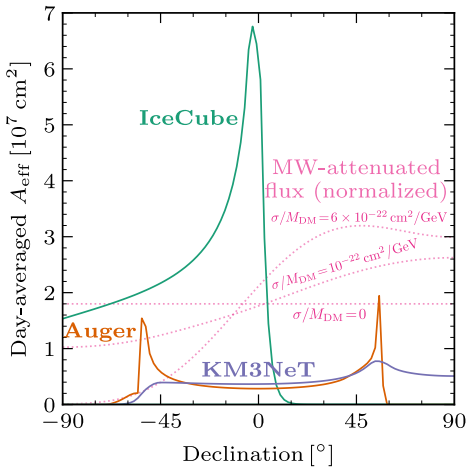
Scatterings of ultra-high-energy neutrinos with dark matter in the intergalactic medium and the Milky Way halo affect the total flux, energy spectrum, and arrival directions of these neutrinos. With mild astrophysical assumptions about dark matter densities, limits on the neutrino-dark matter scattering cross section can be derived even when the neutrino sources remain unknown, as demonstrated using the recent event KM3230213A. Detectors at different latitudes can probe the directional anisotropies induced by scattering in the Milky Way dark matter halo.
What carries the argument
The neutrino-dark matter scattering cross section, which sets the interaction rate that produces flux attenuation, spectral distortion, and directional anisotropies from the Milky Way halo.
If this is right
- Detectors at different Earth latitudes can measure complementary anisotropies caused by neutrinos scattering with Milky Way dark matter.
- Limits on the neutrino-dark matter cross section become possible without precise knowledge of neutrino source locations.
- Both intergalactic and galactic scatterings contribute to changes in the observed energy spectrum and arrival directions.
- The recent KM3230213A event can already be used to derive concrete bounds under standard dark matter density assumptions.
Where Pith is reading between the lines
- Future multi-detector networks could map the dark matter halo shape through neutrino arrival directions if scattering is confirmed.
- The same attenuation logic might apply to other cosmic messengers like high-energy gamma rays if they interact similarly with dark matter.
- Stronger limits would follow from accumulating more ultra-high-energy neutrino events rather than relying on a single detection.
Load-bearing premise
Standard dark matter density profiles hold for the Milky Way halo and enough dark matter exists in the intergalactic medium to cause observable attenuation of the neutrino flux.
What would settle it
Detection of several ultra-high-energy neutrinos showing no reduction in flux, no spectral softening, and no latitude-dependent directional bias that would be expected from scattering with the modeled dark matter distributions.
Figures



read the original abstract
A flux of ultra-high-energy (UHE) neutrinos, produced by astrophysical sources at cosmological distances, is anticipated to exist and reach Earth. In this paper, we investigate the impact on the total flux, energy spectrum, and arrival directions of UHE neutrinos of neutrino-dark matter (DM) scatterings. We study scatterings both in the intergalactic medium and in the Milky Way. We emphasize the complementarity among neutrino detectors at different latitudes, that can probe anisotropies induced by neutrinos scattering with the Milky Way DM halo. We also discuss that, with mild astrophysical assumptions, limits on the DM-$\nu$ scattering cross section can be placed even if the neutrino sources are unknown. Finally, we explore all this phenomenology with the recent UHE neutrino event KM3230213A, and place the corresponding limits on the DM-$\nu$ scattering cross section.
Editorial analysis
A structured set of objections, weighed in public.
Referee Report
Summary. The paper investigates the attenuation of ultra-high-energy (UHE) neutrinos due to scattering with dark matter (DM) in both the intergalactic medium (IGM) and the Milky Way halo. It examines effects on the total flux, energy spectrum, and arrival directions, highlights complementarity between neutrino detectors at different latitudes for detecting halo-induced anisotropies, and claims that limits on the DM-ν scattering cross section can be placed using the recent event KM3230213A even when source locations are unknown, relying on mild astrophysical assumptions about DM density profiles.
Significance. If the calculations hold, the work offers a novel approach to constraining DM-neutrino interactions at ultra-high energies using observed events, independent of specific source identification. The discussion of detector complementarity and application to real data like KM3230213A strengthens its potential impact, though robustness depends on handling of cosmological integrals.
major comments (2)
- [§4] §4 (limits from unknown sources): The optical depth τ = σ ∫ n_DM dl for IGM scattering is computed under a fixed or average source redshift assumption to derive the upper bound on the cross section from KM3230213A. This choice is load-bearing for the central claim that 'mild astrophysical assumptions' suffice without knowing sources; the bound is sensitive to the redshift distribution (e.g., star-formation-rate weighted vs. uniform), and the paper should show explicit marginalization or sensitivity tests to confirm robustness.
- [§3.2] §3.2 (IGM modeling): The mean DM density is fixed by Ω_DM, but the proper distance and clumping factor in the line-of-sight integral still depend on unknown z; without a concrete prior or demonstration that the limit is stable across plausible distributions, the 'parameter-free' or assumption-light character of the bound is not fully established.
minor comments (2)
- [Figure 3] Figure 3 (anisotropy maps): The color scale and latitude dependence could be clarified with explicit labels for detector positions to better illustrate the complementarity claim.
- [Eq. (12)] Eq. (12) (cross-section parametrization): The energy dependence is introduced without a reference to the underlying model; adding a brief justification or citation would improve clarity.
Simulated Author's Rebuttal
We thank the referee for the careful reading and constructive comments on our manuscript. The points raised regarding the sensitivity of the IGM optical depth to source redshift assumptions are well taken, and we address them directly below with plans to strengthen the presentation.
read point-by-point responses
-
Referee: [§4] §4 (limits from unknown sources): The optical depth τ = σ ∫ n_DM dl for IGM scattering is computed under a fixed or average source redshift assumption to derive the upper bound on the cross section from KM3230213A. This choice is load-bearing for the central claim that 'mild astrophysical assumptions' suffice without knowing sources; the bound is sensitive to the redshift distribution (e.g., star-formation-rate weighted vs. uniform), and the paper should show explicit marginalization or sensitivity tests to confirm robustness.
Authors: We agree that the optical depth and resulting cross-section limit depend on the source redshift distribution. Our manuscript employed a representative average redshift to illustrate the bound under mild assumptions without requiring source identification. To address the referee's concern, we will add explicit sensitivity tests in the revised version, comparing the derived limits for a star-formation-rate weighted distribution against a uniform distribution in redshift. These tests will quantify the variation and support the robustness of the central claim. revision: yes
-
Referee: [§3.2] §3.2 (IGM modeling): The mean DM density is fixed by Ω_DM, but the proper distance and clumping factor in the line-of-sight integral still depend on unknown z; without a concrete prior or demonstration that the limit is stable across plausible distributions, the 'parameter-free' or assumption-light character of the bound is not fully established.
Authors: We acknowledge that, although the mean DM density is fixed by Ω_DM, the line-of-sight integral for proper distance introduces a dependence on source redshift z. In the revision we will include a dedicated discussion (or short appendix) demonstrating the stability of the upper limit by evaluating the optical depth across a range of plausible redshifts motivated by UHE neutrino observations. This will make the assumption-light character of the bound more explicit without requiring a full marginalization over an arbitrary prior. revision: yes
Circularity Check
No circularity: limits derived from observed event plus external DM density profiles
full rationale
The paper computes attenuation optical depth τ = σ ∫ n_DM dl using standard Milky Way halo profiles and mean IGM density fixed by Ω_DM, then applies the result to the single observed event KM3230213A to set upper bounds on the DM-ν cross section. These steps rely on external astrophysical inputs and the measured event rather than re-deriving any fitted parameter or self-referential quantity as a prediction. No self-definitional equations, fitted-input predictions, or load-bearing self-citations appear in the derivation chain; the central claim remains independent of its own outputs.
Axiom & Free-Parameter Ledger
free parameters (1)
- DM-neutrino scattering cross section
axioms (2)
- domain assumption Standard Navarro-Frenk-White or similar density profile for Milky Way DM halo
- domain assumption Neutrino sources lie at cosmological distances
Forward citations
Cited by 1 Pith paper
-
Exploring neutrino loss with diffuse astrophysical neutrino fluxes
IceCube diffuse neutrino data constrains neutrino loss from new physics via energy conservation, yielding bounds that vary with attenuation energy dependence and source redshift assumptions while potentially affecting...
Reference graph
Works this paper leans on
-
[1]
The Astrophysics of Ultrahigh Energy Cosmic Rays
K. Kotera and A. V. Olinto,The Astrophysics of Ultrahigh Energy Cosmic Rays,Ann. Rev. Astron. Astrophys.49(2011) 119–153, [1101.4256]
work page internal anchor Pith review Pith/arXiv arXiv 2011
-
[2]
L. A. Anchordoqui,Ultra-High-Energy Cosmic Rays,Phys. Rept.801(2019) 1–93, [1807.09645]
work page internal anchor Pith review Pith/arXiv arXiv 2019
-
[3]
R. J. Wilkinson, C. Boehm, and J. Lesgourgues,Constraining Dark Matter-Neutrino Interactions using the CMB and Large-Scale Structure,JCAP05(2014) 011, [1401.7597]. 15
work page internal anchor Pith review Pith/arXiv arXiv 2014
-
[4]
K. Akita and S. Ando,Constraints on dark matter-neutrino scattering from the Milky-Way satellites and subhalo modeling for dark acoustic oscillations,JCAP11(2023) 037, [2305.01913]
-
[5]
W. Crumrine, E. O. Nadler, R. An, and V. Gluscevic,Dark matter coupled to radiation: Limits from the Milky Way satellites,Phys. Rev. D111(2025), no. 2 023530, [2406.19458]
-
[6]
G. G. Raffelt,Stars as laboratories for fundamental physics: The astrophysics of neutrinos, axions, and other weakly interacting particles. University of Chicago Press, 5, 1996
work page 1996
- [7]
- [8]
- [9]
-
[10]
J. M. Cline, S. Gao, F. Guo, Z. Lin, S. Liu, M. Puel, P. Todd, and T. Xiao,Blazar Constraints on Neutrino-Dark Matter Scattering,Phys. Rev. Lett.130(2023), no. 9 091402, [2209.02713]. [11]KM3NeT Collaboration, S. Aiello et al.,Observation of an ultra-high-energy cosmic neutrino with KM3NeT,Nature638(2025), no. 8050 376–382. [Erratum: Nature 640, E3 (2025)...
-
[11]
Diffusion of Cosmic Rays in Expanding Universe. (I)
V. Berezinsky and A. Z. Gazizov,Diffusion of cosmic rays in expanding universe, Astrophys. J.643(2006) 8–13, [astro-ph/0512090]
work page internal anchor Pith review Pith/arXiv arXiv 2006
-
[12]
Neutrino diagnostics of ultra-high energy cosmic ray protons
M. Ahlers, L. A. Anchordoqui, and S. Sarkar,Neutrino diagnostics of ultra-high energy cosmic ray protons,Phys. Rev. D79(2009) 083009, [0902.3993]. [16]Planck Collaboration, N. Aghanim et al.,Planck 2018 results. VI. Cosmological parameters,Astron. Astrophys.641(2020) A6, [1807.06209]. [Erratum: Astron.Astrophys. 652, C4 (2021)]. 16
work page internal anchor Pith review Pith/arXiv arXiv 2009
-
[13]
E. V. Karukes, M. Benito, F. Iocco, R. Trotta, and A. Geringer-Sameth,A robust estimate of the Milky Way mass from rotation curve data,JCAP05(2020) 033, [1912.04296]. [18]Gravity Collaboration, R. Abuter et al.,A geometric distance measurement to the Galactic center black hole with 0.3% uncertainty,Astron. Astrophys.625(2019) [1904.05721]
-
[14]
J. F. Navarro, C. S. Frenk, and S. D. M. White,The Structure of cold dark matter halos, Astrophys. J.462(1996) 563–575, [astro-ph/9508025]
work page internal anchor Pith review Pith/arXiv arXiv 1996
-
[15]
J. F. Navarro, C. S. Frenk, and S. D. M. White,A Universal density profile from hierarchical clustering,Astrophys. J.490(1997) 493–508, [astro-ph/9611107]
work page internal anchor Pith review Pith/arXiv arXiv 1997
-
[16]
M. Cautun, A. Benitez-Llambay, A. J. Deason, C. S. Frenk, A. Fattahi, F. A. Gómez, R. J. J. Grand, K. A. Oman, J. F. Navarro, and C. M. Simpson,The Milky Way total mass profile as inferred from Gaia DR2,Mon. Not. Roy.Astron. Soc.494(2020), no. 3 4291–4313, [1911.04557]
-
[17]
The Structure of Dark Matter Haloes in Dwarf Galaxies
A. Burkert,The Structure of dark matter halos in dwarf galaxies,Astrophys. J. Lett.447 (1995) L25, [astro-ph/9504041]. [23]KM3NeT, MessMapp Group, Fermi-LAT, Owens Valley Radio Observatory 40-m Telescope Group, SVOM Collaboration, O. Adriani et al.,Characterising Candidate Blazar Counterparts of the Ultra-High-Energy Event KM3-230213A, 2502.08484. [24]Ice...
work page internal anchor Pith review Pith/arXiv arXiv 1995
- [18]
-
[19]
High Energy Neutrinos from Astrophysical Sources: An Upper Bound
E. Waxman and J. N. Bahcall,High-energy neutrinos from astrophysical sources: An Upper bound,Phys. Rev. D59(1999) 023002, [hep-ph/9807282]
work page internal anchor Pith review Pith/arXiv arXiv 1999
-
[20]
J. N. Bahcall and E. Waxman,High-energy astrophysical neutrinos: The Upper bound is robust, Phys. Rev. D64(2001) 023002, [hep-ph/9902383]
work page internal anchor Pith review Pith/arXiv arXiv 2001
-
[21]
L. A. Anchordoqui, J. L. Feng, H. Goldberg, and A. D. Shapere,Neutrino bounds on astrophysical sources and new physics,Phys. Rev. D66(2002) 103002, [hep-ph/0207139]
work page internal anchor Pith review Pith/arXiv arXiv 2002
-
[22]
S. W. Li, P. Machado, D. Naredo-Tuero, and T. Schwemberger,Clash of the Titans: ultra-high energy KM3NeT event versus IceCube data,2502.04508. [30]KM3NeT Collaboration, O. Adriani et al.,Ultrahigh-Energy Event KM3-230213A within the Global Neutrino Landscape,Phys. Rev. X15(2025), no. 3 031016, [2502.08173]. 17
-
[23]
G. J. Feldman and R. D. Cousins,A Unified approach to the classical statistical analysis of small signals,Phys. Rev. D57(1998) 3873–3889, [physics/9711021]
work page internal anchor Pith review Pith/arXiv arXiv 1998
-
[24]
M. Ackermannet al.,High-energy and ultra-high-energy neutrinos: A Snowmass white paper,JHEAp36(2022) 55–110, [2203.08096]
-
[25]
K.-Y. Choi, J. Kim, and C. Rott,Constraining dark matter-neutrino interactions with IceCube-170922A,Phys. Rev. D99(2019), no. 8 083018, [1903.03302]
work page internal anchor Pith review Pith/arXiv arXiv 2019
-
[26]
K. J. Kelly and P. A. N. Machado,Multimessenger Astronomy and New Neutrino Physics, JCAP10(2018) 048, [1808.02889]
work page internal anchor Pith review Pith/arXiv arXiv 2018
- [27]
- [28]
-
[29]
S. L. Glashow,Resonant Scattering of Antineutrinos,Phys. Rev.118(1960) 316–317
work page 1960
-
[30]
R. Alves Batista, A. Dundovic, M. Erdmann, K.-H. Kampert, D. Kuempel, G. Müller, G. Sigl, A. van Vliet, D. Walz, and T. Winchen,CRPropa 3 - a Public Astrophysical Simulation Framework for Propagating Extraterrestrial Ultra-High Energy Particles, JCAP05(2016) 038, [1603.07142]
work page internal anchor Pith review Pith/arXiv arXiv 2016
-
[31]
D. Ehlert, A. van Vliet, F. Oikonomou, and W. Winter,Constraints on the proton fraction of cosmic rays at the highest energies and the consequences for cosmogenic neutrinos and photons,JCAP02(2024) 022, [2304.07321]. [40]KM3NeT Collaboration, O. Adriani et al.,On the Potential Cosmogenic Origin of the Ultra-high-energy Event KM3-230213A,Astrophys. J. Lett...
-
[32]
S. Baker and R. D. Cousins,Clarification of the Use of Chi Square and Likelihood Functions in Fits to Histograms,Nucl. Instrum. Meth.221(1984) 437–442
work page 1984
-
[33]
T. Bertólez-Martínez, G. Herrera, P. Martínez-Miravé, and J. Terol Calvo,The Highest-Energy Neutrino Event Constrains Dark Matter-Neutrino Interactions, 2506.08993
- [34]
-
[35]
T. K. Gaisser, R. Engel, and E. Resconi,Cosmic Rays and Particle Physics:2nd Edition. Cambridge University Press, 6, 2016
work page 2016
-
[36]
S. Palmisano, D. Redigolo, M. Tammaro, and A. Tesi,Exploring ultra-high energy neutrino experiments through the lens of the transport equation,2507.10665
-
[37]
A. M. Dziewonski and D. L. Anderson,Preliminary reference earth model,Phys. Earth Planet. Interiors25(1981) 297–356. 18 [47]Particle Data Group Collaboration, S. Navas et al.,Review of particle physics,Phys. Rev. D110(2024), no. 3 030001
work page 1981
-
[38]
S. I. Dutta, Y. Huang, and M. H. Reno,Tau neutrino propagation and tau energy loss, Phys. Rev. D72(2005) 013005, [hep-ph/0504208]. [49]IceCube Collaboration, M. G. Aartsen et al.,Time-Integrated Neutrino Source Searches with 10 Years of IceCube Data,Phys. Rev. Lett.124(2020), no. 5 051103, [1910.08488]. 19
work page internal anchor Pith review Pith/arXiv arXiv 2005
discussion (0)
Sign in with ORCID, Apple, or X to comment. Anyone can read and Pith papers without signing in.