REVIEW 3 major objections 5 minor 6 references
DynamixSFT: Dynamic Mixture Optimization of Instruction Tuning Collections
T0 review · 3 major / 5 minor · reviewed 2026-08-05 · deepseek-v4-flash
Pith's one-line read This paper claims that a bandit scheduler using a one-step loss-reduction reward can dynamically reweight instruction-tuning datasets, lifting average benchmark performance by up to 2.2% over static mixtures without extra parameters or a va
desk verdict Reasonable dynamic SFT mixture method, but the adaptive reward's contribution is not isolated by a control, and hyperparameter selection on eval plus single runs leave the +2.2% claim under-supported. read the letter →
The pith
A machine-rendered reading of the paper's core claim, the machinery that carries it, and where it could break.
The reading
What carries the argument
The load-bearing pair is the Prior-scaled Boltzmann policy plus the 1-Step Look-ahead reward. The policy (Equation 3) blends the original mixture proportions $p^{(0)}$ with a reward-sharpened softmax $\exp(\beta Q_k)$ and a uniform floor $\gamma/K$, so dynamic weights can drift only as far as the reward justifies while every dataset keeps a nonzero chance. The reward (Equation 4) measures, for each dataset, the average relative loss drop from one temporary gradient step on a fresh mini-batch; this is the signal that tells the scheduler which datasets are currently useful. An exponential moving average (Equation 5) smooths the rewards to handle the non-stationary nature of training.
What would settle it
Direct test: for the 16 Tulu-v2 datasets, compute each dataset's one-step relative loss-reduction reward at the first update and the held-out benchmark change caused by training on that dataset alone; if the rank correlation is not clearly positive, the reward is not tracking final utility. Simpler version: rerun DynamixSFT with per-dataset rewards randomly shuffled or negated; if average benchmark performance still keeps the reported gain, the claimed mechanism is not what is doing the work.
Extended reading notes
Core claim
The paper's central claim is that the right mixture for instruction tuning is a moving target: the optimal proportions change as the model learns, and the model itself can discover them. DynamixSFT defines the sampling probability for dataset $k$ as a convex blend of a prior-scaled softmax and a uniform floor, $p_k = (1-\gamma)\frac{\exp(\beta Q_k)\,p_k^{(0)}}{\sum_j \exp(\beta Q_j)\,p_j^{(0)}} + \gamma/K$, where $p^{(0)}$ is the original dataset distribution, $\beta$ controls exploitation sharpness, $\gamma$ sets a minimum exploration floor, and $Q_k$ is an EMA-smoothed reward estimate. The reward is $r_k = \frac{1}{|B|}\sum_{x\in B} \frac{L_{\mathrm{pre}}(x)-L_{\mathrm{post}}(x)}{L_{\mathr
Load-bearing premise
The load-bearing premise is that a dataset's one-step relative loss reduction on a fresh mini-batch is a faithful proxy for how much that dataset will improve the final benchmark performance; if the most valuable datasets happen to show slower immediate loss drops, the reward signal will steer sampling toward the wrong data.
Editorial extensions
If this is right
- If correct, static, hand-designed mixture recipes in instruction tuning can be replaced by a scheduler that reweights datasets as training proceeds.
- A model can allocate data according to its own current weaknesses, meaning the order and composition of data matter even within a fixed, uncurated collection.
- Because the reward needs only one temporary gradient step, mixture optimization adds only modest compute over naive sampling, so it is feasible in post-training at 1B-3B scale.
- The ablation suggests that the original dataset proportions are a crucial anchor; a uniform starting mixture does not recover the gains even when the same reward updates are applied.
- The entropy-difference variant shows the framework tolerates reward definitions other than loss reduction, so the bandit layer is separable from the choice of utility signal.
Reading between the lines
- A consequence the paper leaves implicit: the one-step loss-reduction reward will tend to favor data the model can already make immediate progress on, so datasets that pay off only after sustained training may be downweighted; on harder or noisier collections this could cap or reverse the gains.
- Because the learned distribution is anchored to the original proportions, the method inherits the strengths and weaknesses of the initial recipe; if the base mixture is badly composed, the bandit can only correct it within the anchor's pull.
- A testable extension would be to compare the one-step loss reward against a leave-one-dataset-out benchmark contribution for each of the 16 datasets; a positive rank correlation would confirm the reward is tracking final utility, while a null or negative correlation would show the gains come from something else.
- The method could naturally be extended from dataset-level arms to instance- or cluster-level arms; the paper itself flags instance-level weighting as open, and the bandit machinery does not depend on the granularity.
Editorial analysis
A structured set of objections, weighed in public.
Referee Report
Summary. The paper proposes DynamixSFT, a dynamic dataset-mixture optimization method for instruction tuning. Datasets are treated as arms in a multi-armed bandit; at each update interval the sampling distribution is recomputed with a Prior-scaled Boltzmann Exploration (Eq. 3) that combines a prior proportional to the original mixture, a uniform floor controlled by gamma, and an exponential-weight reward term. The reward is the relative one-step loss reduction of a virtual gradient step on a fresh mini-batch (Eq. 4), smoothed by an EMA (Eq. 5). The method is evaluated on the Tulu-v2 mixture with LLaMA3.2 1B and Qwen2.5 3B across 10 benchmarks, reporting up to +2.2% and +1.5% average gains over the static full-coverage mixture, and is compared against MultiDDS, MultiUAT, and ablations.
Significance. If the reported gains are real, DynamixSFT is a useful practical contribution: it is lightweight, requires no proxy model or validation-set labels, preserves coverage through the prior anchor and floor, and provides interpretable mixture trajectories. The entropy-reward variant in Figure 4 and the dynamics visualizations are strengths. However, the current empirical support is incomplete in a way that directly affects the central claim: the adaptive reward is never isolated from the static prior-plus-floor component, and hyperparameters appear to be selected on the same evaluation benchmarks. The contribution is a plausible incremental improvement, not yet a fully supported one.
major comments (3)
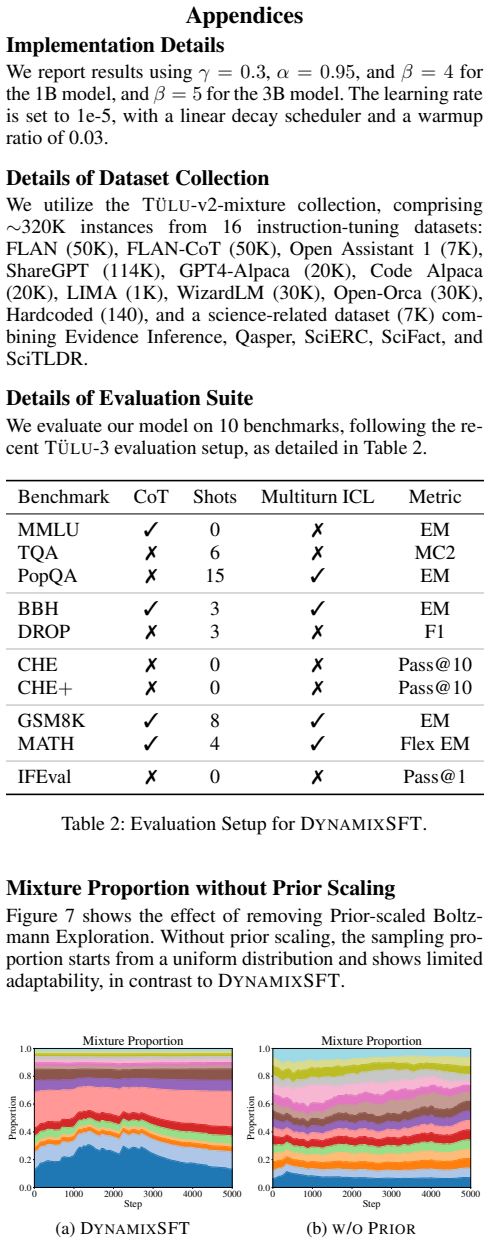
- [§3.2, Eq. (3)–(5)] The paper never isolates the adaptive reward Q. In Eq. (3), the sampling rule contains a large static component: with gamma=0.3, 30% of the mass is uniform, and the remaining mass is anchored to p0 by the prior-scaled Boltzmann term. Since all Q are initialized to zero, the Q=0 policy is p=(1-gamma)*p0 + gamma/K. This static mixture is not reported. The 'W/O PRIOR' row in Table 1 removes p0, not Q, and the text's observation that without the prior the distribution 'remains close to its initial uniform distribution' suggests the reward moves the policy very little. If the Q=0 static mixture matches the 27.40/52.97 averages, the advertised gains come from the prior and floor, not from dynamic reweighting. I request this control for both models; it costs one run each and is necessary to support the central claim of adaptive mixture optimization.
- [§4.2/Table 1; Appendix Implementation Details; Figures 3, 5, 6] The final hyperparameters (gamma=0.3, alpha=0.95, beta=4 for 1B and beta=5 for 3B; T_update=50) appear to be selected from sweeps over update interval, beta, gamma, and alpha on the 1B model's AVG score over the same 10 benchmarks. This is selection on the evaluation set, and no validation split is used anywhere in the pipeline. The reported +2.2%/+1.5% gains are therefore likely optimistic. Additionally, Table 1 reports single runs with no variance or multiple seeds; the within-row differences among Full Coverage, MultiDDS, MultiUAT, and DynamixSFT are often less than 1 point. Please provide a protocol with hyperparameters fixed before seeing the benchmarks, or at least report the full sweep grid and use a hold-out validation set for model selection, and include multiple seeds with standard deviations.
- [§3.2, Eq. (4) and §4.3] The reward definition assumes that one-step relative loss reduction on a fresh mini-batch is a faithful proxy for a dataset's contribution to final benchmark performance. No experiment tests this assumption. The Delta-Entropy comparison in Figure 4 shows the framework is flexible, but it does not validate the proxy. A direct test would be to compute the correlation between per-dataset rewards and per-dataset held-out performance, or to compare DynamixSFT against a reward that is shuffled/randomized while keeping the same sampling rule. Without such evidence, the mechanism driving the gains remains unverified, even if the no-reward control shows the reward has some effect.
minor comments (5)
- [§2 / Appendix Details of Dataset Collection] The text says the collection has 16 datasets and K=16, but the dataset list in §2 contains 15 named entries and the Appendix refers to a combined 'science-related dataset' of five sub-datasets. Figure 2 also shows SciERC_NER and SciERC_Relation separately. Please reconcile the arm count and the dataset list.
- [Figure 2] The panel label for DynamixSFT is corrupted ('D/y.pc/n.pc/a.pc/m.pc/i.pc/x.pcSFT'); it should read DynamixSFT.
- [Figure 4] The caption contains raw LaTeX control sequences ('/uni0394', 'Best baseline /uni0394-Entropy /uni0394-Loss'); the rendering should be fixed.
- [Algorithm 1 / Eq. (4)] Please define the value of epsilon in Eq. (4) and state how the virtual one-step update interacts with the optimizer state and learning-rate schedule; the reward may depend on the current LR and batch composition.
- [§4.1 Baselines] The adaptations of MultiDDS and MultiUAT to instruction tuning are not described (e.g., how validation examples are selected, how gradient similarity is computed across heterogeneous instruction datasets). Add implementation details for reproducibility.
Circularity Check
No circularity found; the reported gains are evaluated on external benchmarks and the reward is an online training signal, not a fitted prediction.
full rationale
DynamixSFT's derivation chain is self-contained and does not reduce to its inputs. The adaptive component is the 1-Step Look-ahead Reward (Eq. 4), which measures relative training-loss reduction on a fresh mini-batch; this is a heuristic reward signal, not a fitted predictor of the 10 benchmark scores. The final comparison (Table 1) is against external benchmarks (MMLU, TruthfulQA, etc.) and against static/dynamic baselines, so the central claim (adaptive mixtures improve average performance) is not definitionally tied to the reward. The prior p(0) and floor gamma/K in Eq. 3 are fixed design choices, not parameters fitted to the evaluation set. The W/O PRIOR ablation and hyperparameter sweeps report behavior on the 1B/3B models but do not define the outcome. The Limitations section honestly restricts claims to small models and dataset-level control. The absence of a no-reward (Q=0) control is a legitimate experimental gap that could affect attribution of the gain to the reward, but that is a question of experimental isolation, not circular derivation. No self-citation is load-bearing; citations to Tulu-2/Tulu-3 are for datasets and evaluation setup, not for the method's correctness. Hence no circular step can be exhibited under the required standard.
Assumptions & free parameters
free parameters (4)
- sharpness factor β =
4 for 1B, 5 for 3B
- uniformity factor γ =
0.3
- EMA smoothing factor α =
0.95
- update interval T_update =
50 steps
assumptions (3)
- domain assumption The original dataset proportions p(0) implicitly reflect each dataset's inherent characteristics and intended contribution to domain coverage.
- domain assumption The 1-step look-ahead relative loss reduction on a fresh mini-batch is a good proxy for dataset utility for final benchmark performance.
- domain assumption The problem is adequately modeled as a non-stationary multi-armed bandit where each dataset is an independent arm with rewards that evolve smoothly under EMA.
Cite this review
Pith. "Pith review of DynamixSFT: Dynamic Mixture Optimization of Instruction Tuning Collections." pith.science (2026). https://pith.science/paper/6RMQDXRD
@misc{pith2026250812116,
  author       = {Pith},
  title        = {Pith review of: DynamixSFT: Dynamic Mixture Optimization of Instruction Tuning Collections},
  year         = {2026},
  howpublished = {\url{https://pith.science/paper/6RMQDXRD}},
  note         = {Machine review of arXiv:2508.12116}
}
read the original abstract
As numerous instruction-tuning datasets continue to emerge, dynamically balancing and optimizing their mixtures has become a critical challenge. To address this, we propose DynamixSFT, a dynamic and automated method for instruction-tuning dataset mixture optimization. We formulate the problem as a multi-armed bandit setup and introduce a Prior-scaled Boltzmann Exploration that softly anchors the updated sampling distribution to the original dataset proportions, thereby preserving the inherent diversity and coverage of the collection. Sampling probabilities are updated using a lightweight 1-Step Look-ahead Reward, reflecting how much the dataset contributes to improving the model's performance at its current state. We demonstrate that DynamixSFT effectively optimizes the Tulu-2-mixture and Tulu-3-mixture collections across 10 benchmarks, while introducing minimal computational overhead over naive sampling. Furthermore, we provide a comprehensive analysis and visualizations to offer deeper insights into the adaptive dynamics of our method.
Figures


Figures from the paper (2 more)

Reference graph
Works this paper leans on
-
[5]
SFTMix: Elevating Language Model Instruction Tun- ing with Mixup Recipe. arXiv:2410.05248. Xie, S. M.; Pham, H.; Dong, X.; Du, N.; Liu, H.; Lu, Y .; Liang, P.; Le, Q. V .; Ma, T.; and Yu, A. W. 2023. DoReMi: Optimizing Data Mixtures Speeds Up Language Model Pre- training. arXiv:2305.10429. Xu, C.; Sun, Q.; Zheng, K.; Geng, X.; Zhao, P.; Feng, J.; Tao, C.;...
arXiv 2023
-
[6]
Dynamic Data Mixing Maximizes Instruction Tuning for Mixture-of-Experts. In NAACL. Appendices Implementation Details We report results using γ = 0.3, α = 0.95, and β = 4 for the 1B model, andβ = 5 for the 3B model. The learning rate is set to 1e-5, with a linear decay scheduler and a warmup ratio of 0.03. Details of Dataset Collection We utilize the T ¨UL...
work page 2000
-
[2019]
Inferring Which Medical Treatments Work from Re- ports of Clinical Trials. In NAACL. Lian, W.; Goodson, B.; Pentland, E.; Cook, A.; V ong, C.; and ”Teknium”. 2023. OpenOrca: An Open Dataset of GPT Augmented FLAN Reasoning Traces. https://huggingface. co/datasets/Open-Orca/OpenOrca. Lin, S.; Hilton, J.; and Evans, O. 2022. TruthfulQA: Mea- suring How Model...
arXiv 2023
-
[2021]
Uncertainty-Aware Balancing for Multilingual and Multi-Domain Neural Machine Translation Training. In EMNLP. Wu, M.; Vu, T.-T.; Qu, L.; and Haf, R. 2024. Mixture-of- Skills: Learning to Optimize Data Usage for Fine-Tuning Large Language Models. In EMNLP. Xiao, Y .; Zhang, S.; Zhou, W.; Ghassemi, M.; and Zhao, S
work page 2024
-
[2023]
OpenAssistant Conversations - Democratizing Large Language Model Alignment. In NeurIPS. Lambert, N.; Morrison, J.; Pyatkin, V .; Huang, S.; Ivison, H.; Brahman, F.; Miranda, L. J. V .; Liu, A.; Dziri, N.; Lyu, S.; Gu, Y .; Malik, S.; Graf, V .; Hwang, J. D.; Yang, J.; Bras, R. L.; Tafjord, O.; Wilhelm, C.; Soldaini, L.; Smith, N. A.; Wang, Y .; Dasigi, P....
arXiv 2025
-
[2025]
Self-Evolving Curriculum for LLM Reasoning. arXiv:2505.14970. Cobbe, K.; Kosaraju, V .; Bavarian, M.; Chen, M.; Jun, H.; Kaiser, L.; Plappert, M.; Tworek, J.; Hilton, J.; Nakano, R.; Hesse, C.; and Schulman, J. 2021. Training Verifiers to Solve Math Word Problems. arXiv:2110.14168. Dasigi, P.; Lo, K.; Beltagy, I.; Cohan, A.; Smith, N. A.; and Gardner, M. ...
arXiv 2021
Reviewed August 5, 2026 · model on record in the stance chip above.
Discussion (0). Sign in to comment.