REVIEW 3 major objections 4 minor 1 cited by
This paper claims that a UAV formation can follow a prescribed path, sense a moving obstacle to centimeter-level accuracy by reconfiguring its shape, and avoid collisions, with the three tasks scheduled conflict-free through a null-space pr
Reviewed by Pith at T0; open to challenge. T0 means a machine referee read the full paper against a public rubric. the ladder, T0–T4 →
A UAV formation follows a path, senses obstacles via ISAC signals, repositions on its virtual circle to lower the CRLB, and fuses avoidance with path-following through null-space priorities.
T0 review reviewed 2026-08-05 challenge →
load-bearing objection Solid integration with one genuinely new variable-formation sensing idea, but the 'conflict-free three-subtask scheduling' claim is not actually simulated. the 3 major comments →
Cooperative Sensing Enhanced UAV Path-Following and Obstacle Avoidance with Variable Formation
The pith
A machine-rendered reading of the paper's core claim, the machinery that carries it, and where it could break.
The reading
Core claim
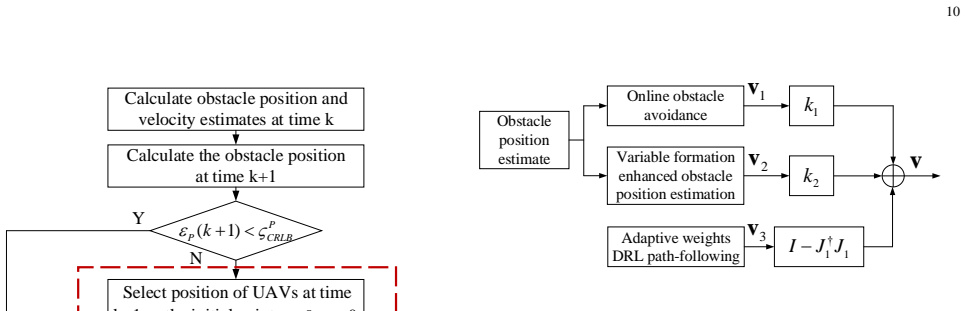
The paper's central claim is that formation geometry itself is a sensing resource. Starting from range and radial-velocity measurements obtained from ISAC signals, the authors derive the Cramér-Rao lower bound for the fused obstacle-position estimate and show that this bound depends on where the UAVs sit on the formation circle. The VFEO algorithm turns that bound into an objective: at time k, if the predicted next-step position error ε_P(k+1) exceeds the threshold ζ_CRLB, it solves a constrained optimization for new UAV positions, subject to staying on the virtual circle, keeping altitude, respecting speed limits, and maintaining safety distances. In simulation the reconfiguration reduces t
What carries the argument
CRLB-based reconfiguration and null-space fusion. The Cramér-Rao lower bound ε_P = sqrt(tr(CRLB_P)) from equations (42)-(51) converts formation geometry into a predicted sensing error, and the VFEO optimization (57) minimizes it over UAV positions on the virtual circle. The null-space-based fusion rule (61), v = k1 v1 + k2 v2 + (I − J†_1 J_1)v3, assigns obstacle avoidance and sensing the highest priority and projects the DRL path-following velocity into their null space, so path-following continues partially even while obstacles are being handled.
Load-bearing premise
The entire sensing gain rests on the obstacle's motion being smooth enough to be predicted by a linear Gaussian model, on strict clock synchronization between UAVs, and on treating averaged measurements as the true ranges in the error bound—if any of these fails, the reshaped formation may not actually deliver the reported accuracy.
What would settle it
Run the VFEO optimization in simulation or field tests with two obstacle trajectories: one matching the Gauss-Markov motion model (17) and one with an abrupt turn or acceleration burst. Measure the actual obstacle-position RMSE around the reconfiguration instants. If the maneuvering trajectory fails to reproduce the 0.02–0.03 m errors or breaks the collision-free guarantee, while the model-matched trajectory succeeds, the smooth-motion/Gaussian premise is the load-bearing assumption.
If this is right
- A formation can improve obstacle localization without adding sensors or retraining, simply by redistributing UAV positions on the same formation circle.
- The DRL policy, trained for a single UAV and driven by master-assigned virtual following targets, scales naturally to different numbers of UAVs.
- After an obstacle-avoidance episode, the formation's path-following error returns to its pre-avoidance level, indicating that avoidance does not permanently disturb the learned following behavior.
- Using ISAC signals for both communication and sensing reduces communication overhead compared with systems that separate the two functions.
- The CRLB threshold provides an online trigger for reconfiguration: the formation reshapes only when predicted sensing error exceeds a set bound.
Where Pith is reading between the lines
- The same CRLB-minimizing reconfiguration idea could be applied to other cooperative localization tasks, such as tracking multiple maneuvering targets or ground users, wherever formation shape can be adjusted; the paper itself only treats a single obstacle.
- The fixed threshold ζ_CRLB = 0.5 m could be made adaptive to mission phase or threat level, since the paper does not explore how the threshold choice trades sensing accuracy against formation stability.
- A testable extension is to compare VFEO's optimized placements against random or equidistant formation placements under identical measurement noise, isolating how much of the error drop comes from the optimized geometry rather than from simply taking fresh measurements.
- The nested null-space structure could be extended to additional subtasks, such as maintaining communication links or energy constraints, by stacking further projections; the paper stops at three subtasks.
Editorial analysis
A structured set of objections, weighed in public.
Referee Report
Summary. The paper proposes a multi-UAV formation path-following, cooperative sensing, and obstacle avoidance architecture for 3D space. Three subtasks are addressed: (i) a DDPG-based path-following policy with an adaptive reward that weights distance and velocity errors (AWPF); (ii) an ISAC-signal-based obstacle position/velocity estimator whose Cramér-Rao lower bound (CRLB) drives a variable formation optimization (VFEO) that repositions UAVs on a virtual circle to reduce the predicted position error; and (iii) an online, pre-training-free obstacle avoidance law. The subtask commands are fused by a null-space-based hierarchical strategy (N-HSF) that assigns top priority to obstacle avoidance and obstacle sensing and projects path-following into the null space of avoidance. Simulations with five UAVs and two dynamic obstacles demonstrate path-following accuracy, improved obstacle position estimates after two formation reconfigurations, and collision-free avoidance, and the paper concludes that the fusion strategy realizes conflict-free scheduling of the three subtasks.
Significance. If fully substantiated, the paper would offer a useful integration of DRL-based path-following, CRLB-optimized cooperative sensing, and null-space control for UAV formations. The AWPF design is a sensible extension of existing reward shaping, and the per-UAV trained policy with virtual-leader-based formation control is a practical scalability feature. The CRLB derivation for non-uniform DM-RS signals and the VFEO optimization are technically concrete, and the complexity analyses for AWPF and VFEO are a valuable addition. The strongest advertised claim, however, is the conflict-free fusion of all three subtasks. That claim is currently not supported by the evidence because the three subtasks are never exercised simultaneously, and the fusion law lacks an arbitration rule between the two equal-priority commands. The paper's single-scenario simulations also leave the quantitative improvements vulnerable to tuning artifacts. With additional validation, the architecture could be a solid contribution; in its present form, the central scheduling claim remains unproven.
major comments (3)
- [§V, Eq. (61); §VI-C] The central claim that N-HSF 'possesses the ability to realize conflict-free scheduling of the three subtasks' (conclusion, Section VII; also asserted in Section VI-C) is not supported by the evidence. In the simulation, sensing+path-following (276/278 s) and avoidance+path-following (281–330 s) are tested separately; the three subtasks are never active simultaneously. The fusion law (61) gives v1 (avoidance) and v2 (sensing) equal highest priority and projects only v3 into the null space of v1. No projection, null-space ordering, or arbitration is defined between v1 and v2, and k1, k2 are not reported. Because the final command is a weighted sum, v1 and v2 can in principle point in conflicting directions and partially cancel; the safety margin implied by constraint (57e) in the VFEO optimization is not preserved in the fused command. A simulation with all three subtasks active, includin
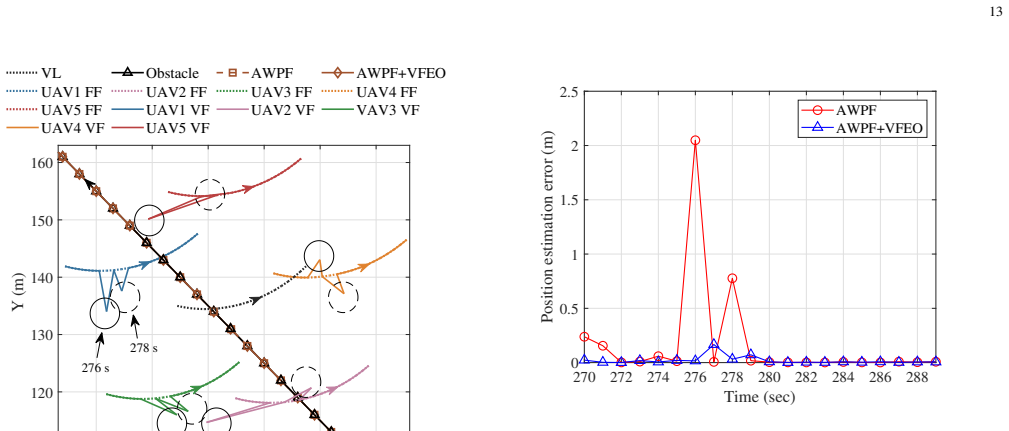
- [§VI, Figs. 10–18] All quantitative conclusions rest on a single simulated scenario: five UAVs, two obstacles, one trajectory per phase. The reported 21–124% AWPF accuracy improvement and the reductions of obstacle position error from 2.05 m to 0.02 m and from 0.78 m to 0.03 m at 276 s and 278 s are single-run values. No Monte Carlo trials, confidence intervals, or sensitivity analyses are provided with respect to the hand-tuned quantities that drive the algorithm: the distance threshold 3 m and constant 40 in (62)–(63), and the positioning accuracy threshold ζP_CRLB = 0.5 m in Table I. Since the AWPF reward schedule and the VFEO trigger are both governed by these parameters, statistical or sensitivity evidence is necessary to establish that the improvements are not artifacts of a particular tuning.
- [§III-D, Eqs. (46)–(47)] The CRLB used in the VFEO objective replaces the true ranges r_o^i with the arithmetic mean of multiple measurements, and the predicted obstacle position at k+1 is obtained from the linear Gauss-Markov model (17) with Gaussian driving noise. If the obstacle motion deviates from (17), or if the strict clock synchronization and Gaussian noise assumptions stated in Section III-C fail, the computed CRLB is not the actual error lower bound. Consequently, the optimized formation from (57) can be suboptimal and the trigger εP(k+1) > ζP_CRLB can be unreliable. This assumption is structural because it underlies both the sensing objective and the reconfiguration condition. A robustness test with model mismatch and imperfect synchronization would clarify the domain of validity of the claimed decimeter-level sensing improvement.
minor comments (4)
- [§IV-A, Eq. (52)] The text states ω2 ∝ 1/ed,ie, but the explicit schedule in (62)–(63) is not a direct proportionality: ω2 = 40/(ed,ie+40) for ed,ie > 3 and 0.95 otherwise. Please reconcile the description with the formula, and use a proper summation notation in ∑ ωo = 1.
- [§III-A, Eqs. (23)–(24)] The peak indices L_{s_i,w} and L_{s_i,q} are used before being explicitly defined. Define them or state clearly that they follow the peak-search procedure of [24].
- [Fig. 11] The legend entry 'VAV3 VF' appears to be a typo for 'UAV3 VF'.
- [Section V] The statement that sensing is equivalently completed by changing VFTs is not fully consistent with v2 being a control velocity in the fusion law (61). Clarify whether the sensing subtask contributes a velocity command or only a VFT update.
Circularity Check
No significant circularity; the sensing and control derivations are anchored in external estimation theory and independent simulations.
full rationale
The paper's central derivations do not reduce to their inputs by construction. The single-UAV ISAC range/Doppler CRLB is adapted from the published framework of [24] (a self-citation, but an external, falsifiable prior result), and the formation-level CRLB follows the standard Fisher-information/TWLS structure of [32]–[35]. The VFEO optimization minimizes the CRLB (57), while the reported 'decimeter-level' improvement is measured as actual TWLS error against the true obstacle trajectory in Fig. 13, not against the optimized CRLB itself, so the claim is not a renamed fit. The AWPF reward (52),(62)–(63) is a hand-designed adaptive schedule; comparing it to fixed-weight baselines is a standard ablation, not a fitted-input-called-prediction. The N-HSF fusion law (61) is a weighted NSB combination with external provenance [38]; the conclusion that it achieves conflict-free scheduling is under-supported because all three subtasks are never active simultaneously in Section VI and k1,k2 are unspecified, but that is an evidentiary gap, not a circular reduction. Self-citations [10],[24],[27],[30] appear in the related-work and signal-model setup, but none is used to forbid alternatives or to assert uniqueness, and the results they provide are external and independently checkable. One internal approximation—true ranges replaced by measurement means in (46)–(47)—is a modeling approximation, not a circular step. Overall circularity score 0.
Axiom & Free-Parameter Ledger
free parameters (3)
- Adaptive reward weight constants (3 m threshold and constant 40) =
3, 40
- CRLB positioning accuracy threshold zeta_CRLB =
0.5 m
- Null-space fusion weights k1, k2 and avoidance gain lambda1 =
not reported
axioms (6)
- domain assumption UAV motion follows the fixed-wing kinetic model (1)-(6) with control mapping (7)-(9)
- domain assumption Obstacle state evolves as the linear Gauss-Markov model (17) with known Phi, Gamma, and Gaussian acceleration noise
- domain assumption Strict clock synchronization among UAVs and zero-mean Gaussian measurement errors with covariance Q
- domain assumption The CRLB is a faithful proxy for the actual estimation error, and true ranges ro_i can be replaced by arithmetic means of measurements
- standard math The TWLS algebraic solution from [34] is unbiased under the small-noise assumption
- ad hoc to paper Formation reconfiguration is restricted to the virtual circle at the virtual-leader height, as in (57a)-(57b)
invented entities (1)
-
Virtual-leader (VL) and virtual following targets (VFTs)
no independent evidence
Cite this review
Pith. "Pith review of Cooperative Sensing Enhanced UAV Path-Following and Obstacle Avoidance with Variable Formation." pith.science (2026). https://pith.science/paper/I7TOCBD5
@misc{pith2026250821316,
  author       = {Pith},
  title        = {Pith review of: Cooperative Sensing Enhanced UAV Path-Following and Obstacle Avoidance with Variable Formation},
  year         = {2026},
  howpublished = {\url{https://pith.science/paper/I7TOCBD5}},
  note         = {Machine review of arXiv:2508.21316}
}
read the original abstract
The high mobility of unmanned aerial vehicles (UAVs) enables them to be used in various civilian fields, such as rescue and cargo transport. Path-following is a crucial way to perform these tasks while sensing and collision avoidance are essential for safe flight. In this paper, we investigate how to efficiently and accurately achieve path-following, obstacle sensing and avoidance subtasks, as well as their conflict-free fusion scheduling. Firstly, a high precision deep reinforcement learning (DRL)-based UAV formation path-following model is developed, and the reward function with adaptive weights is designed from the perspective of distance and velocity errors. Then, we use integrated sensing and communication (ISAC) signals to detect the obstacle and derive the Cramer-Rao lower bound (CRLB) for obstacle sensing by information-level fusion, based on which we propose the variable formation enhanced obstacle position estimation (VFEO) algorithm. In addition, an online obstacle avoidance scheme without pretraining is designed to solve the sparse reward. Finally, with the aid of null space based (NSB) behavioral method, we present a hierarchical subtasks fusion strategy. Simulation results demonstrate the effectiveness and superiority of the subtask algorithms and the hierarchical fusion strategy.
Figures






Forward citations
Cited by 1 Pith paper
-
GDPR-Aware Trajectory Sharing for ISAC-Assisted Robot Navigation: A Case Study on FID-Constrained Collision Prediction
FID-controlled trajectory perturbation yields lower reconstruction leakage and shorter continuous exposure than fixed-error noise at matched missed-conflict rates on real pedestrian traces.
Reference graph
Works this paper leans on
-
[1]
A. Khan, S. Gupta, and S. K. Gupta, “Cooperative control between multi-UA Vs for maximum coverage in disaster management: Review and proposed model,” in Proc. 2nd Int. Conf. Comput. Inf. Technol. , 2022, pp. 271–277
work page 2022
-
[2]
Communication and control in collaborative UA Vs: Recent advances and future trends,
S. Javaid, N. Saeed, Z. Qadir, H. Fahim, B. He, H. Song, and M. Bilal, “Communication and control in collaborative UA Vs: Recent advances and future trends,” IEEE Trans. Intell. Transport. Syst. , vol. 24, no. 6, pp. 5719–5739, 2023
work page 2023
-
[3]
Information-rich formation tracking: a unified scheme of cooperative control and localization,
A. Sen, M. Kothari, and S. R. Sahoo, “Information-rich formation tracking: a unified scheme of cooperative control and localization,” J. Aerosp. Inf. Syst. , vol. 17, no. 8, pp. 390–406, 2020
work page 2020
-
[4]
Coordinated path- following control of fixed-wing unmanned aerial vehicles,
H. Chen, Y . Cong, X. Wang, X. Xu, and L. Shen, “Coordinated path- following control of fixed-wing unmanned aerial vehicles,” IEEE Trans. Syst., Man, Cybern., Syst. , vol. 52, no. 4, pp. 2540–2554, 2021
work page 2021
-
[5]
Concentrated coverage path planning algorithm of UA V formation for aerial photography,
Y . Cao, X. Cheng, and J. Mu, “Concentrated coverage path planning algorithm of UA V formation for aerial photography,” IEEE Sensors J. , vol. 22, no. 11, pp. 11 098–11 111, 2022
work page 2022
-
[6]
Multi-UA V cooperative target tracking based on swarm intelligence,
Z. Xia, J. Du, C. Jiang, J. Wang, Y . Ren, and G. Li, “Multi-UA V cooperative target tracking based on swarm intelligence,” in Proc. IEEE Int. Conf. Commun. , 2021, pp. 1–6
work page 2021
-
[7]
USV formation and path-following control via deep reinforcement learning with random braking,
Y . Zhao, Y . Ma, and S. Hu, “USV formation and path-following control via deep reinforcement learning with random braking,” IEEE Trans. Neural Netw. Learn. Syst. , vol. 32, no. 12, pp. 5468–5478, 2021
work page 2021
-
[8]
Leader-follower formation control for fixed-wing UA Vs using deep reinforcement learn- ing,
Y . Shi, J. Song, Y . Hua, J. Yu, X. Dong, and Z. Ren, “Leader-follower formation control for fixed-wing UA Vs using deep reinforcement learn- ing,” in Proc. 41st Chin. Contr . Conf. , 2022, pp. 3456–3461
work page 2022
-
[9]
3U: Joint design of UA V-USV-UUV networks for cooperative target hunting,
W. Wei, J. Wang, Z. Fang, J. Chen, Y . Ren, and Y . Dong, “3U: Joint design of UA V-USV-UUV networks for cooperative target hunting,” IEEE Trans. V eh. Technol., vol. 72, no. 3, pp. 4085–4090, 2023
work page 2023
-
[10]
Anti-collision technologies for unmanned aerial vehicles: Recent advances and future trends,
Z. Wei, Z. Meng, M. Lai, H. Wu, J. Han, and Z. Feng, “Anti-collision technologies for unmanned aerial vehicles: Recent advances and future trends,” IEEE Internet Things J. , vol. 9, no. 10, pp. 7619–7638, 2021
work page 2021
-
[11]
Sense and avoid technol- ogy in unmanned aerial vehicles: A review,
B. N. Chand, P. Mahalakshmi, and V . Naidu, “Sense and avoid technol- ogy in unmanned aerial vehicles: A review,” in Proc. Int. Conf. Electr ., Electron., Commun., Comput. Technol. Optim. Techn. , 2017, pp. 512– 517
work page 2017
-
[12]
Feasibility study of UA V-assisted anti-jamming positioning,
Z. Wang, R. Liu, Q. Liu, L. Han, and J. S. Thompson, “Feasibility study of UA V-assisted anti-jamming positioning,” IEEE Trans. V eh. Technol., vol. 70, no. 8, pp. 7718–7733, 2021
work page 2021
-
[13]
Three passive TDOA- AOA receivers-based flying-UA V positioning in extreme environments,
C. Xu, Z. Wang, Y . Wang, Z. Wang, and L. Yu, “Three passive TDOA- AOA receivers-based flying-UA V positioning in extreme environments,” IEEE Sensors J. , vol. 20, no. 16, pp. 9589–9595, 2020
work page 2020
-
[14]
UA V position estimation and collision avoidance using the extended Kalman filter,
C. Luo, S. I. McClean, G. Parr, L. Teacy, and R. De Nardi, “UA V position estimation and collision avoidance using the extended Kalman filter,” IEEE Trans. V eh. Technol., vol. 62, no. 6, pp. 2749–2762, 2013
work page 2013
-
[15]
Optimal TDOA sensor-pair placement with uncertainty in source location,
W. Meng, L. Xie, and W. Xiao, “Optimal TDOA sensor-pair placement with uncertainty in source location,” IEEE Trans. V eh. Technol., vol. 65, no. 11, pp. 9260–9271, 2016
work page 2016
-
[16]
Three dimensional collision avoidance for multi unmanned aerial vehicles using velocity obstacle,
C. Y . Tan, S. Huang, K. K. Tan, and R. S. H. Teo, “Three dimensional collision avoidance for multi unmanned aerial vehicles using velocity obstacle,” J. Intell. Robot. Syst. , vol. 97, pp. 227–248, 2020
work page 2020
-
[17]
Quantitative evaluation of Voronoi graph search algorithm in UA V path planning,
C. Zhang, H. Liu, and Y . Tang, “Quantitative evaluation of Voronoi graph search algorithm in UA V path planning,” in Proc. Int. Conf. Software Eng. Serv. Sci. , 2018, pp. 563–567
work page 2018
-
[18]
Formation control and collision avoidance for multi-UA V systems based on Voronoi partition,
J. Hu, M. Wang, C. Zhao, Q. Pan, and C. Du, “Formation control and collision avoidance for multi-UA V systems based on Voronoi partition,” Sci. China Technol. Sci. , vol. 63, no. 1, pp. 65–72, 2020
work page 2020
-
[19]
G. Ahmed, T. Sheltami, M. Deriche, and A. Yasar, “An energy efficient IoD static and dynamic collision avoidance approach based on gradient optimization,” Ad Hoc Netw. , vol. 118, p. 102519, 2021
work page 2021
-
[20]
Collision-aware UA V trajectories for data collection via reinforcement learning,
X. Wang, M. C. Gursoy, T. Erpek, and Y . E. Sagduyu, “Collision-aware UA V trajectories for data collection via reinforcement learning,” inProc. IEEE Glob. Commun. Conf. , 2021, pp. 1–6
work page 2021
-
[21]
A UA V navigation approach based on deep reinforcement learning in large cluttered 3D environments,
Y . Xue and W. Chen, “A UA V navigation approach based on deep reinforcement learning in large cluttered 3D environments,” IEEE Trans. V eh. Technol., vol. 72, no. 3, pp. 3001–3014, 2023. 16
work page 2023
-
[22]
Multi-UA V automatic dynamic obstacle avoidance with experience-shared A2C,
X. Han, J. Wang, Q. Zhang, X. Qin, and M. Sun, “Multi-UA V automatic dynamic obstacle avoidance with experience-shared A2C,” in Proc. Int. Conf. Wirel. Mob. Comput. Netw. Commun. , 2019, pp. 330–335
work page 2019
-
[23]
UA V communications for 5G and beyond: Recent advances and future trends,
B. Li, Z. Fei, and Y . Zhang, “UA V communications for 5G and beyond: Recent advances and future trends,” IEEE Internet Things J. , vol. 6, no. 2, pp. 2241–2263, 2018
work page 2018
-
[24]
Z. Wei, Y . Wang, L. Ma, S. Yang, Z. Feng, C. Pan, Q. Zhang, Y . Wang, H. Wu, and P. Zhang, “5G PRS-based sensing: A sensing reference signal approach for joint sensing and communication system,” IEEE Trans. V eh. Technol., vol. 72, no. 3, pp. 3250–3263, 2023
work page 2023
-
[25]
Joint radar and communication: A survey,
Z. Feng, Z. Fang, Z. Wei, X. Chen, Z. Quan, and D. Ji, “Joint radar and communication: A survey,” China Commun. , vol. 17, no. 1, pp. 1–27, 2020
work page 2020
-
[26]
UA V-enabled integrated sensing and communication: Opportunities and challenges,
K. Meng, Q. Wu, J. Xu, W. Chen, Z. Feng, R. Schober, and A. L. Swindlehurst, “UA V-enabled integrated sensing and communication: Opportunities and challenges,” IEEE Wirel. Commun. , pp. 1–9, 2023
work page 2023
-
[27]
Improve sensing and communication performance of UA V via integrated sensing and communication,
W. Jiang, A. Wang, Z. Wei, M. Lai, C. Pan, Z. Feng, and J. Liu, “Improve sensing and communication performance of UA V via integrated sensing and communication,” in Proc. IEEE 21st Int. Conf. Commun. Technol. , 2021, pp. 644–648
work page 2021
-
[28]
A novel 3D non-stationary localization-assisted ISAC channel model,
R. Yang, Y . Wu, J. Huang, and C.-X. Wang, “A novel 3D non-stationary localization-assisted ISAC channel model,” in Proc. IEEE Wireless Commun. Networking Conf. , 2023, pp. 1–6
work page 2023
-
[29]
Y . Qin, Z. Zhang, X. Li, W. Huangfu, and H. Zhang, “Deep rein- forcement learning based resource allocation and trajectory planning in integrated sensing and communications UA V network,” IEEE Trans. Wireless Commun., 2023
work page 2023
-
[30]
Performance of joint sensing-communication cooperative sensing UA V network,
X. Chen, Z. Feng, Z. Wei, F. Gao, and X. Yuan, “Performance of joint sensing-communication cooperative sensing UA V network,”IEEE Trans. V eh. Technol., vol. 69, no. 12, pp. 15 545–15 556, 2020
work page 2020
-
[31]
Leader-follower interactive potential for target enclosing of perception-limited UA V groups,
D. Zhang, H. Duan, and Z. Zeng, “Leader-follower interactive potential for target enclosing of perception-limited UA V groups,” IEEE Syst. J. , vol. 16, no. 1, pp. 856–867, 2021
work page 2021
-
[32]
Coordinated CRLB-based control for tracking multiple first responders in 3D en- vironments,
S. Papaioannou, S. Kim, C. Laoudias, P. Kolios, S. Kim, T. Theocharides, C. Panayiotou, and M. Polycarpou, “Coordinated CRLB-based control for tracking multiple first responders in 3D en- vironments,” in Proc. Int. Conf. Unmanned Aircr . Syst., 2020, pp. 1475– 1484
work page 2020
-
[33]
Joint TDOA and FDOA estimation: A conditional bound and its use for optimally weighted localization,
A. Yeredor and E. Angel, “Joint TDOA and FDOA estimation: A conditional bound and its use for optimally weighted localization,” IEEE Trans. Signal Process. , vol. 59, no. 4, pp. 1612–1623, 2010
work page 2010
-
[34]
An accurate algebraic solution for moving source location using TDOA and FDOA measurements,
K. Ho and W. Xu, “An accurate algebraic solution for moving source location using TDOA and FDOA measurements,” IEEE Trans. Signal Process., vol. 52, no. 9, pp. 2453–2463, 2004
work page 2004
-
[35]
Achievable localization accuracy of the posi- tioning reference signal of 3GPP LTE,
J. A. del Peral-Rosado, J. A. L ´opez-Salcedo, G. Seco-Granados, F. Zanier, and M. Crisci, “Achievable localization accuracy of the posi- tioning reference signal of 3GPP LTE,” in Proc. Int. Conf. Localization GNSS, 2012, pp. 1–6
work page 2012
-
[36]
X. Hu, Y . Wang, Z. Liu, X. Du, W. Wang, and F. M. Ghannouchi, “Dynamic power allocation in high throughput satellite communications: A two-stage advanced heuristic learning approach,” IEEE Trans. V eh. Technol., vol. 72, no. 3, pp. 3502–3516, 2023
work page 2023
-
[37]
Solving non-linear equation based on steepest descent method,
T. Zhang, “Solving non-linear equation based on steepest descent method,” in Proc. 4th Int. Conf. Inf. Comput. , 2011, pp. 216–218
work page 2011
-
[38]
A novel null-space-based UA V trajectory tracking controller with collision avoidance,
M. C. P. Santos, C. D. Rosales, M. Sarcinelli-Filho, and R. Carelli, “A novel null-space-based UA V trajectory tracking controller with collision avoidance,” IEEE/ASME Trans. Mechatron. , vol. 22, no. 6, pp. 2543– 2553, 2017
work page 2017
-
[39]
NR; Physical Channels and Modulation,
3GPP, “NR; Physical Channels and Modulation,” Tech. Rep. 38.211 , 2020
work page 2020
This paper was first reviewed by deepseek-v4-flash on August 5, 2026.
discussion (0)
Sign in with ORCID, Apple, or X to comment. Anyone can read and Pith papers without signing in.