Self-Organising Memristive Networks as Physical Learning Systems
Pith reviewed 2026-05-18 20:11 UTC · model grok-4.3
The pith
Self-organising memristive networks harness their own nonlinear dynamics to perform physical learning.
A machine-rendered reading of the paper's core claim, the machinery that carries it, and where it could break.
Core claim
Self-organising memristive networks composed of dynamically reconfigurable resistive memory components exhibit non-trivial interactions whose collective nonlinear and adaptive dynamics can be used for learning, with both experiments and mean-field plus graph-theoretic models revealing criticality and dynamical phase transitions between conductance states that parallel plasticity in biological neuronal networks.
What carries the argument
Self-organising memristive networks (SOMNs), physical assemblies of resistive memory nanoscale components whose electrical circuitry reconfigures itself and whose conductance-state transitions produce the adaptive dynamics required for learning.
If this is right
- Continuous learning becomes possible inside resource-limited hardware without external software updates.
- Real-time decision-making for autonomous systems and dynamic sensing can be embedded directly at the edge.
- Energy use for intelligence tasks drops because computation occurs in the physical substrate rather than in separate processors.
- Personalised healthcare devices could run adaptive algorithms locally because the networks support continual plasticity-like behavior.
Where Pith is reading between the lines
- Different fabrication methods for the resistive components may produce networks with distinct critical exponents that could be matched to particular classes of learning problems.
- Mean-field descriptions of the conductance transitions might be used to predict the minimal network size needed for a target task before fabrication.
- Hybrid systems that combine these networks with conventional sensors could test whether the physical learning layer improves robustness to noisy inputs compared with purely digital approaches.
Load-bearing premise
The non-trivial interactions and adaptive dynamics seen in these networks can be steered to perform useful learning tasks in varied hardware implementations.
What would settle it
An experiment in which a self-organising memristive network is given repeated input patterns yet shows no measurable change in its output behavior or conductance distribution would falsify the claim that its dynamics can be harnessed for learning.
Figures


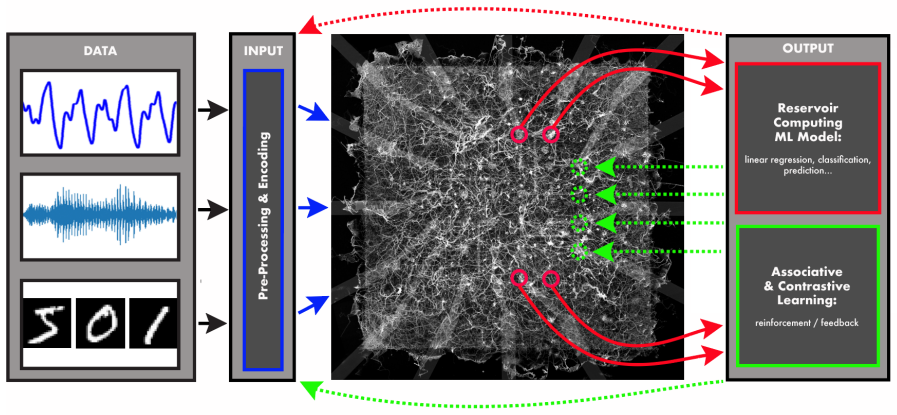
read the original abstract
Learning with physical systems is an emerging paradigm that seeks to harness the intrinsic nonlinear dynamics of physical substrates for learning. The impetus for a paradigm shift in how hardware is used for computational intelligence stems largely from the unsustainability of artificial neural network software implemented on conventional transistor-based hardware. This Perspective highlights one promising approach using physical networks comprised of resistive memory nanoscale components with dynamically reconfigurable, self-organising electrical circuitry. Experimental advances have revealed the non-trivial interactions within these Self-Organising Memristive Networks (SOMNs), offering insights into their collective nonlinear and adaptive dynamics, and how these properties can be harnessed for learning using different hardware implementations. Theoretical approaches, including mean-field theory, graph theory, and concepts from disordered systems, reveal deeper insights into the dynamics of SOMNs, especially during transitions between different conductance states where criticality and other dynamical phase transitions emerge in both experiments and models. Furthermore, parallels between adaptive dynamics in SOMNs and plasticity in biological neuronal networks suggest the potential for realising energy-efficient, brain-like continual learning. SOMNs thus offer a promising route toward embedded edge intelligence, unlocking real-time decision-making for autonomous systems, dynamic sensing, and personalised healthcare, by embedding continuous learning in resource-constrained environments. The overarching aim of this Perspective is to show how the convergence of nanotechnology, statistical physics, complex systems, and self-organising principles offers a unique opportunity to advance a new generation of physical intelligence technologies.
Editorial analysis
A structured set of objections, weighed in public.
Referee Report
Summary. This Perspective article reviews experimental observations of non-trivial interactions, collective nonlinear dynamics, and adaptive behavior in Self-Organising Memristive Networks (SOMNs) composed of resistive memory nanoscale components. It discusses theoretical tools including mean-field theory, graph theory, and concepts from disordered systems that illuminate criticality and dynamical phase transitions during conductance-state changes. The manuscript draws parallels between SOMN plasticity and biological neuronal networks, and argues that these properties can be harnessed to realize energy-efficient, brain-like continual learning, thereby offering a route to embedded edge intelligence for autonomous systems, dynamic sensing, and personalised healthcare.
Significance. If the perspective's synthesis holds, the convergence of nanotechnology, statistical physics, and self-organising principles could help establish physical learning systems as a viable complement to conventional hardware, potentially enabling more sustainable and adaptive computational intelligence in resource-constrained settings. The manuscript usefully collates recent experimental and modeling advances without introducing new data or derivations.
major comments (1)
- [Abstract] Abstract: The claim that observed non-trivial interactions and adaptive dynamics 'can be harnessed for learning using different hardware implementations' and that SOMNs 'offer a promising route toward embedded edge intelligence' is central to the perspective, yet the text provides no quantitative learning-task benchmarks (e.g., classification accuracy, regression error, or energy-per-inference metrics) or explicit control mechanisms that map the reviewed dynamics onto task-relevant outputs. This leaves the transition from 'promising dynamics' to functional learning as an untested assumption rather than a demonstrated capability.
minor comments (1)
- [Abstract] The abstract and closing paragraph could more explicitly separate the reviewed experimental and theoretical results from the forward-looking statements about applications in autonomous systems and healthcare.
Simulated Author's Rebuttal
We thank the referee for their constructive review and recommendation of minor revision. The single major comment is addressed point-by-point below. As this is a Perspective article synthesizing existing literature rather than reporting new experiments, our response focuses on clarifying scope and strengthening references to supporting studies.
read point-by-point responses
-
Referee: [Abstract] Abstract: The claim that observed non-trivial interactions and adaptive dynamics 'can be harnessed for learning using different hardware implementations' and that SOMNs 'offer a promising route toward embedded edge intelligence' is central to the perspective, yet the text provides no quantitative learning-task benchmarks (e.g., classification accuracy, regression error, or energy-per-inference metrics) or explicit control mechanisms that map the reviewed dynamics onto task-relevant outputs. This leaves the transition from 'promising dynamics' to functional learning as an untested assumption rather than a demonstrated capability.
Authors: We agree that a Perspective should clearly ground its forward-looking claims in the reviewed literature. The manuscript does not introduce new benchmarks because its purpose is to collate and interpret recent experimental and modeling advances (as noted in the referee summary). However, the claims are not untested assumptions; they rest on quantitative results reported in the cited works, including demonstrations of classification accuracies above 90% on simple tasks, energy efficiencies orders of magnitude below digital implementations, and explicit mapping of conductance dynamics to output via read-out layers or external control. To address the concern directly, we will revise the abstract to include a brief clause referencing these supporting demonstrations and will add a short paragraph in the main text summarizing key performance metrics from the literature. This revision will make the transition from observed dynamics to functional capability more explicit without altering the Perspective's scope. revision: yes
Circularity Check
No significant circularity; perspective summarizes independent advances without tautological derivations
full rationale
This Perspective reviews experimental observations of collective dynamics in SOMNs, theoretical frameworks (mean-field, graph theory, criticality from disordered systems), and biological parallels drawn from the broader literature. No derivation chain, equations, or first-principles predictions are presented that reduce by construction to self-fitted parameters, renamed inputs, or load-bearing self-citations. Forward-looking statements about embedded edge intelligence rest on cited external advances rather than internal tautologies, rendering the analysis self-contained against independent benchmarks.
Axiom & Free-Parameter Ledger
Lean theorems connected to this paper
-
IndisputableMonolith/Cost/FunctionalEquation.leanwashburn_uniqueness_aczel unclear?
unclearRelation between the paper passage and the cited Recognition theorem.
Theoretical approaches, including mean-field theory, graph theory, and concepts from disordered systems, reveal deeper insights into the dynamics of SOMNs, especially during transitions between different conductance states where criticality and other dynamical phase transitions emerge
-
IndisputableMonolith/Foundation/BranchSelection.leanbranch_selection unclear?
unclearRelation between the paper passage and the cited Recognition theorem.
Using the theoretical framework outlined in sec. 3.1, recent work has formulated a dynamical mean-field theory that attempts to characterize the voltage-induced dynamics of SOMNs by reducing equations of the type (4) to a single mean field dynamical equation. This is written in terms of an effective potential VΔv(⟨g⟩)
What do these tags mean?
- matches
- The paper's claim is directly supported by a theorem in the formal canon.
- supports
- The theorem supports part of the paper's argument, but the paper may add assumptions or extra steps.
- extends
- The paper goes beyond the formal theorem; the theorem is a base layer rather than the whole result.
- uses
- The paper appears to rely on the theorem as machinery.
- contradicts
- The paper's claim conflicts with a theorem or certificate in the canon.
- unclear
- Pith found a possible connection, but the passage is too broad, indirect, or ambiguous to say the theorem truly supports the claim.
Forward citations
Cited by 1 Pith paper
-
Thermal Anomaly Detection using Physics Aware Neuromorphic Networks: Comparison between Raw and L1C Sentinel-2 Data
PANN achieves MCC 0.809 on raw Sentinel-2 L0 data for thermal anomaly detection with 2.44s latency per granule, below the 3.6s acquisition time, and projects even faster neuromorphic hardware performance.
Reference graph
Works this paper leans on
-
[1]
Kaspar, C., Ravoo, B. J., van der Wiel, W. G., Weg- ner, S. V . & Pernice, W. H. P. The rise of intelli- gent matter. Nature 594, 345–355, DOI: 10.1038/ s41586-021-03453-y (2021)
work page 2021
-
[2]
Jaeger, H., Noheda, B. & van der Wiel, W. G. Toward a formal theory for computing machines made out of whatever physics offers. Nat. Commun. 14, 4911 (2023)
work page 2023
-
[3]
Stern, M. & Murugan, A. Learning without neu- rons in physical systems. Annu. Rev. Condens. Mat- ter Phys. 14, 417–441, DOI: https://doi.org/10.1146/ annurev-conmatphys-040821-113439 (2023)
work page 2023
-
[4]
Wang, Z. et al. Resistive switching materials for infor- mation processing. Nat. Rev. Mater. 5, 173–195, DOI: 10.1038/s41578-019-0159-3 (2020)
-
[5]
Haken, H. Information and Self-Organization: A Macroscopic Approach to Complex Systems(Springer: Berlin/Heidelberg, Germany, 2006)
work page 2006
-
[6]
Anderson, P. W. More is different: Broken symmetry and the nature of the hierarchical structure of science. Science 177, 393–396, DOI: 10.1126/science.177.4047. 393 (1972)
-
[7]
Outline of a theory of thought-processes and thinking machines
Caianiello, E. Outline of a theory of thought-processes and thinking machines. J. Theor. Biol. 1, 204–235, DOI: 10.1016/0022-5193(61)90046-7 (1961)
-
[8]
The perceptron: a probabilistic model for information storage and organization in the brain
Rosenblatt, F. The perceptron: a probabilistic model for information storage and organization in the brain. Psychol. Rev. 65, 386–408, DOI: 10.1037/h0042519 (1958)
-
[9]
Principles of Neurodynamics: Percep- trons and the Theory of Brain Mechanisms (Spartan Books, 1962)
Rosenblatt, F. Principles of Neurodynamics: Percep- trons and the Theory of Brain Mechanisms (Spartan Books, 1962)
work page 1962
-
[10]
Hopfield, J. J. Neural networks and physical systems with emergent collective computational abilities. Proc. Natl. Acad. Sci. 79, 2554–2558, DOI: 10.1073/pnas.79. 8.2554 (1982)
-
[11]
Approximation by superpositions of a sigmoidal function
Cybenko, G. Approximation by superpositions of a sigmoidal function. Math. Control. Signals Syst. 2, 303– 314, DOI: 10.1007/BF02551274 (1989)
-
[12]
Stieg, A. Z. et al. Emergent criticality in complex tur- ing b-type atomic switch networks. Adv. Mater. 24, 286–293, DOI: 10.1002/adma.201103053 (2011)
- [13]
-
[14]
Stieg, A. Z. et al. Self-organization and Emergence of Dynamical Structures in Neuromorphic Atomic Switch Networks. In Adamatzky, A. & Chua, L. (eds.) Memristor Networks, 173–209, DOI: 10.1007/ 978-3-319-02630-5_10 (Springer International Publish- ing, 2014)
work page 2014
-
[15]
Sandouk, E. J., Gimzewski, J. K. & Stieg, A. Z. Mul- tistate resistive switching in silver nanoparticle films. Sci. Technol. Adv. Mater. 16, 045004, DOI: 10.1088/ 1468-6996/16/4/045004 (2015)
work page 2015
-
[16]
Mallinson, J. B. et al. Avalanches and criticality in self-organized nanoscale networks. Sci. Adv. 5, DOI: 10.1126/sciadv.aaw8438 (2019)
-
[17]
Christensen, D. V .et al. 2022 roadmap on neuromor- phic computing and engineering. Neuromorphic Com- put. Eng. 2, 022501, DOI: 10.1088/2634-4386/ac4a83 (2022)
- [18]
- [19]
-
[20]
Demis, E. C. et al. Atomic switch net- works—nanoarchitectonic design of a complex system for natural computing. Nanotechnology 26, 204003 (2015)
work page 2015
-
[21]
Mallinson, J. B. et al. Avalanches and criticality in self-organized nanoscale networks. Sci. advances 5, eaaw8438 (2019)
work page 2019
-
[22]
Dynamic models of large-scale brain activity
Breakspear, M. Dynamic models of large-scale brain activity. Nat. Neurosci. 20, 340–352, DOI: 10.1038/nn. 4497 (2017)
work page doi:10.1038/nn 2017
-
[23]
Lynn, C. W. & Bassett, D. S. The physics of brain network structure, function and control. Nat. Rev. Phys. 1, 318–332, DOI: 10.1038/s42254-019-0040-8 (2019)
-
[24]
Diaz-Alvarez, A. et al. Emergent dynamics of neu- romorphic nanowire networks. Sci. Reports 9, DOI: 10.1038/s41598-019-51330-6 (2019)
-
[25]
Topological properties of neuromor- phic nanowire networks
Loeffler, A.et al. Topological properties of neuromor- phic nanowire networks. Front. Neurosci. 14, DOI: 10.3389/fnins.2020.00184 (2020)
-
[26]
Suárez, L. E., Richards, B. A., Lajoie, G. & Misic, B. Learning function from structure in neuromorphic networks. Nat. Mach. Intell. 3, 771–786, DOI: 10.1038/ s42256-021-00376-1 (2021)
work page 2021
-
[27]
Milano, G., Miranda, E. & Ricciardi, C. Connectome of memristive nanowire networks through graph theory. Neural Networks 150, 137–148 (2022)
work page 2022
-
[28]
Vahl, A., Milano, G., Kuncic, Z., Brown, S. A. & Mi- lani, P. Brain-inspired computing with self-assembled 14/20 networks of nano-objects. J. Phys. D: Appl. Phys. 57, 503001, DOI: 10.1088/1361-6463/ad7a82 (2024)
-
[29]
Kim, T. H. et al. Nanoparticle Assemblies as Memris- tors. Nano Lett. 9, 2229–2233, DOI: 10.1021/nl900030n (2009)
-
[30]
Milano, G., Michieletti, F., Pilati, D., Ricciardi, C. & Miranda, E. Self-organizing neuromorphic nanowire networks as stochastic dynamical systems. Nat. Com- mun. 16, 3509 (2025)
work page 2025
-
[31]
Zhu, R. et al. Information dynamics in neuromorphic nanowire networks. Sci. reports 11, 13047 (2021)
work page 2021
-
[32]
Strukov, D. B., Snider, G. S., Stewart, D. R. & Williams, R. S. The missing memristor found. Nature 453, 80–83, DOI: 10.1038/nature06932 (2008)
-
[33]
Caravelli, F. & Carbajal, J. P. Memristors for the cu- rious outsiders. Technologies 6, 118, DOI: 10.3390/ technologies6040118 (2018)
work page 2018
-
[34]
Terasa, M.-I. et al. Pathways towards truly brain-like computing primitives. Mater. Today 69, 41–53, DOI: 10.1016/j.mattod.2023.07.019 (2023)
-
[35]
Chialvo, D. & Bak, P. Learning from mistakes. Neuro- science 90, 1137–1148, DOI: 10.1016/s0306-4522(98) 00472-2 (1999)
-
[36]
Carbajal, J. P., Dambre, J., Hermans, M. & Schrauwen, B. Memristor models for machine learning.Neural Com- put. 27, 725–747, DOI: 10.1162/neco_a_00694 (2015)
-
[37]
Carbajal, J. P., Martin, D. A. & Chialvo, D. R. Learning by mistakes in memristor networks. Phys. Rev. E 105, DOI: 10.1103/physreve.105.054306 (2022)
-
[38]
Barrows, F., Sheldon, F. C. & Caravelli, F. Network analysis of memristive device circuits: dynamics, stabil- ity and correlations, DOI: 10.48550/ARXIV .2402.16015 (2024)
work page internal anchor Pith review doi:10.48550/arxiv 2024
-
[39]
Zhou, Z. et al. Edge intelligence: Paving the last mile of artificial intelligence with edge computing. Proc. IEEE 107, 1738–1762, DOI: 10.1109/JPROC.2019.2918951 (2019)
-
[40]
Bourzac, K. Fixing AI’s energy crisis. Nature DOI: 10.1038/d41586-024-03408-z (2024)
-
[41]
Milano, G., Porro, S., Valov, I. & Ricciardi, C. Recent developments and perspectives for memristive devices based on metal oxide nanowires.Adv. Electron. Mater.5, 1800909, DOI: https://doi.org/10.1002/aelm.201800909 (2019)
-
[42]
Kuncic, Z. & Nakayama, T. Neuromorphic nanowire networks: principles, progress and future prospects for neuro-inspired information processing. Adv. Physics: X 6, DOI: 10.1080/23746149.2021.1894234 (2021)
-
[43]
Manning, H. G. et al. Emergence of winner-takes-all connectivity paths in random nanowire networks. Nat. communications 9, 3219 (2018)
work page 2018
-
[44]
Milano, G., Pedretti, G., Fretto, M. & et al. Brain- inspired structural plasticity through reweighting and rewiring in multi-terminal self-organizing memristive nanowire networks. Adv. Intell. Syst. 2, 2000096, DOI: 10.1002/aisy.202000096 (2020)
-
[45]
Sillin, H. O. et al. A theoretical and experimental study of neuromorphic atomic switch networks for reservoir computing. Nanotechnology 24, 384004 (2013)
work page 2013
-
[46]
Li, Q. et al. Dynamic electrical pathway tuning in neu- romorphic nanowire networks. Adv. Funct. Mater. 30, 2003679, DOI: https://doi.org/10.1002/adfm.202003679 (2020). https://advanced.onlinelibrary.wiley.com/doi/ pdf/10.1002/adfm.202003679
-
[47]
Lilak, S. et al. Spoken digit classification by in-materio reservoir computing with neuromorphic atomic switch networks. Front. Nanotechnol. 3, DOI: 10.3389/fnano. 2021.675792 (2021)
-
[48]
Zhu, R. et al. Online dynamical learning and sequence memory with neuromorphic nanowire networks. Nat. Commun. 14, 6697 (2023)
work page 2023
-
[49]
Kotooka, T. et al. Thermally Stable Ag2Se Nanowire Network as an Effective In-Materio Physical Reservoir Computing Device. Adv. Electron. Mater. 10, 2400443, DOI: 10.1002/aelm.202400443 (2024)
-
[50]
Valov, I., Waser, R., Jameson, J. & Kozicki, M. Electro- chemical metallization memories—fundamentals, appli- cations, prospects. Nanotechnology 22, 254003, DOI: 10.1088/0957-4484/22/28/289502 (2011)
-
[51]
Electrochemical dynamics of nanoscale metallic inclusions in dielectrics
Yang, Y .et al. Electrochemical dynamics of nanoscale metallic inclusions in dielectrics. Nat. communications 5, 4232 (2014)
work page 2014
-
[52]
Milano, G. et al. Electrochemical rewiring through quan- tum conductance effects in single metallic memristive nanowires. Nanoscale Horizons 9, 416–426 (2024)
work page 2024
-
[53]
Bose, S. K., Mallinson, J. B., Gazoni, R. M. & Brown, S. A. Stable self-assembled atomic-switch networks for neuromorphic applications. IEEE Transactions on Electron Devices 64, 5194–5201 (2017)
work page 2017
-
[54]
Bose, S. et al. Neuromorphic behaviour in discontinuous metal films. Nanoscale Horizons 7, 437 (2022)
work page 2022
-
[55]
Carstens, N. et al. Brain-like critical dynamics and long- range temporal correlations in percolating networks of silver nanoparticles and functionality preservation after integration of insulating matrix. Nanoscale Adv. DOI: 10.1039/d2na00121g (2022)
-
[56]
Milano, G., Cultrera, A., Boarino, L., Callegaro, L. & Ricciardi, C. Tomography of memory engrams in self- organizing nanowire connectomes. Nat. Commun. 14, 5723 (2023)
work page 2023
-
[57]
Sattar, A., Fostner, S. & Brown, S. A. Quantized conductance and switching in percolating nanoparticle 15/20 films. Phys. Rev. Lett. 111, 136808, DOI: 10.1103/ PhysRevLett.111.136808 (2013)
work page 2013
-
[58]
Shirai, S. et al. Long-range temporal correlations in scale-free neuromorphic networks. Netw. Neurosci. 4, 432 (2020)
work page 2020
-
[59]
Steel, J. K. et al. A comparison of the properties of 2d and 3d percolating networks of nanoparticles. Phys Rev E in press (2025)
work page 2025
-
[60]
Le, P. Y .et al. Electroformed, self-connected tin ox- ide nanoparticle networks for electronic reservoir com- puting. Adv. Electron. Mater. 6, DOI: 10.1002/aelm. 202000081 (2020)
-
[61]
Mallinson, J. B. et al. Experimental demonstration of reservoir computing with self-assembled percolating networks of nanoparticles. Adv. Mater. 36, DOI: 10. 1002/adma.202402319 (2024)
work page 2024
-
[62]
Schulze, M. et al. Electrical measurements of nanoscale bismuth cluster films. Eur. Phys. J. D 24, 291 (2003)
work page 2003
-
[63]
Minnai, C., Bellacicca, A., Brown, S. A. & Mi- lani, P. Facile fabrication of complex networks of memristive devices. Sci. Reports 7, DOI: 10.1038/ s41598-017-08244-y (2017)
work page 2017
-
[64]
Minnai, C., Mirigliano, M., Brown, S. & Milani, P. The nanocoherer: an electrically and mechanically reset- table memristor based on gold clusters assembled on paper. Nano Futur.2, 011002, DOI: 10.1088/2399-1984/ aab4ee (2018)
-
[65]
Profumo, F. et al. Highly efficient classification of time- series based on resistive switching cluster-assembled ma- terials. Adv. Intell. Syst. DOI: 10.1002/aisy.202401150 (2025)
-
[66]
Rao, T. S., Mondal, I., Bannur, B. & Kulkarni, G. U. A scalable solution recipe for a ag-based neu- romorphic device. Discov. Nano 18, DOI: 10.1186/ s11671-023-03906-5 (2023)
work page 2023
-
[67]
Gronenberg, O. et al. In situ imaging of dynamic cur- rent paths in a neuromorphic nanoparticle network with critical spiking behavior. Adv. Funct. Mater. 34, DOI: 10.1002/adfm.202312989 (2024)
-
[68]
Pal, M. et al. Device area invariant conductance lin- earity in scalable silver nanostructure based neuromor- phic devices with threshold activation following noci- ceptive behavior. Nanoscale 17, 19434–19446, DOI: 10.1039/d5nr01617g (2025)
-
[69]
Pal, M., Vidhyadhiraja, N. S. & Kulkarni, G. U. Realis- ing bio-synapse analogous paired-pulse facilitation (ppf) and release inactivation (ri) and emulating “tip of the tongue” experience through conductance and retention dynamics in ag nano-labyrinth-based neuromorphic de- vice. Adv. Funct. Mater.DOI: 10.1002/adfm.202425635 (2025)
-
[70]
Adejube, B. et al. Silver-based self-organized resistive switching nanoparticle networks with neural-like spik- ing behavior: Implications for neuromorphic computing. ACS Appl. Nano Mater. DOI: 10.1021/acsanm.5c02520 (2025)
-
[71]
van der Ree, A. J. T., Ahmadi, M., Ten Brink, G. H., Kooi, B. J. & Palasantzas, G. Neuromorphic-like dynam- ics in percolating copper nanoparticle networks: Synthe- sis, characterization, and limitations. Phys. Rev. Mater. 9, DOI: 10.1103/physrevmaterials.9.036001 (2025)
-
[72]
van der Ree, A. J. T., Ahmadi, M., Ten Brink, G. H., Kooi, B. J. & Palasantzas, G. Stable millivolt range resistive switching in percolating molybdenum nanopar- ticle networks. ACS Appl. Mater. Interfaces 16, 65157–65164, DOI: 10.1021/acsami.4c12051 (2024)
- [73]
-
[74]
Mallinson, J. et al. Reservoir computing using networks of memristors: effects of topology and heterogeneity. Nanoscale 15, 9663–9674 (2023)
work page 2023
-
[75]
Pike, M. D. et al. Atomic scale dynamics drive brain- like avalanches in percolating nanostructured networks. Nano Lett. 20, 3935 (2020)
work page 2020
-
[76]
Acharya, S. K. et al. Stochastic spiking behaviour in neuromorphic devices enables true random number gen- eration. ACS Appl. Mater. Interfaces 13, 52861 (2021). ACS Editors’ Choice Article Selection
work page 2021
-
[77]
Srinivasa, N., Stepp, N. D. & Cruz-Albrecht, J. Critical- ity as a set-point for adaptive behavior in neuromorphic hardware. Front. Neurosci. 9, DOI: 10.3389/fnins.2015. 00449 (2015)
-
[78]
Muñoz, M. A. Colloquium: Criticality and dynamical scaling in living systems. Rev. Mod. Phys. 90, DOI: 10.1103/revmodphys.90.031001 (2018)
-
[79]
Milano, G. et al. Quantum conductance in memristive devices: fundamentals, developments, and applications. Adv. Mater. 34, 2201248 (2022)
work page 2022
-
[80]
Mallinson, J. B. & Brown, S. A. Time-multiplexed reser- voir computing with percolating networks of nanoparti- cles. In Proceedings of the International Joint Confer- ence on Neural Networks, DOI: 10.1109/IJCNN54540. 2023.10191253 (Gold Coast, Australia, 2023)
discussion (0)
Sign in with ORCID, Apple, or X to comment. Anyone can read and Pith papers without signing in.