REVIEW 4 major objections 4 minor 15 cited by
ManiFlow: A General Robot Manipulation Policy via Consistency Flow Training
T0 review · 4 major / 4 minor · reviewed 2026-08-05 · deepseek-v4-flash
Pith's one-line read By jointly optimizing flow matching with a continuous-time consistency objective, ManiFlow claims that one policy can generate dexterous robot actions in 1–2 inference steps and nearly doubles real-world success over the 3D Diffusion Policy
desk verdict A solid, well-engineered flow-matching policy with a plausible consistency-training twist, but the evaluation protocol inflates the headline numbers and the few-step advantage is not yet convincingly established. read the letter →
The pith
A machine-rendered reading of the paper's core claim, the machinery that carries it, and where it could break.
The reading
What carries the argument
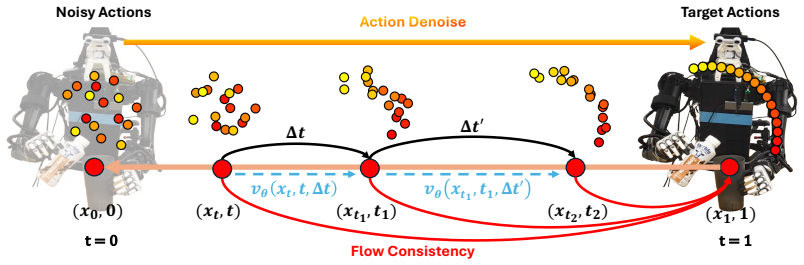
The load-bearing mechanism is the joint training objective: the flow matching loss with Δt set to 0, plus a consistency loss (Eq. 2) whose target is the average velocity from xt toward x̃1 = xt1 + (1 − t1)·v_θ−(xt1, t1, Δt′), a one-step Euler estimate of the clean endpoint made by the EMA model. Two supporting mechanisms carry the empirical claims. First, DiT-X, a diffusion-transformer block that applies AdaLN-Zero scale-and-shift conditioning not only to self-attention and feedforward layers but also to the input and output of cross-attention layers, letting low-dimensional conditioning (timestep, step size, robot state) selectively modulate high-dimensional visual and language tokens. Seco
What would settle it
On held-out demonstration data, compute the EMA one-step endpoint x̃1 = xt + (1−t)·v_θ−(xt, t, Δt′) for random intermediate t and measure the distance to the true data endpoint x1 across many trajectories; if this endpoint error stays large, or grows with action dimensionality and task dexterity, the consistency target is biased toward the model's own predictions rather than the data. A second check: run ManiFlow at 1 step versus 10 steps on a task with a deliberately curved action distribution (e.g., a reach that must bend around an obstacle in joint space). If 1-step success collapses while
Extended reading notes
Core claim
On the paper's own terms, the discovery is that flow matching and consistency training merge into one objective: every point on a noise-to-action path must map to the same estimated clean action. The flow term (Eq. 1) predicts velocity toward the true endpoint; the consistency term (Eq. 2) predicts average velocity toward a one-step Euler estimate of the endpoint made by an EMA copy of the model. A continuously sampled step size Δt is fed to the network, so the model learns shortcuts along the whole trajectory. The claimed payoff: 63.7% and 64.5% success on five bimanual tasks at 1 and 2 inference steps, versus 42.7% and 48.1% for 10-step baselines, and a 98.3% relative real-world gain over
Load-bearing premise
The consistency training target assumes the EMA velocity model is accurate enough that one Euler step from any intermediate noisy action reaches the true clean action; if the learned flow path curves or the EMA velocity is biased, the target inherits the model's own errors and the claimed 1-2 step generation quality is not guaranteed.
Editorial extensions
If this is right
- Dexterous action generation can run at 1-2 denoising steps instead of 10+, clearing a practical latency bar for real-time robot control without any teacher-student distillation stage.
- The same training recipe transfers across observation modalities (2D image, 3D point cloud, language, proprioception) and across embodiments (single-arm, bimanual, humanoid), with the largest margins on the most dexterous tasks.
- Data efficiency improves: trained from scratch on 50 demonstrations per bimanual task, ManiFlow beats a large pretrained vision-language-action baseline on domain-randomized robustness tasks by 58% relative improvement, and keeps scaling to 99.7% success at 500 demonstrations on the lift-pot task.
- Time-sampling choices are load-bearing: Beta-distributed timesteps emphasizing high-noise regions, combined with continuous step-size sampling, outperform uniform, logit-normal, cosine, and mode schedules.
- As a drop-in policy head inside an existing 3D action-diffusion architecture, ManiFlow outperforms the original 25-step DDPM head and extends the length of successfully completed instruction chains on the long-horizon benchmark.
- Few-step capability is not a niche efficiency trick: 1- and 2-step ManiFlow match or beat the 10-step flow and diffusion baselines on five bimanual simulation tasks, so the speed gain comes without a success-rate penalty.
Reading between the lines
- Because the consistency target is the EMA model's own one-step projection of the endpoint, the honest test of 'straightened flow' is a held-out measurement of the endpoint error ‖x̃1 − x1‖ across the noise-to-action trajectory; the paper argues from downstream success rates rather than reporting this quantity directly.
- The consistency objective is agnostic to observation and action spaces, so the same recipe should transfer to force- or tactile-conditioned policies and to navigation or mobile manipulation; the paper's own failure cases (contact-rich insertion and assembly) indicate where a purely kinematic flow will first break.
- The three contributions — consistency loss, Beta timestep sampling, and DiT-X conditioning — are separable; a user porting ManiFlow to a new task would want matched-step ablations of each component against the same encoder, since the paper's DiT-X evidence is mostly presented as convergence curves.
- Reporting wall-clock latency rather than step counts alone would sharpen the real-time claim, since DiT-X cross-attention adds compute per step; step-count savings do not automatically equal latency savings on a given robot.
- A direct cross-check of the straightening claim would be to run ManiFlow at 1 step versus 10 steps on a task whose action distribution is deliberately curved (for example, a reach that must bend around an obstacle in joint space); collapse of 1-step performance would indicate the flow was not actually straightened.
Editorial analysis
A structured set of objections, weighed in public.
Referee Report
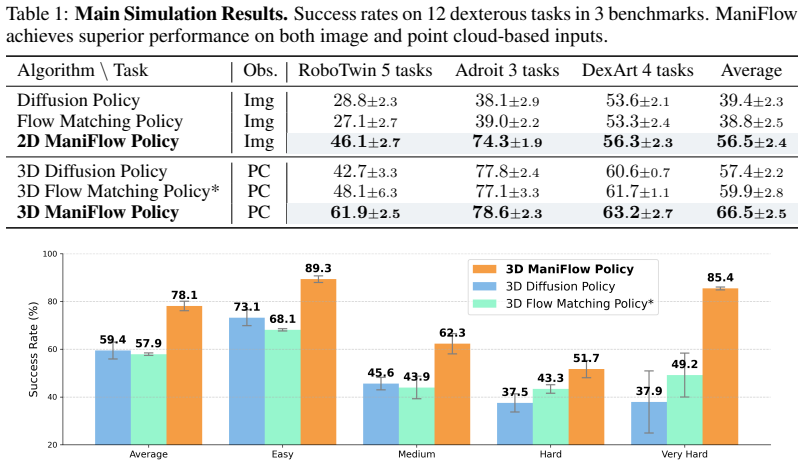
Summary. ManiFlow is a visuomotor imitation-learning policy that combines flow matching with a continuous-time consistency-training objective (Eq. 2) and a DiT-X transformer architecture. The policy is designed to generate high-dimensional dexterous actions from visual, language, and proprioceptive inputs, and to do so in 1--2 inference steps. The paper reports large improvements over 2D/3D diffusion and flow-matching baselines across 12 simulated dexterous tasks (Tab. 1), 48 MetaWorld language-conditioned tasks (Fig. 6), and 8 real-world tasks on humanoid, bimanual, and single-arm platforms (Tab. 2), including a 98.3% relative improvement over 3D Diffusion Policy. The method is described in detail with pseudocode (Alg. 1--2) and extensive ablations (Tabs. 3--6).
Significance. If substantiated, ManiFlow would be a meaningful advance: teacher-free consistency training for few-step action generation is practically attractive, and the multi-modal conditioning architecture appears to help on diverse benchmarks. The empirical coverage is broad, with multiple simulation and real-robot domains, and the paper provides concrete algorithmic details and an unusually extensive ablation set. However, the central few-step inference claim depends on a self-distillation target whose anchoring to the true data distribution is not independently verified, and the headline real-world and simulation numbers rest in part on evaluation choices that need clarification. The contribution is therefore potentially significant but currently conditional on resolving these methodological concerns.
major comments (4)
- [§2.1, Eq. (2); Alg. 2 lines 20–22] The consistency target is computed by a single Euler step from the EMA model: x̃1 = xt1 + (1−t1)v_θ−(xt1, t1, Δt′), and then v_target = (x̃1 − xt)/(1−t). This is a self-distillation loss: the model is trained to reproduce its own (EMA) prediction, not an independent estimate of the true endpoint. The few-step inference claim in Tab. 4 and Sec. 3.2 rests on this target being an accurate approximation of the data endpoint, but no evidence is given that the EMA velocity is accurate enough over the large step (1−t1), especially when t1 is near 0. Please report an independent measure of one-step endpoint error (e.g., ||x̃1 − x1|| on held-out actions) or compare the one-step generated distribution against the data distribution, and discuss why the self-consistency target is not biased toward the model's own early errors.
- [§B.1, Tabs. 1 and 4] Simulation results for Adroit and DexArt report the average of the top five success rates over evaluation checkpoints, while RoboTwin uses the final checkpoint. Selecting the best checkpoints can inflate reported values and may not be applied uniformly to all baselines; the text does not explicitly confirm that every baseline uses an identical selection protocol. Because Tab. 1 averages across heterogeneous protocols, the headline 45.6%/11.0% improvements are not yet reliable. Please report results for a fixed protocol (e.g., final checkpoint or average of the last K checkpoints) for all methods, and provide per-checkpoint curves or standard deviations for the chosen metric.
- [§3.3, Tab. 2] Real-world results are presented as raw success counts over 10–50 trials per cell, with no confidence intervals, error bars, or significance tests. Several differences are small (e.g., Sorting 7/10 vs 8/10; Cap Hanging unseen 2/5 vs 4/5), and the headline “98.3% relative improvement” aggregates many small samples. Please provide Wilson or bootstrap confidence intervals, report exact p-values or overlapping-interval checks, and clarify whether trial counts are identical for both methods in every cell. This is needed to support the near-doubling claim in the abstract.
- [§3.2, Tab. 4] The few-step results are non-monotonic: average success is 63.7% at 1 step, 64.5% at 2 steps, 61.6% at 4 steps, and 61.7–61.9% at 8–10 steps. If the consistency objective straightens the flow, more steps should not degrade accuracy. This pattern needs explanation and a precise description of the inference-time ODE solver and step schedule. The non-monotonicity also raises the concern that the 1-step result may rely on a particular solver configuration; please justify why this is not an artifact of the evaluation.
minor comments (4)
- [§6] The Limitation section discusses data dependence and missing tactile feedback but does not mention the self-distillation target issue or the lack of an independent straightness measurement. A brief discussion of these would help readers calibrate the few-step inference claim.
- [Alg. 2 line 9] The discrete interval U{0, 1/T, 2/T, …, (T−1)/T} uses an undefined T. Please define T and clarify how the continuous-time claim in Sec. 2.1 relates to the discretized sampling in the pseudocode.
- [Tab. 3] The claimed advantage of Beta timestep sampling over Logit-normal is small (78.0 vs 77.7 on average) and the per-task standard deviations overlap. Please add a significance test or soften the claim to “slight improvement” to avoid overstating the scheduler contribution.
- [Fig. 1 caption] The affiliation line contains a misspelling: “Artifical Intelligence” should be “Artificial Intelligence.”
Circularity Check
No significant circularity; consistency training is self-distillation by design and benchmark claims are externally evaluated.
full rationale
ManiFlow's central claims are empirical and are evaluated against external baselines (Diffusion Policy, 3D Diffusion Policy, flow matching policies, and π0) on simulation benchmarks and real-robot tasks. The consistency training objective in Eq. (2) and Algorithm 2 computes a target using a one-step Euler estimate from the EMA model, which is a form of self-distillation; however, this is the proposed training method itself, not a hidden derivation of the reported success rates. The flow matching term LFM still supervises the model with the ground-truth velocity x1 - x0, anchoring the training to the data distribution. The paper does not invoke any load-bearing self-citation or uniqueness theorem: self-citations such as GNFactor, DnACT, Bunny-VisionPro, and Open-TeleVision support data collection and prior architecture choices, not the core validity of ManiFlow. The few-step inference results are measured empirically rather than derived from the consistency objective, and the reported improvements are relative to independently implemented baselines. Therefore, no step in the paper's derivation reduces to its own inputs by construction.
Assumptions & free parameters
free parameters (5)
- Beta timestep sampling parameters (alpha, beta, cutoff) =
alpha=1.0, beta=1.5, s=0.999
- Training batch ratio (flow matching vs. consistency) =
75% flow matching, 25% consistency
- EMA momentum coefficient =
not specified
- Action horizon lengths =
4, 16, 64 depending on task
- Target time conditioning mode =
relative Delta-t mode
assumptions (5)
- domain assumption Linear interpolation x_t = (1-t)x_0 + t x_1 is a valid generative path between noise and data
- ad hoc to paper A single Euler step from t1 to 1 using the EMA velocity accurately reconstructs the data endpoint
- domain assumption The EMA model provides reliable, stable velocity predictions for computing consistency targets
- domain assumption Beta sampling emphasizing the high-noise regime is beneficial for robotic control
- domain assumption Point-wise features without max pooling preserve sufficient geometric information
invented entities (1)
-
DiT-X block
Cite this review
Pith. "Pith review of ManiFlow: A General Robot Manipulation Policy via Consistency Flow Training." pith.science (2026). https://pith.science/paper/4EN75TSU
@misc{pith2026250901819,
  author       = {Pith},
  title        = {Pith review of: ManiFlow: A General Robot Manipulation Policy via Consistency Flow Training},
  year         = {2026},
  howpublished = {\url{https://pith.science/paper/4EN75TSU}},
  note         = {Machine review of arXiv:2509.01819}
}
read the original abstract
This paper introduces ManiFlow, a visuomotor imitation learning policy for general robot manipulation that generates precise, high-dimensional actions conditioned on diverse visual, language and proprioceptive inputs. We leverage flow matching with consistency training to enable high-quality dexterous action generation in just 1-2 inference steps. To handle diverse input modalities efficiently, we propose DiT-X, a diffusion transformer architecture with adaptive cross-attention and AdaLN-Zero conditioning that enables fine-grained feature interactions between action tokens and multi-modal observations. ManiFlow demonstrates consistent improvements across diverse simulation benchmarks and nearly doubles success rates on real-world tasks across single-arm, bimanual, and humanoid robot setups with increasing dexterity. The extensive evaluation further demonstrates the strong robustness and generalizability of ManiFlow to novel objects and background changes, and highlights its strong scaling capability with larger-scale datasets. Our website: maniflow-policy.github.io.
Figures


Figures from the paper (17 more)




Forward citations
Cited by 15 Pith papers
-
DSSP: Diffusion State Space Policy with Full-History Encoding
DSSP is a history-conditioned diffusion state space policy that uses SSMs to encode full observation streams with an auxiliary dynamics objective and hierarchical fusion, achieving SOTA results with reduced model size...
-
$\pi\mathbf{R}^2$: Reactive Real-time Flow Policies
πR² makes flow-matching VLA policies reactive by splitting conditioning into fresh proprioception and stale vision-language features and using a one-step-per-call staircase noise schedule, reaching ~25 Hz closed-loop ...
-
Pix2Act: Image-Space Manipulation Policies with Equivariant Augmentation
Continuous multi-view image-space keypoint trajectories plus per-camera equivariant augmentation beat strong 3D and image baselines on MimicGen and real UR5 tasks.
-
Action Map Policy: Learning 3D Closed-loop Manipulation via Pixel Classification
Projecting 3D gripper keypoints onto camera pixels and classifying those pixels yields millimeter-precise, multi-modal closed-loop manipulation faster than diffusion policies.
-
High-Fidelity One-Step Generative Visuomotor Policy via Recursive Correction, Frequency Consistency, and Contrastive Flow Matching
One-step flow-matching visuomotor policy with recursive correction, dual-timestep spectral consistency, and contrastive mode separation matches or exceeds 10-step baselines at 1 NFE.
-
Support-Constrained RL Enables Real-World Policy Improvement without Real-World Experience
SCORE constrains sim RL to the support of a real-data policy via flow steering, raising average success on eight dexterous tasks from 37.8% to 89.9%.
-
ARP: Enhancing Quantized Skill Abstractions via Visual Alignment and Iterative Refinement for Robotic Manipulation
ARP enhances quantized skill abstractions in imitation learning by coupling visual grounding via contrastive alignment with execution refinement via IRH, reporting SOTA results on LIBERO, Meta-World, and real-robot tasks.
-
Action-Effect Memory Pretraining for Robot Manipulation
AEM pretrains compact history representations via masked modeling on interleaved vision-action sequences to boost downstream robot manipulation in simulation and real settings.
-
Flow-based Policy Adaptation without Policy Updates
GLOVES learns flow models from limited expert demonstrations to selectively correct actions from non-expert policies or operators toward expert distributions using reverse-flow OOD detection as an intervention gate.
-
Let the Dynamics Flow: Stable Flow Matching Dynamical Systems
SFMDS parametrizes dynamical systems via flow matching with soft penalty or hard architectural constraints to enforce stability while preserving multimodality, extended to Lie groups.
-
Let the Dynamics Flow: Stable Flow Matching Dynamical Systems
SFMDS learns multimodal dynamical systems via flow matching under soft or hard Lyapunov/positive-invariance constraints, including on Lie groups, and reports stable robot motion generation.
-
Expanding Spatial and Temporal Context for Robotic Imitation Learning With Scene Graphs
Dynamic scene graphs serve as explicit memory to improve imitation learning policies for spatial-temporal reasoning under partial observability in mobile and tabletop manipulation.
-
ShapeGen: Robotic Data Generation for Category-Level Manipulation
ShapeGen generates shape-diverse 3D robotic manipulation demonstrations without simulators by curating a functional shape library and applying a minimal-annotation pipeline for novel, physically plausible data.
-
LAFP: Preserving Latent Action Structure in Latent Policy Learning via Flow Matching
LAFP applies flow matching to preserve multimodal latent action structure in policy learning and uses inference-time interpolation to fix stochastic misalignment, achieving 10-15% higher success rates in imitation tasks.
-
R3D: Revisiting 3D Policy Learning
A transformer 3D encoder plus diffusion decoder architecture, with 3D-specific augmentations, outperforms prior 3D policy methods on manipulation benchmarks by improving training stability.
Reference graph
Works this paper leans on
-
[1]
C. Chi, Z. Xu, S. Feng, E. Cousineau, Y . Du, B. Burchfiel, R. Tedrake, and S. Song. Diffusion policy: Visuomotor policy learning via action diffusion. The International Journal of Robotics Research, page 02783649241273668, 2023
2023
- [2]
-
[3]
E. Chisari, N. Heppert, M. Argus, T. Welschehold, T. Brox, and A. Valada. Learning robotic manipulation policies from point clouds with conditional flow matching. CoRL, 2024
work page 2024
- [5]
-
[6]
F. Zhang and M. Gienger. Affordance-based robot manipulation with flow matching. arXiv preprint arXiv:2409.01083, 2024
arXiv 2024
- [7]
-
[8]
W. S. Peebles and S. Xie. Scalable diffusion models with transformers. 2023 ieee. In CVF International Conference on Computer Vision (ICCV), volume 4172, 2022
work page 2023
- [9]
Show all 43 references
-
[10]
Y . Ze, G. Zhang, K. Zhang, C. Hu, M. Wang, and H. Xu. 3d diffusion policy. RSS, 2024
2024
-
[11]
X. Liu, C. Gong, and Q. Liu. Flow straight and fast: Learning to generate and transfer data with rectified flow. arXiv preprint arXiv:2209.03003, 2022
2022 arXiv
-
[12]
Y . Song, P. Dhariwal, M. Chen, and I. Sutskever. Consistency models. arXiv preprint arXiv:2303.01469, 2023
2023 arXiv
-
[13]
Frans, D
K. Frans, D. Hafner, S. Levine, and P. Abbeel. One step diffusion via shortcut models. ICLR, 2025
2025
-
[14]
Atchison and S
J. Atchison and S. M. Shen. Logistic-normal distributions: Some properties and uses. Biometrika, 67(2):261–272, 1980
1980
-
[15]
Esser, S
P. Esser, S. Kulal, A. Blattmann, R. Entezari, J. M¨uller, H. Saini, Y . Levi, D. Lorenz, A. Sauer, F. Boesel, et al. Scaling rectified flow transformers for high-resolution image synthesis. In Forty-first International Conference on Machine Learning, 2024
2024
-
[16]
A. Q. Nichol and P. Dhariwal. Improved denoising diffusion probabilistic models. In Interna- tional conference on machine learning, pages 8162–8171. PMLR, 2021
2021
-
[17]
Black, N
K. Black, N. Brown, D. Driess, A. Esmail, M. Equi, C. Finn, N. Fusai, L. Groom, K. Hausman, B. Ichter, et al. A vision-language-action flow model for general robot control. arXiv preprint arXiv:2410.24164, 2024
2024 arXiv
-
[18]
V . Kumar. Manipulators and Manipulation in high dimensional spaces . PhD thesis, Uni- versity of Washington, Seattle, 2016. URL https://digital.lib.washington.edu/ researchworks/handle/1773/38104
2016
-
[19]
C. Bao, H. Xu, Y . Qin, and X. Wang. Dexart: Benchmarking generalizable dexterous manipu- lation with articulated objects. In CVPR, 2023
2023
-
[20]
Y . Mu, T. Chen, S. Peng, Z. Chen, Z. Gao, Y . Zou, L. Lin, Z. Xie, and P. Luo. Robotwin: Dual-arm robot benchmark with generative digital twins (early version). arXiv preprint arXiv:2409.02920, 2024
2024 arXiv
-
[21]
T. Yu, D. Quillen, Z. He, R. Julian, K. Hausman, C. Finn, and S. Levine. Meta-world: A benchmark and evaluation for multi-task and meta reinforcement learning. In Conference on robot learning, pages 1094–1100. PMLR, 2020
2020
-
[22]
T. Chen, Z. Chen, B. Chen, Z. Cai, Y . Liu, Q. Liang, Z. Li, X. Lin, Y . Ge, Z. Gu, et al. Robotwin 2.0: A scalable data generator and benchmark with strong domain randomization for robust bimanual robotic manipulation. arXiv preprint arXiv:2506.18088, 2025
2025 arXiv
-
[23]
K. He, X. Zhang, S. Ren, and J. Sun. Deep residual learning for image recognition. In CVPR, 2016
2016
-
[24]
G. Lu, Z. Gao, T. Chen, W. Dai, Z. Wang, W. Ding, and Y . Tang. Manicm: Real-time 3d diffu- sion policy via consistency model for robotic manipulation. arXiv preprint arXiv:2406.01586, 2024
2024 arXiv
-
[25]
B. Jia, P. Ding, C. Cui, M. Sun, P. Qian, S. Huang, Z. Fan, and D. Wang. Score and distribution matching policy: Advanced accelerated visuomotor policies via matched distillation. arXiv preprint arXiv:2412.09265, 2024
2024 arXiv
-
[26]
Shridhar, L
M. Shridhar, L. Manuelli, and D. Fox. Perceiver-actor: A multi-task transformer for robotic manipulation. In CoRL, 2023
2023
-
[27]
Goyal, J
A. Goyal, J. Xu, Y . Guo, V . Blukis, Y .-W. Chao, and D. Fox. Rvt: Robotic view transformer for 3d object manipulation. In CoRL, 2023. 12
2023
-
[28]
Goyal, V
A. Goyal, V . Blukis, J. Xu, Y . Guo, Y .-W. Chao, and D. Fox. Rvt-2: Learning precise manipu- lation from few demonstrations. RSS, 2024
2024
-
[29]
Y . Ze, G. Yan, Y .-H. Wu, A. Macaluso, Y . Ge, J. Ye, N. Hansen, L. E. Li, and X. Wang. Gnfactor: Multi-task real robot learning with generalizable neural feature fields. In CoRL, 2023
2023
-
[30]
Yan, Y .-H
G. Yan, Y .-H. Wu, and X. Wang. Dnact: Diffusion guided multi-task 3d policy learning.arXiv preprint arXiv:2403.04115, 2024
2024 arXiv
-
[31]
Y . Li, G. Yan, A. Macaluso, M. Ji, X. Zou, and X. Wang. Integrating lmm planners and 3d skill policies for generalizable manipulation. arXiv preprint arXiv:2501.18733, 2025
2025 arXiv
-
[32]
T.-W. Ke, N. Gkanatsios, and K. Fragkiadaki. 3d diffuser actor: Policy diffusion with 3d scene representations. CoRL, 2024
2024
-
[33]
Peebles and S
W. Peebles and S. Xie. Scalable diffusion models with transformers. In ICCV, 2023
2023
-
[34]
Dasari, O
S. Dasari, O. Mees, S. Zhao, M. K. Srirama, and S. Levine. The ingredients for robotic diffu- sion transformers. arXiv preprint arXiv:2410.10088, 2024
2024 arXiv
-
[35]
C. Chi, Z. Xu, C. Pan, E. Cousineau, B. Burchfiel, S. Feng, R. Tedrake, and S. Song. Universal manipulation interface: In-the-wild robot teaching without in-the-wild robots. arXiv preprint arXiv:2402.10329, 2024
2024 arXiv
-
[36]
J. Wang, M. Chen, N. Karaev, A. Vedaldi, C. Rupprecht, and D. Novotny. Vggt: Visual ge- ometry grounded transformer. In Proceedings of the Computer Vision and Pattern Recognition Conference, pages 5294–5306, 2025
2025
-
[37]
J. Zhou, J. Wang, B. Ma, Y .-S. Liu, T. Huang, and X. Wang. Uni3d: Exploring unified 3d representation at scale. arXiv preprint arXiv:2310.06773, 2023
2023 arXiv
-
[38]
L. Yang, Z. Zhang, Z. Zhang, X. Liu, M. Xu, W. Zhang, C. Meng, S. Ermon, and B. Cui. Consistency flow matching: Defining straight flows with velocity consistency. arXiv preprint arXiv:2407.02398, 2024
2024 arXiv
-
[39]
J. Song, C. Meng, and S. Ermon. Denoising diffusion implicit models. ICLR, 2021
2021
-
[40]
X. Li, M. Liu, H. Zhang, C. Yu, J. Xu, H. Wu, C. Cheang, Y . Jing, W. Zhang, H. Liu, et al. Vision-language foundation models as effective robot imitators. arXiv preprint arXiv:2311.01378, 2023
2023 arXiv
-
[41]
Black, M
K. Black, M. Nakamoto, P. Atreya, H. Walke, C. Finn, A. Kumar, and S. Levine. Zero- shot robotic manipulation with pretrained image-editing diffusion models. arXiv preprint arXiv:2310.10639, 2023
2023 arXiv
-
[42]
H. Wu, Y . Jing, C. Cheang, G. Chen, J. Xu, X. Li, M. Liu, H. Li, and T. Kong. Unleash- ing large-scale video generative pre-training for visual robot manipulation. arXiv preprint arXiv:2312.13139, 2023
2023 arXiv
-
[43]
R. Ding, Y . Qin, J. Zhu, C. Jia, S. Yang, R. Yang, X. Qi, and X. Wang. Bunny- visionpro: Real-time bimanual dexterous teleoperation for imitation learning. arXiv preprint arXiv:2407.03162, 2024
2024 arXiv
-
[44]
Cheng, J
X. Cheng, J. Li, S. Yang, G. Yang, and X. Wang. Open-television: Teleoperation with immer- sive active visual feedback. CoRL, 2024. 13 A Policy Implementation Details DexArt Adroit RoboTwin Figure 11: Simulation Tasks Visualization. 12 dexterous manipulation tasks, including 4...
2024
Reviewed August 5, 2026 · model on record in the stance chip above.
Discussion (0). Sign in to comment.