Prospects for toponium formation at the LHC in the single-lepton mode
Pith reviewed 2026-05-18 18:54 UTC · model grok-4.3
The pith
Toponium formation at the LHC can yield a statistically significant excess in single-lepton events using Run 2 data.
A machine-rendered reading of the paper's core claim, the machinery that carries it, and where it could break.
Core claim
By incorporating the Green's function of the non-relativistic QCD Hamiltonian and re-weighting the hard-scattering matrix elements, we demonstrate that a statistically significant excess from toponium formation could already be accessible in Run 2 data in the single-leptonic final state at the LHC. Our results also highlight observables that provide handles for signal characterisation and establish the single-leptonic channel as a competitive and complementary avenue for the ongoing exploration of toponium signatures at colliders.
What carries the argument
The Green's function of the non-relativistic QCD Hamiltonian combined with a re-weighting procedure for hard-scattering matrix elements, which incorporates non-perturbative effects into Monte Carlo simulations of toponium formation.
If this is right
- A statistically significant excess from toponium formation could already be accessible in Run 2 data.
- Observables exist that provide handles for signal characterisation.
- The single-leptonic channel serves as a competitive and complementary probe for toponium signatures at colliders.
Where Pith is reading between the lines
- The single-lepton results could be combined with searches in other final states to strengthen the overall case for toponium.
- Confirmation of the excess would test the non-relativistic treatment of top-quark pairs near production threshold in a new channel.
- The framework offers a template for applying similar non-perturbative modeling to near-threshold phenomena in other heavy-particle processes.
Load-bearing premise
The Green's function of the non-relativistic QCD Hamiltonian together with the re-weighting procedure correctly captures the non-perturbative formation dynamics in the single-lepton final state.
What would settle it
A search in the LHC Run 2 single-lepton dataset that finds no excess in the invariant mass or other kinematic distributions predicted by the non-relativistic framework would show the accessibility claim does not hold.
Figures
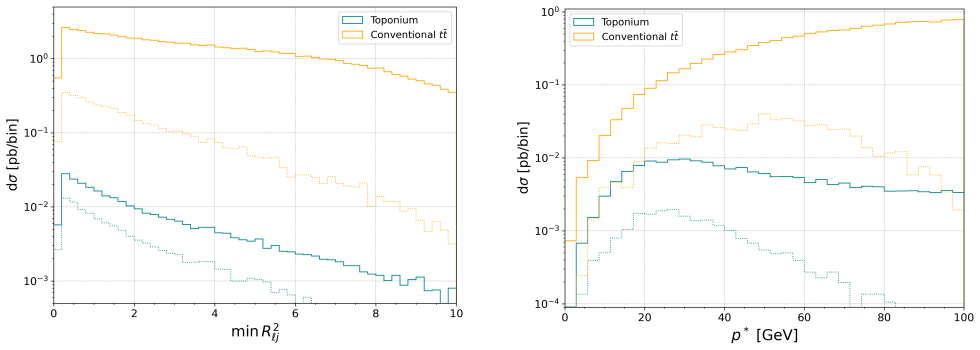
read the original abstract
We investigate the formation of toponium in the single-leptonic final state at the LHC. Our study builds on our recently proposed framework that incorporates the associated non-perturbative effects into Monte Carlo simulations through the Green's function of the non-relativistic QCD Hamiltonian and the re-weighting of hard-scattering matrix elements. This allows us to perform a phenomenological analysis that demonstrates that a statistically significant excess from toponium formation could already be accessible in Run~2 data. Moreover, our results highlight observables that provide handles for signal characterisation and establish the single-leptonic channel as a competitive and complementary avenue for the ongoing exploration of toponium signatures at colliders.
Editorial analysis
A structured set of objections, weighed in public.
Referee Report
Summary. The manuscript presents a Monte Carlo phenomenological study of toponium formation in the single-leptonic final state at the LHC. It builds on a recently proposed framework that incorporates non-perturbative effects through the Green's function of the non-relativistic QCD Hamiltonian combined with re-weighting of hard-scattering matrix elements. The central claim is that this approach reveals a statistically significant excess over Standard Model backgrounds that could already be accessible in existing Run 2 data, while also identifying observables useful for signal characterization and positioning the single-lepton channel as competitive and complementary for toponium searches.
Significance. If the modeling holds, the result would be significant because it suggests toponium signatures may be detectable in a previously under-explored final state using existing data, thereby broadening experimental strategies beyond dilepton or other channels. The integration of NRQCD Green's functions with re-weighting to capture non-perturbative formation dynamics represents a methodological advance for such studies, provided the procedure's robustness is established.
major comments (2)
- [Abstract and framework description] Abstract and framework description: The headline claim that a statistically significant excess is accessible in Run 2 data depends on the re-weighting procedure correctly incorporating non-perturbative formation dynamics into single-lepton kinematics (lepton pT, MET, b-jet distributions) without inflating the excess relative to SM ttbar backgrounds; however, no quantitative validation, error budget, or sensitivity study to variations in the non-perturbative modeling is presented.
- [Phenomenological analysis section] Phenomenological analysis section: The predicted excess relies on the framework introduced in prior work by the same collaboration, yet no independent cross-checks against data, alternative non-perturbative models, or explicit treatment of interference with continuum ttbar under the applied lepton cuts are shown, leaving the size of the excess tied to choices in that earlier work.
minor comments (2)
- The manuscript would benefit from explicit statements of the assumed color-singlet dominance and any neglected interference terms in the re-weighting step.
- Figure captions and legends should more clearly distinguish the toponium signal contribution from the SM background after all selection cuts.
Simulated Author's Rebuttal
We thank the referee for the careful reading and constructive comments on our manuscript. We respond point by point to the major comments below, indicating where we will revise the text to strengthen the presentation of our results and the robustness of the framework.
read point-by-point responses
-
Referee: [Abstract and framework description] Abstract and framework description: The headline claim that a statistically significant excess is accessible in Run 2 data depends on the re-weighting procedure correctly incorporating non-perturbative formation dynamics into single-lepton kinematics (lepton pT, MET, b-jet distributions) without inflating the excess relative to SM ttbar backgrounds; however, no quantitative validation, error budget, or sensitivity study to variations in the non-perturbative modeling is presented.
Authors: We agree that an explicit sensitivity study and error budget for the single-lepton channel would improve the manuscript. The re-weighting procedure and its validation against perturbative limits were presented in our prior work that introduced the framework. In the revised version we will add a dedicated paragraph (or short appendix) showing the effect of varying the NRQCD parameters on the predicted excess significance and on the lepton pT, MET and b-jet distributions, together with a simple uncertainty estimate derived from those variations. revision: yes
-
Referee: [Phenomenological analysis section] Phenomenological analysis section: The predicted excess relies on the framework introduced in prior work by the same collaboration, yet no independent cross-checks against data, alternative non-perturbative models, or explicit treatment of interference with continuum ttbar under the applied lepton cuts are shown, leaving the size of the excess tied to choices in that earlier work.
Authors: Direct cross-checks against data are not possible because toponium has not yet been observed. The framework was validated in the preceding publication through comparisons with fixed-order perturbative calculations. We will revise the phenomenological analysis section to include an explicit discussion of interference between the resonant toponium contribution and the continuum ttbar background under the applied lepton and jet cuts. We will also add a short comparison to an alternative threshold-enhancement model to illustrate the dependence on non-perturbative modeling assumptions. revision: partial
Circularity Check
Central non-perturbative framework for excess prediction rests on self-citation to authors' prior work without independent benchmarks shown here
specific steps
-
self citation load bearing
[Abstract]
"Our study builds on our recently proposed framework that incorporates the associated non-perturbative effects into Monte Carlo simulations through the Green's function of the non-relativistic QCD Hamiltonian and the re-weighting of hard-scattering matrix elements. This allows us to perform a phenomenological analysis that demonstrates that a statistically significant excess from toponium formation could already be accessible in Run~2 data."
The statistically significant excess is generated by feeding the NRQCD Green's function and re-weighting procedure into the single-lepton analysis. Because the procedure is taken from the authors' own recent prior work and no independent external benchmark, parameter-free derivation, or alternative non-perturbative modeling is supplied in the present paper, the size of the predicted excess is fixed by the modeling decisions made in that self-citation.
full rationale
The paper's headline claim of a statistically significant toponium excess in single-lepton Run 2 data is obtained by applying the Green's function of the NRQCD Hamiltonian plus re-weighting of hard matrix elements to Monte Carlo simulations. This framework is explicitly introduced as 'our recently proposed framework' in the abstract, with no parameter-free derivation, external cross-check, or alternative modeling presented in the current manuscript. The re-weighting step directly controls the size and shape of the predicted excess above SM backgrounds after lepton, MET and b-jet selections; because the procedure originates in the authors' own prior work and is imported without new validation against data or independent non-perturbative calculations, the excess prediction reduces to the modeling choices made in that earlier paper. This matches the self-citation load-bearing pattern and raises the circularity score to 6 while leaving room for the underlying perturbative matrix elements to retain independent content.
Axiom & Free-Parameter Ledger
axioms (1)
- domain assumption Non-relativistic QCD Hamiltonian Green's function accurately encodes toponium formation dynamics near threshold
Lean theorems connected to this paper
-
IndisputableMonolith/Cost/FunctionalEquation.leanwashburn_uniqueness_aczel unclear?
unclearRelation between the paper passage and the cited Recognition theorem.
the re-weighting of hard-scattering matrix elements... ratio of the Green’s functions of the non-relativistic QCD Hamiltonian and the free Hamiltonian, G̃(E; p∗)/G̃0(E; p∗)
-
IndisputableMonolith/Foundation/AlphaCoordinateFixation.leanalpha_pin_under_high_calibration unclear?
unclearRelation between the paper passage and the cited Recognition theorem.
solving the Lippmann-Schwinger equation with the QCD potential
What do these tags mean?
- matches
- The paper's claim is directly supported by a theorem in the formal canon.
- supports
- The theorem supports part of the paper's argument, but the paper may add assumptions or extra steps.
- extends
- The paper goes beyond the formal theorem; the theorem is a base layer rather than the whole result.
- uses
- The paper appears to rely on the theorem as machinery.
- contradicts
- The paper's claim conflicts with a theorem or certificate in the canon.
- unclear
- Pith found a possible connection, but the passage is too broad, indirect, or ambiguous to say the theorem truly supports the claim.
Forward citations
Cited by 5 Pith papers
-
Observation of a cross-section enhancement near the $t\bar{t}$ production threshold in $\sqrt{s}=13$ TeV $pp$ collisions with the ATLAS detector
ATLAS reports an 8+ sigma excess in ttbar production near threshold, consistent with NRQCD quasi-bound states and measuring 9.3 pb.
-
Observation of a cross-section enhancement near the $t\bar{t}$ production threshold in $\sqrt{s}=13$ TeV $pp$ collisions with the ATLAS detector
ATLAS observes an excess over 8 sigma in ttbar production near threshold, consistent with NRQCD color-singlet S-wave quasi-bound states, with measured cross-section 9.3^{+1.4}_{-1.3} pb.
-
Phenomenology of Hypothetical Single-Top Hadronic States
QCD sum rule calculations produce ground-state masses for single-top baryons like Lambda_t and mesons like T_t b-bar, with several central values slightly below constituent quark mass sums suggesting possible weak bin...
-
Masses of Purely Top-Quark Bound States: Toponium and the Triply-Top Baryon
QCD sum-rule calculations give negative binding energies for toponium states consistent with near-threshold experimental signals and a central mass for the triply-top baryon slightly above three times the top-quark mass.
-
Top Pair Threshold Revisited
Updated non-relativistic Green's function formalism for ttbar threshold production gives a below-threshold cross section of order 6.5 pb matching recent LHC excess observations.
Reference graph
Works this paper leans on
- [1]
- [2]
- [3]
-
[4]
Rept.1116 (2025) 127 [2404.10674]
ATLAS collaboration,Climbing to the Top of the ATLAS 13 TeV data,Phys. Rept.1116 (2025) 127 [2404.10674]
-
[5]
V.S. Fadin and V.A. Khoze,Threshold Behavior of Heavy Top Production in e+ e- Collisions,JETP Lett.46 (1987) 525
work page 1987
-
[6]
V.S. Fadin, V.A. Khoze and T. Sjostrand,On the Threshold Behavior of Heavy Top Production,Z. Phys. C48 (1990) 613
work page 1990
-
[7]
Bound-state Effects on Top Quark Production at Hadron Colliders
K. Hagiwara, Y. Sumino and H. Yokoya,Bound-state Effects on Top Quark Production at Hadron Colliders,Phys. Lett. B666(2008) 71 [0804.1014]. B. Fukset al.: Prospects for toponium formation at the LHC in the single-lepton mode Page 5 of 6
work page internal anchor Pith review Pith/arXiv arXiv 2008
-
[8]
Bound-state effects on kinematical distributions of top quarks at hadron colliders
Y. Sumino and H. Yokoya,Bound-state effects on kinematical distributions of top quarks at hadron colliders,JHEP 09 (2010) 034 [1007.0075]
work page internal anchor Pith review Pith/arXiv arXiv 2010
- [9]
- [10]
- [11]
-
[12]
ATLAS collaboration,Observation of a cross-section enhancement near the𝑡̄𝑡production threshold in √ 𝑠 = 13 TeV 𝑝𝑝collisions with the ATLAS detector, ATLAS-CONF-2025-008
work page 2025
- [13]
- [14]
- [15]
-
[16]
F. Maltoni, C. Severi, S. Tentori and E. Vryonidou,Quantum detection of new physics in top-quark pair production at the LHC, JHEP 03(2024) 099 [2401.08751]
-
[17]
Aguilar-Saavedra,Toponium hunter’s guide,Phys
J.A. Aguilar-Saavedra,Toponium hunter’s guide,Phys. Rev. D110 (2024) 054032 [2407.20330]
-
[18]
Llanes-Estrada,Ensuring that toponium is glued, not nailed, Phys
F.J. Llanes-Estrada,Ensuring that toponium is glued, not nailed, Phys. Lett. B866 (2025) 139510 [2411.19180]
- [19]
-
[20]
Updated predictions for toponium production at the LHC,
M.V. Garzelli, G. Limatola, S.O. Moch, M. Steinhauser and O. Zenaiev,Updated predictions for toponium production at the LHC,Phys. Lett. B866 (2025) 139532 [2412.16685]
-
[21]
R. Francener, V.P. Goncalves and D.E. Martins,Investigating the exclusive toponium production at the LHC and FCC, 2502.03295
- [22]
-
[23]
B. Fuks,Toponium physics at the Large Hadron Collider, 2505.03869
- [24]
-
[25]
H.-S. Shao and G. Wang,Analytic NNLO transverse-momentum-dependent soft function for heavy quark pair hadroproduction at threshold, 2506.23791
-
[26]
M.J. Strassler and M.E. Peskin,The Heavy top quark threshold: QCD and the Higgs,Phys. Rev. D43 (1991) 1500
work page 1991
-
[27]
M. Jezabek, J.H. Kuhn and T. Teubner,Momentum distributions in t anti-t production and decay near threshold,Z. Phys. C56(1992) 653
work page 1992
- [28]
-
[29]
Top-quark pair production near threshold at LHC
Y. Kiyo, J.H. Kuhn, S. Moch, M. Steinhauser and P. Uwer, Top-quark pair production near threshold at LHC,Eur. Phys. J. C 60(2009) 375 [0812.0919]
work page internal anchor Pith review Pith/arXiv arXiv 2009
- [30]
-
[31]
J. Alwall, R. Frederix, S. Frixione, V. Hirschi, F. Maltoni, O. Mattelaer et al.,The automated computation of tree-level and next-to-leading order differential cross sections, and their matching to parton shower simulations,JHEP 07 (2014) 079 [1405.0301]
work page internal anchor Pith review Pith/arXiv arXiv 2014
-
[32]
Probing CP violation in $e^{+}e^{-}$ production of the Higgs boson and toponia
K. Hagiwara, K. Ma and H. Yokoya,Probing CP violation in𝑒+𝑒− production of the Higgs boson and toponia,JHEP 06 (2016) 048 [1602.00684]
work page internal anchor Pith review Pith/arXiv arXiv 2016
-
[33]
Probing the CP properties of top Yukawa coupling at an $e^+e^-$ collider
K. Hagiwara, H. Yokoya and Y.-J. Zheng,Probing the CP properties of top Yukawa coupling at an𝑒+𝑒− collider,JHEP 02 (2018) 180 [1712.09953]
work page internal anchor Pith review Pith/arXiv arXiv 2018
-
[34]
A comprehensive guide to the physics and usage of PYTHIA 8.3
C. Bierlich et al.,A comprehensive guide to the physics and usage of PYTHIA 8.3,SciPost Phys. Codeb.2022 (2022) 8 [2203.11601]
work page internal anchor Pith review Pith/arXiv arXiv 2022
-
[35]
Generic User Process Interface for Event Generators
E. Boos et al.,Generic User Process Interface for Event Generators, in2nd Les Houches Workshop on Physics at TeV Colliders, 9, 2001 [hep-ph/0109068]
work page internal anchor Pith review Pith/arXiv arXiv 2001
-
[36]
A standard format for Les Houches Event Files
J. Alwall et al.,A Standard format for Les Houches event files, Comput. Phys. Commun.176(2007) 300 [hep-ph/0609017]
work page internal anchor Pith review Pith/arXiv arXiv 2007
-
[37]
New CTEQ global analysis of quantum chromodynamics with high-precision data from the LHC
T.-J. Hou et al.,New CTEQ global analysis of quantum chromodynamics with high-precision data from the LHC,Phys. Rev. D 103 (2021) 014013 [1912.10053]
work page internal anchor Pith review arXiv 2021
-
[38]
LHAPDF6: parton density access in the LHC precision era
A. Buckley, J. Ferrando, S. Lloyd, K. Nordström, B. Page, M. Rüfenacht et al.,LHAPDF6: parton density access in the LHC precision era,Eur. Phys. J. C75 (2015) 132 [1412.7420]
work page internal anchor Pith review Pith/arXiv arXiv 2015
-
[39]
Confronting new physics theories to LHC data with MadAnalysis 5
E. Conte and B. Fuks,Confronting new physics theories to LHC data with MADANALYSIS 5,Int. J. Mod. Phys. A33(2018) 1830027 [1808.00480]
work page internal anchor Pith review Pith/arXiv arXiv 2018
- [40]
-
[41]
The anti-k_t jet clustering algorithm
M. Cacciari, G.P. Salam and G. Soyez,The anti-𝑘𝑡 jet clustering algorithm,JHEP 04 (2008) 063 [0802.1189]
work page internal anchor Pith review Pith/arXiv arXiv 2008
-
[42]
M. Cacciari, G.P. Salam and G. Soyez,FastJet User Manual,Eur. Phys. J. C72 (2012) 1896 [1111.6097]
work page internal anchor Pith review Pith/arXiv arXiv 2012
-
[43]
The total top quark pair production cross-section at hadron colliders through O(alpha_S^4)
M. Czakon, P. Fiedler and A. Mitov,Total Top-Quark Pair-Production Cross Section at Hadron Colliders Through𝑂(𝛼4 𝑆 ), Phys. Rev. Lett.110 (2013) 252004 [1303.6254]. B. Fukset al.: Prospects for toponium formation at the LHC in the single-lepton mode Page 6 of 6
work page internal anchor Pith review Pith/arXiv arXiv 2013
discussion (0)
Sign in with ORCID, Apple, or X to comment. Anyone can read and Pith papers without signing in.