REVIEW 4 major objections 7 minor 65 references
A wavelet-based autoencoder that trains low- and high-frequency latents separately recovers fine image detail that conventional latent tokenizers lose.
Reviewed by Pith at T0; open to challenge. T0 means a machine referee read the full paper against a public rubric. the ladder, T0–T4 →
A wavelet-based VAE that trains low- and high-frequency branches separately improves image reconstruction and diffusion generation.
T0 review reviewed 2026-08-05 challenge →
load-bearing objection The wavelet two-branch VAE shows real gains on ImageNet reconstruction and generation, but the claim that decoupling is the cause is confounded by unmatched capacity in the ablations. the 4 major comments →
Missing Fine Details in Images: Last Seen in High Frequencies
The pith
A machine-rendered reading of the paper's core claim, the machinery that carries it, and where it could break.
The reading
Core claim
The paper's central claim is a diagnosis plus a remedy: standard variational and vector-quantized tokenizers jointly optimize reconstruction across the whole image, and this joint objective is dominated by low-frequency energy, leaving high-frequency details under-fit. FA-VAE addresses the root cause by decomposing each image with a level-1 Haar discrete wavelet transform into low-frequency (LL) and high-frequency (LH, HL, HH) components, encoding and decoding each band with its own encoder-decoder pair, and fusing the sampled latents by concatenation before applying the inverse wavelet transform. The low-frequency branch keeps a VA-VAE-style objective with a vision foundation alignment loss
What carries the argument
The Haar discrete wavelet transform is the load-bearing mechanism: it separates an image into one low-frequency approximation band and three high-frequency detail bands, allowing the training objective to be decoupled into L_low and L_high with separate latents z_L and z_H. The two encoder-decoder pairs are then specialized, with the low branch supervised by frequency and perceptual losses, and the high branch supervised by an L1 loss plus adversarial term, and a simple concatenation fuses the bands into one latent for diffusion modeling.
Load-bearing premise
The central ablation compares FA-VAE against coupled-frequency baselines that are said to use 'similar latent dimensionality,' but the paper does not confirm equal parameter counts or training budgets, so the reconstruction gains could partly come from extra encoder-decoder capacity rather than from frequency decoupling itself.
What would settle it
Train a coupled-frequency variant of the FA-VAE architecture with identical encoder-decoder parameter counts, same loss weights, and same training epochs (matching the decoupled model in everything except the separation of frequency bands), then compare reconstruction loss, LPIPS, and generation FID. If the coupled variant matches FA-VAE's numbers, the decoupling is not the cause of the improvement.
If this is right
- If the decoupling claim holds, any latent tokenizer can adopt frequency-split encoders and decoders without changing the downstream generation backbone, yielding sharper text, edges, and textured regions.
- The frequency-aware latent space should transfer to other latent diffusion and autoregressive pipelines, improving perceptual quality wherever the tokenizer is replaced.
- The two-band structure suggests a natural way to trade off detail versus compression: the high-frequency latent can be down-weighted or dropped when bandwidth is limited, while preserving global structure.
- The class-wise reconstruction analysis implies frequency-aware tokenization reduces representation bias toward easy, low-texture categories, which could improve generative fairness across rare or detailed classes.
- The same wavelet-decoupling recipe may extend to video, 3D shapes, and medical images, where fine structures are also concentrated in high-frequency subbands.
Where Pith is reading between the lines
- The reconstruction gain may partly come from having two encoder-decoder pairs instead of one, since the ablation only matches 'similar latent dimensionality' and the paper does not state equal parameter counts or training budgets; a capacity-matched coupling experiment would isolate the decoupling effect.
- The high-frequency branch's avoidance of pretrained feature losses is itself a claim worth testing: an LPIPS or DINOv2 loss applied directly to the high-frequency band might further improve detail fidelity, or might conflict with the L1 objective.
- Because the residual power spectra show lower energy across both bands, one testable consequence is that FA-VAE latents should also improve downstream tasks that depend on sharp edges, such as super-resolution finetuning or image editing with diffusion inversion.
- The paper leaves open whether a learned, adaptive decomposition (rather than a fixed Haar filter) would preserve even more detail; a learned filter bank could serve as a strict generalization of this method.
Editorial analysis
A structured set of objections, weighed in public.
Referee Report
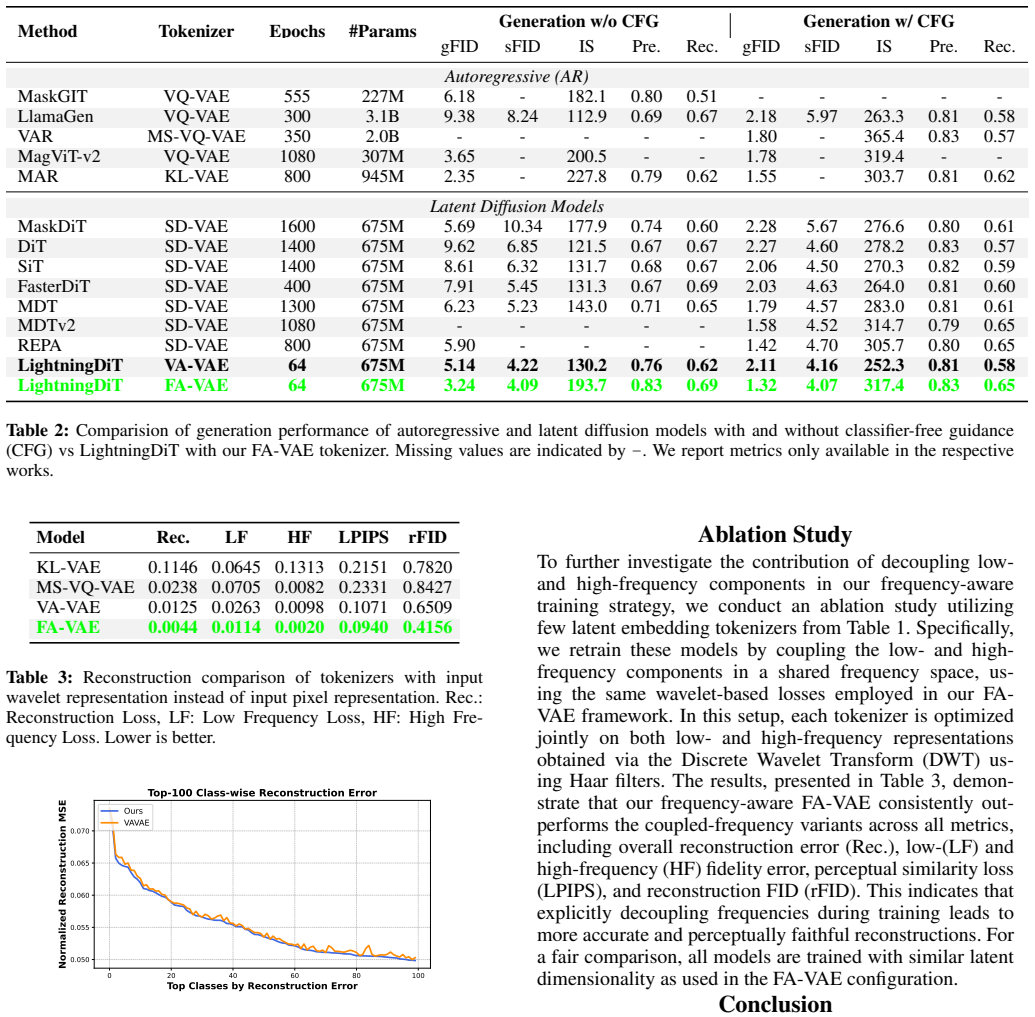
Summary. The paper studies the frequency behavior of latent tokenizers used in latent generative models. It reports that existing VAE variants reconstruct low-frequency content well but underfit high-frequency details, and attributes this to a low-frequency bias in the joint optimization objective. To address this, the paper proposes FA-VAE, which applies a Haar discrete wavelet transform, encodes low- and high-frequency subbands with two independent encoder-decoder pairs, and fuses the resulting latents for downstream diffusion training. Reconstruction experiments on ImageNet report that FA-VAE roughly halves the reconstruction loss of VA-VAE (Table 1) and improves LightningDiT generation FID from 5.14 to 3.24 without CFG (Table 2). The paper also reports an ablation against coupled-frequency variants of several tokenizers (Table 3) and a per-class robustness analysis (Figure 5).
Significance. If the causal claim is established, the contribution is practically valuable: FA-VAE is a simple, modular tokenizer change that yields large reconstruction and generation gains in a standard latent diffusion pipeline, with no generation-time architectural modification. The paper is empirical and uses external metrics (rFID, gFID, LPIPS), so there is no circularity in the evaluation. However, the central attribution of these gains to frequency decoupling is not yet supported because the ablation does not control for model capacity, the frequency-bias analysis uses unnormalized band-wise losses, and Table 1 pools tokenizers trained on different datasets. With matched-capacity controls and normalized frequency metrics, the contribution would be considerably stronger.
major comments (4)
- [Table 3 / Appendix 'Low- and High-Frequency Encoding'] The main ablation does not control for capacity. FA-VAE uses two independent encoder-decoder pairs (one for low frequency, one for the concatenated high-frequency tensor), while the coupled-frequency baselines reuse a single encoder-decoder architecture. The paper only states that 'all models are trained with similar latent dimensionality as used in the FA-VAE configuration' (Table 3), not that parameter counts, FLOPs, or training budgets are matched. The large reconstruction gains (e.g., Rec. 0.0125 to 0.0044 vs VA-VAE) could therefore come from the additional parameters/compute or from the different per-branch objectives (e.g., L1 high-frequency loss, no VF/LPIPS on the high branch) rather than from the decoupling mechanism itself. A capacity-matched coupled baseline is required to attribute the gains to frequency decoupling.
- [Section 'Frequency Evaluation of Latent Embeddings' / Table 1] The claimed 'low-frequency bias' is supported only by raw per-band MSE values L_L and L_H. These bands have very different energies and coefficient counts: after a Haar DWT, natural-image energy is concentrated in the low-pass band, and the high-pass bands contain three orientations. A smaller raw high-frequency loss can simply reflect there being less high-frequency energy to reconstruct, not better optimization. To substantiate the bias claim, the authors should report normalized per-band errors (e.g., L_L/||x_L||^2 and L_H/||x_H||^2) or per-coefficient MSE. This affects the motivation of the paper, not just the presentation.
- [Table 1 / Appendix 'Additional Evaluations'] Table 1 pools tokenizers with different training datasets and budgets. The appendix reveals that DC-AE* models were trained on ImageNet, SAM, FFHQ, and Mapillary Vistas, while KL-VAE* and VQ-VAE* models were trained on OpenImages, and FA-VAE is trained on ImageNet. The headline comparison against VA-VAE is more defensible, but the caption does not disclose these differences, and the statement that FA-VAE 'nearly halves the reconstruction loss of the strongest baseline' conflates architectural contribution with training-data and training-budget differences. Please restrict the main comparison to matched training setups or clearly annotate each row.
- [Section 'Latent Fusion for Generative Modeling' / Table 2] The generation comparison is between LightningDiT trained on the single VA-VAE latent and LightningDiT trained on the concatenated FA-VAE latent (z_L and z_H fused). This changes the latent dimensionality and the generative modeling problem, not only the frequency optimization. The reported gFID improvement (5.14 to 3.24) therefore conflates the effect of frequency decoupling with the effect of the richer, higher-dimensional latent input. A generation experiment using a coupled-frequency tokenizer with the same fused latent structure would clarify the contribution.
minor comments (7)
- [Figure 2] The axis labels '2 × 100', '3 × 100', '4 × 100' are cryptic. Please clarify the frequency axis units or explain the indexing.
- [Section 'Frequency Evaluation of Latent Embeddings'] There is a typo: 'Similarly, To assess' should be 'Similarly, to assess'. Also, the notation V AEs appears with inconsistent spacing throughout the manuscript.
- [Table 3 caption] The phrase 'with input wavelet representation instead of input pixel representation' is unclear. The table compares coupled-frequency training on wavelet inputs against decoupled FA-VAE; please state this explicitly.
- [Section 'Fairness in Latent Representations'] The term 'fairness' is unusual for per-class reconstruction error. The analysis shows lower top-100 class-wise errors, which is better described as per-class robustness or worst-class fidelity, not fairness in the usual sense.
- [Appendix 'Implementation Details'] The sentence 'We experiment with two different f16 tokenizers: one trained without alignment for high frequencies and one with VF loss using DINOv2 for low frequencies' is confusing. Presumably these are two branches of FA-VAE, but the phrasing suggests two separate tokenizers. Please clarify.
- [References] Reference [Li et al. 2024b] is cited as 'ICLR 2025 (withdrawn)'. Citing a withdrawn paper is problematic; please replace with the published/available version or remove.
- [Appendix 'Additional Evaluations'] The statement 'We believe our method, if trained on larger datasets, would exhibit even more beneficial results' is speculative and not supported by the reported experiments. Either provide supporting evidence or remove it.
Circularity Check
No significant circularity: empirical tokenizer design validated on external held-out metrics; self-citations are related-work only.
full rationale
The paper does not claim a formal derivation; it makes an empirical observation (frequency-resolved reconstruction losses), proposes a wavelet-decoupled VAE that optimizes separate low- and high-frequency objectives, and evaluates the result with held-out reconstruction losses, LPIPS, rFID, and generation FID against independently trained baselines. The reported subband losses are the same quantities optimized in the low/high objectives, but this is standard objective-aligned evaluation, not a fitted parameter renamed as a prediction: the validation set is separate, and the comparison models did not optimize those objectives. The ablation in Table 3 uses the same wavelet losses for coupled variants and reports large gains for decoupling; the lack of matched parameter count is a genuine experimental confound (a correctness risk), but it is not a circular reduction because the decoupled model's superiority is not guaranteed by construction. Self-citations (Medi et al. 2024a,b) appear only in related-work context and are not load-bearing. No uniqueness theorem, no ansatz-via-citation, and no renaming of a known result as a new derivation is present.
Axiom & Free-Parameter Ledger
free parameters (3)
- VF loss hyperparameters m1, m2, w_hyper =
0.5, 0.25, 0.1
- KL weight beta =
not reported
- Adversarial and LPIPS loss weights (lambda_GAN, lambda_LPIPS) =
not reported
axioms (4)
- standard math Haar wavelet decomposition with Mulcahy normalization is invertible and separates frequency content.
- domain assumption A KL-regularized VAE latent space is suitable for downstream diffusion generation.
- domain assumption DINOv2 features are a useful perceptual alignment signal for low-frequency content.
- domain assumption Training two separate encoder-decoder branches independently and fusing the latents preserves both structure and detail.
Cite this review
Pith. "Pith review of Missing Fine Details in Images: Last Seen in High Frequencies." pith.science (2026). https://pith.science/paper/T2GVKZ7E
@misc{pith2026250905441,
  author       = {Pith},
  title        = {Pith review of: Missing Fine Details in Images: Last Seen in High Frequencies},
  year         = {2026},
  howpublished = {\url{https://pith.science/paper/T2GVKZ7E}},
  note         = {Machine review of arXiv:2509.05441}
}
read the original abstract
Latent generative models have shown remarkable progress in high-fidelity image synthesis, typically using a two-stage training process that involves compressing images into latent embeddings via learned tokenizers in the first stage. The quality of generation strongly depends on how expressive and well-optimized these latent embeddings are. While various methods have been proposed to learn effective latent representations, generated images often lack realism, particularly in textured regions with sharp transitions, due to loss of fine details governed by high frequencies. We conduct a detailed frequency decomposition of existing state-of-the-art (SOTA) latent tokenizers and show that conventional objectives inherently prioritize low-frequency reconstruction, often at the expense of high-frequency fidelity. Our analysis reveals these latent tokenizers exhibit a bias toward low-frequency information during optimization, leading to over-smoothed outputs and visual artifacts that diminish perceptual quality. To address this, we propose a wavelet-based, frequency-aware variational autoencoder (FA-VAE) framework that explicitly decouples the optimization of low- and high-frequency components. This decoupling enables improved reconstruction of fine textures while preserving global structure. Moreover, we integrate our frequency-preserving latent embeddings into a SOTA latent diffusion model, resulting in sharper and more realistic image generation. Our approach bridges the fidelity gap in current latent tokenizers and emphasizes the importance of frequency-aware optimization for realistic image synthesis, with broader implications for applications in content creation, neural rendering, and medical imaging.
Figures




Reference graph
Works this paper leans on
-
[1]
, " * write output.state after.block = add.period write newline
ENTRY address archivePrefix author booktitle chapter edition editor eid eprint howpublished institution isbn journal key month note number organization pages publisher school series title type volume year label extra.label sort.label short.list INTEGERS output.state before.all mid.sentence after.sentence after.block FUNCTION init.state.consts #0 'before.a...
-
[2]
write newline
" write newline "" before.all 'output.state := FUNCTION n.dashify 't := "" t empty not t #1 #1 substring "-" = t #1 #2 substring "--" = not "--" * t #2 global.max substring 't := t #1 #1 substring "-" = "-" * t #2 global.max substring 't := while if t #1 #1 substring * t #2 global.max substring 't := if while FUNCTION word.in bbl.in capitalize " " * FUNCT...
-
[3]
F.; Amirloo, E.; El-Nouby, A.; Zamir, A.; and Dehghan, A
Bachmann, R.; Allardice, J.; Mizrahi, D.; Fini, E.; Kar, O. F.; Amirloo, E.; El-Nouby, A.; Zamir, A.; and Dehghan, A. 2025. FlexTok: Resampling Images into 1D Token Sequences of Flexible Length. In Forty-second International Conference on Machine Learning
work page 2025
-
[4]
Bj \"o rk, S.; Myhre, J. N.; and Johansen, T. H. 2022. Simpler is better: Spectral regularization and up-sampling techniques for variational autoencoders. In ICASSP 2022-2022 IEEE International Conference on Acoustics, Speech and Signal Processing (ICASSP), 3778--3782. IEEE
work page 2022
-
[5]
Blattmann, A.; Rombach, R.; Ling, H.; Dockhorn, T.; Kim, S. W.; Fidler, S.; and Kreis, K. 2023. Align your Latents: High‑Resolution Video Synthesis with Latent Diffusion Models. In Proc. CVPR 2023
work page 2023
-
[6]
Chang, H.; Zhang, H.; Jiang, L.; Liu, C.; and Freeman, W. T. 2022. Maskgit: Masked generative image transformer. In Proceedings of the IEEE/CVF Conference on Computer Vision and Pattern Recognition, 11315--11325
work page 2022
-
[7]
Chen, H.; Han, Y.; Chen, F.; Li, X.; Wang, Y.; Wang, J.; Wang, Z.; Liu, Z.; Zou, D.; and Raj, B. 2025. Masked autoencoders are effective tokenizers for diffusion models. In Forty-second International Conference on Machine Learning
work page 2025
-
[8]
Chen, J.; Cai, H.; Chen, J.; Xie, E.; Yang, S.; Tang, H.; Li, M.; Lu, Y.; and Han, S. 2024. Deep compression autoencoder for efficient high-resolution diffusion models. arXiv preprint arXiv:2410.10733
Pith/arXiv arXiv 2024
-
[9]
Deng, J.; Dong, W.; Socher, R.; Li, L.-J.; Li, K.; and Fei-Fei, L. 2009. Imagenet: A large-scale hierarchical image database. In 2009 IEEE conference on computer vision and pattern recognition, 248--255. Ieee
2009
-
[10]
Dong, Y.; Zuo, Q.; Gu, X.; Yuan, W.; Zhao, Z.; Dong, Z.; Bo, L.; and Huang, Q. 2024. GPLD3D: Latent Diffusion of 3D Shape Generative Models by Enforcing Geometric and Physical Priors. In Proc. CVPR 2024, 56–66
work page 2024
-
[11]
Esser et al., P. e. a. 2021. Taming Transformers for High-Resolution Image Synthesis. In Proceedings of the IEEE/CVF Conference on Computer Vision and Pattern Recognition (CVPR), 12873--12883
work page 2021
-
[12]
C.; Bermano, A.; and Cohen-Or, D
Gal, R.; Hochberg, D. C.; Bermano, A.; and Cohen-Or, D. 2021. Swagan: A style-based wavelet-driven generative model. ACM Transactions on Graphics (TOG), 40(4): 1--11
work page 2021
-
[13]
Gao, S.; Zhou, P.; Cheng, M.-M.; and Yan, S. 2023. Masked diffusion transformer is a strong image synthesizer. In Proceedings of the IEEE/CVF International Conference on Computer Vision, 23164--23173
work page 2023
-
[14]
Guth, F.; Coste, S.; De Bortoli, V.; and Mallat, S. 2022. Wavelet Score‑Based Generative Modeling. In NeurIPS. Multi‑scale diffusion over wavelet coefficients, linear time complexity
work page 2022
-
[15]
Heusel, M.; Ramsauer, H.; Unterthiner, T.; Nessler, B.; and Hochreiter, S. 2017. GANs trained by a two time-scale update rule converge to a local Nash equilibrium. In Advances in Neural Information Processing Systems (NeurIPS), 6626--6637
work page 2017
-
[16]
Huang, L.; Fang, R.; Zhang, A.; Song, G.; Liu, S.; Liu, Y.; and Li, H. 2024. Fouriscale: A frequency perspective on training-free high-resolution image synthesis. In European conference on computer vision, 196--212. Springer
work page 2024
-
[17]
Huang, Z.; Qiu, X.; Ma, Y.; Zhou, Y.; Chen, J.; Zhang, H.; Zhang, C.; and Li, X. 2025. Nfig: Autoregressive image generation with next-frequency prediction. arXiv preprint arXiv:2503.07076
arXiv 2025
-
[18]
R.; Liu, Z.; Shayani, H.; and Fu, C.-W
Hui, K.-H.; Sanghi, A.; Rampini, A.; Malekshan, K. R.; Liu, Z.; Shayani, H.; and Fu, C.-W. 2024. Make-a-shape: a ten-million-scale 3d shape model. In Forty-first International Conference on Machine Learning
work page 2024
-
[19]
Jiang, H.; Luo, A.; Fan, H.; Han, S.; and Liu, S. 2023. Low-light image enhancement with wavelet-based diffusion models. ACM Transactions on Graphics (TOG), 42(6): 1--14
work page 2023
-
[20]
Jiang, L.; Dai, B.; Wu, W.; and Loy, C. C. 2021. Focal Frequency Loss for Image Reconstruction and Synthesis. In Proceedings of the IEEE/CVF International Conference on Computer Vision (ICCV), 13919--13929
work page 2021
-
[21]
Karras, T.; Laine, S.; and Aila, T. 2019. A Style-Based Generator Architecture for Generative Adversarial Networks. In CVPR
work page 2019
-
[22]
Kim, C.; Moon, S. J.; and Park, G.-M. 2025. WINE: Wavelet-Guided GAN Inversion and Editing for High-Fidelity Refinement. In 2025 IEEE/CVF Winter Conference on Applications of Computer Vision (WACV), 4523--4532
work page 2025
-
[23]
Kim, Y.; Hwang, G.; Zhang, J.; and Park, E. 2025. Diffusehigh: Training-free progressive high-resolution image synthesis through structure guidance. In Proceedings of the AAAI conference on artificial intelligence, 4338--4346
work page 2025
-
[24]
Kingma, D. P.; and Welling, M. 2013. Auto-Encoding Variational Bayes. arXiv preprint arXiv:1312.6114
Pith/arXiv arXiv 2013
-
[25]
Kirillov, A.; Mintun, E.; Ravi, N.; Mao, H.; Rolland, L.; Gustafson, Y.; Xiao, C.-Y.; Whitehead, S.; et al. 2023. Segment Anything. arXiv preprint arXiv:2304.02643
Pith/arXiv arXiv 2023
-
[26]
Kouzelis, T.; Kakogeorgiou, I.; Gidaris, S.; and Komodakis, N. 2025. Eq-vae: Equivariance regularized latent space for improved generative image modeling. arXiv preprint arXiv:2502.09509
Pith/arXiv arXiv 2025
-
[27]
Krasin, I.; Duerig, T.; Alldrin, N.; Ferrari, V.; Abu-El-Haija, S.; Kuznetsova, A.; Rom, H.; Uijlings, J.; and et al. 2017. OpenImages: A public dataset for large-scale multi-label and multi-class image classification. Dataset available from https://storage.googleapis.com/openimages/web/index.html
work page 2017
-
[28]
Lee, D.; Kim, C.; Kim, S.; Cho, M.; and Han, W.-S. 2022. Autoregressive Image Generation Using Residual Quantization. In Proceedings of the IEEE/CVF Conference on Computer Vision and Pattern Recognition (CVPR), 11523--11532
work page 2022
-
[29]
Li, T.; Tian, Y.; Li, H.; Deng, M.; and He, K. 2024 a . Autoregressive Image Generation without Vector Quantization. arXiv preprint arXiv:2406.11838
Pith/arXiv arXiv 2024
-
[30]
Li, Y.; Zhao, H.; Zhou, J.; Xu, G.; Hu, T.; Chen, G.; and Wang, H. 2024 b . FedSR: Frequency‑Aware Enhancement for Diffusion‑based Image Super‑Resolution. In ICLR 2025 (withdrawn). Amplitude and high‑frequency enhancement modules for diffusion SR
work page 2024
-
[31]
Luo, S.; Tan, Y.; Huang, L.; Li, J.; and Zhao, H. 2024. Latent Consistency Models: Synthesizing High‑Resolution Images with Few‑Step Inference. In Proc. ICLR 2024
work page 2024
-
[32]
Ma, N.; Goldstein, M.; Albergo, M. S.; Boffi, N. M.; Vanden-Eijnden, E.; and Xie, S. 2024. Sit: Exploring flow and diffusion-based generative models with scalable interpolant transformers. arXiv preprint arXiv:2401.08740
Pith/arXiv arXiv 2024
-
[33]
Medi, T.; Rampini, A.; Reddy, P.; Jayaraman, P. K.; and Keuper, M. 2024 a . 3D-WAG: Hierarchical Wavelet-Guided Autoregressive Generation for High-Fidelity 3D Shapes. arXiv preprint arXiv:2411.19037
-
[34]
Medi, T.; Tayyub, J.; Sarmad, M.; Lindseth, F.; and Keuper, M. 2024 b . FullFormer: Generating Shapes Inside Shapes. In K \"o the, U.; and Rother, C., eds., Pattern Recognition, 147--162. Cham: Springer Nature Switzerland. ISBN 978-3-031-54605-1
work page 2024
-
[35]
Miwa, K.; Sasaki, K.; Arai, H.; Takahashi, T.; and Yamaguchi, Y. 2025. One-d-piece: Image tokenizer meets quality-controllable compression. arXiv preprint arXiv:2501.10064
Pith/arXiv arXiv 2025
-
[36]
Mulcahy, C. 1997. Image compression using the Haar wavelet transform. Spelman Science and Mathematics Journal, 1(1): 22--31
work page 1997
-
[37]
Neuhold, G.; Ollmann, T.; Rota Bulo, S.; and Kontschieder, P. 2017. The Mapillary Vistas Dataset for Semantic Understanding of Street Scenes. In ICCV
work page 2017
-
[38]
Oquab, M.; Darcet, T.; Moutakanni, T.; Vo, H.; Szafraniec, M.; Khalidov, V.; Fernandez, P.; Haziza, D.; Massa, F.; El-Nouby, A.; et al. 2023. Dinov2: Learning robust visual features without supervision. arXiv preprint arXiv:2304.07193
Pith/arXiv arXiv 2023
-
[39]
Peebles, W.; and Xie, S. 2023. Scalable diffusion models with transformers. In Proceedings of the IEEE/CVF International Conference on Computer Vision, 4195--4205
work page 2023
-
[40]
Phung, H.; Dao, Q.; and Tran, A. 2023. Wavelet Diffusion Models Are Fast and Scalable Image Generators. In Proceedings of the IEEE/CVF Conference on Computer Vision and Pattern Recognition (CVPR), 10199--10208
work page 2023
-
[41]
Qian, Y.; Cai, Q.; Pan, Y.; Li, Y.; Yao, T.; Sun, Q.; and Mei, T. 2024. Boosting diffusion models with moving average sampling in frequency domain. In Proceedings of the IEEE/CVF conference on computer vision and pattern recognition, 8911--8920
work page 2024
-
[42]
Rombach, R.; Blattmann, A.; Lorenz, D.; Esser, P.; and Ommer, B. 2022. High-Resolution Image Synthesis With Latent Diffusion Models. In Proceedings of the IEEE/CVF Conference on Computer Vision and Pattern Recognition (CVPR), 10684--10695
work page 2022
-
[43]
Skorokhodov, I.; Girish, S.; Hu, B.; Menapace, W.; Li, Y.; Abdal, R.; Tulyakov, S.; and Siarohin, A. 2025. Improving the diffusability of autoencoders. arXiv preprint arXiv:2502.14831
Pith/arXiv arXiv 2025
-
[44]
Sun, P.; Jiang, Y.; Chen, S.; Zhang, S.; Peng, B.; Luo, P.; and Yuan, Z. 2024. Autoregressive Model Beats Diffusion: Llama for Scalable Image Generation. arXiv preprint arXiv:2406.06525
Pith/arXiv arXiv 2024
-
[45]
Szegedy, C.; Vanhoucke, V.; Ioffe, S.; Shlens, J.; and Wojna, Z. 2016. Rethinking the inception architecture for computer vision. In Proceedings of the IEEE Conference on Computer Vision and Pattern Recognition (CVPR), 2818--2826
work page 2016
-
[46]
Takida, Y.; Ikemiya, Y.; Shibuya, T.; Shimada, K.; Choi, W.; Lai, C.-H.; Murata, N.; Uesaka, T.; Uchida, K.; Liao, W.-H.; et al. 2023. Hq-vae: Hierarchical discrete representation learning with variational bayes. arXiv preprint arXiv:2401.00365
Pith/arXiv arXiv 2023
-
[47]
Tian, K.; Jiang, Y.; Yuan, Z.; Peng, B.; and Wang, L. 2024. Visual Autoregressive Modeling: Scalable Image Generation via Next-Scale Prediction. In Advances in Neural Information Processing Systems, volume 37, 84839--84865
work page 2024
-
[48]
Vahdat, A.; and Kautz, J. 2020. NVAE : A Deep Hierarchical Variational Autoencoder. In Neural Information Processing Systems (NeurIPS)
work page 2020
-
[49]
Van Den Oord, A.; Vinyals, O.; et al. 2017. Neural discrete representation learning. Advances in neural information processing systems, 30
2017
-
[50]
Xie, E.; Chen, J.; Chen, J.; Cai, H.; Tang, H.; Lin, Y.; Zhang, Z.; Li, M.; Zhu, L.; Lu, Y.; and Han, S. 2024. Sana: Efficient High-Resolution Image Synthesis with Linear Diffusion Transformer. arXiv:2410.10629
Pith/arXiv arXiv 2024
-
[51]
Xie, E.; Chen, J.; Zhao, Y.; Yu, J.; Zhu, L.; Lin, Y.; Zhang, Z.; Li, M.; Chen, J.; Cai, H.; et al. 2025. SANA 1.5: Efficient Scaling of Training-Time and Inference-Time Compute in Linear Diffusion Transformer. arXiv:2501.18427
Pith/arXiv arXiv 2025
-
[52]
Xu, W.; Yue, X.; Wang, Z.; Teng, Y.; Zhang, W.; Liu, X.; Zhou, L.; Ouyang, W.; and Bai, L. 2025. Exploring representation-aligned latent space for better generation. arXiv preprint arXiv:2502.00359
Pith/arXiv arXiv 2025
-
[53]
Yang, X.; Zhou, D.; Feng, J.; and Wang, X. 2023. Diffusion probabilistic model made slim. In Proceedings of the IEEE/CVF Conference on computer vision and pattern recognition, 22552--22562
work page 2023
-
[54]
Yao, J.; Cheng, W.; Liu, W.; and Wang, X. 2024. FasterDiT: Towards Faster Diffusion Transformers Training without Architecture Modification. arXiv preprint arXiv:2410.10356
Pith/arXiv arXiv 2024
-
[55]
Yao, J.; Yang, B.; and Wang, X. 2025. Reconstruction vs. generation: Taming optimization dilemma in latent diffusion models. In Proceedings of the IEEE/CVF Conference on Computer Vision and Pattern Recognition
work page 2025
-
[56]
B.; Versari, L.; Sohn, K.; Minnen, D.; Cheng, Y.; Birodkar, V.; Gupta, A.; Gu, X.; et al
Yu, L.; Lezama, J.; Gundavarapu, N. B.; Versari, L.; Sohn, K.; Minnen, D.; Cheng, Y.; Birodkar, V.; Gupta, A.; Gu, X.; et al. 2023. Language Model Beats Diffusion--Tokenizer is Key to Visual Generation. arXiv preprint arXiv:2310.05737
Pith/arXiv arXiv 2023
-
[57]
Yu, Q.; Weber, M.; Deng, X.; Shen, X.; Cremers, D.; and Chen, L.-C. 2024 a . An Image is Worth 32 Tokens for Reconstruction and Generation. In Advances in Neural Information Processing Systems, volume 37, 128940--128966
work page 2024
-
[58]
Yu, S.; Kwak, S.; Jang, H.; Jeong, J.; Huang, J.; Shin, J.; and Xie, S. 2024 b . Representation Alignment for Generation: Training Diffusion Transformers Is Easier Than You Think. arXiv preprint arXiv:2410.06940
Pith/arXiv arXiv 2024
-
[59]
Yu, Y.; Zhan, F.; Lu, S.; Pan, J.; Ma, F.; Xie, X.; and Miao, C. 2021. WaveFill: A Wavelet-Based Generation Network for Image Inpainting. In Proceedings of the IEEE/CVF International Conference on Computer Vision (ICCV), 14114--14123
work page 2021
-
[60]
Yuan, X.; Li, L.; Wang, J.; Yang, Z.; Lin, K.; Liu, Z.; and Wang, L. 2023. Spatial-frequency u-net for denoising diffusion probabilistic models. arXiv preprint arXiv:2307.14648
work page internal anchor Pith review Pith/arXiv arXiv 2023
-
[61]
Zhang, J.; Huang, Q.; Liu, J.; Guo, X.; and Huang, D. 2025. Diffusion-4K: Ultra-High-Resolution Image Synthesis with Latent Diffusion Models. In Proceedings of the Computer Vision and Pattern Recognition Conference (CVPR), 23464--23473
work page 2025
-
[62]
A.; Shechtman, E.; and Wang, O
Zhang, R.; Isola, P.; Efros, A. A.; Shechtman, E.; and Wang, O. 2018. The unreasonable effectiveness of deep features as a perceptual metric. In Proceedings of the IEEE Conference on Computer Vision and Pattern Recognition (CVPR), 586--595
work page 2018
-
[63]
Zhao, C.; Cai, W.; Dong, C.; and Hu, C. 2024. Wavelet-based fourier information interaction with frequency diffusion adjustment for underwater image restoration. In Proceedings of the IEEE/CVF Conference on Computer Vision and Pattern Recognition, 8281--8291
work page 2024
-
[64]
Zheng, H.; Nie, W.; Vahdat, A.; and Anandkumar, A. 2023. Fast training of diffusion models with masked transformers. arXiv preprint arXiv:2306.09305
Pith/arXiv arXiv 2023
-
[65]
Zhou, C.; Wang, X.; and Zhang, M. 2024. Unifying Generation and Prediction on Graphs with Latent Graph Diffusion. In Proc. NeurIPS 2024
work page 2024
This paper was first reviewed by deepseek-v4-flash on August 5, 2026.
discussion (0)
Sign in with ORCID, Apple, or X to comment. Anyone can read and Pith papers without signing in.