PnP-CM: Consistency Models as Plug-and-Play Priors for Inverse Problems
Pith reviewed 2026-05-18 13:36 UTC · model grok-4.3
The pith
Consistency models can be reinterpreted as proximal operators to serve as plug-and-play priors in ADMM for solving inverse problems.
A machine-rendered reading of the paper's core claim, the machinery that carries it, and where it could break.
Core claim
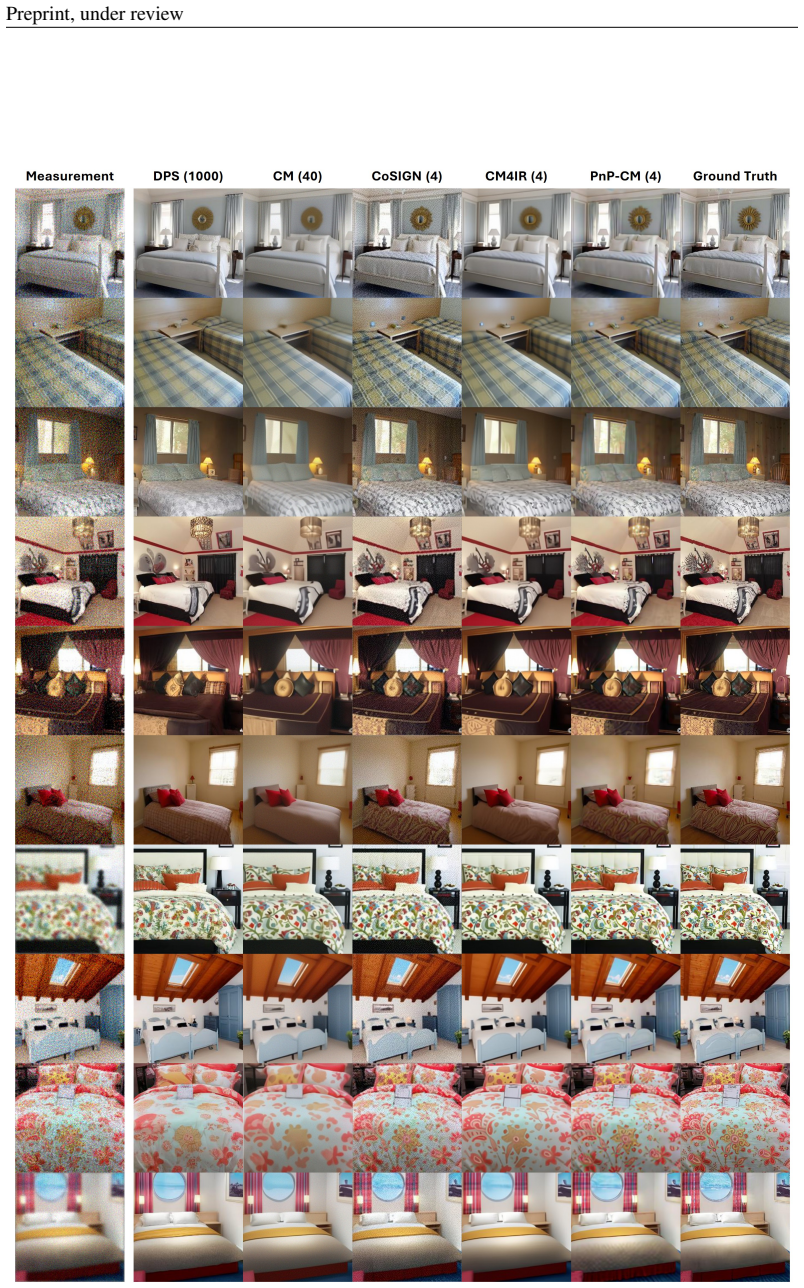
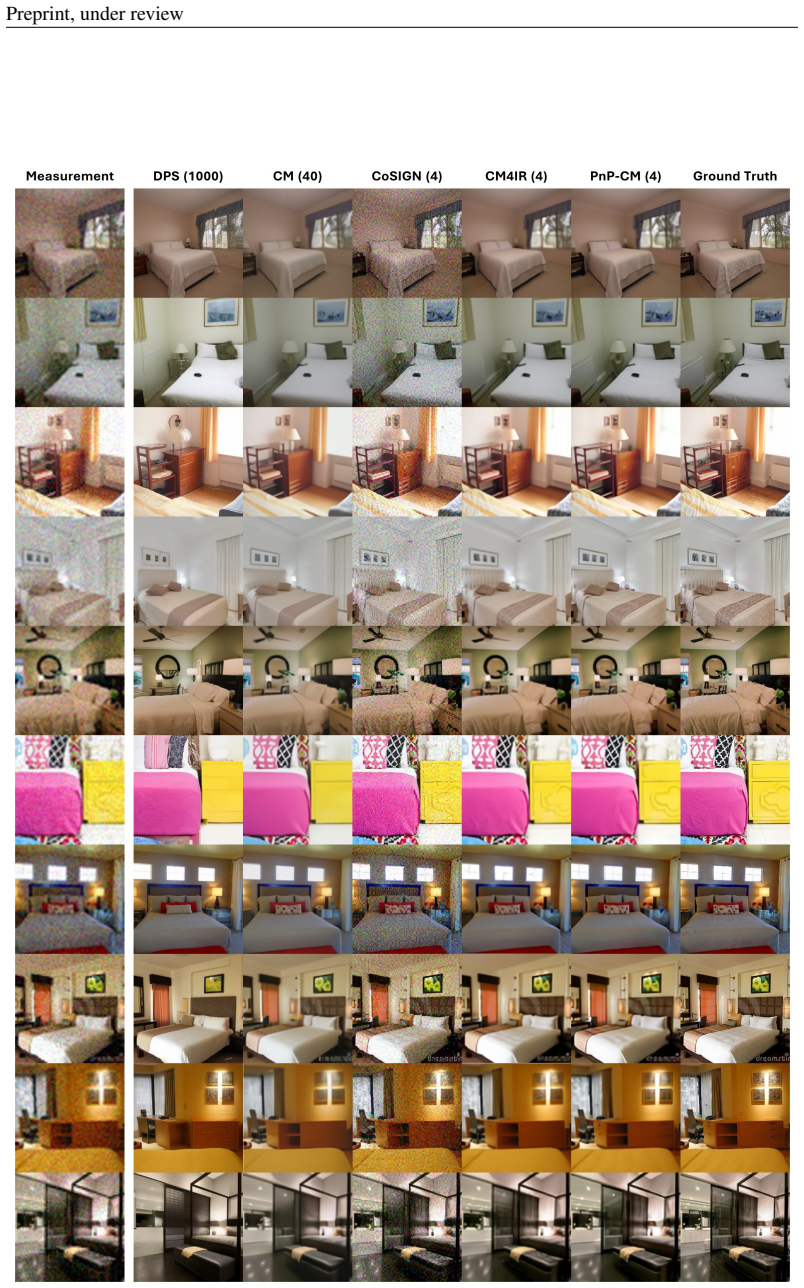
By treating consistency models as proximal operators, PnP-CM provides a unified ADMM-based solver that handles linear and nonlinear inverse problems, achieving high-quality results in as few as four neural function evaluations and meaningful outputs in two steps, while outperforming other consistency model approaches and being applied to MRI data for the first time.
What carries the argument
The PnP-ADMM iteration where the consistency model acts as the proximal operator for the prior, augmented with noise perturbation and momentum-based updates to handle the low number of function evaluations.
Load-bearing premise
That a consistency model trained on one dataset can function effectively as a proximal operator for the prior in a different inverse problem without any fine-tuning.
What would settle it
Reconstructing images from measurements in a new nonlinear inverse problem where PnP-CM produces artifacts or lower quality than traditional methods even after 4 steps would falsify the effectiveness claim.
Figures




read the original abstract
Diffusion models have found extensive use in solving inverse problems, by sampling from an approximate posterior distribution of data given the measurements. Recently, consistency models (CMs) have been proposed to directly predict the final output from any point on the diffusion ODE trajectory, enabling high-quality sampling in just a few neural function evaluations (NFEs). CMs have also been utilized for inverse problems, but existing CM-based solvers either require additional task-specific training or utilize data fidelity operations with slow convergence, limiting their applicability to large-scale problems and making them difficult to extend to nonlinear settings. In this work, we reinterpret CMs as proximal operators of a prior, enabling their integration into plug-and-play (PnP) frameworks. Specifically, we propose PnP-CM, an ADMM-based PnP solver that provides a unified framework for solving a wide range of inverse problems, and incorporates noise perturbations and momentum-based updates to improve performance in the low-NFE regime. We evaluate our approach on a diverse set of linear and nonlinear inverse problems. We also train and apply CMs to MRI data for the first time. Our results show that PnP-CM achieves high-quality reconstructions in as few as 4 NFEs, and produces meaningful results in 2 steps, highlighting its effectiveness in real-world inverse problems while outperforming existing CM-based approaches.
Editorial analysis
A structured set of objections, weighed in public.
Referee Report
Summary. The manuscript proposes PnP-CM, a plug-and-play ADMM framework that reinterprets pre-trained consistency models as proximal operators of an implicit data prior for solving linear and nonlinear inverse problems. It incorporates noise perturbations to the CM input and momentum-based updates to the iterates specifically to stabilize performance in the low-NFE regime. The approach is evaluated on diverse inverse problems including MRI reconstruction (claimed as the first application of CMs to MRI), with the central claim that it achieves high-quality results in as few as 4 NFEs (and meaningful results in 2 steps) while outperforming existing CM-based solvers without task-specific training.
Significance. If the performance claims and the proximal reinterpretation hold under scrutiny, the work would provide a training-free, unified PnP route for deploying fast consistency models on large-scale and nonlinear inverse problems, addressing a practical gap where prior CM solvers either require fine-tuning or exhibit slow convergence.
major comments (2)
- [Proposed PnP-CM algorithm and low-NFE stabilization] The central construction treats the CM output as the proximal map of an implicit prior inside ADMM. However, the method description explicitly adds noise perturbations to the input of the CM and momentum-based updates to the ADMM iterates specifically to stabilize the low-NFE regime. This indicates that the bare proximal reinterpretation (i.e., feeding the current ADMM variable directly into a fixed pre-trained CM) does not by itself produce the reported 2- and 4-NFE results. If the unmodified proximal step already satisfies the necessary fixed-point or contraction properties for ADMM, the extra mechanisms would be superfluous; their inclusion therefore suggests an unstated mismatch between the CM consistency function and the proximal operator required by the splitting.
- [Experimental results and evaluation] The abstract states that the method was evaluated on diverse linear and nonlinear problems including MRI and that it outperforms prior CM approaches, but provides no quantitative metrics, baseline details, or ablation results on the contribution of the added noise schedule and momentum coefficient. Without these, the central performance claims cannot be verified and the load-bearing role of the proposed adaptations remains unclear.
minor comments (1)
- [Method] Notation for the momentum coefficient and noise perturbation schedule should be introduced with explicit definitions and ranges early in the method section to improve reproducibility.
Simulated Author's Rebuttal
We thank the referee for the detailed and constructive review. We address each major comment below, clarifying the algorithmic foundations and committing to expanded experimental documentation in the revision.
read point-by-point responses
-
Referee: [Proposed PnP-CM algorithm and low-NFE stabilization] The central construction treats the CM output as the proximal map of an implicit prior inside ADMM. However, the method description explicitly adds noise perturbations to the input of the CM and momentum-based updates to the ADMM iterates specifically to stabilize the low-NFE regime. This indicates that the bare proximal reinterpretation (i.e., feeding the current ADMM variable directly into a fixed pre-trained CM) does not by itself produce the reported 2- and 4-NFE results. If the unmodified proximal step already satisfies the necessary fixed-point or contraction properties for ADMM, the extra mechanisms would be superfluous; their inclusion therefore suggests an unstated mismatch between the CM consistency function and the proximal operator required by the splitting.
Authors: We appreciate the referee's careful reading. The proximal-operator reinterpretation of consistency models remains the theoretical foundation of PnP-CM and is valid for the ADMM splitting; the consistency function is treated as an (approximate) proximal map of an implicit prior. In practice, however, pre-trained consistency models are finite approximations to the underlying diffusion process and therefore yield inexact proximal steps. When the number of ADMM iterations is restricted to the 2-4 NFE regime, these approximations can destabilize the iterates. The added noise perturbations restore consistency with the model's training distribution at each step, while the momentum updates provide acceleration for the inexact splitting scheme. Such stabilization techniques are standard in the PnP literature when proximal operators are only approximate. We will revise the manuscript to include a dedicated subsection that (i) states the proximal interpretation formally, (ii) explains why the bare step alone is insufficient for few-NFE convergence, and (iii) justifies the noise and momentum terms as practical enhancements that preserve the overall PnP framework rather than indicating a fundamental mismatch. revision: partial
-
Referee: [Experimental results and evaluation] The abstract states that the method was evaluated on diverse linear and nonlinear problems including MRI and that it outperforms prior CM approaches, but provides no quantitative metrics, baseline details, or ablation results on the contribution of the added noise schedule and momentum coefficient. Without these, the central performance claims cannot be verified and the load-bearing role of the proposed adaptations remains unclear.
Authors: We agree that the current presentation would benefit from greater transparency. The full manuscript contains quantitative comparisons on the reported tasks, but we acknowledge that the abstract and experimental section do not sufficiently highlight the numerical metrics, the precise baseline implementations, or ablations isolating the noise schedule and momentum coefficient. In the revised version we will (i) add a table summarizing PSNR/SSIM values across all tasks and baselines, (ii) provide explicit implementation details for each competing CM-based solver, and (iii) include a dedicated ablation study that quantifies the contribution of the noise perturbation schedule and the momentum parameter to the observed low-NFE performance. These additions will make the performance claims verifiable and will clarify the practical importance of the proposed stabilizations. revision: yes
Circularity Check
Standard reinterpretation of pre-trained CMs inside ADMM with minor self-citation; no load-bearing reduction to fitted inputs or definitions
full rationale
The paper's core step reinterprets consistency models as proximal operators for PnP-ADMM integration, drawing on existing ADMM splitting and pre-trained CMs without defining the proximal map in terms of the target reconstruction or fitting parameters to the reported low-NFE results. Noise perturbations and momentum updates are explicitly added as stabilizers rather than being derived from the proximal claim itself. Any self-citations to prior CM or PnP work are not load-bearing for the central performance claims, which remain independently testable against external inverse-problem benchmarks. This yields only a minor circularity score with no equations reducing predictions to inputs by construction.
Axiom & Free-Parameter Ledger
free parameters (2)
- momentum coefficient
- noise perturbation schedule
axioms (1)
- domain assumption Consistency models trained on clean data can be treated as proximal operators of an implicit image prior without further adaptation.
Lean theorems connected to this paper
-
IndisputableMonolith/Cost/FunctionalEquation.leanwashburn_uniqueness_aczel unclear?
unclearRelation between the paper passage and the cited Recognition theorem.
we reinterpret CMs as proximal operators of a prior, enabling their integration into plug-and-play (PnP) frameworks... incorporates noise perturbations and momentum-based updates
-
IndisputableMonolith/Foundation/AbsoluteFloorClosure.leanreality_from_one_distinction unclear?
unclearRelation between the paper passage and the cited Recognition theorem.
PnP-CM achieves high-quality reconstructions in as few as 4 NFEs
What do these tags mean?
- matches
- The paper's claim is directly supported by a theorem in the formal canon.
- supports
- The theorem supports part of the paper's argument, but the paper may add assumptions or extra steps.
- extends
- The paper goes beyond the formal theorem; the theorem is a base layer rather than the whole result.
- uses
- The paper appears to rely on the theorem as machinery.
- contradicts
- The paper's claim conflicts with a theorem or certificate in the canon.
- unclear
- Pith found a possible connection, but the passage is too broad, indirect, or ambiguous to say the theorem truly supports the claim.
Forward citations
Cited by 2 Pith papers
-
Stochastic Generative Plug-and-Play Priors
Noise injection into plug-and-play algorithms using pretrained score-based diffusion denoisers optimizes a Gaussian-smoothed objective and yields better reconstructions for severely ill-posed imaging tasks.
-
Plug-and-Play Consistency Models for MIMO Channel Estimation
Plug-and-play consistency models recover angular-domain MIMO channels from pilot observations in a small number of iterations.
Reference graph
Works this paper leans on
-
[1]
Zero-shot adaptation for approximate posterior sampling of diffusion models in inverse problems
Ya s ar Utku Al c alar and Mehmet Ak c akaya. Zero-shot adaptation for approximate posterior sampling of diffusion models in inverse problems. In Proc. Eur. Conf. Comput. Vis., pp.\ 444--460, 2024
work page 2024
-
[2]
On the convergence of N esterov's accelerated gradient method in stochastic settings, 2020
Mahmoud Assran and Michael Rabbat. On the convergence of N esterov's accelerated gradient method in stochastic settings, 2020. arXiv:2002.12414
-
[3]
On perturbed proximal gradient algorithms
Yves F Atchad \'e , Gersende Fort, and Eric Moulines. On perturbed proximal gradient algorithms. J. Mach. Learn. Res., 18 0 (10): 0 1--33, 2017
work page 2017
-
[4]
Pattern recognition and machine learning, volume 4
Christopher M Bishop and Nasser M Nasrabadi. Pattern recognition and machine learning, volume 4. Springer, 2006
work page 2006
-
[5]
Stephen Boyd, Neal Parikh, Eric Chu, Borja Peleato, and Jonathan Eckstein. Distributed optimization and statistical learning via the alternating direction method of multipliers. Found. Trends Mach. Learn., 3 0 (1): 0 1--122, 2011
work page 2011
-
[6]
Performance analysis of plug-and-play ADMM : A graph signal processing perspective
Stanley H Chan. Performance analysis of plug-and-play ADMM : A graph signal processing perspective. IEEE Trans. Comput. Imag., 5 0 (2): 0 274--286, 2019
work page 2019
-
[7]
Plug-and-play ADMM for image restoration: F ixed-point convergence and applications
Stanley H Chan, Xiran Wang, and Omar A Elgendy. Plug-and-play ADMM for image restoration: F ixed-point convergence and applications. IEEE Trans. Comput. Imag., 3 0 (1): 0 84--98, 2016
work page 2016
-
[8]
Score-based diffusion models for accelerated MRI
Hyungjin Chung and Jong Chul Ye. Score-based diffusion models for accelerated MRI . Med. Image Anal., 80, 2022. A rt. no. 102479
work page 2022
-
[9]
Diffusion posterior sampling for general noisy inverse problems
Hyungjin Chung, Jeongsol Kim, Michael T Mccann, Marc L Klasky, and Jong Chul Ye. Diffusion posterior sampling for general noisy inverse problems. In Proc. Int. Conf. Learn. Represent., 2023 a
work page 2023
-
[10]
Direct diffusion bridge using data consistency for inverse problems
Hyungjin Chung, Jeongsol Kim, and Jong Chul Ye. Direct diffusion bridge using data consistency for inverse problems. In Proc. Adv. Neural Inf. Process. Syst., pp.\ 7158--7169, 2023 b
work page 2023
-
[11]
Decomposed diffusion sampler for accelerating large-scale inverse problems
Hyungjin Chung, Suhyeon Lee, and Jong Chul Ye. Decomposed diffusion sampler for accelerating large-scale inverse problems. In Proc. Int. Conf. Learn. Represent., 2024
work page 2024
-
[12]
On the global and linear convergence of the generalized alternating direction method of multipliers
Wotao Deng and Wotao Yin. On the global and linear convergence of the generalized alternating direction method of multipliers. J. Sci. Comput., 66 0 (3): 0 889--916, 2016
work page 2016
-
[13]
Diffusion models beat GAN s on image synthesis
Prafulla Dhariwal and Alexander Nichol. Diffusion models beat GAN s on image synthesis. In Proc. Adv. Neural Inf. Process. Syst., pp.\ 8780--8794, 2021
work page 2021
-
[14]
Jonathan Eckstein and Wang Yao. Understanding the convergence of the alternating direction method of multipliers: T heoretical and computational perspectives. Pac. J. Optim., 11 0 (4): 0 619--644, 2015
work page 2015
-
[15]
Compressed sensing image reconstruction via recursive spatially adaptive filtering
Karen Egiazarian, Alessandro Foi, and Vladimir Katkovnik. Compressed sensing image reconstruction via recursive spatially adaptive filtering. In Proc. IEEE Int. Conf. Image Process., volume 1, pp.\ 549--552, 2007
work page 2007
-
[16]
Zero-shot image restoration using few-step guidance of consistency models (and beyond)
Tomer Garber and Tom Tirer. Zero-shot image restoration using few-step guidance of consistency models (and beyond). In Proc. IEEE/CVF Conf. Comput. Vis. Pattern Recog., pp.\ 2398--2407, 2025
work page 2025
-
[17]
Fast alternating direction optimization methods
Tom Goldstein, Brendan O'Donoghue, Simon Setzer, and Richard Baraniuk. Fast alternating direction optimization methods. SIAM J. Imag. Sci., 7 0 (3): 0 1588--1623, 2014
work page 2014
-
[18]
Escaping saddle points efficiently with occupation-time-adapted perturbations, 2020
Xin Guo, Jiequn Han, Mahan Tajrobehkar, and Wenpin Tang. Escaping saddle points efficiently with occupation-time-adapted perturbations, 2020. arXiv:2005.04507
-
[19]
Kerstin Hammernik, Thomas K \"u stner, Burhaneddin Yaman, Zhengnan Huang, Daniel Rueckert, Florian Knoll, and Mehmet Ak c akaya. Physics-driven deep learning for computational magnetic resonance imaging: Combining physics and machine learning for improved medical imaging. IEEE Signal Process. Mag., 40 0 (1): 0 98--114, 2023
work page 2023
-
[20]
Denoising diffusion probabilistic models
Jonathan Ho, Ajay Jain, and Pieter Abbeel. Denoising diffusion probabilistic models. In Proc. Adv. Neural Inf. Process. Syst., pp.\ 6840--6851, 2020
work page 2020
-
[21]
On the linear convergence of the alternating direction method of multipliers
Mingyi Hong and Zhi-Quan Luo. On the linear convergence of the alternating direction method of multipliers. Math. Program., 162: 0 165--199, 2017
work page 2017
-
[22]
Mingyi Hong, Zhi-Quan Luo, and Meisam Razaviyayn. Convergence analysis of alternating direction method of multipliers for a family of nonconvex problems. SIAM J. Optim., 26 0 (1): 0 337--364, 2016
work page 2016
-
[23]
Escaping saddle points for nonsmooth weakly convex functions via perturbed proximal algorithms, 2021
Minhui Huang. Escaping saddle points for nonsmooth weakly convex functions via perturbed proximal algorithms, 2021. arXiv:2102.02837
-
[24]
A plug-and-play priors approach for solving nonlinear imaging inverse problems
Ulugbek S Kamilov, Hassan Mansour, and Brendt Wohlberg. A plug-and-play priors approach for solving nonlinear imaging inverse problems. IEEE Signal Process. Lett., 24 0 (12): 0 1872--1876, 2017
work page 2017
-
[25]
Elucidating the design space of diffusion-based generative models
Tero Karras, Miika Aittala, Timo Aila, and Samuli Laine. Elucidating the design space of diffusion-based generative models. In Proc. Adv. Neural Inf. Process. Syst., pp.\ 26565--26577, 2022
work page 2022
-
[26]
Muckley, Mary Bruno, Aaron Defazio, Marc Parente, Krzysztof J
Florian Knoll, Jure Zbontar, Anuroop Sriram, Matthew J. Muckley, Mary Bruno, Aaron Defazio, Marc Parente, Krzysztof J. Geras, Joe Katsnelson, Hersh Chandarana, et al. fast MRI : a publicly available raw k-space and DICOM dataset of knee images for accelerated MR image reconstruction using machine learning. Radiol., Artif. Intell, 2 0 (1), Jan. 2020. A rt....
work page 2020
-
[27]
I ^2 SB: Image-to-Image Schr\"odinger Bridge
Guan-Horng Liu, Arash Vahdat, De-An Huang, Evangelos A Theodorou, Weili Nie, and Anima Anandkumar. I ^2 SB: Image-to-Image Schr\"odinger Bridge . In Proc. Int. Conf. Mach. Learn., 2023 a
work page 2023
-
[28]
Flow straight and fast: L earning to generate and transfer data with rectified flow
Xingchao Liu, Chengyue Gong, and qiang liu. Flow straight and fast: L earning to generate and transfer data with rectified flow. In Proc. Int. Conf. Learn. Represent., 2023 b
work page 2023
-
[29]
Insta F low: O ne step is enough for high-quality diffusion-based text-to-image generation
Xingchao Liu, Xiwen Zhang, Jianzhu Ma, Jian Peng, and qiang liu. Insta F low: O ne step is enough for high-quality diffusion-based text-to-image generation. In Proc. Int. Conf. Learn. Represent., 2024
work page 2024
-
[30]
Simplifying, stabilizing and scaling continuous-time consistency models
Cheng Lu and Yang Song. Simplifying, stabilizing and scaling continuous-time consistency models. In Proc. Int. Conf. Learn. Represent., 2025
work page 2025
-
[31]
A variational perspective on solving inverse problems with diffusion models
Morteza Mardani, Jiaming Song, Jan Kautz, and Arash Vahdat. A variational perspective on solving inverse problems with diffusion models. In Proc. Int. Conf. Learn. Represent., 2024
work page 2024
-
[32]
On distillation of guided diffusion models
Chenlin Meng, Robin Rombach, Ruiqi Gao, Diederik Kingma, Stefano Ermon, Jonathan Ho, and Tim Salimans. On distillation of guided diffusion models. In Proc. IEEE/CVF Conf. Comput. Vis. Pattern Recog., pp.\ 14297--14306, 2023
work page 2023
-
[33]
Variational diffusion posterior sampling with midpoint guidance
Badr Moufad, Yazid Janati, Lisa Bedin, Alain Durmus, Randal Douc, Eric Moulines, and Jimmy Olsson. Variational diffusion posterior sampling with midpoint guidance. In Proc. Int. Conf. Learn. Represent., 2025
work page 2025
-
[34]
A method of solving a convex programming problem with convergence rate o( 1/k^2 )
Y Nesterov. A method of solving a convex programming problem with convergence rate o( 1/k^2 ). Proceedings of the USSR Academy of Sciences, 269: 0 3, 1983
work page 1983
-
[35]
Trevor Park and George Casella. The B ayesian lasso. J. Amer. Stat. Assoc., 103 0 (482): 0 681--686, 2008
work page 2008
-
[36]
Progressive distillation for fast sampling of diffusion models
Tim Salimans and Jonathan Ho. Progressive distillation for fast sampling of diffusion models. In Proc. Int. Conf. Learn. Represent., 2022
work page 2022
-
[37]
Denoising diffusion implicit models
Jiaming Song, Chenlin Meng, and Stefano Ermon. Denoising diffusion implicit models. In Proc. Int. Conf. Learn. Represent., 2021 a
work page 2021
-
[38]
Pseudoinverse-guided diffusion models for inverse problems
Jiaming Song, Arash Vahdat, Morteza Mardani, and Jan Kautz. Pseudoinverse-guided diffusion models for inverse problems. In Proc. Int. Conf. Learn. Represent., 2023 a
work page 2023
-
[39]
Improved techniques for training consistency models
Yang Song and Prafulla Dhariwal. Improved techniques for training consistency models. In Proc. Int. Conf. Learn. Represent., 2024
work page 2024
-
[40]
Score-based generative modeling through stochastic differential equations
Yang Song, Jascha Sohl-Dickstein, Diederik P Kingma, Abhishek Kumar, Stefano Ermon, and Ben Poole. Score-based generative modeling through stochastic differential equations. In Proc. Int. Conf. Learn. Represent., 2021 b
work page 2021
-
[41]
Yang Song, Prafulla Dhariwal, Mark Chen, and Ilya Sutskever. Consistency models. In Proc. Int. Conf. Mach. Learn., 2023 b
work page 2023
-
[42]
A differential equation for modeling N esterov's accelerated gradient method: T heory and insights
Weijie Su, Stephen Boyd, and Emmanuel J Candes. A differential equation for modeling N esterov's accelerated gradient method: T heory and insights. J. Mach. Learn. Res., 17 0 (153): 0 1--43, 2016
work page 2016
-
[43]
Nesterov accelerated ADMM for fast diffeomorphic image registration
Alexander Thorley, Xi Jia, Hyung Jin Chang, Boyang Liu, Karina Bunting, Victoria Stoll, Antonio de Marvao, Declan P O’Regan, Georgios Gkoutos, Dipak Kotecha, et al. Nesterov accelerated ADMM for fast diffeomorphic image registration. In Proc. Int. Conf. Med. Image Comput. Comput.-Assist. Intervent., pp.\ 150--160, 2021
work page 2021
-
[44]
Regression shrinkage and selection via the lasso
Robert Tibshirani. Regression shrinkage and selection via the lasso. J. Roy. Stat. Soc., Ser. B (Methodol.), 58 0 (1): 0 267--288, 1996
work page 1996
-
[45]
Back-projection based fidelity term for ill-posed linear inverse problems
Tom Tirer and Raja Giryes. Back-projection based fidelity term for ill-posed linear inverse problems. IEEE Trans. Image Process., 29: 0 6164--6179, 2020
work page 2020
-
[46]
Plug-and-play priors for model based reconstruction
Singanallur V Venkatakrishnan, Charles A Bouman, and Brendt Wohlberg. Plug-and-play priors for model based reconstruction. In IEEE Global Conf. Signal Inf. Process., pp.\ 945--948, 2013
work page 2013
-
[47]
Scheduled restart momentum for accelerated stochastic gradient descent
Bao Wang, Tan Nguyen, Tao Sun, Andrea L Bertozzi, Richard G Baraniuk, and Stanley J Osher. Scheduled restart momentum for accelerated stochastic gradient descent. SIAM J. Imag. Sci., 15 0 (2): 0 738--761, 2022
work page 2022
-
[48]
Zero-shot image restoration using denoising diffusion null-space model
Yinhuai Wang, Jiwen Yu, and Jian Zhang. Zero-shot image restoration using denoising diffusion null-space model. In Proc. Int. Conf. Learn. Represent., 2023
work page 2023
-
[49]
Sparse B ayesian learning for basis selection
David P Wipf and Bhaskar D Rao. Sparse B ayesian learning for basis selection. IEEE Trans. Signal Process., 52 0 (8): 0 2153--2164, 2004
work page 2004
-
[50]
Improved distribution matching distillation for fast image synthesis
Tianwei Yin, Micha \"e l Gharbi, Taesung Park, Richard Zhang, Eli Shechtman, Fredo Durand, and Bill Freeman. Improved distribution matching distillation for fast image synthesis. In Proc. Adv. Neural Inf. Process. Syst., pp.\ 47455--47487, 2024 a
work page 2024
-
[51]
One-step diffusion with distribution matching distillation
Tianwei Yin, Micha \"e l Gharbi, Richard Zhang, Eli Shechtman, Fredo Durand, William T Freeman, and Taesung Park. One-step diffusion with distribution matching distillation. In Proc. IEEE/CVF Conf. Comput. Vis. Pattern Recog., pp.\ 6613--6623, 2024 b
work page 2024
-
[52]
LSUN: Construction of a Large-scale Image Dataset using Deep Learning with Humans in the Loop
Fisher Yu, Ari Seff, Yinda Zhang, Shuran Song, Thomas Funkhouser, and Jianxiong Xiao. LSUN : C onstruction of a large-scale image dataset using deep learning with humans in the loop, 2015. arXiv:1506.03365
work page internal anchor Pith review Pith/arXiv arXiv 2015
-
[53]
Adding conditional control to text-to-image diffusion models
Lvmin Zhang, Anyi Rao, and Maneesh Agrawala. Adding conditional control to text-to-image diffusion models. In Proc. IEEE/CVF Int. Conf. Comput. Vis., pp.\ 3836--3847, 2023
work page 2023
-
[54]
C o SIGN : F ew-step guidance of consistency model to solve general inverse problems
Jiankun Zhao, Bowen Song, and Liyue Shen. C o SIGN : F ew-step guidance of consistency model to solve general inverse problems. In Proc. Eur. Conf. Comput. Vis., pp.\ 108--126, 2024
work page 2024
-
[55]
Denoising diffusion models for plug-and-play image restoration
Yuanzhi Zhu, Kai Zhang, Jingyun Liang, Jiezhang Cao, Bihan Wen, Radu Timofte, and Luc Van Gool. Denoising diffusion models for plug-and-play image restoration. In Proc. IEEE/CVF Conf. Comput. Vis. Pattern Recog. Workshop, 2023
work page 2023
-
[56]
\@ifxundefined[1] #1\@undefined \@firstoftwo \@secondoftwo \@ifnum[1] #1 \@firstoftwo \@secondoftwo \@ifx[1] #1 \@firstoftwo \@secondoftwo [2] @ #1 \@temptokena #2 #1 @ \@temptokena \@ifclassloaded agu2001 natbib The agu2001 class already includes natbib coding, so you should not add it explicitly Type <Return> for now, but then later remove the command n...
-
[57]
\@lbibitem[] @bibitem@first@sw\@secondoftwo \@lbibitem[#1]#2 \@extra@b@citeb \@ifundefined br@#2\@extra@b@citeb \@namedef br@#2 \@nameuse br@#2\@extra@b@citeb \@ifundefined b@#2\@extra@b@citeb @num @parse #2 @tmp #1 NAT@b@open@#2 NAT@b@shut@#2 \@ifnum @merge>\@ne @bibitem@first@sw \@firstoftwo \@ifundefined NAT@b*@#2 \@firstoftwo @num @NAT@ctr \@secondoft...
-
[58]
(QGT+ o/߸ ;fQ Zt鐒gvZxG*J Y ȮY! dZs (HE E 2 n=#R
@open @close @open @close and [1] URL: #1 \@ifundefined chapter * \@mkboth \@ifxundefined @sectionbib * \@mkboth * \@mkboth\@gobbletwo \@ifclassloaded amsart * \@ifclassloaded amsbook * \@ifxundefined @heading @heading NAT@ctr thebibliography [1] @ \@biblabel @NAT@ctr \@bibsetup #1 @NAT@ctr @ @openbib .11em \@plus.33em \@minus.07em 4000 4000 `\.\@m @bibit...
discussion (0)
Sign in with ORCID, Apple, or X to comment. Anyone can read and Pith papers without signing in.