Gravitational waveforms from periodic orbits around a novel regular black hole
Pith reviewed 2026-05-18 12:32 UTC · model grok-4.3
The pith
Periodic orbits around a regular black hole with a Minkowski core generate gravitational waveforms showing phase shifts and amplitude modulations from quantum gravity effects that differ from Schwarzschild predictions.
A machine-rendered reading of the paper's core claim, the machinery that carries it, and where it could break.
Core claim
The paper establishes that periodic orbits around the novel regular black hole with Minkowski core, parameterized by α0 and classified by rational q, produce gravitational waveforms via numerical kludge methods that exhibit quantum gravity-induced phase shifts and amplitude modulations. Radiation reaction disrupts periodicity, and larger α0 and q enhance distinguishability from Schwarzschild waveforms in faithfulness tests, while large-scale behaviors remain similar to those of Hayward and quantum Oppenheimer-Snyder black holes.
What carries the argument
The deviation parameter α0 in the regular black hole metric with Minkowski core, which modifies the spacetime and thereby alters bound orbits and the resulting numerical kludge gravitational waveforms.
If this is right
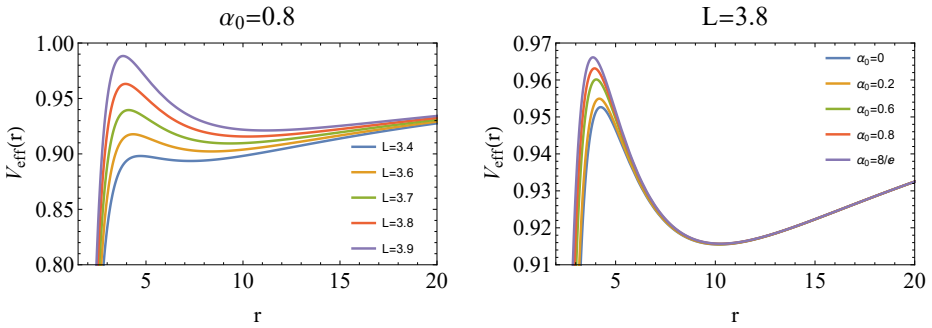
- The bound-orbit region reshapes under α0 while zoom-whirl structures remain intact.
- Radiation reaction from gravitational wave emission breaks the periodicity of the orbits.
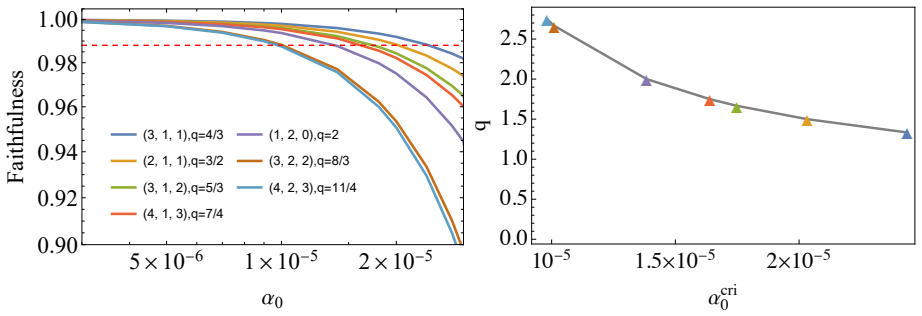
- Larger α0 and q values reduce faithfulness to Schwarzschild waveforms and improve distinguishability.
- Large-scale orbits and waveforms remain macroscopically similar to those of Hayward and quantum Oppenheimer-Snyder black holes.
Where Pith is reading between the lines
- Observations with future gravitational wave detectors could place bounds on α0 by searching for or excluding the predicted phase and amplitude deviations.
- The approach of classifying orbits by rational q and computing kludge waveforms could be applied to other regular black hole models for comparative tests of quantum signatures.
- If phase shifts are absent in real data at expected scales, it would constrain the physical relevance of Minkowski-core regular black hole metrics.
- The persistence of zoom-whirl features under quantum corrections suggests that certain orbital qualitative traits may be robust across different spacetime modifications.
Load-bearing premise
The novel regular black hole metric with Minkowski core is assumed to provide a physically relevant description of quantum gravity effects at the scales relevant for periodic orbits and gravitational wave emission.
What would settle it
A high-precision gravitational wave observation from a periodic orbit around an astrophysical black hole that matches Schwarzschild predictions exactly, with no detectable phase shift or amplitude modulation at parameter values where α0 effects are predicted to appear.
Figures


read the original abstract
We explore potential quantum gravity signatures by studying periodic orbits and their GW emissions around a novel regular black hole (BH) featuring a Minkowski core. Using a rational number $q$, periodic orbits are classified, revealing that the deviation parameter $\alpha_0$ reshapes the bound-orbit region while preserving characteristic ``zoom-whirl" structures. Numerical kludge waveforms reveal detectable phase shifts and amplitude modulations induced by quantum gravity effects with radiation reaction breaking orbital periodicity. Faithfulness analysis demonstrates that larger $\alpha_{0}$ and $q$ enhance distinguishability from the Schwarzschild case, and a comparison with Hayward and quantum Oppenheimer-Snyder BHs shows their similar large-scale behaviors yield macroscopically indistinguishable orbits and waveforms.
Editorial analysis
A structured set of objections, weighed in public.
Referee Report
Summary. The paper explores potential quantum gravity signatures by studying periodic orbits and their GW emissions around a novel regular black hole featuring a Minkowski core. Using a rational number q, periodic orbits are classified, revealing that the deviation parameter α0 reshapes the bound-orbit region while preserving characteristic zoom-whirl structures. Numerical kludge waveforms reveal detectable phase shifts and amplitude modulations induced by quantum gravity effects with radiation reaction breaking orbital periodicity. Faithfulness analysis demonstrates that larger α0 and q enhance distinguishability from the Schwarzschild case, and a comparison with Hayward and quantum Oppenheimer-Snyder BHs shows their similar large-scale behaviors yield macroscopically indistinguishable orbits and waveforms.
Significance. If the numerical results hold, this manuscript contributes to probing quantum gravity effects in gravitational wave signals from strong-field periodic orbits. The demonstration of phase shifts and enhanced distinguishability for larger deviation parameters provides a concrete example of how regular black hole metrics can lead to observable differences. Credit is given for the numerical computations supporting phase shifts and the comparative analysis with other regular black hole models, which helps contextualize the findings at large scales.
major comments (1)
- [Waveform generation and numerical methods] The central results depend on numerical kludge waveforms. Standard kludge methods combine geodesic motion with approximate wave generation and radiation reaction often tuned to Schwarzschild. For the novel metric with Minkowski core, the geometry near the center and effective potential differ, affecting orbital frequencies and multipoles. The manuscript does not detail the adaptation of the kludge (e.g., re-derivation of source terms or validation against the new geodesic equations), which risks uncontrolled errors in the reported phase shifts and faithfulness. This is a load-bearing issue for the claim that the effects are due to quantum gravity parameter α0.
minor comments (3)
- [Abstract] The abstract is clear but could include a brief mention of the specific metric form or key equations for better context.
- [Notation] Ensure consistent use of α_0 versus α0 throughout the text and figures.
- [References] Consider adding references to prior works on numerical kludge waveforms in modified gravity to strengthen the methodological foundation.
Simulated Author's Rebuttal
We thank the referee for their careful review and for recognizing the potential of our numerical results to probe quantum gravity effects. We address the major comment on waveform generation and numerical methods below, providing clarification on our approach while agreeing to enhance the manuscript's detail.
read point-by-point responses
-
Referee: The central results depend on numerical kludge waveforms. Standard kludge methods combine geodesic motion with approximate wave generation and radiation reaction often tuned to Schwarzschild. For the novel metric with Minkowski core, the geometry near the center and effective potential differ, affecting orbital frequencies and multipoles. The manuscript does not detail the adaptation of the kludge (e.g., re-derivation of source terms or validation against the new geodesic equations), which risks uncontrolled errors in the reported phase shifts and faithfulness. This is a load-bearing issue for the claim that the effects are due to quantum gravity parameter α0.
Authors: We appreciate this substantive point regarding the need for explicit documentation of our numerical implementation. In our work, the kludge waveforms are constructed by first solving the geodesic equations derived directly from the novel regular black hole metric, which incorporates the deviation parameter α0 into the effective potential and orbital frequencies. The particle trajectories are obtained via numerical integration of these metric-specific equations rather than Schwarzschild-tuned ones. Wave generation proceeds via the quadrupole formula, with multipole moments evaluated along the computed trajectory in the modified geometry; radiation reaction is included through energy and angular momentum loss rates computed consistently from the metric's Killing vectors and conserved quantities. We performed internal validations by cross-checking orbital periods and zoom-whirl frequencies against the analytic effective potential for varying α0. That said, we acknowledge that the manuscript would benefit from expanded exposition of these adaptations and validation steps to reduce any ambiguity. We will revise the methods section accordingly in the next version. revision: yes
Circularity Check
No circularity: results from direct numerical integration of orbits and kludge waveforms
full rationale
The paper classifies periodic orbits via rational q and integrates geodesics in the novel regular BH metric with parameter α0, then generates numerical kludge waveforms and computes faithfulness distances to Schwarzschild. These steps are computational outputs from the metric and radiation-reaction model rather than any reduction by definition, fitted-parameter renaming, or load-bearing self-citation. The central distinguishability claims follow from the simulated phase shifts and amplitude modulations; no equation or result is shown to equal its own input by construction. The derivation chain remains self-contained against the stated numerical procedure.
Axiom & Free-Parameter Ledger
free parameters (1)
- α0
axioms (2)
- domain assumption The spacetime is described by the novel regular black hole metric featuring a Minkowski core.
- domain assumption The kludge approximation provides a sufficiently accurate representation of gravitational waveforms for the purpose of detecting phase shifts.
invented entities (1)
-
Regular black hole with Minkowski core
no independent evidence
Lean theorems connected to this paper
-
IndisputableMonolith/Foundation/RealityFromDistinction.leanreality_from_one_distinction unclear?
unclearRelation between the paper passage and the cited Recognition theorem.
We explore potential quantum gravity signatures by studying periodic orbits and their GW emissions around a novel regular black hole featuring a Minkowski core. Using a rational number q, periodic orbits are classified... Numerical kludge waveforms reveal detectable phase shifts...
-
IndisputableMonolith/Foundation/DimensionForcing.leanD3_admits_circle_linking unclear?
unclearRelation between the paper passage and the cited Recognition theorem.
the deviation parameter α₀ reshapes the bound-orbit region while preserving characteristic 'zoom-whirl' structures
What do these tags mean?
- matches
- The paper's claim is directly supported by a theorem in the formal canon.
- supports
- The theorem supports part of the paper's argument, but the paper may add assumptions or extra steps.
- extends
- The paper goes beyond the formal theorem; the theorem is a base layer rather than the whole result.
- uses
- The paper appears to rely on the theorem as machinery.
- contradicts
- The paper's claim conflicts with a theorem or certificate in the canon.
- unclear
- Pith found a possible connection, but the passage is too broad, indirect, or ambiguous to say the theorem truly supports the claim.
Forward citations
Cited by 7 Pith papers
-
Particle motions and gravitational waveforms in rotating black hole spacetimes of loop quantum gravity
The LQG parameter ξ enlarges equatorial bound orbit energy ranges, confines off-equatorial trajectories, and produces larger deviations from Kerr waveforms in EMRI models for two rotating LQG black holes, though signa...
-
Gravitational radiations from periodic orbits around a black hole in the effective field theory extension of general relativity
Periodic orbits around EFTGR black holes produce gravitational waveforms whose substructures increase in complexity with higher zoom numbers.
-
Periodic orbits and their gravitational wave radiations in $\gamma$-metric
Deviations from γ=1 in the Zipoy-Voorhees metric shift the (z,w,v) classification of periodic orbits and induce phase shifts plus amplitude modulations in their gravitational-wave signals.
-
Probing Gravitational Wave Signatures from Periodic Orbits of Regular Black Holes in Asymptotically Safe Gravity
The quantum parameter ξ in an asymptotically safe regular black hole shifts the innermost stable orbit, enhances whirl behavior in periodic geodesics, and produces amplitude-modulated millihertz gravitational-wave str...
-
Gravitational waves of extreme-mass-ratio inspirals in a rotating black hole with Dehnen dark matter halo
EMRI waveforms in a rotating black hole with Dehnen DM halo show amplitude and phase shifts from Kerr, with mismatch rising as DM mass parameter and black hole spin increase.
-
Assessing EMRI Detectability of the Rotating Quantum Oppenheimer-Snyder Black Hole
Quantum corrections in rotating black holes produce detectable but spin-suppressed gravitational wave phase shifts in LISA EMRIs.
-
Taxonomy of periodic orbits and gravitational waves in a non-rotating Destounis-Suvorov-Kokkotas black hole spacetime
Periodic orbits around a non-rotating Destounis-Suvorov-Kokkotas black hole are taxonomized with integer triplets and their gravitational waveforms are calculated, showing that large deformations eliminate circular or...
Reference graph
Works this paper leans on
-
[1]
TianQin: a space-borne gravitational wave detector
W.-R. Hu and Y.-L. Wu,The Taiji Program in Space for gravitational wave physics and the nature of gravity, Natl. Sci. Rev.4(2017), no. 5 685–686. [8]TianQinCollaboration, J. Luo et al.,TianQin: a space-borne gravitational wave detector, Class. Quant. Grav.33(2016), no. 3 035010, [arXiv:1512.02076]
work page internal anchor Pith review Pith/arXiv arXiv 2017
-
[2]
V. Cardoso, S. Hopper, C. F. B. Macedo, C. Palenzuela, and P. Pani,Gravitational-wave signatures of exotic compact objects and of quantum corrections at the horizon scale, Phys. Rev. D94(2016), no. 8 084031, [arXiv:1608.08637]
work page internal anchor Pith review Pith/arXiv arXiv 2016
-
[3]
Echoes from the Abyss: Tentative evidence for Planck-scale structure at black hole horizons
J. Abedi, H. Dykaar, and N. Afshordi,Echoes from the Abyss: Tentative evidence for Planck-scale structure at black hole horizons, Phys. Rev. D96(2017), no. 8 082004, [arXiv:1612.00266]
work page internal anchor Pith review Pith/arXiv arXiv 2017
-
[4]
Q. Tan, S. Long, W. Deng, and J. Jing,Quasinormal modes and echoes of a double braneworld, JHEP02(2025) 055, [arXiv:2410.06945]. [12]Event Horizon TelescopeCollaboration, K. Akiyama et al.,First M87 Event Horizon Telescope Results. I. The Shadow of the Supermassive Black Hole, Astrophys. J. Lett.875 (2019) L1, [arXiv:1906.11238]. [13]Event Horizon Telesco...
-
[5]
Black holes, gravitational waves and fundamental physics: a roadmap
L. Barack et al.,Black holes, gravitational waves and fundamental physics: a roadmap, Class. Quant. Grav.36(2019), no. 14 143001, [arXiv:1806.05195]
work page internal anchor Pith review Pith/arXiv arXiv 2019
-
[6]
W. A. Bardeen and W. K. Tung,Invariant amplitudes for photon processes, Phys. Rev.173 (1968) 1423–1433. [Erratum: Phys.Rev.D 4, 3229–3229 (1971)]
work page 1968
-
[7]
S. A. Hayward,Formation and evaporation of regular black holes, Phys. Rev. Lett.96(2006) 19 031103, [gr-qc/0506126]
work page internal anchor Pith review Pith/arXiv arXiv 2006
-
[8]
Singularities and the Finale of Black Hole Evaporation
L. Xiang, Y. Ling, and Y. G. Shen,Singularities and the Finale of Black Hole Evaporation, Int. J. Mod. Phys. D22(2013) 1342016, [arXiv:1305.3851]
work page internal anchor Pith review Pith/arXiv arXiv 2013
-
[9]
On a regular modified Schwarzschild spacetime
H. Culetu,On a regular modified Schwarzschild spacetime,arXiv:1305.5964
work page internal anchor Pith review Pith/arXiv arXiv
-
[10]
A. Simpson and M. Visser,Regular black holes with asymptotically Minkowski cores, Universe6(2019), no. 1 8, [arXiv:1911.01020]
-
[11]
Y. Ling and M.-H. Wu,Regular black holes with sub-Planckian curvature, Class. Quant. Grav.40(2023), no. 7 075009, [arXiv:2109.05974]
-
[12]
Y. Ling and M.-H. Wu,Modified regular black holes with time delay and 1-loop quantum correction *, Chin. Phys. C46(2022), no. 2 025102, [arXiv:2109.12938]
- [13]
-
[14]
Y. Ling and M.-H. Wu,The Shadows of Regular Black Holes with Asymptotic Minkowski Cores, Symmetry14(2022), no. 11 2415, [arXiv:2205.08919]
- [15]
-
[16]
S. Yang, W.-D. Guo, Q. Tan, and Y.-X. Liu,Axial gravitational quasinormal modes of a self-dual black hole in loop quantum gravity, Phys. Rev. D108(2023), no. 2 024055, [arXiv:2304.06895]
- [17]
-
[18]
S. Yang, W.-D. Guo, Q. Tan, L. Zhao, and Y.-X. Liu,Parametrized quasinormal frequencies and Hawking radiation for axial gravitational perturbations of a holonomy-corrected black hole, Phys. Rev. D110(2024), no. 6 064051, [arXiv:2406.15711]
- [19]
-
[20]
X. Qiao, Z.-W. Xia, Q. Pan, H. Guo, W.-L. Qian, and J. Jing,Gravitational waves from extreme mass ratio inspirals in Kerr-MOG spacetimes, JCAP03(2025) 006, [arXiv:2408.10022]
- [21]
- [22]
-
[23]
K. Glampedakis and D. Kennefick,Zoom and whirl: Eccentric equatorial orbits around spinning black holes and their evolution under gravitational radiation reaction, Phys. Rev. D 66(2002) 044002, [gr-qc/0203086]
work page internal anchor Pith review Pith/arXiv arXiv 2002
-
[24]
The motion of point particles in curved spacetime
E. Poisson,The Motion of point particles in curved space-time, Living Rev. Rel.7(2004) 6, [gr-qc/0306052]
work page internal anchor Pith review Pith/arXiv arXiv 2004
-
[25]
A Periodic Table for Black Hole Orbits
J. Levin and G. Perez-Giz,A Periodic Table for Black Hole Orbits, Phys. Rev. D77(2008) 103005, [arXiv:0802.0459]
work page internal anchor Pith review Pith/arXiv arXiv 2008
-
[26]
Zoom-Whirl Orbits in Black Hole Binaries
J. Healy, J. Levin, and D. Shoemaker,Zoom-Whirl Orbits in Black Hole Binaries, Phys. Rev. Lett.103(2009) 131101, [arXiv:0907.0671]
work page internal anchor Pith review Pith/arXiv arXiv 2009
-
[27]
T. A. Apostolatos, G. Lukes-Gerakopoulos, and G. Contopoulos,How to Observe a Non-Kerr Spacetime Using Gravitational Waves, Phys. Rev. Lett.103(2009) 111101, [arXiv:0906.0093]
work page internal anchor Pith review Pith/arXiv arXiv 2009
-
[28]
E. E. Flanagan and T. Hinderer,Transient resonances in the inspirals of point particles into black holes, Phys. Rev. Lett.109(2012) 071102, [arXiv:1009.4923]
work page internal anchor Pith review Pith/arXiv arXiv 2012
-
[29]
C. P. L. Berry, R. H. Cole, P. Ca˜ nizares, and J. R. Gair,Importance of transient resonances in extreme-mass-ratio inspirals, Phys. Rev. D94(2016), no. 12 124042, [arXiv:1608.08951]
work page internal anchor Pith review Pith/arXiv arXiv 2016
-
[30]
L. Speri and J. R. Gair,Assessing the impact of transient orbital resonances, Phys. Rev. D 103(2021), no. 12 124032, [arXiv:2103.06306]
- [31]
-
[32]
Dynamics of Black Hole Pairs I: Periodic Tables
J. Levin and B. Grossman,Dynamics of Black Hole Pairs. I. Periodic Tables, Phys. Rev. D 79(2009) 043016, [arXiv:0809.3838]
work page internal anchor Pith review Pith/arXiv arXiv 2009
-
[33]
Homoclinic Orbits around Spinning Black Holes I: Exact Solution for the Kerr Separatrix
J. Levin and G. Perez-Giz,Homoclinic Orbits around Spinning Black Holes. I. Exact Solution for the Kerr Separatrix, Phys. Rev. D79(2009) 124013, [arXiv:0811.3814]
work page internal anchor Pith review Pith/arXiv arXiv 2009
-
[34]
Energy Level Diagrams for Black Hole Orbits
J. Levin,Energy Level Diagrams for Black Hole Orbits, Class. Quant. Grav.26(2009) 235010, [arXiv:0907.5195]
work page internal anchor Pith review Pith/arXiv arXiv 2009
-
[35]
The harmonic structure of generic Kerr orbits
R. Grossman, J. Levin, and G. Perez-Giz,The harmonic structure of generic Kerr orbits, 21 Phys. Rev. D85(2012) 023012, [arXiv:1105.5811]
work page internal anchor Pith review Pith/arXiv arXiv 2012
-
[36]
Rational Orbits around Charged Black Holes
V. Misra and J. Levin,Rational Orbits around Charged Black Holes, Phys. Rev. D82(2010) 083001, [arXiv:1007.2699]
work page internal anchor Pith review Pith/arXiv arXiv 2010
-
[37]
Deng,Geodesics and periodic orbits around quantum-corrected black holes, Phys
X.-M. Deng,Geodesics and periodic orbits around quantum-corrected black holes, Phys. Dark Univ.30(2020) 100629
work page 2020
- [38]
-
[39]
S. Yang, Y.-P. Zhang, T. Zhu, L. Zhao, and Y.-X. Liu,Gravitational waveforms from periodic orbits around a quantum-corrected black hole, JCAP01(2025) 091, [arXiv:2407.00283]
- [40]
-
[41]
G. Z. Babar, A. Z. Babar, and Y.-K. Lim,Periodic orbits around a spherically symmetric naked singularity, Phys. Rev. D96(2017), no. 8 084052, [arXiv:1710.09581]
work page internal anchor Pith review Pith/arXiv arXiv 2017
-
[42]
M. Azreg-A¨ ınou, Z. Chen, B. Deng, M. Jamil, T. Zhu, Q. Wu, and Y.-K. Lim,Orbital mechanics and quasiperiodic oscillation resonances of black holes in Einstein-Æther theory, Phys. Rev. D102(2020), no. 4 044028, [arXiv:2004.02602]
-
[43]
S.-W. Wei, J. Yang, and Y.-X. Liu,Geodesics and periodic orbits in Kehagias-Sfetsos black holes in deformed Horava-Lifshitz gravity, Phys. Rev. D99(2019), no. 10 104016, [arXiv:1904.03129]
work page internal anchor Pith review Pith/arXiv arXiv 2019
-
[44]
T.-Y. Zhou and Y. Xie,Precessing and periodic motions around a black-bounce/traversable wormhole, Eur. Phys. J. C80(2020), no. 11 1070
work page 2020
-
[45]
H.-Y. Lin and X.-M. Deng,Rational orbits around 4DEinstein–Lovelock black holes, Phys. Dark Univ.31(2021) 100745
work page 2021
-
[46]
B. Gao and X.-M. Deng,Bound orbits around modified Hayward black holes, Mod. Phys. Lett. A36(2021), no. 33 2150237
work page 2021
-
[47]
J. Zhang and Y. Xie,Probing a black-bounce-Reissner–Nordstr¨ om spacetime with precessing and periodic motion, Eur. Phys. J. C82(2022), no. 10 854
work page 2022
-
[48]
R. Wang, F. Gao, and H. Chen,Periodic orbits around a static spherically symmetric black hole surrounded by quintessence, Annals Phys.447(2022), no. 1 169167
work page 2022
-
[49]
J. Zhang and Y. Xie,Probing a self-complete and Generalized-Uncertainty-Principle black 22 hole with precessing and periodic motion, Astrophys. Space Sci.367(2022), no. 2 17
work page 2022
-
[50]
H.-Y. Lin and X.-M. Deng,Precessing and periodic orbits around hairy black holes in Horndeski’s Theory, Eur. Phys. J. C83(2023), no. 4 311
work page 2023
- [51]
-
[52]
L. Huang and X.-M. Deng,Can a particle’s motion distinguish scale-dependent Planck stars from renormalization group improved Schwarzschild black holes?, Phys. Rev. D109(2024), no. 12 124005
work page 2024
- [53]
- [54]
- [55]
- [56]
- [57]
- [58]
-
[59]
O. Shabbir, M. Jamil, and M. Azreg-A¨ ınou,Periodic orbits and their gravitational wave radiations around the Schwarzschild-MOG black hole, Phys. Dark Univ.47(2025) 101816, [arXiv:2501.04367]
- [60]
-
[61]
Chandrasekhar, The mathematical theory of black holes
S. Chandrasekhar, The mathematical theory of black holes. Oxford University Press, USA, 1985
work page 1985
-
[62]
S. A. Hughes, S. Drasco, E. E. Flanagan, and J. Franklin,Gravitational radiation reaction and inspiral waveforms in the adiabatic limit, Phys. Rev. Lett.94(2005) 221101, [gr-qc/0504015]
work page internal anchor Pith review Pith/arXiv arXiv 2005
-
[63]
P. A. Sundararajan, G. Khanna, and S. A. Hughes,Towards adiabatic waveforms for inspiral into Kerr black holes. I. A New model of the source for the time domain perturbation equation, Phys. Rev. D76(2007) 104005, [gr-qc/0703028]
work page internal anchor Pith review Pith/arXiv arXiv 2007
-
[64]
Faster computation of adiabatic EMRIs using resonances
R. Grossman, J. Levin, and G. Perez-Giz,Faster computation of adiabatic extreme mass-ratio inspirals using resonances, Phys. Rev. D88(2013), no. 2 023002, [arXiv:1108.1819]
work page internal anchor Pith review Pith/arXiv arXiv 2013
-
[65]
"Kludge" gravitational waveforms for a test-body orbiting a Kerr black hole
S. Babak, H. Fang, J. R. Gair, K. Glampedakis, and S. A. Hughes,’Kludge’ gravitational waveforms for a test-body orbiting a Kerr black hole, Phys. Rev. D75(2007) 024005, [gr-qc/0607007]. [Erratum: Phys.Rev.D 77, 04990 (2008)]
work page internal anchor Pith review Pith/arXiv arXiv 2007
-
[66]
Post-Newtonian Theory for Gravitational Waves
L. Blanchet,Post-Newtonian Theory for Gravitational Waves, Living Rev. Rel.17(2014) 2, [arXiv:1310.1528]
work page internal anchor Pith review Pith/arXiv arXiv 2014
-
[67]
P. C. Peters,Gravitational radiation and the motion of two point masses, Phys. Rev.136 (1964), no. 4B B1224
work page 1964
- [68]
discussion (0)
Sign in with ORCID, Apple, or X to comment. Anyone can read and Pith papers without signing in.