Microscopic study of nuclei synthesis in pycnonuclear reaction ¹²C + ¹²C in neutron stars
Pith reviewed 2026-05-18 09:20 UTC · model grok-4.3
The pith
Compound nucleus formation from carbon collisions is far more probable in quasibound states than zero-point vibrations inside neutron stars.
A machine-rendered reading of the paper's core claim, the machinery that carries it, and where it could break.
Core claim
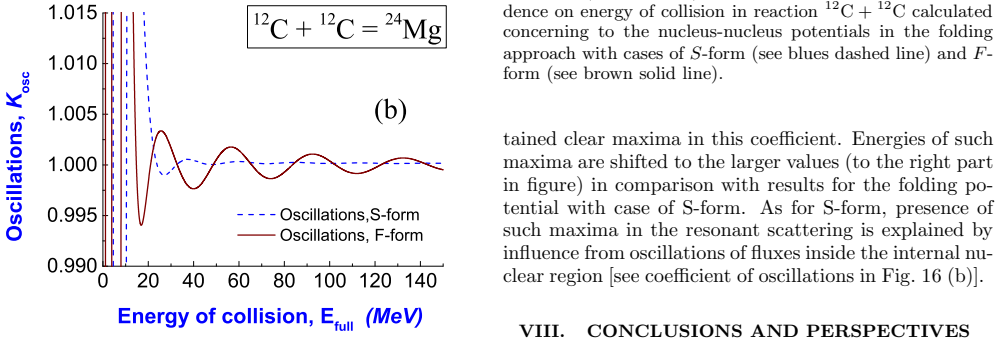
The wave functions of resonance states of 24Mg are set by the interaction between two 12C nuclei. Clear maxima appear in the probability of compound-nucleus formation at the first quasibound energies. These energies lie below the barrier maximum, so the compound system is held by a barrier that blocks decay by tunneling. This produces a new excited nucleus 24Mg inside the neutron star. The folding potential built from a semi-realistic nucleon-nucleon interaction and shell-model wave functions for p-shell nuclei gives results that differ essentially from those obtained with a Woods-Saxon potential.
What carries the argument
Folding potential derived from semi-realistic nucleon-nucleon interaction and shell-model wave functions for p-shell nuclei, together with the multiple internal reflections method for calculating formation probabilities.
Load-bearing premise
The folding potential built from semi-realistic nucleon-nucleon interaction and shell-model wave functions for p-shell nuclei correctly describes the effective force between two carbon nuclei in dense stellar matter, while the multiple internal reflections method gives the true formation probability without extra medium corrections.
What would settle it
Finding that the lowest quasibound energy for the 12C + 12C system exceeds the barrier maximum, or that formation probability is larger in zero-point vibration states than in quasibound states, would show the proposed mechanism for stable 24Mg synthesis does not hold.
Figures


read the original abstract
Purpose To investigate synthesis of nuclei in pycnonuclear reactions in dense medium of neutron stars on the basis of understanding, how the compound nucleus is formed during collision of two nuclei. To implement microscopic formulation of nuclear interactions and fusion in pycnonuclear reactions in dense medium. Methods (1) Nuclei synthesis in pycnonuclear reaction in dense medium of neutron star is investigated in the folding approximation of the cluster model. (2) Formation of compound nucleus in dense medium is studied with the method of Multiple Internal Reflections. Results (1) Wave functions of resonance states of $^{24}$Mg are determined by interaction of two $^{12}$C nuclei. (2) Clear maxima of probability of formation of compound nucleus in dense stellar medium are established at first time. (3) Difference between quasibound energies for potential of Woods-Saxon type and folding potentials with the shell-model approximation for wave functions is essential. (4) Formation of the compound nucleus is much more probable in the quasibound states than in states of zero-point vibrations. (5) Only the first quasibound energies for $^{12}$C + $^{12}$Care smaller than the barrier maximums. At these energies compound nuclear system has barrier which prevents its decay going through tunneling phenomenon. This is the new excited nucleus $^{24}$Mg synthesised in the neutron star. \item[Conclusions] Cluster approach with folding potential provides significant modification of picture of formation of compound nucleus, previously obtained concerning the potential of Woods-Saxon type. The highest precision is provided by the folding potential, created by semi-realistic nucleon-nucleon potential and shell-model description of the internal structure of interacting $p$-shell nuclei.
Editorial analysis
A structured set of objections, weighed in public.
Referee Report
Summary. The manuscript investigates nuclei synthesis in the pycnonuclear reaction 12C + 12C within the dense medium of neutron stars. It employs a microscopic folding potential constructed from a semi-realistic nucleon-nucleon interaction and shell-model wave functions for p-shell nuclei, combined with the multiple internal reflections (MIR) method, to compute resonance wave functions of 24Mg, identify probability maxima for compound-nucleus formation, and compare quasibound energies against the barrier maximum. The central conclusion is that compound-nucleus formation is far more probable in quasibound states than in zero-point vibrations, with only the lowest quasibound energies lying below the barrier, thereby stabilizing a new excited 24Mg state via tunneling suppression.
Significance. If the numerical results hold, the work supplies a parameter-sensitive but microscopically grounded alternative to phenomenological Woods-Saxon treatments of fusion in stellar interiors, potentially refining models of neutron-star crust nucleosynthesis. The explicit contrast between folding and Woods-Saxon potentials and the use of shell-model inputs constitute a clear methodological advance, though the absence of tabulated energies, probabilities, and convergence diagnostics limits immediate usability.
major comments (3)
- [Abstract / Results] Abstract and Results section: the claims that 'clear maxima of probability of formation of compound nucleus in dense stellar medium are established at first time' and that 'formation of the compound nucleus is much more probable in the quasibound states' rest on unshown numerical solutions of the MIR equations; no tables of quasibound energies, barrier heights, formation probabilities, or error estimates are supplied, preventing verification of the ordering relative to the barrier maximum.
- [Methods / Results] Methods and Results: the folding potential is built from fitted semi-realistic NN parameters and shell-model wave functions, yet the manuscript does not quantify how variations in these inputs (or the addition of electron-screening or lattice-polarization corrections appropriate to neutron-star densities) shift the quasibound energies relative to the barrier; this sensitivity directly affects the claim that only the first quasibound energies lie below the barrier maximum.
- [Results] Results: the statement that 'only the first quasibound energies for 12C + 12C are smaller than the barrier maximums' is presented without the corresponding numerical values, without a direct comparison table to the Woods-Saxon case, and without convergence checks on the MIR truncation, rendering the stabilization argument for the excited 24Mg untestable from the given text.
minor comments (2)
- [Abstract] Abstract: 'at first time' should read 'for the first time'; '12C + 12Care' is missing a space.
- [Methods] The manuscript would benefit from explicit statements of the MIR basis size, integration limits, and numerical precision used to locate the probability maxima.
Simulated Author's Rebuttal
We thank the referee for the thorough review and constructive feedback on our manuscript. We address each major comment point by point below, indicating revisions where the manuscript will be updated to improve verifiability and completeness while maintaining the focus of the original microscopic approach.
read point-by-point responses
-
Referee: [Abstract / Results] Abstract and Results section: the claims that 'clear maxima of probability of formation of compound nucleus in dense stellar medium are established at first time' and that 'formation of the compound nucleus is much more probable in the quasibound states' rest on unshown numerical solutions of the MIR equations; no tables of quasibound energies, barrier heights, formation probabilities, or error estimates are supplied, preventing verification of the ordering relative to the barrier maximum.
Authors: We agree that explicit numerical tabulation would strengthen verifiability of the claims. The probability maxima are derived from solutions of the MIR equations and are visualized in the figures, but we will add a dedicated table in the revised Results section listing the quasibound energies, barrier maxima, and formation probabilities for the key states. This will allow direct confirmation that formation is more probable in quasibound states than zero-point vibrations. No formal error estimates were part of the original analysis, but we will note the numerical stability of the MIR implementation. revision: yes
-
Referee: [Methods / Results] Methods and Results: the folding potential is built from fitted semi-realistic NN parameters and shell-model wave functions, yet the manuscript does not quantify how variations in these inputs (or the addition of electron-screening or lattice-polarization corrections appropriate to neutron-star densities) shift the quasibound energies relative to the barrier; this sensitivity directly affects the claim that only the first quasibound energies lie below the barrier maximum.
Authors: The parameters for the semi-realistic NN interaction and shell-model wave functions are taken from established literature values for p-shell nuclei, as described in the Methods. A full quantitative sensitivity study to input variations or inclusion of electron-screening and lattice-polarization effects at neutron-star densities would require extensive new computations outside the present scope. We will add a paragraph discussing the expected robustness, noting that such corrections are typically smaller than the differences between folding and phenomenological potentials already highlighted, and reference prior work on screening in dense media. revision: partial
-
Referee: [Results] Results: the statement that 'only the first quasibound energies for 12C + 12C are smaller than the barrier maximums' is presented without the corresponding numerical values, without a direct comparison table to the Woods-Saxon case, and without convergence checks on the MIR truncation, rendering the stabilization argument for the excited 24Mg untestable from the given text.
Authors: We accept that the absence of tabulated values and a direct comparison limits immediate testability. In the revision we will insert a table in the Results section with the quasibound energies for the folding potential, the corresponding Woods-Saxon values, and the barrier maxima, explicitly showing that only the lowest quasibound states lie below the barrier. We will also add a statement confirming that the MIR truncation parameter was chosen to achieve convergence of resonance positions to better than the precision needed for the stabilization conclusion. revision: yes
Circularity Check
No significant circularity; results are computed outputs from independent microscopic model
full rationale
The paper applies a folding potential built from a semi-realistic NN interaction plus shell-model wave functions for p-shell nuclei, together with the multiple internal reflections method, to compute quasibound energies, barrier comparisons, and formation probabilities for the 12C+12C system. The reported findings—that formation is more probable in quasibound states, that only the lowest quasibound energies lie below barrier maxima, and that these differ substantially from Woods-Saxon results—are direct numerical outputs of this framework rather than redefinitions or statistical forcings of the inputs. No equations reduce the target claims to prior fits by construction, and the model choices remain externally falsifiable against nuclear structure data and alternative potentials without self-referential loops.
Axiom & Free-Parameter Ledger
free parameters (2)
- parameters of the semi-realistic nucleon-nucleon potential
- parameters of the Woods-Saxon potential
axioms (2)
- domain assumption Shell-model wave functions adequately describe the internal structure of p-shell nuclei such as 12C
- domain assumption The folding approximation remains valid inside the dense medium of a neutron star
Lean theorems connected to this paper
-
IndisputableMonolith/Cost/FunctionalEquation.leanwashburn_uniqueness_aczel unclear?
unclearRelation between the paper passage and the cited Recognition theorem.
folding approximation of the cluster model... method of Multiple Internal Reflections... Volkov, Hasegawa-Nagata and Minnesota potentials
-
IndisputableMonolith/Foundation/RealityFromDistinction.leanreality_from_one_distinction unclear?
unclearRelation between the paper passage and the cited Recognition theorem.
quasibound energies... barrier maximums... new excited nucleus 24Mg
What do these tags mean?
- matches
- The paper's claim is directly supported by a theorem in the formal canon.
- supports
- The theorem supports part of the paper's argument, but the paper may add assumptions or extra steps.
- extends
- The paper goes beyond the formal theorem; the theorem is a base layer rather than the whole result.
- uses
- The paper appears to rely on the theorem as machinery.
- contradicts
- The paper's claim conflicts with a theorem or certificate in the canon.
- unclear
- Pith found a possible connection, but the passage is too broad, indirect, or ambiguous to say the theorem truly supports the claim.
Reference graph
Works this paper leans on
- [1]
-
[2]
811 × 10+30 (see Eqs. (45)–(46) in Ref. [6], see also references for method, tests, demonstrations for different nuclear reactions, etc.). Note that this approach pro- vides also high precision tests for checking calculations which is fulfilled with accuracy up 10 − 14 (there is no other approaches providing such accuracy in estimation of penetrabilities of...
-
[3]
(see also Ref. [16], p. 83, Sect. 3.5): (1) transforma- tion of H to 4He at density higher than 5 ·104 g ·cm− 3, (2) transformation of 4He to 12C at density higher than 8 ·108 g ·cm− 3, (3) transformation of 12C to 24Mg at 3 density higher than 6 ·109 g ·cm− 3. As Hamada and Salpeter estimated, 12C are converted to 24Mg in pyc- nonuclear reactions above a...
-
[4]
4829 fm of 8 mass root-mean-square radius
738 fm, then with the shell-mode wave functions we obtain the experimental value [54] Rm = 2. 4829 fm of 8 mass root-mean-square radius. In Fig. 5 we demonstrate spectrum of the resonance states, obtained with the folding and Woods-Saxon po- tentials. One can see that the folding potential generates almost uniformly distributed resonance states over the s...
-
[5]
Thus, such quantities can be used to prove resonance states and locate their positions
The internal weight for narrow resonance state reach its maximum and is close to 100%, the internal weight for wide resonance state has a contribution of 46% which is substantially larger than for other states of continuous spectrum. Thus, such quantities can be used to prove resonance states and locate their positions. FIG. 12: (Color online) Spectrum of...
work page 1936
-
[6]
Two resonance states were found for the orbital momenta from 10 to 18
It was established that the composition of the attractive nuclear potential and centrifugal barrier combined with the Coulomb repulsive interaction creates favorable conditions for residing of two res- onance states, one is narrow of order of several keV and another is wider than 1 MeV. Two resonance states were found for the orbital momenta from 10 to 18...
-
[7]
462 for the folding potential with F-form (see Tabl
487 and E2 = 8. 462 for the folding potential with F-form (see Tabl. III). The barrier maxima are Vmax = 5 . 972 MeV for the potential of Woods- Saxon type (at r = 8. 33 fm),Vmax = 7. 366 MeV for the folding potential with S-form (at r = 6. 65 fm), Vmax = 5. 744 MeV for the folding potential with F-form (at r = 8. 65 fm) (see Fig. 2 and Fig. 14). So, at t...
-
[8]
E. E. Salpeter and H. M. Van Horn, Astrophys. J. 155, 183 (1969)
work page 1969
-
[9]
S. Schramm and S. E. Koonin, Astrophys. J. 365, 296 18 (1990); erratum: 377, 343 (1991)
work page 1990
- [10]
- [11]
-
[12]
A. G. W. Cameron, Astrophys. J. 130, 916 (1959)
work page 1959
- [13]
- [14]
- [15]
-
[16]
D. G. Yakovlev, K. P. Levenfish, and O. Y. Gnedin, Eu- rop. Phys. Journ. A 25 (s01), 669 (2005)
work page 2005
- [17]
-
[18]
E. E. Salpeter and H. M. van Horn, Astrophys. J. 155, 183 (1969)
work page 1969
- [19]
- [20]
- [21]
-
[22]
Ya. B. Zel’dovich and O. H. Guseynov, Astrophys. J. 144, 840 (1965)
work page 1965
-
[23]
S. L. Shapiro and S. A. Teukolsky, Black Holes, White Dwarfs, and Neutron Stars: The Physics of Compact Ob- jects (Wiley-VCH Verlag GmbH & Co. KGaA, Wein- heim, 2004), 645 pp
work page 2004
-
[24]
L. R. Gasques, A. V. Afanasjev, E. F. Aguilera, M. Beard, L. C. Chamon, P. Ring, M. Wiescher, and D. G. Yakovlev, Phys. Rev. C 72 , 025806 (2005)
work page 2005
-
[25]
L. H. Chien, D. T. Khou, D. C. Cuong, and N. H. Phuc, Phys. Rev. C 98 , 064604 (2018)
work page 2018
-
[26]
B. Buck, C. B. Dover, and J. P. Vary, Phys. Rev. C 11 , 1803 (1975)
work page 1975
- [27]
- [28]
-
[29]
Y. Abe, Y. Kond¯ o, and T. Matsuse, Prog. Theor. Phys. 59, 1393 (1978)
work page 1978
-
[30]
Y. Abe, Y. Kond¯ o, and T. Matsuse, Prog. Theor. Phy. Suppl. 68, 303 (1980)
work page 1980
- [31]
- [32]
- [33]
-
[34]
B. Buck, P. D. B. Hopkins, and A. C. Merchant, Nucl. Phys. A 513, 75 (1990)
work page 1990
- [35]
-
[36]
Y. Kond¯ o , M. E. Brandan, and G. R. Satchler, Nucl. Phys. A 637, 175 (1998)
work page 1998
-
[37]
L. H. Chien, D. T. Khoa, D. C. Cuong, and N. H. Phuc, Phys. Rev. C 98, 064604 (2018)
work page 2018
-
[38]
D. G. Yakovlev, L. R. Gasques, M. Beard, M. Wiescher, and A. V. Afanasjev, Phys. Rev. C 74 , 035803 (2006); arXiv:astro-ph/0608488
work page internal anchor Pith review Pith/arXiv arXiv 2006
-
[39]
P. A. Kravchuk and D. G. Yakovlev, Phys. Rev. C 89 , 015802 (2014)
work page 2014
-
[40]
Astrophysical S-factors for fusion reactions involving C, O, Ne and Mg isotopes
M. Beard, A. V. Afanasjev, L. C. Chamon, L. R. Gasques, M. Wiescher, and D. G. Yakovlev, At. Dat. Nucl. Dat. Tabl. 96, 541 (2010); arXiv: 1002.0741 [astro-ph]
work page internal anchor Pith review Pith/arXiv arXiv 2010
- [41]
-
[42]
A. V. Afanasjev, M. Beard, A. I. Chugunov, M. Wiescher, and D. G. Yakovlev, Phys. Rev. C 85 , 054615 (2012); arXiv: 1204.3174 [astro-ph.SR]
work page internal anchor Pith review Pith/arXiv arXiv 2012
-
[43]
S. P. Maydanyuk, P.-M. Zhang, and S. V. Belchikov, Nucl. Phys. A 940, 89 (2015); arXiv:1504.00567
work page internal anchor Pith review Pith/arXiv arXiv 2015
-
[44]
S. P. Maydanyuk, P.-M. Zhang, and L.-P. Zou, Phys. Rev. C96, 014602 (2017); arXiv:1711.07012
work page internal anchor Pith review Pith/arXiv arXiv 2017
-
[45]
J. A. Wheeler, Phys. Rev. 52, 1083 (1937)
work page 1937
-
[46]
J. A. Wheeler, Phys. Rev. 52, 1107 (1937)
work page 1937
- [47]
- [48]
-
[49]
J. P. Elliott, Proceedings of the Royal Society of Londo n Series A 245, 128 (1958)
work page 1958
-
[50]
J. P. Elliott, Proceedings of the Royal Society of Londo n Series A 245, 562 (1958)
work page 1958
-
[51]
Y. A. Lashko, G. F. Filippov, and V. S. Vasilevsky, Nucl. Phys. A 941, 121 (2015), 1503.06005
work page internal anchor Pith review Pith/arXiv arXiv 2015
-
[52]
G. F. Filippov and I. P. Okhrimenko, Sov. J. Nucl. Phys. 32, 480 (1981)
work page 1981
-
[53]
G. F. Filippov, Sov. J. Nucl. Phys. 33, 488 (1981)
work page 1981
-
[54]
G. F. Filippov, V. S. Vasilevsky, and L. L. Chopovsky, Sov. J. Part. Nucl. 15, 600 (1984)
work page 1984
-
[55]
M. Abramowitz and A. Stegun, Handbook of Mathe- matical Functions (Dover Publications, Inc., New-York, 1972)
work page 1972
- [56]
-
[57]
D. R. Thompson, M. LeMere, and Y. C. Tang, Nucl. Phys. A286, 53 (1977)
work page 1977
- [58]
- [59]
-
[60]
A. B. Volkov, Nucl. Phys. 74, 33 (1965)
work page 1965
-
[61]
J. H. Kelley, J. E. Purcell, and C. G. Sheu, Nucl. Phys. A968, 71 (2017)
work page 2017
-
[62]
N. Kalzhigitov, V. O. Kurmangaliyeva, N. Zh. Takibayev , and V. S. Vasilevsky, Ukr. J. Phys. 68, 3 (2023)
work page 2023
-
[63]
A. U. Hazi and H. S. Taylor, Phys. Rev. A 1, 1109 (1970)
work page 1970
- [64]
-
[65]
T. Myo, Y. Kikuchi, H. Masui, and K. Kat¯ o, Progr. Part. Nucl. Phys. 79, 1 (2014); arXiv: 1410.4356 [nucl-th]
work page internal anchor Pith review Pith/arXiv arXiv 2014
-
[66]
H. Horiuchi, K. Ikeda, and K. Kat¯ o, Progr. Theor. Phys. Suppl. 192, 1 (2012)
work page 2012
-
[67]
V. S. Olkhovsky and S. P. Maydanyuk, Ukr. Phys. Journ. 45, 1262 (2000); arXiv: nucl-th/0406035
work page internal anchor Pith review Pith/arXiv arXiv 2000
-
[68]
S. P. Maydanyuk, V. S. Olkhovsky, and A. K. Zaichenko, Journ. Phys. Stud. 6, 1 (2002); arXiv: nucl-th/0407108
work page internal anchor Pith review Pith/arXiv arXiv 2002
-
[69]
S. P. Maydanyuk, S. V. Belchikov, Journ. Phys. Stud. 14 (4), 40 (2011)
work page 2011
-
[70]
F. Cardone, S. P. Maidanyuk, R. Mignani, and V. S. Olkhovsky, Found. Phys. Lett. 19, 441 (2006)
work page 2006
-
[71]
D. Glas, U. Mosel, Nucl. Phys. A237, 429 (1975)
work page 1975
-
[72]
D. Glas, U. Mosel, Phys. Rev. C10, 2620 (1974)
work page 1974
-
[73]
Yu.A. Lashko, V.S. Vasilevsky, and V.I. Zhaba, Phys. Rev. C 110 (3), 035806 (2024), arXiv: 2405.09229 [nucl- th]
discussion (0)
Sign in with ORCID, Apple, or X to comment. Anyone can read and Pith papers without signing in.