Energy extraction from a rotating black hole via magnetic reconnection: Bumblebee gravity
Pith reviewed 2026-05-18 03:34 UTC · model grok-4.3
The pith
In Bumblebee gravity, greater Lorentz symmetry breaking makes energy extraction from rotating black holes via magnetic reconnection more probable and nearer the center.
A machine-rendered reading of the paper's core claim, the machinery that carries it, and where it could break.
Core claim
In the Kerr-Sen-like spacetime induced by Bumblebee gravity, the allowed regions for energy extraction via magnetic reconnection expand and the covering factor rises when the Lorentz symmetry breaking rate and Bumblebee charge are increased, so that successful extraction becomes more likely and occurs closer to the central black hole; the single most favorable case arises when the cosmic censorship hypothesis is only marginally not violated.
What carries the argument
The covering factor, defined as an internal property of the accretion system that quantifies its capability for extracting energy via magnetic reconnection.
If this is right
- Energy extraction via magnetic reconnection succeeds over a wider range of plasma conditions when the Lorentz symmetry breaking rate is larger.
- The location of peak extraction efficiency moves inward toward the event horizon as the Bumblebee charge grows.
- For any fixed black-hole mass and spin, the configuration that yields the highest covering factor occurs at the boundary where cosmic censorship is marginally violated.
- The extractable energy available through this channel is set by the black-hole parameters once the modified spacetime is fixed.
Where Pith is reading between the lines
- If the covering-factor increase survives more realistic plasma models, then X-ray or radio observations of jet power could place new bounds on the allowed range of Bumblebee parameters.
- The same trend might appear in other modified-gravity spacetimes that alter the near-horizon geometry while preserving asymptotic flatness.
Load-bearing premise
The magnetic reconnection model and plasma streamline assumptions developed for ordinary Kerr spacetime remain valid without change when applied to the Kerr-Sen-like metric of Bumblebee gravity.
What would settle it
A calculation of the allowed energy-extraction regions for successively larger Bumblebee charges that shows those regions shrinking instead of expanding would falsify the central claim.
Figures


read the original abstract
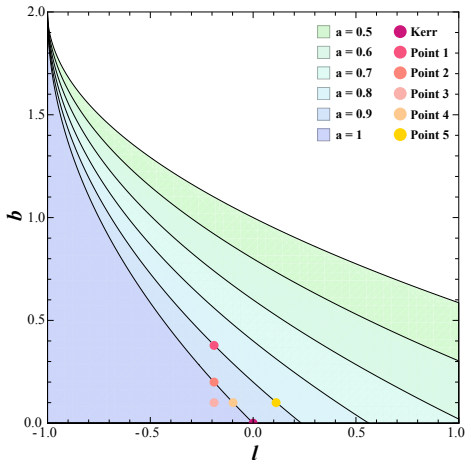
Many efforts were made in order to better understand the energy extraction via magnetic reconnection from a rotating black hole, following the work of Comisso and Asenjo in 2021. We also tried to make some progress in our previous works, in which we discussed differences between bulk plasma with different streamlines and also defined the covering factor as an internal property of an accretion system to quantify its capability on extracting energy via magnetic reconnection from its central black hole. In this study, we aim to explore this topic within the framework of a Kerr-Sen-like spacetime induced from Bumblebee gravity, which, among various alternative theories of gravity beyond pure Einstein gravity, stands out as a promising candidate for explaining certain high energy astrophysical phenomena. More specifically, we would like to analyze the influence of the rate of Lorentz symmetry breaking and the Bumblebee charge, the two additional parameters in Bumblebee gravity except for the black hole mass and spin, on the energy extraction via magnetic reconnection. By analyzing the allowed regions for energy extraction and the variations of covering factor, we find that energy extraction becomes more likely to succeed and tends to occur closer to the central region when the spacetime carries bigger rate of Lorentz symmetry breaking and Bumblebee charge. Furthermore, our results indicate that the most favorable spacetime configuration for energy extraction via magnetic reconnection, when the extractable energy of the central black hole is determined, corresponds to the scenario in which the cosmic censorship hypothesis is marginally not violated.
Editorial analysis
A structured set of objections, weighed in public.
Referee Report
Summary. The paper extends the Comisso-Asenjo 2021 magnetic reconnection framework for energy extraction from Kerr black holes to a Kerr-Sen-like metric in Bumblebee gravity. It introduces two additional parameters—the Lorentz symmetry breaking rate and the Bumblebee charge—and analyzes their effects on the allowed regions for successful extraction and on the covering factor (defined as an internal accretion-system property). The central claim is that larger values of both parameters make extraction more likely and shift it closer to the central region, with the most favorable configuration occurring when the cosmic censorship hypothesis is marginally violated.
Significance. If the transplantation of the reconnection model proves valid, the work offers a systematic parameter study of how Lorentz violation and Bumblebee charge modify black-hole energy extraction, potentially linking modified-gravity effects to high-energy astrophysical observables such as jets or flares. The covering-factor diagnostic is a useful internal metric that builds directly on the authors’ prior papers. The result is falsifiable in principle through future observations or numerical simulations once the model assumptions are explicitly verified for the new spacetime.
major comments (3)
- [§3] §3 (Bumblebee metric and reconnection setup): the energy-extraction inequalities and plasma-streamline assumptions are imported from the Kerr case without re-derivation of the frame-dragging angular velocity or the null-geodesic conditions in the presence of the vector condensate; the modified Killing vectors alter the ergosphere, so the transplant is load-bearing for the claim that extraction occurs closer to the horizon with increasing parameters.
- [§4.1] §4.1 (Allowed regions): the reported trends with Lorentz-breaking rate and Bumblebee charge are obtained by direct substitution into the Comisso-Asenjo inequalities; no explicit check is provided that the magnetic-field-line angular velocity Ω_F retains the same functional form under the Bumblebee line element.
- [§5] §5 (Covering factor and cosmic censorship): the conclusion that the optimum occurs at marginal CCH violation fixes the extractable energy and then varies the covering factor; the paper does not demonstrate robustness of the covering-factor curves to changes in the post-hoc streamline choices or to the altered null geodesics.
minor comments (2)
- [Abstract] Abstract: no quantitative error estimates or explicit ranges for the covering-factor variations are stated, making it difficult to assess the magnitude of the reported trends.
- [Throughout] Notation: the symbols for the Lorentz-breaking rate and Bumblebee charge should be defined once at first use and used consistently thereafter to avoid ambiguity in the parameter scans.
Simulated Author's Rebuttal
We thank the referee for the thorough review and constructive feedback on our manuscript extending the magnetic reconnection energy extraction framework to a Kerr-Sen-like spacetime in Bumblebee gravity. We address each major comment below, indicating planned revisions where appropriate to strengthen the derivations and robustness checks.
read point-by-point responses
-
Referee: [§3] §3 (Bumblebee metric and reconnection setup): the energy-extraction inequalities and plasma-streamline assumptions are imported from the Kerr case without re-derivation of the frame-dragging angular velocity or the null-geodesic conditions in the presence of the vector condensate; the modified Killing vectors alter the ergosphere, so the transplant is load-bearing for the claim that extraction occurs closer to the horizon with increasing parameters.
Authors: We acknowledge the referee's point that explicit re-derivation strengthens the presentation. The Bumblebee-induced metric preserves the same Killing vectors ∂_t and ∂_φ as the Kerr case, so the frame-dragging angular velocity retains the form Ω = −g_tφ/g_φφ, albeit with metric components modified by the Lorentz-breaking parameter ℓ and Bumblebee charge q. The ergosphere is located where g_tt = 0, and the energy-extraction conditions follow from the conserved energy and angular momentum along null geodesics. We will add a dedicated subsection in §3 (and a short appendix) that explicitly recomputes the ergosphere boundary, confirms the null-geodesic conditions, and shows how the modified Ω enters the reconnection inequalities. This will make the transplantation transparent without altering the reported trends. revision: yes
-
Referee: [§4.1] §4.1 (Allowed regions): the reported trends with Lorentz-breaking rate and Bumblebee charge are obtained by direct substitution into the Comisso-Asenjo inequalities; no explicit check is provided that the magnetic-field-line angular velocity Ω_F retains the same functional form under the Bumblebee line element.
Authors: The referee correctly notes that we performed direct substitution. In the model, Ω_F is set to a fixed fraction of the horizon angular velocity Ω_H = −g_tφ/g_φφ evaluated at the event horizon. Because the Bumblebee metric modifies g_tφ and g_φφ, Ω_H (and therefore Ω_F) acquires an explicit dependence on ℓ and q. We will insert an explicit calculation of Ω_F in §4.1, demonstrating that its functional form remains Ω_F = κ Ω_H with the same constant κ used in the Kerr case, while the numerical value of Ω_H changes with the new parameters. This check will be added to the revised manuscript. revision: yes
-
Referee: [§5] §5 (Covering factor and cosmic censorship): the conclusion that the optimum occurs at marginal CCH violation fixes the extractable energy and then varies the covering factor; the paper does not demonstrate robustness of the covering-factor curves to changes in the post-hoc streamline choices or to the altered null geodesics.
Authors: We agree that a robustness discussion improves the manuscript. The covering factor is defined as an internal accretion-system diagnostic independent of the specific geodesic details once the energy-extraction inequalities are satisfied. The trends we report arise after fixing the extractable energy (i.e., fixing M and a while varying ℓ and q up to the marginal CCH boundary). To address the concern, we will add a short paragraph and one supplementary figure in §5 showing that the covering-factor curves remain qualitatively unchanged under ±10 % variations in the streamline parameters adopted from our prior works and that the null-geodesic conditions continue to hold throughout the explored parameter space. This will be included in the revision. revision: yes
Circularity Check
Covering factor and reconnection framework transplanted from prior self-citations without re-derivation for Bumblebee metric
specific steps
-
self citation load bearing
[Abstract]
"we also tried to make some progress in our previous works, in which we discussed differences between bulk plasma with different streamlines and also defined the covering factor as an internal property of an accretion system to quantify its capability on extracting energy via magnetic reconnection from its central black hole. In this study, we aim to explore this topic within the framework of a Kerr-Sen-like spacetime induced from Bumblebee gravity... By analyzing the allowed regions for energy extraction and the variations of covering factor, we find that energy extraction becomes more likely"
The covering factor is introduced as a pre-defined internal property from the authors' prior papers and then directly applied to compute extraction capability and trends versus Lorentz-breaking rate and Bumblebee charge in the new metric. The quantification step therefore inherits its functional form from the self-citation rather than being re-derived from the Bumblebee line element.
full rationale
The paper's central results on how Lorentz-breaking rate and Bumblebee charge affect allowed regions and covering factor rest on direct substitution into the Comisso-Asenjo 2021 reconnection inequalities and the authors' earlier definition of covering factor. No independent re-derivation of plasma streamlines, magnetic field angular velocity, or energy-extraction condition is shown for the modified Killing vectors and ergosphere of the Kerr-Sen-like Bumblebee line element. This creates partial circularity via self-citation load-bearing, but the metric substitution itself supplies new parameter dependence and the external 2021 reference prevents full reduction to inputs.
Axiom & Free-Parameter Ledger
free parameters (2)
- Lorentz symmetry breaking rate
- Bumblebee charge
axioms (2)
- domain assumption The magnetic reconnection efficiency formulas derived for Kerr spacetime remain applicable after substitution of the Bumblebee metric.
- domain assumption The covering factor can be treated as a well-defined internal property of the accretion flow independent of the specific gravity theory.
Lean theorems connected to this paper
-
IndisputableMonolith/Foundation/AlexanderDuality.leanalexander_duality_circle_linking unclear?
unclearRelation between the paper passage and the cited Recognition theorem.
By analyzing the allowed regions for energy extraction and the variations of covering factor, we find that energy extraction becomes more likely to succeed ... when the spacetime carries bigger rate of Lorentz symmetry breaking and Bumblebee charge.
-
IndisputableMonolith/Cost/FunctionalEquation.leanwashburn_uniqueness_aczel contradicts?
contradictsCONTRADICTS: the theorem conflicts with this paper passage, or marks a claim that would need revision before publication.
the two additional parameters in Bumblebee gravity except for the black hole mass and spin
What do these tags mean?
- matches
- The paper's claim is directly supported by a theorem in the formal canon.
- supports
- The theorem supports part of the paper's argument, but the paper may add assumptions or extra steps.
- extends
- The paper goes beyond the formal theorem; the theorem is a base layer rather than the whole result.
- uses
- The paper appears to rely on the theorem as machinery.
- contradicts
- The paper's claim conflicts with a theorem or certificate in the canon.
- unclear
- Pith found a possible connection, but the passage is too broad, indirect, or ambiguous to say the theorem truly supports the claim.
Forward citations
Cited by 1 Pith paper
-
Magnetic reconnection in five-dimensional Kerr black hole
Magnetic reconnection enables higher energy extraction efficiency from singly-rotating five-dimensional Kerr black holes than from doubly-rotating ones and can exceed the Blandford-Znajek process in the single-rotation case.
Reference graph
Works this paper leans on
-
[1]
A Magnetohydrodynamic Model for the Formation of Episodic Jets
F. Yuan, J. Lin, K. Wu, and L. C. Ho, “A Magnetohydrodynamic Model for the Formation of Episodic Jets,” Mon. Not. Roy. Astron. Soc.395(2009) 2183–2188,arXiv:0811.2893 [astro-ph]
work page internal anchor Pith review Pith/arXiv arXiv 2009
-
[2]
Modeling the inner part of the jet in M87: Confronting jet morphology with theory,
H. Yang, F. Yuan, H. Li, Y. Mizuno, F. Guo, R. Lu, L. C. Ho, X. Lin, A. A. Zdziarski, and J. Wang, “Modeling the inner part of the jet in M87: Confronting jet morphology with theory,” Sci. Adv.10no. 12, (2024) adn3544,arXiv:2403.15950 [astro-ph.HE]
-
[3]
L. Xi and Y. Feng, “Revisiting flares in Sagittarius A* based on general relativistic magnetohydrodynamic numerical simulations of black hole accretion,” Mon. Not. Roy. Astron. Soc.531no. 3, (2024) 3136–3150,arXiv:2405.17408 [astro-ph.HE]
-
[4]
The impact of resistivity on the variability of black hole accretion flows,
A. Nathanail, Y. Mizuno, I. Contopoulos, C. M. Fromm, A. Cruz-Osorio, K. Moriyama, and L. Rezzolla, “The impact of resistivity on the variability of black hole accretion flows,” Astron. Astrophys.693(2025) A56,arXiv:2411.16684 [astro-ph.HE]
-
[5]
Magnetic Reconnection and Hot Spot Formation in Black Hole Accretion Disks,
B. Ripperda, F. Bacchini, and A. Philippov, “Magnetic Reconnection and Hot Spot Formation in Black Hole Accretion Disks,” Astrophys. J.900no. 2, (2020) 100,arXiv:2003.04330 [astro-ph.HE]
-
[6]
Magnetic reconnection plasmoid model for Sagittarius A* flares,
N. Aimar, A. Dmytriiev, F. H. Vincent, I. E. Mellah, T. Paumard, G. Perrin, and A. Zech, “Magnetic reconnection plasmoid model for Sagittarius A* flares,” Astron. Astrophys.672 (2023) A62,arXiv:2301.11874 [astro-ph.HE]
-
[7]
GRMHD modelling of accretion flow around Sagittarius A* constrained by EHT measurements,
G. Sen, D. Maity, and S. Das, “GRMHD modelling of accretion flow around Sagittarius A* constrained by EHT measurements,”arXiv:2510.03602 [astro-ph.HE]
-
[8]
Gravitational collapse: The role of general relativity,
R. Penrose, “Gravitational collapse: The role of general relativity,” Riv. Nuovo Cim.1(1969) 252–276
work page 1969
-
[9]
Energy Limits on the Penrose Process,
R. M. Wald, “Energy Limits on the Penrose Process,” Astrophys. J.191(1974) 231
work page 1974
-
[10]
Energy Extraction from a Rotating Black Hole by Magnetic Reconnection in Ergosphere
S. Koide and K. Arai, “Energy Extraction from a Rotating Black Hole by Magnetic Reconnection in Ergosphere,” Astrophys. J.682(2008) 1124,arXiv:0805.0044 [astro-ph]
work page internal anchor Pith review Pith/arXiv arXiv 2008
-
[11]
Magnetic Reconnection as a Mechanism for Energy Extraction from Rotating Black Holes,
L. Comisso and F. A. Asenjo, “Magnetic Reconnection as a Mechanism for Energy Extraction from Rotating Black Holes,” Phys. Rev. D103no. 2, (2021) 023014,arXiv:2012.00879 [astro-ph.HE]. 27
-
[12]
Rotating Magnetospheres: an Exact 3-D Solution,
F. C. Michel, “Rotating Magnetospheres: an Exact 3-D Solution,” Astrophys. J.180(Mar.,
-
[13]
Spacetime approach to force-free magnetospheres,
S. E. Gralla and T. Jacobson, “Spacetime approach to force-free magnetospheres,” Mon. Not. Roy. Astron. Soc.445no. 3, (2014) 2500–2534,arXiv:1401.6159 [astro-ph.HE]. [Erratum: Mon.Not.Roy.Astron.Soc. 534, 1541 (2024)]
-
[14]
A. Tchekhovskoy, R. Narayan, and J. C. McKinney, “Efficient generation of jets from magnetically arrested accretion on a rapidly spinning black hole,” Mon. Not. Roy. Astron. Soc. Lett.418no. 1, (11, 2011) L79–L83, https://academic.oup.com/mnrasl/article-pdf/418/1/L79/56939896/mnrasl 418 1 l79.pdf. https://doi.org/10.1111/j.1745-3933.2011.01147.x
-
[15]
J. C. McKinney, “General relativistic force-free electrodynamics: a new code and applications to black hole magnetospheres,” Mon. Not. Roy. Astron. Soc.367(2006) 1797–1807, arXiv:astro-ph/0601410
work page internal anchor Pith review Pith/arXiv arXiv 2006
-
[16]
Particle Acceleration in Collisionless Magnetically Arrested Disks,
J. Vos, B. Cerutti, M. Moscibrodzka, and K. Parfrey, “Particle Acceleration in Collisionless Magnetically Arrested Disks,” Phys. Rev. Lett.135no. 1, (2025) 015201,arXiv:2410.19061 [astro-ph.HE]
-
[17]
General Theory of the Plasmoid Instability
L. Comisso, M. Lingam, Y. M. Huang, and A. Bhattacharjee, “General Theory of the Plasmoid Instability,” Physics of Plasmas23(2016) 100702,arXiv:1608.04692 [physics.plasm-ph]
work page internal anchor Pith review Pith/arXiv arXiv 2016
-
[18]
Plasmoid Instability in Forming Current Sheets
L. Comisso, M. Lingam, Y.-M. Huang, and A. Bhattacharjee, “Plasmoid Instability in Forming Current Sheets,” Astrophys. J.850no. 2, (2017) 142,arXiv:1707.01862 [astro-ph.HE]
work page internal anchor Pith review Pith/arXiv arXiv 2017
-
[19]
Energy extraction via magnetic reconnection in Lorentz breaking Kerr–Sen and Kiselev black holes,
A. Carleo, G. Lambiase, and L. Mastrototaro, “Energy extraction via magnetic reconnection in Lorentz breaking Kerr–Sen and Kiselev black holes,” Eur. Phys. J. C82no. 9, (2022) 776, arXiv:2206.12988 [gr-qc]
-
[20]
Magnetic reconnection and energy extraction from a spinning black hole with broken Lorentz symmetry,
M. Khodadi, “Magnetic reconnection and energy extraction from a spinning black hole with broken Lorentz symmetry,” Phys. Rev. D105no. 2, (2022) 023025,arXiv:2201.02765 [gr-qc]
-
[21]
S.-W. Wei, H.-M. Wang, Y.-P. Zhang, and Y.-X. Liu, “Effects of tidal charge on magnetic reconnection and energy extraction from spinning braneworld black hole,” JCAP04no. 04, (2022) 050,arXiv:2201.12729 [gr-qc]
-
[22]
Energy Extraction via Magnetic Reconnection in the Ergosphere of a Rotating Non-Kerr Black Hole,
W. Liu, “Energy Extraction via Magnetic Reconnection in the Ergosphere of a Rotating Non-Kerr Black Hole,” Astrophys. J.925no. 2, (2022) 149,arXiv:2204.07338 [astro-ph.HE]. 28
-
[23]
Extracting energy via magnetic reconnection from Kerr–de Sitter black holes,
C.-H. Wang, C.-Q. Pang, and S.-W. Wei, “Extracting energy via magnetic reconnection from Kerr–de Sitter black holes,” Phys. Rev. D106no. 12, (2022) 124050,arXiv:2209.08837 [gr-qc]
-
[24]
Kerr-Newman-modified-gravity black hole’s impact on the magnetic reconnection,
S. Shaymatov, M. Alloqulov, B. Ahmedov, and A. Wang, “Kerr-Newman-modified-gravity black hole’s impact on the magnetic reconnection,” Phys. Rev. D110no. 4, (2024) 044005, arXiv:2307.03012 [gr-qc]
-
[25]
Energy extraction via magnetic reconnection in magnetized black holes,
S.-J. Zhang, “Energy extraction via magnetic reconnection in magnetized black holes,” JCAP 07(2024) 042,arXiv:2405.16941 [gr-qc]
-
[26]
Magnetic reconnection and energy extraction from a Konoplya–Zhidenko rotating non-Kerr black hole,
F. Long, S. Wang, S. Chen, and J. Jing, “Magnetic reconnection and energy extraction from a Konoplya–Zhidenko rotating non-Kerr black hole,” Eur. Phys. J. C85no. 1, (2025) 26, arXiv:2409.11942 [gr-qc]
-
[27]
X.-X. Zeng and K. Wang, “Energy Extraction via Magnetic Reconnection in Kerr-Sen-AdS 4 Black Hole: Circular Plasma and Plunging Plasma,”arXiv:2507.10520 [gr-qc]
-
[28]
X.-X. Zeng and K. Wang, “Energy extraction from the Kerr-Bertotti-Robinson black hole via magnetic reconnection in a circular and a plunging plasma,” Phys. Rev. D112no. 6, (2025) 064032,arXiv:2507.21777 [gr-qc]
-
[29]
Rotating Charged Black Hole Solution in Heterotic String Theory
A. Sen, “Rotating charged black hole solution in heterotic string theory,” Phys. Rev. Lett.69 (1992) 1006–1009,arXiv:hep-th/9204046
work page internal anchor Pith review Pith/arXiv arXiv 1992
-
[30]
Lorentz and CPT breaking in gamma-ray burst neutrinos from string theory,
C. Li and B.-Q. Ma, “Lorentz and CPT breaking in gamma-ray burst neutrinos from string theory,” JHEP03(2023) 230,arXiv:2303.04765 [hep-ph]
-
[31]
M. Khodadi, G. Lambiase, and L. Mastrototaro, “Spontaneous Lorentz symmetry breaking effects on GRBs jets arising from neutrino pair annihilation process near a black hole,” Eur. Phys. J. C83no. 3, (2023) 239,arXiv:2302.14200 [hep-ph]
-
[32]
Strange quark stars and condensate dark stars in Bumblebee gravity,
G. Panotopoulos and A. ¨Ovg¨ un, “Strange quark stars and condensate dark stars in Bumblebee gravity,” Nucl. Phys. B1017(2025) 116956,arXiv:2409.05801 [gr-qc]
-
[33]
An exact Schwarzschild-like solution in a bumblebee gravity model
R. Casana, A. Cavalcante, F. P. Poulis, and E. B. Santos, “Exact Schwarzschild-like solution in a bumblebee gravity model,” Phys. Rev. D97no. 10, (2018) 104001,arXiv:1711.02273 [gr-qc]
work page internal anchor Pith review Pith/arXiv arXiv 2018
- [34]
-
[35]
C. Ding, C. Liu, R. Casana, and A. Cavalcante, “Exact Kerr-like solution and its shadow in a gravity model with spontaneous Lorentz symmetry breaking,” Eur. Phys. J. C80no. 3, (2020) 178,arXiv:1910.02674 [gr-qc]
-
[36]
Static spherical vacuum solutions in the bumblebee gravity model,
R. Xu, D. Liang, and L. Shao, “Static spherical vacuum solutions in the bumblebee gravity model,” Phys. Rev. D107no. 2, (2023) 024011,arXiv:2209.02209 [gr-qc]
-
[37]
Bumblebee cosmology: Tests using distance- and time-redshift probes,
X. Zhu, R. Xu, and D. Xu, “Bumblebee cosmology: Tests using distance- and time-redshift probes,”arXiv:2411.18559 [astro-ph.CO]
-
[38]
S. K. Jha, S. Aziz, and A. Rahaman, “Study of Einstein-bumblebee gravity with Kerr-Sen-like solution in the presence of a dispersive medium,” Eur. Phys. J. C82no. 2, (2022) 106, arXiv:2103.17021 [gr-qc]
-
[39]
Z. Wang, S. Chen, and J. Jing, “Constraint on parameters of a rotating black hole in Einstein-bumblebee theory by quasi-periodic oscillations,” Eur. Phys. J. C82no. 6, (2022) 528, arXiv:2112.02895 [gr-qc]
-
[40]
Investigating rotating black holes in bumblebee gravity: insights from EHT observations,
S. U. Islam, S. G. Ghosh, and S. D. Maharaj, “Investigating rotating black holes in bumblebee gravity: insights from EHT observations,” JCAP12(2024) 047,arXiv:2410.05395 [gr-qc]
-
[41]
Probing bumblebee gravity with black hole X-ray data,
J. Gu, S. Riaz, A. B. Abdikamalov, D. Ayzenberg, and C. Bambi, “Probing bumblebee gravity with black hole X-ray data,” Eur. Phys. J. C82no. 8, (2022) 708,arXiv:2206.14733 [gr-qc]
-
[42]
Energy extraction from a Kerr black hole via magnetic reconnection within the plunging region,
B. Chen, Y. Hou, J. Li, and Y. Shen, “Energy extraction from a Kerr black hole via magnetic reconnection within the plunging region,” Phys. Rev. D110no. 6, (2024) 063003, arXiv:2405.11488 [gr-qc]
-
[43]
Y. Shen, H.-Y. YuChih, and B. Chen, “Energy extraction from a rotating black hole via magnetic reconnection: The plunging bulk plasma and orientation angle,” Phys. Rev. D110 no. 12, (2024) 123010,arXiv:2409.07345 [gr-qc]
-
[44]
Y. Shen and H.-Y. YuChih, “Energy extraction from a rotating black hole via magnetic reconnection: Parameters in reconnection models,” Phys. Rev. D111no. 2, (2025) 023003, arXiv:2412.03010 [astro-ph.HE]
-
[45]
Black-hole electrodynamics - an absolute-space/universal-time formulation,
D. MacDonald and K. S. Thorne, “Black-hole electrodynamics - an absolute-space/universal-time formulation,” Mon. Not. Roy. Astron. Soc.198(1982) 345–383
work page 1982
-
[46]
Why does steady-state magnetic reconnection have a maximum local rate of order 0.1?
Y.-H. Liu, M. Hesse, F. Guo, W. Daughton, H. Li, P. A. Cassak, and M. A. Shay, “Why does steady-state magnetic reconnection have a maximum local rate of order 0.1?,” Phys. Rev. Lett. 118no. 8, (2017) 085101,arXiv:1611.07859 [physics.plasm-ph]. 30
work page internal anchor Pith review Pith/arXiv arXiv 2017
-
[47]
On the relativistic magnetic reconnection
Y. E. Lyubarsky, “On the relativistic magnetic reconnection,” Mon. Not. Roy. Astron. Soc.358 (2005) 113–119,arXiv:astro-ph/0501392
work page internal anchor Pith review Pith/arXiv arXiv 2005
-
[48]
Thermal-inertial effects on magnetic reconnection in relativistic pair plasmas
L. Comisso and F. A. Asenjo, “Thermal-inertial effects on magnetic reconnection in relativistic pair plasmas,” Phys. Rev. Lett.113(2014) 045001,arXiv:1402.1115 [physics.plasm-ph]
work page internal anchor Pith review Pith/arXiv arXiv 2014
-
[49]
Gravity, Lorentz Violation, and the Standard Model
V. A. Kostelecky, “Gravity, Lorentz violation, and the standard model,” Phys. Rev. D69 (2004) 105009,arXiv:hep-th/0312310
work page internal anchor Pith review Pith/arXiv arXiv 2004
-
[50]
Signals for Lorentz Violation in Post-Newtonian Gravity
Q. G. Bailey and V. A. Kostelecky, “Signals for Lorentz violation in post-Newtonian gravity,” Phys. Rev. D74(2006) 045001,arXiv:gr-qc/0603030
work page internal anchor Pith review Pith/arXiv arXiv 2006
-
[51]
Dynamic instability analysis for bumblebee black holes: The odd parity,
Z.-F. Mai, R. Xu, D. Liang, and L. Shao, “Dynamic instability analysis for bumblebee black holes: The odd parity,” Phys. Rev. D109no. 8, (2024) 084076,arXiv:2401.07757 [gr-qc]
-
[52]
Neutron stars in the bumblebee theory of gravity,
P. Ji, Z. Li, L. Yang, R. Xu, Z. Hu, and L. Shao, “Neutron stars in the bumblebee theory of gravity,” Phys. Rev. D110no. 10, (2024) 104057,arXiv:2409.04805 [gr-qc]
-
[53]
F. Camilloni and L. Rezzolla, “Self-consistent Multidimensional Penrose Process Driven by Magnetic Reconnection,” Astrophys. J. Lett.982no. 1, (2025) L31,arXiv:2411.04184 [gr-qc]
-
[54]
Finite-Resistivity Instabilities of a Sheet Pinch,
H. P. Furth, J. Killeen, and M. N. Rosenbluth, “Finite-Resistivity Instabilities of a Sheet Pinch,” Physics of Fluids6no. 4, (Apr., 1963) 459–484
work page 1963
-
[55]
Dynamo-driven plasmoid formation from a current-sheet instability
F. Ebrahimi, “Dynamo-driven plasmoid formation from a current-sheet instability,” Phys. Plasmas23(2016) 120705,arXiv:1610.09050 [physics.plasm-ph]
work page internal anchor Pith review Pith/arXiv arXiv 2016
-
[56]
L. Sironi, D. A. Uzdensky, and D. Giannios, “Relativistic Magnetic Reconnection in Astrophysical Plasmas: A Powerful Mechanism of Nonthermal Emission,”arXiv:2506.02101 [astro-ph.HE]
-
[57]
T. H. N. Tsung, G. R. Werner, D. A. Uzdensky, and M. C. Begelman, “Dissipation and particle acceleration in astrophysical jets with velocity and magnetic shear: Interaction of Kelvin-Helmholtz and Drift-Kink Instabilities,”arXiv:2501.04090 [astro-ph.HE]. 31
discussion (0)
Sign in with ORCID, Apple, or X to comment. Anyone can read and Pith papers without signing in.