Minijet thermalization and jet transport coefficients in QCD kinetic theory
Pith reviewed 2026-05-18 03:20 UTC · model grok-4.3
The pith
Including recoiling medium particles in jet transport coefficients restores consistency with full QCD kinetic evolution of minijets in the quark-gluon plasma.
A machine-rendered reading of the paper's core claim, the machinery that carries it, and where it could break.
Core claim
In QCD kinetic theory simulations of minijets propagating through a thermal gluon plasma, incorporating both collinear radiation and elastic scatterings, standard definitions of jet transport coefficients neglect contributions from recoiling medium particles. Including these contributions restores consistency with the kinetic evolution. The minijet thermalization time scales remarkably well with the jet-quenching parameter q-hat.
What carries the argument
QCD kinetic theory evolution of minijets with isotropic hard thermal loop screening for soft exchanges, explicit elastic scatterings, and collinear radiation.
Load-bearing premise
The isotropic hard thermal loop screening accurately captures the net effect of soft quark and gluon exchanges on the minijet evolution.
What would settle it
Running the same kinetic simulation with and without explicit recoil tracking and checking whether the extracted q-hat, energy loss, and drag then match the standard transport-coefficient formulas would directly test the inconsistency claim.
Figures


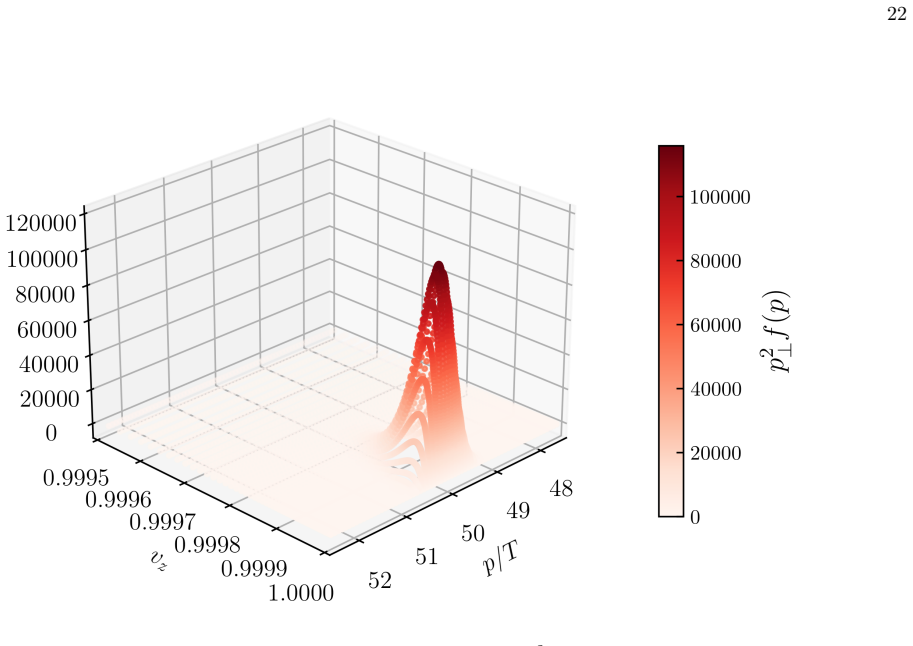

read the original abstract
We apply weakly coupled QCD kinetic theory to investigate the thermalization of high-momentum on-shell partons (minijets) in a Quark-Gluon Plasma (QGP). Our approach incorporates isotropic hard thermal loop screening to model soft quark and gluon exchanges, allowing us to verify consistency with established analytic results of jet transport coefficients. We perform kinetic simulations of minijets propagating through a thermal gluon plasma, incorporating both collinear radiation and elastic scatterings. The resulting evolution is compared to predictions from jet transport coefficients, including the longitudinal and transverse jet-quenching parameters $\hat{q}$, energy loss, and the drag coefficient. We find that standard definitions of jet transport coefficients neglect the contributions from recoiling medium particles. Including these contributions restores consistency with the kinetic evolution. Finally, we show that the minijet thermalization time scales remarkably well with $\hat{q}$ and we produce a phenomenological estimate of the minijet quenching time in heavy-ion collisions.
Editorial analysis
A structured set of objections, weighed in public.
Referee Report
Summary. The paper applies weakly coupled QCD kinetic theory with isotropic hard thermal loop screening to simulate the evolution of high-momentum on-shell minijets in a thermal gluon plasma, including both elastic scatterings and collinear radiation. It compares the resulting kinetic evolution to predictions based on standard jet transport coefficients (longitudinal and transverse q-hat, energy loss, and drag). The central claim is that conventional definitions of these coefficients omit contributions from recoiling medium particles; including recoils restores consistency between the transport-coefficient predictions and the full kinetic evolution. The authors further report that minijet thermalization time scales well with q-hat and provide a phenomenological estimate for the minijet quenching time in heavy-ion collisions.
Significance. If the central claim holds, the work would identify a systematic correction to jet transport coefficients that has been overlooked in prior analytic and phenomenological treatments. The reported scaling of thermalization time with q-hat offers a potentially useful simplification for modeling jet quenching. The use of kinetic theory to cross-check against established analytic results for transport coefficients is a methodological strength that supports the consistency tests.
major comments (2)
- [Methods / kinetic evolution and recoil accounting] The restoration of consistency after including recoils is the load-bearing claim. The manuscript must explicitly detail, in the section describing the Boltzmann solver and recoil extraction, how recoil momentum transfers are isolated (e.g., by post-scattering differencing of medium parton momenta) and added to the effective transport coefficients without double-counting medium back-reaction already evolved by the kinetic equation itself.
- [Comparison of kinetic evolution to transport coefficients] The comparison to 'standard definitions' of q-hat, energy loss, and drag risks circularity because those coefficients are frequently derived within similar kinetic-theory frameworks. The paper should specify, with reference to the relevant equations or cited analytic expressions, which independent definitions are used for the baseline and how the recoil term is constructed to be independent of the current simulation.
minor comments (2)
- Clarify the precise implementation of isotropic HTL screening for soft exchanges and confirm that it reproduces the expected analytic limits for elastic scattering rates.
- Add error bands or statistical uncertainties to the scaling plots of thermalization time versus q-hat to substantiate the 'remarkably well' claim.
Simulated Author's Rebuttal
We thank the referee for the careful reading of our manuscript and for the constructive comments, which help strengthen the presentation of our methodological approach. We agree that greater explicitness is needed on the recoil isolation procedure and on the independence of the baseline transport coefficients. We will revise the manuscript accordingly to address both points.
read point-by-point responses
-
Referee: [Methods / kinetic evolution and recoil accounting] The restoration of consistency after including recoils is the load-bearing claim. The manuscript must explicitly detail, in the section describing the Boltzmann solver and recoil extraction, how recoil momentum transfers are isolated (e.g., by post-scattering differencing of medium parton momenta) and added to the effective transport coefficients without double-counting medium back-reaction already evolved by the kinetic equation itself.
Authors: We agree that the current manuscript would benefit from more explicit detail on this procedure. In the revised version we will expand the Boltzmann solver section to state that, after each elastic scattering, the recoil momentum transfer is isolated by subtracting the pre-scattering four-momentum of the medium gluon from its post-scattering four-momentum. These differences are accumulated separately and added to the effective longitudinal and transverse jet-quenching parameters. The medium back-reaction is evolved self-consistently within the full kinetic equation for the distribution function; the recoil contribution to the transport coefficients is computed from the initial thermal ensemble plus the isolated momentum transfers only, thereby avoiding double-counting. revision: yes
-
Referee: [Comparison of kinetic evolution to transport coefficients] The comparison to 'standard definitions' of q-hat, energy loss, and drag risks circularity because those coefficients are frequently derived within similar kinetic-theory frameworks. The paper should specify, with reference to the relevant equations or cited analytic expressions, which independent definitions are used for the baseline and how the recoil term is constructed to be independent of the current simulation.
Authors: We will add a clarifying paragraph that removes any ambiguity. The baseline coefficients are taken from the established analytic expressions in the perturbative QCD literature for elastic scattering and collinear radiation rates in a thermal medium (without explicit recoil tracking), specifically the formulas for q-hat, dE/dx, and the drag coefficient as derived in the works cited in our introduction and methods. These expressions are independent of our numerical simulation. The recoil term is obtained by direct post-processing of the simulation events: we sum the momentum transfers to medium partons recorded in each scattering, which constitutes a numerical extraction rather than an analytic derivation from the same framework. We will reference the precise equations used for both the baseline and the added recoil contribution. revision: yes
Circularity Check
No significant circularity detected
full rationale
The paper's central chain compares full QCD kinetic simulations of minijet evolution (including collinear radiation and elastic scatterings with isotropic HTL screening) against analytic jet transport coefficients. The observation that recoil contributions from medium particles must be added to restore agreement is a direct numerical test rather than a definitional identity. The reported scaling of thermalization time with q-hat is an empirical result extracted from the same simulations, not a parameter fitted to force the scaling. No load-bearing step reduces by construction to a prior self-citation, an ansatz smuggled via citation, or a renaming of a known result; the derivation remains self-contained against the independent kinetic evolution.
Axiom & Free-Parameter Ledger
axioms (2)
- domain assumption Weakly coupled QCD kinetic theory applies to minijet propagation in thermal gluon plasma
- domain assumption Isotropic hard thermal loop screening adequately models soft quark and gluon exchanges
Lean theorems connected to this paper
-
IndisputableMonolith/Cost/FunctionalEquation.leanwashburn_uniqueness_aczel unclear?
unclearRelation between the paper passage and the cited Recognition theorem.
We find that standard definitions of jet transport coefficients neglect the contributions from recoiling medium particles. Including these contributions restores consistency with the kinetic evolution.
-
IndisputableMonolith/Foundation/DimensionForcing.leanreality_from_one_distinction unclear?
unclearRelation between the paper passage and the cited Recognition theorem.
the minijet thermalization time scales remarkably well with q-hat
What do these tags mean?
- matches
- The paper's claim is directly supported by a theorem in the formal canon.
- supports
- The theorem supports part of the paper's argument, but the paper may add assumptions or extra steps.
- extends
- The paper goes beyond the formal theorem; the theorem is a base layer rather than the whole result.
- uses
- The paper appears to rely on the theorem as machinery.
- contradicts
- The paper's claim conflicts with a theorem or certificate in the canon.
- unclear
- Pith found a possible connection, but the passage is too broad, indirect, or ambiguous to say the theorem truly supports the claim.
Forward citations
Cited by 1 Pith paper
-
Kinetic and canonical momentum broadening in the Glasma
Derives gauge-invariant equations of motion for kinetic and canonical momentum of particles in a classical non-Abelian background, finding that transverse fields contribute to kinetic momentum broadening even in the e...
Reference graph
Works this paper leans on
-
[1]
Heavy Ion Collisions: The Big Picture, and the Big Questions
W. Busza, K. Rajagopal, and W. van der Schee, Heavy Ion Collisions: The Big Picture, and the Big Questions, Ann. Rev. Nucl. Part. Sci.68, 339 (2018), arXiv:1802.04801 [hep-ph]
work page internal anchor Pith review Pith/arXiv arXiv 2018
-
[2]
S. Schlichting and D. Teaney, The First fm/c of Heavy- Ion Collisions, Ann. Rev. Nucl. Part. Sci.69, 447 (2019), arXiv:1908.02113 [nucl-th]
- [3]
- [4]
-
[5]
Introductory lectures on jet quenching in heavy ion collisions
J. Casalderrey-Solana and C. A. Salgado, Introductory lectures on jet quenching in heavy ion collisions, Acta Phys. Polon. B38, 3731 (2007), arXiv:0712.3443 [hep- ph]
work page internal anchor Pith review Pith/arXiv arXiv 2007
-
[6]
D. d’Enterria, Jet quenching, Landolt-Bornstein23, 471 (2010), arXiv:0902.2011 [nucl-ex]
work page internal anchor Pith review Pith/arXiv arXiv 2010
-
[7]
Heavy-ion collisions at the Large Hadron Collider: a review of the results from Run 1
N. Armesto and E. Scomparin, Heavy-ion collisions at the Large Hadron Collider: a review of the results from Run 1, Eur. Phys. J. Plus131, 52 (2016), arXiv:1511.02151 [nucl-ex]
work page internal anchor Pith review Pith/arXiv arXiv 2016
-
[8]
Review of Jet Measurements in Heavy Ion Collisions
M. Connors, C. Nattrass, R. Reed, and S. Salur, Jet mea- surements in heavy ion physics, Rev. Mod. Phys.90, 025005 (2018), arXiv:1705.01974 [nucl-ex]
work page internal anchor Pith review Pith/arXiv arXiv 2018
-
[9]
L. Cunqueiro and A. M. Sickles, Studying the QGP with Jets at the LHC and RHIC, Prog. Part. Nucl. Phys.124, 103940 (2022), arXiv:2110.14490 [nucl-ex]
-
[10]
Parton energy loss and momentum broadening at NLO in high temperature QCD plasmas
J. Ghiglieri and D. Teaney, Parton energy loss and mo- mentum broadening at NLO in high temperature QCD plasmas, Int. J. Mod. Phys. E24, 1530013 (2015), arXiv:1502.03730 [hep-ph]
work page internal anchor Pith review Pith/arXiv arXiv 2015
-
[11]
P. B. Arnold, G. D. Moore, and L. G. Yaffe, Effective kinetic theory for high temperature gauge theories, JHEP 01, 030, arXiv:hep-ph/0209353
work page internal anchor Pith review Pith/arXiv arXiv
-
[12]
Jet-Medium Interactions at NLO in a Weakly-Coupled Quark-Gluon Plasma
J. Ghiglieri, G. D. Moore, and D. Teaney, Jet-Medium Interactions at NLO in a Weakly-Coupled Quark-Gluon Plasma, JHEP03, 095, arXiv:1509.07773 [hep-ph]
work page internal anchor Pith review Pith/arXiv arXiv
-
[13]
A lattice study of the jet quenching parameter
M. Panero, K. Rummukainen, and A. Sch¨ afer, Lattice Study of the Jet Quenching Parameter, Phys. Rev. Lett. 112, 162001 (2014), arXiv:1307.5850 [hep-ph]
work page internal anchor Pith review Pith/arXiv arXiv 2014
- [14]
- [15]
- [16]
-
[17]
D. Avramescu, V. B˘ aran, V. Greco, A. Ipp, D. I. M¨ uller, and M. Ruggieri, Simulating jets and heavy quarks in the glasma using the colored particle-in-cell method, Phys. Rev. D107, 114021 (2023), arXiv:2303.05599 [hep-ph]
- [18]
-
[19]
H. Liu, K. Rajagopal, and U. A. Wiedemann, Calculating the jet quenching parameter from AdS/CFT, Phys. Rev. Lett.97, 182301 (2006), arXiv:hep-ph/0605178
work page internal anchor Pith review Pith/arXiv arXiv 2006
-
[20]
Gauge/String Duality, Hot QCD and Heavy Ion Collisions
J. Casalderrey-Solana, H. Liu, D. Mateos, K. Rajagopal, and U. Achim Wiedemann,Gauge/String Duality, Hot QCD and Heavy Ion Collisions(Cambridge University Press, 2014) arXiv:1101.0618 [hep-th]
work page internal anchor Pith review Pith/arXiv arXiv 2014
- [21]
- [22]
-
[23]
J. Uphoff, F. Senzel, O. Fochler, C. Wesp, Z. Xu, and C. Greiner, Elliptic flow and nuclear modification factor in ultrarelativistic heavy-ion collisions within a partonic transport model, Phys. Rev. Lett.114, 112301 (2015), arXiv:1401.1364 [hep-ph]
work page internal anchor Pith review Pith/arXiv arXiv 2015
-
[24]
I. Grishmanovskii, O. Soloveva, T. Song, C. Greiner, and E. Bratkovskaya, Jet transport coefficients by elas- tic and radiative scatterings in the strongly interacting quark-gluon plasma, Phys. Rev. C110, 014908 (2024), arXiv:2402.04923 [hep-ph]
-
[25]
Y. He, T. Luo, X.-N. Wang, and Y. Zhu, Linear Boltz- mann Transport for Jet Propagation in the Quark-Gluon Plasma: Elastic Processes and Medium Recoil, Phys. Rev. C91, 054908 (2015), [Erratum: Phys.Rev.C 97, 019902 (2018)], arXiv:1503.03313 [nucl-th]
work page internal anchor Pith review Pith/arXiv arXiv 2015
-
[26]
K. M. Burkeet al.(JET), Extracting the jet transport co- efficient from jet quenching in high-energy heavy-ion col- lisions, Phys. Rev. C90, 014909 (2014), arXiv:1312.5003 [nucl-th]
work page internal anchor Pith review Pith/arXiv arXiv 2014
-
[27]
Paquet, Applications of emulation and Bayesian methods in heavy-ion physics, J
J.-F. Paquet, Applications of emulation and Bayesian methods in heavy-ion physics, J. Phys. G51, 103001 (2024), arXiv:2310.17618 [nucl-th]
-
[28]
S. Caoet al.(JETSCAPE), Determining the jet trans- port coefficient ˆqfrom inclusive hadron suppression mea- surements using Bayesian parameter estimation, Phys. Rev. C104, 024905 (2021), arXiv:2102.11337 [nucl-th]
-
[29]
B. Karmakar, D. Zigic, I. Salom, J. Auvinen, P. Huovi- nen, M. Djordjevic, and M. Djordjevic, Constrainingη/s through high-p⊥theory and data, Phys. Rev. C108, 044907 (2023), arXiv:2305.11318 [hep-ph]
-
[30]
R. Ehlerset al.(JETSCAPE), Bayesian inference anal- ysis of jet quenching using inclusive jet and hadron suppression measurements, Phys. Rev. C111, 054913 (2025), arXiv:2408.08247 [hep-ph]
-
[31]
S. Cao and X.-N. Wang, Jet quenching and medium response in high-energy heavy-ion collisions: a review, Rept. Prog. Phys.84, 024301 (2021), arXiv:2002.04028 [hep-ph]. 13
-
[32]
S. Schlichting and I. Soudi, Medium-induced fragmenta- tion and equilibration of highly energetic partons, JHEP 07, 077, arXiv:2008.04928 [hep-ph]
-
[33]
Y. Mehtar-Tani, S. Schlichting, and I. Soudi, Jet ther- malization in QCD kinetic theory, JHEP05, 091, arXiv:2209.10569 [hep-ph]
-
[34]
K. Boguslavski, A. Kurkela, T. Lappi, F. Lindenbauer, and J. Peuron, Jet momentum broadening during initial stages in heavy-ion collisions, Phys. Lett. B850, 138525 (2024), arXiv:2303.12595 [hep-ph]
-
[35]
K. Boguslavski, A. Kurkela, T. Lappi, F. Linden- bauer, and J. Peuron, Jet quenching parameter in QCD kinetic theory, Phys. Rev. D110, 034019 (2024), arXiv:2312.00447 [hep-ph]
-
[36]
K. Boguslavski, A. Kurkela, T. Lappi, F. Lindenbauer, and J. Peuron, Limiting attractors in heavy-ion collisions, Phys. Lett. B852, 138623 (2024), arXiv:2312.11252 [hep- ph]
- [37]
-
[38]
Bottom-up thermalization in heavy ion collisions
R. Baier, A. H. Mueller, D. Schiff, and D. T. Son, ’Bottom up’ thermalization in heavy ion collisions, Phys. Lett. B 502, 51 (2001), arXiv:hep-ph/0009237
work page internal anchor Pith review Pith/arXiv arXiv 2001
-
[39]
Approach to equilibrium in weakly coupled nonabelian plasmas
A. Kurkela and E. Lu, Approach to Equilibrium in Weakly Coupled Non-Abelian Plasmas, Phys. Rev. Lett. 113, 182301 (2014), arXiv:1405.6318 [hep-ph]
work page internal anchor Pith review Pith/arXiv arXiv 2014
-
[40]
Isotropization and hydrodynamization in weakly coupled heavy-ion collisions
A. Kurkela and Y. Zhu, Isotropization and hydrody- namization in weakly coupled heavy-ion collisions, Phys. Rev. Lett.115, 182301 (2015), arXiv:1506.06647 [hep- ph]
work page internal anchor Pith review Pith/arXiv arXiv 2015
-
[41]
Chemical Equilibration in Weakly Coupled QCD
A. Kurkela and A. Mazeliauskas, Chemical equilibration in weakly coupled QCD, Phys. Rev. D99, 054018 (2019), arXiv:1811.03068 [hep-ph]
work page internal anchor Pith review Pith/arXiv arXiv 2019
-
[42]
Chemical Equilibration in Hadronic Collisions
A. Kurkela and A. Mazeliauskas, Chemical Equilibra- tion in Hadronic Collisions, Phys. Rev. Lett.122, 142301 (2019), arXiv:1811.03040 [hep-ph]
work page internal anchor Pith review Pith/arXiv arXiv 2019
- [43]
- [44]
-
[45]
K. Boguslavski and F. Lindenbauer, Soft-gluon exchange matters: Isotropic screening in QCD kinetic theory, Phys. Rev. D110, 074017 (2024), arXiv:2407.09605 [hep-ph]
-
[46]
M. C. Abraao York, A. Kurkela, E. Lu, and G. D. Moore, UV cascade in classical Yang-Mills theory via kinetic the- ory, Phys. Rev. D89, 074036 (2014), arXiv:1401.3751 [hep-ph]
work page internal anchor Pith review Pith/arXiv arXiv 2014
-
[47]
A. Kurkela, A. Mazeliauskas, and R. T¨ ornkvist, Collec- tive flow in single-hit QCD kinetic theory, JHEP11, 216, arXiv:2104.08179 [hep-ph]
-
[48]
A. Kurkela, A. Mazeliauskas, J.-F. Paquet, S. Schlicht- ing, and D. Teaney, Effective kinetic description of event-by-event pre-equilibrium dynamics in high-energy heavy-ion collisions, Phys. Rev. C99, 034910 (2019), arXiv:1805.00961 [hep-ph]
work page internal anchor Pith review Pith/arXiv arXiv 2019
-
[49]
A. Kurkela, A. Mazeliauskas, J.-F. Paquet, S. Schlicht- ing, and D. Teaney, Matching the Nonequilibrium Ini- tial Stage of Heavy Ion Collisions to Hydrodynamics with QCD Kinetic Theory, Phys. Rev. Lett.122, 122302 (2019), arXiv:1805.01604 [hep-ph]
work page internal anchor Pith review Pith/arXiv arXiv 2019
-
[50]
A. Kurkela, R. T¨ ornkvist, and K. Zapp, AMY Lorentz invariant parton cascade – the thermal equilibrium case, Eur. Phys. J. C84, 74 (2024), arXiv:2211.15454 [hep-ph]
-
[51]
Kinetic transport is needed to reliably extract shear viscosity from pA and AA data
A. Kurkela, U. A. Wiedemann, and B. Wu, Opacity de- pendence of elliptic flow in kinetic theory, Eur. Phys. J. C79, 759 (2019), arXiv:1805.04081 [hep-ph]
- [52]
-
[53]
Mehtar-Tani, arXiv:1903.00506 [hep-ph]
Y. Mehtar-Tani, Gluon bremsstrahlung in finite media beyond multiple soft scattering approximation, JHEP07, 057, arXiv:1903.00506 [hep-ph]
- [54]
- [55]
- [56]
- [57]
-
[58]
L. Cunqueiro, D. Pablos, A. Soto-Ontoso, M. Spousta, A. Takacs, and M. Verweij, Isolating perturbative QCD splittings in heavy-ion collisions, Phys. Rev. D110, 014015 (2024), arXiv:2311.07643 [hep-ph]
- [59]
- [60]
-
[61]
S. Acharyaet al.(ALICE), Search for quasi-particle scat- tering in the quark-gluon plasma with jet splittings in pp and Pb−Pb collisions at √sNN = 5.02 TeV, (2024), arXiv:2409.12837 [nucl-ex]. [62]Firstk T scan of the Lund jet plane in heavy-ion colli- sions to test the factorization of the vacuum and medium parton shower, Tech. Rep. (CERN, Geneva, 2025)
-
[62]
P. B. Arnold, G. D. Moore, and L. G. Yaffe, Transport coefficients in high temperature gauge theories. 1. Lead- ing log results, JHEP11, 001, arXiv:hep-ph/0010177
work page internal anchor Pith review Pith/arXiv arXiv
-
[63]
P. B. Arnold, G. D. Moore, and L. G. Yaffe, Transport coefficients in high temperature gauge theories. 2. Beyond leading log, JHEP05, 051, arXiv:hep-ph/0302165
work page internal anchor Pith review Pith/arXiv arXiv
-
[64]
P. B. Arnold and W. Xiao, High-energy jet quenching in weakly-coupled quark-gluon plasmas, Phys. Rev. D78, 125008 (2008), arXiv:0810.1026 [hep-ph]
work page internal anchor Pith review Pith/arXiv arXiv 2008
-
[65]
M. A. York and G. D. Moore, Second order hydrody- namic coefficients from kinetic theory, Phys. Rev. D79, 054011 (2009), arXiv:0811.0729 [hep-ph]
work page internal anchor Pith review Pith/arXiv arXiv 2009
-
[66]
Second-order Hydrodynamics in Next-to-Leading-Order QCD
J. Ghiglieri, G. D. Moore, and D. Teaney, Second-order Hydrodynamics in Next-to-Leading-Order QCD, Phys. Rev. Lett.121, 052302 (2018), arXiv:1805.02663 [hep- ph]
work page internal anchor Pith review Pith/arXiv arXiv 2018
-
[67]
R. T¨ ornkvist and K. Zapp, Small systems and the single- hit approximation in the AMY parton cascade Alpaca, 14 Phys. Lett. B856, 138952 (2024), arXiv:2309.04458 [hep- ph]
-
[68]
A simple sum rule for the thermal gluon spectral function and applications
P. Aurenche, F. Gelis, and H. Zaraket, A Simple sum rule for the thermal gluon spectral function and applications, JHEP05, 043, arXiv:hep-ph/0204146
work page internal anchor Pith review Pith/arXiv arXiv
-
[69]
T. Liou, A. H. Mueller, and B. Wu, Radiativep ⊥- broadening of high-energy quarks and gluons in QCD matter, Nucl. Phys. A916, 102 (2013), arXiv:1304.7677 [hep-ph]
work page internal anchor Pith review Pith/arXiv arXiv 2013
-
[70]
Renormalization of the jet-quenching parameter
J.-P. Blaizot and Y. Mehtar-Tani, Renormalization of the jet-quenching parameter, Nucl. Phys. A929, 202 (2014), arXiv:1403.2323 [hep-ph]
work page internal anchor Pith review Pith/arXiv arXiv 2014
-
[71]
Radiative corrections to the jet quenching parameter in dilute and dense media
J.-P. Blaizot and F. Dominguez, Radiative corrections to the jet quenching parameter in dilute and dense media, Phys. Rev. D99, 054005 (2019), arXiv:1901.01448 [hep- ph]
work page internal anchor Pith review Pith/arXiv arXiv 2019
-
[72]
P. Arnold, Universality (beyond leading log) of soft ra- diative corrections to ˆqin p⊥ broadening and energy loss, JHEP03, 134, arXiv:2111.05348 [hep-ph]
- [73]
-
[74]
P. Caucal and Y. Mehtar-Tani, Anomalous diffusion in QCD matter, Phys. Rev. D106, L051501 (2022), arXiv:2109.12041 [hep-ph]
-
[75]
P. Caucal and Y. Mehtar-Tani, Universality aspects of quantum corrections to transverse momentum broaden- ing in QCD media, JHEP09, 023, arXiv:2203.09407 [hep- ph]
-
[76]
P. Caucal and Y. Mehtar-Tani, Transverse momentum broadening in large media from NLL BFKL to all orders in pQCD, Phys. Rev. D108, 014008 (2023), arXiv:2209.08900 [hep-ph]
- [77]
- [78]
- [79]
- [80]
discussion (0)
Sign in with ORCID, Apple, or X to comment. Anyone can read and Pith papers without signing in.