Renormalization-Group Invariant Parity-Doublet Model for Nuclear and Neutron-Star Matter
Pith reviewed 2026-05-17 23:55 UTC · model grok-4.3
The pith
A multiplicatively renormalizable mean-field approach incorporates baryonic vacuum contributions into the Parity-Doublet Model in a renormalization-group invariant way.
A machine-rendered reading of the paper's core claim, the machinery that carries it, and where it could break.
Core claim
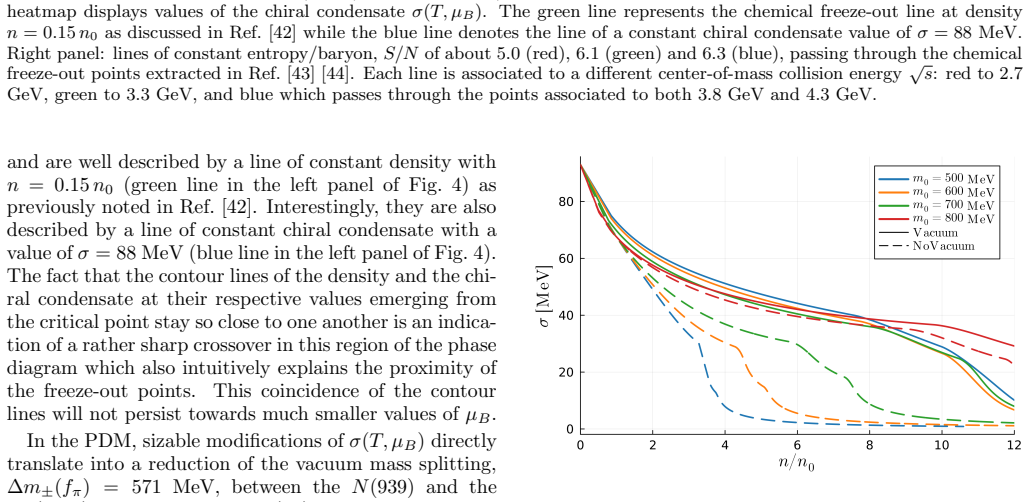
The central claim is that a multiplicatively renormalizable mean-field approach can include baryonic vacuum contributions to the grand-canonical potential of the Parity-Doublet Model in an explicitly renormalization-group invariant form. Applied to two-flavor nuclear matter, this shows the importance of vacuum fluctuations for the evolution of the chiral condensate with density and temperature, for chosen values of m0, in the context of chiral symmetry restoration relevant to neutron stars.
What carries the argument
The multiplicatively renormalizable mean-field approach that includes baryonic vacuum contributions in an explicitly renormalization-group invariant form within the Parity-Doublet Model.
If this is right
- The evolution of the chiral condensate with baryon density is affected by the inclusion of vacuum fluctuations.
- The thermodynamics of symmetric and asymmetric nuclear matter at high densities and temperatures are influenced.
- Chiral symmetry restoration occurs in a manner that accounts for vacuum effects in neutron-star relevant conditions.
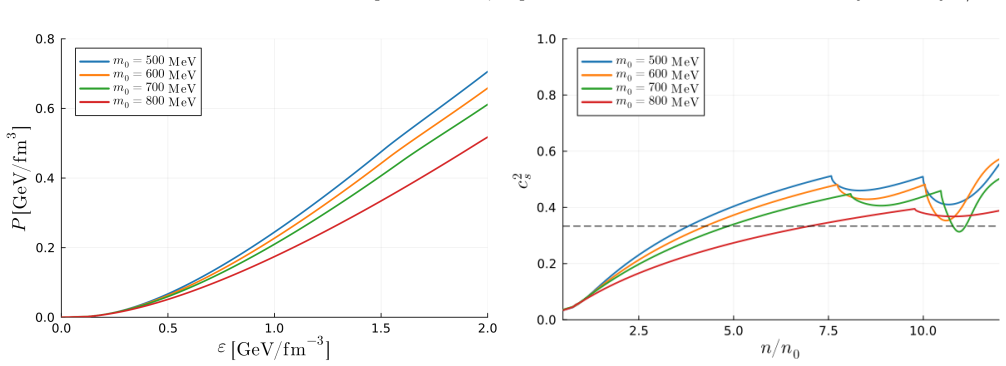
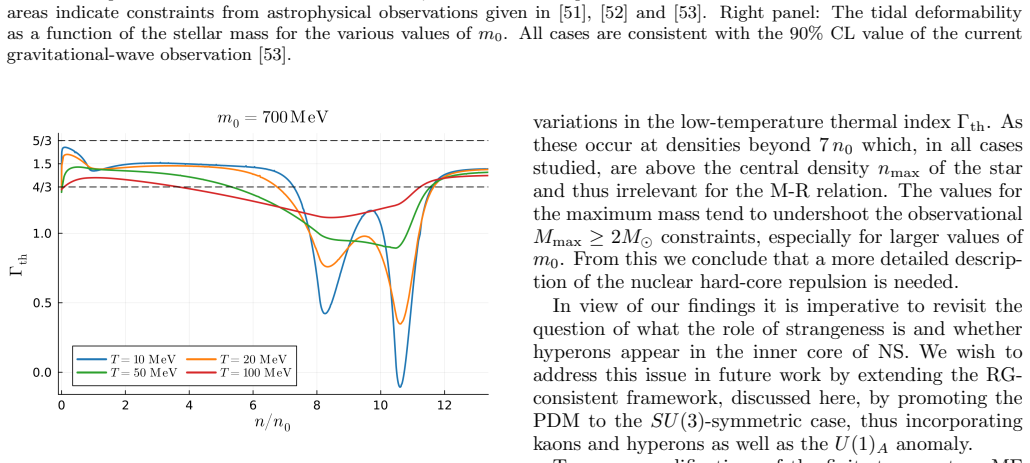
- This provides a more consistent framework for modeling the equation of state in neutron stars.
Where Pith is reading between the lines
- This RG-invariant treatment could be generalized to include more flavors or strange baryons for better neutron star modeling.
- Comparisons with other effective models or lattice simulations at finite density might be facilitated by this approach.
- Earlier Parity-Doublet Model studies may require revision if they omitted consistent vacuum fluctuation contributions.
Load-bearing premise
The approach relies on specific fixed choices of the chirally invariant baryon mass m0 together with the mean-field approximation and two-flavor truncation.
What would settle it
An explicit calculation showing that the chiral condensate evolution with density remains unchanged when vacuum fluctuations are added via this RG-invariant method compared to inconsistent treatments, or that results for the chosen m0 violate known nuclear matter saturation properties.
Figures




read the original abstract
The Parity-Doublet Model (PDM) is a chirally invariant effective theory for strong-interaction matter involving nucleons and their opposite-parity partners in a parity-doubling framework. We introduce a multiplicatively renormalizable mean-field approach to include the baryonic vacuum contributions to the resulting grand-canonical potential in an explicitly renormalization-group invariant form. As an application, we evaluate the pertinent thermodynamics of two-flavor symmetric and asymmetric nuclear matter, focusing on the restoration of spontaneously broken chiral symmetry at baryon densities and temperatures relevant for the astrophysics of neutron stars. Special attention is paid to the effect of the baryonic vacuum fluctuations on the evolution of chiral condensate with baryon density and temperature for specific choices of the chirally invariant baryon mass $m_0$ to demonstrate the importance of consistently including these vacuum fluctuations in the PDM.
Editorial analysis
A structured set of objections, weighed in public.
Referee Report
Summary. The manuscript introduces a multiplicatively renormalizable mean-field formulation of the Parity-Doublet Model (PDM) that incorporates baryonic vacuum contributions to the grand-canonical potential in an explicitly renormalization-group invariant manner. The authors apply the framework to two-flavor symmetric and asymmetric nuclear matter, compute the thermodynamics, and examine the restoration of chiral symmetry at baryon densities and temperatures relevant to neutron stars, with emphasis on the role of vacuum fluctuations for chosen values of the chirally invariant baryon mass m0.
Significance. If the RG-invariant treatment of vacuum terms produces a robust qualitative modification to the chiral-condensate evolution, the construction supplies a technically consistent extension of the PDM that could improve descriptions of dense matter in neutron-star contexts. The explicit multiplicative renormalizability and focus on vacuum contributions constitute a clear technical advance over standard mean-field implementations.
major comments (1)
- [Application to nuclear and neutron-star matter (results section)] The central claim that consistent inclusion of RG-invariant vacuum fluctuations is important for the chiral-condensate evolution rests on fixed choices of the chirally invariant mass m0 together with the mean-field and strict two-flavor approximations. No systematic variation of m0, no estimate of its uncertainty at neutron-star densities, and no test of sensitivity to strangeness degrees of freedom are reported; this leaves open whether the reported qualitative change is an artifact of those choices rather than a general feature of the renormalizable construction.
minor comments (1)
- [Model construction] Notation for the renormalized couplings and the explicit form of the RG-invariant vacuum term should be cross-referenced to the defining equations to improve readability.
Simulated Author's Rebuttal
We thank the referee for the thorough review and insightful comments on our manuscript. We address the major comment in detail below and have made revisions to strengthen the presentation of our results.
read point-by-point responses
-
Referee: The central claim that consistent inclusion of RG-invariant vacuum fluctuations is important for the chiral-condensate evolution rests on fixed choices of the chirally invariant mass m0 together with the mean-field and strict two-flavor approximations. No systematic variation of m0, no estimate of its uncertainty at neutron-star densities, and no test of sensitivity to strangeness degrees of freedom are reported; this leaves open whether the reported qualitative change is an artifact of those choices rather than a general feature of the renormalizable construction.
Authors: We agree that the results are presented for specific choices of m0 and within the two-flavor mean-field framework. The aim of this work is to establish the multiplicatively renormalizable formulation and to highlight the role of vacuum fluctuations by direct comparison for representative m0 values used in the PDM literature. The qualitative change in the condensate evolution is driven by the inclusion of the RG-invariant vacuum terms, which modify the effective potential independently of the particular m0. Nevertheless, to address the concern, we have added a new subsection discussing the dependence on m0 within the range 0.5 to 1.0 GeV and included a note on the limitations of the two-flavor approximation, with plans for future work on strange degrees of freedom. revision: yes
Circularity Check
No significant circularity; RG-invariant vacuum inclusion is a new construction with m0 as explicit input
full rationale
The paper presents a multiplicatively renormalizable mean-field method to incorporate baryonic vacuum contributions into the grand-canonical potential in explicitly RG-invariant form. This is applied to the Parity-Doublet Model for two-flavor matter, with the chirally invariant mass m0 treated as a fixed choice rather than a derived or fitted quantity. No load-bearing step reduces by construction to a self-fit, self-citation chain, or ansatz smuggled from prior work by the same authors. The demonstration of vacuum fluctuation effects on the chiral condensate follows directly from the new construction evaluated at chosen m0 values, remaining self-contained against the stated mean-field and two-flavor truncation without renaming known results or forcing predictions from internal parameters.
Axiom & Free-Parameter Ledger
free parameters (1)
- chirally invariant baryon mass m0
axioms (2)
- domain assumption Mean-field approximation is sufficient for the thermodynamics at the densities and temperatures considered.
- domain assumption Two-flavor symmetric and asymmetric nuclear matter captures the essential physics for neutron-star applications.
Lean theorems connected to this paper
-
IndisputableMonolith/Cost/FunctionalEquation.leanwashburn_uniqueness_aczel unclear?
unclearRelation between the paper passage and the cited Recognition theorem.
the RG-invariant scale parameter Lambda ... generated by dimensional transmutation ... to replace the renormalization scale and the relevant dimensionless interaction strength without introducing a new parameter
What do these tags mean?
- matches
- The paper's claim is directly supported by a theorem in the formal canon.
- supports
- The theorem supports part of the paper's argument, but the paper may add assumptions or extra steps.
- extends
- The paper goes beyond the formal theorem; the theorem is a base layer rather than the whole result.
- uses
- The paper appears to rely on the theorem as machinery.
- contradicts
- The paper's claim conflicts with a theorem or certificate in the canon.
- unclear
- Pith found a possible connection, but the passage is too broad, indirect, or ambiguous to say the theorem truly supports the claim.
Forward citations
Cited by 2 Pith papers
-
Massive hybrid stars within the extended three-flavor quark-meson diquark model
Adding vector and axial-vector mesons to the extended quark-meson diquark model produces a sufficiently stiff equation of state to support hybrid stars above 2 solar masses with quark cores at central densities of at ...
-
Kinetic Mixing and Axial Charges in the Parity-Doublet Model
Kinetic mixing terms are introduced in the parity-doublet model to reproduce the empirical axial charge g_A ≈ 1.28 of the nucleon along with masses of the nucleon and N*(1535).
Reference graph
Works this paper leans on
-
[1]
representations, N1 andN 2, with chirally invariant Yukawa couplings to theO(4) vector (σ, ⃗ π) of sigma-meson and pion fields. Requiring so-called “mirror assignment” [18], where the left-handedN 2 transforms as the right-handedN 1 and vice versa underSU(2) L ×SU(2) R, it is then possible to introduce a chirally invariant fermion massm 0, common to both ...
-
[2]
and ˜λ0 = 1/u 0 = ln(Λ/m 0)/π2 to fixσ 0 =f π (at the reference scale) and theσ-meson (curvature) mass parameterm σ, see below. 6 D. Parameter Fixing and Best Fit We now focus on the choice of the parameters for the PDM. These are fixed both from hadron phenomenology and the saturation properties of nuclear matter. The distinctive parameter of the PDM is ...
-
[3]
Strong-interaction matter under extreme con- ditions
in the mesonic potential (20), and the dimensionless parametersc 6,c 8,g ω,g ρ for the strengths of higher-order couplings and vector repulsion (m σ is allowed to vary between 400 MeV and 550 MeV, but otherwise not constrained and quoted for reference here, see text). No V acuum Contribution m0 [MeV] EB [MeV] n0 [fm−3] Esym [MeV] K∞ [MeV] σ(n0) [MeV] L[Me...
-
[4]
S. S. Afonin, Parity Doubling in Particle Physics, Int. J. Mod. Phys. A22, 4537 (2007), arXiv:0704.1639 [hep-ph]
work page internal anchor Pith review Pith/arXiv arXiv 2007
-
[5]
C. E. Detar and T. Kunihiro, LinearσModel With Parity Doubling, Phys. Rev. D39, 2805 (1989)
work page 1989
-
[6]
M. Gell-Mann and M. Levy, The axial vector current in beta decay, Nuovo Cim.16, 705 (1960)
work page 1960
-
[7]
B. D. Serot and J. D. Walecka, The Relativistic Nuclear Many Body Problem, Adv. Nucl. Phys.16, 1 (1986)
work page 1986
-
[8]
C. E. Detar and J. B. Kogut, The Hadronic Spectrum of the Quark Plasma, Phys. Rev. Lett.59, 399 (1987)
work page 1987
-
[9]
C. E. Detar and J. B. Kogut, Measuring the Hadronic Spectrum of the Quark Plasma, Phys. Rev. D36, 2828 (1987)
work page 1987
-
[10]
Light baryons below and above the deconfinement transition: medium effects and parity doubling
G. Aarts, C. Allton, D. De Boni, S. Hands, B. J¨ ager, C. Praki, and J.-I. Skullerud, Light baryons below and above the deconfinement transition: medium effects and parity doubling, JHEP06, 034, arXiv:1703.09246 [hep- lat]
work page internal anchor Pith review Pith/arXiv arXiv
-
[11]
M. Marczenko, D. Blaschke, K. Redlich, and C. Sasaki, Parity Doubling and the Dense Matter Phase Dia- gram under Constraints from Multi-Messenger Astron- omy, Universe5, 180 (2019), arXiv:1905.04974 [nucl-th]
- [12]
-
[13]
J. Eser and J.-P. Blaizot, Thermodynamics of the parity- doublet model: Symmetric nuclear matter and the chiral transition, Phys. Rev. C109, 045201 (2024), arXiv:2309.06566 [nucl-th]
-
[14]
J. Steinheimer, S. Schramm, and H. Stocker, The hadronic SU(3) Parity Doublet Model for Dense Mat- ter, its extension to quarks and the strange equation of state, Phys. Rev. C84, 045208 (2011), arXiv:1108.2596 [hep-ph]
work page internal anchor Pith review Pith/arXiv arXiv 2011
-
[15]
T. Minamikawa, B. Gao, T. Kojo, and M. Harada, Chiral Restoration of Nucleons in Neutron Star Matter: Studies Based on a Parity Doublet Model, Symmetry15, 745 (2023), arXiv:2302.00825 [nucl-th]
- [16]
-
[17]
Senger (CBM), Probing dense QCD matter in the lab- oratory—The CBM experiment at FAIR, Phys
P. Senger (CBM), Probing dense QCD matter in the lab- oratory—The CBM experiment at FAIR, Phys. Scripta 95, 074003 (2020), arXiv:2005.03321 [nucl-ex]
-
[18]
Adamczewski-Muschet al.(HADES), HADES and the QCD phase diagram, PoSCPOD2021, 003 (2022)
J. Adamczewski-Muschet al.(HADES), HADES and the QCD phase diagram, PoSCPOD2021, 003 (2022)
work page 2022
-
[19]
J. Eser and J.-P. Blaizot, Thermodynamics of the parity- doublet model. II. Asymmetric and neutron matter, Phys. Rev. C110, 065205 (2024), arXiv:2408.01302 [nucl-th]
- [20]
-
[21]
D. Jido, Y. Nemoto, M. Oka, and A. Hosaka, Chiral sym- metry for positive and negative parity nucleons, Nucl. Phys. A671, 471 (2000), arXiv:hep-ph/9805306
work page internal anchor Pith review Pith/arXiv arXiv 2000
-
[22]
Y.-B. Yang, J. Liang, Y.-J. Bi, Y. Chen, T. Draper, K.- F. Liu, and Z. Liu, Proton Mass Decomposition from the QCD Energy Momentum Tensor, Phys. Rev. Lett.121, 212001 (2018), arXiv:1808.08677 [hep-lat]
work page internal anchor Pith review Pith/arXiv arXiv 2018
- [23]
-
[24]
Navaset al.(Particle Data Group), Review of particle physics, Phys
S. Navaset al.(Particle Data Group), Review of particle physics, Phys. Rev. D110, 030001 (2024)
work page 2024
-
[25]
Vacuum fluctuations and the thermodynamics of chiral models
V. Skokov, B. Friman, E. Nakano, K. Redlich, and B. J. Schaefer, Vacuum fluctuations and the thermodynam- ics of chiral models, Phys. Rev. D82, 034029 (2010), arXiv:1005.3166 [hep-ph]
work page internal anchor Pith review Pith/arXiv arXiv 2010
-
[26]
L. Brandes, N. Kaiser, and W. Weise, Fluctuations and phases in baryonic matter, Eur. Phys. J. A57, 243 (2021), arXiv:2103.06096 [nucl-th]
-
[27]
Chiral Mirror-Baryon-Meson Model and Nuclear Matter beyond Mean-Field
J. Weyrich, N. Strodthoff, and L. von Smekal, Chi- ral mirror-baryon-meson model and nuclear matter be- yond mean-field approximation, Phys. Rev. C92, 015214 (2015), arXiv:1504.02697 [nucl-th]
work page internal anchor Pith review Pith/arXiv arXiv 2015
- [28]
- [29]
-
[30]
C. Drischler, P. G. Giuliani, S. Bezoui, J. Piekarewicz, and F. Viens, Bayesian mixture model approach to quan- tifying the empirical nuclear saturation point, Phys. Rev. C110, 044320 (2024), arXiv:2405.02748 [nucl-th]
-
[31]
J. R. Stone, N. J. Stone, and S. A. Moszkowski, Incom- pressibility in finite nuclei and nuclear matter, Phys. Rev. C89, 044316 (2014), arXiv:1404.0744 [nucl-th]
work page internal anchor Pith review Pith/arXiv arXiv 2014
-
[32]
M. Baldo and G. F. Burgio, The nuclear symme- try energy, Prog. Part. Nucl. Phys.91, 203 (2016), arXiv:1606.08838 [nucl-th]
work page internal anchor Pith review Pith/arXiv arXiv 2016
-
[33]
A. Agadjanov, D. Djukanovic, G. von Hippel, H. B. Meyer, K. Ottnad, and H. Wittig, Nucleon Sigma Terms with Nf=2+1 Flavors of O(a)-Improved Wil- son Fermions, Phys. Rev. Lett.131, 261902 (2023), arXiv:2303.08741 [hep-lat]
-
[34]
Nucleon charges andσ-terms in lattice QCD,
C. Alexandrou, S. Bacchio, J. Finkenrath, C. Iona, G. Koutsou, Y. Li, and G. Spanoudes, Nucleon charges andσ-terms in lattice QCD, Phys. Rev. D111, 054505 (2025), arXiv:2412.01535 [hep-lat]
-
[35]
High-precision determination of the pion-nucleon $\sigma$-term from Roy-Steiner equations
M. Hoferichter, J. Ruiz de Elvira, B. Kubis, and U.- G. Meißner, High-Precision Determination of the Pion- NucleonσTerm from Roy-Steiner Equations, Phys. Rev. Lett.115, 092301 (2015), arXiv:1506.04142 [hep-ph]. 16
work page internal anchor Pith review Pith/arXiv arXiv 2015
-
[36]
M. Hoferichter, J. R. de Elvira, B. Kubis, and U.- G. Meißner, On the role of isospin violation in the pion–nucleonσ-term, Phys. Lett. B843, 138001 (2023), arXiv:2305.07045 [hep-ph]
- [37]
-
[38]
In-medium chiral condensate beyond linear density approximation
N. Kaiser, P. de Homont, and W. Weise, In-medium chiral condensate beyond linear density approximation, Phys. Rev. C77, 025204 (2008), arXiv:0711.3154 [nucl- th]
work page internal anchor Pith review Pith/arXiv arXiv 2008
-
[39]
V. A. Karnaukhov and A. S. Botvina, Comment on ’The experimental liquid-vapor phase diagram of bulk nuclear matter’, J. Phys. G40, 058001 (2013)
work page 2013
-
[40]
B. K. Agrawal, J. N. De, and S. K. Samaddar, Deter- mining the density content of symmetry energy and neu- tron skin: an empirical approach, Phys. Rev. Lett.109, 262501 (2012), arXiv:1212.0292 [nucl-th]
work page internal anchor Pith review Pith/arXiv arXiv 2012
-
[41]
B. K. Agrawal, J. N. De, S. K. Samaddar, G. Colo, and A. Sulaksono, Constraining the density dependence of the symmetry energy from nuclear masses, Phys. Rev. C87, 051306 (2013), arXiv:1305.5336 [nucl-th]
work page internal anchor Pith review Pith/arXiv arXiv 2013
- [42]
- [43]
-
[44]
F. J. Fattoyev, C. J. Horowitz, J. Piekarewicz, and G. Shen, Relativistic effective interaction for nuclei, giant resonances, and neutron stars, Phys. Rev. C82, 055803 (2010), arXiv:1008.3030 [nucl-th]
work page internal anchor Pith review Pith/arXiv arXiv 2010
-
[45]
Chemical freeze-out in heavy ion collisions at large baryon densities
S. Floerchinger and C. Wetterich, Chemical freeze-out in heavy ion collisions at large baryon densities, Nucl. Phys. A890-891, 11 (2012), arXiv:1202.1671 [nucl-th]
work page internal anchor Pith review Pith/arXiv arXiv 2012
-
[46]
Decoding the phase structure of QCD via particle production at high energy
A. Andronic, P. Braun-Munzinger, K. Redlich, and J. Stachel, Decoding the phase structure of QCD via par- ticle production at high energy, Nature561, 321 (2018), arXiv:1710.09425 [nucl-th]
work page internal anchor Pith review Pith/arXiv arXiv 2018
-
[47]
The thermal proton yield anomaly in Pb-Pb collisions at the LHC and its resolution
A. Andronic, P. Braun-Munzinger, B. Friman, P. M. Lo, K. Redlich, and J. Stachel, The thermal proton yield anomaly in Pb-Pb collisions at the LHC and its reso- lution, Phys. Lett. B792, 304 (2019), arXiv:1808.03102 [hep-ph]
work page internal anchor Pith review Pith/arXiv arXiv 2019
- [48]
- [49]
-
[50]
Fluctuations in the quark-meson model for QCD with isospin chemical potential
K. Kamikado, N. Strodthoff, L. von Smekal, and J. Wambach, Fluctuations in the quark-meson model for QCD with isospin chemical potential, Phys. Lett. B718, 1044 (2013), arXiv:1207.0400 [hep-ph]
work page internal anchor Pith review Pith/arXiv arXiv 2013
-
[51]
F. Geurts and R.-A. Tripolt, Electromagnetic probes: Theory and experiment, Prog. Part. Nucl. Phys.128, 104004 (2023), arXiv:2210.01622 [hep-ph]
- [52]
-
[53]
Wambach, Baryon-rich QCD matter, J
J. Wambach, Baryon-rich QCD matter, J. Phys. Conf. Ser.2536, 012002 (2023), arXiv:2304.14833 [hep-ph]
-
[54]
M. C. Milleret al., PSR J0030+0451 Mass and Radius fromN ICERData and Implications for the Properties of Neutron Star Matter, Astrophys. J. Lett.887, L24 (2019), arXiv:1912.05705 [astro-ph.HE]
work page internal anchor Pith review Pith/arXiv arXiv 2019
- [55]
-
[56]
B. P. Abbottet al.(LIGO Scientific, Virgo), GW170817: Measurements of neutron star radii and equation of state, Phys. Rev. Lett.121, 161101 (2018), arXiv:1805.11581 [gr-qc]
work page internal anchor Pith review Pith/arXiv arXiv 2018
-
[57]
Relativistic Mean-Field Theory and the High-Density Nuclear Equation of State
H. Mueller and B. D. Serot, Relativistic mean field the- ory and the high density nuclear equation of state, Nucl. Phys. A606, 508 (1996), arXiv:nucl-th/9603037
work page internal anchor Pith review Pith/arXiv arXiv 1996
- [58]
-
[59]
K. Fukushima and S. Minato, Speed of sound and trace anomaly in a unified treatment of the two-color diquark superfluid, the pion-condensed high-isospin matter, and the 2SC quark matter, Phys. Rev. D111, 094006 (2025), arXiv:2411.03781 [hep-ph]
- [60]
-
[61]
Composition and thermodynamics of nuclear matter with light clusters
S. Typel, G. R¨ opke, T. Kl¨ ahn, D. Blaschke, and H. H. Wolter, Composition and thermodynamics of nuclear matter with light clusters, Phys. Rev. C81, 015803 (2010), arXiv:0908.2344 [nucl-th]
work page internal anchor Pith review Pith/arXiv arXiv 2010
-
[62]
H. Gholami, TOVExtravaganza: Python toolkit for solv- ing the Tolman-Oppenheimer-Volkoff (TOV) equations and exploring neutron star properties (2025)
work page 2025
-
[63]
H. Kochankovski, G. Lioutas, S. Blacker, A. Bauswein, A. Ramos, and L. Tolos, Impact of hyperons on neutron star mergers: Gravitational waves, mass ejection, and black hole formation, Phys. Rev. D112, 023014 (2025), arXiv:2501.12905 [astro-ph.HE]
-
[64]
B. Fore and S. Reddy, Pions in hot dense matter and their astrophysical implications, Phys. Rev. C101, 035809 (2020), arXiv:1911.02632 [astro-ph.HE]
discussion (0)
Sign in with ORCID, Apple, or X to comment. Anyone can read and Pith papers without signing in.