Magnetic flux and its topological effects in Aharonov-Bohm effect
Pith reviewed 2026-05-17 22:17 UTC · model grok-4.3
The pith
The confined magnetic field punctures the particle's configuration space, producing the Aharonov-Bohm phase shift through topology alone.
A machine-rendered reading of the paper's core claim, the machinery that carries it, and where it could break.
Core claim
The role of the confined magnetic field is to impart a puncture in the configuration space, R^2, of the charge. Therefore, the quantum state corresponding to the charged quantum particle acquires the phase shift due to its response to the modified topology of the configuration space, R^2-{0}, corresponding to the charge.
What carries the argument
The puncture that turns the configuration space R^2 into the topologically distinct space R^2 minus a point, thereby forcing any closed path that encircles the point to produce a flux-dependent phase in the wave function.
If this is right
- The measured phase depends only on the total enclosed flux and the winding number of the path around the puncture.
- The interference pattern is altered even when the particle never enters the region containing the magnetic field.
- The standard vector-potential description outside the solenoid is not required to obtain the exact phase value.
- Any gauge-invariant observable built from paths that share the same winding number will exhibit the same flux dependence.
Where Pith is reading between the lines
- The same puncture mechanism may supply a topological account for other confined-flux phenomena that appear nonlocal in ordinary treatments.
- It suggests constructing analog systems, such as lattices with artificial defects, to isolate and measure the purely topological contribution to phase shifts.
- If correct, the view implies that the effect should survive in any quantum theory whose configuration space can be punctured while preserving the same fundamental group.
Load-bearing premise
The flux-dependent phase is generated entirely by the topological change in configuration space and does not rely on the usual vector-potential mechanism outside the field region.
What would settle it
An explicit solution of the Schrödinger equation on the full plane R^2 with the same confined flux that yields a phase different from the topological prediction, or an interference experiment in which the phase remains unchanged after the puncture is removed while the flux is kept fixed.
Figures
read the original abstract
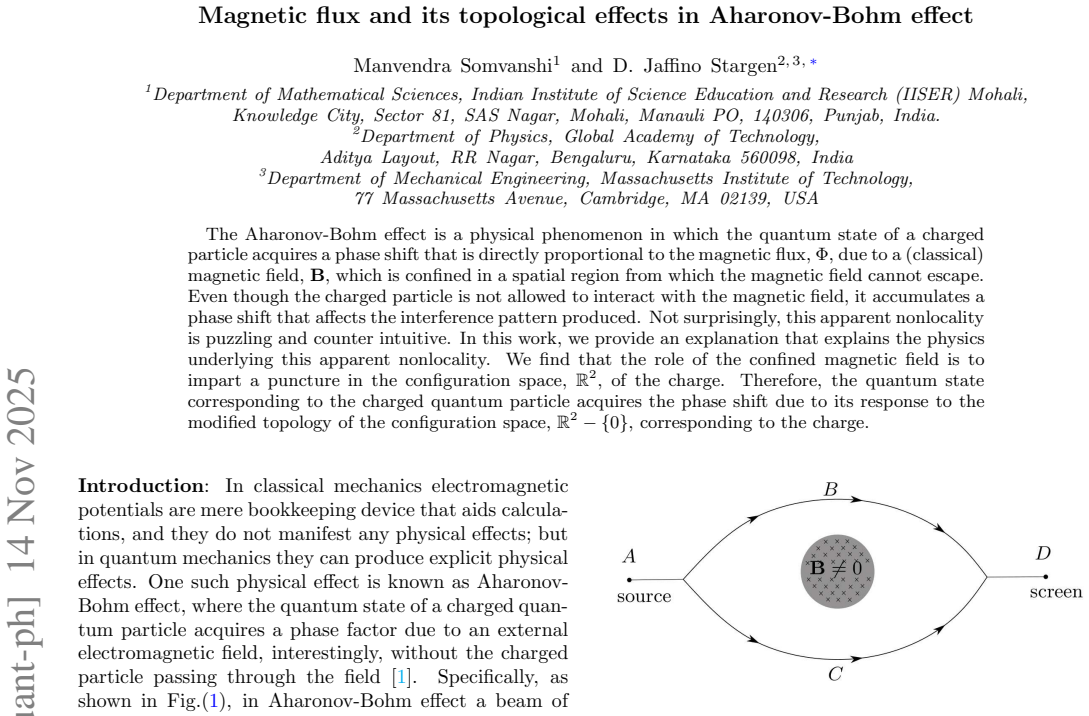
The Aharonov-Bohm effect is a physical phenomenon in which the quantum state of a charged particle acquires a phase shift that is directly proportional to the magnetic flux, $\Phi$, due to a (classical) magnetic field, ${\mathbf B}$, which is confined in a spatial region from which the magnetic field cannot escape. Even though the charged particle is not allowed to interact with the magnetic field, it accumulates a phase shift that affects the interference pattern produced. Not surprisingly, this apparent nonlocality is puzzling and counter intuitive. In this work, we provide an explanation that explains the physics underlying this apparent nonlocality. We find that the role of the confined magnetic field is to impart a puncture in the configuration space, $\mathbb{R}^2$, of the charge. Therefore, the quantum state corresponding to the charged quantum particle acquires the phase shift due to its response to the modified topology of the configuration space, $\mathbb{R}^2-\{0\}$, corresponding to the charge.
Editorial analysis
A structured set of objections, weighed in public.
Referee Report
Summary. The manuscript argues that the Aharonov-Bohm effect arises because a confined magnetic field punctures the configuration space R^2 of a charged particle, so that the quantum state acquires its flux-dependent phase shift solely by responding to the modified topology of R^2 minus a point.
Significance. If the central claim were established by an explicit derivation, the work would supply a topological account of the apparent nonlocality in the Aharonov-Bohm effect and clarify the role of multiply-connected configuration spaces in quantum mechanics. The present text, however, offers only a conceptual statement without deriving the precise phase value from topology alone.
major comments (1)
- [Abstract] Abstract: the statement that the particle 'acquires the phase shift due to its response to the modified topology of the configuration space, R^2-{0}' does not derive the specific proportionality to the enclosed flux Φ. The fundamental group π1(R^2-{0}) ≅ Z permits arbitrary flat U(1) connections; nothing in the topology itself fixes the holonomy angle to 2π Φ/Φ0 without reintroducing a connection or an equivalent integral of the vector potential.
Simulated Author's Rebuttal
We thank the referee for the careful reading and for identifying a key point about the explicit derivation of the phase. We respond to the major comment below and indicate how we will strengthen the presentation.
read point-by-point responses
-
Referee: [Abstract] Abstract: the statement that the particle 'acquires the phase shift due to its response to the modified topology of the configuration space, R^2-{0}' does not derive the specific proportionality to the enclosed flux Φ. The fundamental group π1(R^2-{0}) ≅ Z permits arbitrary flat U(1) connections; nothing in the topology itself fixes the holonomy angle to 2π Φ/Φ0 without reintroducing a connection or an equivalent integral of the vector potential.
Authors: We agree that the fundamental group π₁(ℝ² ∖ {0}) ≅ ℤ classifies homotopy classes but does not by itself select a unique holonomy; any flat U(1) connection is topologically allowed. In the manuscript the confined flux Φ plays a dual role: it creates the puncture that changes the topology of the configuration space and, through the associated vector potential, fixes the specific circulation ∮ A · dl = Φ that determines the holonomy 2π Φ / Φ₀. The topological modification accounts for the nonlocal character of the effect, because the wave function must be single-valued on the multiply connected domain. We acknowledge that the present abstract is concise and does not spell out this relation explicitly. We will therefore revise the abstract to distinguish the topological origin of nonlocality from the flux-dependent value of the holonomy and will add a short paragraph in the main text that recalls how the line integral of A yields the phase on the punctured plane. revision: yes
Circularity Check
No significant circularity; topological reinterpretation does not reduce to input by construction
full rationale
The paper's central claim is that the confined B field punctures R^2, after which the quantum state acquires the AB phase shift solely by responding to the topology of R^2-{0}. This is an interpretive explanation rather than a derivation chain containing equations or parameters that are fitted and then renamed as predictions. No self-citations, ansatzes, or uniqueness theorems are invoked in the provided text to bear the load of the flux proportionality. The argument does not equate the observed phase to its own inputs by definition; it simply attributes the known effect to the puncture. While the topology alone permits arbitrary holonomies and does not fix the specific value 2πΦ/Φ0 without additional structure, this is a question of explanatory completeness or correctness, not circularity per the enumerated patterns. The derivation is self-contained as a conceptual reframing and receives score 0.
Axiom & Free-Parameter Ledger
axioms (1)
- domain assumption Quantum mechanics on a multiply connected configuration space produces a phase shift determined by the topology of the space.
invented entities (1)
-
Puncture in configuration space
no independent evidence
Lean theorems connected to this paper
-
IndisputableMonolith/Foundation/AlexanderDuality.leanalexander_duality_circle_linking unclear?
unclearRelation between the paper passage and the cited Recognition theorem.
the role of the confined magnetic field is to impart a puncture in the configuration space, R², of the charge... modified topology of the configuration space, R²-{0}
-
IndisputableMonolith/Cost/FunctionalEquation.leanwashburn_uniqueness_aczel unclear?
unclearRelation between the paper passage and the cited Recognition theorem.
Hamiltonian... identical with... free particle in the punctured plane... β = α ≡ -qΦ/2π
What do these tags mean?
- matches
- The paper's claim is directly supported by a theorem in the formal canon.
- supports
- The theorem supports part of the paper's argument, but the paper may add assumptions or extra steps.
- extends
- The paper goes beyond the formal theorem; the theorem is a base layer rather than the whole result.
- uses
- The paper appears to rely on the theorem as machinery.
- contradicts
- The paper's claim conflicts with a theorem or certificate in the canon.
- unclear
- Pith found a possible connection, but the passage is too broad, indirect, or ambiguous to say the theorem truly supports the claim.
Reference graph
Works this paper leans on
-
[1]
corre- sponding to the charged particle in the Aharonov-Bohm setup [ 1] in Fig.( 1) is identically same as the Hamiltonian of a free particle in the punctured plane in Eq.( 23), if the parameter, β , is assumed to be β = α ≡ − qΦ/ 2π . The charge,q, and mass, m, of the particle in the Aharonov- Bohm setup is not directly interacting with the magnetic field...
-
[2]
is to impart a puncture in the configu- ration space of the charge, R2. Therefore, the charged particle responds only to the modified topology of its configuration space, which is R2 − { 0}. We find that quantizing the modified configuration space, R2 − { 0}, leads to a family of unitarily inequivalent operator repre- sentations, which are parametrized by a rea...
-
[3]
and Bohm, B., Significance of Elec- tromagnetic Potentials in the Quantum Theory, Phys
Aharonov, Y. and Bohm, B., Significance of Elec- tromagnetic Potentials in the Quantum Theory, Phys. Rev. D , 115:485, (1959)
work page 1959
-
[4]
J. J. Sakurai, Modern Quantum Mechanics (Addison- Wesley Publishing Company, 1994)
work page 1994
-
[5]
Peshkin, M., The Aharonov-Bohm effect: Why it cannot be eliminated from quantum mechanics, Physics Reports, 80:375, (1981)
work page 1981
-
[6]
and Gonzalo, I., Microscopic theory of the Aharonov-Bohm effect, EuroPhysics Letters, 45:418, (1999)
Santos, E. and Gonzalo, I., Microscopic theory of the Aharonov-Bohm effect, EuroPhysics Letters, 45:418, (1999)
work page 1999
-
[7]
and Kaufherr, T., The Effect of a Magnetic Flux Line in Quantum Theory, Phys
Aharonov, Y. and Kaufherr, T., The Effect of a Magnetic Flux Line in Quantum Theory, Phys. Rev. Lett. , 92:070404, (2004)
work page 2004
-
[8]
Peshkin, M., Against a proposed alterna- tive explanation of the Aharonov–Bohm effect, J. Phys. A: Math. Theor. , 43:354031, (2010)
work page 2010
-
[9]
Vaidman, L., Role of potentials in the Aharonov-Bohm effect, Phys. Rev. A , 86:040101, (2012)
work page 2012
-
[10]
Aharonov, Y., Cohen, E., and, Rohrlich, D., Nonlocality of the Aharonov-Bohm effect, Phys. Rev. D , 93:042110, (2016)
work page 2016
-
[11]
and Vedral, V., Aharonov-Bohm Phase is Locally Generated Like All Other Quantum Phases, Phys
Marletto, C. and Vedral, V., Aharonov-Bohm Phase is Locally Generated Like All Other Quantum Phases, Phys. Rev. Lett. , 125:040401, (2020)
work page 2020
-
[12]
von Neumann, J. and Beyer, R. T., Mathematical Foun- dations of Quantum Mechanics: New Edition (Princeton University Press, Princeton, New Jersey, 2018). 5
work page 2018
-
[13]
Wald, R. M., Quantum Field Theory in Curved Spacetime and Black Hole Thermodynamics (University of Chicago press, Chicago, 1994)
work page 1994
-
[14]
and Stargen, D.J., Group theoretic quan- tization of punctured plane, arXiv, 2510.25794, (2025)
Somvanshi, M. and Stargen, D.J., Group theoretic quan- tization of punctured plane, arXiv, 2510.25794, (2025)
-
[15]
C. J. Isham, Topological and Global Aspects of Quantum Theory, in Les Houches Summer School on Theoretical Physics: Relativity, Groups and Topology, 1059–1290, (1983)
work page 1983
discussion (0)
Sign in with ORCID, Apple, or X to comment. Anyone can read and Pith papers without signing in.