Scattering of massive spin-2 field via graviton exchanges with different spin fields and the long range gravitational potential
Pith reviewed 2026-05-17 21:09 UTC · model grok-4.3
The pith
Graviton exchanges produce the Newtonian potential plus spin-dependent corrections for a massive spin-2 test field.
A machine-rendered reading of the paper's core claim, the machinery that carries it, and where it could break.
Core claim
The two-body gravitational potential between a massive spin-2 Fierz-Pauli field and other massive fields is obtained by taking the non-relativistic limit of the tree-level graviton-exchange scattering amplitudes. At order G the potential contains the standard Newtonian attraction together with polarization-dependent corrections; at order G squared the spin-independent, spherically symmetric term is recovered for scattering with a scalar.
What carries the argument
Non-relativistic reduction of the single-graviton-exchange scattering amplitudes in the minimally coupled theory of a massive Fierz-Pauli spin-2 field with general relativity.
If this is right
- The potential between spin-2 and spin-1/2 particles contains polarization-dependent forces at order G.
- The same method yields post-Newtonian corrections once higher-order graviton exchanges are included.
- The framework extends in principle to any massive higher-spin test field coupled to gravity.
Where Pith is reading between the lines
- The same scattering technique could be applied to check consistency of gravitational potentials in theories containing multiple massive spin-2 fields.
- Precision measurements of spin-dependent forces between polarized objects, if ever feasible, would provide a direct test of the subleading terms.
Load-bearing premise
The massive spin-2 field couples to gravity only through the standard minimal prescription, so that the non-relativistic limit of the scattering amplitudes directly yields the potential without extra corrections from the field’s mass or self-interactions.
What would settle it
An explicit mismatch between the non-relativistic reduction of the computed O(G) amplitude and the expected Newtonian term plus spin-dependent pieces would falsify the extraction procedure.
Figures


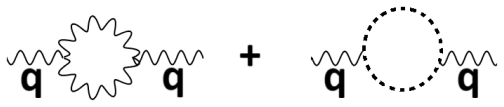
read the original abstract
In this work, we compute the graviton mediated scattering amplitude of a massive spin-2 Fierz-Pauli field with various other massive spin fields, and in the non-relativistic limit, find out the corresponding two-body gravitational potentials. The massive spin-2 field does not represent gravity here. The theory of gravity is taken to be the usual massless general relativity, and the massive spin-2 field is taken as a test quantum field coupled to gravity via the standard minimal prescription. We first compute the tree level 2-2 scattering of a massive spin-2 field with massive scalar, spin-1, and spin-1/2 fields with one graviton exchanges. Leading Newton potential, as well as the subleading spin or polarisation dependent terms at ${\cal O}(G)$ have been computed. We also consider the next to the leading order (${\cal O}(G^2)$) scattering of the massive spin-2 field with a massive scalar, and demonstrate the spin independent, spherically symmetric leading part of the two body gravitational potential. The present paper can be considered as an attempt to compute the gravitational potential in the context of a higher spin field theory.
Editorial analysis
A structured set of objections, weighed in public.
Referee Report
Summary. The paper computes tree-level 2-to-2 scattering amplitudes of a massive Fierz-Pauli spin-2 field with massive scalar, spin-1, and spin-1/2 fields mediated by single graviton exchange in massless GR. From these amplitudes the authors extract the non-relativistic two-body gravitational potentials, reporting the leading Newtonian term together with sub-leading spin- or polarization-dependent corrections at O(G). They additionally evaluate the O(G²) amplitude for the spin-2–scalar system and isolate the spin-independent, spherically symmetric piece of the resulting potential.
Significance. If the calculations are correct, the work supplies explicit analytic expressions for gravitational potentials felt by a massive spin-2 test particle, extending the classic scalar, vector and fermion cases. The O(G²) result for the scalar channel is a modest but concrete step toward higher-order potentials in the presence of higher-spin matter. The manuscript is a straightforward application of standard Feynman rules and non-relativistic reduction; its main value lies in the concrete expressions rather than in conceptual novelty.
major comments (1)
- [non-relativistic reduction] The non-relativistic reduction is performed directly on the tree-level amplitudes. For a rank-2 tensor field the propagator and graviton vertices contain multiple independent tensor structures; an incomplete expansion in |p|/m could leave residual mass-dependent terms that do not appear for lower-spin fields. Explicit verification that the leading spin-independent potential at both O(G) and O(G²) is free of such corrections would strengthen the central claim (see the paragraph following Eq. (X) in the O(G) section and the O(G²) discussion).
minor comments (3)
- [Abstract] The abstract states that the massive spin-2 field is a test field coupled via the minimal prescription; this should be repeated once in the introduction for clarity.
- [amplitude computation] Several intermediate steps in the amplitude calculation (contraction of polarization tensors, trace terms, etc.) are omitted. Adding a short appendix with the key contractions would improve reproducibility.
- [Introduction] The paper would benefit from a brief comparison with existing literature on gravitational potentials for higher-spin fields (e.g., works on massive spin-2 in curved backgrounds).
Simulated Author's Rebuttal
We thank the referee for the careful reading of our manuscript and the constructive comment on the non-relativistic reduction. The recommendation for minor revision is appreciated, and we address the point raised below.
read point-by-point responses
-
Referee: [non-relativistic reduction] The non-relativistic reduction is performed directly on the tree-level amplitudes. For a rank-2 tensor field the propagator and graviton vertices contain multiple independent tensor structures; an incomplete expansion in |p|/m could leave residual mass-dependent terms that do not appear for lower-spin fields. Explicit verification that the leading spin-independent potential at both O(G) and O(G²) is free of such corrections would strengthen the central claim (see the paragraph following Eq. (X) in the O(G) section and the O(G²) discussion).
Authors: We thank the referee for highlighting this subtlety specific to the rank-2 field. In deriving the potentials we performed a systematic expansion of the full tree-level amplitudes (including all tensor structures in the massive spin-2 propagator and the graviton vertices) in powers of |p|/m, keeping only the terms that survive in the non-relativistic limit. After projecting onto the appropriate polarization tensors and taking the appropriate limits, the leading spin-independent pieces at both O(G) and O(G²) reduce exactly to the Newtonian form -G m1 m2/r with no residual mass-dependent corrections. To make this verification explicit we will add a short clarifying paragraph immediately after the relevant equations in the revised manuscript, together with a brief outline of the expansion steps that eliminate potential artifacts. revision: yes
Circularity Check
No significant circularity; derivation is self-contained
full rationale
The paper computes explicit tree-level graviton-exchange amplitudes for a massive Fierz-Pauli spin-2 test field coupled minimally to standard GR, then extracts the non-relativistic two-body potentials at O(G) and O(G^2) directly from those amplitudes. No parameters are fitted to data and then relabeled as predictions, no self-definitional loops appear in the propagator or vertex expansions, and no load-bearing uniqueness theorem or ansatz is imported via self-citation. The central results follow from standard Feynman rules and the usual |p|/m expansion without reducing to the paper's own inputs by construction.
Axiom & Free-Parameter Ledger
axioms (2)
- domain assumption Minimal coupling of the massive spin-2 field to the graviton via the standard prescription in flat-space GR
- domain assumption Validity of the non-relativistic limit on the scattering amplitudes to extract two-body potentials
Forward citations
Cited by 1 Pith paper
-
$\xi R\phi^2$ non-minimal coupling, and the long range gravitational potential for different spin fields from 2-2 scattering amplitudes
The ξ R φ² non-minimal coupling produces a leading r^{-4} long-range gravitational potential from one-loop 2-2 scattering amplitudes in perturbative quantum gravity with vanishing cosmological constant, with explicit ...
Reference graph
Works this paper leans on
-
[1]
R. Utiyama and B. S. DeWitt,Renormalization of a classical gravitational field interacting with quantized matter fields, J. Math. Phys.3, 608 (1962)
work page 1962
-
[2]
Weinberg,Infrared photons and gravitons, Phys
S. Weinberg,Infrared photons and gravitons, Phys. Rev.140, B516 (1965)
work page 1965
-
[3]
D. G. Boulware and S. Deser,Can gravitation have a finite range?, Phys. Rev. D6, 3368–3382 (1972)
work page 1972
-
[4]
G. ’tHooft and M. J. G. Veltman,One-loop divergencies in the theory of gravitation, Ann. Inst. H. Poincar´ e, Phys. Theor. A20, 69–94 (1974)
work page 1974
-
[5]
S. Deser and P. van Nieuwenhuisen,One-loop divergences of quantized Einstein-Maxwell fields, Phys. Rev. D10, 401 (1974)
work page 1974
-
[6]
S. Deser and P. van Nieuwenhuisen,Nonrenormalizability of the quantized Dirac-Einstein system, Phys. Rev. D10, 411 (1974)
work page 1974
- [7]
-
[8]
K. S. Stelle,Renormalization of higher derivative quantum gravity, Phys. Rev. D16, 953 (1977)
work page 1977
-
[9]
B. L. Voronov and I. V. Tyutin,On renormalization ofR 2 gravitation, Sov. Journ. Nucl. Phys.39, 998 (1984)
work page 1984
-
[10]
M. H. Goroff and A. Sagnotti,The Ultraviolet Behavior of Einstein Gravity, Nucl. Phys. B266, 709–736 (1986)
work page 1986
-
[11]
Faddeev-Popov ghosts in quantum gravity beyond perturbation theory
A. Eichhorn,Faddeev-Popov ghosts in quantum gravity beyond perturbation theory, Phys. Rev. D87, 124016 (2013) [arXiv:1301.0632 [hep-th]]
work page internal anchor Pith review Pith/arXiv arXiv 2013
- [12]
-
[13]
V. Mukhanov and S. Winitzki,Introduction to quantum effects in gravity, Cambridge University Press (UK), 2007
work page 2007
-
[14]
R. P. Woodard,Perturbative Quantum Gravity Comes of Age, Int. J. Mod. Phys. D23, 1430020 (2014) [arXiv:1407.4748 [gr-qc]]
work page internal anchor Pith review Pith/arXiv arXiv 2014
-
[15]
Kiefer,Quantum gravity, Oxford University Press (UK), 2017
C. Kiefer,Quantum gravity, Oxford University Press (UK), 2017
work page 2017
-
[16]
I. L. Buchbinder and I. L. Shapiro,Introduction to Quantum Field Theory with Applications to Quantum Gravity, Oxford University Press (UK), 2021
work page 2021
-
[17]
Pagels,Energy-Momentum Structure Form Factors of Particles, Phys
H. Pagels,Energy-Momentum Structure Form Factors of Particles, Phys. Rev.144, 1250–1260 (1966). 20
work page 1966
-
[18]
Iwasaki,Quantum theory of gravitation vs
Y. Iwasaki,Quantum theory of gravitation vs. classical theory. - fourth-order potential, Prog. Theor. Phys.46, 1587–1609 (1971)
work page 1971
-
[19]
K. Hiida and H. Okamura,Gauge transformation and gravitational potentials, Prog. Theor. Phys47, 1743–1757 (1972)
work page 1972
-
[20]
B. M. Barker and R. F. O’Connell,Gravitational Two-Body Problem with Arbitrary Masses, Spins, and Quadrupole Moments, Phys. Rev. D12, 329–335 (1975)
work page 1975
-
[21]
J. F. Donoghue,Leading quantum correction to the newtonian potential, Phys. Rev. Lett.72, 2996 (1994) [arxiv:9310024 [gr-qc]]
work page 1994
-
[22]
J. F. Donoghue,General relativity as an effective field theory: The leading quantum corrections, Phys. Rev. D50, 3874–3888 (1994) [arxiv:9405057 [gr-qc]]
work page 1994
-
[23]
I. J. Muzinich and S. Vokos,Long range forces in quantum gravity, Phys. Rev. D52, 3472–3483 (1995) [arXiv:9501083 [hep-th]]
work page 1995
-
[24]
H. W. Hamber and S. Liu,On the quantum corrections to the Newtonian potential, Phys. Lett. B357, 51–56 (1995) [arxiv:9505182 [hep-th]]
work page 1995
-
[25]
N. E. J. Bjerrum-Bohr, J. F. Donoghue, and B. R. Holstein,Quantum corrections to the Schwarzschild and Kerr metrics, Phys. Rev. D,68084005 (2003) [arxiv:0211071 [hep-th]]
work page 2003
-
[26]
N. E. J. Bjerrum Bohr, J. F. Donoghue, and B. R. Holstein,Quantum Gravitational Corrections to the Non- relativistic Scattering Potential of Two Masses, Phys. Rev. D67, 084033 (2003) [arxiv:0211072 [hep-th]]
work page 2003
- [27]
- [28]
-
[29]
J. F. Donoghue,Introduction to the effective field theory description of gravity(1995) [arXiv:9512024 [gr-qc]]
work page 1995
-
[30]
A. A. Akhundov, S. Bellucci and A. Shiekh,Gravitational interaction to one loop in effective quantum gravity, Phys. Lett. B395, 16–23 (1997) [arxiv:9611018 [gr-qc]]
work page 1997
-
[31]
N. E. J. Bjerrum-Bohr,Leading quantum gravitational corrections to scalar QED, Phys. Rev. D66, 084023 (2002) [arxiv:0206236 [hep-th]]
work page 2002
-
[32]
J. F. Donoghue and T. Torma,Power counting of loop diagrams in general relativity, Physical Review D54, 4963-4972 (1996) [arXiv:9602121[hep-th]]
work page 1996
-
[33]
Modanese,Potential energy in quantum gravity, Nucl
G. Modanese,Potential energy in quantum gravity, Nucl. Phys. B434, 697–708 (1995) [arXiv:9408103 [hep-th]]
work page 1995
-
[34]
Bern,Perturbative quantum gravity and its relation to gauge theory, Living Rev
Z. Bern,Perturbative quantum gravity and its relation to gauge theory, Living Rev. Relt.5(2002) [arXiv:0206071 [gr-qc]]
work page 2002
-
[35]
C. P. Burgess,Quantum gravity in everyday life: General relativity as an effective field theory, Living Rev. Rel.7, 5–56 (2004) [arXiv:0311082 [gr-qc]]
work page 2004
-
[36]
W. D. Goldberger and I. Z. Rothstein,An Effective field theory of gravity for extended objects, Phys. Rev. D73, 104029 (2006) [arXiv:0409156 [hep-th]]. 21
work page 2006
-
[37]
A. Akhundov and A. Shiekh,A Review of Leading Quantum Gravitational Corrections to Newtonian Gravity, Electron. J. Theor. Phys.5, 1–16 (2008) [arXiv:0611091 [gr-qc]]
work page 2008
-
[38]
B. R. Holstein and A. Ross,Spin Effects in Long Range Gravitational Scattering(2008) [arXiv:0802.0716 [hep-ph]]
work page internal anchor Pith review Pith/arXiv arXiv 2008
-
[39]
N. E. J. Bjerrum-Bohr, J. F. Donoghue, B. R. Holstein, L. Plant´ e and P. Vanhove,Bending of Light in Quantum Gravity, Phys. Rev. Lett.114, 061301 (2015) [arXiv:1410.7590 [hep-th]]
work page internal anchor Pith review Pith/arXiv arXiv 2015
-
[40]
N. E. J. Bjerrum-Bohr, J. F. Donoghue, B. K. El-Menoufi, B. R. Holstein, L. Plant´ e and P. Vanhove,The Equivalence Principle in a Quantum World, Int. J. Mod. Phys. D24, 1544013 (2015) [arXiv:1505.04974 [hep-th]]
work page internal anchor Pith review Pith/arXiv arXiv 2015
-
[41]
Dong Bai and Yue Huang,More on the Bending of Light in Quantum Gravity, Phys. Rev. D95, 064045 (2017) [arXiv:1612.07629 [hep-th]]
work page internal anchor Pith review Pith/arXiv arXiv 2017
-
[42]
D. J. Toms,Quantum gravitational contributions to quantum electrodynamics, Nature468, 56–59 (2010) [arXiv:1010.0793 [hep-th]]
work page internal anchor Pith review Pith/arXiv arXiv 2010
-
[43]
P. C. Malta and L. P. R. Ospedal and K. P. B. Veiga and J. A. Helayel-Neto,Comparative aspects of spin- dependent interaction potentials for spin-1/2 and spin-1 matter fields, Adv. High Energy Phys.2016, 2531436 (2016) [arXiv:1510.03291 [hep-th]]
work page internal anchor Pith review Pith/arXiv arXiv 2016
-
[44]
M. B. Fr¨ ob,Quantum gravitational corrections for spinning particles, JHEP10, 051 (2016) [arXiv:1607.03129 [hep-th]]
work page internal anchor Pith review Pith/arXiv arXiv 2016
-
[45]
S. Foffa, P. Mastrolia, R. Sturani, and C. Sturm,Effective field theory approach to the gravitational two-body dynamics, at fourth post-Newtonian order and quintic in the Newton constant, Phys. Rev. D95, 104009 (2017) [arXiv:1612.00482 [gr-qc]]
work page internal anchor Pith review Pith/arXiv arXiv 2017
-
[46]
J. F. Donoghue, M. M. Ivanov and A. Shkerin,EPFL Lectures on General Relativity as a Quantum Field Theory, 2017 [arXiv:1702.00319 [hep-th]]
work page internal anchor Pith review Pith/arXiv arXiv 2017
-
[47]
S. C. Ulhoa, A. F. Santos, and F. C. Khanna,Scattering of fermions by gravitons, Gen. Relt. Gravit.49(2017) [arXiv:1608.00559 [gr-qc]]
work page internal anchor Pith review Pith/arXiv arXiv 2017
-
[48]
Levi,Effective Field Theories of Post-Newtonian Gravity: A comprehensive review, Rept
M. Levi,Effective Field Theories of Post-Newtonian Gravity: A comprehensive review, Rept. Prog. Phys.83, 075901 (2020) [arXiv:1807.01699 [hep-th]]
-
[49]
Weak gravitational interaction of fermions: quantum viewpoint
T. Olyaei, and A. Aziziy,Weak gravitational interaction of fermions: quantum viewpoint, Mod. Phys. Lett. A33, 1850218 (2018) [arXiv:1804.06939 [physics.gen-ph]]
work page internal anchor Pith review Pith/arXiv arXiv 2018
- [50]
-
[51]
M. Fierz and W. Pauli,On relativistic wave equations for particles of arbitrary spin in an electromagnetic field, Proc. R. Soc. Lond. A173, 211–232 (1939)
work page 1939
-
[52]
Dvali,Black holes with quantum massive spin-2 hair, Phys
G. Dvali,Black holes with quantum massive spin-2 hair, Phys. Rev. D74, 044013 (2006) [arXiv:0605295 [hep- th]]
work page 2006
-
[53]
Claudia de Rham and Gregory Gabadadze,Selftuned Massive Spin-2, Phys. Lett. B693, 334–338 (2010) [arXiv:1006.4367 [hep-th]]. 22
work page internal anchor Pith review Pith/arXiv arXiv 2010
-
[54]
Generalization of the Fierz-Pauli Action
C. de Rham and G. Gabadadze,Generalization of the Fierz-Pauli Action, Phys. Rev. D82, 044020, (2010) [arXiv:1007.0443 [hep-th]]
work page internal anchor Pith review Pith/arXiv arXiv 2010
-
[55]
S. Folkerts, C. Germani, and N. Wintergerst,Massive spin-2 theories, Cosmology and Particle Physics beyond Standard Models : Ten Years of the SEENET-MTP Network, 87–97 (2014) [arXiv:1310.0453 [hep-th]]
work page internal anchor Pith review Pith/arXiv arXiv 2014
-
[56]
Classical and quantum theory of the massive spin-two field
A. Koenigstein, F. Giacosa, D. H. Rischke,Classical and quantum theory of the massive spin-two field, Ann. Phys.368, 16-55 (2016) [arXiv:1508.00110 [hep-th]]
work page internal anchor Pith review Pith/arXiv arXiv 2016
-
[57]
R. Jalali and A. Shirzad,Hamiltonian structure of Fierz-Pauli gravitons, partially massless fields and gauge symmetry, Nucl. Phys. B976, 115711 (2022) [arXiv:2010.04503 [hep-th]]
- [58]
-
[59]
L. Farolfi and F. Fecit,The Fierz-Pauli theory on curved spacetime at one-loop and its counterterms, Eur. Phys. J. C85, 356 (2025) [arXiv:2503.11304 [hep-th]]
-
[60]
H. van Dam and M. J. G. Veltman,Massive and massless Yang-Mills and gravitational fields, Nucl. Phys. B22, 397 (1970)
work page 1970
-
[61]
V. I. Zakharov,Linearized gravitation theory and the graviton mass, JETP Lett.12, 312 (1970)
work page 1970
-
[62]
P. Creminelli, A. Nicolis, M. Papucci, and E. Trincherini,Ghosts in massive gravity, JHEP0509, 003 (2005) [arXiv:hep-th/0505147]
work page internal anchor Pith review Pith/arXiv arXiv 2005
-
[63]
Claudia de Rham,Massive Gravity, Living Rev. Rel.17, 7 (2014) [arXiv:1401.4173 [hep-th]]
work page internal anchor Pith review Pith/arXiv arXiv 2014
-
[64]
G. Gambuti and N. Maggiore,Fierz–Pauli theory reloaded: from a theory of a symmetric tensor field to linearized massive gravity, Eur. Phys. J. C81, 171 (2021) [arXiv:2102.10813 [gr-qc]]
-
[65]
T. Tachinami and Y. Sendouda,Nonrelativistic stellar structure in the Fierz-Pauli theory and generic linear massive gravity, Phys. Rev. D110, 064013 (2024) [arXiv:2403.16363 [gr-qc]]. 23
discussion (0)
Sign in with ORCID, Apple, or X to comment. Anyone can read and Pith papers without signing in.