Recognition: 2 theorem links
· Lean TheoremOmniAlpha: Aligning Transparency-Aware Generation via Multi-Task Unified Reinforcement Learning
Pith reviewed 2026-05-17 04:36 UTC · model grok-4.3
The pith
A single reinforcement learning model unifies transparency-aware image tasks like matting and layer decomposition.
A machine-rendered reading of the paper's core claim, the machinery that carries it, and where it could break.
Core claim
OmniAlpha combines an end-to-end alpha-aware VAE and a sequence-to-sequence Diffusion Transformer with a bi-directional layer axis in positional encoding to model multiple RGBA inputs and outputs in one pass. After multi-task supervised fine-tuning, it performs GRPO-style post-training with layer-aware rewards on decoded RGBA outputs to optimize cross-layer coherence and transparency details, leading to better performance than the SFT baseline and competitive results with specialized models on five task categories.
What carries the argument
GRPO-style post-training with rewards defined directly on decoded RGBA outputs, which optimizes for compositional fidelity and alpha-boundary precision in a unified Diffusion Transformer setup.
If this is right
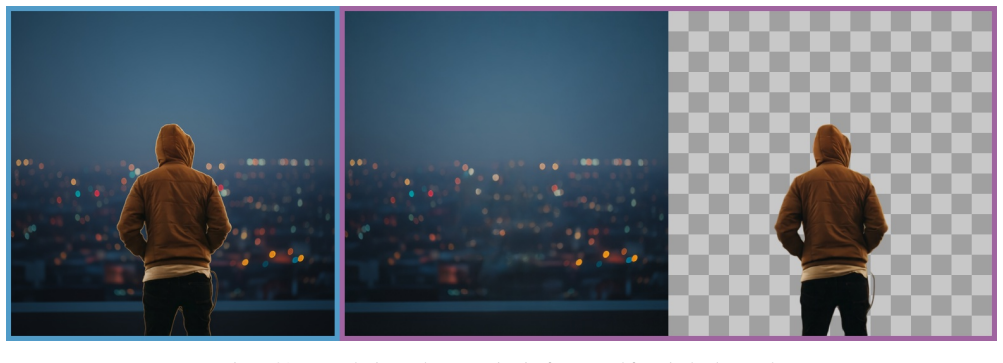
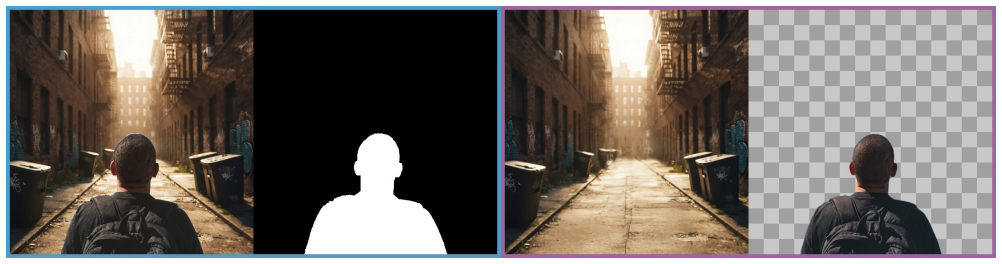
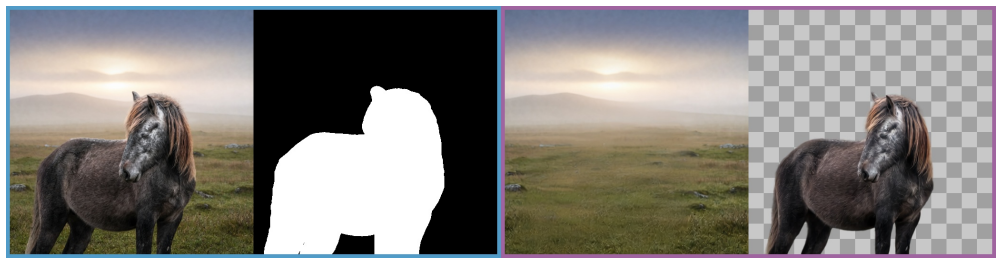
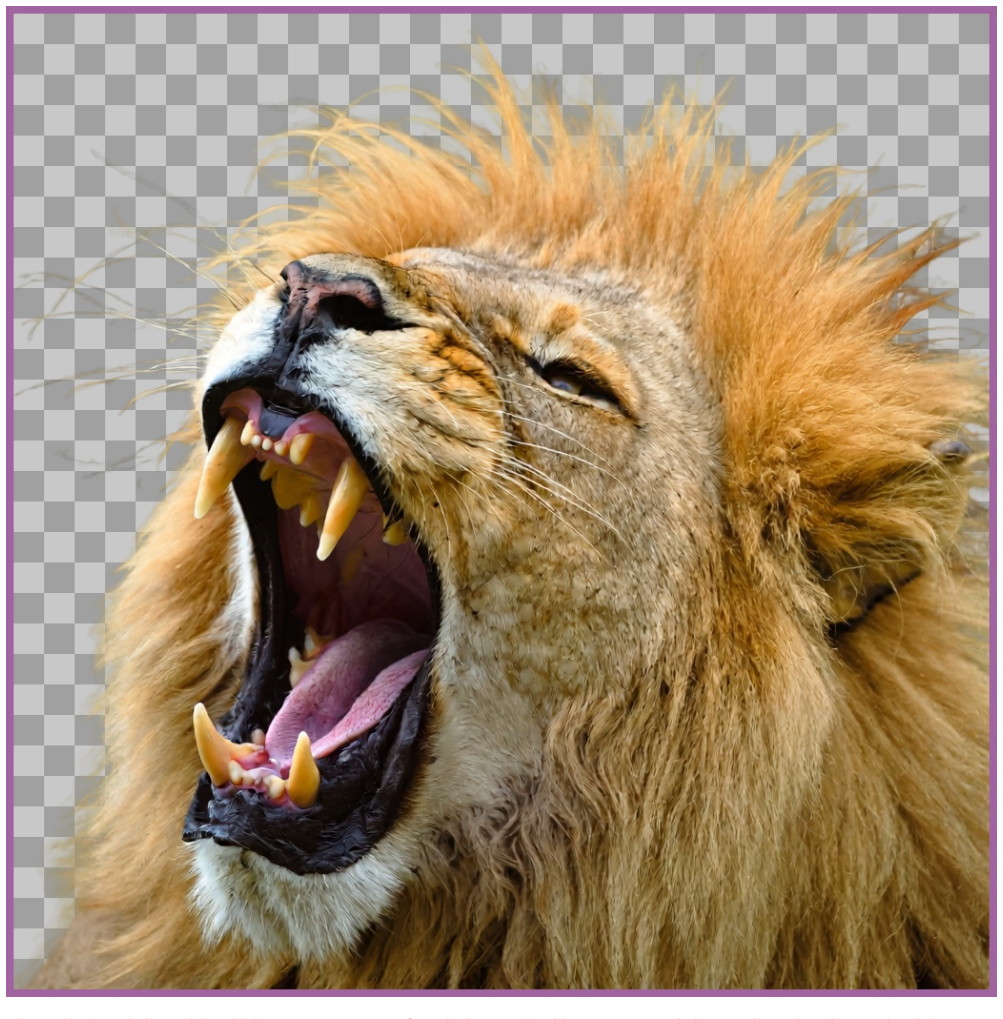
- A unified model can perform image matting, object removal, layer decomposition, and multi-layer creation without needing separate pipelines.
- Direct optimization on RGBA outputs improves cross-layer coherence and fine transparency details over standard supervised training.
- The approach achieves a 9.07% relative reduction in RGB L1 error for layer decomposition compared to baselines.
- Automatic matting sees 74% and 68% improvements on SAD and Grad metrics over conventional tools.
- Strong performance against specialized expert models across multiple transparency tasks.
Where Pith is reading between the lines
- If the reward design generalizes well, this could lead to easier integration of transparency editing into general image generation systems.
- Extending the bi-directional layer encoding might allow handling dynamic or video-based transparency tasks in future work.
- Testing the model on inputs with unusual lighting or complex real-world transparencies would check for any distribution shift issues.
- Combining this with other diffusion-based editing techniques could expand its use in creative applications.
Load-bearing premise
That defining rewards on the decoded RGBA outputs will improve cross-layer coherence and transparency without the model finding ways to game the rewards that hurt performance on real inputs.
What would settle it
Running the model on a new set of real photographs with overlapping semi-transparent objects and measuring if the output layers show more inconsistencies or artifacts than outputs from combining multiple specialized matting and decomposition tools.
Figures










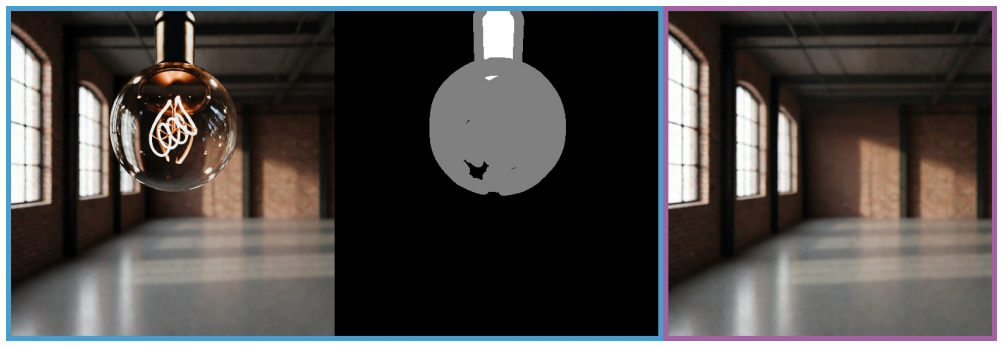


read the original abstract
Transparency-aware generation requires modeling not only RGB appearance but also alpha-based opacity and cross-layer composition, which are essential for tasks such as image matting, object removal, layer decomposition, and multi-layer content creation. However, existing RGBA-related methods remain largely fragmented, with separate pipelines designed for individual tasks. While a unified model is desirable, supervised fine-tuning alone is insufficient, as localized regression objectives cannot directly optimize the compositional fidelity, alpha-boundary precision, and structural consistency required for high-quality RGBA generation. To address this, we propose OmniAlpha, a unified multi-task reinforcement learning framework for transparency-aware generation and manipulation. OmniAlpha combines an end-to-end alpha-aware VAE and a sequence-to-sequence Diffusion Transformer, with a bi-directional layer axis in positional encoding to jointly model multiple RGBA inputs and outputs within a single forward pass. Built on a multi-task SFT cold start, it further performs GRPO-style post-training with layer-aware rewards defined on decoded RGBA outputs, enabling direct optimization of cross-layer coherence and fine transparency details. Experiments across five categories of transparency-aware tasks show that OmniAlpha consistently outperforms its unified SFT baseline and achieves strong performance against specialized expert models, including a 9.07% relative reduction in RGB L1 on layer decomposition and 74%/68% improvements over conventional matting tools on SAD/Grad for automatic matting.
Editorial analysis
A structured set of objections, weighed in public.
Referee Report
Summary. The manuscript proposes OmniAlpha, a unified multi-task reinforcement learning framework for transparency-aware generation and manipulation. It integrates an end-to-end alpha-aware VAE with a sequence-to-sequence Diffusion Transformer that incorporates a bi-directional layer axis in positional encoding to jointly model multiple RGBA inputs and outputs. Starting from a multi-task SFT cold start, the method applies GRPO-style post-training using layer-aware rewards defined on decoded RGBA outputs to optimize cross-layer coherence and alpha-boundary precision. Experiments across five categories of transparency-aware tasks report consistent outperformance over the unified SFT baseline and competitive or superior results against specialized expert models, including a 9.07% relative reduction in RGB L1 on layer decomposition and 74%/68% gains on SAD/Grad metrics for automatic matting.
Significance. If the empirical gains prove robust and attributable to the RL stage rather than implementation details, the work could meaningfully advance unified modeling of RGBA tasks that are currently handled by fragmented pipelines. The architectural choice of bi-directional layer positional encoding and the shift from localized regression to reward-based optimization of compositional fidelity represent a coherent extension of diffusion-based methods to layered content creation.
major comments (2)
- [Abstract] Abstract: The central claim that GRPO-style post-training with rewards defined on decoded RGBA outputs directly optimizes cross-layer coherence and fine transparency details is load-bearing, yet the abstract provides no formulation, weighting, or explicit penalty terms for inter-layer inconsistencies. Without this, it is impossible to evaluate whether the rewards target structural consistency or permit superficial metric improvements that do not generalize.
- [Abstract] Abstract: The reported quantitative gains (9.07% RGB L1 reduction, 74%/68% SAD/Grad improvements) are presented without accompanying ablation of the layer-axis encoding, alpha-aware VAE, or statistical significance testing, and without direct comparison of the same metrics on the SFT baseline. This weakens attribution of improvements to the GRPO stage rather than other factors.
minor comments (2)
- [Abstract] The abstract refers to 'five categories of transparency-aware tasks' without enumerating them or indicating how task-specific metrics were aggregated, which reduces clarity for readers evaluating the breadth of the evaluation.
- Notation for the bi-directional layer positional encoding and the precise interface between the alpha-aware VAE and the Diffusion Transformer could be introduced earlier to aid reproducibility.
Simulated Author's Rebuttal
We thank the referee for the detailed and insightful comments. We address each major comment point by point below, agreeing to revisions where the manuscript can be strengthened.
read point-by-point responses
-
Referee: [Abstract] Abstract: The central claim that GRPO-style post-training with rewards defined on decoded RGBA outputs directly optimizes cross-layer coherence and fine transparency details is load-bearing, yet the abstract provides no formulation, weighting, or explicit penalty terms for inter-layer inconsistencies. Without this, it is impossible to evaluate whether the rewards target structural consistency or permit superficial metric improvements that do not generalize.
Authors: We acknowledge that the abstract is concise and does not detail the reward formulation. The full paper in Section 3.3 describes the layer-aware rewards as a combination of per-layer RGB L1, alpha SAD and gradient terms, plus a cross-layer coherence reward based on the composited RGBA output. We will revise the abstract to include a short description of the reward terms, including the explicit penalty for inter-layer inconsistencies, to better support the central claim. revision: yes
-
Referee: [Abstract] Abstract: The reported quantitative gains (9.07% RGB L1 reduction, 74%/68% SAD/Grad improvements) are presented without accompanying ablation of the layer-axis encoding, alpha-aware VAE, or statistical significance testing, and without direct comparison of the same metrics on the SFT baseline. This weakens attribution of improvements to the GRPO stage rather than other factors.
Authors: The manuscript does provide direct comparisons to the SFT baseline for these metrics in the experimental section (Tables 2 and 3), where the reported gains are shown relative to SFT. Ablations for the bi-directional layer positional encoding and alpha-aware VAE are detailed in Section 4.2. However, we agree that statistical significance testing is missing. We will add this in the revised version, along with ensuring the abstract or results section explicitly highlights the SFT comparisons for the quoted metrics. We will also consider including a summary of key ablations in the abstract if feasible. revision: partial
Circularity Check
No significant circularity; empirical gains reported on held-out evaluations
full rationale
The paper describes a multi-task SFT cold-start followed by GRPO-style RL with rewards defined on decoded RGBA outputs. Reported metrics (RGB L1, SAD/Grad) are evaluated on held-out tasks and compared against both unified SFT baseline and specialized expert models. No equations or claims reduce the final performance numbers to the reward terms by construction. No self-citation load-bearing uniqueness theorems, ansatzes smuggled via prior work, or self-definitional loops are present in the abstract or described method. The derivation chain is self-contained against external benchmarks and does not rely on renaming known results or fitted inputs presented as predictions.
Axiom & Free-Parameter Ledger
axioms (1)
- domain assumption Localized regression objectives cannot directly optimize compositional fidelity, alpha-boundary precision, and structural consistency
Lean theorems connected to this paper
-
IndisputableMonolith/Foundation/AlexanderDuality.leanalexander_duality_circle_linking unclear?
unclearRelation between the paper passage and the cited Recognition theorem.
MSRoPE-BiL, a RoPE method with a bi-directionally extendable layer axis... target latents assigned negative indices z = -k
-
IndisputableMonolith/Cost/FunctionalEquation.leanwashburn_uniqueness_aczel unclear?
unclearRelation between the paper passage and the cited Recognition theorem.
GRPO-style post-training with layer-aware rewards defined on decoded RGBA outputs
What do these tags mean?
- matches
- The paper's claim is directly supported by a theorem in the formal canon.
- supports
- The theorem supports part of the paper's argument, but the paper may add assumptions or extra steps.
- extends
- The paper goes beyond the formal theorem; the theorem is a base layer rather than the whole result.
- uses
- The paper appears to rely on the theorem as machinery.
- contradicts
- The paper's claim conflicts with a theorem or certificate in the canon.
- unclear
- Pith found a possible connection, but the passage is too broad, indirect, or ambiguous to say the theorem truly supports the claim.
Forward citations
Cited by 2 Pith papers
-
RevealLayer: Disentangling Hidden and Visible Layers via Occlusion-Aware Image Decomposition
RevealLayer decomposes natural images into multiple RGBA layers using diffusion models with region-aware attention, occlusion-guided adaptation, and a composite loss, outperforming prior methods on a new benchmark dataset.
-
UniVidX: A Unified Multimodal Framework for Versatile Video Generation via Diffusion Priors
UniVidX unifies diverse video generation tasks into one conditional diffusion model using stochastic condition masking, decoupled gated LoRAs, and cross-modal self-attention.
Reference graph
Works this paper leans on
-
[1]
Transmat- ting: Enhancing transparent objects matting with transform- ers, 2022
Huanqia Cai, Fanglei Xue, Lele Xu, and Lili Guo. Transmat- ting: Enhancing transparent objects matting with transform- ers, 2022. 5
work page 2022
-
[2]
Prismlayers: Open data for high-quality multi-layer transpar- ent image generative models, 2025
Junwen Chen, Heyang Jiang, Yanbin Wang, Keming Wu, Ji Li, Chao Zhang, Keiji Yanai, Dong Chen, and Yuhui Yuan. Prismlayers: Open data for high-quality multi-layer transpar- ent image generative models, 2025. 5
work page 2025
-
[3]
Layerfusion: Harmo- nized multi-layer text-to-image generation with generative priors, 2024
Yusuf Dalva, Yijun Li, Qing Liu, Nanxuan Zhao, Jianming Zhang, Zhe Lin, and Pinar Yanardag. Layerfusion: Harmo- nized multi-layer text-to-image generation with generative priors, 2024. 3
work page 2024
-
[4]
Puma: Empowering unified mllm with multi-granular visual generation, 2024
Rongyao Fang, Chengqi Duan, Kun Wang, Hao Li, Hao Tian, Xingyu Zeng, Rui Zhao, Jifeng Dai, Hongsheng Li, and Xihui Liu. Puma: Empowering unified mllm with multi-granular visual generation, 2024. 2, 3
work page 2024
-
[5]
Robert M. Haralick, Stanley R. Sternberg, and Xinhua Zhuang. Image analysis using mathematical morphology. IEEE Transactions on Pattern Analysis and Machine Intelli- gence, PAMI-9(4):532–550, 1987. 6, 2
work page 1987
-
[6]
Denoising diffu- sion probabilistic models, 2020
Jonathan Ho, Ajay Jain, and Pieter Abbeel. Denoising diffu- sion probabilistic models, 2020. 2
work page 2020
-
[7]
Hu, Yelong Shen, Phillip Wallis, Zeyuan Allen- Zhu, Yuanzhi Li, Shean Wang, Lu Wang, and Weizhu Chen
Edward J. Hu, Yelong Shen, Phillip Wallis, Zeyuan Allen- Zhu, Yuanzhi Li, Shean Wang, Lu Wang, and Weizhu Chen. Lora: Low-rank adaptation of large language models, 2021. 7
work page 2021
-
[8]
Diffusion for natural image matting, 2024
Yihan Hu, Yiheng Lin, Wei Wang, Yao Zhao, Yunchao Wei, and Humphrey Shi. Diffusion for natural image matting, 2024. 2, 3
work page 2024
-
[9]
Psdiffusion: Harmonized multi-layer image generation via layout and appearance alignment, 2025
Dingbang Huang, Wenbo Li, Yifei Zhao, Xinyu Pan, Yanhong Zeng, and Bo Dai. Psdiffusion: Harmonized multi-layer image generation via layout and appearance alignment, 2025. 3
work page 2025
-
[10]
Dream- layer: Simultaneous multi-layer generation via diffusion mode, 2025
Junjia Huang, Pengxiang Yan, Jinhang Cai, Jiyang Liu, Zhao Wang, Yitong Wang, Xinglong Wu, and Guanbin Li. Dream- layer: Simultaneous multi-layer generation via diffusion mode, 2025. 3
work page 2025
-
[11]
Designedit: Multi-layered latent decomposition and fusion for unified & accurate image editing, 2024
Yueru Jia, Yuhui Yuan, Aosong Cheng, Chuke Wang, Ji Li, Huizhu Jia, and Shanghang Zhang. Designedit: Multi-layered latent decomposition and fusion for unified & accurate image editing, 2024. 3
work page 2024
-
[12]
Auto-encoding varia- tional bayes, 2022
Diederik P Kingma and Max Welling. Auto-encoding varia- tional bayes, 2022. 2
work page 2022
-
[13]
Flux.1 kontext: Flow matching for in-context image generation and editing in latent space, 2025
Black Forest Labs, Stephen Batifol, Andreas Blattmann, Fred- eric Boesel, Saksham Consul, Cyril Diagne, Tim Dockhorn, Jack English, Zion English, Patrick Esser, Sumith Kulal, Kyle Lacey, Yam Levi, Cheng Li, Dominik Lorenz, Jonas Müller, Dustin Podell, Robin Rombach, Harry Saini, Axel Sauer, and Luke Smith. Flux.1 kontext: Flow matching for in-context imag...
work page 2025
-
[14]
Privacy- preserving portrait matting, 2021
Jizhizi Li, Sihan Ma, Jing Zhang, and Dacheng Tao. Privacy- preserving portrait matting, 2021. 5
work page 2021
-
[15]
Jizhizi Li, Jing Zhang, Stephen J. Maybank, and Dacheng Tao. Bridging composite and real: Towards end-to-end deep image matting, 2021. 5
work page 2021
-
[16]
Deep automatic natural image matting, 2021
Jizhizi Li, Jing Zhang, and Dacheng Tao. Deep automatic natural image matting, 2021. 7
work page 2021
- [17]
-
[18]
Jizhizi Li, Jing Zhang, and Dacheng Tao. Referring image matting, 2023. 7
work page 2023
-
[19]
Xiaodi Li, Zongxin Yang, Ruijie Quan, and Yi Yang. Drip: Unleashing diffusion priors for joint foreground and alpha prediction in image matting.Advances in Neural Information Processing Systems 37, 2024. 3
work page 2024
-
[20]
Visualcloze: A universal image generation framework via visual in-context learning, 2025
Zhong-Yu Li, Ruoyi Du, Juncheng Yan, Le Zhuo, Zhen Li, Peng Gao, Zhanyu Ma, and Ming-Ming Cheng. Visualcloze: A universal image generation framework via visual in-context learning, 2025. 2, 3
work page 2025
-
[21]
Real-time high-resolution background matting, 2020
Shanchuan Lin, Andrey Ryabtsev, Soumyadip Sengupta, Brian Curless, Steve Seitz, and Ira Kemelmacher-Shlizerman. Real-time high-resolution background matting, 2020. 5
work page 2020
-
[22]
Tripartite information mining and inte- gration for image matting
Yuhao Liu, Jiake Xie, Xiao Shi, Yu Qiao, Yujie Huang, Yong Tang, and Xin Yang. Tripartite information mining and inte- gration for image matting. InProceedings of the IEEE/CVF International Conference on Computer Vision (ICCV), pages 7555–7564, 2021. 5
work page 2021
-
[23]
Decoupled Weight Decay Regularization
Ilya Loshchilov and Frank Hutter. Decoupled weight decay regularization.arXiv preprint arXiv: 1711.05101, 2017. 6
work page internal anchor Pith review Pith/arXiv arXiv 2017
- [24]
-
[25]
Scalable diffusion models with transformers, 2023
William Peebles and Saining Xie. Scalable diffusion models with transformers, 2023. 2, 3
work page 2023
-
[26]
Art: Anonymous re- gion transformer for variable multi-layer transparent image generation, 2025
Yifan Pu, Yiming Zhao, Zhicong Tang, Ruihong Yin, Haox- ing Ye, Yuhui Yuan, Dong Chen, Jianmin Bao, Sirui Zhang, Yanbin Wang, Lin Liang, Lijuan Wang, Ji Li, Xiu Li, Zhouhui Lian, Gao Huang, and Baining Guo. Art: Anonymous re- gion transformer for variable multi-layer transparent image generation, 2025. 3
work page 2025
-
[27]
Attention-guided hi- erarchical structure aggregation for image matting
Yu Qiao, Yuhao Liu, Xin Yang, Dongsheng Zhou, Mingliang Xu, Qiang Zhang, and Xiaopeng Wei. Attention-guided hi- erarchical structure aggregation for image matting. InThe IEEE Conference on Computer Vision and Pattern Recogni- tion (CVPR), 2020. 5
work page 2020
-
[28]
Alfie: Democratising rgba image generation with no $$$, 2024
Fabio Quattrini, Vittorio Pippi, Silvia Cascianelli, and Rita Cucchiara. Alfie: Democratising rgba image generation with no $$$, 2024. 3
work page 2024
-
[29]
High-resolution image synthesis with latent diffusion models, 2022
Robin Rombach, Andreas Blattmann, Dominik Lorenz, Patrick Esser, and Björn Ommer. High-resolution image synthesis with latent diffusion models, 2022. 2, 3, 5
work page 2022
-
[30]
Rord: A real-world object removal dataset
Min-Cheol Sagong, Yoon-Jae Yeo, Seung-Won Jung, and Sung-Jea Ko. Rord: A real-world object removal dataset. In British Machine Vision Conference, 2022. 7
work page 2022
-
[31]
Roformer: Enhanced transformer with rotary position embedding.Neurocomputing, 568:127063,
Jianlin Su, Murtadha Ahmed, Yu Lu, Shengfeng Pan, Wen Bo, and Yunfeng Liu. Roformer: Enhanced transformer with rotary position embedding.Neurocomputing, 568:127063,
-
[32]
Yanan Sun, Chi-Keung Tang, and Yu-Wing Tai. Semantic image matting, 2021. 5
work page 2021
-
[33]
Ultrahigh resolution image/video matting with spatio-temporal sparsity
Yanan Sun, Chi-Keung Tang, and Yu-Wing Tai. Ultrahigh resolution image/video matting with spatio-temporal sparsity. InProceedings of the IEEE/CVF Conference on Computer Vision and Pattern Recognition (CVPR), pages 14112–14121,
- [34]
-
[35]
Zile Wang, Hao Yu, Jiabo Zhan, and Chun Yuan. Alphavae: Unified end-to-end rgba image reconstruction and generation with alpha-aware representation learning.arXiv preprint arXiv: 2507.09308, 2025. 3, 4, 7
-
[36]
Objectdrop: Bootstrap- ping counterfactuals for photorealistic object removal and insertion, 2024
Daniel Winter, Matan Cohen, Shlomi Fruchter, Yael Pritch, Alex Rav-Acha, and Yedid Hoshen. Objectdrop: Bootstrap- ping counterfactuals for photorealistic object removal and insertion, 2024. 2, 3
work page 2024
-
[37]
Qwen-image technical report, 2025
Chenfei Wu, Jiahao Li, Jingren Zhou, Junyang Lin, Kaiyuan Gao, Kun Yan, Sheng ming Yin, Shuai Bai, Xiao Xu, Yilei Chen, Yuxiang Chen, Zecheng Tang, Zekai Zhang, Zhengyi Wang, An Yang, Bowen Yu, Chen Cheng, Dayiheng Liu, De- qing Li, Hang Zhang, Hao Meng, Hu Wei, Jingyuan Ni, Kai Chen, Kuan Cao, Liang Peng, Lin Qu, Minggang Wu, Peng Wang, Shuting Yu, Tingk...
work page 2025
-
[38]
Omnigen2: Exploration to advanced multimodal generation, 2025
Chenyuan Wu, Pengfei Zheng, Ruiran Yan, Shitao Xiao, Xin Luo, Yueze Wang, Wanli Li, Xiyan Jiang, Yexin Liu, Jun- jie Zhou, Ze Liu, Ziyi Xia, Chaofan Li, Haoge Deng, Jia- hao Wang, Kun Luo, Bo Zhang, Defu Lian, Xinlong Wang, Zhongyuan Wang, Tiejun Huang, and Zheng Liu. Omnigen2: Exploration to advanced multimodal generation, 2025. 3
work page 2025
-
[39]
Dreamomni: Unified image generation and editing, 2025
Bin Xia, Yuechen Zhang, Jingyao Li, Chengyao Wang, Yitong Wang, Xinglong Wu, Bei Yu, and Jiaya Jia. Dreamomni: Unified image generation and editing, 2025. 3
work page 2025
-
[40]
Teaching diffu- sion models to ground alpha matte.Transactions on Machine Learning Research, 2025
Tianyi Xiang, Weiying Zheng, Yutao Jiang, Tingrui Shen, Hewei Yu, Yangyang Xu, and Shengfeng He. Teaching diffu- sion models to ground alpha matte.Transactions on Machine Learning Research, 2025. 3
work page 2025
-
[41]
Omnigen: Unified image generation,
Shitao Xiao, Yueze Wang, Junjie Zhou, Huaying Yuan, Xin- grun Xing, Ruiran Yan, Chaofan Li, Shuting Wang, Tiejun Huang, and Zheng Liu. Omnigen: Unified image generation,
-
[42]
Ning Xu, Brian Price, Scott Cohen, and Thomas Huang. Deep image matting, 2017. 5
work page 2017
-
[43]
Generative image layer decomposition with visual effects, 2024
Jinrui Yang, Qing Liu, Yijun Li, Soo Ye Kim, Daniil Pakho- mov, Mengwei Ren, Jianming Zhang, Zhe Lin, Cihang Xie, and Yuyin Zhou. Generative image layer decomposition with visual effects, 2024. 2, 3
work page 2024
-
[44]
Vitmatte: Boosting image matting with pretrained plain vision transformers, 2023
Jingfeng Yao, Xinggang Wang, Shusheng Yang, and Baoyuan Wang. Vitmatte: Boosting image matting with pretrained plain vision transformers, 2023. 2, 3
work page 2023
-
[45]
Matte anything: Interactive natural image matting with seg- ment anything models, 2024
Jingfeng Yao, Xinggang Wang, Lang Ye, and Wenyu Liu. Matte anything: Interactive natural image matting with seg- ment anything models, 2024. 3
work page 2024
-
[46]
Mask guided matting via progressive refinement network, 2021
Qihang Yu, Jianming Zhang, He Zhang, Yilin Wang, Zhe Lin, Ning Xu, Yutong Bai, and Alan Yuille. Mask guided matting via progressive refinement network, 2021. 5
work page 2021
-
[47]
Transparent image layer diffusion using latent transparency, 2024
Lvmin Zhang and Maneesh Agrawala. Transparent image layer diffusion using latent transparency, 2024. 2, 3, 7
work page 2024
-
[48]
Objectclear: Complete object removal via object-effect attention, 2025
Jixin Zhao, Shangchen Zhou, Zhouxia Wang, Peiqing Yang, and Chen Change Loy. Objectclear: Complete object removal via object-effect attention, 2025. 3, 5, 6, 2
work page 2025
-
[49]
Junhao Zhuang, Yanhong Zeng, Wenran Liu, Chun Yuan, and Kai Chen. A task is worth one word: Learning with task prompts for high-quality versatile image inpainting, 2024. 3 10 OMNIALPHA: A Sequence-to-Sequence Framework for Unified Multi-Task RGBA Generation Supplementary Material A. Details of Model Architecture A.1. Opaque Initialization of V AE Formally...
work page 2024
-
[50]
**Prompt Language Bias** Phrases like “minimalist”, “clean”, “clinical”, “white surface”, “black backdrop”, or “soft light” tend to push the model toward high-key smooth color gradients, causing loss of structure and producing featureless lavender, gray, or white surfaces
- [51]
-
[52]
**Single-Subject Isolation Bias** Qwen-Image-Edit and similar pipelines overemphasize the main object (e.g., a vial, dropper, person), and if the surrounding region has low entropy, the denoising process collapses it into a flat gradient. **→Your rewriting must proactively prevent these failures.** Every edited prompt should include clear spatial context,...
-
[56]
A background image (input condition)
-
[58]
A blended image generated by Method A conditioned on this background and prompt
-
[59]
4 Compare the two generated images according to the following three aspects:
A blended image generated by Method B conditioned on this background and prompt Your goal is to compare Method A and Method B and decide which generated image is overall better. 4 Compare the two generated images according to the following three aspects:
-
[62]
How well the given background is preserved and incorporated Then, decide which method is overall better (you may also choose a tie if they are comparable). Respond ONLY with a JSON object in this exact format: {"better": "<A|B|tie>", "reasoning": "<brief explanation based on the three aspects>"}""" }, "fg2full": { "description": "full image generation fro...
- [65]
-
[66]
A foreground object (input condition)
-
[67]
A text prompt describing the desired scene (ground-truth text prompt)
-
[68]
A blended image generated by Method A conditioned on this foreground and prompt
-
[69]
Compare the two generated images according to the following three aspects:
A blended image generated by Method B conditioned on this foreground and prompt Your goal is to compare Method A and Method B and decide which generated image is overall better. Compare the two generated images according to the following three aspects:
-
[70]
Visual quality and clarity
-
[71]
Alignment with the input text prompt
-
[72]
How well the given foreground is preserved and incorporated Then, decide which method is overall better (you may also choose a tie if they are comparable). Respond ONLY with a JSON object in this exact format: {"better": "<A|B|tie>", "reasoning": "<brief explanation based on the three aspects>"}""" } For bothfg2full andbg2full, we mitigate potential order...
discussion (0)
Sign in with ORCID, Apple, or X to comment. Anyone can read and Pith papers without signing in.