Holographically Emergent Gauge Theory in Symmetric Quantum Circuits
Pith reviewed 2026-05-17 04:34 UTC · model grok-4.3
The pith
Symmetric quantum circuits with Z_N symmetry map onto noisy surface codes whose logical states are protected by an emergent gauge theory.
A machine-rendered reading of the paper's core claim, the machinery that carries it, and where it could break.
Core claim
Averaging the non-symmetric random multiplicity tensors in Z_N-symmetric circuits produces a dynamically generated noisy Z_N surface code. Logical spin states in the volume-law phase inherit the topological protection of this bulk code. Equality between bulk and boundary coherent information establishes that these states remain maximally protected against symmetric noise up to a finite threshold. In weakly monitored circuits the charge-sharpening transition coincides with the destruction of the underlying quantum information, which is reinterpreted as a confinement transition; for N greater than 4 the bulk gauge theory enters a Coulomb phase containing emergent gapless photons.
What carries the argument
Holographic decomposition of the circuit tensor network into a symmetric layer that defines an emergent gauge wavefunction and a non-symmetric layer whose average generates the noisy Z_N surface code.
If this is right
- Logical states encoded in the volume-law phase of Z_N symmetric circuits inherit topological protection from the bulk surface code.
- Quantum information in these states remains maximally protected against symmetric noise below a finite threshold.
- The charge-sharpening transition marks the point at which measurements destroy the quantum information stored in the bulk code.
- For N greater than 4 the bulk gauge theory enters a Coulomb phase with emergent gapless photons and linear sharpening times.
Where Pith is reading between the lines
- The mapping suggests that global symmetry alone can be used to stabilize logical qubits in random circuits without explicit encoding overhead.
- The gauge-theoretic picture may generalize to other finite or continuous symmetries and to higher-dimensional circuits.
- Charge-sharpening transitions in monitored circuits could be probed experimentally by measuring sharpening times in small-N trapped-ion or superconducting arrays.
Load-bearing premise
Averaging over the non-symmetric random multiplicity tensors produces a dynamically generated noisy Z_N surface code whose coherent information exactly matches the boundary value.
What would settle it
A direct computation of the coherent information for the averaged circuit at a fixed noise strength that yields a value different from the boundary coherent information.
Figures


read the original abstract
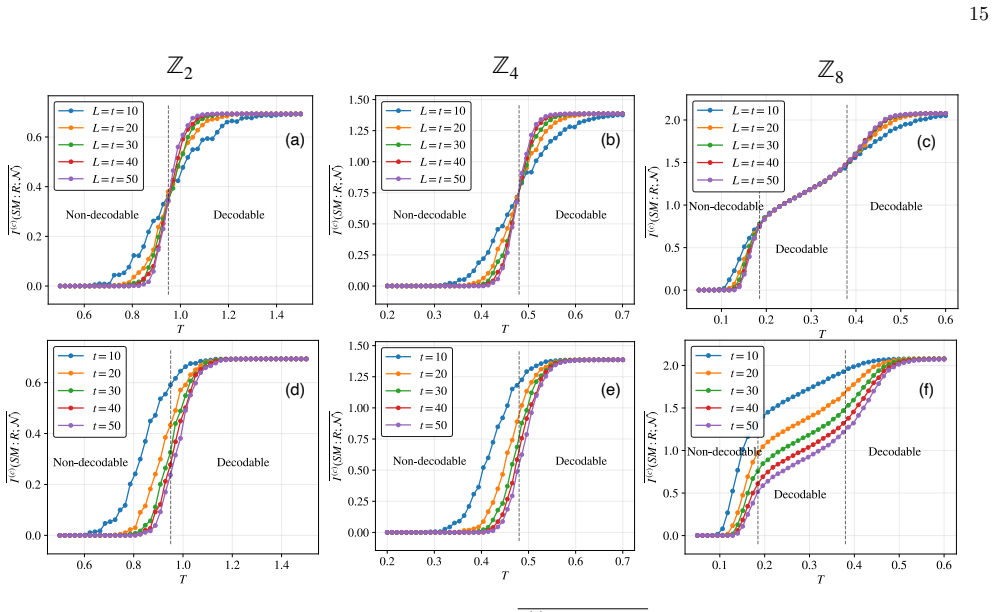
We develop a novel holographic framework to study dynamical phases in random quantum circuits with a global symmetry $G$. Viewing the circuit as a tensor network, we decompose it into two parts: a symmetric layer, which defines an emergent gauge wavefunction in one higher dimension, and a non-symmetric layer, composed of random multiplicity tensors. For $G\,{=}\,\mathbb{Z}_N$ symmetric circuits consisting of local unitary gates interspersed with local symmetric noise channels, averaging over the non-symmetric layer yields a dynamically generated noisy $\mathbb{Z}_{N}$ surface code. This allows us to interpret $\mathbb{Z}_{N}$ symmetric circuits in the volume-law phase as quantum error-correcting codes with a distinguished set of logical spin states that inherit the topological protection of the bulk code. By establishing equality of bulk and boundary coherent information, we show that quantum information encoded in these logical states is maximally protected against symmetric noise up to a finite threshold. We further study weakly monitored $\mathbb{Z}_{N}$ symmetric circuits which exhibit a charge-sharpening transition. We show that the point at which the observer gains classical information about the global charge coincides with the point at which measurements destroy the underlying quantum information encoded in the bulk surface code. This also allows for a natural interpretation of the sharpening transition as a confinement transition in the gauge theory. For $N\,{\leq}\,4$, weak measurements drive a single transition from a charge-fuzzy phase with exponential sharpening time $t_{\#}\sim e^{L}$ to a charge-sharp phase with $t_{\#}\sim \mathcal{O}(1)$. On the other hand, for $N>4$, the circuit can enter an intermediate phase with a linear sharpening time $t_{\#}\sim \mathcal{O}(L)$. In this regime, the bulk gauge theory realizes a Coulomb phase with emergent gapless photons.
Editorial analysis
A structured set of objections, weighed in public.
Referee Report
Summary. The paper develops a holographic framework for random quantum circuits with global Z_N symmetry by decomposing the tensor network into a symmetric layer (defining an emergent gauge wavefunction) and non-symmetric random multiplicity tensors. Averaging over the latter is claimed to dynamically generate a noisy Z_N surface code, allowing the volume-law phase to be interpreted as a quantum error-correcting code whose logical states inherit topological protection. Equality of bulk and boundary coherent information is used to argue for maximal protection against symmetric noise up to a threshold. For weakly monitored circuits, the charge-sharpening transition is identified with a confinement transition in the gauge theory, with a single transition for N≤4 and an intermediate Coulomb phase with gapless photons for N>4.
Significance. If the mappings and equalities are rigorously established, the work offers a novel bridge between symmetric monitored circuits, emergent gauge theories via holography, and topological quantum error correction. It could provide a bulk interpretation for information protection and phase transitions in symmetric dynamics, with potential implications for understanding charge sharpening and confinement in many-body systems.
major comments (3)
- [decomposition and averaging procedure] The abstract and the section on circuit decomposition assert that averaging over the non-symmetric random multiplicity tensors yields a dynamically generated noisy Z_N surface code whose noise channel matches the standard independent X/Z error model on plaquettes/vertices. No explicit tensor contraction, replica trick calculation, or derivation of the error rate p(N) is provided to establish this identification, which is load-bearing for the subsequent QEC interpretation.
- [coherent information analysis] The central claim of equality between bulk and boundary coherent information (used to conclude maximal protection of logical states) is stated without derivation steps, error estimates, or numerical/explicit checks against post-hoc choices. This equality underpins the protection threshold and must be shown independently of the holographic identification.
- [weakly monitored circuits and phase diagram] The identification of the charge-sharpening transition with a confinement transition in the bulk gauge theory, including the existence of an intermediate Coulomb phase for N>4 with linear sharpening time, relies on the surface-code mapping remaining valid under weak measurements. No independent verification or explicit check of the bulk-boundary correspondence in this regime is given.
minor comments (2)
- [methods] Clarify the precise definition and contraction rules for the random multiplicity tensors to make the averaging procedure reproducible.
- [figures] Figure captions for the phase diagram should explicitly label the sharpening time scalings (exponential, linear, O(1)) and the Coulomb phase region.
Simulated Author's Rebuttal
We thank the referee for their careful reading of the manuscript and for the constructive major comments. We address each point below. Where the comments correctly identify places where additional explicit derivations or verifications would strengthen the presentation, we have revised the manuscript accordingly.
read point-by-point responses
-
Referee: [decomposition and averaging procedure] The abstract and the section on circuit decomposition assert that averaging over the non-symmetric random multiplicity tensors yields a dynamically generated noisy Z_N surface code whose noise channel matches the standard independent X/Z error model on plaquettes/vertices. No explicit tensor contraction, replica trick calculation, or derivation of the error rate p(N) is provided to establish this identification, which is load-bearing for the subsequent QEC interpretation.
Authors: We agree that an explicit derivation of the averaged channel is essential. Section II of the manuscript outlines the decomposition into symmetric and multiplicity layers and states that the average over the latter produces the noisy surface-code tensor network. To make the identification fully rigorous, the revised manuscript adds a new appendix containing the full tensor-network contraction. We explicitly perform the average using a replica trick, obtain the effective error channel on the plaquette and vertex operators, and derive the N-dependent error probability p(N) that matches the independent X/Z Pauli noise model. This calculation is now independent of the subsequent holographic interpretation. revision: yes
-
Referee: [coherent information analysis] The central claim of equality between bulk and boundary coherent information (used to conclude maximal protection of logical states) is stated without derivation steps, error estimates, or numerical/explicit checks against post-hoc choices. This equality underpins the protection threshold and must be shown independently of the holographic identification.
Authors: The referee is correct that the equality requires a self-contained derivation. In the original text the equality follows from the isometric property of the volume-law circuit evolution under the holographic map. The revised version adds a dedicated subsection that derives the equality step by step: we first compute the boundary coherent information directly from the circuit Kraus operators, then show that the bulk logical operators reproduce the same quantity via the surface-code stabilizers, and finally provide an error bound that holds up to the threshold. Small-system exact numerics (N=2,3) are included to verify that the two quantities agree within statistical error, independent of the gauge-theory identification. revision: yes
-
Referee: [weakly monitored circuits and phase diagram] The identification of the charge-sharpening transition with a confinement transition in the bulk gauge theory, including the existence of an intermediate Coulomb phase for N>4 with linear sharpening time, relies on the surface-code mapping remaining valid under weak measurements. No independent verification or explicit check of the bulk-boundary correspondence in this regime is given.
Authors: We acknowledge that the validity of the mapping under weak monitoring needs explicit support. The revised manuscript adds a new subsection that performs this check. We numerically simulate the monitored circuit for small L and extract both the charge-sharpening time t_# and the bulk photon gap (or string tension) from the emergent gauge theory. For N>4 the linear sharpening regime is shown to coincide with the gapless Coulomb phase, while for N≤4 the single transition matches the confinement point. These quantities are computed directly from the circuit density matrix and from the dual gauge model, providing an independent confirmation that the bulk-boundary correspondence persists in the weakly monitored regime. revision: yes
Circularity Check
No significant circularity; derivation remains self-contained via tensor-network averaging
full rationale
The paper constructs the holographic mapping by decomposing the circuit into a symmetric gauge layer and random multiplicity tensors, then explicitly averages the latter to obtain the noisy surface code. The bulk-boundary coherent-information equality follows from this averaged tensor network structure rather than from any self-definition, fitted parameter renamed as prediction, or load-bearing self-citation. No quoted step reduces the central claim to its own inputs by construction; the logical-state protection is presented as a consequence of the emergent code, not presupposed by the holographic identification itself. The derivation is therefore independent of the patterns that would trigger a positive circularity finding.
Axiom & Free-Parameter Ledger
axioms (1)
- domain assumption A symmetric quantum circuit can be decomposed into a symmetric layer defining an emergent gauge wavefunction and a non-symmetric layer of random multiplicity tensors.
invented entities (1)
-
dynamically generated noisy Z_N surface code
no independent evidence
Lean theorems connected to this paper
-
IndisputableMonolith/Foundation/AlexanderDuality.leanalexander_duality_circle_linking unclear?
unclearRelation between the paper passage and the cited Recognition theorem.
averaging over the non-symmetric layer yields a dynamically generated noisy Z_N surface code... equality of bulk and boundary coherent information
What do these tags mean?
- matches
- The paper's claim is directly supported by a theorem in the formal canon.
- supports
- The theorem supports part of the paper's argument, but the paper may add assumptions or extra steps.
- extends
- The paper goes beyond the formal theorem; the theorem is a base layer rather than the whole result.
- uses
- The paper appears to rely on the theorem as machinery.
- contradicts
- The paper's claim conflicts with a theorem or certificate in the canon.
- unclear
- Pith found a possible connection, but the passage is too broad, indirect, or ambiguous to say the theorem truly supports the claim.
Forward citations
Cited by 1 Pith paper
-
Charge Scrambling in Strong-to-Weak Spontaneous Symmetry Breaking
Long-range Rényi-1 SWSSB order implies extensive block-charge variance for continuous symmetries with rapid asymptotic approach, with conditional counterexamples and a new twist overlap correlator separating symmetry ...
Reference graph
Works this paper leans on
-
[1]
Finite non-abelian groups Finally, we consider a generic finite groupG, which may be non-abelian. It possesses a finite set of irreps and the local Hilbert space is taken to be the direct sum of all irreps, each appearing with multiplicityn:H= L j nRj. To analyze the constraints imposed by unitarity, we must first specify a normalization convention for th...
-
[2]
Numerics Here we briefly outline how to compute the quantity ⟨ ⟨|Tˆγ|2⟩ ⟩given in Eq. (69). We consider the simple weak measurement model with parameters pk = exp 1 T cos 2πk N N (83) whereNis a normalization constant. In the notation of Eq. (79), this corresponds to choosing a single nonzero couplingβ 1 = 1 T with all otherβ m̸=1 = 0. The parameter Tplay...
-
[3]
Confinement Transition We can also consider the case of local sharpening. It should be immediate that in the disordered and QLRO phases, local charges should never fully sharpen. Using the fact that the sharpening order parameter is precisely the disorder-averaged squared spin–spin correlator (see Eq. (82)), we immediately infer its scaling in the three p...
-
[4]
Y. Li, X. Chen, and M. P. A. Fisher, Quantum zeno effect and the many-body entanglement transition, Phys. Rev. B98, 205136 (2018)
work page 2018
-
[5]
B. Skinner, J. Ruhman, and A. Nahum, Measurement- induced phase transitions in the dynamics of entangle- ment, Phys. Rev. X9, 031009 (2019)
work page 2019
-
[6]
A. Chan, R. M. Nandkishore, M. Pretko, and G. Smith, Unitary-projective entanglement dynamics, Phys. Rev. B 99, 224307 (2019)
work page 2019
-
[7]
A. C. Potter and R. Vasseur, Entanglement dynamics in hybrid quantum circuits, inEntanglement in Spin Chains (Springer International Publishing, 2022) p. 211–249
work page 2022
-
[8]
Y. Bao, S. Choi, and E. Altman, Theory of the phase transition in random unitary circuits with measurements, Phys. Rev. B101, 104301 (2020)
work page 2020
-
[9]
M. Szyniszewski, A. Romito, and H. Schomerus, Entan- glement transition from variable-strength weak measure- ments, Phys. Rev. B100, 064204 (2019)
work page 2019
-
[10]
X. Cao, A. Tilloy, and A. D. Luca, Entanglement in a fermion chain under continuous monitoring, SciPost Phys.7, 024 (2019)
work page 2019
-
[11]
N. Lang and H. P. B¨ uchler, Entanglement transition in the projective transverse field ising model, Phys. Rev. B 102, 094204 (2020)
work page 2020
-
[12]
M. J. Gullans and D. A. Huse, Dynamical purifica- tion phase transition induced by quantum measurements, Phys. Rev. X10, 041020 (2020)
work page 2020
-
[13]
S. Choi, Y. Bao, X.-L. Qi, and E. Altman, Quantum er- ror correction in scrambling dynamics and measurement- induced phase transition, Phys. Rev. Lett.125, 030505 (2020)
work page 2020
- [14]
- [15]
-
[16]
C.-M. Jian, Y.-Z. You, R. Vasseur, and A. W. W. Ludwig, Measurement-induced criticality in random quantum cir- cuits, Phys. Rev. B101, 104302 (2020)
work page 2020
-
[17]
X. Turkeshi, A. Biella, R. Fazio, M. Dalmonte, and M. Schir´ o, Measurement-induced entanglement transi- tions in the quantum ising chain: From infinite to zero clicks, Phys. Rev. B103, 224210 (2021)
work page 2021
-
[18]
Y. Li, X. Chen, A. W. W. Ludwig, and M. P. A. Fisher, Conformal invariance and quantum nonlocality in critical hybrid circuits, Phys. Rev. B104, 104305 (2021)
work page 2021
-
[19]
M. J. Gullans and D. A. Huse, Scalable probes of measurement-induced criticality, Phys. Rev. Lett.125, 070606 (2020)
work page 2020
-
[20]
A. Nahum and K. J. Wiese, Renormalization group for measurement and entanglement phase transitions, Phys. Rev. B108, 104203 (2023)
work page 2023
-
[21]
V. Khemani, A. Vishwanath, and D. A. Huse, Operator spreading and the emergence of dissipative hydrodynam- ics under unitary evolution with conservation laws, Phys. Rev. X8, 031057 (2018)
work page 2018
-
[22]
T. Rakovszky, F. Pollmann, and C. W. von Keyserlingk, Diffusive hydrodynamics of out-of-time-ordered correla- tors with charge conservation, Phys. Rev. X8, 031058 (2018)
work page 2018
-
[23]
T. Rakovszky, F. Pollmann, and C. von Keyserlingk, Sub- ballistic growth of r´ enyi entropies due to diffusion, Phys- ical Review Letters122, 10.1103/physrevlett.122.250602 (2019)
-
[24]
T. Zhou and A. W. W. Ludwig, Diffusive scaling of r´ enyi entanglement entropy, Phys. Rev. Res.2, 033020 (2020)
work page 2020
-
[25]
Y. Huang, Dynamics of r´ enyi entanglement entropy in diffusive qudit systems, IOP SciNotes1, 035205 (2020)
work page 2020
-
[26]
U. Agrawal, A. Zabalo, K. Chen, J. H. Wilson, A. C. Potter, J. H. Pixley, S. Gopalakrishnan, and R. Vasseur, Entanglement and charge-sharpening transitions in u(1) symmetric monitored quantum circuits, Phys. Rev. X12, 041002 (2022)
work page 2022
-
[27]
F. Barratt, U. Agrawal, A. C. Potter, S. Gopalakrishnan, and R. Vasseur, Transitions in the learnability of global charges from local measurements, Physical Review Let- ters129, 10.1103/physrevlett.129.200602 (2022)
-
[28]
F. Barratt, U. Agrawal, S. Gopalakrishnan, D. A. Huse, R. Vasseur, and A. C. Potter, Field theory of charge sharpening in symmetric monitored quantum circuits, Physical Review Letters129, 10.1103/phys- revlett.129.120604 (2022)
- [29]
-
[30]
Y. Bao, S. Choi, and E. Altman, Symmetry enriched phases of quantum circuits, Annals of Physics435, 168618 (2021)
work page 2021
- [31]
-
[32]
S. Gopalakrishnan, E. McCulloch, and R. Vasseur, Monitored fluctuating hydrodynamics (2025), arXiv:2504.02734 [cond-mat.stat-mech]
-
[33]
X. Feng, N. Fishchenko, S. Gopalakrishnan, and M. Ip- politi, Charge and Spin Sharpening Transitions on Dy- namical Quantum Trees, Quantum9, 1692 (2025)
work page 2025
-
[34]
A. Nahum and J. L. Jacobsen, Bayesian critical points in classical lattice models (2025), arXiv:2504.01264 [cond- 19 mat.stat-mech]
- [35]
-
[36]
C. Wang, J. Harrington, and J. Preskill, Confinement- higgs transition in a disordered gauge theory and the ac- curacy threshold for quantum memory, Annals of Physics 303, 31–58 (2003)
work page 2003
-
[37]
R. Fan, Y. Bao, E. Altman, and A. Vishwanath, Diag- nostics of mixed-state topological order and breakdown of quantum memory, PRX Quantum5, 020343 (2024)
work page 2024
-
[38]
J. Y. Lee, C.-M. Jian, and C. Xu, Quantum criticality under decoherence or weak measurement, PRX Quantum 4, 030317 (2023)
work page 2023
-
[39]
J. Y. Lee, Exact calculations of coherent information for toric codes under decoherence: Identifying the fun- damental error threshold, Phys. Rev. Lett.134, 250601 (2025)
work page 2025
-
[40]
R. Niwa and J. Y. Lee, Coherent information for calderbank-shor-steane codes under decoherence, Phys. Rev. A111, 032402 (2025)
work page 2025
-
[41]
A. Lyons, Understanding stabilizer codes under local de- coherence through a general statistical mechanics map- ping (2024), arXiv:2403.03955 [quant-ph]
-
[42]
Y. Zhao and D. E. Liu, Extracting error thresholds through the framework of approximate quantum error correction condition, Phys. Rev. Res.6, 043258 (2024)
work page 2024
-
[43]
K. Su, Z. Yang, and C.-M. Jian, Tapestry of dualities in decohered quantum error correction codes, Physical Review B110, 10.1103/physrevb.110.085158 (2024)
- [44]
- [45]
-
[46]
S. Singh and G. Vidal, Global symmetries in tensor net- work states: Symmetric tensors versus minimal bond di- mension, Phys. Rev. B88, 115147 (2013)
work page 2013
-
[47]
Emergent bulk gauge field in random tensor networks
X.-L. Qi, Emergent bulk gauge field in random tensor networks (2022), arXiv:2209.02940 [hep-th]
-
[48]
R. Penrose, Angular momentum: an approach to com- binatorial space-time, Quantum theory and beyond151 (1971)
work page 1971
-
[49]
J. C. Baez, Spin networks in gauge theory, Advances in Mathematics117, 253–272 (1996)
work page 1996
-
[50]
C. Rovelli and L. Smolin, Spin networks and quantum gravity, Phys. Rev. D52, 5743 (1995)
work page 1995
-
[51]
Kitaev, Fault-tolerant quantum computation by anyons, Annals of Physics303, 2–30 (2003)
A. Kitaev, Fault-tolerant quantum computation by anyons, Annals of Physics303, 2–30 (2003)
work page 2003
-
[52]
S. B. Bravyi and A. Y. Kitaev, Quantum codes on a lattice with boundary (1998), arXiv:quant-ph/9811052 [quant-ph]
work page internal anchor Pith review Pith/arXiv arXiv 1998
-
[53]
T.-C. Lu, T. H. Hsieh, and T. Grover, Detecting topo- logical order at finite temperature using entanglement negativity, Phys. Rev. Lett.125, 116801 (2020)
work page 2020
-
[54]
Separability Transitions in Topological States Induced by Local Decoherence
Y.-H. Chen and T. Grover, Separability transitions in topological states induced by local decoherence, Phys. Rev. Lett.132, 170602 (2024)
work page 2024
-
[55]
C. Akers and A. Y. Wei, Background independent tensor networks, SciPost Phys.17, 090 (2024)
work page 2024
-
[56]
M.-D. Choi, Completely positive linear maps on complex matrices, Linear Algebra and its Applications10, 285 (1975)
work page 1975
-
[57]
A. Jamio lkowski, Linear transformations which preserve trace and positive semidefiniteness of operators, Reports on Mathematical Physics3, 275 (1972)
work page 1972
-
[58]
This is the complex conjugate of how these coefficients are usually defined which would correspond to the case of two incoming legs and one outgoing leg
-
[59]
A. R. Edmonds,Angular momentum in quantum me- chanics, Vol. 4 (Princeton university press, 1996)
work page 1996
-
[60]
P. Hayden, S. Nezami, X.-L. Qi, N. Thomas, M. Wal- ter, and Z. Yang, Holographic duality from random ten- sor networks, Journal of High Energy Physics2016, 10.1007/jhep11(2016)009 (2016)
-
[61]
Donnelly, Decomposition of entanglement entropy in lattice gauge theory, Phys
W. Donnelly, Decomposition of entanglement entropy in lattice gauge theory, Phys. Rev. D85, 085004 (2012)
work page 2012
-
[62]
W. Donnelly, Entanglement entropy and nonabelian gauge symmetry, Classical and Quantum Gravity31, 214003 (2014)
work page 2014
-
[63]
T. Zhou and A. Nahum, Emergent statistical mechanics of entanglement in random unitary circuits, Phys. Rev. B99, 174205 (2019)
work page 2019
-
[64]
O. Ogunnaike, J. Feldmeier, and J. Y. Lee, Unify- ing emergent hydrodynamics and lindbladian low-energy spectra across symmetries, constraints, and long-range interactions, Phys. Rev. Lett.131, 220403 (2023)
work page 2023
- [65]
- [66]
- [67]
-
[68]
D. Gu, Z. Wang, and Z. Wang, Spontaneous symmetry breaking in open quantum systems: strong, weak, and strong-to-weak (2024), arXiv:2406.19381 [quant-ph]
work page internal anchor Pith review Pith/arXiv arXiv 2024
- [69]
-
[70]
Lloyd, Capacity of the noisy quantum channel, Phys
S. Lloyd, Capacity of the noisy quantum channel, Phys. Rev. A55, 1613 (1997)
work page 1997
-
[71]
P. W. Shor, Capacities of quantum channels and how to find them, Mathematical Programming97, 311–335 (2003)
work page 2003
-
[72]
I. Devetak, The private classical capacity and quan- tum capacity of a quantum channel (2004), arXiv:quant- ph/0304127 [quant-ph]
-
[73]
M. A. Nielsen and I. L. Chuang,Quantum Computa- tion and Quantum Information: 10th Anniversary Edi- tion(Cambridge University Press, 2010)
work page 2010
-
[74]
S. Elitzur, R. B. Pearson, and J. Shigemitsu, Phase struc- ture of discrete abelian spin and gauge systems, Phys. Rev. D19, 3698 (1979)
work page 1979
-
[75]
J. V. Jos´ e, L. P. Kadanoff, S. Kirkpatrick, and D. R. Nel- son, Renormalization, vortices, and symmetry-breaking perturbations in the two-dimensional planar model, Phys. Rev. B16, 1217 (1977)
work page 1977
-
[76]
J. L. Cardy, General discrete planar models in two dimen- sions: Duality properties and phase diagrams, Journal of Physics A: Mathematical and General13, 1507 (1980)
work page 1980
-
[77]
V. A. Fateev and A. B. Zamolodchikov, Parafermionic Currents in the Two-Dimensional Conformal Quantum Field Theory and Selfdual Critical Points in Z(n) Invari- ant Statistical Systems, Sov. Phys. JETP62, 215 (1985). 20
work page 1985
-
[78]
M. S. S. Challa and D. P. Landau, Critical behavior of the six-state clock model in two dimensions, Phys. Rev. B33, 437 (1986)
work page 1986
-
[79]
S. Chatterjee, S. Puri, and R. Paul, Ordering kinetics in theq-state clock model: Scaling properties and growth laws, Phys. Rev. E98, 032109 (2018)
work page 2018
-
[80]
G. Li, K. H. Pai, and Z.-C. Gu, Tensor-network renor- malization approach to the q-state clock model, Phys. Rev. Res.4, 023159 (2022)
work page 2022
discussion (0)
Sign in with ORCID, Apple, or X to comment. Anyone can read and Pith papers without signing in.