The High Cost of Incivility: Quantifying Interaction Inefficiency via Multi-Agent Monte Carlo Simulations
Pith reviewed 2026-05-17 00:37 UTC · model grok-4.3
The pith
Simulations of LLM agent debates show toxic participants increase conversation length by about 25 percent.
A machine-rendered reading of the paper's core claim, the machinery that carries it, and where it could break.
Core claim
In Monte Carlo simulations of adversarial debates between LLM agents, conversations involving agents given toxic system prompts require approximately 25 percent more arguments to reach a conclusion than baseline control groups, providing a quantifiable proxy for the operational inefficiency caused by incivility.
What carries the argument
Monte Carlo simulation of multi-agent 1-on-1 debates that measures convergence time as the count of arguments needed until a conclusion is reached, comparing control agents to agents given toxic prompts.
If this is right
- The latency of toxicity can serve as a proxy measure for financial damage in corporate and academic settings.
- Agent-based modeling supplies a reproducible and ethical substitute for human-subject experiments on social friction.
- Quantified inefficiency from incivility can be tracked across repeated simulations to test mitigation strategies.
Where Pith is reading between the lines
- If the 25 percent figure generalizes, organizations could run targeted simulations to forecast productivity losses from specific forms of workplace toxicity before they occur.
- The method opens the possibility of scaling the simulations to multi-person groups or longer-running discussions to map how toxicity compounds over time.
- Linking the latency metric to salary or output data could produce dollar estimates of incivility costs that are otherwise hard to isolate in real settings.
Load-bearing premise
That the interaction patterns produced by LLM agents given toxic system prompts validly model the efficiency losses caused by toxic human participants in real adversarial debates.
What would settle it
Running the same debate protocol with human participants and finding that the increase in turns or time for toxic conditions differs substantially from the 25 percent observed in the simulations.
Figures


read the original abstract
Workplace toxicity is widely recognized as detrimental to organizational culture, yet quantifying its direct impact on operational efficiency remains methodologically challenging due to the ethical and practical difficulties of reproducing conflict in human subjects. This study leverages Large Language Model (LLM) based Multi-Agent Systems to simulate 1-on-1 adversarial debates, creating a controlled "sociological sandbox". We employ a Monte Carlo method to simulate hundrets of discussions, measuring the convergence time (defined as the number of arguments required to reach a conclusion) between a baseline control group and treatment groups involving agents with "toxic" system prompts. Our results demonstrate a statistically significant increase of approximately 25\% in the duration of conversations involving toxic participants. We propose that this "latency of toxicity" serves as a proxy for financial damage in corporate and academic settings. Furthermore, we demonstrate that agent-based modeling provides a reproducible, ethical alternative to human-subject research for measuring the mechanics of social friction.
Editorial analysis
A structured set of objections, weighed in public.
Referee Report
Summary. The manuscript uses LLM-based multi-agent systems to simulate 1-on-1 adversarial debates via Monte Carlo methods over hundreds of runs. It compares convergence time, defined as the number of arguments required to reach a conclusion, between a baseline control condition and treatment conditions in which agents receive 'toxic' system prompts. The central result is a statistically significant increase of approximately 25% in conversation duration under toxic conditions, interpreted as a 'latency of toxicity' that proxies financial and operational damage in organizational settings. The work positions agent-based modeling as a reproducible, ethical substitute for human-subject research on social friction.
Significance. If the result holds after methodological clarification, the paper offers a scalable, controlled computational framework for quantifying interaction inefficiencies that are otherwise difficult to study ethically. The Monte Carlo approach and focus on measurable convergence provide a reproducible template that could be extended to other social dynamics. Credit is due for attempting to address a practically relevant question with simulation rather than direct human experimentation.
major comments (3)
- [Methods] Methods: The description supplies no information on the statistical test used to support the claim of statistical significance, the number of Monte Carlo runs performed, variance or standard error across runs, the specific LLM model and sampling parameters (temperature, top-p, seed control), or the exact wording of the toxic versus control system prompts. These omissions prevent independent verification that the reported 25% increase is robust rather than sensitive to implementation details.
- [Results] Results: No tables, figures, or supplementary data report the distribution of convergence times, confidence intervals, or p-values underlying the 'approximately 25%' figure. Without these, it is impossible to assess whether the effect is consistent or whether stochastic LLM behavior could produce comparable differences under neutral prompts.
- [Discussion] Discussion: The central claim that toxic-prompted LLM agents validly model efficiency losses caused by real human incivility rests on an unvalidated proxy. No calibration against human debate transcripts, psychological incivility measures, or sensitivity analysis on prompt phrasing is described, leaving open the possibility that measured latency reflects prompt-following artifacts rather than generalizable social mechanisms.
minor comments (2)
- [Abstract] Abstract contains the typo 'hundrets' (should be 'hundreds').
- [Introduction] Notation for 'latency of toxicity' is introduced without a formal definition or equation; a brief operationalization would improve clarity.
Simulated Author's Rebuttal
We thank the referee for the constructive feedback, which highlights important areas for improving the clarity, reproducibility, and interpretation of our work. We address each major comment below and outline the revisions we will make.
read point-by-point responses
-
Referee: [Methods] Methods: The description supplies no information on the statistical test used to support the claim of statistical significance, the number of Monte Carlo runs performed, variance or standard error across runs, the specific LLM model and sampling parameters (temperature, top-p, seed control), or the exact wording of the toxic versus control system prompts. These omissions prevent independent verification that the reported 25% increase is robust rather than sensitive to implementation details.
Authors: We agree that these details are necessary for reproducibility. In the revised manuscript we will add a dedicated Methods subsection that specifies the LLM model and version, all sampling parameters (temperature, top-p, and seed settings), the precise system prompts for both the toxic and control conditions, the exact number of Monte Carlo runs performed, and the statistical procedure (Welch’s two-sample t-test) together with the resulting p-values, means, and standard errors. revision: yes
-
Referee: [Results] Results: No tables, figures, or supplementary data report the distribution of convergence times, confidence intervals, or p-values underlying the 'approximately 25%' figure. Without these, it is impossible to assess whether the effect is consistent or whether stochastic LLM behavior could produce comparable differences under neutral prompts.
Authors: We acknowledge the current absence of these supporting statistics. The revised version will include a new figure showing the distributions of convergence times under both conditions, a table reporting means, standard deviations, 95 % confidence intervals, and p-values, and a brief discussion of how the Monte Carlo design and large run count address stochastic variability in LLM outputs. revision: yes
-
Referee: [Discussion] Discussion: The central claim that toxic-prompted LLM agents validly model efficiency losses caused by real human incivility rests on an unvalidated proxy. No calibration against human debate transcripts, psychological incivility measures, or sensitivity analysis on prompt phrasing is described, leaving open the possibility that measured latency reflects prompt-following artifacts rather than generalizable social mechanisms.
Authors: We accept that the proxy relationship between LLM behavior and human incivility is not yet calibrated. We will revise the Discussion to present the simulation explicitly as a controlled computational proxy rather than a direct analogue, add a limitations paragraph that notes the lack of human-data calibration, and outline planned sensitivity analyses on prompt phrasing. We maintain that the observed difference in convergence time under controlled toxic prompts is a useful starting point for quantifying interaction inefficiency, but we will moderate language to reflect the preliminary nature of the proxy. revision: partial
Circularity Check
No significant circularity: direct simulation outputs
full rationale
The paper runs Monte Carlo simulations of LLM agents under baseline and toxic-prompt conditions, then directly compares measured convergence times (number of arguments to conclusion) between groups. No equations, parameter fitting, or derivations are described that would reduce the reported 25% latency difference to a self-defined input or self-citation chain. The result is an empirical statistic from the simulation runs themselves rather than a prediction forced by construction from prior fitted values or author-defined uniqueness theorems. The choice of prompt wording is an experimental design decision, not a circular redefinition of the output metric.
Axiom & Free-Parameter Ledger
free parameters (1)
- toxic system prompt wording
axioms (1)
- domain assumption LLM agents with modified system prompts behave analogously to humans in adversarial debates
invented entities (1)
-
latency of toxicity
no independent evidence
Lean theorems connected to this paper
-
IndisputableMonolith/Foundation/RealityFromDistinction.leanreality_from_one_distinction unclear?
unclearRelation between the paper passage and the cited Recognition theorem.
We employ a Monte Carlo method to simulate hundrets of discussions, measuring the convergence time... statistically significant increase of approximately 25% in the duration of conversations involving toxic participants.
-
IndisputableMonolith/Cost/FunctionalEquation.leanwashburn_uniqueness_aczel unclear?
unclearRelation between the paper passage and the cited Recognition theorem.
toxic system prompts produce interaction patterns that validly model the efficiency losses
What do these tags mean?
- matches
- The paper's claim is directly supported by a theorem in the formal canon.
- supports
- The theorem supports part of the paper's argument, but the paper may add assumptions or extra steps.
- extends
- The paper goes beyond the formal theorem; the theorem is a base layer rather than the whole result.
- uses
- The paper appears to rely on the theorem as machinery.
- contradicts
- The paper's claim conflicts with a theorem or certificate in the canon.
- unclear
- Pith found a possible connection, but the passage is too broad, indirect, or ambiguous to say the theorem truly supports the claim.
Forward citations
Cited by 1 Pith paper
-
Beyond Inefficiency: Systemic Costs of Incivility in Multi-Agent Monte Carlo Simulations
Monte Carlo simulations of LLM agents confirm that toxic debates take 25% longer to converge, with larger delays in smaller models, and show a first-mover advantage independent of toxicity.
Reference graph
Works this paper leans on
-
[1]
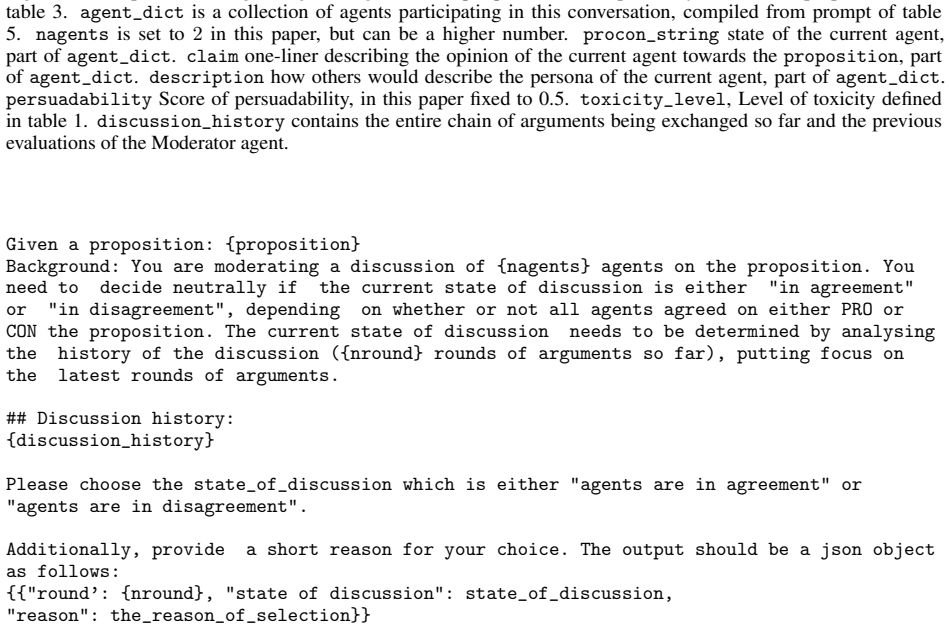
nagents is set to 2 in this paper, but can be a higher number. procon_string state of the current agent, part of agent_dict. claim one-liner describing the opinion of the current agent towards the proposition, part of agent_dict. description how others would describe the persona of the current agent, part of agent_dict. persuadability Score of persuadabil...
-
[2]
nround is a counter of how many arguments have been exchanged so far
nagents is set to 2 in this paper, but can be a higher number. nround is a counter of how many arguments have been exchanged so far. discussion_history contains the entire chain of arguments being exchanged so far and the previous evaluations of the Moderator agent. 11
discussion (0)
Sign in with ORCID, Apple, or X to comment. Anyone can read and Pith papers without signing in.