Recognition: 2 theorem links
· Lean TheoremIn situ substrate birefringence characterization in gravitational wave detectors using a heterodyne polarimetry method
Pith reviewed 2026-05-16 20:57 UTC · model grok-4.3
The pith
A heterodyne polarimetry method measures birefringence distributions inside gravitational wave detector test masses without removal.
A machine-rendered reading of the paper's core claim, the machinery that carries it, and where it could break.
Core claim
We present a heterodyne polarimetry method that enables in situ birefringence characterizations, hence diagnosing the gravitational wave interferometer. We experimentally demonstrate the proposed method with a tabletop setup. We also discuss its applicability to current and future gravitational wave detectors and the detectable limit.
What carries the argument
Heterodyne polarimetry method using polarized light interference to map birefringence distribution in substrates.
If this is right
- Identifies sources of optical loss and control disturbances in gravitational wave interferometers.
- Enables diagnostics without removing test mass substrates from the optical path.
- Applies to existing detectors such as LIGO and Virgo as well as future upgrades.
- Establishes a detectable limit for birefringence inhomogeneities under operational conditions.
Where Pith is reading between the lines
- Real-time integration could support continuous monitoring of substrate quality during detector operation.
- The approach may generalize to other high-precision optical cavities where material birefringence limits performance.
- If noise-free at scale, it shortens maintenance cycles by replacing offline substrate inspections.
Load-bearing premise
The tabletop demonstration will accurately predict performance when integrated into a full-scale high-power interferometer without introducing new noise or optical losses.
What would settle it
A measurement campaign comparing the method's results against an independent reference technique after installation in a high-power interferometer, showing discrepancies larger than expected errors, would falsify the applicability claim.
Figures




read the original abstract
High-quality test mass substrates play essential roles in laser interferometric gravitational wave detectors. Inhomogeneous birefringence distribution in test mass substrates, however, can degrade the sensitivity of the detector by introducing the optical loss and disturbing the interferometer controls. In this paper, we present a heterodyne polarimetry method that enables in situ birefringence characterizations, hence diagnosing the gravitational wave interferometer. We experimentally demonstrate the proposed method with a tabletop setup. We also discuss its applicability to current and future gravitational wave detectors and the detectable limit.
Editorial analysis
A structured set of objections, weighed in public.
Referee Report
Summary. The manuscript presents a heterodyne polarimetry method for in situ characterization of birefringence in test-mass substrates of gravitational-wave interferometers. It describes the technique, reports a tabletop experimental demonstration, and discusses applicability to current and future detectors together with an estimate of the detectable limit.
Significance. If the method can be shown to operate without degrading sensitivity at full interferometer power and vacuum conditions, it would supply a practical diagnostic for substrate inhomogeneities that currently limit optical loss and control stability. The tabletop demonstration establishes basic functionality at low power, but quantitative performance metrics and scaling arguments are required before the significance can be fully assessed.
major comments (2)
- [Experimental demonstration] Experimental demonstration section: the abstract states that a tabletop experiment was performed, yet no quantitative birefringence values, uncertainty budgets, repeatability data, or comparison against an independent reference measurement are supplied. Without these, the claim of experimental validation remains unsupported.
- [Applicability discussion] Applicability discussion: the assessment that the probe beam will not introduce measurable scattered-light noise, insertion loss, or control-loop disturbances at hundreds-of-watts arm-cavity power rests on qualitative statements only; no explicit calculation or simulation of these effects under vacuum conditions is provided.
minor comments (1)
- [Abstract] The abstract would benefit from a single sentence stating the achieved sensitivity or detectable birefringence limit obtained in the tabletop run.
Simulated Author's Rebuttal
We thank the referee for the constructive comments, which help clarify the presentation of our experimental results and the applicability analysis. We address each major comment below and will revise the manuscript accordingly to strengthen the claims.
read point-by-point responses
-
Referee: Experimental demonstration section: the abstract states that a tabletop experiment was performed, yet no quantitative birefringence values, uncertainty budgets, repeatability data, or comparison against an independent reference measurement are supplied. Without these, the claim of experimental validation remains unsupported.
Authors: We agree that additional quantitative details are required to fully substantiate the experimental validation. In the revised manuscript we will expand the experimental demonstration section to report the measured birefringence values obtained with the heterodyne polarimetry setup, include a detailed uncertainty budget, present repeatability data from multiple runs, and add a direct comparison against an independent reference measurement performed with a commercial polarimeter on the same samples. These additions will be placed in a new subsection with accompanying tables and figures. revision: yes
-
Referee: Applicability discussion: the assessment that the probe beam will not introduce measurable scattered-light noise, insertion loss, or control-loop disturbances at hundreds-of-watts arm-cavity power rests on qualitative statements only; no explicit calculation or simulation of these effects under vacuum conditions is provided.
Authors: We acknowledge that the current discussion relies on qualitative arguments and will strengthen it with quantitative estimates. The revised applicability section will contain explicit calculations of scattered-light noise, insertion loss, and control-loop disturbances induced by the probe beam at the power levels and vacuum conditions of current and future detectors. These calculations will use the known optical parameters of the test-mass substrates and include a simple ray-tracing simulation of the probe-beam propagation to confirm that all effects remain below the detector noise floor. revision: yes
Circularity Check
No significant circularity in experimental method presentation
full rationale
The paper introduces a heterodyne polarimetry technique for in-situ birefringence measurement and supports the claim solely through direct experimental demonstration on a tabletop setup. No equations, fitted parameters, or derivations are invoked that reduce the result to a tautology or self-referential input. Applicability to full-scale detectors is discussed as an extension rather than derived from the experiment itself. The central result is an independent measurement technique validated externally to the target interferometer conditions, with no self-citation load-bearing steps or ansatz smuggling present in the provided text.
Axiom & Free-Parameter Ledger
axioms (1)
- domain assumption Heterodyne polarimetry can map substrate birefringence distribution in situ without adding measurable noise or loss to the interferometer.
Lean theorems connected to this paper
-
IndisputableMonolith/Cost/FunctionalEquation.leanwashburn_uniqueness_aczel unclear?
unclearRelation between the paper passage and the cited Recognition theorem.
heterodyne polarimetry method... Jones matrix... α− := πd/λ (nx−ny)... V_I = A cos ϕ, V_Q = A sin ϕ... approximation (sin α− sin 2θ)² + {arctan(tan α− cos 2θ)}² ≈ α−²
-
IndisputableMonolith/Foundation/AlexanderDuality.leanalexander_duality_circle_linking unclear?
unclearRelation between the paper passage and the cited Recognition theorem.
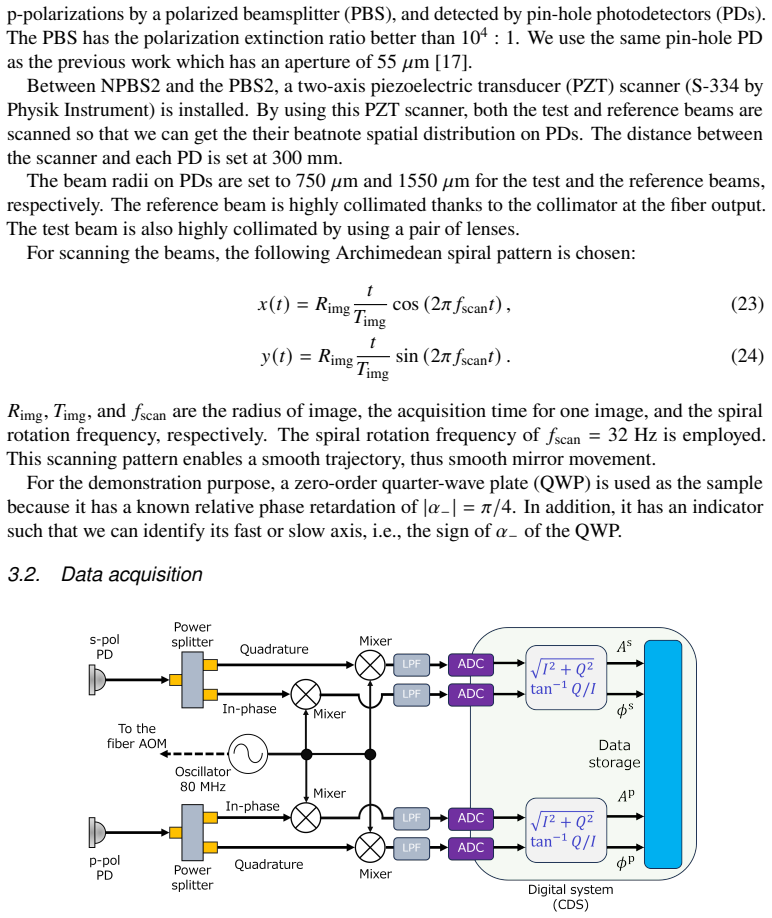
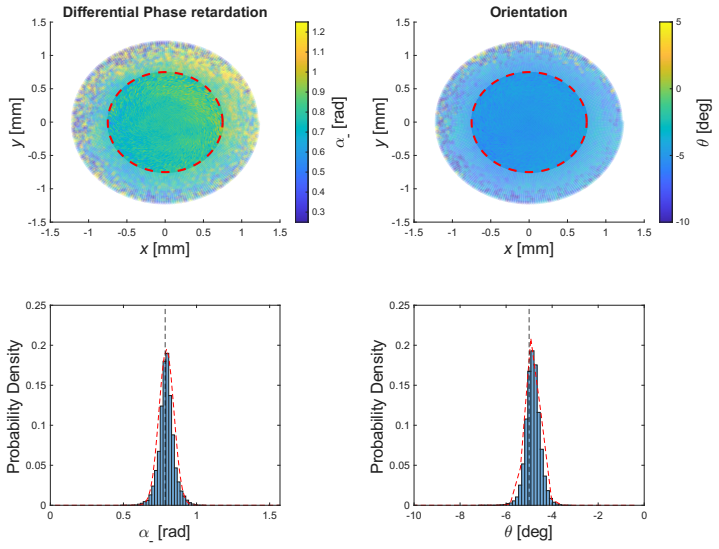
tabletop PPC setup... Archimedean spiral scan... detectable limit ℒ=0.05% for Cosmic Explorer PRG=65
What do these tags mean?
- matches
- The paper's claim is directly supported by a theorem in the formal canon.
- supports
- The theorem supports part of the paper's argument, but the paper may add assumptions or extra steps.
- extends
- The paper goes beyond the formal theorem; the theorem is a base layer rather than the whole result.
- uses
- The paper appears to rely on the theorem as machinery.
- contradicts
- The paper's claim conflicts with a theorem or certificate in the canon.
- unclear
- Pith found a possible connection, but the passage is too broad, indirect, or ambiguous to say the theorem truly supports the claim.
Reference graph
Works this paper leans on
-
[1]
Interferometer design of the kagra gravitational wave detector,
Y. Aso, Y. Michimura, K. Somiya,et al., “Interferometer design of the kagra gravitational wave detector,” Phys. Rev. D88, 043007 (2013)
work page 2013
-
[2]
J. Aasi, B. P. Abbott, R. Abbott,et al., “Advanced LIGO,” Class. Quantum Gravity32, 074001 (2015)
work page 2015
-
[3]
Advanced virgo: a second-generation interferometric gravitational wave detector,
F. Acernese, M. Agathos, K. Agatsuma,et al., “Advanced virgo: a second-generation interferometric gravitational wave detector,” Class. Quantum Gravity32, 024001 (2014)
work page 2014
-
[4]
Observation of gravitational waves from a binary black hole merger,
B. P. Abbott, R. Abbott, T. D. Abbott,et al., “Observation of gravitational waves from a binary black hole merger,” Phys. Rev. Lett.116, 061102 (2016)
work page 2016
-
[5]
GW170817: ObservationofGravitationalWavesfromaBinaryNeutron Star Inspiral,
B.P.Abbott,R.Abbott,T.D.Abbott,etal.,“GW170817: ObservationofGravitationalWavesfromaBinaryNeutron Star Inspiral,” Phys. Rev. Lett.119, 161101 (2017)
work page 2017
-
[6]
The einstein telescope: a third-generation gravitational wave observatory,
M. Punturo, M. Abernathy, F. Acernese,et al., “The einstein telescope: a third-generation gravitational wave observatory,” Class. Quantum Gravity27, 194002 (2010)
work page 2010
-
[7]
Gravitational-wave physics with cosmic explorer: Limits to low-frequency sensitivity,
E. D. Hall, K. Kuns, J. R. Smith,et al., “Gravitational-wave physics with cosmic explorer: Limits to low-frequency sensitivity,” Phys. Rev. D103, 122004 (2021)
work page 2021
-
[8]
Large and extremely low loss: the unique challenges of gravitational wave mirrors,
J. Degallaix, C. Michel, B. Sassolas,et al., “Large and extremely low loss: the unique challenges of gravitational wave mirrors,” J. Opt. Soc. Am. A36, C85–C94 (2019)
work page 2019
-
[9]
Influence of nonuniformity in sapphire substrates for a gravitational wave telescope,
K. Somiya, E. Hirose, and Y. Michimura, “Influence of nonuniformity in sapphire substrates for a gravitational wave telescope,” Phys. Rev. D100, 082005 (2019)
work page 2019
-
[10]
H. Wang, Y. Aso, M. Leonardi,et al., “Characterization of birefringence inhomogeneity of kagra sapphire mirrors from transmitted wavefront error measurements,” Phys. Rev. D110, 082007 (2024)
work page 2024
-
[11]
Birefringence-induced losses in interferometers,
W. Winkler, A. Rüdiger, R. Schilling,et al., “Birefringence-induced losses in interferometers,” Opt. Commun.112, 245–252 (1994)
work page 1994
-
[12]
Birefringence measurements on crystalline silicon,
C. Krüger, D. Heinert, A. Khalaidovski,et al., “Birefringence measurements on crystalline silicon,” Class. Quantum Gravity33, 015012 (2015)
work page 2015
-
[13]
Precision mapping of a silicon test mass birefringence,
V. Jaberian Hamedan, A. Adam, C. Blair,et al., “Precision mapping of a silicon test mass birefringence,” Appl. Phys. Lett.122, 064101 (2023)
work page 2023
-
[14]
S.Zeidler,M.Eisenmann,M.Bazzan,etal.,“Correlationbetweenbirefringenceandabsorptionmappinginlarge-size Sapphire substrates for gravitaional-wave interferometry,” Sci. Rep.13, 21393 (2023)
work page 2023
-
[15]
S.Tanioka,T.Pearce,andK.Kokeyama,“Developmentofapolarimetrymethodtowardinsitusubstratebirefringence characterization of ground-based gravitational wave detectors,” Rev. Sci. Instruments96, 074503 (2025)
work page 2025
-
[16]
Frequency-resolving spatiotemporal wave-front sensor,
K. Goda, D. Ottaway, B. Connelly,et al., “Frequency-resolving spatiotemporal wave-front sensor,” Opt. Lett.29, 1452–1454 (2004)
work page 2004
-
[17]
K. Agatsuma, L. van der Schaaf, M. van Beuzekom,et al., “High-performance phase camera as a frequency selective laser wavefront sensor for gravitational wave detectors,” Opt. Express27, 18533–18548 (2019)
work page 2019
-
[18]
L. van der Schaaf, K. Agatsuma, M. van Beuzekom,et al., “Advanced virgo phase cameras,” J. Physics: Conf. Ser. 718, 072008 (2016)
work page 2016
-
[19]
Overview of KAGRA: Detector design and construction history,
T. Akutsu, M. Ando, K. Arai,et al., “Overview of KAGRA: Detector design and construction history,” Prog. Theor. Exp. Phys.2021, 05A101 (2020)
work page 2021
-
[20]
Note on power measured at OFI s-pol rejected light monitor,
Yuta Michimura, “Note on power measured at OFI s-pol rejected light monitor,” https://dcc.ligo.org/LIGO- G2201296/public (2022)
work page 2022
-
[21]
S. Rowlinson, A. Dmitriev, A. W. Jones,et al., “Feasibility study of beam-expanding telescopes in the interferometer arms for the einstein telescope,” Phys. Rev. D103, 023004 (2021)
work page 2021
-
[22]
Residual stress birefringence of highly reflective mirrors with different numbers of layers,
S. Xiao, B. Li, and J. Wang, “Residual stress birefringence of highly reflective mirrors with different numbers of layers,” Appl. Opt.59, A99–A105 (2020)
work page 2020
-
[23]
Advanced LIGO detector performance in the fourth observing run,
E. Capote, W. Jia, N. Aritomi,et al., “Advanced LIGO detector performance in the fourth observing run,” Phys. Rev. D111, 062002 (2025)
work page 2025
-
[24]
Y. Michimura, H. Wang, F. Salces-Carcoba,et al., “Effects of mirror birefringence and its fluctuations to laser interferometric gravitational wave detectors,” Phys. Rev. D109, 022009 (2024)
work page 2024
-
[25]
Active wavefront correction in laser interferometric gravitational wave detectors,
R. C. Lawrence, “Active wavefront correction in laser interferometric gravitational wave detectors,” Ph.D. thesis, Massachusetts Institute of Technology (2003)
work page 2003
discussion (0)
Sign in with ORCID, Apple, or X to comment. Anyone can read and Pith papers without signing in.