REVIEW 2 major objections 5 minor 1 cited by
The neutrino fog—the irreducible solar-neutrino background that caps dark-matter discovery—shifts with the model: a Z-portal with a strong neutron coupling lowers it, a proton-only Scotogenic model raises it.
Reviewed by Pith at T0; open to challenge. T0 means a machine referee read the full paper against a public rubric. the ladder, T0–T4 →
Isospin-violating dark matter shifts the neutrino fog: in xenon, a Z-portal model (f_n/f_p ≈ -22) lowers the discovery limit while the Scotogenic model (f_n/f_p = 0) raises it.
T0 review reviewed 2026-08-03 challenge →
load-bearing objection The paper's central message is right — the neutrino fog moves with the DM isospin ratio — but the Scotogenic example is computed with elastic kinematics for an inelastic model, and the σχ−n normalization is ambiguous; revision required. the 2 major comments →
Shifting the neutrino fog: studying the Isospin-violating Dark Matter case
The pith
A machine-rendered reading of the paper's core claim, the machinery that carries it, and where it could break.
The reading
Core claim
For a xenon detector, the paper computes 90% discovery limits via a profile-likelihood ratio that treats neutrino flux normalisations as nuisance parameters, for both a Z-portal model and the Scotogenic model. It finds that the Z-portal model, which couples strongly to neutrons, shifts the discovery limit to lower WIMP–nucleon cross-sections than the isospin-conserving case, allowing the experiment to probe deeper before the neutrino background becomes limiting; the Scotogenic model, which couples only to protons, shifts the limit upward. Holding the neutrino spectrum fixed, the entire shift comes from the DM-rate prefactor [Z + (f_n/f_p)(A−Z)]^2, illustrating that the neutrino fog is a dyna
What carries the argument
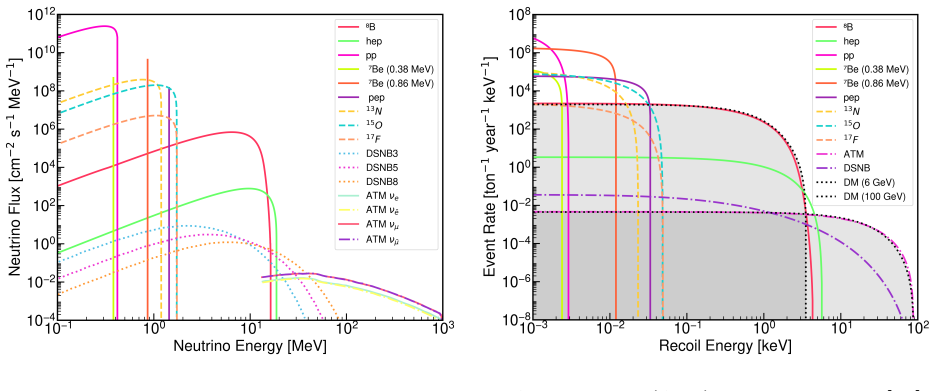
The central object is the ratio of neutron-to-proton DM couplings, r = f_n/f_p. It controls the DM rate through [Z + r(A−Z)]^2, while the neutrino background enters through the weak charge Q_W^2, which is almost entirely neutron-dominated and independent of r. The contrast between an r-dependent DM signal and an r-independent neutrino background is what moves the discovery limit. The profile-likelihood-ratio test, comparing a background-only hypothesis with a background-plus-DM hypothesis and profiling the neutrino flux uncertainties, converts this shift into a quantified neutrino fog.
Load-bearing premise
The whole argument leans on treating every model's dark-matter signal as an elastic, spin-independent recoil whose rate goes as the square of [Z + r(A−Z)] with r fixed; for the Scotogenic model that link is not made, because the interaction defined there is inelastic and momentum-dependent, and the energy gap between the two states never enters the calculation.
What would settle it
Recompute the Scotogenic discovery limit without the elastic-rate shortcut: include the inelastic threshold v_min = sqrt(m_N E_r/2μ_N) + δ/sqrt(2 m_N E_r) for the N1→N2 transition and the q^2-dependent charge-radius operator from Eq. (24). If that changes the low-mass boundary of the r = 0 fog in Figs. 5–6 by more than the exposure variation, the plotted Scotogenic curve is not a prediction of the model as defined. Separately, if future xenon data locate the discovery limit on the isospin-conserving curve, the Z-portal's predicted downward shift would be ruled out.
If this is right
- For a xenon target, the Z-portal model (r ≈ −22.18) lowers the neutrino fog below the standard isospin-conserving curve, so a given exposure tests smaller cross-sections before neutrinos block the search.
- The Scotogenic model (r = 0) raises the neutrino fog, meaning larger exposures or other strategies are needed to reach the same sensitivity.
- No single neutrino floor exists: any quoted discovery limit for spin-independent WIMP scattering implicitly assumes a value of f_n/f_p and must be re-derived for the model under study.
- The relative sensitivity of two targets, such as xenon versus germanium, depends on r, so combining targets can help determine whether dark matter couples preferentially to neutrons or protons.
- For ratios with |r| much larger than 1, the sign of r is almost irrelevant because the contribution is squared; destructive cancellation matters only near r ≈ −0.7 for xenon.
Where Pith is reading between the lines
- Extension not pursued in the paper: the same rate-versus-background argument should apply to other nuclear targets and to other scattering operators; wherever the signal scales with a different combination of protons and neutrons than the neutrino weak charge, the fog will shift.
- If the inelastic structure of the Scotogenic interaction is taken seriously, the r = 0 curve is not yet a full model prediction: the N1→N2 mass splitting enters the minimum velocity and the photon charge-radius operator adds momentum dependence, so recomputing the spectrum could change the low-mass shape of the discovery limit and close off part of the plotted region.
- The direction and magnitude of the fog shift could themselves be used as a diagnostic: a future measurement localising where the neutrino background dominates in the (mass, cross-section) plane would give direct information on f_n/f_p, complementary to standard rate-normalisation constraints.
Editorial analysis
A structured set of objections, weighed in public.
Referee Report
Summary. This paper examines how the 'neutrino fog' — the irreducible CEνNS background in dark-matter direct-detection experiments — shifts when the DM-nucleus spin-independent interaction is isospin-violating (fn ≠ fp). The authors compute discovery limits with a profile-likelihood-ratio approach for a xenon target, using standard solar, atmospheric, and DSNB fluxes and a 150-bin recoil energy range. They show that the DM rate scales as [Z + (fn/fp)(A−Z)]^2 (Eq. 30) while the neutrino background is independent of fn/fp, so a large negative ratio (Z-portal model, fn/fp ≈ −22) lowers the fog, whereas a proton-only coupling (Scotogenic model, fn/fp = 0) raises it. A comparison with a germanium target is also provided. The qualitative isospin-scaling argument is simple and sound; the model-specific illustration for the Scotogenic model is, however, computed with elastic kinematics and a contact interaction, despite the model being defined as inelastic N1→N2 scattering with momentum-dependent operators.
Significance. The central observation is secured by the rate formula and is a useful reminder that neutrino-floor limits should be re-derived for each DM model. The paper makes this concrete with a standard PLR treatment, which is more rigorous than the isocurve method. The two examples are well chosen to bracket the effect: a neutron-dominated coupling that lowers the fog and a proton-only coupling that raises it. However, as it stands, the Scotogenic curve in Figs. 5 and 6 is not a prediction of the model defined in Sec. V.A. If the inelastic kinematics and the q^2-dependence of the operators were properly included, the conclusion that the Scotogenic model produces a 'higher neutrino fog' would need to be re-examined, since the accessible mass range and recoil spectrum change. The generic fn/fp = 0 scenario still demonstrates the qualitative effect, but it should be labelled as such.
major comments (2)
- [Sec. V.A and Fig. 5 (right)] The Scotogenic model is defined by the inelastic transition N1→N2 through the photon-mediated operators of Eq. (24), with a mass splitting δ=M2−M1 that never appears in the rate calculation. The plotted curve uses the elastic vmin of Eq. (2), the Klein-Nystrand form factor of Eq. (5), and the contact amplitude [Z + (fn/fp)(A−Z)]^2. For δ ≳ 10 keV the correct vmin contains δ/√(2m_N E_r) and most of the low-mass region becomes kinematically forbidden; moreover the c12 operator scales as q^2, changing the recoil shape. Thus the right panel of Fig. 5 and the corresponding statement in the Conclusions are not predictions of the Scotogenic model. Please either perform the full inelastic calculation or relabel the curve as a generic proton-only (fn/fp = 0) benchmark.
- [Sec. IV, Eq. (16) and text below] The stated threshold E_th = 10^{-3} eV is unphysical for nuclear-recoil detectors; even if intended as keV, the value needs to be corrected. Because the discovery limits in Figs. 5–6 are absolute cross-section values, an incorrect threshold changes the numerical results, including the exposure at which the fog is reached. Please state the threshold and binning unambiguously (e.g., log-spaced bins from 1 keV to 1 MeV) and rerun the analysis if the computation actually used 10^{-3} eV.
minor comments (5)
- [Eqs. (18)-(19)] In H0 and H1 the same symbol N_obs is assigned hypothesis-dependent values. Since the PLR uses an Asimov dataset, N_obs should be identical in both hypotheses; please rewrite the notation.
- [Sec. III vs Sec. V.B] The weak mixing angle is quoted as sin^2θ_W = 0.2368 in Sec. III (around Eq. 14) but 0.23873 in Sec. V.B (around Eq. 29). Since fn/fp = −22.18 depends directly on this value, the two should be made consistent or the running of the angle explained.
- [Eq. (12)] E_ν^min = √(m_N E_r/2) is an approximation; the full kinematic expression should be given or a reference cited, especially since low-energy recoils are central to the fog.
- [Abstract/Introduction] The phrase 'First observation of solar neutrinos through coherent elastic neutrino-nucleus scattering by dark matter (DM) direct detection experiments' is grammatically unclear; it should read 'by direct detection experiments'.
- [Figs. 5-6 and Sec. V.C] If the Scotogenic panel is relabelled as a generic benchmark, the corresponding line styles and text in Fig. 6 and Sec. V.C should be updated consistently to avoid attributing the curve to the Scotogenic model.
Circularity Check
No significant circularity: the IVDM fog shift follows from the stated coupling ratios and standard CEνNS formulas; no fitted parameter is relabeled as a prediction.
full rationale
The paper's central derivation chain is self-contained. The proportionality R_DM ∝ [Z + (fn/fp)(A−Z)]^2 (Eq. 30) is literally Eq. 4 rewritten for the SI cross-section, and the neutrino background (Eqs. 12–15) has no fn/fp dependence; the discovery-limit shift therefore follows from the stated inputs plus the profile-likelihood procedure (Eqs. 16–22). No quantity in that chain is fitted to the fog curves: fn/fp = −22.18 is computed from SM Z-quark couplings and sin^2θ_W (Eq. 29), and fn/fp = 0 for the Scotogenic illustration is stated from the photon-mediated coupling. The scan over r in Fig. 4 is illustrative rather than a fit to data. The only author-overlapping citation is [21] for the standard CEνNS differential cross-section; because that formula is an independently verifiable standard result, it is real evidence and does not make the argument circular. The skeptic's concern about the Scotogenic curve—that Section V.A defines inelastic N1→N2 scattering with charge-radius and dipole operators (Eqs. 24–27) while the rate computation uses elastic kinematics (Eq. 2), the Klein–Nystrand form factor (Eq. 5), and the contact-SI amplitude of Eq. 4/30, with the mass splitting δ absent—is a physics-correctness/internal-consistency issue, not a circularity: the plotted curve does not reduce to the model's own equations, it omits part of them. Thus no step in the paper's own derivation equals its input by construction.
Axiom & Free-Parameter Ledger
free parameters (3)
- Isospin ratio f_n/f_p in Figs. 4-6 =
scan values: -100, -22.18, -1, 0, 1, 100 (not fitted)
- Recoil energy threshold E_th =
10^-3 eV as printed
- Exposure values in Fig. 5 =
10^-2 to 10^7 ton-year
axioms (6)
- domain assumption Standard Halo Model truncated Maxwellian velocity distribution (Eqs. 6-9) with v0=220 km/s, vesc=544 km/s, vobs=550 km/s
- domain assumption Equal proton and neutron nuclear form factors
- standard math Wilk's theorem applies: q0 is asymptotically chi^2 with one degree of freedom
- ad hoc to paper Scotogenic inelastic scattering can be treated as elastic SI scattering
- domain assumption Idealized detector: no energy resolution, no efficiency, no non-neutrino backgrounds
- standard math CEνNS weak-charge formula with gV_p, gV_n from low-energy sin^2θ_W = 0.2368
Cite this review
Pith. "Pith review of Shifting the neutrino fog: studying the Isospin-violating Dark Matter case." pith.science (2026). https://pith.science/paper/R6OPNA7A
@misc{pith2026251219784,
  author       = {Pith},
  title        = {Pith review of: Shifting the neutrino fog: studying the Isospin-violating Dark Matter case},
  year         = {2026},
  howpublished = {\url{https://pith.science/paper/R6OPNA7A}},
  note         = {Machine review of arXiv:2512.19784}
}
read the original abstract
First observation of solar neutrinos through coherent elastic neutrino-nucleus scattering by dark matter (DM) direct detection (DD) experiments makes the study of the neutrino fog of the most relevance. This irreducible neutrino background depends on the target material as well as other experimental parameters. Recently, it has also been remarked the dependence of the neutrino fog on the DM models under consideration. In this work, we study the case of Isospin-violating dark matter (IVDM) models, discussing specific examples of DM models and making a detailed analysis of the implications of IVDM on the neutrino fog. We also explore the conditions under which this background can be mitigated for specific DM models.
Figures


Forward citations
Cited by 1 Pith paper
-
Sterile Neutrino Mixing Parameters from Solar-Neutrino Coherent Scattering
Future dark matter detectors with ~3000 ton-yr exposure could probe sterile neutrino mixing with νμ and ντ in parameter space not reached by long-baseline or atmospheric searches.
Reference graph
Works this paper leans on
-
[1]
E. Aprile, J. Aalbers, F. Agostini, M. Alfonsi, L. Althueser, F. D. Amaro, V. C. Antochi, E. Angelino, F. Arneodo, D. Barge, et al. (XENON Collaboration), Phys. Rev. Lett.123, 251801 (2019), URLhttps://link.aps.org/doi/10.1103/PhysRevLett.123.251801
-
[2]
D. Akerib, H. Ara´ ujo, X. Bai, A. Bailey, J. Balajthy, P. Beltrame, E. Bernard, A. Bernstein, T. Biesiadzinski, E. Boulton, et al., Physical Review Letters116(2016), ISSN 1079-7114, URLhttp://dx.doi.org/10.1103/PhysRevLett.116.161301
-
[3]
Z. Bo, W. Chen, X. Chen, Y. Chen, Z. Cheng, X. Cui, Y. Fan, D. Fang, Z. Gao, L. Geng, et al. (PandaX Collaboration), Phys. Rev. Lett.134, 011805 (2025), URLhttps://link. aps.org/doi/10.1103/PhysRevLett.134.011805
-
[4]
J. Aalbers, D. S. Akerib, C. W. Akerlof, A. K. Al Musalhi, F. Alder, A. Alqahtani, S. K. Alsum, C. S. Amarasinghe, A. Ames, T. J. Anderson, et al. (LUX-ZEPLIN Collaboration), Phys. 18 Rev. Lett.131, 041002 (2023), URLhttps://link.aps.org/doi/10.1103/PhysRevLett. 131.041002
- [5]
- [6]
-
[7]
D. Z. Freedman, Phys. Rev. D9, 1389 (1974), URLhttps://link.aps.org/doi/10.1103/ PhysRevD.9.1389
1974
-
[8]
D. Akimov, J. B. Albert, P. An, C. Awe, P. S. Barbeau, B. Becker, V. Belov, A. Brown, A. Bolozdynya, B. Cabrera-Palmer, et al., Science357, 1123–1126 (2017), ISSN 1095-9203, URLhttp://dx.doi.org/10.1126/science.aao0990
-
[9]
C. A. J. O’Hare, Physical Review Letters127(2021), ISSN 1079-7114, URLhttp://dx.doi. org/10.1103/PhysRevLett.127.251802
-
[10]
Z. Bo, W. Chen, X. Chen, Y. Chen, Z. Cheng, X. Cui, Y. Fan, D. Fang, Z. Gao, L. Geng, et al. (PandaX Collaboration), Phys. Rev. Lett.133, 191001 (2024), URLhttps://link. aps.org/doi/10.1103/PhysRevLett.133.191001
-
[11]
E. Aprile, J. Aalbers, K. Abe, S. Ahmed Maouloud, L. Althueser, B. Andrieu, E. Angelino, D. Ant´ on Martin, F. Arneodo, L. Baudis, et al. (XENON Collaboration), Phys. Rev. Lett. 133, 191002 (2024), URLhttps://link.aps.org/doi/10.1103/PhysRevLett.133.191002
-
[12]
D. S. Akerib, A. K. A. Musalhi, F. Alder, B. J. Almquist, C. S. Amarasinghe, A. Ames, T. J. Anderson, N. Angelides, H. M. Ara´ ujo, J. E. Armstrong, et al.,Searches for light dark matter and evidence of coherent elastic neutrino-nucleus scattering of solar neutrinos with the lux-zeplin (lz) experiment(2025), 2512.08065, URLhttps://arxiv.org/abs/2512.08065
Pith/arXiv arXiv 2025
-
[13]
J. L. Feng, J. Kumar, D. Marfatia, and D. Sanford, Physics Letters B703, 124–127 (2011), ISSN 0370-2693, URLhttp://dx.doi.org/10.1016/j.physletb.2011.07.083
-
[14]
V. D. Romeri, A. Majumdar, D. K. Papoulias, and R. Srivastava,New light mediators and the neutrino fog: Implications from xenonnt nuclear recoil data(2025), 2512.08853, URL https://arxiv.org/abs/2512.08853
Pith/arXiv arXiv 2025
-
[15]
V. M. Lozano, S. Pramanik, S. Sadhukhan, and A. Terrones,Neutrino fog in the light dark sector: the role of isospin violation(2025), 2508.05787, URLhttps://arxiv.org/abs/2508. 19 05787
Pith/arXiv arXiv 2025
-
[16]
J. D. Lewin and P. F. Smith, Astropart. Phys.6, 87 (1996)
1996
-
[17]
D. K. Papoulias, T. S. Kosmas, and Y. Kuno, Frontiers in Physics7(2019), ISSN 2296-424X, URLhttp://dx.doi.org/10.3389/fphy.2019.00191
arXiv 2019
-
[18]
S. R. Klein and J. Nystrand, Physical Review C60(1999), ISSN 1089-490X, URLhttp: //dx.doi.org/10.1103/PhysRevC.60.014903
-
[19]
C. Savage, K. Freese, and P. Gondolo, Phys. Rev. D74, 043531 (2006), URLhttps://link. aps.org/doi/10.1103/PhysRevD.74.043531
-
[20]
K. Freese, M. Lisanti, and C. Savage, Reviews of Modern Physics85, 1561–1581 (2013), ISSN 1539-0756, URLhttp://dx.doi.org/10.1103/RevModPhys.85.1561
-
[21]
V. De Romeri, O. G. Miranda, D. K. Papoulias, G. Sanchez Garcia, M. T´ ortola, and J. W. F. Valle, Journal of High Energy Physics2023(2023), ISSN 1029-8479, URLhttp://dx.doi. org/10.1007/JHEP04(2023)035
-
[22]
Navas et al
S. Navas et al. (Particle Data Group), Phys. Rev. D110, 030001 (2024)
2024
- [23]
-
[24]
D. Baxter, I. M. Bloch, E. Bodnia, X. Chen, J. Conrad, P. Di Gangi, J. E. Y. Dobson, D. Durnford, S. J. Haselschwardt, A. Kaboth, et al., The European Physical Journal C81 (2021), ISSN 1434-6052, URLhttp://dx.doi.org/10.1140/epjc/s10052-021-09655-y
-
[25]
G. Cowan, K. Cranmer, E. Gross, and O. Vitells, Eur. Phys. J. C71, 1554 (2011), [Erratum: Eur.Phys.J.C 73, 2501 (2013)], 1007.1727
Pith/arXiv arXiv 2011
-
[26]
J. Billard, E. Figueroa-Feliciano, and L. Strigari, Phys. Rev. D89, 023524 (2014), URL https://link.aps.org/doi/10.1103/PhysRevD.89.023524
-
[27]
J. Billard, F. Mayet, and D. Santos, Phys. Rev. D85, 035006 (2012), 1110.6079
Pith/arXiv arXiv 2012
-
[28]
D. Aristizabal Sierra, V. De Romeri, L. J. Flores, and D. K. Papoulias, JCAP01, 055 (2022), 2109.03247
Pith/arXiv arXiv 2022
-
[29]
N. Carlin et al. (COSINE-100), Sci. Adv.11, adv6503 (2025), 2409.13226
Pith/arXiv arXiv 2025
-
[30]
Z. Kang, T. Li, T. Liu, C. Tong, and J. M. Yang, Journal of Cosmology and Astroparticle Physics2011, 028 (2011), URLhttps://doi.org/10.1088/1475-7516/2011/01/028
-
[31]
V. M. Lozano, M. Peir´ o, and P. Soler, JHEP04, 175 (2015), 1503.01780
Pith/arXiv arXiv 2015
-
[32]
J. L. Feng, J. Kumar, D. Marfatia, and D. Sanford, inSnowmass 2013: Snowmass on the Mississippi(2013), 1307.1758. 20
Pith/arXiv arXiv 2013
-
[33]
M. T. Frandsen, F. Kahlhoefer, S. Sarkar, and K. Schmidt-Hoberg, JHEP09, 128 (2011), 1107.2118
Pith/arXiv arXiv 2011
-
[34]
A. Drozd, B. Grzadkowski, J. F. Gunion, and Y. Jiang, JCAP10, 040 (2016), 1510.07053
Pith/arXiv arXiv 2016
-
[35]
D. Schmidt, T. Schwetz, and T. Toma, Phys. Rev. D85, 073009 (2012), 1201.0906
Pith/arXiv arXiv 2012
- [36]
- [37]
-
[38]
L. Lopez Honorez, E. Nezri, J. F. Oliver, and M. H. G. Tytgat, JCAP02, 028 (2007), hep- ph/0612275
arXiv 2007
-
[39]
L. Lopez Honorez and C. E. Yaguna, JCAP01, 002 (2011), 1011.1411
Pith/arXiv arXiv 2011
-
[40]
A. Ibarra, C. E. Yaguna, and O. Zapata, Phys. Rev. D93, 035012 (2016), 1601.01163
Pith/arXiv arXiv 2016
-
[41]
G. Arcadi, Y. Mambrini, and F. Richard, Journal of Cosmology and Astroparticle Physics 2015, 018 (2015), URLhttps://dx.doi.org/10.1088/1475-7516/2015/03/018
-
[42]
J. L. Feng, J. Kumar, and D. Sanford, Physical Review D88(2013), ISSN 1550-2368, URL http://dx.doi.org/10.1103/PhysRevD.88.015021. 21
This paper was first reviewed by deepseek-v4-flash on August 3, 2026.
discussion (0)
Sign in with ORCID, Apple, or X to comment. Anyone can read and Pith papers without signing in.