Supercurrent from the imaginary part of the Andreev levels in non-Hermitian Josephson junctions
Pith reviewed 2026-05-16 19:00 UTC · model grok-4.3
The pith
Non-Hermitian Josephson junctions produce supercurrent from the phase derivative of Andreev level broadening.
A machine-rendered reading of the paper's core claim, the machinery that carries it, and where it could break.
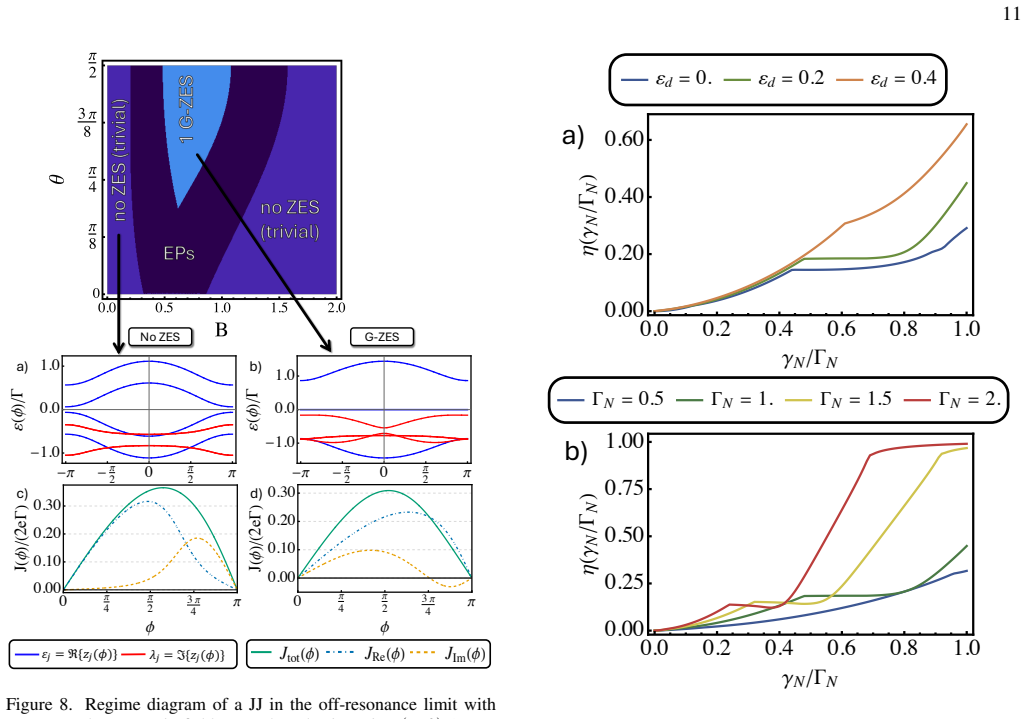
Core claim
When the Andreev current formula is extended to non-Hermitian Josephson junctions, a novel supercurrent term appears that is proportional to the phase derivative of the imaginary part of the Andreev levels; this contribution originates from the breaking of a time-reversal-like symmetry and can be resolved in broken-symmetry spectral configurations that lack exceptional points.
What carries the argument
The extended Andreev current formula applied to the complex eigenvalues of the non-Hermitian effective Hamiltonian, where the imaginary parts encode level broadening whose phase derivative supplies the new current term.
If this is right
- The new term becomes measurable in chosen Andreev spectra that sit in the broken symmetry phase away from exceptional points.
- An experimental protocol can isolate the contribution by varying the superconducting phase while tracking the current.
- The phase dependence of the imaginary part directly signals the underlying symmetry breaking in open junctions.
- Detection would constitute a signature of non-Hermiticity independent of exceptional-point physics.
Where Pith is reading between the lines
- Analogous derivative terms could appear in other open superconducting devices whose effective descriptions are non-Hermitian.
- Current measurements in hybrid junctions may need re-interpretation once broadening-phase coupling is included.
- Time-dependent drives or different reservoir couplings might amplify or suppress the same contribution.
Load-bearing premise
The conventional Andreev current expression remains valid after the eigenvalues become complex in the non-Hermitian Hamiltonian.
What would settle it
An experiment that measures the supercurrent in a junction tuned to a broken time-reversal symmetry phase with no exceptional points and finds the additional term absent or present would decide whether the extended formula holds.
Figures



read the original abstract
We investigate the electronic transport properties of a superconductor-quantum dot-superconductor Josephson junction coupled to a ferromagnetic metal reservoir in the presence of an external magnetic field. The device is described by an effective non-Hermitian Hamiltonian, whose complex eigenvalues encode the energy (real part) and the broadening (imaginary part) of the Andreev quasi-bound states. When extending the Andreev current formula to the non-Hermitian case, a novel contribution arises that is proportional to the phase derivative of the levels broadening. This term becomes particularly relevant in the presence of exceptional points (EPs) in the spectrum, but its experimental detection is not straightforward. We identify optimal Andreev spectrum configurations where this novel current contribution can be clearly highlighted, and we outline an experimental protocol for its detection. We point out that the phase dependence in the levels imaginary part originates from the breaking of a time-reversal-like symmetry. In particular, spectral configurations in the broken phase of the symmetry and without EPs can be obtained, where this novel contribution can be easily resolved. The proposed protocol would allow to probe for the first time a fingerprint of non-Hermiticity in open junctions that is not strictly related to the presence of EPs.
Editorial analysis
A structured set of objections, weighed in public.
Referee Report
Summary. The manuscript studies supercurrent in a non-Hermitian S-QD-S Josephson junction coupled to a ferromagnetic reservoir under magnetic field. An effective non-Hermitian Bogoliubov-de Gennes Hamiltonian yields complex Andreev eigenvalues whose real parts give energies and imaginary parts give broadenings. The central claim is that the standard Andreev current formula extends to this setting by acquiring an extra term proportional to the phase derivative of the level broadenings; this term is said to be experimentally accessible in spectral configurations that break a time-reversal-like symmetry yet avoid exceptional points.
Significance. If the extension of the current formula is placed on a firm microscopic footing, the work would supply a new, EP-independent transport signature of non-Hermiticity in open Josephson junctions. The identification of symmetry-broken configurations without exceptional points and the outline of a detection protocol are concrete strengths that could guide experiments.
major comments (3)
- [Section on current formula extension (near Eq. for non-Hermitian Andreev current)] The manuscript asserts that the supercurrent is obtained by direct substitution of complex eigenvalues into the Hermitian Andreev formula plus a term ∝ ∂Γ_n/∂φ, but supplies no derivation of this replacement from the steady-state expectation value of the current operator. A microscopic calculation (Keldysh contour, Lindblad master equation, or scattering theory for the open system) is required to justify why the left-right eigenvector structure and possible non-diagonalizability at exceptional points do not alter the result.
- [Discussion of exceptional points and current] The claim that the novel contribution is 'particularly relevant' near exceptional points is not supported by an explicit calculation of the current at or across an EP, where the Hamiltonian is non-diagonalizable and the usual spectral decomposition fails.
- [Symmetry analysis paragraph] The time-reversal-like symmetry whose breaking produces phase dependence in the imaginary parts is introduced without an explicit operator definition or proof that its breaking is necessary and sufficient for a nonzero ∂Γ/∂φ term.
minor comments (2)
- [Abstract and theoretical model] Notation for the complex eigenvalues (E_n + i Γ_n/2 or similar) should be stated once and used consistently; the factor of 2 in the definition of Γ_n is not fixed in the abstract.
- [Figure captions] Figure captions for the proposed spectral configurations should explicitly label the symmetry-broken, EP-free regime and indicate the magnitude of the new current term relative to the conventional term.
Simulated Author's Rebuttal
We thank the referee for the careful reading and constructive comments on our manuscript. We address each major comment below and have revised the manuscript to strengthen the derivations, symmetry analysis, and discussion of exceptional points.
read point-by-point responses
-
Referee: [Section on current formula extension (near Eq. for non-Hermitian Andreev current)] The manuscript asserts that the supercurrent is obtained by direct substitution of complex eigenvalues into the Hermitian Andreev formula plus a term ∝ ∂Γ_n/∂φ, but supplies no derivation of this replacement from the steady-state expectation value of the current operator. A microscopic calculation (Keldysh contour, Lindblad master equation, or scattering theory for the open system) is required to justify why the left-right eigenvector structure and possible non-diagonalizability at exceptional points do not alter the result.
Authors: We agree that the original presentation lacked a detailed derivation. In the revised manuscript we have added an explicit calculation of the steady-state current expectation value using the bi-orthogonal left and right eigenvectors of the non-Hermitian Bogoliubov-de Gennes Hamiltonian. This derivation shows that the additional term proportional to ∂Γ_n/∂φ emerges directly from the phase dependence of the imaginary parts when the current operator is evaluated in the steady state. The formula holds for diagonalizable cases away from exceptional points; we have clarified the limitations of the bi-orthogonal decomposition at EPs. A full Keldysh-contour or Lindblad treatment of the open system coupled to the ferromagnetic reservoir lies beyond the present scope and is noted as future work. revision: partial
-
Referee: [Discussion of exceptional points and current] The claim that the novel contribution is 'particularly relevant' near exceptional points is not supported by an explicit calculation of the current at or across an EP, where the Hamiltonian is non-diagonalizable and the usual spectral decomposition fails.
Authors: We accept the criticism. The revised manuscript removes the phrasing that the contribution is 'particularly relevant' near EPs and instead emphasizes the symmetry-broken configurations without EPs, where the novel term can be isolated experimentally. We have added a brief note that the spectral decomposition fails exactly at an EP and that the formula applies only in the vicinity of, but not at, the exceptional point. revision: yes
-
Referee: [Symmetry analysis paragraph] The time-reversal-like symmetry whose breaking produces phase dependence in the imaginary parts is introduced without an explicit operator definition or proof that its breaking is necessary and sufficient for a nonzero ∂Γ/∂φ term.
Authors: We have revised the symmetry section to provide an explicit definition of the time-reversal-like operator (time reversal combined with a spin rotation induced by the ferromagnetic reservoir). We now include a short proof that preservation of this symmetry forces the imaginary parts Γ_n to be independent of the superconducting phase φ, while its breaking is both necessary and sufficient for a nonzero ∂Γ_n/∂φ term. This establishes the direct link between symmetry breaking and the novel current contribution. revision: yes
- A complete microscopic derivation of the current using Keldysh contour or Lindblad master equation for the open non-Hermitian system.
Circularity Check
No circularity detected in derivation chain
full rationale
The paper presents the supercurrent extension as a direct substitution of complex Andreev eigenvalues into the standard phase-derivative formula, yielding an additional term proportional to ∂Γ_n/∂φ. This step is an explicit modeling assumption rather than a reduction of the output to the input by construction, self-definition, or fitted-parameter renaming. No load-bearing self-citation chain, uniqueness theorem imported from prior work, or ansatz smuggling is required; the derivation remains self-contained once the extension is granted. The absence of any quoted equation that equates the novel term to a fit or prior result by tautology confirms zero circularity.
Axiom & Free-Parameter Ledger
axioms (2)
- domain assumption The open junction can be described by an effective non-Hermitian Hamiltonian whose complex eigenvalues give Andreev level energies and broadenings.
- ad hoc to paper The Andreev current formula can be directly extended to the non-Hermitian case by using complex eigenvalues.
Forward citations
Cited by 1 Pith paper
-
$0-\pi$ transitions in non-Hermitian magnetic Josephson junctions
Non-Hermitian dissipation shifts 0-π transitions in magnetic Josephson junctions to higher fields and enables angle-based control at fixed magnitude via complex eigenvalues of the effective Hamiltonian.
Reference graph
Works this paper leans on
-
[1]
1G-ZES Forγ=0.5,0.8, we can get some phase windows with no EPs in the Andreev spectrum, upper panel of Fig. 5. Specif- ically, the appearance of FE-EPs, dashed lines in upper panel of Fig. 5, is strongly retarded so that ZE-EPs, thick lines, can annihilate in pairs atφ=0 andφ=±π. In theγ N interval between the annihilation of internal ZE-EP and the reappe...
-
[2]
γ=0.5, the external ZE-EP and the FE-EP appear in the spec- trum almost at the same time
2G-ZES After the G-ZES region, for intermediate asymmetries, e.g. γ=0.5, the external ZE-EP and the FE-EP appear in the spec- trum almost at the same time. Differently, for highly asym- metric JJs,γ=0.8, the FE-EP manifest in the spectrumafter the annihilation of the external ZE-EP atφ=0, see the brown thick and dashed curves in the upper panel of Fig. 5....
-
[3]
the third brown-shaded region in Fig
no ZES (quartet) By further increasingγ N the system exits the 2 G-ZES re- gion and, at the annihilation point of the FE-EP, reaches a re- gion with no EPs and ZES, i.e. the third brown-shaded region in Fig. 5, where the imaginary part is still phase-dispersive. Thisquartet regionis achieved when one of the spins on the dot is almost decoupled from F, e.g...
-
[4]
Measurement protocol JIm can be detected experimentally by the means of com- bined Josephson currentJ(φ)and conductancedI/dVmea- surements, performed by varying the phase biasφas in the scheme of Ref. [57]. Specifically, viadI/dV(φ)spectroscopy one can easily ac- cess at anyφthe real part of energy levels from the peaks of the response. The measurement of...
-
[5]
≠0 ZE-EPFE-EP BrokenTRS phaseUnbrokenTRS phase !
Experimentally accessible regimes In order to investigate if the state of the JJ can be easily tuned between the different regimes, e.g. hosting EPs as well as G-ZES, we explored the ABS spectral configurations by varying the orientation and amplitude of the external mag- netic field,Bandθ. This investigation is motivated by the fact that the position of ...
work page 2020
-
[6]
Josephson current in the infinite and finite∆cases In Sec. II C we introduced Eq. 10 that allows to calculate the junction CPR starting from the quasi-ABS, i.e. the eigenval- ues of ˇHe f f , in every spectral configuration, e.g. ABS spectra hosting EPs or global zero-energy states (G-ZES) as in Fig. 1. In Ref.[54], to derive the above Andreev current for...
-
[7]
CPR in the time-reversal symmetric case, the contribution from the imaginary parts at the EPs Eq. 11 that we report here for the sake of simplicity JABS(φ) ∆→∞ T→0=J Re +J Im = ∑ j JRe,j +∑ j JIm,j ,with JRe,j ∆→∞ T→0=− e π ∂φ ε j arctan(ε j/λ j)− π 2 ,(D9) JIm,j ∆→∞ T→0=− e π ∂φ λ j ln(|z j|). accounts for the current coming from both real and imaginary ...
-
[8]
T. M. Philip, M. R. Hirsbrunner, and M. J. Gilbert, Loss of hall conductivity quantization in a non-hermitian quantum anoma- lous hall insulator, Phys. Rev. B98, 155430 (2018)
work page 2018
-
[9]
Y . Chen and H. Zhai, Hall conductance of a non-hermitian chern insulator, Phys. Rev. B98, 245130 (2018)
work page 2018
-
[10]
E. J. Bergholtz and J. C. Budich, Non-hermitian weyl physics in topological insulator ferromagnet junctions, Phys. Rev. Res. 1, 012003 (2019)
work page 2019
-
[11]
J. C. Budich and E. J. Bergholtz, Non-hermitian topological sensors, Phys. Rev. Lett.125, 180403 (2020)
work page 2020
-
[12]
J. Cayao, Exceptional degeneracies in non-hermitian rashba semiconductors, Journal of Physics: Condensed Matter35, 254002 (2023)
work page 2023
-
[13]
S. Mi, D. I. Pikulin, M. Marciani, and C. W. J. Beenakker, X- shaped and y-shaped andreev resonance profiles in a supercon- ducting quantum dot, Journal of Experimental and Theoretical Physics119, 1018 (2014)
work page 2014
-
[14]
P. San-Jose, J. Cayao, E. Prada, and R. Aguado, Majorana bound states from exceptional points in non-topological super- conductors, Scientific Reports6, 21427 (2016)
work page 2016
- [15]
-
[16]
J. Cayao and A. M. Black-Schaffer, Bulk bogoliubov fermi arcs in non-hermitian superconducting systems, Phys. Rev. B107, 104515 (2023)
work page 2023
- [17]
-
[18]
S. Sayyad and J. L. Lado, Topological phase diagrams of ex- actly solvable non-hermitian interacting kitaev chains, Phys. Rev. Res.5, L022046 (2023)
work page 2023
-
[19]
J. Cayao, Non-hermitian zero-energy pinning of andreev and majorana bound states in superconductor-semiconductor sys- tems, Phys. Rev. B110, 085414 (2024)
work page 2024
-
[20]
J. Cayao and R. Aguado, Non-hermitian minimal kitaev chains, Phys. Rev. B111, 205432 (2025)
work page 2025
-
[21]
K. Kawabata, Y . Ashida, H. Katsura, and M. Ueda, Parity- time-symmetric topological superconductor, Phys. Rev. B98, 085116 (2018)
work page 2018
-
[22]
J. Cayao and A. M. Black-Schaffer, Exceptional odd-frequency pairing in non-hermitian superconducting systems, Phys. Rev. B105, 094502 (2022)
work page 2022
-
[23]
V . Kornich and B. Trauzettel, Andreev bound states in junctions formed by conventional andPT-symmetric non-hermitian su- perconductors, Phys. Rev. Res.4, 033201 (2022)
work page 2022
-
[24]
V . Kornich and B. Trauzettel, Signature ofPT-symmetric non-hermitian superconductivity in angle-resolved photoelec- tron fluctuation spectroscopy, Phys. Rev. Res.4, L022018 (2022)
work page 2022
-
[25]
V . Kornich, Current-voltage characteristics of the normal metal- insulator-pt-symmetric non-hermitian superconductor junction as a probe of non-hermitian formalisms, Phys. Rev. Lett.131, 116001 (2023)
work page 2023
-
[26]
P. Kokhanchik, D. Solnyshkov, and G. Malpuech, Non- hermitian skin effect induced by rashba-dresselhaus spin-orbit coupling, Phys. Rev. B108, L041403 (2023)
work page 2023
-
[27]
C. Payá, O. Solow, E. Prada, R. Aguado, and K. Flensberg, Non-hermitian skin effect and electronic nonlocal transport (2025), arXiv:2510.00921 [cond-mat.mes-hall]
work page internal anchor Pith review Pith/arXiv arXiv 2025
-
[28]
H. Breuer and F. Petruccione,The Theory of Open Quantum Systems(Oxford University Press, 2002)
work page 2002
-
[29]
U. Weiss,Quantum Dissipative Systems, 4th ed. (WORLD SCIENTIFIC, 2012) https://www.worldscientific.com/doi/pdf/10.1142/8334
- [30]
-
[31]
C. M. Bender, Making sense of non-hermitian hamiltonians, Reports on Progress in Physics70, 947 (2007)
work page 2007
-
[32]
C. M. Bender and S. Boettcher, Real spectra in non-hermitian hamiltonians having PT symmetry, Phys. Rev. Lett.80, 5243 (1998)
work page 1998
-
[33]
K. Kawabata, K. Shiozaki, M. Ueda, and M. Sato, Symmetry and topology in non-hermitian physics, Phys. Rev. X9, 041015 (2019)
work page 2019
-
[34]
M. V . Berry, Physics of nonhermitian degeneracies, Czechoslo- vak Journal of Physics54, 1039 (2004)
work page 2004
-
[35]
B. Peng, ¸ S. K. Özdemir, S. Rotter, H. Yilmaz, M. Liertzer, F. Monifi, C. M. Bender, F. Nori, and L. Yang, Loss-induced suppression and revival of lasing, Science346, 328 (2014), https://www.science.org/doi/pdf/10.1126/science.1258004
-
[36]
J. Doppler, A. A. Mailybaev, J. Böhm, U. Kuhl, A. Girschik, F. Libisch, T. J. Milburn, P. Rabl, N. Moiseyev, and S. Rot- ter, Dynamically encircling an exceptional point for asymmetric mode switching, Nature537, 76 (2016)
work page 2016
-
[37]
P. St-Jean, V . Goblot, E. Galopin, A. Lemaître, T. Ozawa, L. Le Gratiet, I. Sagnes, J. Bloch, and A. Amo, Lasing in topo- logical edge states of a one-dimensionallattice, Nature Photon- ics11, 651 (2017)
work page 2017
-
[38]
H. Zhou, C. Peng, Y . Yoon, C. W. Hsu, K. A. Nelson, L. Fu, J. D. Joannopoulos, M. Solja ˇci´c, and B. Zhen, Ob- 17 servation of bulk fermi arc and polarization half charge from paired exceptional points, Science359, 1009 (2018), https://www.science.org/doi/pdf/10.1126/science.aap9859
-
[39]
R. El-Ganainy, M. Khajavikhan, D. N. Christodoulides, and S. K. Ozdemir, The dawn of non-hermitian optics, Communi- cations Physics2, 37 (2019)
work page 2019
-
[40]
D. W. Schönleber, A. Eisfeld, and R. El-Ganainy, Optomechan- ical interactions in non-hermitian photonic molecules, New Journal of Physics18, 045014 (2016)
work page 2016
-
[41]
H. Xu, D. Mason, L. Jiang, and J. G. E. Harris, Topological energy transfer in an optomechanical system with exceptional points, Nature537, 80 (2016)
work page 2016
-
[42]
B. Zhen, C. W. Hsu, Y . Igarashi, L. Lu, I. Kaminer, A. Pick, S.-L. Chua, J. D. Joannopoulos, and M. Solja ˇci´c, Spawning rings of exceptional points out of dirac cones, Nature525, 354 (2015)
work page 2015
-
[43]
H. Shen, B. Zhen, and L. Fu, Topological band theory for non- hermitian hamiltonians, Phys. Rev. Lett.120, 146402 (2018)
work page 2018
- [44]
-
[45]
E. J. Bergholtz, J. C. Budich, and F. K. Kunst, Excep- tional topology of non-hermitian systems, Rev. Mod. Phys.93, 015005 (2021)
work page 2021
-
[46]
N. Okuma and M. Sato, Non-hermitian topological phenomena: A review, Annual Review of Condensed Matter Physics14, 83 (2023)
work page 2023
-
[47]
V . M. Martinez Alvarez, J. E. Barrios Vargas, and L. E. F. Foa Torres, Non-hermitian robust edge states in one dimension: Anomalous localization and eigenspace condensation at excep- tional points, Phys. Rev. B97, 121401 (2018)
work page 2018
- [48]
- [49]
-
[50]
M.-H. L. Xiujuan Zhang, Tian Zhang and Y .- F. Chen, A review on non-hermitian skin ef- fect, Advances in Physics: X7, 2109431 (2022), https://doi.org/10.1080/23746149.2022.2109431
- [51]
- [52]
- [53]
-
[54]
H. Geng, J. Y . Wei, M. H. Zou, L. Sheng, W. Chen, and D. Y . Xing, Nonreciprocal charge and spin transport induced by non- hermitian skin effect in mesoscopic heterojunctions, Phys. Rev. B107, 035306 (2023)
work page 2023
-
[55]
Q. Yan, H. Li, Q.-F. Sun, and X. C. Xie, Transport theory in non-hermitian systems, Phys. Rev. B110, 045138 (2024)
work page 2024
-
[56]
P.-X. Shen, Z. Lu, J. L. Lado, and M. Trif, Non-hermitian fermi- dirac distribution in persistent current transport, Phys. Rev. Lett. 133, 086301 (2024)
work page 2024
- [57]
-
[58]
C. W. J. Beenakker, Josephson effect in a junction cou- pled to an electron reservoir, Applied Physics Letters 125, 122601 (2024), https://pubs.aip.org/aip/apl/article- pdf/doi/10.1063/5.0215522/20158679/122601_1_5.0215522.pdf
work page doi:10.1063/5.0215522/20158679/122601_1_5.0215522.pdf 2024
-
[59]
J. Cayao and M. Sato, Non-hermitian phase-biased josephson junctions, Phys. Rev. B110, L201403 (2024)
work page 2024
-
[60]
J. Cayao and M. Sato, Non-hermitian multiterminal phase- biased josephson junctions, Phys. Rev. B110, 235426 (2024)
work page 2024
-
[61]
R. Capecelatro, M. Marciani, G. Campagnano, and P. Lucig- nano, Andreev non-hermitian hamiltonian for open josephson junctions from green’s functions, Phys. Rev. B111, 064517 (2025)
work page 2025
-
[62]
D. M. Pino, Y . Meir, and R. Aguado, Thermodynamics of non- hermitian josephson junctions with exceptional points, Phys. Rev. B111, L140503 (2025)
work page 2025
-
[63]
D. C. Ohnmacht, V . Wilhelm, H. Weisbrich, and W. Belzig, Non-hermitian topology in multiterminal superconducting junctions, Phys. Rev. Lett.134, 156601 (2025)
work page 2025
-
[64]
O. Solow and K. Flensberg, Signatures of exceptional points in multiterminal superconductor–normal metal junctions, Phys. Rev. B112, L161402 (2025)
work page 2025
-
[65]
J. Qi, M. Lu, J. Liu, C.-Z. Chen, and X. C. Xie, Non-hermitian superconducting diode effect, Phys. Rev. B112, L060502 (2025)
work page 2025
- [66]
-
[67]
J. Cayao and M. Sato, Non-hermitian josephson junc- tions with four majorana zero modes, Journal of the Physical Society of Japan95, 014705 (2026), https://doi.org/10.7566/JPSJ.95.014705
- [68]
-
[69]
Zagoskin,Quantum Theory of Many-Body Systems, 2nd ed
A. Zagoskin,Quantum Theory of Many-Body Systems, 2nd ed. (Springer Cham, 2014)
work page 2014
-
[70]
A. Furusaki, Dc josephson effect in dirty sns junctions: Numer- ical study, Physica B: Condensed Matter203, 214 (1994)
work page 1994
-
[71]
J. C. Cuevas, A. Martín-Rodero, and A. L. Yeyati, Hamiltonian approach to the transport properties of superconducting quan- tum point contacts, Phys. Rev. B54, 7366 (1996)
work page 1996
-
[72]
T. Meng, S. Florens, and P. Simon, Self-consistent descrip- tion of andreev bound states in josephson quantum dot devices, Phys. Rev. B79, 224521 (2009)
work page 2009
-
[73]
A. Zazunov, R. Egger, T. Jonckheere, and T. Martin, Anoma- lous josephson current through a spin-orbit coupled quantum dot, Phys. Rev. Lett.103, 147004 (2009)
work page 2009
-
[74]
T. Jonckheere, A. Zazunov, K. V . Bayandin, V . Shumeiko, and T. Martin, Nonequilibrium supercurrent through a quantum dot: Current harmonics and proximity effect due to a normal-metal lead, Phys. Rev. B80, 184510 (2009)
work page 2009
-
[75]
T. Yamashita, J. Lee, T. Habe, and Y . Asano, Proximity effect in a ferromagnetic semiconductor with spin-orbit interactions, Phys. Rev. B100, 094501 (2019)
work page 2019
-
[76]
M. Minutillo, R. Capecelatro, and P. Lucignano, Realiza- tion of 0-πstates in superconductor/ferromagnetic insula- tor/superconductor josephson junctions: The role of spin-orbit interaction and lattice impurities, Phys. Rev. B104, 184504 (2021)
work page 2021
-
[77]
C. Benjamin, T. Jonckheere, A. Zazunov, and T. Martin, Con- trollable junction in a josephson quantum-dot device with molecular spin, Eur. Phys. J. B 10.1140/epjb/e2007-00167-6 (2007)
-
[78]
R. Capecelatro, V . Brosco, G. Campagnano, and P. Lucignano, Andreev spin-noise detector, Phys. Rev. B108, 104508 (2023). 18
work page 2023
- [79]
-
[80]
I. V . Bobkova, A. M. Bobkov, and M. A. Silaev, Gauge theory of the long-range proximity effect and spontaneous currents in su- perconducting heterostructures with strong ferromagnets, Phys. Rev. B96, 094506 (2017)
work page 2017
discussion (0)
Sign in with ORCID, Apple, or X to comment. Anyone can read and Pith papers without signing in.