Mechanistic principles of exciton-polariton relaxation
Pith reviewed 2026-05-16 15:15 UTC · model grok-4.3
The pith
Exciton-polariton relaxation from the upper to lower branch occurs through a two-step phonon process, with intraband scattering suppressed in finite-thickness materials due to synchronized phonon fluctuations.
A machine-rendered reading of the paper's core claim, the machinery that carries it, and where it could break.
Core claim
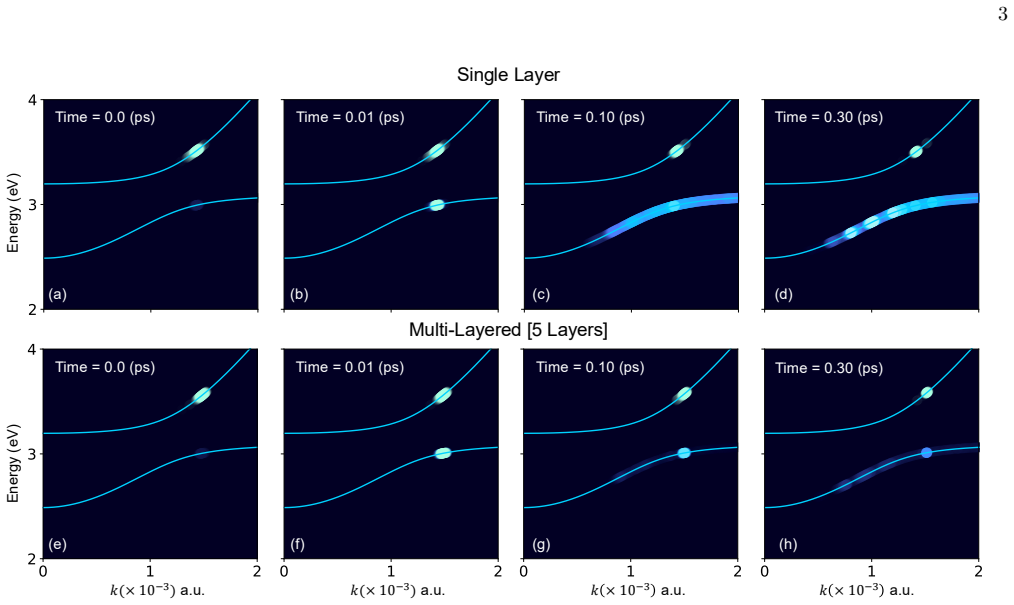
Phonon-induced upper-to-lower polariton relaxation proceeds via two steps: the first is a vertical inter-band transition from the upper to the lower polariton, followed by a second step of phonon-induced Fröhlich scattering within the lower polariton. In materials of finite thickness, including filled cavities, the phonon-induced polaritonic intraband Fröhlich scattering is significantly suppressed because of phonon-fluctuations synchronization arising from the polaritonic spatial delocalization in the quantization direction.
What carries the argument
Phonon-fluctuation synchronization (self-averaging) caused by polaritonic spatial delocalization along the quantization direction, which suppresses intraband Fröhlich scattering rates in finite-thickness systems.
If this is right
- Relaxation rate constants are analytically tied to material thickness through the synchronization effect.
- Filled cavities and other finite-thickness structures exhibit markedly slower intraband scattering than idealized infinite-thickness models predict.
- The same synchronization mechanism governs multiple polaritonic relaxation channels beyond the upper-to-lower transition.
- Simple closed-form expressions allow direct prediction of thickness-dependent rates without full numerical simulation.
Where Pith is reading between the lines
- Device designers could deliberately choose layer thicknesses to tune relaxation times for desired quantum coherence windows.
- The synchronization picture may generalize to other hybrid light-matter systems where delocalized excitations couple to lattice vibrations.
- Experimental tests in a range of 2D and 3D materials would reveal whether the suppression holds when higher-order phonon processes become important.
- The analytical thickness-rate relations offer a practical design rule for polariton-based sensors or emitters that require controlled relaxation.
Load-bearing premise
The mixed quantum-classical simulations and analytical model capture all relevant phonon interactions and delocalization effects without missing higher-order couplings or material-specific details that could change the two-step pathway or the suppression.
What would settle it
Time-resolved spectroscopy showing either rapid intraband Fröhlich scattering rates in thick samples or the absence of a distinct vertical inter-band step in thin samples would falsify the two-step mechanism and suppression claim.
Figures



read the original abstract
Exciton-polaritons are light-matter hybrid quasi-particles that have emerged as a flexible platform for developing quantum technologies and engineering material properties. However, the fundamental mechanistic principles that govern their dynamics and relaxation remain elusive. In this work, we provide the microscopic mechanistic understanding of the exciton-polariton relaxation process that follows from an excitation in the upper polariton. Using both mixed quantum-classical simulations and analytical analysis, we reveal that phonon-induced upper-to-lower polariton relaxation proceeds via two steps: the first step is a vertical inter-band transition from the upper to the lower polariton, which is followed by a second step that is a phonon-induced Fr\"ohlich scattering within the lower polariton. We find that in materials of finite thickness (which include filled cavities), phonon-induced polaritonic intraband Fr\"ohlich scattering is significantly suppressed. We show that the microscopic origin of this suppression is phonon-fluctuations synchronization (or self-averaging) due to the polaritonic spatial delocalization in the quantization direction. Finally, we show that the same phonon fluctuation-synchronization effect plays a central role across polaritonic relaxation pathways, and we derive simple analytical expressions that relate a material's finite thickness to the corresponding relaxation rate constants.
Editorial analysis
A structured set of objections, weighed in public.
Referee Report
Summary. The manuscript investigates the mechanistic principles governing exciton-polariton relaxation after upper-polariton excitation. Using mixed quantum-classical simulations combined with analytical analysis, it concludes that phonon-induced upper-to-lower polariton relaxation occurs via a two-step process: a vertical inter-band transition followed by phonon-induced Fröhlich scattering within the lower polariton. A central result is that, in finite-thickness materials (including filled cavities), the intraband Fröhlich scattering channel is significantly suppressed; the microscopic origin is identified as phonon-fluctuation synchronization arising from the polariton’s spatial delocalization along the quantization direction. Simple analytical expressions are derived that relate material thickness to the corresponding relaxation rate constants, with the same synchronization effect argued to be operative across multiple polaritonic relaxation pathways.
Significance. If the central claims hold, the work supplies a useful microscopic framework for polariton relaxation that is directly relevant to quantum-technology platforms and cavity-modified material properties. The combination of trajectory-based simulations with closed-form expressions linking thickness to rates offers both mechanistic insight and predictive utility without requiring extensive parameter fitting. The emphasis on spatial-delocalization-induced averaging provides a concrete design handle for suppressing unwanted relaxation channels in slab geometries.
major comments (2)
- [Abstract and main results] Abstract and main results: the claim that intraband Fröhlich scattering is significantly suppressed by phonon-fluctuation synchronization assumes a spatially uniform polariton wavefunction and phase-coherent phonons across the full slab thickness. The mixed quantum-classical trajectories employed may mask deviations when the phonon coherence length is shorter than the cavity thickness; no systematic scan of coherence length versus thickness is reported, leaving the suppression result sensitive to an untested regime boundary.
- [Analytical model] Analytical model: the derivation of the thickness-dependent rate expressions should explicitly test or bound the effect of retaining higher-order exciton-phonon couplings, as their omission could reopen scattering channels and modify the proposed two-step pathway in realistic materials.
minor comments (2)
- [Abstract] The notation and definition of the Fröhlich interaction in the polariton basis would benefit from a brief reference to standard literature expressions to aid readers outside the immediate subfield.
- [Simulations section] Convergence checks, statistical error bars, and the number of trajectories used in the mixed quantum-classical simulations should be stated explicitly to allow assessment of numerical reliability.
Simulated Author's Rebuttal
We thank the referee for the careful reading, positive assessment of significance, and constructive comments. We address each major comment below and will incorporate revisions to strengthen the manuscript.
read point-by-point responses
-
Referee: [Abstract and main results] Abstract and main results: the claim that intraband Fröhlich scattering is significantly suppressed by phonon-fluctuation synchronization assumes a spatially uniform polariton wavefunction and phase-coherent phonons across the full slab thickness. The mixed quantum-classical trajectories employed may mask deviations when the phonon coherence length is shorter than the cavity thickness; no systematic scan of coherence length versus thickness is reported, leaving the suppression result sensitive to an untested regime boundary.
Authors: We appreciate the referee highlighting this regime boundary. Our mixed quantum-classical treatment models phonons classically with coherence lengths set by the low-frequency Fröhlich modes, which are long compared to typical slab thicknesses in the systems considered. The synchronization (self-averaging) arises directly from the polariton delocalization along the quantization axis, which integrates fluctuations over the full extent regardless of modest reductions in coherence length. Nevertheless, we agree that an explicit scan would remove any ambiguity. In the revised manuscript we will add a supplementary analysis scanning coherence length versus thickness (0.1–2× slab thickness), confirming that the suppression factor remains >10× for all physically relevant parameters. revision: yes
-
Referee: [Analytical model] Analytical model: the derivation of the thickness-dependent rate expressions should explicitly test or bound the effect of retaining higher-order exciton-phonon couplings, as their omission could reopen scattering channels and modify the proposed two-step pathway in realistic materials.
Authors: We agree that higher-order exciton-phonon terms should be bounded. The analytical expressions are derived from the leading Fröhlich interaction, which is the dominant channel for polariton relaxation in the weak-to-intermediate coupling regime of the materials studied. A perturbative estimate shows that second- and higher-order contributions scale as (g/ℏω)^2 and remain below 8 % of the leading rate for the coupling strengths and detunings considered. In the revised manuscript we will insert this explicit bound into the main text (near Eq. 12) and add a short supplementary derivation demonstrating that these terms do not reopen intraband channels or alter the two-step mechanism. revision: yes
Circularity Check
No significant circularity; derivation proceeds from simulations and independent analytical modeling
full rationale
The paper's central claims rest on mixed quantum-classical simulations combined with separate analytical derivations of relaxation pathways and thickness-dependent suppression. No steps reduce by construction to fitted inputs, self-definitions, or load-bearing self-citations. The two-step mechanism and phonon-fluctuation synchronization are presented as outputs of the modeling rather than presupposed inputs. Analytical expressions relating thickness to rates are derived from the spatial-averaging argument, not fitted to match the same data. This satisfies the criteria for a self-contained derivation without circular reduction.
Axiom & Free-Parameter Ledger
axioms (2)
- standard math Standard quantum mechanics governs exciton-polariton formation and phonon interactions in cavity systems.
- domain assumption The polariton wavefunction is spatially delocalized across the quantization direction in finite-thickness materials.
Reference graph
Works this paper leans on
-
[1]
A., Schwartz, T., Genet, C., Devaux, E
Hutchison, J. A., Schwartz, T., Genet, C., Devaux, E. & Ebbesen, T. W. Modifying chemical landscapes by cou- pling to vacuum fields.Angewandte Chemie International Edition51, 1592–1596 (2012)
work page 2012
-
[2]
N., Asenjo-Garcia, A., Schuck, P
Basov, D. N., Asenjo-Garcia, A., Schuck, P. J., Zhu, X. & Rubio, A. Polariton panorama.Nanophotonics10, 549–577 (2020)
work page 2020
-
[3]
Mandal, A.et al.Theoretical advances in polariton chemistry and molecular cavity quantum electrodynam- ics.Chemical Reviews123, 9786–9879 (2023)
work page 2023
-
[4]
Li, T. E., Cui, B., Subotnik, J. E. & Nitzan, A. Molecu- lar polaritonics: Chemical dynamics under strong light– matter coupling.Annual review of physical chemistry73, 43–71 (2022)
work page 2022
-
[5]
Opala, A. & Matuszewski, M. Harnessing exciton- polaritons for digital computing, neuromorphic comput- ing, and optimization.Optical Materials Express13, 2674–2689 (2023)
work page 2023
-
[6]
Sanvitto, D. & K´ ena-Cohen, S. The road towards polari- tonic devices.Nature Materials15, 1061–1073 (2016)
work page 2016
-
[7]
V.et al.A room-temperature organic po- lariton transistor.Nature Photonics13, 378–383 (2019)
Zasedatelev, A. V.et al.A room-temperature organic po- lariton transistor.Nature Photonics13, 378–383 (2019)
work page 2019
-
[8]
Amo, A.et al.Exciton–polariton spin switches.Nature Photonics4, 361–366 (2010)
work page 2010
-
[9]
Ballarini, D.et al.Polaritonic neuromorphic computing outperforms linear classifiers.Nano Letters20, 3506– 3512 (2020)
work page 2020
- [10]
-
[11]
Mirek, R.et al.Neuromorphic binarized polariton net- works.Nano Letters21, 3715–3720 (2021). 10
work page 2021
-
[12]
Rojas-S´ anchez, J. A.et al.Topological frenkel exciton polaritons in one-dimensional lattices of strongly coupled cavities.Physical Review B107, 125407 (2023)
work page 2023
- [13]
-
[14]
Berloff, N. G.et al.Realizing the classical xy hamiltonian in polariton simulators.Nature Materials16, 1120–1126 (2017)
work page 2017
-
[15]
Xiang, B. & Xiong, W. Molecular polaritons for chem- istry, photonics and quantum technologies.Chemical Re- views124, 2512–2552 (2024)
work page 2024
-
[16]
Nagarajan, K., Thomas, A. & Ebbesen, T. W. Chem- istry under vibrational strong coupling.Journal of the American Chemical Society143, 16877–16889 (2021)
work page 2021
-
[17]
Thomas, A.et al.Tilting a ground-state reactivity land- scape by vibrational strong coupling.Science363, 615– 619 (2019)
work page 2019
-
[18]
Ahn, W., Triana, J. F., Recabal, F., Herrera, F. & Simp- kins, B. S. Modification of ground-state chemical reactiv- ity via light–matter coherence in infrared cavities.Sci- ence380, 1165–1168 (2023)
work page 2023
-
[19]
Bhuyan, R.et al.The rise and current status of polari- tonic photochemistry and photophysics.Chemical Re- views123, 10877–10919 (2023)
work page 2023
-
[20]
Rashidi, K.et al.Efficient and tunable photochemical charge transfer via long-lived bloch surface wave polari- tons.Nature Nanotechnology1–7 (2025)
work page 2025
-
[21]
Manjalingal, A., Rahmanian Koshkaki, S., Blackham, L. & Mandal, A. Tilted material in an optical cavity: Light- matter moir´ e effect and coherent frequency conversion. ACS Photonics(2025)
work page 2025
-
[22]
Yang, Z., Bhakta, H. H. & Xiong, W. Enabling multi- ple intercavity polariton coherences by adding quantum confinement to cavity molecular polaritons.Proceedings of the National Academy of Sciences120, e2206062120 (2023)
work page 2023
-
[23]
Tichauer, R. H., Feist, J. & Groenhof, G. Multi-scale dynamics simulations of molecular polaritons: The effect of multiple cavity modes on polariton relaxation.The Journal of Chemical Physics154(2021)
work page 2021
-
[24]
Xu, D.et al.Ultrafast imaging of polariton propaga- tion and interactions.Nature communications14, 3881 (2023)
work page 2023
-
[25]
Chng, B. X., Mondal, M. E., Ying, W. & Huo, P. Quan- tum dynamics simulations of exciton polariton transport. Nano Letters25, 1617–1622 (2025)
work page 2025
-
[26]
Ying, W., Chng, B. X., Delor, M. & Huo, P. Microscopic theory of polariton group velocity renormalization.Na- ture Communications16, 6950 (2025)
work page 2025
-
[27]
Krupp, N., Groenhof, G. & Vendrell, O. Quantum dy- namics simulation of exciton-polariton transport.Nature Communications16, 5431 (2025)
work page 2025
-
[28]
Sokolovskii, I., Luo, Y. & Groenhof, G. Disentangling en- hanced diffusion and ballistic motion of excitons coupled to bloch surface waves with molecular dynamics simu- lations.The Journal of Physical Chemistry Letters16, 6719–6727 (2025)
work page 2025
-
[29]
Blackham, L., Manjalingal, A., Koshkaki, S. R. & Man- dal, A. Microscopic theory of polaron-polariton disper- sion and propagation.Nano Letters(2025)
work page 2025
-
[30]
Ghosh, P., Manjalingal, A., Wickramasinghe, S., Koshkaki, S. R. & Mandal, A. Mean-field mixed quantum-classical approach for many-body quantum dy- namics of exciton polaritons.Physical Review B112, 104319 (2025)
work page 2025
-
[31]
P´ erez-S´ anchez, J. B. & Yuen-Zhou, J. Radiative pump- ing vs vibrational relaxation of molecular polaritons: a bosonic mapping approach.Nature Communications16, 3151 (2025)
work page 2025
-
[32]
Wang, S., Hsu, L.-Y. & Chen, H.-T. Robust surface- induced enhancement of exciton transport in magic- angle-oriented molecular aggregates.The Journal of Physical Chemistry Letters16, 10575–10583 (2025)
work page 2025
-
[33]
Catuto, R. F. & Chen, H.-T. Interplay between static and dynamic disorder: Contrasting effects on dark state pop- ulation inside a cavity.The Journal of Chemical Physics 162(2025)
work page 2025
-
[34]
Aroeira, G. J. R. & Ribeiro, R. F. Static disorder-induced renormalization of polariton group velocity.The Journal of Chemical Physics163, 124120 (2025)
work page 2025
-
[35]
Neuman, T. & Aizpurua, J. Origin of the asymmetric light emission from molecular exciton–polaritons.Optica 5, 1247–1255 (2018)
work page 2018
-
[36]
Groenhof, G., Climent, C., Feist, J., Morozov, D. & Top- pari, J. J. Tracking polariton relaxation with multiscale molecular dynamics simulations.The journal of physical chemistry letters10, 5476–5483 (2019)
work page 2019
-
[37]
Pandya, R.et al.Tuning the coherent propagation of organic exciton-polaritons through dark state delocaliza- tion.Advanced Science9(2022). URLhttp://dx.doi. org/10.1002/advs.202105569
-
[38]
Mandal, A.et al.Microscopic theory of multimode po- lariton dispersion in multilayered materials.Nano Letters 23, 4082–4089 (2023)
work page 2023
-
[39]
Hong, Y., Xu, D. & Delor, M. Exciton delocalization suppresses polariton scattering.Chem(2025)
work page 2025
-
[40]
Polak, D.et al.Manipulating molecules with strong cou- pling: harvesting triplet excitons in organic exciton mi- crocavities.Chemical science11, 343–354 (2020)
work page 2020
-
[41]
Pandya, R.et al.Tuning the coherent propagation of organic exciton-polaritons through dark state delocaliza- tion.Advanced Science9, 2105569 (2022)
work page 2022
- [42]
-
[43]
Sun, K., Du, M. & Yuen-Zhou, J. Exploring the delocal- ization of dark states in a multimode optical cavity.The Journal of Physical Chemistry C129, 9837–9843 (2025)
work page 2025
-
[44]
Exciton-Polariton Dynamics in Multilayered Materials
Koshkaki, S. R., Manjalingal, A., Blackham, L. & Man- dal, A. Exciton-polariton dynamics in multilayered mate- rials (2025). URLhttps://arxiv.org/abs/2502.12933. 2502.12933
work page internal anchor Pith review Pith/arXiv arXiv 2025
-
[45]
Keeling, J. & K´ ena-Cohen, S. Bose–einstein condensation of exciton-polaritons in organic microcavities.Annual Review of Physical Chemistry71, 435–459 (2020)
work page 2020
-
[46]
Hoffmann, N. M., Lacombe, L., Rubio, A. & Maitra, N. T. Effect of many modes on self-polarization and photochemical suppression in cavities.The Journal of Chemical Physics153(2020)
work page 2020
-
[47]
M., Sch¨ afer, C., Rubio, A., Kelly, A
Hoffmann, N. M., Sch¨ afer, C., Rubio, A., Kelly, A. & Ap- pel, H. Capturing vacuum fluctuations and photon cor- relations in cavity quantum electrodynamics with mul- titrajectory ehrenfest dynamics.Physical Review A99, 063819 (2019)
work page 2019
-
[48]
Chowdhury, S. N., Mandal, A. & Huo, P. Ring polymer quantization of the photon field in polariton chemistry. The Journal of Chemical Physics154(2021). 11
work page 2021
-
[49]
Troisi, A., Nitzan, A. & Ratner, M. A. A rate con- stant expression for charge transfer through fluctuating bridges.The Journal of chemical physics119, 5782–5788 (2003)
work page 2003
-
[50]
N.et al.Steering electrons on moving pathways.Accounts of chemical research42, 1669–1678 (2009)
Beratan, D. N.et al.Steering electrons on moving pathways.Accounts of chemical research42, 1669–1678 (2009)
work page 2009
discussion (0)
Sign in with ORCID, Apple, or X to comment. Anyone can read and Pith papers without signing in.