Gravitational waves in metric-affine bumblebee gravity
Pith reviewed 2026-05-15 15:18 UTC · model grok-4.3
The pith
In metric-affine bumblebee gravity the graviton dispersion relation depends on the angle between the wave vector and the background vector.
A machine-rendered reading of the paper's core claim, the machinery that carries it, and where it could break.
Core claim
Working in the geometric-optics limit of the linearized theory, the authors obtain a modified wave operator whose dispersion relation for the graviton modes depends on the orientation of the wave vector relative to the constant background vector. Only two independent tensor polarizations propagate for both timelike and spacelike configurations, although their propagation speeds and polarization tensors differ. The retarded Green function constructed from this operator yields an explicit radiation-zone waveform: a timelike background produces a speed-modified, amplitude-renormalized quadrupole signal evaluated at a shifted retarded time, whereas a spacelike background introduces anisotropicam
What carries the argument
The modified wave operator for metric perturbations linearized around a constant, uniform vacuum expectation value of the bumblebee vector field, from which the dispersion relation and retarded Green function are obtained.
If this is right
- Only two tensor modes propagate in both timelike and spacelike backgrounds.
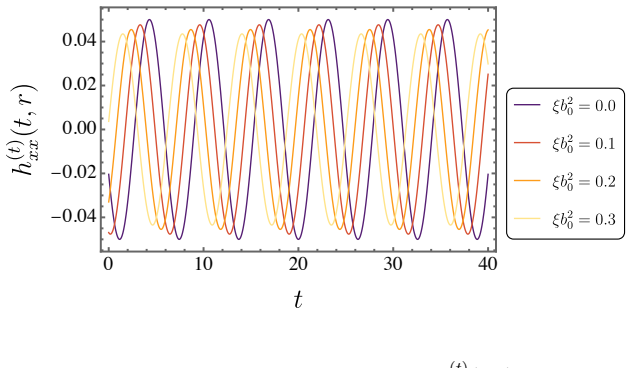
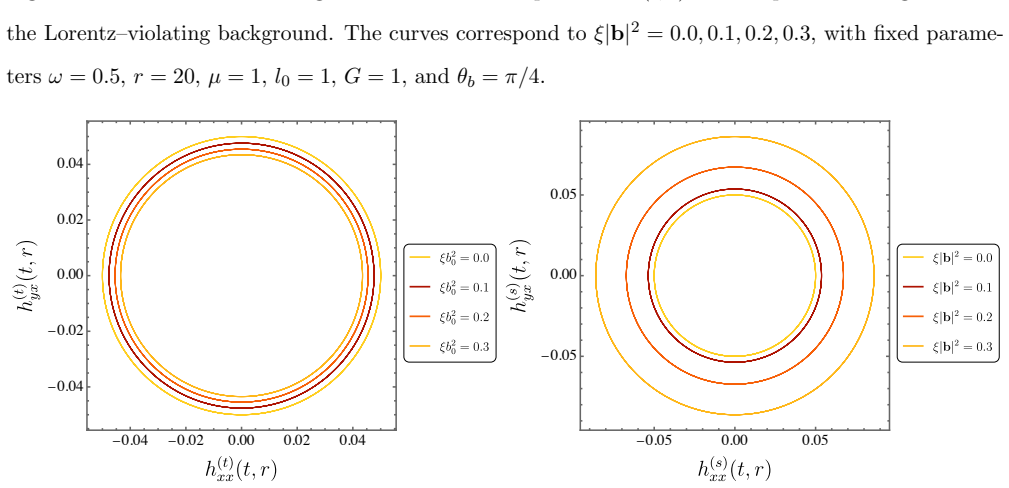
- Timelike backgrounds produce a uniform shift in propagation speed together with an overall amplitude renormalization while preserving the quadrupole structure of the waveform.
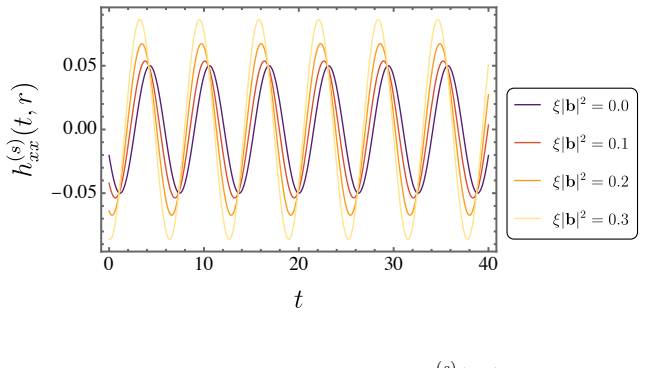
- Spacelike backgrounds generate anisotropic corrections to the quadrupole amplitude plus an additional radiation term proportional to the third time derivative of the quadrupole moment.
- The Lorentz-violating parameter combination ξ b^{2} can be bounded using multimessenger data from events such as GW170817 together with waveform consistency requirements from gravitational-wave detectors.
Where Pith is reading between the lines
- Arrival-time differences between gravitational waves and electromagnetic signals could become direction-dependent, offering an additional observable for multimessenger events.
- Parameter estimation pipelines for binary mergers may need to include the extra third-derivative term to avoid systematic biases when the background vector is spacelike.
- Similar orientation-dependent effects on wave propagation are likely to appear in other vector-tensor models that realize spontaneous Lorentz breaking through a constant vector background.
Load-bearing premise
The geometric-optics limit of the linearized equations around a uniform constant vacuum expectation value of the bumblebee field remains valid for the wavelengths and source strengths of astrophysical gravitational-wave events.
What would settle it
A directional dependence in the measured propagation speed of gravitational waves from a single source, or the presence of a waveform component proportional to the third time derivative of the quadrupole moment, that cannot be reproduced by standard general-relativistic waveforms or instrumental effects.
Figures
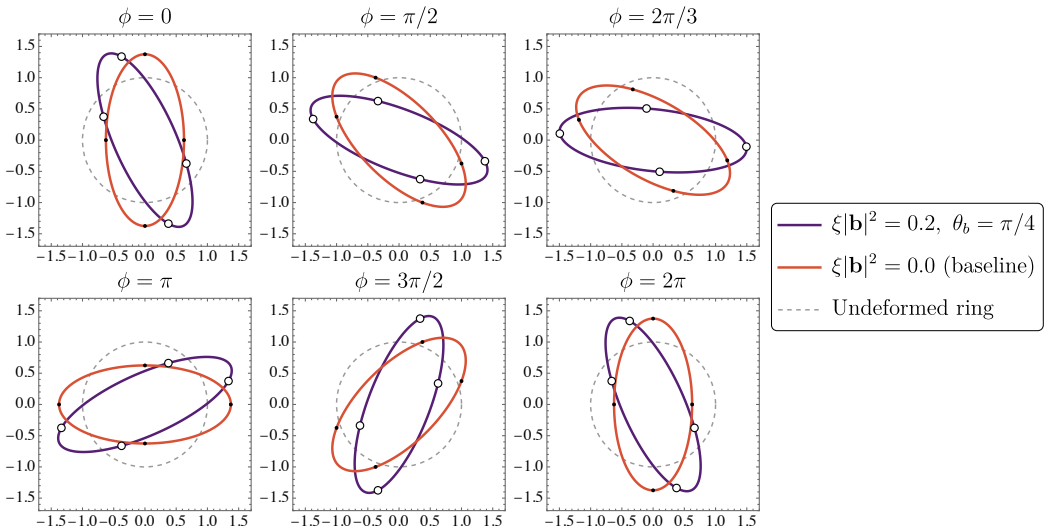
read the original abstract
We study the propagation and emission of gravitational waves in the metric-affine formulation of the bumblebee model, where spontaneous Lorentz symmetry breaking arises from a vector field acquiring a nonvanishing vacuum expectation value. Working in the geometric-optics limit of the linearized theory, we derive the modified dispersion relation governing the graviton modes and show that it depends on the orientation of the wave vector relative to the background vector. The polarization sector is examined for timelike and spacelike configurations of the Lorentz-violating vacuum. In both cases only two independent tensor modes propagate, although their propagation properties and tensor structure depend on the orientation of the background field. We then construct the retarded Green function associated with the modified wave operator and determine the radiation-zone produced by localized sources. In the timelike configuration the Lorentz-violating effects appear through a modified propagation speed and an overall amplitude renormalization, leading to a shifted retarded time while preserving the quadrupole structure of the waveform. In contrast, the spacelike sector introduces anisotropic corrections to the quadrupole amplitude together with an additional contribution proportional to the third time derivative of the quadrupole moment. As an astrophysical application, the gravitational radiation emitted by a circular binary black hole system is evaluated, allowing observational constraints on the Lorentz-violating combination $\xi b^{2}$ to be estimated using multimessenger bounds from GW170817/GRB~170817A and waveform consistency requirements from gravitational wave observations.
Editorial analysis
A structured set of objections, weighed in public.
Referee Report
Summary. The paper examines gravitational wave propagation and emission in the metric-affine bumblebee model with spontaneous Lorentz symmetry breaking from a vector field acquiring a nonzero vacuum expectation value. Working in the geometric-optics limit of the linearized theory, it derives a modified dispersion relation for graviton modes that depends on the wave-vector orientation relative to the background vector, analyzes the polarization structure for timelike and spacelike configurations (finding only two propagating tensor modes in each case), constructs the associated retarded Green function, and obtains the radiation-zone waveform. Timelike backgrounds yield a modified propagation speed and amplitude renormalization while preserving quadrupole structure; spacelike backgrounds introduce anisotropic quadrupole corrections plus a term proportional to the third time derivative of the quadrupole moment. The framework is applied to a circular binary black-hole system to estimate constraints on the Lorentz-violating parameter combination ξb² from GW170817/GRB 170817A multimessenger bounds and waveform consistency.
Significance. If the central derivations are valid, the work supplies an explicit, orientation-dependent waveform template for Lorentz-violating effects in a metric-affine setting, distinguishing timelike versus spacelike vacuum alignments and linking them to observable modifications in propagation speed, amplitude, and higher-derivative terms. This could enable targeted multimessenger tests of spontaneous Lorentz violation beyond the standard model, particularly if the geometric-optics construction can be shown to apply to realistic astrophysical sources.
major comments (1)
- [Astrophysical application (final section)] The astrophysical application to circular binary black holes assumes the geometric-optics (eikonal) limit remains valid when the orbital wavelength is set by the source frequency. No explicit check is provided that this wavelength is parametrically shorter than both the curvature radius of the binary and any gradient scale induced by the background bumblebee vector, which is required to justify passing from the local plane-wave dispersion relation to the global retarded integral used for the waveform.
minor comments (1)
- The abstract and introduction would benefit from a brief, explicit statement of the metric-affine action before linearization, including the precise definition of the coupling ξ, to allow readers to trace the origin of the modified wave operator without external references.
Simulated Author's Rebuttal
We thank the referee for the careful reading and constructive comment on our manuscript. The point raised about the validity of the geometric-optics limit in the astrophysical application is well taken, and we address it directly below. We will revise the manuscript to incorporate an explicit justification and check.
read point-by-point responses
-
Referee: The astrophysical application to circular binary black holes assumes the geometric-optics (eikonal) limit remains valid when the orbital wavelength is set by the source frequency. No explicit check is provided that this wavelength is parametrically shorter than both the curvature radius of the binary and any gradient scale induced by the background bumblebee vector, which is required to justify passing from the local plane-wave dispersion relation to the global retarded integral used for the waveform.
Authors: We agree that an explicit check strengthens the presentation. In our setup the bumblebee vector acquires a constant vacuum expectation value, so its covariant derivatives vanish identically and no intrinsic gradient scale exists. The only relevant scale is therefore the curvature radius set by the binary orbit. In the quadrupole regime we employ, the orbital wavelength λ = 2πc/Ω satisfies λ ≪ r (where r is the orbital separation) precisely when the slow-motion condition v = Ωr ≪ c holds—the same hierarchy already assumed for the validity of the quadrupole formula itself. For the GW170817-like parameters used in our estimates, this inequality is satisfied by several orders of magnitude throughout the inspiral. We will add a concise paragraph in the astrophysical-application section stating these facts, confirming that the background is uniform, and verifying the parametric separation for the frequencies and distances considered. This justifies the use of the local dispersion relation inside the retarded integral. revision: yes
Circularity Check
Minor self-citation present but derivation remains independent of fitted inputs
full rationale
The paper begins from the metric-affine bumblebee action, performs linearization around a constant uniform VEV, and derives the modified dispersion relation and retarded Green function in the geometric-optics limit using standard eikonal methods. No load-bearing equation reduces tautologically to a fitted parameter or to a self-citation chain; the central claims about timelike/spacelike configurations and quadrupole modifications follow directly from the wave operator without circular redefinition. Any self-citations are peripheral and do not justify uniqueness or ansatz choices.
Axiom & Free-Parameter Ledger
free parameters (1)
- ξb²
axioms (1)
- domain assumption Linearized metric-affine gravity around a flat background with constant uniform bumblebee vev
invented entities (1)
-
Bumblebee vector field
no independent evidence
Lean theorems connected to this paper
-
IndisputableMonolith/Foundation/RealityFromDistinction.leanreality_from_one_distinction contradicts?
contradictsCONTRADICTS: the theorem conflicts with this paper passage, or marks a claim that would need revision before publication.
k² − ξ[(b·k)² − ½b²k²] = 0 ... ω² = v_t² |k|² with v_t² = (1 + ξb₀²/2)/(1 − ξb₀²/2)
What do these tags mean?
- matches
- The paper's claim is directly supported by a theorem in the formal canon.
- supports
- The theorem supports part of the paper's argument, but the paper may add assumptions or extra steps.
- extends
- The paper goes beyond the formal theorem; the theorem is a base layer rather than the whole result.
- uses
- The paper appears to rely on the theorem as machinery.
- contradicts
- The paper's claim conflicts with a theorem or certificate in the canon.
- unclear
- Pith found a possible connection, but the passage is too broad, indirect, or ambiguous to say the theorem truly supports the claim.
Reference graph
Works this paper leans on
-
[1]
Timelike background 22
-
[2]
Strain–based bounds from waveform consistency 23
Spacelike background parallel to propagation 23 B. Strain–based bounds from waveform consistency 23
-
[3]
Choice of tolerances from observational systematics 23
-
[4]
Bound from amplitude modulation 24
-
[5]
Bound from the absence of a dominant ... I ij contribution 24 VIII. Conclusions25 IX. Acknowledgments26 X. Data Availability Statement27 References 27 2 I. INTRODUCTION Investigations into the possible breakdown of Lorentz symmetry have attracted sustained atten- tion in theoretical physics. One of the first motivations arose in string-motivated settings,...
-
[6]
[57] A conservative symmetric bound is therefore vg −c c ≲3×10 −15 ⇒ |ξ|b 2 0 ≲6×10 −15.(68)
Timelike background Forb µ = (b0,0,0,0) the tensor modes propagate withω 2 =v 2 t |k|2 and, for|ξb 2 0| ≪1, one may parameterize vt ≃1 + ξ 2 b 2 0 =⇒ vt −c c ≃ ξ 2 b 2 0 .(67) The joint detection of GW170817 and GRB 170817A constrains the difference between the speed of gravity and the speed of light to lie in the interval−3×10 −15 ≲(v g −c)/c≲7×10 −16, a...
-
[7]
Spacelike background parallel to propagation Forb µ = (0,0,0, b 3) with propagation along thezaxis, the dispersion relation again takes the formω 2 =v 2 s |k|2 and yields the same linearized mapping|(v s −c)/c| ≃ |ξ|b 2 3/2 in the perturbative regime. Hence the multimessenger bound implies |ξ|b 2 3 ≲6×10 −15 (spacelike background aligned with propagation)...
-
[8]
Choice of tolerances from observational systematics Two observationally motivated tolerance scales may be identified. A first one is adetection- limitedtolerance of order 1/ρ, whereρdenotes the network matched-filter signal-to-noise ratio (SNR). For GW170817 the reported network value isρ≃32.4 [58], implying 1/ρ≃3×10 −2. A second relevant scale is associa...
-
[9]
Bound from amplitude modulation If the quadrupole term is rescaled by a direction-dependent factor, the leading contribution may be written as h(2) ij (t, r) = 2G r 1 +δA(θ b) ¨Iij(tr), t r =t−r.(71) In the present spacelike sector, the explicit radiation–zone waveform shows that the quadrupole piece carries an isotropicO(ξ|b| 2) renormalization together ...
-
[10]
Bound from the absence of a dominant ... I ij contribution The additional higher–derivative term in the spacelike waveform is read directly from the radiation–zone expression, δB(θ b) = ξ(b·r) 2 2r = ξ|b|2r 2 cos2 θb.(76) 24 For a quasi–monochromatic signal at characteristic angular frequencyω≃2πf, one expects| ... I ij| ∼ ω| ¨Iij|. The ratio between the ...
work page 2025
-
[11]
Phenomenological Gravitational Constraints on Strings and Higher Dimensional Theories,
V. A. Kostelecky and S. Samuel, “Phenomenological Gravitational Constraints on Strings and Higher Dimensional Theories,”Phys. Rev. Lett., vol. 63, p. 224, 1989
work page 1989
-
[12]
Gravitational Phenomenology in Higher Dimensional Theories and Strings,
V. A. Kostelecky and S. Samuel, “Gravitational Phenomenology in Higher Dimensional Theories and Strings,”Phys. Rev. D, vol. 40, pp. 1886–1903, 1989
work page 1903
-
[13]
V. A. Kostelecky and R. Potting, “CPT and strings,”Nucl. Phys. B, vol. 359, pp. 545–570, 1991
work page 1991
-
[14]
CPT, strings, and meson factories,
V. A. Kostelecky and R. Potting, “CPT, strings, and meson factories,”Phys. Rev. D, vol. 51, pp. 3923–3935, 1995
work page 1995
-
[15]
Dirac-Born-Infeld action from spontaneous breakdown of Lorentz symmetry in brane- world scenarios,
F. Gliozzi, “Dirac-Born-Infeld action from spontaneous breakdown of Lorentz symmetry in brane- world scenarios,”Phys. Rev. D, vol. 84, p. 027702, 2011
work page 2011
-
[16]
Nonstandard optics from quantum space-time,
R. Gambini and J. Pullin, “Nonstandard optics from quantum space-time,”Phys. Rev. D, vol. 59, p. 124021, 1999
work page 1999
-
[17]
Lorentz violations in multifractal spacetimes,
G. Calcagni, “Lorentz violations in multifractal spacetimes,”Eur. Phys. J. C, vol. 77, no. 5, p. 291, 2017
work page 2017
-
[18]
On loop quantum gravity phenomenology and the issue of Lorentz invariance,
M. Bojowald, H. A. Morales-Tecotl, and H. Sahlmann, “On loop quantum gravity phenomenology and the issue of Lorentz invariance,”Phys. Rev. D, vol. 71, p. 084012, 2005
work page 2005
-
[19]
Quantum gravity and Lorentz invariance deformation in the standard model,
J. Alfaro, “Quantum gravity and Lorentz invariance deformation in the standard model,”Phys. Rev. Lett., vol. 94, p. 221302, 2005
work page 2005
-
[20]
A Phenomenological description of quantum gravity induced space-time noise,
G. Amelino-Camelia, “A Phenomenological description of quantum gravity induced space-time noise,”Nature, vol. 410, pp. 1065–1067, 2001
work page 2001
-
[21]
CPT violation and the standard model,
D. Colladay and V. A. Kostelecky, “CPT violation and the standard model,”Phys. Rev. D, vol. 55, pp. 6760–6774, 1997
work page 1997
-
[22]
Lorentz violating extension of the standard model,
D. Colladay and V. A. Kostelecky, “Lorentz violating extension of the standard model,”Phys. Rev. D, vol. 58, p. 116002, 1998
work page 1998
-
[23]
Gravity, Lorentz violation, and the standard model,
V. A. Kostelecky, “Gravity, Lorentz violation, and the standard model,”Phys. Rev. D, vol. 69, p. 105009, 2004. 27
work page 2004
-
[24]
Gravity with a dynamical preferred frame,
T. Jacobson and D. Mattingly, “Gravity with a dynamical preferred frame,”Phys. Rev. D, vol. 64, p. 024028, 2001
work page 2001
-
[25]
Chern-Simons modification of general relativity,
R. Jackiw and S. Y. Pi, “Chern-Simons modification of general relativity,”Phys. Rev. D, vol. 68, p. 104012, 2003
work page 2003
-
[26]
Generalized bumblebee models and Lorentz-violating electrodynamics,
M. D. Seifert, “Generalized bumblebee models and Lorentz-violating electrodynamics,”Phys. Rev. D, vol. 81, p. 065010, 2010
work page 2010
-
[27]
Exact Schwarzschild-like solution in a bumblebee gravity model,
R. Casana, A. Cavalcante, F. P. Poulis, and E. B. Santos, “Exact Schwarzschild-like solution in a bumblebee gravity model,”Phys. Rev. D, vol. 97, no. 10, p. 104001, 2018
work page 2018
-
[28]
Influence of a Kalb-Ramond black hole on neutrino behavior,
Y. Shi and A. A. Ara´ ujo Filho, “Influence of a Kalb-Ramond black hole on neutrino behavior,” JHEP, vol. 08, p. 028, 2025
work page 2025
-
[29]
Effects of bumblebee gravity on neutrino motion,
Y. Shi and A. A. Ara´ ujo Filho, “Effects of bumblebee gravity on neutrino motion,”JCAP, vol. 11, p. 045, 2025
work page 2025
-
[30]
Exact traversable wormhole solution in bumblebee gravity,
A. ¨Ovg¨ un, K. Jusufi, and˙I. Sakallı, “Exact traversable wormhole solution in bumblebee gravity,” Phys. Rev. D, vol. 99, no. 2, p. 024042, 2019
work page 2019
-
[31]
Modified particle dynamics and thermodynamics in a traversable wormhole in bumblebee gravity,
A. A. Ara´ ujo Filho, J. A. A. S. Reis, and A.¨Ovg¨ un, “Modified particle dynamics and thermodynamics in a traversable wormhole in bumblebee gravity,”Eur. Phys. J. C, vol. 85, no. 1, p. 83, 2025
work page 2025
-
[32]
Gravitational waves effects in a Lorentz–violating scenario,
K. M. Amarilo, M. B. F. Filho, A. A. A. Filho, and J. A. A. S. Reis, “Gravitational waves effects in a Lorentz–violating scenario,”Phys. Lett. B, vol. 855, p. 138785, 2024
work page 2024
-
[33]
Black holes with a cosmological constant in bumblebee gravity,
R. V. Maluf and J. C. S. Neves, “Black holes with a cosmological constant in bumblebee gravity,” Phys. Rev. D, vol. 103, no. 4, p. 044002, 2021
work page 2021
-
[34]
Einstein-Hilbert graviton modes modified by the Lorentz-violating bumblebee Field,
R. V. Maluf, C. A. S. Almeida, R. Casana, and M. M. Ferreira, Jr., “Einstein-Hilbert graviton modes modified by the Lorentz-violating bumblebee Field,”Phys. Rev. D, vol. 90, no. 2, p. 025007, 2014
work page 2014
-
[35]
Constraints on Nonmetricity from Bounds on Lorentz Violation,
J. Foster, V. A. Kosteleck´ y, and R. Xu, “Constraints on Nonmetricity from Bounds on Lorentz Violation,”Phys. Rev. D, vol. 95, no. 8, p. 084033, 2017
work page 2017
-
[36]
Riemann-Finsler geometry and Lorentz-violating kinematics,
A. Kostelecky, “Riemann-Finsler geometry and Lorentz-violating kinematics,”Phys. Lett. B, vol. 701, pp. 137–143, 2011
work page 2011
-
[37]
Metric-affine bumblebee gravity: classical aspects,
A. Delhom, J. R. Nascimento, G. J. Olmo, A. Y. Petrov, and P. J. Porf´ ırio, “Metric-affine bumblebee gravity: classical aspects,”Eur. Phys. J. C, vol. 81, no. 4, p. 287, 2021
work page 2021
-
[38]
Radiative corrections in metric-affine bumblebee model,
A. Delhom, J. R. Nascimento, G. J. Olmo, A. Y. Petrov, and P. J. Porf´ ırio, “Radiative corrections in metric-affine bumblebee model,”Phys. Lett. B, vol. 826, p. 136932, 2022
work page 2022
-
[39]
Born–Infeld inspired mod- ifications of gravity,
J. Beltran Jimenez, L. Heisenberg, G. J. Olmo, and D. Rubiera-Garcia, “Born–Infeld inspired mod- ifications of gravity,”Phys. Rept., vol. 727, pp. 1–129, 2018
work page 2018
-
[40]
Ricci-Based Gravity theories and their impact on Maxwell and nonlinear electromagnetic models,
A. Delhom, G. J. Olmo, and E. Orazi, “Ricci-Based Gravity theories and their impact on Maxwell and nonlinear electromagnetic models,”JHEP, vol. 11, p. 149, 2019. 28
work page 2019
-
[41]
Mapping Ricci-based theories of gravity into general relativity,
V. I. Afonso, G. J. Olmo, and D. Rubiera-Garcia, “Mapping Ricci-based theories of gravity into general relativity,”Phys. Rev. D, vol. 97, no. 2, p. 021503, 2018
work page 2018
-
[42]
Mapping nonlinear gravity into General Relativity with nonlinear electrodynamics,
V. I. Afonso, G. J. Olmo, E. Orazi, and D. Rubiera-Garcia, “Mapping nonlinear gravity into General Relativity with nonlinear electrodynamics,”Eur. Phys. J. C, vol. 78, no. 10, p. 866, 2018
work page 2018
-
[43]
Ghosts in metric-affine higher order curvature gravity,
J. Beltr´ an Jim´ enez and A. Delhom, “Ghosts in metric-affine higher order curvature gravity,”Eur. Phys. J. C, vol. 79, no. 8, p. 656, 2019
work page 2019
-
[44]
Vacuum solution within a metric-affine bumblebee gravity,
A. A. A. Filho, J. R. Nascimento, A. Y. Petrov, and P. J. Porf´ ırio, “Vacuum solution within a metric-affine bumblebee gravity,”Phys. Rev. D, vol. 108, no. 8, p. 085010, 2023
work page 2023
-
[45]
An exact stationary ax- isymmetric vacuum solution within a metric-affine bumblebee gravity,
A. A. Ara´ ujo Filho, J. R. Nascimento, A. Y. Petrov, and P. J. Porf´ ırio, “An exact stationary ax- isymmetric vacuum solution within a metric-affine bumblebee gravity,”JCAP, vol. 07, p. 004, 2024
work page 2024
-
[46]
S. K. Jha and A. Rahaman, “Quasinormal modes, and different aspects of Hawking radiation within the metric-affine bumblebee gravity framework,”Nucl. Phys. B, vol. 1002, p. 116536, 2024
work page 2024
-
[47]
How does non-metricity affect particle creation and evaporation in bumblebee gravity?,
A. A. Ara´ ujo Filho, “How does non-metricity affect particle creation and evaporation in bumblebee gravity?,”JCAP, vol. 06, p. 026, 2025. [Erratum: JCAP 02, E01 (2026)]
work page 2025
-
[48]
Scattering effects of bumblebee gravity in metric-affine formalism,
N. Heidari, C. F. B. Macedo, A. A. A. Filho, and H. Hassanabadi, “Scattering effects of bumblebee gravity in metric-affine formalism,”Eur. Phys. J. C, vol. 84, no. 11, p. 1221, 2024
work page 2024
-
[49]
The role of non-metricity on neutrino behavior in bumblebee gravity,
Y. Shi and A. A. Ara´ ujo Filho, “The role of non-metricity on neutrino behavior in bumblebee gravity,” 5 2025
work page 2025
-
[50]
G. Lambiase, L. Mastrototaro, R. C. Pantig, and A. Ovgun, “Probing Schwarzschild-like black holes in metric-affine bumblebee gravity with accretion disk, deflection angle, greybody bounds, and neu- trino propagation,”JCAP, vol. 12, p. 026, 2023
work page 2023
-
[51]
Gravitational lensing by a Lorentz-violating black hole,
A. A. A. Filho, J. R. Nascimento, A. Y. Petrov, and P. J. Porf´ ırio, “Gravitational lensing by a Lorentz-violating black hole,”Eur. Phys. J. Plus, vol. 140, no. 11, p. 1117, 2025
work page 2025
-
[52]
Lensing Fingerprints of Scalar Hair and Broken Symmetries via Three Semi-Analytical Methods,
A. ¨Ovg¨ un and R. C. Pantig, “Lensing Fingerprints of Scalar Hair and Broken Symmetries via Three Semi-Analytical Methods,” 7 2025
work page 2025
-
[53]
N¨ aherungsweise integration der feldgleichungen der gravitation,
A. Einstein, “N¨ aherungsweise integration der feldgleichungen der gravitation,”Sitzungsberichte der K¨ oniglich Preussischen Akademie der Wissenschaften Berlin, pp. 688–696, 1916
work page 1916
-
[54]
A. Einstein, “ ¨Uber gravitationswellen,”Sitzungsberichte der K¨ oniglich Preussischen Akademie der Wissenschaften Berlin, pp. 154–167, 1918
work page 1918
-
[55]
Gravitational radiation from point masses in a keplerian orbit,
P. C. Peters and J. Mathews, “Gravitational radiation from point masses in a keplerian orbit,”Phys. Rev., vol. 131, pp. 435–440, 1963
work page 1963
-
[56]
Observation of gravitational waves from a binary black hole merger,
B. P. e. a. Abbott, “Observation of gravitational waves from a binary black hole merger,”Phys. Rev. Lett., vol. 116, p. 061102, 2016
work page 2016
-
[57]
R. e. a. Abbott, “Gwtc-3: Compact binary coalescences observed by ligo and virgo during the second 29 part of the third observing run,”Phys. Rev. X, vol. 13, p. 041039, 2023
work page 2023
-
[58]
Testing general relativity with present and future astrophysical observations,
E. Bertiet al., “Testing general relativity with present and future astrophysical observations,”Class. Quant. Grav., vol. 32, p. 243001, 2015
work page 2015
-
[59]
Gravitational-wave tests of general relativity with ground-based detectors and pulsar timing arrays,
N. Yunes and X. Siemens, “Gravitational-wave tests of general relativity with ground-based detectors and pulsar timing arrays,”Living Rev. Rel., vol. 16, p. 9, 2013
work page 2013
-
[60]
Testing local lorentz invariance with gravitational waves,
V. A. Kostelecky and M. Mewes, “Testing local lorentz invariance with gravitational waves,”Phys. Lett. B, vol. 757, pp. 510–514, 2016
work page 2016
-
[61]
Lorentz and diffeomorphism violations in linearized gravity,
V. A. Kostelecky and M. Mewes, “Lorentz and diffeomorphism violations in linearized gravity,”Phys. Lett. B, vol. 779, pp. 136–142, 2018
work page 2018
-
[62]
Signals for lorentz violation in gravitational waves,
M. Mewes, “Signals for lorentz violation in gravitational waves,”Phys. Rev. D, vol. 99, p. 104062, 2019
work page 2019
-
[63]
Multi-messenger observations of a binary neutron star merger,
B. P. e. a. Abbott, “Multi-messenger observations of a binary neutron star merger,”Astrophys. J. Lett., vol. 848, p. L12, 2017
work page 2017
-
[64]
Gw170817: Observation of gravitational waves from a binary neutron star inspiral,
B. P. e. a. Abbott, “Gw170817: Observation of gravitational waves from a binary neutron star inspiral,”Phys. Rev. Lett., vol. 119, p. 161101, 2017
work page 2017
-
[65]
Gravitational waves in a minimal gravitational SME,
A. A. Ara´ ujo Filho, N. Heidari, and I. P. Lobo, “Gravitational waves in a minimal gravitational SME,” 2 2026
work page 2026
-
[66]
Propagation effects of Lorentz violation in gravita- tional waves,
A. A. Ara´ ujo Filho, N. Heidari, and I. P. Lobo, “Propagation effects of Lorentz violation in gravita- tional waves,” 2 2026
work page 2026
-
[67]
Gravitational waves and gamma-rays from a binary neutron star merger: Gw170817 and grb 170817a,
B. P. Abbottet al., “Gravitational waves and gamma-rays from a binary neutron star merger: Gw170817 and grb 170817a,”Astrophys. J. Lett., vol. 848, p. L13, 2017
work page 2017
-
[68]
Gw170817: Observation of gravitational waves from a binary neutron star inspiral,
B. P. Abbottet al., “Gw170817: Observation of gravitational waves from a binary neutron star inspiral,”Phys. Rev. Lett., vol. 119, p. 161101, 2017
work page 2017
-
[69]
R. Abbottet al., “Gwtc-3: Compact binary coalescences observed by ligo and virgo during the second part of the third observing run,”Phys. Rev. X, vol. 13, p. 041039, 2023. 30
work page 2023
discussion (0)
Sign in with ORCID, Apple, or X to comment. Anyone can read and Pith papers without signing in.