Probing excited-state quantum phase transitions with trapped cold ions
Pith reviewed 2026-05-14 21:39 UTC · model grok-4.3
The pith
Concrete protocols allow a single trapped ion to probe excited-state quantum phase transitions by varying its qubit-phonon coupling.
A machine-rendered reading of the paper's core claim, the machinery that carries it, and where it could break.
Core claim
A specific class of excited states in the Extended Rabi Model occurring between two critical ESQPT energies in its (anti)Jaynes-Cummings superradiant phase can be used to define ESQPT witness observables whose critical scaling behaviors can be observed by driving the qubit-phonon coupling strength across the critical points in a trapped ion experiment.
What carries the argument
The Extended Rabi Model Hamiltonian and its excited states in the superradiant phase, which motivate the definition of ESQPT witness observables that exhibit critical scaling when the system is driven across quantum critical points.
If this is right
- The witness observables display distinct critical scaling near the ESQPT points.
- Driving the coupling strength linearly at finite rates produces different state evolutions across the critical energies.
- The ERM control parameters map directly to experimental parameters in trapped ion setups.
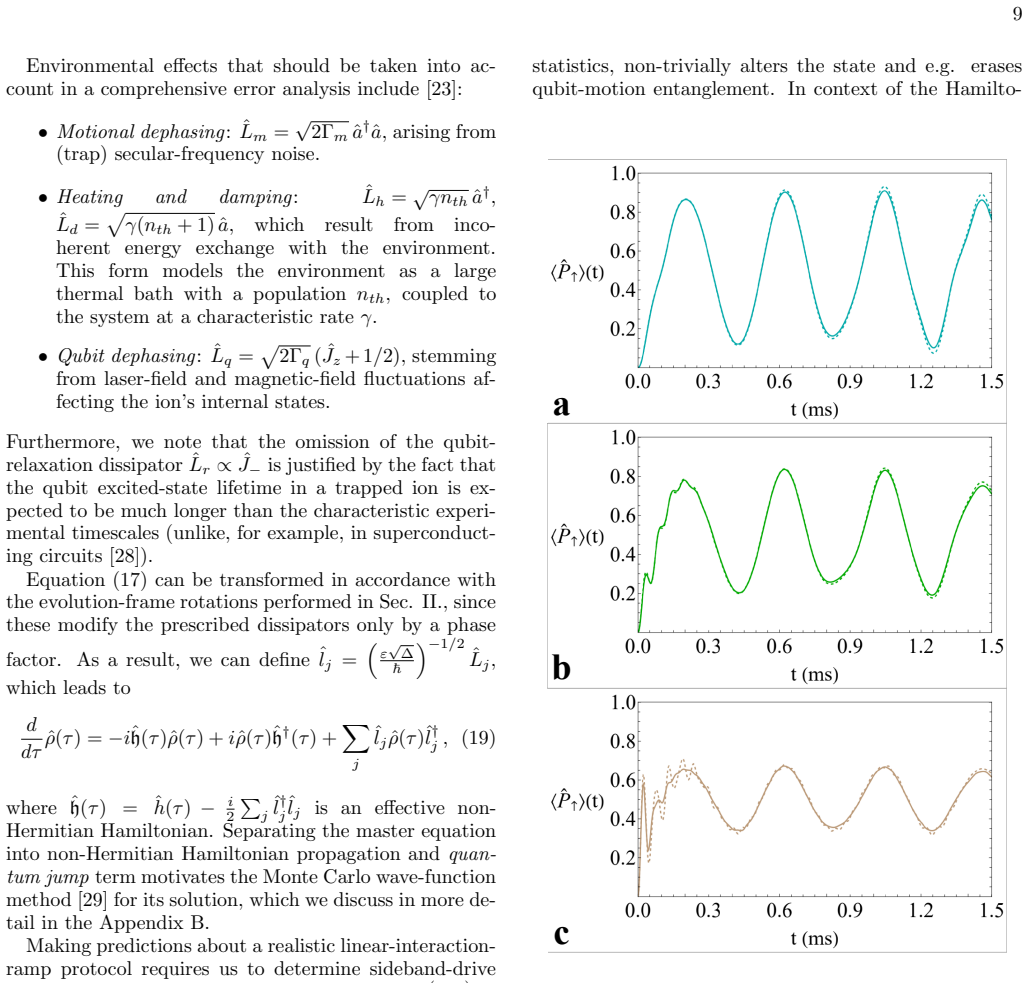
- Unitary evolutions and open-system corrections can both be simulated for state-of-the-art ion traps.
Where Pith is reading between the lines
- Implementing these protocols could enable studies of quantum criticality in minimal systems without requiring large ensembles of particles.
- Similar driving techniques might apply to other quantum simulators for exploring excited-state transitions.
- The resilience of the single-ion setup could make ESQPTs more accessible for experimental verification than in many-body systems.
Load-bearing premise
The identified excited states in the Extended Rabi Model can be prepared, maintained, and driven across critical points in a trapped ion with enough fidelity that the witness observables stay measurable before decoherence takes over.
What would settle it
Measuring whether the proposed witness observables exhibit the predicted critical scaling behaviors when the qubit-phonon coupling is varied across the critical values in a laboratory trapped-ion experiment.
Figures

read the original abstract
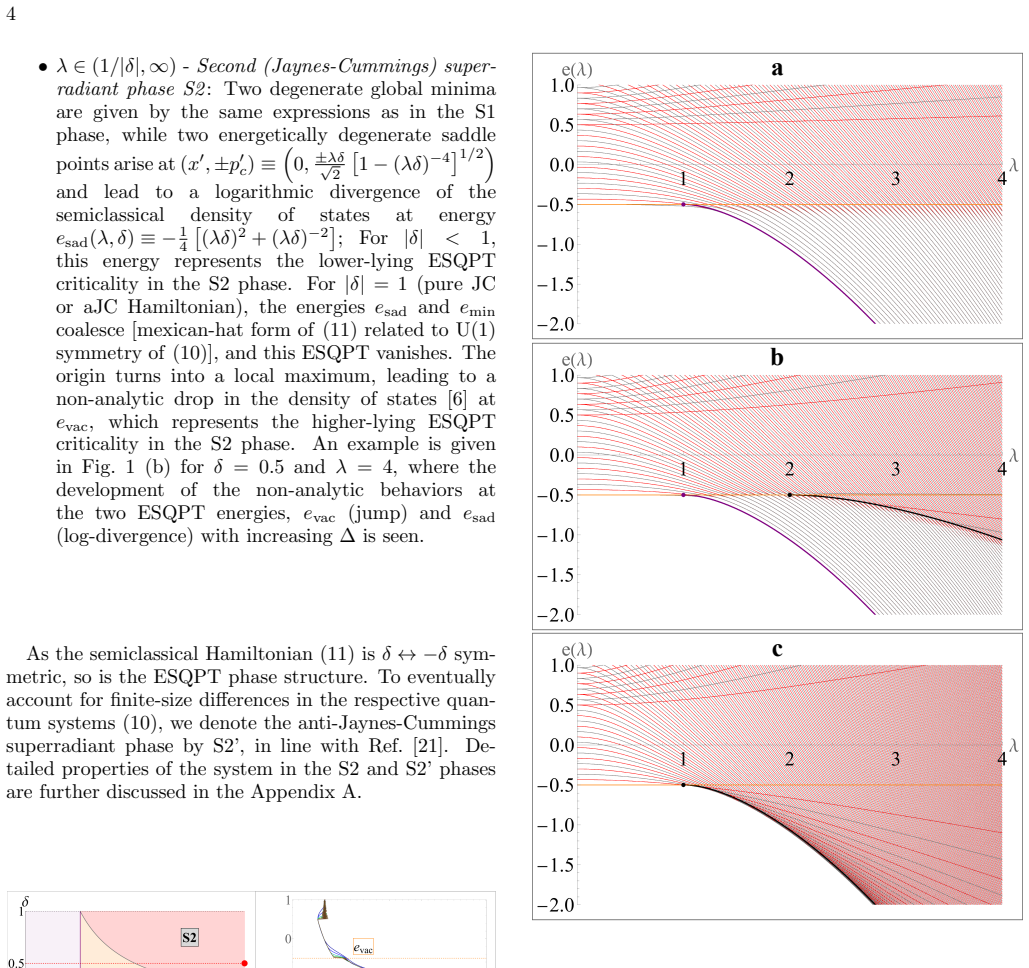
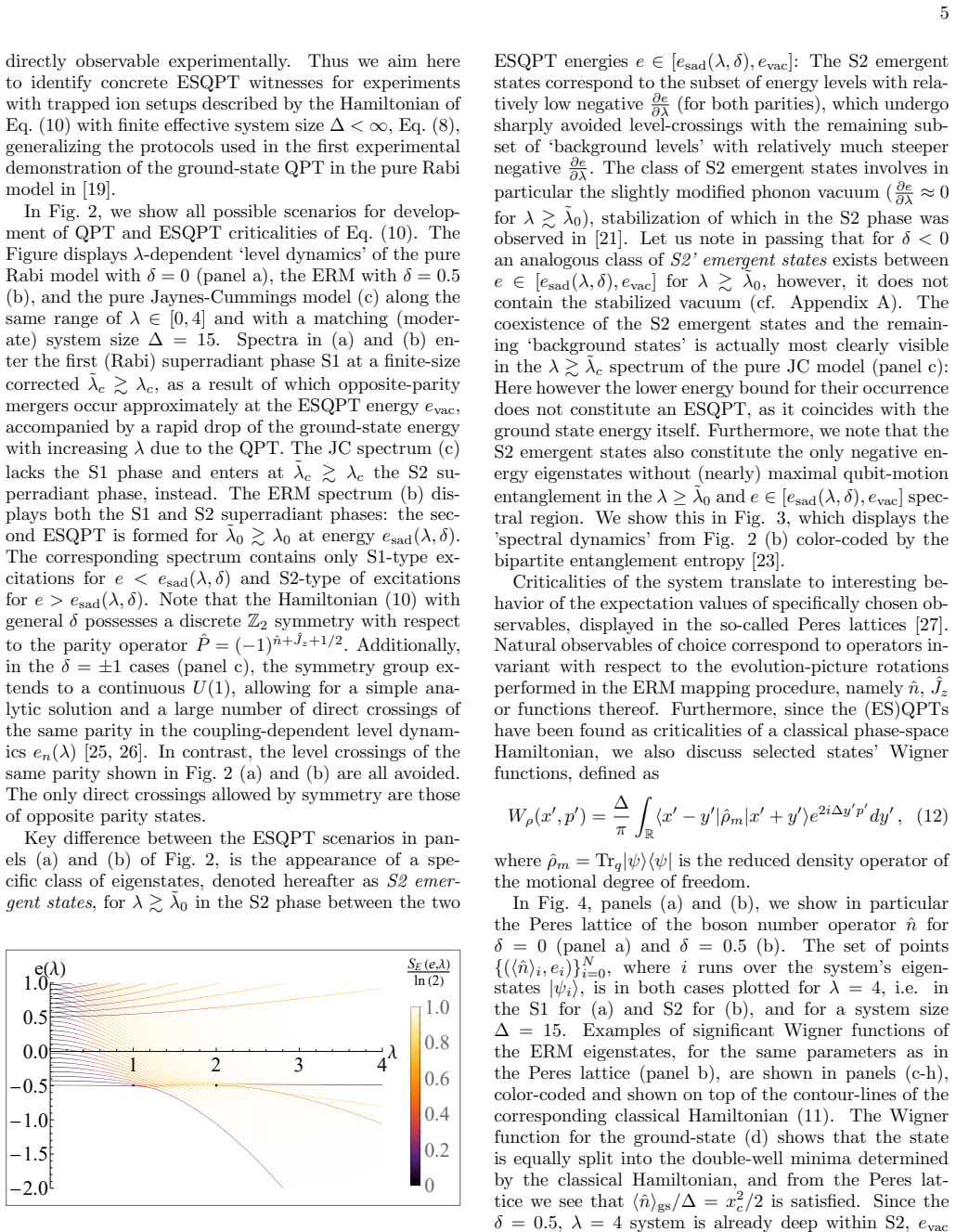
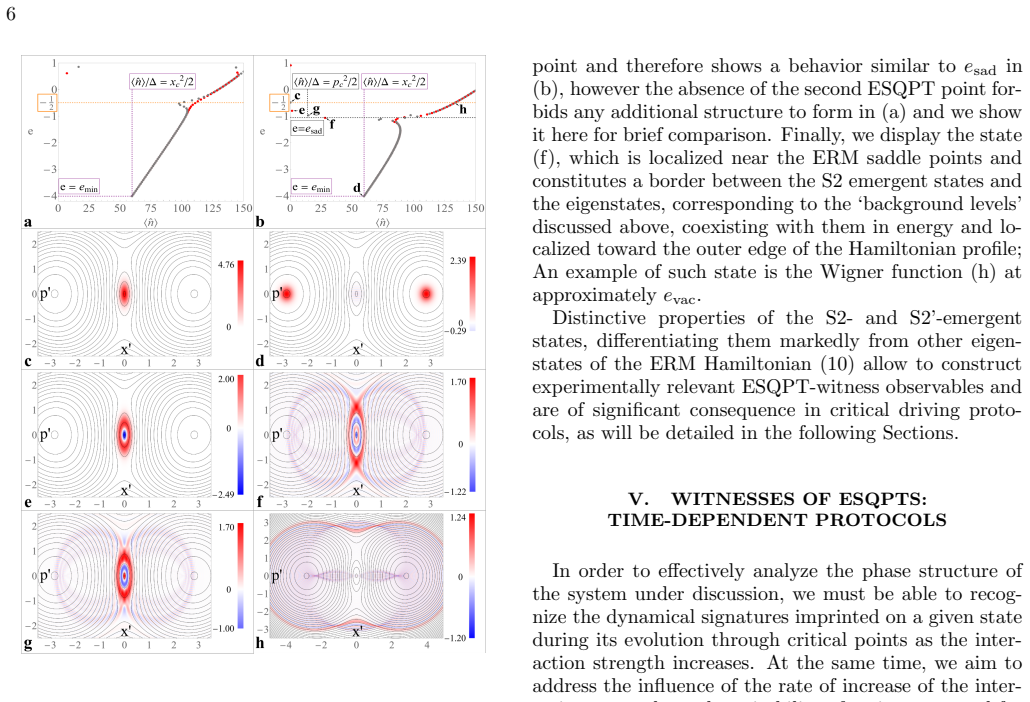
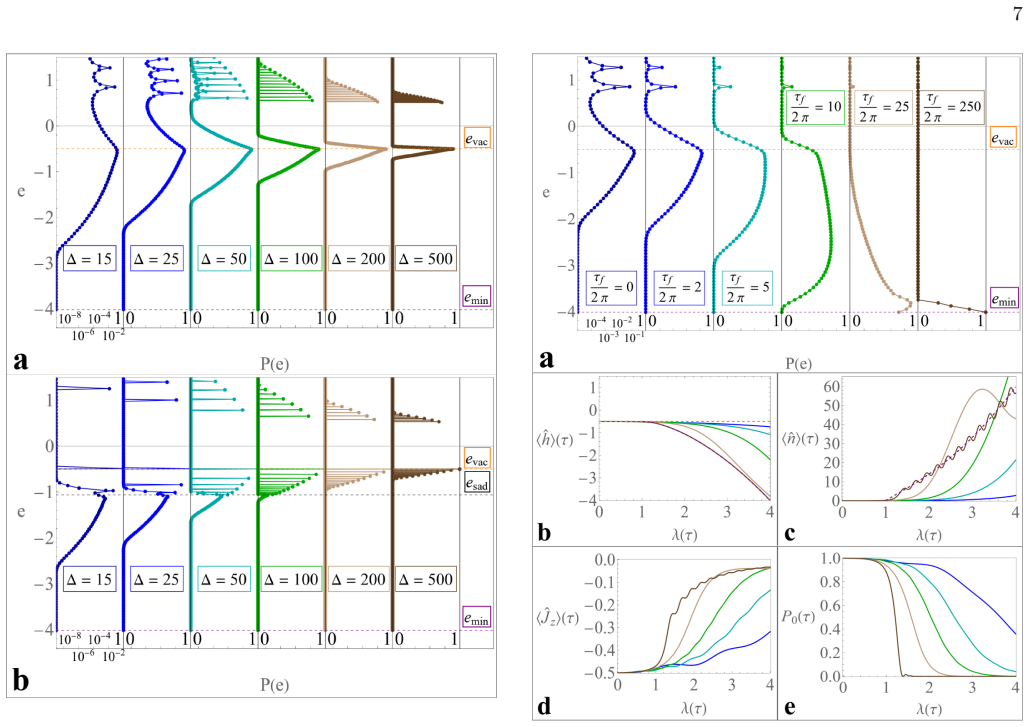
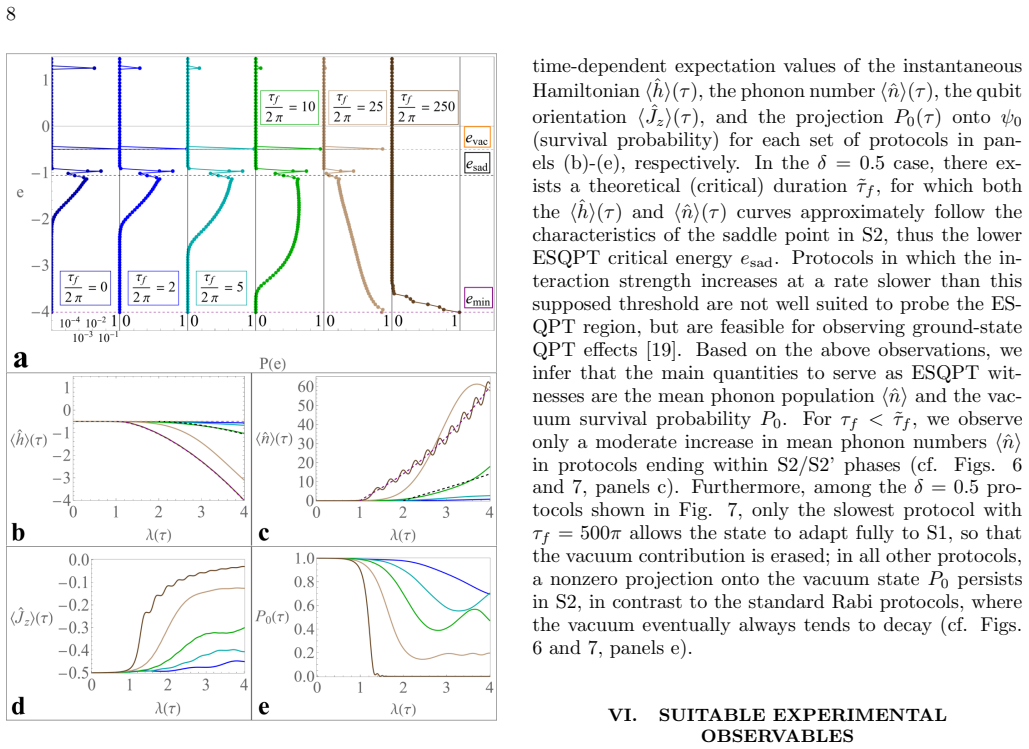
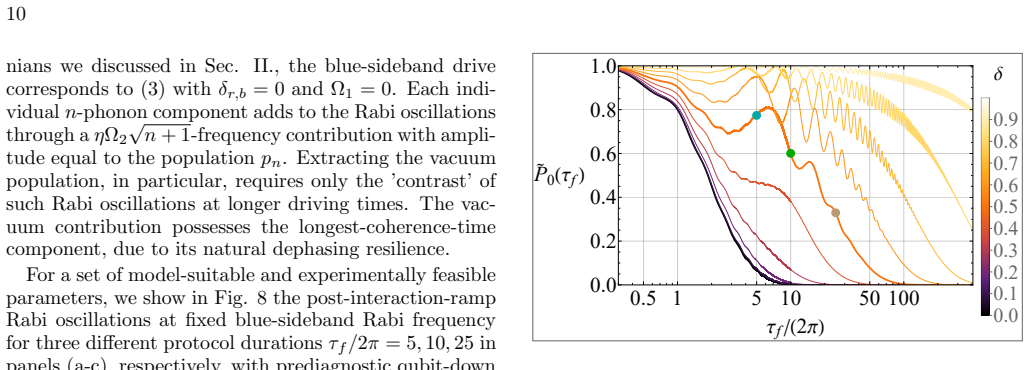
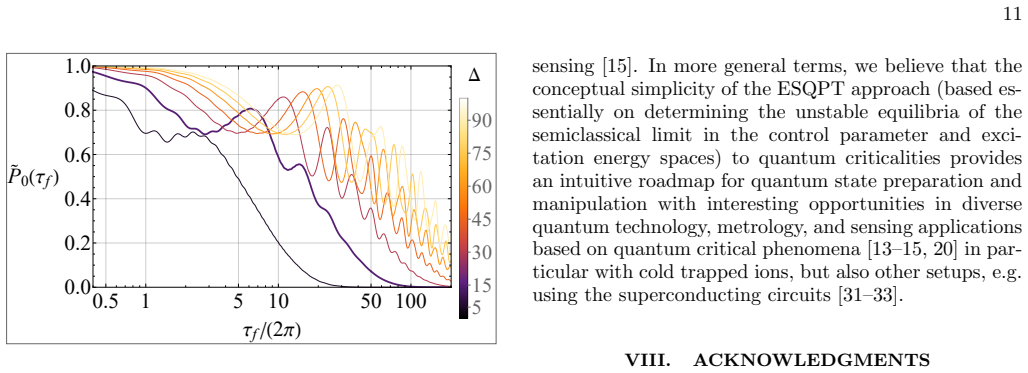
We propose concrete protocols to realize quantum criticality due to excited-state quantum phase transitions (ESQPTs) experimentally in presumably the simplest and most resilient system involving a single trapped ion oscillating in a radio-frequency Paul trap. We identify a specific class of excited states of the Extended Rabi Model (ERM) Hamiltonian, which occur between two critical ESQPT energies of the model in its (anti)Jaynes-Cummings superradiant phase. Properties of these states motivate the definition of several ESQPT witness observables. We study their critical scaling behaviors as well as various distinct state evolutions by driving the system across the quantum criticalities by changing the qubit-phonon coupling strength linearly in time at different finite rates. A mapping of the theoretical control parameters of the ERM to the experimental parameters of a trapped ion setup is provided, and simulations are performed for values referencing existing state-of-the-art setups, addressing both unitary state evolutions as well as relevant open-system corrections.
Editorial analysis
A structured set of objections, weighed in public.
Referee Report
Summary. The manuscript proposes concrete protocols to realize and probe excited-state quantum phase transitions (ESQPTs) in a single trapped ion in a radio-frequency Paul trap by mapping the Extended Rabi Model (ERM) to the experimental system. It identifies a specific class of excited states between two critical ESQPT energies in the (anti)Jaynes-Cummings superradiant phase, defines several witness observables, examines their critical scaling and state evolution under linear-in-time ramps of the qubit-phonon coupling at varying finite rates, provides an explicit mapping of ERM parameters to trapped-ion controls, and reports both unitary and open-system simulations using state-of-the-art Paul-trap parameters.
Significance. If the simulations confirm that the proposed witness observables retain measurable critical scaling signatures under realistic decoherence, the work would establish a minimal and resilient platform for experimental ESQPT studies, enabling direct tests of non-analytic features in driven open quantum systems with current trapped-ion technology and potentially informing protocols for other criticality phenomena.
major comments (2)
- [Simulations section (open-system analysis)] Simulations section (open-system analysis): The central claim that ESQPT witness observables remain measurable requires that decoherence (motional heating, qubit relaxation, dephasing) does not wash out non-analytic scaling on the timescales of the linear ramps; the abstract references such simulations but provides no explicit Lindblad operators, quantitative ratios of ramp rate to decoherence rates, or scaling plots demonstrating survival of the signatures, leaving the load-bearing assumption unverified.
- [Mapping and state-preparation paragraph] Mapping and state-preparation paragraph: The identification of the specific class of excited states between the two critical ESQPT energies and the protocol for their preparation and maintenance must be shown to be compatible with the finite ramp rates; without error analysis or fidelity estimates for state preparation in the presence of the trap parameters, the feasibility of crossing the critical points with sufficient coherence cannot be assessed.
minor comments (1)
- [Abstract] Abstract: The phrase 'presumably the simplest and most resilient system' would benefit from a one-sentence comparison to other platforms (e.g., cavity QED or superconducting circuits) to clarify the advantage.
Simulated Author's Rebuttal
We thank the referee for their careful reading of our manuscript and for providing constructive comments that will help improve the clarity and completeness of our work. We address the major comments below.
read point-by-point responses
-
Referee: Simulations section (open-system analysis): The central claim that ESQPT witness observables remain measurable requires that decoherence (motional heating, qubit relaxation, dephasing) does not wash out non-analytic scaling on the timescales of the linear ramps; the abstract references such simulations but provides no explicit Lindblad operators, quantitative ratios of ramp rate to decoherence rates, or scaling plots demonstrating survival of the signatures, leaving the load-bearing assumption unverified.
Authors: We appreciate the referee highlighting the need for more explicit details in the open-system analysis. Our simulations do incorporate open-system effects using a Lindblad master equation with operators corresponding to motional heating, qubit relaxation, and dephasing, employing parameters from state-of-the-art trapped-ion experiments. To address this comment, we will revise the simulations section to explicitly list the Lindblad operators, provide quantitative ratios between the ramp rates and decoherence rates, and include additional scaling plots that demonstrate the persistence of the non-analytic signatures under realistic decoherence levels. This will strengthen the verification of our central claim. revision: yes
-
Referee: Mapping and state-preparation paragraph: The identification of the specific class of excited states between the two critical ESQPT energies and the protocol for their preparation and maintenance must be shown to be compatible with the finite ramp rates; without error analysis or fidelity estimates for state preparation in the presence of the trap parameters, the feasibility of crossing the critical points with sufficient coherence cannot be assessed.
Authors: We agree that a more detailed analysis of state preparation is warranted to fully assess feasibility. In the revised manuscript, we will expand the relevant paragraph to include error analysis and fidelity estimates for preparing the identified class of excited states, taking into account the finite ramp rates and the specific trap parameters. This will provide a clearer demonstration of the compatibility with experimental constraints and the maintenance of coherence during the crossing of critical points. revision: yes
Circularity Check
No circularity: proposal maps ERM to ion trap via independent definitions and simulations
full rationale
The paper defines witness observables from properties of identified excited states in the Extended Rabi Model, studies their scaling under linear driving, and maps parameters to Paul-trap experiments with open-system Lindblad simulations using standard decoherence rates. None of these steps reduce by construction to fitted inputs or self-citations; the central claims rest on explicit Hamiltonian evolution and numerical integration rather than renaming or re-deriving quantities from the same data.
Axiom & Free-Parameter Ledger
axioms (1)
- domain assumption The Extended Rabi Model Hamiltonian accurately describes the qubit-phonon dynamics of a single trapped ion in a Paul trap.
Lean theorems connected to this paper
-
IndisputableMonolith/Cost/FunctionalEquation.leanwashburn_uniqueness_aczel unclear?
unclearRelation between the paper passage and the cited Recognition theorem.
We identify a specific class of excited states of the Extended Rabi Model (ERM) Hamiltonian... Properties of these states motivate the definition of several ESQPT witness observables... linear-interaction-ramp driving protocols
-
IndisputableMonolith/Foundation/DimensionForcing.leanreality_from_one_distinction unclear?
unclearRelation between the paper passage and the cited Recognition theorem.
semiclassical Hamiltonian h(x',p',m') = x'^2 + p'^2/2 + m' p^2 λ^2 (x'^2 + δ^2 p'^2) + 1
What do these tags mean?
- matches
- The paper's claim is directly supported by a theorem in the formal canon.
- supports
- The theorem supports part of the paper's argument, but the paper may add assumptions or extra steps.
- extends
- The paper goes beyond the formal theorem; the theorem is a base layer rather than the whole result.
- uses
- The paper appears to rely on the theorem as machinery.
- contradicts
- The paper's claim conflicts with a theorem or certificate in the canon.
- unclear
- Pith found a possible connection, but the passage is too broad, indirect, or ambiguous to say the theorem truly supports the claim.
Reference graph
Works this paper leans on
-
[1]
R. V. Sol´ e,Phase Transitions, Princeton University Press (2011)
work page 2011
-
[2]
L. D. Carr,Understanding Quantum Phase Transitions, CRC Press (2010)
work page 2010
-
[3]
Sachdev,Quantum Phase Transitions, 2nd edition, Cambridge University Press (2011)
S. Sachdev,Quantum Phase Transitions, 2nd edition, Cambridge University Press (2011)
work page 2011
-
[4]
J. A. Hertz, Phys. Rev. B 14, 1165 (1976)
work page 1976
- [5]
- [6]
- [7]
- [8]
-
[9]
´A. L. Corps, A. Rela˜ no and J. C. Halimeh, Phys. Rev. Research,6, 043080 (2025)
work page 2025
- [10]
- [11]
-
[12]
P. Feldmann, C. Klempt, A. Smerzi, L. Santos and M. Gessner, Phys. Rev. Lett.126, 230602 (2021)
work page 2021
- [13]
-
[14]
Beaulieu et al., PRX QUANTUM6, 020301 (2025)
G. Beaulieu et al., PRX QUANTUM6, 020301 (2025)
work page 2025
-
[15]
G. Mihailescu, U. Alushi, R. Di Cania, S. Felicetti and K. Gietka, quant-phys 2510.02035, (2025)
-
[16]
D. Leibfried, R. Blatt, C. Monroe and D. Wineland, Rev. Mod. Phys.75, 281 (2003)
work page 2003
-
[17]
Hwang, M. J., Puebla, R., & Plenio, M. B., Phys. Rev. Lett.,115, 180404, (2015)
work page 2015
-
[18]
J. S. Pedernales, I. Lizuain, S. Felicetti, G. Romero, L. Lamata and E. Solano, Sci. Rep.5, 15472 (2015)
work page 2015
- [19]
- [20]
-
[21]
Str´ ansk´ y, P., Cejnar, P., Filip, R., Physical Review A 104, 053722, (2021)
work page 2021
-
[22]
D. F. James, Appl. Phys. B66: 181-190, (1998)
work page 1998
-
[23]
C. Gardiner and P. Zoller,The Quantum World of Ultra-Cold Atoms and Light, Book I-III, Imperial Col- lege Press,London, (2014)
work page 2014
-
[24]
C. Huerta Alderete, M. P. Morales Rodr´ ıguez, and B. M. Rodr´ ıguez-Lara. Sci.Rep.9: 2734, (2019)
work page 2019
- [25]
- [26]
- [27]
-
[28]
Pietik¨ ainen, et al., PRX Quantum5, 040307, (2024)
I. Pietik¨ ainen, et al., PRX Quantum5, 040307, (2024)
work page 2024
- [29]
- [30]
-
[31]
Ch´ avez-Carlos et al., npj Quantum Information9, 76 (2023)
J. Ch´ avez-Carlos et al., npj Quantum Information9, 76 (2023)
work page 2023
- [32]
- [33]
- [34]
-
[35]
The S2 and S2’ excited phases for|δ| ̸= 1 in fact display remnants of U(1) symmetry of the (a)JC Hamiltonians, endowed with the unusual kinetic termH∝ −p 2 locally aroundx=p= 0 related to the (locally) Mexican-hat- form of the semiclassical (a)JC Hamiltonians of Eq. (11). A more rigorous interpretation possibly in terms of quasi- and partial dynamical sym...
-
[36]
compared to higher Fock states
By choosing the non-interacting ground state, we do not imply that it is optimal for application of all the discussed critical phenomena in quantum state manipulation, how- ever, it is definitely the best state for acquiring a proof of concept experimentally due to its enhanced dephasing 15 resilience, e.g. compared to higher Fock states. Detailed optimiz...
discussion (0)
Sign in with ORCID, Apple, or X to comment. Anyone can read and Pith papers without signing in.